
 100% FREE ACCESS
12th Standard CBSE Syllabus & Materials
12th Standard CBSE
CBSE 12th Economics Government Budget and the Economy Previous year Question Papers Study Material - QB365 Set A
NEW12th Standard CBSE
CBSE 12th Computer Science Interface Python with MySQL - New Previous year Question Papers Study Material - QB365 Set A
NEW12th Standard CBSE
CBSE 12th Computer Science Database Concept - New Previous year Question Papers Study Material - QB365 Set A
NEW12th Standard CBSE
CBSE 12th Computer Science Data Communication - New Previous year Question Papers Study Material - QB365 Set A
NEW12th Standard CBSE
CBSE 12th Computer Science Data Structures - New Previous year Question Papers Study Material - QB365 Set A
NEW12th Standard CBSE
CBSE 12th Computer Science Functions - New Previous year Question Papers Study Material - QB365 Set A

Published on: 31/07/2018
From the chapter Open Economy Macroeconomics, some of the important questions are covered in this question paper. The questions are covers from the book back and the previous year questions.
Download CBSE Class 12th Standard CBSE undefined question papers, sample papers, important questions, and previous year solved papers in PDF format. Get free study materials, NCERT solutions, and exam preparation resources for Class 12th Standard CBSE undefined
Questions + Answers key
Take MCQ Biology Test
1.
Why is flexible rate of exchange called free rate of exchange?
2.
Explain the effect of the appreciation of domestic currency on exports.
3.
Explain the effect of appreciation of domestic currency on imports.
4.
How is foreign exchange rate determined in the market? Use diagram.
5.
Define flexible exchange rate system.
6.
State whether the following statements are true or false. Give reasons for your answer:
(i) The difference between the value of exports and imports of goods and services is called trade balance.
(ii) External assistance is not recorded in Balance of Payments account.
7.
What is meant by visible and invisible items in the balance of payment account? Give two examples of invisible items.
8.
Which two transactions determine the balance of trade?
9.
Suppose it takes 1.25 yen to buy a rupee, and the price level in Japan is 3 and the price level in India is 1.2. Calculate the real exchange rate between India and Japan (the price of Japanese goods in terms of Indian goods). First find out the nominal exchange rate as a price of yen in rupees).
10.
Distinguish between the balance of trade and balance on current account.
11.
Give the meaning of 'foreign exchange and foreign exchange rate'. Giving reason explain the relation between foreign exchange rate and demand for foreign exchange.
12.
Explain the causes of disequilibrium in the balance of payments.
13.
Balance of trade includes only ___________ items.
14.
If exports exceed imports, then BoP is _________
15.
Balance of Payment has ___________ accounts.
16.
Foreign investment has _________ sub-components.
17.
________________ rate of exchange is that rate, which is determined by the demand for and supply of different currencies in the foreign exchange market.
18.
Demand for foreign exchange also depends upon payments of international loans.
19.
Forward market deals with current sale and purchase of foreign exchange.
20.
Fixed exchange rate is determined by the supply of and demand for different currencies in the foreign exchange market.
21.
Capital transfers are concerned with capital receipts and capital payment.
22.
Balance of payments may be positive or negative.
23.
Other things remaining the same, when in a country the market price of foreign currency falls, national income is likely:
To rise
To fall
To rise or to fall
To remain affected
24.
How many accounts of balance of payment are there?
Two
Four
Three
Five
25.
Hybrid in management of fixed and flexible exchange rate is known as__________
Managed floating
Crawling peg
Wider Bands
None of these
26.
What is the cause of devaluation of any country's currency?
Increase in the domestic inflation rate
Domestic real interest rates are less than foreign interest rates
Much increase in the income
All of these
27.
Market, where the national currencies are traded for one another, is known as ___________
Domestic exchange market
Foreign exchange market
Bazaar
Shop
1.
Flexible rate of exchange is called free rate of exchange as it is freely determined by the forces of supply and demand in the international money market.
2.
Appreciation of a currency means an increase in the value of the domestic currency in terms of the foreign currency. The price of the domestic currency, in terms of a foreign currency, increases, and the foreign exchange rate decreases. For instance, suppose rupee has appreciated in terms of a pound. That is, the foreign exchange rate between India and UK has decreased. The price of one pound has decreased from Rs.70 to Rs.60. UK citizens can buy only Rs.60 worth of goods by parting one pound compared to Rs.70 worth of goods prior to fall in the exchange rate. Since Indian goods have become expensive for UK citizens, they will buy less of them. Consequently, Indian exports to the UK will decrease.
3.
Appreciation of a currency means an increase in the value of the domestic currency in terms of the foreign currency. The price of the domestic currency, in terms of a foreign currency, increases, and the foreign exchange rate decreases. For instance, suppose rupee has appreciated in terms of a pound. That is, the foreign exchange rate between India and UK has decreased. The price of one pound 11 has decreased from Rs.70 to Rs.60. It implies that Indian citizens can buy one pound worth of goods 11 by parting only Rs.60 compared to Rs.70 prior to fall in the exchange rate. Since UK goods have become cheaper for Indians, they will buy more of them. Consequently, Indian imports from the UK will increase.
4.
The exchange rate in the foreign market is determined by the intersection of supply and demand curves of the foreign exchange. The foreign exchange market, like any other normal market, comprises of a downward sloping demand curve and an upward sloping supply curve.
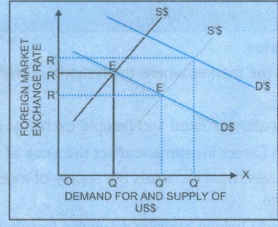
In the following diagram, the vertical axis shows the price stated in terms of the domestic currency, that is, the amount of rupee for one US dollar. The horizontal axis measures the quantity demanded or supplied.
At a point, E.the intersection of demand and supply curves determines the equilibrium exchange rate in the foreign market (R*) and equilibrium quantity (Q*) of the foreign currency. that is.US dollar (dollar). An increase in the demand for US dollars in India will cause the demand curve to shift to D'dollar and the exchange rate rises to R'. Similarly, falls.an increase in the supply of US dollars will cause the supply curve shift to S'dollar and the exchange falls to R". In this case. the domestic currency is more valuable.
5.
Flexible exchange rate is the system in which the exchange rate is determined by the demand and supply forces in the foreign exchange market.
6.
(i) False. Balance of trade refers to the relationship between the value of imports and exports of the goods of a country. It does not include invisible items such as services.
(ii) False. External assistance is a component of Balance of Payments account.
7.
All types of physical goods exported and imported are called visible items in the Balance of Payment account. On the other hand, all those services whose export and import are not visible are known as invisible items in the balance of payment account.
Two examples of invisible items are:
(i) shipping
(ii) Insurance and banking.
8.
Export and import of visible items determine the balance of trade.
9.
Foreign price of domestic rupee = I .25
Price level of foreign country (Pf) = 3
Price level of domestic country (P) = 1.2
\(Nominal\ Exchange\ Rate(e)=\frac { 1 }{ Foreign\ price\ of\ domestic\ rupee } \)
\(\\ \ =\frac { 1 }{ 1.25 } =0.8\)
\(\\ Real\ Exchange\ Rate=\frac { { eP }_{ f } }{ P } \)
\(\\=\frac { 0.8\times 3 }{ 1.2 } =2\)
Thus, the real exchange rate between India and Japan is 2. Since the real exchange rate is greater than I, it indicates that Japanese goods are expensive than Indian goods.
10.
| Balance Trade | Balance on Current Account |
|---|---|
| The balance of trade refers to the relationship between the value of imports and exports of the goods of a country. | The current account balance is obtained by adding trade in services and net transfers to the trade balance. |
| It includes only visible items. | It includes visible items, invisible items and transfers. |
| The balance of trade is a narrow concept. | The current account balance is a broad concept. |
11.
Foreign exchange refers to any foreign currency. Thus, US dollars, British pounds are foreign exchange for India. Foreign exchange rate is the price of one currency in terms of another currency. It is the rate at which exports and imports of a country are valued during a period of time.
There is an inverse relation between foreign exchange rate and demand for foreign exchange. Higher the foreign exchange rate, lower the demand for foreign exchange and lower the foreign exchange rate, higher the demand for foreign exchange. Suppose the price of US dollar in India falls from ~ 50 to ~ 40. It means that earlier Indian .. people had to part with ~ 50 to buy one dollar worth of goods from USA. Now they have to part with ~ 40 to buy one dollar worth of goods from USA. It implies that American goods have become cheaper for Indian buyers.
At a lower price of US dollar, India is ready to buy more goods from USA. This raises the demand for US dollars. So, lower the price of US dollars, higher is the demand for US dollars and vice versa. Graphically, the demand curve of foreign exchange is downward sloping signifying the inverse relation between foreign exchange rate and demand for foreign exchange.
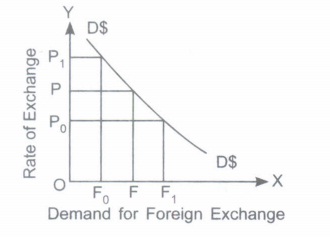
In the figure, at price OP, the demand for foreign exchange is OF. At a lower price OP0, the demand is OF1, i.e., higher. At a higher price OP1, demand is OF0, i.e., lower than OF.
12.
Following are the causes of disequilibrium in Balance of Payments:
1. Natural Causes
Natural calamities like famine, flood, etc. may cause disequilibrium in the Balance of Payments of an economy as these calamities result in a reduction in production and exports and increase in imports.
2. Economic Causes
(i) Economic Development: In order to accelerate the pace of development, underdeveloped countries have to depend on foreign assistance.These countries import advanced machinery, capital goods, and raw material, etc, which results in the excess of imports over exports.Hence, there arises the problem of disequilibrium in Balance of Payments.
(ii) Cyclical Fluctuations: Cyclical fluctuations like inflation and depression also cause the problem of disequilibrium of Balance of Payments. If there is a depression in the world market than exports of a country are affected adversely. Similarly, if prices start rising within the economy, the rate of increase in imports exceeds that of exports, which results in disequilibrium.
(iii) Capital Outflow: If a country invests its capital in other countries in order to earn more dividend then it may result in unfavorable Balance of Payments of the country investing the capital and favorable Balance of Payments of the country where the capital is invested.Hence, the problem of disequilibrium arises.
3. Political Factors
Government expenditure in foreign countries, political instability, cause disequilibrium political relations with other countries partition or unification of cause disequilibrium in Balanceof Paymentsof a country.
13.
()
visible.
14.
()
favourable
15.
()
three
16.
()
two
17.
()
flexible
18.
(a)
19.
(b)
20.
(b)
21.
(a)
22.
(b)
23.
(b)
To fall
24.
(a)
Two
25.
(a)
Managed floating
26.
(d)
All of these
27.
(b)
Foreign exchange market

12th Standard CBSE Syllabus & Materials
12th Standard CBSE
CBSE 12th Computer Science Python Revision Tour I - New Previous year Question Papers Study Material - QB365 Set A
NEW12th Standard CBSE
CBSE 12th Business Studies Planning Important Questions And Answers Study Material - QB365 Set A
NEW12th Standard CBSE
CBSE 12th Business Studies Business Environment Important Questions And Answers Study Material - QB365 Set A
NEW12th Standard CBSE
CBSE 12th Business Studies Principles of Management Important Questions And Answers Study Material - QB365 Set A



CBSE 12th Standard CBSE Subjects
CBSE Standards











