
 100% FREE ACCESS
12th Standard CBSE Syllabus & Materials
12th Standard CBSE
CBSE 12th Economics Government Budget and the Economy Previous year Question Papers Study Material - QB365 Set A
NEW12th Standard CBSE
CBSE 12th Computer Science Interface Python with MySQL - New Previous year Question Papers Study Material - QB365 Set A
NEW12th Standard CBSE
CBSE 12th Computer Science Database Concept - New Previous year Question Papers Study Material - QB365 Set A
NEW12th Standard CBSE
CBSE 12th Computer Science Data Communication - New Previous year Question Papers Study Material - QB365 Set A
NEW12th Standard CBSE
CBSE 12th Computer Science Data Structures - New Previous year Question Papers Study Material - QB365 Set A
NEW12th Standard CBSE
CBSE 12th Computer Science Functions - New Previous year Question Papers Study Material - QB365 Set A

Published on: 27/07/2018
Some of the important questions are prepared from this chapter Introductory Microeconomics. In this question paper, questions are prepared from the book back and creative question.
Download CBSE Class 12th Standard CBSE undefined question papers, sample papers, important questions, and previous year solved papers in PDF format. Get free study materials, NCERT solutions, and exam preparation resources for Class 12th Standard CBSE undefined
Questions + Answers key
Take MCQ Biology Test
1.
Distinguish between microeconomics and macroeconomics.
2.
What is a Production Possibility Frontier?
3.
What will be the effect on equilibrium prices and quantity of mobile phones, if the import duty is increased on the import of mobile phone in India from china?
4.
What is production Possibility Frontier?What do the points on, below and outside the PPF represent?
5.
Why do problems related to allocation of resources in an economy arise? Explain.
6.
What are the important features of a capitalist economy?
7.
What is meant by economising of resources?Why is there a need for it?
8.
What is macroeconomics?
9.
Why is the study of consumer's equilibrium a subject matter of microeconomics?
10.
Why Production Possibility Curve is also called transformation curve?
11.
Define Production Possibility Curve.
12.
What is normative economics?
13.
Define an economy.
14.
What is meant by economic problem?
15.
To choose the commodity or factor at minimum possible cost with the objective of gaining special profit is known as
Economising behaviour
Non-economic behaviour
Irrational behaviour
Inefficient behaviour
16.
What is the shape of Production possibility Curve?
Concave to the origin
Convex to the origin
Straight Line
U-shaped
17.
The study of individual; as well as social choice in the presence of scarcity is known as:
Political Science
Economics
Sociology
Geography
18.
When demand decrease and supply is perfectly inelastic, what will the effect on equilibrium price?
Decrease
Increase
Constant
None of these
19.
What is called the increased shortage of goods above the determined price through rationing?
Open market
Closed market
Support market
Black market
20.
Who has developed the FAD theory?
Prof. Amartya sen
Samuelson
Harrod
Adam smith
21.
What is the effect of excess supply on market price?
It will decrease
It will increase
It will be constant
It will zero
22.
What is the effect of excess demand on market price?
It will decrease
It will increase
It will be constant
it will zero
23.
The mother of all economic problems is ___________.
24.
___________ activities are studied in economics.
1.
Following are the points of distinction between microeconomics and macroeconomics:
| Basis | Microeconomics | Macroeconomics |
| Scope of the Study | Microeconomics is the study of a particular household, firm, industry, good, individual pnce, wage, income, etc. | Macroeconomics "is the study of economy as a whole or its aggregates such as national Income, level of employment, general pnce level, aggregate demand, aggregatedemand, Ietc. |
| Subject Matter | Microeconomics deals with the price of Individual goods and individual factors of production |
Macroeconomics deals with the general price level. |
| Central Problem | Microeconomics emphasises on the price determination and allocation of resources. | Macroeconomics emphasises on the determination of national income and em 10 ment. |
2.
Production Possibility Frontier (PPF) is the graph depicting all the possible combinations of two goods (services) that can be produced in an economy by making an efficient and full utilisation of all the resources and given state of technology. It is also known as the Production Possibility Curve (PPC). PPF can be shown with the help of the given figure.
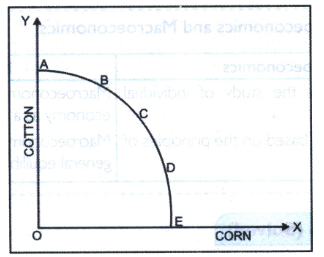
The figure illustrates the production possibilities of the economy. Any point on the curve represents a combination of corn and cotton that can be produced with full utilisation of the economy's resources. The curve represents the maximum amount of corn that can be produced in the economy for any given amount of cotton and vice-versa.
3.
An increase in import duty would cause the demand curve to shift backward. As a result, the equilibrium prices and quantity of mobile phones would fall.
4.
A Production Frontier(PPF) represents opportunities available to an economy with the given amount of resources.
(i) A point lying on the PPF represents that all the resources have been fully and efficiently utilised. More of one good can be produced only after sacrificing some quantity of the other good.
(ii) A point lying below the PPF represents under utilisation of resources. The production can be increased by employing all the resources.
(iii) A point lying outside the PPF represents the combination of two goods that cannot be attained with given amount of resources and technology.
5.
Problems related to allocation of resources in an economy arise due to the following two basic features of resources;
(i) Resources are Limited: The resources used to produce goods and services that satisfy human wants are limited. Limited resources are incapable of satisfying unlimited human wants.
(ii) Limited Resource have Alternative Uses: The resources used for producing goods and services are not only limited but they also have many competing usages. As a result, an individual has to face the problem of making a choice among the available alternatives.
6.
The characteristics of a capitalist of free-market economy are as follows:
(i) Profit is the main motive of carrying out various economic activities.
(ii) Factors of production are privately owned.
(iii) Consumers are free to choose whatever they can afford.
(iv) Prices of goods and services are determined by market forces of demand and supply with minimum intervention by the government.
7.
Economising of resources means using the productive resources in the most economical and efficient way. The economical use of resources is required in an economic system because the resources are scare while the wants are infinite. In such circumstances, any wastage of resources has to be avoided.
8.
()
Macroeconomics is that branch of economics which studies the behaviour of the economy as a whole. Level of output and employment are the principal macroeconomic issues.
9.
()
Consumer equilibrium is a subject matter of microeconomics because it is a study of individual consumer behaviour.
10.
()
The Production Possibility Curve is also called transformation curve because it shows trade-off between two goods. The movement along this curve indicates that one good is transformed into another, not physically, but by transferring from one use to the other.
11.
()
Production Possibility Curve (PPC) is a curve that shows different combinations of two goods that can be produced with availbale resources and given state of technology.
12.
()
Normative economics is an free economic approach that analyses the consequences of economic behaviour, evaluates them as good or bad and may suggest a course of action.
13.
()
Economy refers to the system of production, distribution and consumption of economic goods and services by different agents in a country or region.
14.
()
Economic problem is the problem arising from the necessity of choice.
15.
(a)
Economising behaviour
16.
(a)
Concave to the origin
17.
(b)
Economics
18.
(a)
Decrease
19.
(d)
Black market
20.
(a)
Prof. Amartya sen
21.
(a)
It will decrease
22.
(b)
It will increase
23.
()
scarcity
24.
()
Economic

12th Standard CBSE Syllabus & Materials
12th Standard CBSE
CBSE 12th Computer Science Python Revision Tour I - New Previous year Question Papers Study Material - QB365 Set A
NEW12th Standard CBSE
CBSE 12th Business Studies Planning Important Questions And Answers Study Material - QB365 Set A
NEW12th Standard CBSE
CBSE 12th Business Studies Business Environment Important Questions And Answers Study Material - QB365 Set A
NEW12th Standard CBSE
CBSE 12th Business Studies Principles of Management Important Questions And Answers Study Material - QB365 Set A



CBSE 12th Standard CBSE Subjects
CBSE Standards











