
 100% FREE ACCESS
12th Standard CBSE Syllabus & Materials
12th Standard CBSE
CBSE 12th Economics Government Budget and the Economy Previous year Question Papers Study Material - QB365 Set A
NEW12th Standard CBSE
CBSE 12th Computer Science Interface Python with MySQL - New Previous year Question Papers Study Material - QB365 Set A
NEW12th Standard CBSE
CBSE 12th Computer Science Database Concept - New Previous year Question Papers Study Material - QB365 Set A
NEW12th Standard CBSE
CBSE 12th Computer Science Data Communication - New Previous year Question Papers Study Material - QB365 Set A
NEW12th Standard CBSE
CBSE 12th Computer Science Data Structures - New Previous year Question Papers Study Material - QB365 Set A
NEW12th Standard CBSE
CBSE 12th Computer Science Functions - New Previous year Question Papers Study Material - QB365 Set A

Published on: 30/07/2018
In this question paper, some of the important one mark, two and five marks questions from the chapter Theory of Consumer Behaviour are covered. The questions are prepared from the book back and PTA question.
Download CBSE Class 12th Standard CBSE undefined question papers, sample papers, important questions, and previous year solved papers in PDF format. Get free study materials, NCERT solutions, and exam preparation resources for Class 12th Standard CBSE undefined
Questions + Answers key
Take MCQ Biology Test
1.
Explain proportional or percentage method for measuring price elasticity of demand.
2.
Explain the geometric method of measuring price elasticity of demand.
3.
Explain the causes of a leftward shift in the demand curve of a commodity.
4.
Suppose a consumer wants to consume two goods which are available only in integer units. The two goods are equally priced at Rs.10 and the consumer's income is Rs.40.
(i) Write down all the bundles that are available to the consumer.
(ii) Among the bundles that are available to the consumer, identify those, which cost her exactly Rs.40.
5.
When the price of a good to Rs.11 per unit the consumer's demand falls from 11 units to 7 units.The price elasticity of demand is (-) 1.What was price before change?Use expenditure approach of price elasticity of demand to answer this question.
6.
Price elasticity of demand of a good is -0.75. Calculate the percentage fall in its price that will result in 15 percent rise in its demand.
7.
A consumer buys 30 units of a good at a price of Rs.10 per unit.Price elasticity of demand for the good is (-) 1.How many units will the consumer buy at a price of Rs.9 per unit? Calculate.
8.
What do you mean by an 'inferior good'? Give some examples.
9.
What is the demand for a good said to be elastic?
10.
Define price elasticity of demand.
11.
How the consumer's equilibrium is attained?
12.
Define an indifference curve.
13.
Give equation of Budget line.
14.
How is the price elasticity of demand of a commodity affected by the number of its substitutes?
15.
How does change in price of a substitute good affect the demand of the given good. Explain with the help of an example.
16.
Explain the effect of rise in the prices of related goods on the demand of a good.
17.
What is budget set? Explain what can lead to change in budget set?
18.
Demand is ___________ in short period.
19.
Elasticity of demand of necessary good is __________
20.
There is ______________ relationship between demand and price.
21.
Utility is ___________________.
22.
Want satisfying power of a good is called __________________.
23.
Demand will be elastic for those goods whose consumption can be postponed.
24.
Demand is inelastic in long period.
25.
Elasticity of demand is used to measure the responsiveness of quantity demanded to a given change in the price.
26.
Utility is objective.
27.
TU starts diminishing when MU begins to diminish.
28.
If Marginal Rate of Substitution is increasing throughout, the indifference curve will be:
Downward sloping convex
Downward sloping concave
Downward sloping straight line
Upward sloping convex
29.
Goods whose demand decreases with the increase in income?
Normal goods
Substitutes
Inferior goods
All of these
30.
In the consumer's equilibrium, the budget line ________ the indifference curve.
intersects
is parallel to
is tangent to
is same as
31.
Slope of budget line is:
\(\frac { { P }_{ X } }{ { P }_{ Y } } \)
\({ P }_{ X }-{ P }_{ Y }\)
\({ P }_{ X }+{ P }_{ Y }\)
\({ MRS }_{ XY }\)
32.
Want satisfying power of a commodity is known as________________.
Consumption
Production
Exchange
Utility
1.
According to this method, price elasticity of demand is measured as the ratio of percentage change in quantity demanded of the commodity to percentage change in its price. That is,
\({ E }_{ D }=\frac { ./.\quad Change\quad in\quad Quantity\quad Demanded }{ ./.\quad Change\quad in\quad the\quad Price } \)
\( =frac \ { \triangle Q }{ Q } \times \frac { P }{ \triangle P } =\frac { \triangle Q }{ \triangle P } \times \frac { P }{ Q } \) ..............(I)
where; P = Original price
Q = Original demand
\(\triangle \) Q = Change in demand
\(\triangle \) P = Change in price
Example: Suppose the quantity of sugar demanded by a household is 4 kg at price Rs.12 per kg. When the price falls to Rs.I I per kg, quantity demanded increases to 6 kg.
Original Pprice of the Good; P = Rs.12
Original Quantity Demanded; Q = 4kg
New Price of the Good; P1 = Rs.11
Change in Price; \(\triangle \) P = P-P = 11-12 = (-)1
New Quantity Demanded; \(\triangle \)Q = 6 kg
Change n Quantity Supplied;\(\triangle \) Q = Q1-Q = 6-4 = 2
Substituting appropriate values in (I); we get
Price Elasticity of Demanded; ED = \(\frac { 2 }{ (-)1 } \times \frac { 12 }{ 4 } =(-)6\)
The value of elasticity of demand equal to 6 in our example implies that the percentage change in quantity demanded of the commodity is 6 times the percentage change in its price.
2.
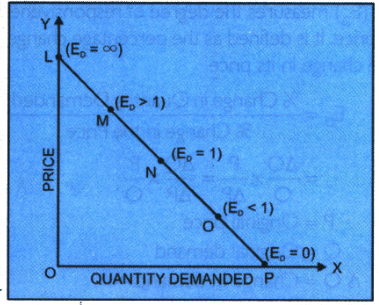
In geometric method or point method, the elasticity of demand at any point on the straight line demand curve is determined as the ratio of the lower segment and the upper segment of the demand curve at that point.That is, \({ E }_{ D }=\frac { Lower\quad Segment\quad of\quad the\quad DemandCurve }{ UpperSegment\quad of\quad the\quad DemandCurve } \)
The diagram below shows the price elasticity of demand at different points on the straight line demand curve.
3.
Following are the causes of a leftward shift in the demand curve:
(i) Decrease in the Prices of Substitute Goods: Substitute goods are those goods which can be used in place of one another, such as tea and coffee, or ballpoint pen and ink pen. If X and Y are substitutes then a decrease in the price ofY will decrease the demand for the X as latter is relatively expensive now. The consumer will substitute Y for X, and the demand curve for X shifts to the left.
(ii) Increase in the Prices of Complementary Goods: Complementary goods are those goods which are always consumed together to satisfy a particular need or wartt. If goods X and Yare complements, an increase in the price ofY contracts its demand, and thus, decreases, the demand for X. The demand curve for X shifts to the left.
(iii) Fall in Income: With a fall in income, the consumer is capable of buying less. Thus, a fall in income decreases the demand for normal goods at a given price, and the demand curve shifts to the left.
(iv) Negative Change in Hobbies: Tastes and preferences of consumer also affect the demand for a good. With the negative changes in hobbies, the consumer's demand for a good decreases, which shifts the demand curve towards the left.
4.
(i) The bundles that are available to the consumer are as under:
(a) (0, 0), (0, 1), (0, 2), (0, 3), (0, 4)
(b) (1, 0), (1, 1), (1, 2), (1, 3)
(c) (2, 0), (2, 1), (2, 2)
(d) (3,0), (3, 1)
(e) (4,0)
(ii) Following bundles cost exactly Rs.40 to the consumer:
(a) (0\(\times\)10) + (4\(\times\)10) = Rs.40
(b) (1\(\times\)10) + (3\(\times\)10) = Rs.40
(c) (2\(\times\)10) + (2\(\times\)10) = Rs.40
(d) (3\(\times\)10) + (1\(\times\)10) = Rs.40
(e) (4\(\times\)10) + (0\(\times\)10) = Rs.40
5.
Original Price; P = ?
New Price; P1 = Rs. 11
Original Quantity Demanded; Q = 11
New Quantity Demanded; Q1 = 7
Total Expenditure after Price Change = P1 \(\times\) Q1
= Rs.11\(\times\)7 = Rs.77
The price elasticity of demand is (-) I. ED = (-) I·implies unit elasticity. That is, with any change in price (increase or decrease), the total expenditure remains unchanged. Thus,
Total Expenditure after Price Change (P\(\times\)Q) = Rs.77
P\(\times\)11 = Rs. 77
P = \(\frac { Rs.77 }{ Rs.11 } \) P = Rs.7
Thus, the price before change is Rs.7 per unit.
6.
Price elasticity of demand for a good is given as \({ E }_{ D }=\frac { ./. \ \ Change\ in\ the\ Quantity\ Demanded }{./. \ \ Change\ in\ the\ Price } \) ........(i)
Here, ED = (-) 0.75 and % Change in quantity demanded = 15
Substituting appropriate values in (I); we get . (-) 0.75 = \(\frac { 15 }{./. \ \ Change\ in\ Price } \)
% Change in Price = \(\frac { 15 }{ (-)0.75 } =(-)20\)
Thus, the price will fall by 20 percentage due to a rise in demand by 15 percent.
7.
Price elasticity of demand for a good is given as \({ E }_{ D }=\frac { \triangle Q }{ \triangle P } \times \frac { P }{ Q } \)
Original Price; P = Rs.10
New Price; P1 = Rs.9
Change in Price; P = P1 - P = 9 - 10= - 1
Original Quantity Demanded; Q = 30
New Quantity Demanded; Q1 = ?
Change in Quantity Demanded; \(\triangle \)Q = Q1 - Q = Q1 - 30 .........(i)
Elasticity of Demand; ED = - I
Substituting appropriate values in (I), we get
\(-1=\frac { { Q }_{ 1 }-30 }{ -1 } \times \frac { 10 }{ 30 } \)
3 = Q1 - 30
Q1 = 30+3 = 33
Therefore, the consumer will buy 33 units at price of Rs.9 per unit.
8.
A normal good is a good the demand for which increases as income increases and decreases as income increases at a given price.The demand curve for inferior goods is negatively sloped.The effect of change in income on inferior goods can be explained with the help of a diagram
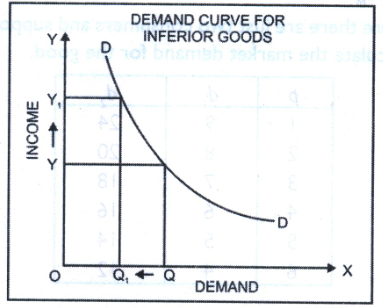
The diagram shows that an increase in the income from OY to OY1 decreases the demand from OQ to OQ1.Examples of inferior goods may include low quality food items like coarse, cereals, cheap vegetable oil, etc.
9.
()
The demand for a good said to be elastic when a percentage change in quantity demanded is greater than percentage change in price.
10.
()
Price elasticity of demand \({ (E }_{ D })\) measures the degree of responsiveness of the quantity demanded of a good to the change in its price.
11.
()
Consumer's equilibrium is attained when Marginal Utility of the good in terms of money becomes equal to its price.That is,
\({ P }_{ X }=\frac { M{ U }_{ X } }{ M{ U }_{ M } } \)
12.
()
An indifference curve is a locus of all the points representing combinations of two goods among which the consumer is indifferent.
13.
()
The budget line represents all the bundles of two goods that a consumer can purchase with his ao her entire income at current prices.A budget line is given by an equation:
\({ P }_{ 1 }{ X }_{ 1 }+{ P }_{ 2 }{ X }_{ 2 }=M\)
14.
The demand for a commodity is relatively elastic if there are close substitutes available for it.Commodities like tea, fountain pen, ghee, etc. have relatively elastic demand as they have substitutes like coffee, ball point pen, oil, etc.respectively.For instance, people will substitute ball-point pen for fountain pen if the price for ball-point pen falls.
The demand for a commodity is relatively inelastic if there are no substitutes available for it.Commodities like salt, water, etc. have relatively inelastic demand.The demand for salt will not get affected due to a change in its price.
15.
Substitutes are those goods which can be used in place of one another.Following are the examples of two goods which are substitutes of each other:
(i) Ghee and oil
(ii) Fountain pen and ballpoint pen
(iii) Tea and coffee
The demand for a good is affected by changes in the price of substitute goods.
(i) Rise in the Price of Substitute Good: A rise in the price of tea will increase the demand for the coffee as latter is relatively cheaper now.The consumer will substitute coffee for tea.The demand curve for coffee would shift to the right.
(ii) Fall in the Price of Substitute Good: A fall in the price of tea will decrease the demand for the coffee as latter is relatively expensive now.The consumer will substitute tea for coffee.The demand curve for coffee would shift to the left.
16.
A related good can be complement or a substitute.The effect of a rise in the price of a substitute and a complement is described below.
Substitutes: If goods X and Y are substitutes, an increase in the price of Y will increase the demand for the X; and a decrease in the price of Y will decrease the demand for X.
Complements: If goods X and Y are complements, a fall in the price of Y leads to a rise in the demand for X, and a rise in the price of Y leads to a fall in the demand for X.
17.
The budget set includes all the possible bundles of two goods (commodities) that a consumer can afford to buy with his or her income at the prevailing market prices.The budget set depends on the income of the consumer and the prices of the goods and services.Accordingly, a budget set will change under the following conditions:
(i) Change in the money income of the consumer.
(ii) Change in the price of any of the goods.
18.
()
inelastic
19.
()
inelastic
20.
()
negative
21.
()
relative
22.
()
utility
23.
(a)
24.
(b)
25.
(a)
26.
(b)
27.
(b)
28.
(b)
Downward sloping concave
29.
(c)
Inferior goods
30.
(c)
is tangent to
31.
(a)
\(\frac { { P }_{ X } }{ { P }_{ Y } } \)
32.
(d)
Utility

12th Standard CBSE Syllabus & Materials
12th Standard CBSE
CBSE 12th Computer Science Python Revision Tour I - New Previous year Question Papers Study Material - QB365 Set A
NEW12th Standard CBSE
CBSE 12th Business Studies Planning Important Questions And Answers Study Material - QB365 Set A
NEW12th Standard CBSE
CBSE 12th Business Studies Business Environment Important Questions And Answers Study Material - QB365 Set A
NEW12th Standard CBSE
CBSE 12th Business Studies Principles of Management Important Questions And Answers Study Material - QB365 Set A



CBSE 12th Standard CBSE Subjects
CBSE Standards











