
 100% FREE ACCESS
12th Standard CBSE Syllabus & Materials
12th Standard CBSE
CBSE 12th Economics Government Budget and the Economy Previous year Question Papers Study Material - QB365 Set A
NEW12th Standard CBSE
CBSE 12th Computer Science Interface Python with MySQL - New Previous year Question Papers Study Material - QB365 Set A
NEW12th Standard CBSE
CBSE 12th Computer Science Database Concept - New Previous year Question Papers Study Material - QB365 Set A
NEW12th Standard CBSE
CBSE 12th Computer Science Data Communication - New Previous year Question Papers Study Material - QB365 Set A
NEW12th Standard CBSE
CBSE 12th Computer Science Data Structures - New Previous year Question Papers Study Material - QB365 Set A
NEW12th Standard CBSE
CBSE 12th Computer Science Functions - New Previous year Question Papers Study Material - QB365 Set A

Published on: 30/07/2018
From the chapter Production and Cost, some of the important questions are covered in this question paper. The questions are covers from the book back and the previous year questions.
Students, subscribe and get plenty of question paper with answer key. For subscription please click here.
Download CBSE Class 12th Standard CBSE undefined question papers, sample papers, important questions, and previous year solved papers in PDF format. Get free study materials, NCERT solutions, and exam preparation resources for Class 12th Standard CBSE undefined
Questions + Answers key
Take MCQ Biology Test
1.
A producer invests his own savings in starting a business and employs a manager to look after it.Identify implicit and explicit costs from this information.Explain.
2.
A farmer takes a farm on rent and carries on farming with the help of family members.Identify explicit cost and implicit cost from this information Explain
3.
Explain the likely behaviour of Total Product and Marginal Product When only one input is increased while all other inputs are kept unchanged.
4.
Find out the maximum possible output for a firm with zero unit of L and 10 units of K when its production function is: \(Q=5L+2K\)
5.
The following table gives the marginal product schedule of labour.It is also given that total product of labour is zero at zero level of employment.Calculate the total cost and average product schedules of labour
| L | \({ MP }_{ L }\) |
| 1 | 3 |
| 2 | 5 |
| 3 | 7 |
| 4 | 5 |
| 5 | 3 |
| 6 | 1 |
6.
What is the total product of an input?
7.
Explain the concepts of the short run and long run.
8.
Distinguish between (i) Fixed Cost and Variable Cost.giving examples and (i)Average Cost and Marginal Cost giving an example.
9.
State the relationship between Total Cost and Marginal Cost.
10.
Explain the law of variable proportions through the behaviour of total and marginal product. Give reasons.
11.
What do you understand by increasing returns to scale? How do they arise?
12.
What are the total fixed cost,total variable cost and total cost of a firm? How are they related?
13.
Give the meaning of constant returns to scale.
14.
Define returns to a factor.
15.
List any three inputs used in production.
16.
What is the general shape of the MP curve?
17.
What is meant by Total Physical Product?
18.
TC increase at a diminishing rate when MC is------------
19.
MC cuts AC at its-----------point
20.
In the second stage of Law of variable Proportions ,MP is ------------------
21.
Returns to scale is related with-------------
22.
-------- of utility is called production
23.
Fixed cost does not change with change in quantity of output.
24.
AC curve is \(\cup -\)shaped
25.
Return to scale applies when all factors of production are variable.
26.
The formula of MP is,\(MP=\frac { TP }{ L } \)
27.
Production function studies the functional relationship between physical input and physical output.
28.
why is the Average Cost curve \(\cup -\)shaped?
Due to Law of Variable Proportion
Due to constant returns
Due to profit
Due to loss
29.
Average Cost (AC)=
\(\frac { TC }{ Q } \)
TC*Q
\(\frac { \Delta TC }{ \Delta Q } \)
TC-MC
30.
Which among the following is the type of Fixed Cost in the short-run?
Salary of permanent employee
Depreciation cost
Interest on fixed capital
All of these
31.
Does the Average Product is zero,Total Product will be-----------
Some time
Always
Never
All of these
32.
Which among the following is the factor of production?
Land
Capital
Human capital
All of the these
1.
in the given case, payment of salary to the manager is the explicit cost because it is a payment to outsider.The use of own saving in starting the business constitutes implicit cost because it is the cost of self-employed resource.
2.
In the given case, the labour cost of the family members constitutes implicit cost because it is the cost of self-employed resources.The rent paid on a firm is the explicit cost because it is the cost of outside resources.
3.
The Law of variable Proportions explains the behaviour of Total Product ~nd Marginal Product. It states that when more and more units of a variable factor are employed, keeping the other factors fixed, the Total Product (TP) first increases at an increasing rate, then increases at a diminishing rate and finally starts falling.The different phases in the behaviour of TP and MP can be explained as below.
| Phase | Total Product (TP) | Marginal Product(MP) |
| I | TP raises at increasing rate | MP raises |
| II | TP raises at decreasing rate | MP falls but remains positive |
| III | TP falls | MP falls and becomes negative |
4.
The production function is given as: \(Q=5L+2K\)
Substituting L=0 and K=10 in (I)we get: ..............(1)
Q = 5(0) + 2(10)
= 0 + 20
= 20
Thus, the maximum possible output that the firm can produce with 0 units of L and 10 units of K is 20 units.
5.
|
L |
MPL |
TPn = TPn-1 + MPn |
\(\mathrm{AP}_{L}=\frac{\mathrm{TP}_{L}}{L}\) |
|
1 |
3 |
3 |
\(\frac{3}{1}=3\) |
|
2 |
5 |
3 + 5 = 8 |
\(\frac{8}{2}=4\) |
|
3 |
7 |
8 + 7 = 15 |
\(\frac{15}{3}=5\) |
|
4 |
5 |
15 + 5 = 20 |
\(\frac{20}{4}=5\) |
|
5 |
3 |
20 + 3 = 23 |
\(\frac{23}{5}=4.6\) |
|
6 |
1 |
23 + 1 = 24 |
\(\frac{24}{6}=4\) |
6.
Total product is defined as the sum total of output produced by a firm by employing a particular input. It is also known as the Total Physical Product and is represented as
\(\mathrm{TP}=\sum Q_{x}\)
Where, ∑ represents summation of all outputs and Qx represents units of output x produced by an input.
7.
Short run:-
In short run, a firm cannot change all the inputs, which means that the output can be increased (decreased) only by employing more (less) of the variable factor (labour). It is generally assumed that in short run a firm does not have sufficient or enough time to vary its fixed factors such as, installing a new machine, etc. Hence, the output levels vary only because of varying employment levels of the variable factor.
Algebraically, the short run production function is expressed as
\(Q_{x}=f(L, \bar{K})\)
Where,
Qx = units of output x produced
L = labour input
\(\bar{K}\)= constant units of capital
Long run:-
In long run, a firm can change all its inputs, which means that the output can be increased (decreased) by employing more (less) of both the inputs − variable and fixed factors. In the long run, all inputs (including capital) are variable and can be changed according to the required levels of output. The law that explains this long run concept is called returns to scale. The long run production function is expressed as
Qx = f (L, K)
Both L and K are variable and can be varied.
8.
(i) Following are the points of difference between Fixed Cost and Variable Cost:
| S.No | Fixed Cost (FC) | Variable Cost (VC) |
| 1 | Fixed Costs (FC) are the costs incurred on the employment of fixed factors of production | Variable Costs (VC) are the costs incurred on the employment of vaiable factors of production |
| 2. | These costs remain constant and do not change with the level of output | These costs vary with the vary level of output |
| 3 | Examples
|
Examples
|
(ii) Following are the points of difference between Average Cost and Marginal Cost
| S.No | Average Cost(AC) | Marginal Cost (MC) |
| 1 | Average Cost(AC) is the cost per unit of output produced | Marginal Cost (MC) is the change in the Total Cost by producing an additional unit of output. |
| 2. | It is calculated by dividing the Total Cost with the number of units produced \(AC=\frac { TC }{ q } \) q being the units of output produced |
It can be derived as: \(MC_{ q }=TC_{ q }-TC_{ q-1 }\\ or\quad MC=\frac { \Delta TC }{ \Delta q } \) q being the units of output produced |
9.
The relationship between Total Cost (TC) and Marginal Cost (MC) is given below:
(i) Marginal Cost is estimated as the difference between the Total Cost of two successive units of capital. That is
\(MC_{ q }=TC_{ q }-TC_{ q-1 }\\ orMC=\frac { \Delta TC }{ \Delta q } \)
(ii) When MC is diminishing,TC increases at a diminishing rate.
(iii)When MC is rising,TC increases at an increasing rate.
(iv) When MC reaches its lowest point, TC stops increasing at a decreasing rate
10.
The factors of production can be classified as fixed and variable factors. The fixed factors cannot be changed over a short period. The Law of Variable Proportions (or the Law of Returns to a Factor) states that when more and more units of a variable factor are employed, keeping the other factors fixed, the Total Product (TP) first increases at an increasing rate, then increases at a diminishing rate and finallIy starts falling.The law explains the change in output due to the change in the proportions between the fixed and variable factors. The law of returns to a factor can be explained with the help of following diagram:
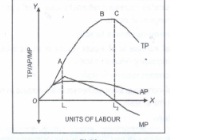
Stage I: Increasing Returns to Variable Factor
The Total Product (TP) increases at an increasing rate from 0 to \(L_{ 1 }\) units of labour. That is, Marginal Product (MP) is increasing.
Stage 2: Diminishing Returns to Variable Factor
The Total Product (TP) increases at a diminishing rate from \(L_{ 1 }\) , to \(L_{ 2 }\) units of labour. That is, Marginal Product (MP) is decreasing. MP is 0 at \(L_{ 2 }\) units of labour. •
Stage 3: Negative Returns to Variable Factor
The Total Product (TP) is decreasing beyond ~ units of labour. The output decreases as an additional unit of labour is employed. That is, Marginal Product (MP) is negative.
11.
Increasing returns to scale implies that a proportionate change in the output is greater than the proportionate change in input. For example, the output increases by 20 percent due to 15 percent increase in all the inputs. Increasing returns to scale are due to economies of scale. Economies of scale indica e that long run Average Cost decreases, which corresponds to increasing returns to scale in terms 0 output. Economies of scale can be classified as::
1. Internal Economies of Scale: These include
(i) Technical Economies
(ii) Financial Economies
(iii) Marketing Economies
(iv) Managerial Economies
(v) Labour Economies
(vi) Risk-bearing Economies
(vii) Economies due to Indivisibilities
2. External Economies of Scale:These include
(i) Economies of Concentration
(ii) Economies of Information
(iii) Economies of Disintegration
12.
Total Fixed Cost (TFC)
This refers to the costs incurred by a firm in order to acquire the fixed factors for production like cost of machinery, buildings, depreciation, etc. In short run, fixed factors cannot vary and accordingly the fixed cost remains the same through all output levels. These are also called overhead costs.
Total Variable Cost (TVC)
This refers to the costs incurred by a firm on variable inputs for production. As we increase quantities of variable inputs, accordingly the variable cost also goes up. It is also called ‘Prime cost’ or ‘Direct cost’ and includes expenses like − wages of labour, fuel expenses, etc.
Total Cost (TC)
The sum of total fixed cost and total variable cost is called the total cost.
Total cost = Total fixed cost + Total variable cost
TC = TFC + TVC
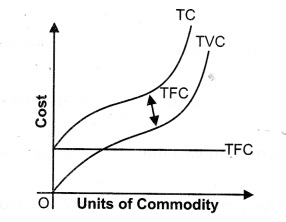
Relationship between TC, TFC, and TVC
1) TFC curve remains constant throughout all the levels of output as fixed factor is constant in short run.
2) TVC rises as the output is increased by employing more and more of labour units. Till point Z, TVC rises at a decreasing rate, and so the TC curve also follows the same pattern.
3) The difference between TC and TVC is equivalent to TFC.
4) After point Z, TVC rises at an increasing rate and therefore TC also rises at an increasing rate.
5) Both TVC and TFC is derived from TC i.e. TC = TVC + TFC
13.
()
When the proportional increase in all inputs results in an increase in output by the same proportion. it is called constant returns to scale.
14.
()
Returns to a factor refer to the effects of changes in variable factor of production on output , when other factors remain fixed.
15.
()
Inputs used in production include :
(i) Land
(ii) Labour
(iii) Capital
16.
()
MP curve is an inverted \(\cup \)-shaped curve (\(\cap \))
17.
()
Total Physical Product (TPP) or Total Product(TP) is the total output produced by a firm using its variable inputs during a period of time.
18.
()
decreasing
19.
()
lowest
20.
()
zero
21.
()
long run
22.
()
Creation
23.
(a)
24.
(a)
25.
(a)
26.
(b)
27.
(a)
28.
(a)
Due to Law of Variable Proportion
29.
(a)
\(\frac { TC }{ Q } \)
30.
(d)
All of these
31.
(c)
Never
32.
(d)
All of the these

12th Standard CBSE Syllabus & Materials
12th Standard CBSE
CBSE 12th Computer Science Python Revision Tour I - New Previous year Question Papers Study Material - QB365 Set A
NEW12th Standard CBSE
CBSE 12th Business Studies Planning Important Questions And Answers Study Material - QB365 Set A
NEW12th Standard CBSE
CBSE 12th Business Studies Business Environment Important Questions And Answers Study Material - QB365 Set A
NEW12th Standard CBSE
CBSE 12th Business Studies Principles of Management Important Questions And Answers Study Material - QB365 Set A



CBSE 12th Standard CBSE Subjects
CBSE Standards











