
 100% FREE ACCESS
12th Standard CBSE Syllabus & Materials
12th Standard CBSE
CBSE 12th Economics Government Budget and the Economy Previous year Question Papers Study Material - QB365 Set A
NEW12th Standard CBSE
CBSE 12th Computer Science Interface Python with MySQL - New Previous year Question Papers Study Material - QB365 Set A
NEW12th Standard CBSE
CBSE 12th Computer Science Database Concept - New Previous year Question Papers Study Material - QB365 Set A
NEW12th Standard CBSE
CBSE 12th Computer Science Data Communication - New Previous year Question Papers Study Material - QB365 Set A
NEW12th Standard CBSE
CBSE 12th Computer Science Data Structures - New Previous year Question Papers Study Material - QB365 Set A
NEW12th Standard CBSE
CBSE 12th Computer Science Functions - New Previous year Question Papers Study Material - QB365 Set A

Published on: 25/10/2025
Download CBSE Class 12th Standard CBSE Maths question papers, sample papers, important questions, and previous year solved papers in PDF format. Get free study materials, NCERT solutions, and exam preparation resources for Class 12th Standard CBSE Maths
Questions + Answers key
Take MCQ Maths Test
1.
If the function \(f(x)=\left\{\begin{array}{cc} \frac{\sin x}{x}+\cos x, & \text { if } x \neq 0 \\ k, & \text { if } x=0 \end{array}\right.\) is continuous at x = 0, then find the value of k.
2.
If A is a matrix of order 3 x 3,then show that (A2)-1=(A-1)2
3.
If \(\tan ^{-1} x+\tan ^{-1} y=\frac{4 \pi}{5}\), then find \(\cot ^{-1} x+\cot ^{-1} y\)
4.
If A = \(\left[ \begin{matrix} sinx & -cosx \\ cosx & sinx \end{matrix} \right] \) 0 < x < \(\frac { \pi }{ 2 } \) and A + A' =I, Where I us unit matrix, find value of x.
5.
Let f : \(R\rightarrow R\) is defined by f(x) = |x|. Is function f onto? Give reasons.
6.
If \(y=e^{m \sin ^{-1} x}\), then show that \(\left(1-x^2\right) \frac{d^2 y}{d x^2}-x \frac{d y}{d x}-m^2 y=0\)
7.
If \(y=\sin (\sin x)\), prove that \(\frac{d^2 y}{d x^2}+\tan x \frac{d y}{d x}+y \cos ^2 x=0\)
8.
If A is a square matrix such that A2 = I, then find the simplified value of (A - 1)3 + (A +1)3 - 7A.
9.
Evaluate each of the following.
\(\cos ^{-1}\left(\cos \frac{7 \pi}{6}\right)\)
10.
Find the co - factors of the elements of the determinant: \(\left| \begin{matrix} 2 & -3 & 5 \\ 6 & 0 & 4 \\ 1 & 5 & -7 \end{matrix} \right| \) and verify that a11 A31 + a12 A32 + a13 A33 = 0.
11.
Show that the function \(f:N\rightarrow N\) given by \(f(2)=1\) and \(f(x)=x-1\) , for every \(x>2\) is onto but not one-one.
12.
Water is passed into an inverted cone of base radius 5cm and depth 10cm at the rate of \(3\over2\)c.c./sec. Find rate at which level of water is rising when depth is 4cm
13.
Let \(f(x)=\left\{\begin{array}{ll} \frac{1-\cos 4 x}{x^{2}}, & \text { if } x<0 \\ a, & \text { if } x=0 \\ \frac{\sqrt{x}}{\sqrt{16+\sqrt{x}}-4} & \text { if } x>0 \end{array}\right.\) for what value of a f is continuous at x = 0 ?
14.
An automobile company uses three types of steels S1 S2 and S3 for producing three types of cars C1C2 and C3 Steel requirements (in tonnes) for each type of cars are given below
| Steel/Car | C1 | C2 | C3 |
| S1 | 2 | 3 | 4 |
| S2 | 1 | 1 | 2 |
| S3 | 3 | 2 | 1 |
Find the number of cars of each type which can be produced using 29, 13and 16 tonnes of steel of three types, respectively.
15.
Find the value of \(\cos ^{-1}\left(-\frac{1}{2}\right)+\tan ^{-1}(-\sqrt{3})-\operatorname{cosec}^{-1}(2)\)
16.
Find the intervals in which f(x) = sin3x - cos3x,0 < x < π is strictly increasing or strictly decreasing.
17.
Write the value of \(tan^{-1}\left[2sin\left(2cos^{-1}{\sqrt{3}\over2}\right)\right]\)
18.
If \(f(x)=|\cos x|\), then \(f^{\prime}\left(\frac{3 \pi}{4}\right)\) is
1
-1
\(\frac{-1}{\sqrt{2}}\)
\(\frac{1}{\sqrt{2}}\)
19.
If A and B are invertible square matrices of the same order, then which of the following is not correct?
\(adj A=|A| \cdot A^{-1}\)
\(\operatorname{det}\left(A^{-1}\right)=[\operatorname{det}(A)]^{-1}\)
\((A B)^{-1}=B^{-1} A^{-1}\)
\((A+B)^{-1}=B^{-1}+A^{-1}\)
20.
A matrix has 18 elements, then possible number of orders of a matrix are
3
4
6
5
21.
It isgiven thatatx= I, the function f(x) = x4 - 62x2 + ax + 9 attains its maximum value, on the interval [0, 2]. The value of a is
20
-120
120
52
22.
Let function f: R \(\rightarrow\) R is defined as f(x) = 2x3 -1 If f-1 exists, then f-1 is
\(2 x^{3}+1\)
\((2 x)^{3}+1\)
\((1-2 x)^{3}\)
\(\left(\frac{1+x}{2}\right)^{\frac{1}{3}}\)
23.
Let the function 'f' : N \(\rightarrow\) N be defined by \(f(x)= {2} x+3, \forall x \in N \text { . Then } f^{\prime \prime} \text { is }\)
not onto
bijective function
many-one, into function
none of these
24.
A kite is moving horizontally at a height of 151.5m. If the speed of kite is 10 m/ s, then the rate at which the string is being let out when the kite is 250 m away from the boy who is flying the kite and the height of the boy 1.5m is
4 m/s
6 m/s
7 m/s
8 m/s
25.
If \(f(x)=2 x \text { and } g(x)=\frac{x^{2}}{2}+1\) then which of the following can be a discontinuous function?
f(x) + g (x)
f(x) - g(x)
f(x). g (x)
\(\frac{g(x)}{f(x)}\)
26.
The area of the triangle formed by 3 collinear points is
one
two
zero
four
27.
Iff \(f(x)=\left|\begin{array}{ccc} 0 & x-a & x-b \\ x+a & 0 & x-c \\ x+b & x+c & 0 \end{array}\right|\) then
f(a) = 0
f(b) = 0
f(0) = 0
f(1) = 0
28.
If matrix \(A=\left[a_{i j}\right]_{2 \times 2},\ where \ a_{i j}=\left\{\begin{array}{l}1, \text { if } i \neq j \\ 0, \text { if } i=j\end{array}\right.\) Then \(A^{2}\) is equal to
I
A
0
None ofthese
29.
The greatest and least value of $\(\left(\sin ^{-1} x\right)^{2} +\left(\cos ^{-1} x\right)^{2}\)$ are respectively
\(\frac{5 \pi^{2}}{4} and \frac{\pi^{2}}{8}\)
\(\frac{\pi}{2} and -\frac{\pi}{2}\)
\(\frac{\pi^{2}}{4} and -\frac{\pi^{2}}{4}\)
\(\frac{\pi^{2}}{4}\) and 0
30.
For what real value of y will matrix A be equal to matrix B, where
\(A=\begin{bmatrix} 3x-4 & 5y \\ 8 & { y }^{ 2 }-4y \end{bmatrix};B=\begin{bmatrix} x+1 & 6{ y }^{ 2 }+1 \\ 8 & -3 \end{bmatrix}\)
1, 3
No real value
1/3, 1/2
2 and 3
31.
Value of \(sin\left( 2{ cos }^{ -1 }\left( \frac { -1 }{ 2 } \right) \right) \)
\(\sqrt3\)/2
-1
-\(\sqrt3\)/2
-1/2
32.
If sin–1 x = y, then
0 ≤ y ≤ ㅠ
\(-\frac { \pi }{ 2 } \le y\le \frac { \pi }{ 2 } \)
0 < y < π
\(-\frac { \pi }{ 2 } < y < \frac { \pi }{ 2 }\)
33.
The side of an equilateral triangle is increasing at the rate of 2 cm/s. The rate at which area increases when the side is 10 is
10 cm²/s
\(\sqrt3\) cm²/s
10 \(\sqrt3\) cm²/s
\(\frac{10}{3}\)cm²/s
34.
A function f is said to be continuous for x ∈ R, if
it is continuous at x = 0
differentiable at x = 0
continuous at two points
differentiable for x ∈ R
35.
If sec-1 x + sec-1 y = 
\(\pi\)
\(\frac{\pi}{2}\)
\(\frac{3\pi}{2}\)
≥-ㅠ
36.
Two men on either side of a temple of 30 m high observe its top at the angles of elevation = α and ẞ respectively. (as shown in the figure below).
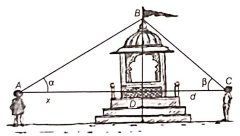
The distance between the two men is 40√3 m and the distance between the first person A and the temple is 30√3 m. Based on the above information answer the following questions.
∠CAB = α =
| a) sin-1 (2/√3) | b) sin-1 (1/2) | c) sin-1 (2) | d) sin-1 (√3/2) |
(ii) \(\angle C A B=\alpha=\)
| a) \(\cos ^{-1}\left(\frac{1}{5}\right)\) | b) \(\cos ^{-1}\left(\frac{2}{5}\right)\) | c) \(\cos ^{-1}\left(\frac{\sqrt{3}}{2}\right)\) | d) \(\cos ^{-1}\left(\frac{4}{5}\right)\) |
(iii) \(\angle B C A=\beta=\)
| a) \(\tan ^{-1}\left(\frac{1}{2}\right)\) | b) \(\tan ^{-1} (2)\) | c) \(\tan ^{-1}\left(\frac{1}{\sqrt{3}}\right)\) | d) \(\tan ^{-1}(\sqrt{3})\) |
(iv) \(\angle A B C=\)
| a) \(\frac{\pi}{4}\) | b) \(\frac{\pi}{6}\) | c) \(\frac{\pi}{2}\) | d) \(\frac{\pi}{3}\) |
(v) Domain and range of \(\cos ^{-1} x=\)
| a) \((-1,1),(0, \pi)\) | b) \([-1,1],(0, \pi)\) | c) \([-1,1],[0, \pi]\) | d) \((-1,1),\left[-\frac{\pi}{2}, \frac{\pi}{2}\right]\) |
37.
A general election of Lok Sabha is a gigantic exercise About 911 million people were eligible to vote and voter turnout was about 67%, the highest ever.

Let l be the set of all citizens of India who were eligible to exercise their voting right in general election held in 2019. A relation R is defined on I as follows
R = {(V1,V2) : V1,V2 ∈ l and both use their voting right in general election-2019).
Answer the following questions using the above information.
(i) Two neighbours X and Y ∈ 1. X exercised his voting right while y did not cast her vote in general election-2019. Which of the following is true?
(a) (X, Y) ∈ R
(b) (Y, X) ∈ R
(c) (X, X) ∈ R
(d) (X, Y) ∈ R
(ii) Mr. X and his wife W both exercised their voting right in general election 2019. Which of the following is true?
(a) both (X, W) and (W,X) ∈ R
(b) (X, W) ∈ R but (W,X) ∉ R
(c) both (X, W) and (W,X) ∉ R
(d) (W,X) ∈ R but (X, W) ∉ R
(iii) Three friends F1, F2 and F3 exercised their voting right in general election-2019, then which of the following is true?
(a) \(\left(F_1, F_2\right) \in R,\left(F_2, F_3\right) \in R\) and \(\left(F_1, F_3\right) \in R\)
(b) \(\left(F_1, F_2\right) \in R,\left(F_2, F_3\right) \in R\) and \(\left(F_1, F_3\right) \notin R\)
(c) \(\left(F_1, F_2\right) \in R,\left(F_2, F_2\right) \in R\) but \(\left(F_3, F_3\right) \notin R\)
(d) \(\left(F_1, F_2\right) \notin R,\left(F_2, F_3\right) \notin R\) and \(\left(F_1, F_3\right) \notin R\)
(iv) The above defined relation R is
(a) Symmetric and transitive but not reflexive z
(b) Universal relation
(c) Equivalence relation
(d) Reflexive but not symmetric and transitive
(v) Mr. Shyam exercised his voting right in General Election-2019, then Mr. Shyam is related to which of the following?
(a) All those eligible voters who cast their votes
(b) Family members of Mr.Shyam
(c) All citizens of India
(d) Eligible voters of India
38.
To promote the making of toilets for women, an organisation tried to generate awareness through (i) house calls (ii) emails and (iii) announcements. The cost for each mode per attempt is given below:
(i) Rs.50 (ii) Rs.20 (iii) Rs.40
The number of attempts made in the villages X, Y and Z are given below:
\(\begin{array}{llll} & (\mathrm{i}) & (\mathrm{ii}) & (\mathrm{iii}) \\ X & 400 & 300 & 100 \\ Y & 300 & 250 & 75 \\ Z & 500 & 400 & 150 \end{array}\)
Also, the chance of making of toilets corresponding to one attempt of given modes is
(i) 2% (ii) 4% (iii) 20%
Based on the above information, answer the following questions.
(i) The cost incurred by the organisation on village X is
| (a) 10000 | (b) Rs.15000 | (c) 30000 | (d) Rs.20000 |
(ii) The cost incurred by the organisation on village Y is
| (a) Rs.25000 | (b) Rs.18000 | (c) Rs.23000 | (d) Rs.28000 |
(iii) The cost incurred by the organisation on village Z is
| (a) Rs.19000 | (b) Rs.39000 | (c) Rs.4500 | (d) Rs.5000 |
(iv) The total number of toilets that can be expected after the promotion in village X, is
| (a) 20 | (b) 30 | (c) 40 | (d) 50 |
(v) The total number of toilets that can be expected after the promotion in village Z, is
| (a) 26 | (b) 36 | (c) 46 | (d) 56 |
39.
Assertion: If y = log10 x + loge y, then \(\frac{dy}{dx}=\frac{log_{10}e}{x}\left ( \frac{y}{y-1} \right )\)
Reason: \(\frac{d}{dx}(log_{10}x)=\frac{log \space x}{log \space 10}\) and \(\frac{d}{dx}(log_{e}x)=\frac{log \space x}{log \space e}\)
(a) Assertion is correct, Reason is correct; Reason is a correct explanation for assertion.
(b) Assertion is correct, Reason is correct; Reason is not a correct explanation for Assertion
(c) Assertion is correct, Reason is incorrect
(d) Assertion is incorrect, Reason is correct.
40.
Assertion: If two positive numbers are such that sum is 16 and sum of their cubes is minimum, then numbers are 8,8.
Reason: If f be a function defined on an interval I and c \(\in\)I and let f be twice differentiable at c, then x = c is a point of local minima if f'(c) = 0 and f''(c) > 0 and f(c) is local minimum value of f.
(a) Assertion is correct, Reason is correct; Reason is a correct explanation for assertion.
(b) Assertion is correct, Reason is correct; Reason is not a correct explanation for Assertion
(c) Assertion is correct, Reason is incorrect
(d) Assertion is incorrect, Reason is correct.
1.
\( \text {Hint } \lim _{x \rightarrow 0} f(x)=f(0) \)
\(\Rightarrow \lim _{x \rightarrow 0} \frac{\sin x}{x}+\lim _{x \rightarrow 0} \cos x=k \)
\(\Rightarrow 1+1=k \)
2.
\(\left(A^{2}\right)^{-1}=(A A)^{-1}=\left(A^{-1} A^{-1}\right) \quad\left[\because(A B)^{-1}=B^{-1} A^{-1}\right]
\)
\(=\left(A^{-1}\right)^{2}\)
3.
\( \tan ^{-1} x+\tan ^{-1} y=\frac{4 \pi}{5} \)
\(\text {Now, } \tan ^{-1} x+\cot ^{-1} x=\frac{\pi}{2} \)
\(\tan ^{-1} x=\frac{\pi}{2}-\cot ^{-1} x \)
\(\therefore \frac{\pi}{2}-\cot ^{-1} x+\frac{\pi}{2}-\cot ^{-1} y=\frac{4 \pi}{5} \)
\(-\cot ^{-1} x-\cot ^{-1} y+\pi=\frac{4 \pi}{5} \)
\(\cot ^{-1} x+\cot ^{-1} y=\pi-\frac{4 \pi}{5} \)
\(=\frac{\pi}{5} \)
4.
x = \(\frac { \pi }{ 6 } \)
5.
f is not onto, as for some y ∈ R from co-domain, there is no x ∈ R from domain such that y = f{x), e.g. for - 2 ∈ R (co-domain) there is no x ∈ R (domain) such that f{x) = -2, i.e. |x|= -2. Hence, not onto.
6.
Given, \(y=e^{m \sin ^{-1} x}\)
On differentiating both sides of Eq.(i) w.r.t. x, we get \(\frac{d y}{d x}=e^{m \sin ^{-1} x} \frac{d}{d x}\left(m \sin ^{-1} x\right)\)
[by using chain rule of derivative]
\(=e^{m \sin ^{-1} x} \cdot m \frac{1}{\sqrt{1-x^2}}\)
\(\Rightarrow \sqrt{1-x^2} \frac{d y}{d x}=m y\)
Now, on squaring both sides, we get
\(\left(1-x^2\right)\left(\frac{d y}{d x}\right)^2=m^2 y^2\)
On differentiating both sides of Eq. (ii) w.r.t. x, we get
\(\left(1-x^2\right) 2\left(\frac{d y}{d x}\right) \frac{d^2 y}{d x^2}+\left(\frac{d y}{d x}\right)^2(-2 x)=2 m^2 y\left(\frac{d y}{d x}\right)\)
\(\Rightarrow \quad\left(1-x^2\right) \frac{d^2 y}{d x^2}-x \frac{d y}{d x}=m^2 y\)
\( {\left[\text { dividing both sides by } 2\left(\frac{d y}{d x}\right)\right]}\)
\( \therefore \quad\left(1-x^2\right) \frac{d^2 y}{d x^2}-x \frac{d y}{d x}-m^2 y=0\)
Hence proved.
7.
Given, \(y=\sin (\sin x)\)
On differentiating both sides w.r.t. x, we get
\(\frac{d y}{d x}=\cos (\sin x) \cdot \cos x\)
Again, on differentiating both sides w.r.t. x, we get
\(\frac{d^2 y}{d x^2}=\cos (\sin x) \cdot(-\sin x)\)
\(\Rightarrow \frac{d^2 y}{d x^2}=\frac{1}{\cos x} \cdot\left(\frac{d y}{d x}\right)\left(-\cos x(-\sin x)-y \cos ^2 x\right.\)
[using Eqs. (i) and (ii)]
\(\Rightarrow \quad \frac{d^2 y}{d x^2}=-\tan x \frac{d y}{d x}-y \cos ^2 x\)
\(\Rightarrow \quad \frac{d^2 y}{d x^2}+\tan x \frac{d y}{d x}+y \cos ^2 x=0\)
Hence proved.
8.
Given, A 2 = 1
Now, (A - I)3 + (A + I)3 -7A = (A3 - 3A 21 + 3AI2- ]3)+(A3 + 3A2 I + 3AI2 + ]3) -7A
= (A3 - 3A2 + 3AI - I) + (A3 + 3A2 + 3AI + I) - 7A
[ஃ A 21 = A 2 and 13 = 12 = 1]
= 2A3 + 6AI - 7A = 2A 2A + 6A - 7A [ஃ AI = A]
= 2IA-A
= 2A-A = A
[from Eq. (i)]
[ஃ IA = A]
9.
\( \cos ^{-1}\left(\cos \frac{7 \pi}{6}\right) =\cos ^{-1}\left\{\cos \left(2 \pi-\frac{5 \pi}{6}\right)\right\} \)
\([ \because \frac{7 \pi}{6} \notin[0, \pi], \text { so we write } \frac{7 \pi}{6} \text { as } \left.\left(2 \pi-\frac{5 \pi}{6}\right)\right] \)
\(=\cos ^{-1}\left(\cos \frac{5 \pi}{6}\right)[\because \cos (2 \pi-\theta)=\cos \theta] \)
\(=\frac{5 \pi}{6} \quad\left[\because \frac{5 \pi}{6} \in[0, \pi]\right] \)
10.
\(M_{11}=\begin{vmatrix} 0&4\\5&-7\end{vmatrix}=-0-20=-20\)
\(A_{11}=(-1)^{1+1}M_{11}=(-1)^2(-20)=-20\)
\(M_{12}=\begin{vmatrix}6&4\\1&-7 \end{vmatrix}=-42-4=-46\)
\(A_{12}=(-1)^{1+2}M_{12}=(-1)^3(-46)=(-1)(-46)=46\)
\(M_{13}=\begin{vmatrix}6&0\\1&5 \end{vmatrix}=30-0=30\)
\(A_{13}=(-1)^{1+3}M_{13}=(-1)^4(30)=30\)
\(M_{21}=\begin{vmatrix} -3&5\\5&-7\end{vmatrix}=21-25=-4\)
\(A_{21}=(-1)^{ 2+1}M_{21}=(-1)^3(-4=(-1 )(-4)=4)\)
\(M_{22}=\begin{vmatrix} 2&5\\1&-7\end{vmatrix}=-14-15=-19\)
\(A_{22}=(-1)^{2+2}M_{22}=(1)^4(-19)=-19\)
\(M_{23}=\begin{vmatrix} 2&-3\\1&5\end{vmatrix}=10+3=13\)
\(A_{23}=(-1)^{2+3}M_{23}=(-1)^513=-13\)
\(M_{31}=\begin{vmatrix}-3&5\\0&4 \end{vmatrix}=-12-0=-12\)
\(A_{31}=(-1)^{3+1}M_{31}=(-1)^4(-12)=-12\)
\(M_{32}=\begin{vmatrix} 2&5\\6&4\end{vmatrix}=8-30=-22\)
\(A_{32}=(-1)^{3+2}M_{32}=(-1)^5(-22)=(-1)(-22)=22\)
\(M_{33}=\begin{vmatrix} 2&-3\\6&0\end{vmatrix}=0+18=18\)
\(A_{33}=(-1)^{3+3}M_{33}=(-1)^6(18)=18\)
(ii)\(a_{11}A_{31}+a_{12}A_{32}+a_{13}A_{32}\)
\(=(2)(-12)+(-3)(22)+(5)(18)=-24-66+90=0\)
11.
f is not one-one, as f(1) = f(2) = 1. But f is onto, as given any y \(\in \) N, y \(\ne\) 1, we can choose x as y + 1 such that f (y + 1) = y + 1 – 1 = y. Also for 1 \(\in \) N, we have f(1) = 1.
12.
\(\text { From figure, } \frac{5}{10}=\frac{r}{h} \Rightarrow r=\frac{h}{2} ; \frac{d V}{d t}=\frac{3}{2} \mathrm{cc} / \mathrm{s}\)
\(\text { Volume of the cone, } V=\frac{1}{3} \pi r^{2} h\)
\(=\frac{1}{3} \pi\left(\frac{h}{2}\right)^{2} h=\frac{1}{12} \pi h^{3} \)
\(\frac{d V}{d t}=\frac{1}{12} \pi \cdot 3 h^{2} \cdot \frac{d h}{d t} \Rightarrow \frac{3}{2}=\frac{\pi}{4} h^{2} \cdot \frac{d h}{d t} \)
\(\left.\Rightarrow \frac{d h}{d t}=\frac{6}{\pi h^{2}} \Rightarrow \frac{d h}{d t}\right]_{h=4}=\frac{6}{16 \pi}=\frac{3}{8 \pi} \mathrm{cm} / \mathrm{s}\)
13.
At x = 0, we have f(0) = a.
\(\mathrm{LHL} =\lim _{x \rightarrow 0^{-}} f(x)=\lim _{h \rightarrow 0} \frac{1-\cos 4 h}{h^{2}}=\lim _{h \rightarrow 0} \frac{4 \cdot 2 \sin ^{2} 2 h}{4 \cdot h^{2}} \)
\(=\lim _{h \rightarrow 0} 8\left(\frac{\sin ^{2} h}{2 h}\right)^{2} \quad\left[\because \lim _{x \rightarrow 0} \frac{\sin x}{x}=1\right] \)
\( \mathrm{RHL} =\lim _{h \rightarrow 0^{+}} f(x)=\lim _{h \rightarrow 0} \frac{\sqrt{h}}{\sqrt{16+\sqrt{h}-4}} \times \frac{\sqrt{16+\sqrt{h}+4}}{\sqrt{16+\sqrt{h}+4}} \)
\(=\lim _{h \rightarrow 0} \frac{\sqrt{h}[\sqrt{16+\sqrt{h}}+4]}{16+\sqrt{h}-16}=4+4=8 \)
\(\therefore \mathrm{LHL}=\mathrm{RHL}=f(0) \text { [Ans. 8] }\)
14.
Let x be the number of C1 cars produced, y be the number of C2 cars produced and z be the number of C3 cars produced.
Now, according to the given conditions, we have
2x + 3y +4 z = 29, x + y + 2z =13 and 3x + 2y + z = 16
[Ans. x = 2, y = 3 and z = 4]
15.
Firstly, assume the given inverse trigonometric function equal to y( or x) Let \(y=\cos ^{-1}\left(-\frac{1}{2}\right)\)
\(\Rightarrow \cos y=\frac{-1}{2}=-\cos \frac{\pi}{3}=\cos \left(\pi-\frac{\pi}{3}\right) \)
\(\Rightarrow \cos y=\cos \left(\frac{2 \pi}{3}\right) \Rightarrow y=\frac{2 \pi}{3}\)
Since, the principal value branch of \(\cos ^{-1} is [0, \pi]\) and
\(\frac{2 \pi}{3} \in[0, \pi]\)
So, the principal value of \(\cos ^{-1}\left(-\frac{1}{2}\right)\) is \(\frac{2 \pi}{3}\).
Now, find the principal value of \(tan ^{-1}(-\sqrt{3})\ Let\ x=\tan ^{-1}(-\sqrt{3})\)
\(\Rightarrow \tan x=-\sqrt{3}=-\tan \frac{\pi}{3} \quad\left[\because \tan \frac{\pi}{3}=\sqrt{3}\right]\)
\(\Rightarrow \tan x=\tan \left(\frac{-\pi}{3}\right) \quad[\because \tan (-\theta)=-\tan \theta]\)
\(\Rightarrow x=-\frac{\pi}{3}\)
Since, the principal value branch of \(\tan ^{-1}\) is \(\left(\frac{-\pi}{2}, \frac{\pi}{2}\right)\) and \(-\frac{\pi}{3} \in\left(\frac{-\pi}{2}, \frac{\pi}{2}\right)\)
Now, find the principal value of \(\operatorname{cosec}^{-1}\)
Let \(z=\operatorname{cosec}^{-1}(2) \Rightarrow \operatorname{cosec} z=2=\operatorname{cosec} \frac{\pi}{6} \Rightarrow z=\frac{\pi}{6}\)
Since, the principal value branch of \(\operatorname{cosec}^{-1}\) is \(\left[\frac{-\pi}{2}, \frac{\pi}{2}\right]-\{0\}\) and \(\frac{\pi}{6} \in\left[\frac{-\pi}{2}, \frac{\pi}{2}\right]-\{0\}\)
So, the principal value of \(\operatorname{cosec}^{-1}(2)\) is \(\frac{\pi}{6}\).
\(\therefore \cos ^{-1}\left(-\frac{1}{2}\right)+\tan ^{-1}(-\sqrt{3})-\operatorname{cosec}^{-1} 2\)
\(=\frac{2 \pi}{3}-\frac{\pi}{3}-\frac{\pi}{6}=\frac{(4-2-1) \pi}{6}=\frac{\pi}{6}\)
16.
\(\Rightarrow f'(x)=3\cos3x+3\sin3x\)
\(=3(\cos3x+\sin3x)\)
Put \(f'(x)=0\)
\(\Rightarrow \cos3x+\sin3x=0\)
\(\Rightarrow \sin3x=-\cos3x\)
\(\Rightarrow -\tan3x=1\)
\(\Rightarrow \tan3x=-1\)
As 0
ஃ tan 3x is negative for the following values:
\(3x=\frac{3\pi}{4}\)
\(\Rightarrow x=\frac{\pi}{4}\)
\(3x=\pi+\frac{3\pi}{4}=\frac{7\pi}{4}\)
\(\Rightarrow x=\frac{7\pi}{12}\)
\(3x=\frac{7\pi}{4}+\pi=\frac{11\pi}{4}\)
\(\Rightarrow x=\frac{11\pi}{12}\)
Hence we have intervals:
Hence, \(f(x)-\sin3x-\cos3x\) is strictly increasing in the intervals \((0,\frac{\pi}{4})\cup(\frac{7\pi}{12},\frac{11\pi}{12}) \) and strictly decreasing in intervals \((\frac{\pi}{4},\frac{7\pi}{12})\cup(\frac{11\pi}{12},\pi)\)
17.
\(\text {Consider } \tan ^{-1}\left[2 \sin \left(2 \cos ^{-1} \frac{\sqrt{3}}{2}\right)\right] \)
\(=\tan ^{-1}\left[2 \sin \left(2 \cdot \frac{\pi}{6}\right)\right]=\tan ^{-1}\left[2 \sin \frac{\pi}{3}\right] \)
\(=\tan ^{-1}\left(2 \cdot \frac{\sqrt{3}}{2}\right)=\tan ^{-1}(\sqrt{3})=\frac{\pi}{3} \)
18.
(a)
1
19.
(d)
\((A+B)^{-1}=B^{-1}+A^{-1}\)
20.
(c)
6
21.
(c)
120
22.
(d)
\(\left(\frac{1+x}{2}\right)^{\frac{1}{3}}\)
23.
(a)
not onto
24.
(a)
4 m/s
25.
We know that, if and g are continuous functions, then
(a) f + g is continuous
(b) f - g is continuous.
(c) fg is continuous
(d) \(\frac{f}{g}\) is continuous at these points, where \(g(x) \neq 0\)
Here,\(\frac{g(x)}{f(x)}=\frac{\frac{x^{2}}{2}+1}{2 x}=\frac{x^{2}+2}{4 x}\)
which is discontinuous at x = o
26.
By definition of collinearity.
27.
Clearly,
\( f(a) =\left|\begin{array}{ccc} 0 & 0 & a-b \\ 2 a & 0 & a-c \\ a+b & a+c & 0 \end{array}\right| \)
\(=[(a-b)\{2 a \cdot(a+c)\}] \neq 0 \)
\( \therefore \ f(b) =\left|\begin{array}{ccc} 0 & b-a & 0 \\ b+a & 0 & b-c \\ 2 b & b+c & 0 \end{array}\right|\)
\( =-(b-a)[2 b(b-c)] \)
\( =-2 b(b-a)(b-c) \neq 0 \)
28.
(a)
I
29.
(a)
\(\frac{5 \pi^{2}}{4} and \frac{\pi^{2}}{8}\)
30.
(b)
No real value
31.
(c)
-\(\sqrt3\)/2
32.
(b)
\(-\frac { \pi }{ 2 } \le y\le \frac { \pi }{ 2 } \)
33.
As \(\frac { dx }{ dt } =2\) cm/s, x is side of equiolatral triangle.
A = \(\frac { \sqrt { 3 } }{ 4 } { x }^{ 2 }\)
\(\Rightarrow \frac { dA }{ dx } =\frac { \sqrt { 3 } }{ 2 } { x }\frac { dx }{ dt } \)
= \(\frac { \sqrt { 3 } }{ 2 } x2=\sqrt { 3 } x\)
∴\(|\frac{dA}{dx}|\)x=10 = 10\(\sqrt3\) cm2/s
34.
As differentiable functions is continuous also
35.
as sec-1x + sec-1 y = \(\frac{\pi}{2}\)
⇒ \(\frac{\pi}{2}\) - cosec-1 x + \(\frac{\pi}{2}\) - cosec-1 y = \(\frac{\pi}{2}\)
⇒ cosec-1 x + cosec-1 y = \(\frac{\pi}{2}\)
36.
(i) (b) \(\ln \triangle A B D\)
\(\tan \alpha =\frac{B D}{A D}\)
\( =\frac{30}{30 \sqrt{3}}=\frac{1}{\sqrt{3}} \)
\(\Rightarrow \alpha =30^{\circ}\)
\(\therefore \sin \alpha =\sin 30^{\circ}=\frac{1}{2}\)
\(\Rightarrow \alpha =\sin ^{-1}\left(\frac{1}{2}\right)\)
(ii) (c) \(\cos \alpha=\cos 30^{\circ}=\frac{\sqrt{3}}{2}\)
\(\Rightarrow \alpha =\cos ^{-1}\left(\frac{\sqrt{3}}{2})\right.\)
(iii) (d) \(\ln \triangle B DC\)
\(\tan \beta =\frac{(BD)}{(C D)}\)
\(=\frac{30}{10 \sqrt{3}}=\sqrt{3} \)
\(\Rightarrow \beta =\tan ^{-1}(\sqrt{3})\)
(iv) \( \text { (c) Since, } \alpha=\sin ^{-1}\left(\frac{1}{2}\right)=\frac{\pi}{6} \text {, } \)
\(\beta=\tan ^{-1}(\sqrt{3})=\frac{\pi}{3} \)
\(\therefore \quad \angle A B C=\pi-\left(\frac{\pi}{6}+\frac{\pi}{3}\right)\)
\( =\pi-\frac{\pi}{2}=\frac{\pi}{2}\)
(v) (c) We know that domain and range of \(\cos ^{-1} x\) are [-1,1] and \([0, \pi]\) respectively.
37.
(i) (d) Given, R = {(V1,V2) : V1,V2 ∈ l}and both use their voting right in general election-2019. Since, X,Y∈ I⋅X exercised his voting right while Y did not cast her vote in general election-2019.
∴ Clearly, (X,Y)∉R
(ii) (a) Relation is symmetric.
∴(X,W)∈R
⇒(W,X)∈R
(iii) (a) Since, (F,F)∈R,F ∈ I and F use their voting right.
⇒R is reflexive.
⇒(F1,F2)∈R
⇒(F2,F1)∈R
R is symmetric.
and (F1,F2) ∈ R
and (F2,F3) ∈ R
⇒ (F1,F3) ∈ R
(By transitive property)
(iv) (c) Given, relation RR is reflexive, symmetric and transitive.
∴R is equivalence relation.
(v) (a) Clearly, Mr. Shyam exercised his voting right in general election-2019, then Mr. Shyam is related to all those eligible voters who cast their votes.
38.
(i) (c) : Let Rs. A, Rs. B and Rs.C be the cost incurred by the organisation for villages X, Y and Z respectively. Then A, B, C will be given by the following matrix equation.
\(\left[\begin{array}{ccc} 400 & 300 & 100 \\ 300 & 250 & 75 \\ 500 & 400 & 150 \end{array}\right]\left[\begin{array}{l} 50 \\ 20 \\ 40 \end{array}\right]=\left[\begin{array}{c} A \\ B \\ C \end{array}\right]\)
\(\Rightarrow\left[\begin{array}{l} A \\ B \\ C \end{array}\right]=\left[\begin{array}{c} 400 \times 50+300 \times 20+100 \times 40 \\ 300 \times 50+250 \times 20+75 \times 40 \\ 500 \times 50+400 \times 20+150 \times 40 \end{array}\right]\)
(ii) (c)
(iii) (b)
(iv) (c) : Total number of toilets that can be expected in each village is given by the following matrix.
\(\begin{array}{l} X \\ Y \\ Z \end{array}\left[\begin{array}{ccc} 400 & 300 & 100 \\ 300 & 250 & 75 \\ 500 & 400 & 150 \end{array}\right]\)\(\left[\begin{array}{c} 2 / 100 \\ 4 / 100 \\ 20 / 100 \end{array}\right]\)
\(\begin{array}{l} X \\ Y \\ Z \end{array}\)\(\left[\begin{array}{c} 8+12+20 \\ 6+10+15 \\ 10+16+30 \end{array}\right]\)=\(\begin{array}{l} X \\ Y \\ Z \end{array}\)\(\left[\begin{array}{c} 40 \\ 31 \\ 56 \end{array}\right]\)
(v) (d)
39.
(c) Assertion is correct, Reason is incorrect
40.
(a) Assertion is correct, Reason is correct; Reason is a correct explanation for assertion.

12th Standard CBSE Syllabus & Materials
12th Standard CBSE
CBSE 12th Computer Science Python Revision Tour I - New Previous year Question Papers Study Material - QB365 Set A
NEW12th Standard CBSE
CBSE 12th Business Studies Planning Important Questions And Answers Study Material - QB365 Set A
NEW12th Standard CBSE
CBSE 12th Business Studies Business Environment Important Questions And Answers Study Material - QB365 Set A
NEW12th Standard CBSE
CBSE 12th Business Studies Principles of Management Important Questions And Answers Study Material - QB365 Set A



NCERT Books

Syllabus

Exam Pattern

Sample Question Papers

Previous year Question Papers

Important Notes

MCQ Practice test

NCERT Exemplers

Case study Questions

Image Based Questions

Passage based Questions

HOT Questions

Value Based Questions

Model Questions Papers
NCERT ( Book Back ) Questions

Assertion and Reason
Important Questions And Answers

CBSE 12th Standard CBSE Subjects
CBSE Standards








