
 100% FREE ACCESS
12th Standard CBSE Syllabus & Materials
12th Standard CBSE
CBSE 12th Economics Government Budget and the Economy Previous year Question Papers Study Material - QB365 Set A
NEW12th Standard CBSE
CBSE 12th Computer Science Interface Python with MySQL - New Previous year Question Papers Study Material - QB365 Set A
NEW12th Standard CBSE
CBSE 12th Computer Science Database Concept - New Previous year Question Papers Study Material - QB365 Set A
NEW12th Standard CBSE
CBSE 12th Computer Science Data Communication - New Previous year Question Papers Study Material - QB365 Set A
NEW12th Standard CBSE
CBSE 12th Computer Science Data Structures - New Previous year Question Papers Study Material - QB365 Set A
NEW12th Standard CBSE
CBSE 12th Computer Science Functions - New Previous year Question Papers Study Material - QB365 Set A

Published on: 25/10/2025
Download CBSE Class 12th Standard CBSE Maths question papers, sample papers, important questions, and previous year solved papers in PDF format. Get free study materials, NCERT solutions, and exam preparation resources for Class 12th Standard CBSE Maths
Questions + Answers key
Take MCQ Maths Test
1.
Find the intervals in which the function \('f'\) given by \(f(x)=2x^{ 2 }-3x\) is:
(a) strictly increasing
(b) strictly decreasing
2.
Find dy/dx in the following: \(y={ e }^{ x^{ 3 } }\)
3.
If \(A=\left[\begin{matrix}3&1\\ -1&2\end{matrix}\right]\), show that: A2 -5A+7I=0.hence find A-1
4.
Show that the function defined by \(f(x)=sin\left( { x }^{ 2 } \right) \) is a continuous function.
5.
Show that:
\({ tan }^{ -1 }\frac { 1 }{ 2 } +{ tan }^{ -1 }\frac { 2 }{ 11 } ={ tan }^{ -1 }\frac { 3 }{ 4 } \)
6.
A ladder 13m long is leaning against a vertical wall. The bottom of the ladder is dragged away from the wall along the ground at the rate of 2cm/sec. How fast is its height on the wall decreasing when the foot of the ladder is 5m away from the wall?
7.
Differentiate (x2 – 5x + 8) (x3 + 7x + 9) in three ways mentioned below:
(i) by using product rule
(ii) by expanding the product to obtain a single polynomial.
(iii) by logarithmic differentiation.
Do they all give the same answer?
8.
Find all points of discontinuity of f, where f is defined by
\(f(x)=\left\{\begin{array}{cl} \frac{|x|}{x}, & \text { if } x \neq 0 \\ 0, & \text { if } x=0 \end{array}\right.\)
9.
Find-the intervals in which the function f given by \(f(x)=\sin x+\cos x, 0 \leq x \leq 2 \pi\) is strictly increasing or strictly decreasing.
10.
If length of three sides of a trapezium other than base are equal to 10 cm, then find the area of the trapezium when it is maximum.
11.
\(A=\left[ \begin{matrix} 2 & -1 & 1 \\ -1 & 2 & -1 \\ 1 & -1 & 2 \end{matrix} \right] ,\) then verify that A3- 6A2 + 9A - 4I = 0 and hence find A-1 .
12.
Show that of all the rectangles inscribed in a given fixed circle, the square has the maximum area.
13.
Find all the points of discontinuity of the function f defined by
\(f(x)=\begin{cases} x+2 \ \ , \ if \ \ x<1 \\ \quad 0\quad \ , \ if \ \ x=1 \\ x-2 \ \ \ , \ if\ \ x>1 \end{cases}\)
14.
Find a matrix A such that \(2 A-3 B+5 C=O\), where \(B=\left[\begin{array}{rrr}-2 & 2 & 0 \\ 3 & 1 & 4\end{array}\right] \)and \(C=\left[\begin{array}{rrr}2 & 0 & -2 \\ 7 & 1 & 6\end{array}\right]\).
15.
Determine whether the following relations are reflective, symmetric and transitive:
Relation R in the set A = {1, 2, 3...13, 14} defined as R = {(x, y) : 3x - y = 0}
16.
A stone is dropped into a quiet lake and waves moves in circles at a speed of 5 cm/ s. At the instant when the radius of the circular wave is 8 cm, how fast is the enclosed area increasing?
17.
Show that the function f given by \(f(x)=x^{3}-3 x^{2}+4 x, x \in R\) is strictly increasing on R.
18.
Find the relationship between a and b so that the function f defined by f \(f(x)=\left\{\begin{array}{l} a x+1, \text { if } x \leq 3 \\ b x+3, \text { if } x>3 \end{array}\right.\) is continuous at x = 3.
19.
Write the derivative of the function f(x) = tan-1 \(\sqrt { sinx } \) w.r.to x
20.
The interval in which y = x2 e–x is increasing is
(– ∞, ∞)
(– 2, 0)
(2, ∞)
(0, 2)
21.
On which of the following intervals is the function f given by f (x) = x100 + sin x–1 decreasing?
(0, 1)
\(\frac{\pi}{2}\), ㅠ
0, \(\frac{\pi}{2}\)
None of these
22.
Which of the following functions are decreasing on 0, \(\frac{\pi}{2}\)?
cos x
cos 2x
cos 3x
tan x
23.
If A is an invertible matrix of order 2, then det (A–1) is equal to
det (A)
\(\frac{1}{det(A)}\)
1
0
24.
If Δ = \(\left| \begin{matrix} { a }_{ 11 } & { a }_{ 12 } & { a }_{ 13 } \\ { a }_{ 21 } & { a }_{ 22 } & { a }_{ 23 } \\ { a }_{ 31 } & { a }_{ 32 } & { a }_{ 33 } \end{matrix} \right| \) and Aij is Cofactors of aij, then value of Δ is given by
a11 A31+ a12 A32 + a13 A33
a11 A11+ a12 A21 + a13 A31
a21 A11+ a22 A12 + a23 A13
a11 A11+ a21 A21 + a31 A31
25.
Assume X, Y, Z, W and P are matrices of order 2 × n, 3 × k, 2 × p, n × 3 and p × k, respectively.
If n = p, then the order of the matrix 7X – 5Z is:
p × 2
2 × n
n × 3
p × n
26.
The number of all possible matrices of order 3 × 3 with each entry
27
18
81
512
27.
\({ \cos }^{ -1 }\left( \cos\frac { 7\pi }{ 6 } \right) \) is equal to
\(\frac { 7\pi }{ 6 } \)
\(\frac { 5\pi }{ 6 } \)
\(\frac { \pi }{ 3 } \)
\(\frac { \pi }{ 6 } \)
28.
Let A = {1, 2, 3}. Then number of equivalence relations containing (1, 2) is
1
2
3
4
29.
Let f : R ⟶ R be defined as f(x) = x4. Choose the correct answer
f is one-one onto
f is many-one onto
f is one-one but not onto
f is neither one-one nor onto
1.
We have:
\(f(x)=2x^{ 2 }-3x\)
\( \therefore f(x)=4x-3\)
(a) For \(f(x)\)to be strictly decreasing function of x.
\(f'(x)>0\)
\(\Rightarrow 4x-3>0\)
\(\Rightarrow x>\frac { 3 }{ 4 } \)
Hence \('f'\) is strictly decreasing function of x
\(f'(x)<0\Rightarrow 4x-3<0\)
\(\Rightarrow x<\frac { 3 }{ 4 } \)
Hence \('f'\) is strictly decreasing in \(\left( \frac { 3 }{ 4 } \infty \right) \)
(b) For \(f(x)\) to be strictly decreasing function of x.
\(f(x)<0\Rightarrow 4x-3<0\)
\(\Rightarrow x<\frac { 3 }{ 4 } \)
Hence \('f'\) is strictly decreasing in \(\left( -\infty ,\frac { 3 }{ 4 } \right) \)
2.
\(Let\quad y={ e }^{ x^{ 3 } }\)
\(\frac { dy }{ dx } ={ e }^{ x^{ 3 } }\frac { d }{ dx } ({ x }^{ 3 })\)
\(={ e }^{ x^{ 3 } }.{ 3 }x^{ 2 }={ 3 }x^{ 2 }{ e }^{ x^{ 3 } }\)
3.
\(A=\left[\begin{array}{rr} 3 & 1 \\ -1 & 2 \end{array}\right] \)
\(A^{2}=A \cdot A=\left[\begin{array}{rr} 3 & 1 \\ -1 & 2 \end{array}\right]\left[\begin{array}{rr} 3 & 1 \\ -1 & 2 \end{array}\right]=\left[\begin{array}{cc} 9-1 & 3+2 \\ -3-2 & -1+4 \end{array}\right]=\left[\begin{array}{rr} 8 & 5 \\ -5 & 3 \end{array}\right] \)
\(\therefore A^{2}-5 A+7 I \)
\(=\left[\begin{array}{rr} 8 & 5 \\ -5 & 3 \end{array}\right]-5\left[\begin{array}{rr} 3 & 1 \\ -1 & 2 \end{array}\right]+7\left[\begin{array}{ll} 1 & 0 \\ 0 & 1 \end{array}\right] \)
\(=\left[\begin{array}{rr} 8 & 5 \\ -5 & 3 \end{array}\right]-\left[\begin{array}{ll} 15 & 5 \\ -5 & 10 \end{array}\right]+\left[\begin{array}{ll} 7 & 0 \\ 0 & 7 \end{array}\right] \)
\(=\left[\begin{array}{ll} -7 & 0 \\ 0 & -7 \end{array}\right]+\left[\begin{array}{ll} 7 & 0 \\ 0 & 7 \end{array}\right]=\left[\begin{array}{ll} 0 & 0 \\ 0 & 0 \end{array}\right] \)
\(\text { Hence, } A^{2}-5 A+7 I=O .\)
\(\therefore A \cdot A-5 A=-7 I \)
\(\Rightarrow A \cdot A\left(A^{-1}\right)-5 A A^{-1}=-7 I A^{-1} \quad\left[\text { Post-multiplying by } A^{-1} \text { as }|A| \neq 0\right] \)
\(\Rightarrow A\left(A A^{-1}\right)-5 I=-7 A^{-1} \)
\(\Rightarrow A I-5 I=-7 A^{-1} \)
\(\Rightarrow A^{-1}=-\frac{1}{7}(A-5 I) \)
\(\Rightarrow A^{-1}=\frac{1}{7}(5 I-A) \)
\(=\frac{1}{7}\left(\left[\begin{array}{ll} 5 & 0 \\ 0 & 5 \end{array}\right]-\left[\begin{array}{rr} 3 & 1 \\ -1 & 2 \end{array}\right]\right)=\frac{1}{7}\left[\begin{array}{lr} 2 & -1 \\ 1 & 3 \end{array}\right] \)
\(\therefore A^{-1}=\frac{1}{7}\left[\begin{array}{rr} 2 & -1 \\ 1 & 3 \end{array}\right]\)
4.
Observe that the function is defined for every real number. The function f may be thought of as a composition g o h of the two functions g and h, where g(x) = sin x and h(x) = x2. Since both g and h are continuous functions, by Theorem 2, it can be deduced that f is a continuous function
5.
\(LHS={ tan }^{ -1 }\frac { 1 }{ 2 } +{ tan }^{ -1 }\frac { 2 }{ 11 } \)
\(={ tan }^{ -1 }\frac { \frac { 1 }{ 2 } +\frac { 2 }{ 11 } }{ 1-\frac { 1 }{ 2 } .\frac { 2 }{ 11 } } ={ tan }^{ -1 }\frac { 15 }{ 20 } ={ tan }^{ -1 }\frac { 3 }{ 4 } =RHS.\)
6.
Let A be foot of ladder x m away from the wall and if y m be height of ladder on wall
\(y=\sqrt{169-x^{2}} \Rightarrow \frac{d y}{d t}=\frac{-x}{\sqrt{169-x^{2}}} \cdot \frac{d x}{d t} \)
\(\left.\frac{d y}{d t}\right]_{x=5}=-\frac{5}{12} \times 2=-\frac{5}{6} \mathrm{~cm} / \mathrm{s} \quad\left[\frac{d x}{d t}=2 \mathrm{~cm} / \mathrm{s}\right] \)
Hence,height of the wall is decreasing at \(5\over6\)cm/sec
7.
(i) \(\text { Let } y=\left(x^{5}-5 x+8\right)\left(x^{3}+7 x+9\right)\)
\(\text { Let } x^{2}-5 x+8=u \text { and } x^{3}+7 x+9=v\)
\(\therefore y=u v\)
\(\Rightarrow \frac{d y}{d x}=\frac{d u}{d x} \cdot v+u \cdot \frac{d v}{d x}\)
\(\text { (By using product rule) }\)
\(\Rightarrow \frac{d y}{d x}=\frac{d}{d x}\left(x^{2}-5 x+8\right) \cdot\left(x^{3}+7 x+9\right)+\left(x^{2}-5 x+8\right) \cdot \frac{d}{d x}\left(x^{3}+7 x+9\right)\)
\(\Rightarrow \frac{d y}{d x}=(2 x-5)\left(x^{3}+7 x+9\right)+\left(x^{2}-5 x+8\right)\left(3 x^{2}+7\right)\)
\(\Rightarrow \frac{d y}{d x}=2 x\left(x^{3}+7 x+9\right)-5\left(x^{3}+7 x+9\right)+x^{2}\left(3 x^{2}+7\right)-5 x\left(3 x^{2}+7\right)+8\left(3 x^{2}+7\right)\)
\(\Rightarrow \frac{d y}{d x}=\left(2 x^{4}+14 x^{2}+18 x\right)-5 x^{3}-35 x-45+\left(3 x^{4}+7 x^{2}\right)-15 x^{3}-35 x+24 x^{2}+56\)
\(\therefore \frac{d y}{d x}=5 x^{4}-20 x^{3}+45 x^{2}-52 x+11 \)
(ii) \(y=\left(x^{2}-5 x+8\right)\left(x^{3}+7 x+9\right) \)
\(= x^{2}\left(x^{3}+7 x+9\right)-5 x\left(x^{3}+7 x+9\right)+8\left(x^{3}+7 x+9\right) \)
\(= x^{5}+7 x^{3}+9 x^{2}-5 x^{4}-35 x^{2}-45 x+8 x^{3}+56 x+72 \)
\(= x^{5}-5 x^{4}+15 x^{3}-26 x^{2}+11 x+72 \)
\(\therefore \frac{d y}{d x}=\frac{d}{d x}\left(x^{5}-5 x^{4}+15 x^{3}-26 x^{2}+11 x+72\right) \)
\(=\frac{d}{d x}\left(x^{5}\right)-5 \frac{d}{d x}\left(x^{4}\right)+15 \frac{d}{d x}\left(x^{3}\right)-26 \frac{d}{d x}\left(x^{2}\right)+11 \frac{d}{d x}(x)+\frac{d}{d x}(72) \)
\(=5 x^{4}-5 \times 4 x^{3}+15 \times 3 x^{2}-26 \times 2 x+11 \times 1+0 \)
\(=5 x^{4}-20 x^{3}+45 x^{2}-52 x+11 \)
(iii) \(y=\left(x^{2}-5 x+8\right)\left(x^{3}+7 x+9\right)\)
Taking logarithm on both the sides, we obtain
\(\log y=\log \left(x^{2}-5 x+8\right)+\log \left(x^{3}+7 x+9\right)\)
Differentiating both sides with respect to x, we obtain
\(\frac{1}{y} \frac{d y}{d x}=\frac{d}{d x} \log \left(x^{2}-5 x+8\right)+\frac{d}{d x} \log \left(x^{3}+7 x+9\right) \)
\(\Rightarrow \frac{1}{y} \frac{d y}{d x}=\frac{1}{x^{2}-5 x+8} \cdot \frac{d}{d x}\left(x^{2}-5 x+8\right)+\frac{1}{x^{3}+7 x+9} \cdot \frac{d}{d x}\left(x^{3}+7 x+9\right) \)
\(\Rightarrow \frac{d y}{d x}=y\left[\frac{1}{x^{2}-5 x+8} \times(2 x-5)+\frac{1}{x^{3}+7 x+9} \times\left(3 x^{2}+7\right)\right] \)
\(\Rightarrow \frac{d y}{d x}=\left(x^{2}-5 x+8\right)\left(x^{3}+7 x+9\right)\left[\frac{2 x-5}{x^{2}-5 x+8}+\frac{3 x^{2}+7}{x^{3}+7 x+9}\right] \)
\(\Rightarrow \frac{d y}{d x}=\left(x^{2}-5 x+8\right)\left(x^{3}+7 x+9\right)\left[\frac{(2 x-5)\left(x^{3}+7 x+9\right)+\left(3 x^{2}+7\right)\left(x^{2}-5 x+8\right)}{\left(x^{2}-5 x+8\right)\left(x^{3}+7 x+9\right)}\right] \)
\(\Rightarrow \frac{d y}{d x}=2 x\left(x^{3}+7 x+9\right)-5\left(x^{3}+7 x+9\right)+3 x^{2}\left(x^{2}-5 x+8\right)+7\left(x^{2}-5 x+8\right) \)
\(\Rightarrow \frac{d y}{d x}=\left(2 x^{4}+14 x^{2}+18 x\right)-5 x^{3}-35 x-45+\left(3 x^{4}-15 x^{3}+24 x^{2}\right)+\left(7 x^{2}-35 x+56\right) \)
\(\Rightarrow \frac{d y}{d x}=5 x^{4}-20 x^{3}+45 x^{2}-52 x+11 \)
From the above three observations, it can be concluded that all the results of \(\frac{d y}{d x}\) are same
8.
\(f(x)=\left\{\begin{array}{cl} \frac{|x|}{x}, & \text { if } x \neq 0 \\ 0, & \text { if } x=0 \end{array}\right.\)
The given function f is defined at all the points of the real line.
Let c be a point on the real line.
Case I: \(\text { If } c<0, \text { then } f(c)=-1 \)
\(\lim _{x \rightarrow c} f(x)=\lim _{x \rightarrow c}(-1)=-1 \)
\(\therefore \lim _{x \rightarrow c} f(x)=f(c) \)
Therefore, f is continuous at all points x < 0
Case II:
If c = 0, then the left hand limit of f at x = 0 is,
\(\lim _{x \rightarrow 0^{-}} f(x)=\lim _{x \rightarrow 0^{-}}(-1)=-1\)
The right hand limit of f at x = 0 is,
\(\lim _{x \rightarrow 0^{+}} f(x)=\lim _{x \rightarrow 0^{+}}(1)=1\)
It is observed that the left and right hand limit of f at x = 0 do not coincide.
Therefore, f is not continuous at x = 0
Case III: \(\text { If } c>0, \text { then } f(c)=1 \)
\(\lim _{x \rightarrow c} f(x)=\lim _{x \rightarrow c}(1)=1 \)
\(\therefore \lim _{x \rightarrow c} f(x)=f(c) \)
Therefore, f is continuous at all points x, such that x > 0
Hence, x = 0 is the only point of discontinuity of f.
9.
We have
f(x) = sin x + cos x,
or f'(x) = cos x – sin x
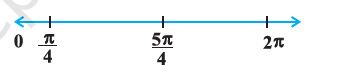
Now f'(x) = 0 gives sin x = cos x which gives that \(x=\frac{\pi}{4}, \frac{5 \pi}{4} \text { as } 0 \leq x \leq 2 \pi\)
The points \(x=\frac{\pi}{4} \text { and } x=\frac{5 \pi}{4}\) divide the interval [0, 2p] into three disjoint intervals namely,
\(\left[0, \frac{\pi}{4}\right),\left(\frac{\pi}{4}, \frac{5 \pi}{4}\right) \text { and }\left(\frac{5 \pi}{4}, 2 \pi\right]\)
\(\text {Note that } f^{\prime}(x)>0 \text {if } x \in\left[0, \frac{\pi}{4}\right) \cup\left(\frac{5 \pi}{4}, 2 \pi\right]\)
or f is increasing in the intervals \(\left[0, \frac{\pi}{4}\right) \text { and }\left(\frac{5 \pi}{4}, 2 \pi\right]\)
\(\text {Also }f^{\prime}(x)<0 \text { if } x \in\left(\frac{\pi}{4}, \frac{5 \pi}{4}\right)\)
or is plecreasing in \( \left(\frac{\pi}{4}, \frac{5 \pi}{4}\right)\)
| Interval | Sign of f'(x) | Nature of function |
| \(\left[0, \frac{\pi}{4}\right)\) | > 0 | f is increasing |
| \(\left(\frac{\pi}{4}, \frac{5 \pi}{4}\right)\) | < 0 | f is decreasing |
| \(\left(\frac{5 \pi}{4}, 2 \pi\right]\) | > 0 | f is increasing |
10.
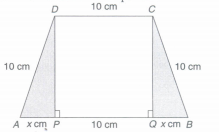
the required trapezium is as given in figure. Draw perpendiculars DP and CQ on AB. Let AP = x cm. Note that \(\Delta \)APD \(\cong \) \(\Delta \) BQC.
Therefore, QB = x cm. Also, by pythagoras theorem DP = QC = \(\sqrt { 100-{ x }^{ 2 } } \)
Let A be the area of the trapezium.
Then, A \(\equiv \) A(x)
\(=\frac { 1 }{ 2 } (sum\ of\ parallel\ sides)\times (height)\)
\(=\frac { 1 }{ 2 } (2x+10+10)\sqrt { 100-{ x }^{ 2 } } \)
= (x + 10)\(\sqrt { 100-{ x }^{ 2 } } \)
\(or\ A'(x)=(x+10)\frac { (-2x) }{ 2\sqrt { 100-{ x }^{ 2 } } } +(\sqrt { 100-{ x }^{ 2 }) } \)
\(=\frac { -2{ x }^{ 2 }-10x+100 }{ \sqrt { 100-{ x }^{ 2 } } } \)
Now, A'(x) = 0 gives 2x2 + 10x - 100 = 0,
i.e., x = 5 and x = -10
So, x = 5.
Now, A''(x) = \(\frac { \sqrt { 100-{ x }^{ 2 } } (-4x-10)-(-2x^{ 2 }-10x+100)\frac { (-2x) }{ 2\sqrt { 100-{ x }^{ 2 } } } }{ 100-{ x }^{ 2 } } \)
\(=\frac { { 2x }^{ 3 }-300x-1000 }{ { (100-{ x }^{ 2 }) }^{ \frac { 1 }{ 2 } } } \)
(on simplification)
or \(A''(5)=\frac { { 2(5) }^{ 3 }-300(5)-1,000 }{ (100-(5{ ) }^{ 2 })^{ \frac { 3 }{ 2 } } } \)
\(=\frac { -2,250 }{ 75\sqrt { 75 } } =\frac { -30 }{ \sqrt { 75 } } <0\)
Thus, area of trapezium is maximum at x = 5 and the maximum area is given by
A(5) = (5 + 10)\(\sqrt { 100-{ (5) }^{ 2 } } \)
= 15\(\sqrt { 75 } =75\sqrt { 3 } { cm }^{ 2 }\)
11.
\({ A }^{ 2 }=\left[ \begin{matrix} 2 & -1 & 1 \\ -1 & 2 & -1 \\ 1 & -1 & 2 \end{matrix} \right] \left[ \begin{matrix} 2 & -1 & 1 \\ -1 & 2 & -1 \\ 1 & -1 & 2 \end{matrix} \right] \)
\(=\left[ \begin{matrix} 4+1+1 & -2-2-1 & 2+1+2 \\ -2-2-1 & 1+4+1 & -1-2-2 \\ 2+1+2 & -1-2-2 & 1-1-4 \end{matrix} \right] \)
\(=\left[ \begin{matrix} 6 & -5 & 5 \\ -5 & 6 & -5 \\ 5 & -5 & 6 \end{matrix} \right] \)
\({ A }^{ 3 }=\left[ \begin{matrix} 2 & -1 & 1 \\ -1 & 2 & -1 \\ 1 & -1 & 2 \end{matrix} \right] \left[ \begin{matrix} 6 & -5 & 5 \\ -5 & 6 & -5 \\ 5 & -5 & 6 \end{matrix} \right] \left[ \because { A }^{ 3 }=A.{ A }^{ 2 } \right] \)
\(=\left[ \begin{matrix} 12+5+5 & -10-6-5 & 10+5+6 \\ -6-10-5 & 5+12+5 & -5-10-6 \\ 6+5+10 & -5-6-10 & 5+5+12 \end{matrix} \right] \)
\(=\left[ \begin{matrix} 22 & -21 & 21 \\ -21 & 22 & -21 \\ 21 & -21 & 22 \end{matrix} \right] \)
Now, A3- 6A2 + 9A - 4I
\(=\left[ \begin{matrix} 22 & -21 & 21 \\ -21 & 22 & -21 \\ 21 & -21 & 22 \end{matrix} \right] -6\left[ \begin{matrix} 6 & -5 & 5 \\ -5 & 6 & -5 \\ 5 & -5 & 6 \end{matrix} \right] +9\left[ \begin{matrix} 2 & -1 & 1 \\ -1 & 2 & -1 \\ 1 & -1 & 2 \end{matrix} \right] -4\left[ \begin{matrix} 1 & 0 & 0 \\ 0 & 1 & 0 \\ 0 & 0 & 1 \end{matrix} \right] I\)
\(=\left[ \begin{matrix} 0 & 0 & 0 \\ 0 & 0 & 0 \\ 0 & 0 & 0 \end{matrix} \right] =0\)(zero matrix)
\(\therefore\) A3 - 6A2 + 9A - 4I = 0
Pre-multiplying by A-1, we get
A-1A.A2 - 6A-1A.A + 9A-1A. - 4A-1I = 0
A2 - 6A + 9I - 4A-1 = 0
\(\Rightarrow\) 4A-1 = A2- 6A + 9I
\({ A }^{ -1 }=\frac { 1 }{ 4 } \left[ \begin{matrix} 3 & 1 & -1 \\ 1 & 3 & 1 \\ -1 & 1 & 3 \end{matrix} \right] \)
\(=\left[ \begin{matrix} \frac { 3 }{ 4 } & \frac { 1 }{ 4 } & -\frac { 1 }{ 4 } \\ \frac { 1 }{ 4 } & \frac { 3 }{ 4 } & \frac { 1 }{ 4 } \\ -\frac { 1 }{ 4 } & \frac { 1 }{ 4 } & \frac { 3 }{ 4 } \end{matrix} \right] \)
12.
Let ABCD be a rectangle inscribed in a given circle with centre at 0 and radius a.
Let AB = 2x and BC = 2y
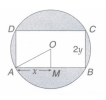
Then, OA2 = OM2 + AM2
\(\Rightarrow a^2=y^2+x^2\)
\(\Rightarrow y=\sqrt{a^2-x^2}\)
Let A be the area of the rectangle.
\(\therefore A=4xy=4x\sqrt{x^2-x^2}\)
\(\Rightarrow \ \ \frac{dA}{dx}=4\{\frac{a^2-2x^2}{\sqrt{a^2-x^2}}\}\)
For maximum or minimum value of A,
\(\frac{dA}{dx}=0\)
\(=4\{\frac{a^2-2x^2}{\sqrt{a^2-x^2}}\}=0\Rightarrow\ \ x=\frac{a}{\sqrt{2}}\)
Now, \(\frac{d^2A}{dx^2}=4\frac{d}{dx}\{(a^2-2x^2)(a^2-x^2)^{-1/2}\}\)
\(\Rightarrow \frac{d^2A}{dx^2}=4[-4x(a^2-x^2)^{-1/2}+(a^2-2x^2)\times(-1/2)(a^2-x^2)^(-3/2)(-2x)]\)
\(=[\frac{-4x}{\sqrt{a^2-x^2}}+\frac{x(a^2-2x^2)}{(a^2-x^2)^{3/2}}]\)
\(\therefore\ (\frac{d^2A}{dx^2})_{x=\frac{a}{\sqrt2}}=-16<0\)
Thus A is maximum when \(x=\frac{a}{\sqrt2}\)
putting \(x=\frac{a}{\sqrt2}\) in (i) \(y=\frac{a}{\sqrt2}\)
Therefore \(x=y=\frac{a}{\sqrt2}\)
Hence area is maximum when x = y ⇒ 2x = 2y
i.e., the rectangle is a square.
13.
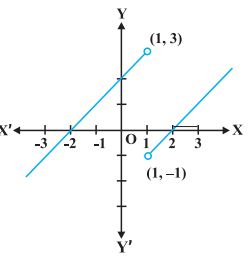
As in the example we find that f is continuous at all real numbers x \(\ne\) 1. The left hand limit of f at x = 1 is
\(\lim _{x \rightarrow 1^{-}} f(x)=\lim _{x \rightarrow 1^{-}}(x+2)=1+2=3\)
The right hand limit of f at x = 1 is
\(\lim _{x \rightarrow 1^{+}} f(x)=\lim _{x \rightarrow 1^{+}}(x-2)=1-2=-1\)
Since, the left and right hand limits of f at x = 1 do not coincide, f is not continuous at x = 1. Hence x = 1 is the only point of discontinuity of f.
14.
Given, 2A - 3B + 5C = O
\(\Rightarrow 2 A=3 B-5 C\)
\(\Rightarrow 2 A=3\left[\begin{array}{rrr}
-2 & 2 & 0 \\
3 & 1 & 4
\end{array}\right]-5\left[\begin{array}{rrr}
2 & 0 & -2 \\
7 & 1 & 6
\end{array}\right]\)
\(\Rightarrow 2 A=\left[\begin{array}{rrr}
-6 & 6 & 0 \\
9 & 3 & 12
\end{array}\right]-\left[\begin{array}{rrr}
10 & 0 & -10 \\
35 & 5 & 30
\end{array}\right]\)
\(\Rightarrow 2 A=\left[\begin{array}{rrr}
-6-10 & 6-0 & 0-(-10) \\
9-35 & 3-5 & 12-30
\end{array}\right]\)
\( \Rightarrow A=\frac{1}{2}\left[\begin{array}{rrr}
-16 & 6 & 10 \\
-26 & -2 & -18
\end{array}\right] \Rightarrow A=\left[\begin{array}{rrr}
-8 & 3 & 5 \\
-13 & -1 & -9
\end{array}\right]\)
15.
A = {1, 2, 3 ...13, 14}
R = {(x, y) : 3x - y = 0}
∴ R = {(1, 3), (2, 6), (3, 9),(4, 12)}
R is not reflexive since (1, 2), (2, 2)...(14, 14) ∉ R
Also, R is not symmetric as (1, 3) ∈R, but (3, 1) ∉ R.[3(3) - 1 ≠ 0]
Also, R is not transitive as (1, 3), (3, 9) ∈R, but (1, 9) ∉ R.
[3(1) - 9 ≠ 0]
Hence R is neither reflexive, nor symmetric, nor transitive.
16.
The area of a circle (A) with radius (r) is given by .
.
Therefore, the rate of change of area (A) with respect to time (t) is given by,
 [By chain rule]
It is given that .
.
Thus, when r = 8 cm,

Hence, when the radius of the circular wave is 8 cm, the enclosed area is increasing at the rate of 80 π cm2/s.
17.
Note that
f '(x) = 3x2 – 6x + 4
= 3(x2 – 2x + 1) + 1
= 3(x – 1)2 + 1 > 0, in every interval of R
Therefore, the function f is increasing on R.
18.
Given, \(f(x)=\left\{\begin{array}{l} a x+1, \text { if } x \leq 3 \\ b x+3, \text { if } x>3 \end{array}\right.\)
and f(x) is continuous at x = 3.
Here, a and b are two unknowns
Now, at x = 3, f(3) = a(3) + 1 = 3a + 1
\( \mathrm{LHL} =\lim _{x \rightarrow 3^{-}} f(x)=\lim _{x \rightarrow 3^{-}}(a x+1) \)
\(=\lim _{h \rightarrow 0}\{a(3-h)+1\} \text { [put } x=3- \text { ; when } x \rightarrow 3^{-} \text {then } \left.h \rightarrow 0\right]\)
\(=\lim _{h \rightarrow 0}(3 a-a h+1)=3 a+1 \)
\( \text {and } \mathrm{RHL} =\lim _{x \rightarrow 3^{+}} f(x)=\lim _{x \rightarrow 3^{+}}\{b x+3\} \)
\(=\lim _{h \rightarrow 0}\{b(3+h)+3\} \text { [put } x=3+h ; \text { when } x \rightarrow 3^{+}, \text {then } \left.h \rightarrow 0\right]\)
\(=\lim _{h \rightarrow 0}\{3 b+b h+3\}=3 b+3 \)
Since, f(x) is continuous at x = 3.
At x = 3, f(3) = LHL = RHL
\(\text { i.e. } \quad 3 a+1=3 a+1=3 b+3 \)
\(\Rightarrow 3 a+1=3 b+3 \)
\(\Rightarrow 3 a=3 b+3-1 \)
\(\Rightarrow a=\frac{(3 b+2)}{3} \Rightarrow a=b+\frac{2}{3} \)
which is the required relation between a and b
19.
\(\left\{ \frac { cosx }{ 2\sqrt { sinx } \left( 1+sinx \right) } \right\} \)
20.
(d)
(0, 2)
21.
(d)
None of these
22.
(b)
cos 2x
23.
(b)
\(\frac{1}{det(A)}\)
24.
(d)
a11 A11+ a21 A21 + a31 A31
25.
(b)
2 × n
26.
(d)
512
27.
(b)
\(\frac { 5\pi }{ 6 } \)
28.
(b)
2
29.
(d)
f is neither one-one nor onto

12th Standard CBSE Syllabus & Materials
12th Standard CBSE
CBSE 12th Computer Science Python Revision Tour I - New Previous year Question Papers Study Material - QB365 Set A
NEW12th Standard CBSE
CBSE 12th Business Studies Planning Important Questions And Answers Study Material - QB365 Set A
NEW12th Standard CBSE
CBSE 12th Business Studies Business Environment Important Questions And Answers Study Material - QB365 Set A
NEW12th Standard CBSE
CBSE 12th Business Studies Principles of Management Important Questions And Answers Study Material - QB365 Set A



NCERT Books

Syllabus

Exam Pattern

Sample Question Papers

Previous year Question Papers

Important Notes

MCQ Practice test

NCERT Exemplers

Case study Questions

Image Based Questions

Passage based Questions

HOT Questions

Value Based Questions

Model Questions Papers
NCERT ( Book Back ) Questions

Assertion and Reason
Important Questions And Answers

CBSE 12th Standard CBSE Subjects
CBSE Standards








