
 100% FREE ACCESS
12th Standard CBSE Syllabus & Materials
12th Standard CBSE
CBSE 12th Economics Government Budget and the Economy Previous year Question Papers Study Material - QB365 Set A
NEW12th Standard CBSE
CBSE 12th Computer Science Interface Python with MySQL - New Previous year Question Papers Study Material - QB365 Set A
NEW12th Standard CBSE
CBSE 12th Computer Science Database Concept - New Previous year Question Papers Study Material - QB365 Set A
NEW12th Standard CBSE
CBSE 12th Computer Science Data Communication - New Previous year Question Papers Study Material - QB365 Set A
NEW12th Standard CBSE
CBSE 12th Computer Science Data Structures - New Previous year Question Papers Study Material - QB365 Set A
NEW12th Standard CBSE
CBSE 12th Computer Science Functions - New Previous year Question Papers Study Material - QB365 Set A

Published on: 25/10/2025
Download CBSE Class 12th Standard CBSE Maths question papers, sample papers, important questions, and previous year solved papers in PDF format. Get free study materials, NCERT solutions, and exam preparation resources for Class 12th Standard CBSE Maths
Questions + Answers key
Take MCQ Maths Test
1.
Find the least value of the function \(f(x)=a x+\frac{b}{x}(a>0, b>0, x>0)\)
2.
Check whether the function \(f: R \rightarrow R\) defined by \(f(x)=x^3+x\), has any critical point/s or not?
If yes, then find the point/s.
3.
If \(f(x)=\frac{1}{4 x^2+2 x+1}, x \in R\), then find the maximum value of f(x).
4.
The total cost C(x) associated with the production of x units of an item is given by C(x) = 0.005x3 - 0.02 x2 + 30x + 5000. Find the marginal cost when 3 units are produced, where by marginal cost we mean the instantaneous rate of change of total cost at any level of output.
5.
Find the interval/s in which the function : R→R defined by f(x)=xex, is increasing.
6.
The area of the circle is increasing at a uniform rate of 2 cm2/sec. How fast is the circumference of the circle increasing when the radius r = 5 cm?
7.
Find the equation bf the tangent and normal to the curve \(16 x^{2}+9 y^{2}=144 \text { at }\left(x_{1}, y_{1}\right)\) where \(x_{1}=2 \text { and } y_{1}>0\) Also, find the points of intersection, where both "tangent and normal cuts X-axis.
8.
A stone is dropped into a quiet lake and waves moves in circles at a speed of 5 cm/ s. At the instant when the radius of the circular wave is 8 cm, how fast is the enclosed area increasing?
9.
The radius of a circle is increasing at the rate of 0.9 cm/s. What is the rate of increase of its circumference?
10.
Find the value of a if tangent to curve y = x2-ax + 7 is parallel to the line 2x - y + 9 = 0 at (- 1, 1).
11.
Prove that the area of a right angled triangle of given hypotenuse is maximum, when the triangle is isosceles.
12.
Prove that the height of the cylinder of maximum volume that can be inscribed in a sphere of radius R is \(2R\over \sqrt{3}\). Also find the maximum volume.
13.
A wire of length 34 m is to be cut into two pieces. One of the pieces is to be made into a square and the other into a rectangle whose length is twice its breadth. What should be the lengths of the two pieces, so that the combined area of the square and the rectangle is minimum?
14.
Find the value of p for which the curves \(x^{2}=9 p(9-y) \text { and } x^{2}=p(y+1)\) cuts each other at right angles.
15.
An Airforce plane is ascending vertically at the rate of 100 km/h. If the radius of the Earth is r km, then how fast is the area of the Earth visible from the plane increasing at 3 min after it started ascending? Given that the visible area A at height h is given by \(A=2 \pi r^{2} \frac{h}{r+h}\) .
16.
Show that the altitude of the right circular cone of maximum volume that can be inscribed in a sphere of radius r is \(\frac { 4r }{ 3 } \) Also show that the maximum volume of the cone is \(\frac { 8 }{ 27 } \) of the volume of the sphere.
17.
Let f(x) = \(\left|\begin{array}{cc} x^2 & \sin x \\ p & -1 \end{array}\right|\), where p is a constant. Then, the value of p for which f'(0) = 1 is
R
1
0
-1
18.
At \(x=\frac{5 \pi}{6}, f(x)=2 \sin 3 x+3 \cos 3 x\) is
maximum
minimum
zero
neither maximum nor minimum
19.
If x + y = K is normal to \(y^{2}=12 x\) then K is
3
9
-9
-3
20.
The volume of cube is increasing at the constant rate of 3cm3/s. Find the rate of change of edge of the cube when its edge is 5 cm.
25 cm3/sec
25 cm/s
1/25 cm/s
1/25 cm3/s
21.
A cylindrical tank of radius 10 m is being filled with wheat at the rate of 314 cubic metre per hour. Then the depth of the wheat is increasing at the rate of
1 m/h
0.1 m/h
1.1 m/h
0.5 m/h
22.
The point on the curve x2 = 2y which is nearest to the point (0, 5) is
(2 \(\sqrt2\),4)
(2 \(\sqrt2\),0)
(0, 0)
(2, 2)
23.
The approximate change in the volume of a cube of side x metres caused by increasing the side by 3% is
0.06 x3 m3
0.6 x3 m3
0.09 x3 m3
0.9 x3 m3
24.
The line y = x + 1 is a tangent to the curve y2 = 4x at the point
(1, 2)
(2, 1)
(1, – 2)
(– 1, 2)
25.
Which of the following functions are decreasing on 0, \(\frac{\pi}{2}\)?
cos x
cos 2x
cos 3x
tan x
26.
The point on the curve where tangent to the curve y2 = x, makes an angle of 45° clockwise with the x-axis is
\(\left( -\frac { 1 }{ 2 } ,\frac { 1 }{ 4 } \right) \)
\(\left( \frac { 1 }{ 4 } ,-\frac { 1 }{ 2 } \right) \)
(-2, 4)
(4, 2)
27.
Nitin wants to construct a rectangular plastic tank for his house that can hold 80 ft 3 of water. The top of the tank is open. The width of tank will be 5 ft but the length and heights are variables. Building the tank cost Rs.20 per sq. foot for the base and Rs. 10 per square foot for the side.
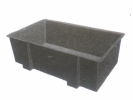
Based on the above information, answer the following questions.
(i) In order to make a least expensive water tank, Nitin need to minimize its
| (a) Volume | (b) Base | (c) Curved surface area | (d) Cost |
(ii) Total cost of tank as a function of h can' be' represented as
| (a) c(h) = 100 h - 320 - 1600lh | (b) (h) = 100 h - 320 h - 720 h2 |
| (c) c(h) = 100 + 220 h + 1600 h2 | (d) \(c(h)=100 h+320+\frac{1600}{h}\) |
(iii) Range of h is
| (a) (3,5) | (b) \((0, \infty)\) | (c) (0,8) | (d) (0,3) |
(iv) Value of h at which c(h) is minimum, is
| (a) 4 | (b) 5 | (c) 6 | (d) 6.7 |
(v) The cost ofleast expensive tank is
| (a) Rs. 1020 | (b) Rs. 1100 | (c) Rs. 1120 | (d) Rs. 1220 |
28.
A tin can manufacturer designs a cylindrical tin can for a company making sanitizer and disinfector. The tin can is made to hold 3 litres of sanitizer or disinfector.
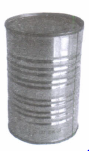
Based on the above in formation, answer the following questions.
(i) If r cm be the radius and h em be the height of the cylindrical tin can, then the surface area expressed as a function of r as
| (a) \(2 \pi r^{2}\) | (b) \(\sqrt{\frac{500}{\pi}} \mathrm{cm}\) | (c) \(\sqrt[3]{\frac{1500}{\pi}} \mathrm{cm}\) | (d) \(2 \pi r^{2}+\frac{6000}{r}\) |
(ii) The radius that will minimize the cost of the material to manufacture the tin can is
| (a) \(\sqrt[3]{\frac{600}{\pi}} \mathrm{cm}\) | (b) \(\sqrt{\frac{500}{\pi}} \mathrm{cm}\) | (c) \(\sqrt[3]{\frac{1500}{\pi}} \mathrm{cm}\) | (d) \(\sqrt{\frac{1500}{\pi}} \mathrm{cm}\) |
(iii) The height thatt will minimize the cost of the material to manufacture the tin can is
| (a) \(\sqrt[3]{\frac{1500}{\pi}} \mathrm{cm}\) | (b) \(2 \sqrt[3]{\frac{1500}{\pi}} \mathrm{cm}\) | (c) \(\sqrt{\frac{1500}{\pi}}\) | (d) \(2 \sqrt{\frac{1500}{\pi}}\) |
(iv) If the cost of material used to manufacture the tin can is Rs.100/m2 and \(\sqrt[3]{\frac{1500}{\pi}} \approx 7.8\) then minimum cost is approximately
| (a) Rs. 11.538 | (b) Rs. 12 | (c) Rs. 13 | (d) Rs. 14 |
(v) To minimize the cost of the material used to manufacture the tin can, we need to minimize the
| (a) volume | (b) curved surface area | (c) total surface area | (d) surface area of the base |
29.
Mr. Sahil is the owner of a high rise residential society having 50 apartments. When he set rent at Rs. 10000/month, all apartments are rented. If he increases rent by Rs. 250/ month, one fewer apartment is rented. The maintenance cost for each occupied unit is Rs. 500/month. Based on the above information answer the following questions.
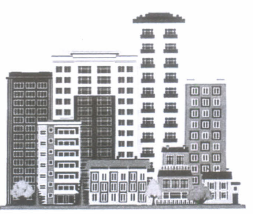
Based on the above information answer the following questions.
(i) If P is the rent price per apartment and N is the number of rented apartment, then profit is given by
| (a) NP | (b) (N - 500)P | (c) N(P - 500) | (d) none of these |
(ii) If x represent the number of apartments which are not rented, then the profit expressed as a function of x is
| (a) (50 - x) (38 + x) | (b) (50 + x) (38 - x) | (c) 250(50 - x) (38 + x) | (d) 250(50 + x) (38 - x) |
(iii) If P = 10500, then N =
| (a) 47 | (b) 48 | (c) 49 | (d) 50 |
(iv) If P = 11,000, then the profit is
| (a) Rs. 11000 | (b) Rs. 11500 | (c) Rs. 15800 | (d) Rs.16500 |
30.
An owner of an electric bi~e rental company have determined that if they charge customers Rs. x per day to rent a bike, where 50 Rs. x Rs. 200, then number of bikes (n), they rent per day can be shown by linear function n(x) = 2000 - 10x. If they charge Rs. 50 per day or less, they will rent all their bikes. If they charge Rs. 200 or more per day, they will not rent any bike. Based on the above information, answer the following questions.
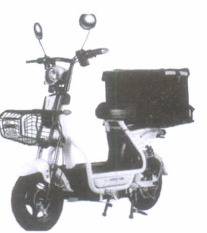
Based on the above information, answer the following questions
(i) Total revenue R as a function of x can be represented as
| (a) 2000x - 10x2 | (b) 2000x + 10x2 | (c) 2000 - 10x | (d) 2000 - 5x2 |
(ii) If R(x) denote the revenue, then maximum value of R(x) occur when x equals
| (a) 10 | (b) 100 | (c) 1000 | (d) 50 |
(iii) At x = 260, the revenue collected by the company is
| (a) Rs. 10 | (b) Rs. 500 | (c) Rs. 0 | (d) Rs. 1000 |
(iv) The number of bikes rented per day, if x = 105 is
| (a) 850 | (b) 900 | (c) 950 | (d) 1000 |
(v) Maximum revenue collected by company is
| (a) Rs. 40,000 | (b) Rs. 50,000 | (c) Rs. 75,000 | (d) Rs. 1,00,000 |
31.
The Government declare that farmers can get Rs.300 per quintal for their onions on 1st July and after that,the price will be dropped by Rs. 3 per quintal per extra day.
Shyams father has 80 quintal of onions in the field on 1st July and he estimates that crop is increasing at the rate of 1 quintal per day.
Based on the above information, answer the following questions.
(i) If x is the number of days after 1st July, then price and quantity ofonion respectively can be expressed as
| (a) Rs. (300 - 3x), (80 + x) quintals | (b) Rs. (300 - 3x), (80 - x) quintals |
| (c) Rs. (300 + x), 80 quintals | (d) None of these |
(ii) Revenue R as a function of x can be represented as
| (a) R(x) = 3x2 - 60x - 24000 | (b) R(x) = -3x2 + 60x + 24000 |
| (c) R(x) = 3x2 + 40x - 16000 | (d) R(x) = 3x2- 60x - 14000 |
(iii) Find the number of days after 1stJuly, when Shyams father attain maximum revenue.
| (a) 10 | (b) 20 | (c) 12 | (d) 22 |
(iv) On which day should Shyam's father harvest the onions to maximise his revenue?
| (a) 11thuly | (b) 20th July | (c) 12th July | (d) 22nd July |
(v) Maximum revenue is equal to
| (a) Rs. 20,000 | (b) Rs. 24,000 | (c) Rs. 24,300 | (d) Rs. 24,700 |
32.
Assertion: The minimum value of the function y = cos x in [0,2\(\pi\)] is at x = \(\pi\).
Reason: The first derivative of the function is zero at x = \(\pi\) and second derivative is negative at x = \(\pi\).
(a) Assertion is correct, Reason is correct; Reason is a correct explanation for assertion.
(b) Assertion is correct, Reason is correct; Reason is not a correct explanation for Assertion
(c) Assertion is correct, Reason is incorrect
(d) Assertion is incorrect, Reason is correct.
33.
Assertion: The maximum value of the function y = sin x in [0,2\(\pi\)] is at x = \(\frac{\pi}{2}\)
Reason: The first derivative of the function is zero at x = \(\frac{\pi}{2}\)and second derivative is negative at x = \(\frac{\pi}{2}\)
(a) Assertion is correct, Reason is correct; Reason is a correct explanation for assertion.
(b) Assertion is correct, Reason is correct; Reason is not a correct explanation for Assertion
(c) Assertion is correct, Reason is incorrect
(d) Assertion is incorrect, Reason is correct.
34.
Assertion: The ordinate of a point describing the circle x2 + y2 = 25 decreases at the rate of 1.5 cm/s.The rate of change of the abscissa of the point when ordinate equals 4 cm is 2 cm/s.
Reason: xdx + ydy = 0.
(a) Assertion is correct, Reason is correct; Reason is a correct explanation for assertion.
(b) Assertion is correct, Reason is correct; Reason is not a correct explanation for Assertion
(c) Assertion is correct, Reason is incorrect
(d) Assertion is incorrect, Reason is correct.
35.
Assertion: f(x) = cos2 x + cos3 \(\left ( x+\frac{\pi}{3} \right )\)-cos xcos3 \(\left ( x+\frac{\pi}{3} \right )\)then f'(x) = 0
Reason: Derivative of constant function is zero.
(a) Assertion is correct, Reason is correct; Reason is a correct explanation for assertion.
(b) Assertion is correct, Reason is correct; Reason is not a correct explanation for Assertion
(c) Assertion is correct, Reason is incorrect
(d) Assertion is incorrect, Reason is correct.
36.
Assertion: The curves x = y2 and xy = k cut at right angle, if 8k2 =1.
Reason: Two curves intersect at right angle, if the tangents to the curves at the point of intersection are perpendicular to each other i.e., product of their slope is -1.
(a) Assertion is correct, Reason is correct; Reason is a correct explanation for assertion.
(b) Assertion is correct, Reason is correct; Reason is not a correct explanation for Assertion
(c) Assertion is correct, Reason is incorrect
(d) Assertion is incorrect, Reason is correct.
1.
We have, \(f(x)=a x+\frac{b}{x}(a>0, b>0, x>0)\)
\(\therefore \quad f^{\prime}(x)=a-\frac{b}{x^2}\) and \(f^{\prime \prime}(x)=\frac{2 b}{x^3}\)
For maxima and minima of f(x),
\(f^{\prime}(x) =0 \)
\(\Rightarrow a-\frac{b}{x^2} =0\)
\(\Rightarrow x^2 =\frac{b}{a} \)
\(\Rightarrow x =\sqrt{\frac{b}{a}} \quad[\because x>0(\text { given })]\)
Again, \(f^{\prime \prime}\left(\sqrt{\frac{b}{a}}\right)=\frac{2 b}{\left(\frac{b}{a}\right)^{3 / 2}}=\frac{2 a^{3 / 2}}{\sqrt{b}}>0\) \([\because a>0, b>0]\)
So, f(x) has least value at \(x=\sqrt{\frac{b}{a}}\)
\(\therefore f_{\min }(x) =f\left(\sqrt{\frac{b}{a}}\right)=a \sqrt{\frac{b}{a}}+\frac{b}{\sqrt{\frac{b}{a}}} \)
\( =\sqrt{a b}+\sqrt{a b}=2 \sqrt{a b}\)
2.
Given, $f(x)=x^3+x, \forall x \in R$
On differentiating w.r.t. x, we get
\( f^{\prime}(x)=3 x^2+1 \)
\(\because x^2>0, \forall x \in R\)
\(\therefore f^{\prime}(x)\) can never be zero or undefined, \(\forall x \in R\).
\(\Rightarrow \quad f^{\prime}(x)>0\)
Hence, no critical point exists.
3.
Given, \(f(x)=\frac{1}{4 x^2+2 x+1}\)
On differentiating w.r.t. x, we get
\(f^{\prime}(x)=\frac{0-1(8 x+2)}{\left(4 x^2+2 x+1\right)^2}\)
For maxima or minima, we put
\( f^{\prime}(x) =0\)
\(\Rightarrow 8 x+2 =0\)
\(\Rightarrow x =-\frac{1}{4}\)
Again, differentiating Eq. (i) w.r.t. x, we get
\( -8\left(4 x^2+2 x+1\right)^2+(8 x+2) \times 2\)
\(f^{\prime \prime}(x)=\frac{\left(4 x^2+2 x+1\right)(8 x+2)}{\left(4 x^2+2 x+1\right)^4}\)
At \(x=\frac{-1}{4}, f^{\prime \prime}\left(\frac{-1}{4}\right)<0\)
\(\Rightarrow f(x)\) is maximum at \(x=\frac{-1}{4}\)
Therefore Maximum value of f(x) is
\(f\left(\frac{-1}{4}\right)=\frac{1}{4\left(\frac{-1}{4}\right)^2+2\left(\frac{-1}{4}\right)+1}=\frac{1}{\frac{1}{4}+\frac{1}{2}}=\frac{4}{3}\)
4.
We have, \(C(x)=0.005 x^3-0.02 x^2+30 x+5000\) Clearly, the marginal cost, MC \((x)=\frac{d}{d x} C(x)\)
\(=\frac{d}{d x}\left(0.005 x^3-0.02 x^2+30 x+5000\right) \)
\(=0.005 \times 3 x^2-0.02 \times 2 x+30+0 \)
\(=0015 x^2-0.04 x+30\)
Now, marginal cost when 3 units are produced
\(=\mathrm{MC}(3)=0.015(9)-0.04(3)+30\)
=0.135-0.12+30=30.015
5.
Given, f(x) = xex
On differentiating w.r.t. x, we get
\(f^{\prime}(x)=x e^x+e^x=e^x(x+1)\)
For f(x) to be increasing, we have
Hence, the required interval, where f(x) increases is [-1, \(\infty\)).
\( f^{\prime}(x)=e^x(x+1) \geq 0\)
\( \Rightarrow \quad x \geq-1 \text { as } e^x>0, \forall x \in R\)
6.
Let r be the radius of the circle, A be the area and C be the circumference at any time t.
Then, A = \(\pi\)r2 and C = 2 \(\pi\)r
It is given that \(\frac{d A}{d t}=2 \mathrm{~cm}^2 / \mathrm{s}\)
\(\begin{aligned} \Rightarrow & \frac{d}{d t}\left(\pi r^2\right) =2 \end{aligned}\)
\(\begin{aligned} \Rightarrow & 2 \pi r \cdot \frac{d r}{d t} =2 \end{aligned}\)
\(\begin{aligned} \Rightarrow & \frac{d r}{d t}=\frac{1}{\pi r} \end{aligned}\)
Now, C = 2 \(\pi\)r
\(\begin{aligned} \Rightarrow \quad \frac{d C}{d t} & =2 \pi \cdot \frac{d r}{d t} \end{aligned}\)
\(\begin{aligned} =2 \pi \times \frac{1}{\pi r} \end{aligned}\)
\(\begin{aligned} \Rightarrow \quad \frac{d C}{d t} & =\frac{2}{r} \end{aligned}\)
\(\begin{aligned} \Rightarrow \quad\left(\frac{d C}{d t}\right)_{r=5} & =\frac{2}{5} \mathrm{~cm} / \mathrm{s} \end{aligned}\)
7.
Equation of tangent is \(8 x+3 \sqrt{5} y=36\) meet at X-axis at \(\left(\frac{9}{2}, 0\right)\) and equation of normal is \(24 y-9 \sqrt{5} x=14 \sqrt{5}\) meet X-axis at \(\left(-\frac{14}{9}, 0\right)\)
8.
The area of a circle (A) with radius (r) is given by .
.
Therefore, the rate of change of area (A) with respect to time (t) is given by,
 [By chain rule]
It is given that .
.
Thus, when r = 8 cm,

Hence, when the radius of the circular wave is 8 cm, the enclosed area is increasing at the rate of 80 π cm2/s.
9.
1.8πcm/s
10.
Given, \(y=x^2-ax+7\)
\(\Rightarrow \frac{dy}{dx}=2x-a\)
\(m_1=2x-a\)
Line \(2x-y+9=0\)
\(\Rightarrow 2-\frac{dy}{dx}=0\)
\(\Rightarrow \frac{dy}{dx}=2=m_2\)
for parallel, \(m_1=m_2\)
\(\therefore 2x-a=2\)
\(\Rightarrow 2(-1)-a=2\)
\(\Rightarrow -2-2=a\)
\(\Rightarrow a=-4\)
11.
Let a and b be the sides of right angled triangle and c be the hypotenuse.
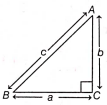
From \(\triangle A B C\), we have
\(c^2=a^2+b^2\)
Area of \(\triangle A B C,(A)=\frac{1}{2} a \cdot b=\frac{1}{2} a \sqrt{c^2-a^2}\)
\(\left[\because b=\sqrt{c^2-a^2}\right]\)
On differentiating both sides w.r.t. a, we get
\(\frac{d A}{d a} =\frac{1}{2} \cdot 1 \cdot \sqrt{c^2-a^2}+\frac{1}{2} \cdot a \cdot \frac{1}{2} \cdot \frac{(-2 a)}{\sqrt{c^2-a^2}} =\frac{1}{2}\left(\sqrt{c^2-a^2}-\frac{a^2}{\sqrt{c^2-a^2}}\right)\)
For maxima or minima, put \(\frac{d A}{d a}=0\)
\( \Rightarrow \frac{1}{2}\left(\sqrt{c^2-a^2}-\frac{a^2}{\sqrt{c^2-a^2}}\right)=0 \Rightarrow c^2-a^2-a^2=0 \)
\( \Rightarrow \quad c^2=2 a^2 \Rightarrow a=\frac{c}{\sqrt{2}}\)
\(\text { Now, } \quad \frac{d^2 A}{d a^2}=\frac{1}{2}\left[\frac{-a}{\sqrt{c^2-a^2}}-\frac{a^3}{\left(c^2-a^2\right)^{3 / 2}}\right]\)
\(=-\frac{1}{2} a\left[\frac{c^2-a^2+a^2}{\left(c^2-a^2\right)^{3 / 2}}\right] \)
\(=-\frac{1}{2} \frac{c^2 a}{\left(c^2-a^2\right)^{3 / 2}}<0\)
\(\therefore\) Area of \(\triangle A B C\) is maximum and
\(b=\sqrt{c^2-a^2}=\sqrt{2 a^2-a^2}=a\)
Hence, the triangle is isosceles.
Hence proved.
12.
Let we have a sphere of radius R and a cylinder is inscribed in it. EB = r be the radius of the cylinder and BC = h be the height of cylinder.
In right angled \(\Delta A B C\) we have
\((A C)^{2}=(A B)^{2}+(B C)^{2}\) [using Pythagoras theorem]
\(\Rightarrow(2 R)^{2}=(2 r)^{2}+h^{2} \Rightarrow 4 R^{2}=4 r^{2}+h^{2} \)
\(\Rightarrow \cdot r^{2}=\frac{1}{4}\left(4 R^{2}-h^{2}\right) \)
volume of cylinder \(V=\pi r^{-2} h\)
\(\Rightarrow V=\pi\left[\frac{1}{4}\left(4 R^{2}-h^{2}\right)\right] h\)
\(\Rightarrow V=\frac{\pi}{4}\left(4 R^{2} h-h^{3}\right)\) ...(ii)
On differentiating V w.r.t. II, we get
\(\frac{d V}{d h}=\frac{\pi}{4}\left(4 R^{2}-3 h^{2}\right)\)
For maxima or minima put \(\frac{d V}{d h}=0\)
\(\Rightarrow \frac{\pi}{4}\left(4 R^{2}-3 h^{2}\right)=0 \Rightarrow 4 R^{2}=3 h^{2}\)
\(\Rightarrow h=\frac{2 R}{\sqrt{3}} \ [\because \text { height cannot be negative }] \)
On differentiating both sides of Eq. (iii) w.r.t. h, we get
\( \frac{d^{2} V}{d h^{2}} =-\frac{3}{2} \pi h \)
\(\text { At } h=\frac{2 R}{\sqrt{3}}, \frac{d^{2} V}{d h^{2}} =-\frac{3}{2} \pi \times \frac{2 R}{\sqrt{3}}=-\sqrt{3} \pi R<0[\because R>0] \)
\(\therefore\) Volume of cylinder is maximum at \(h=\frac{2 R}{\sqrt{3}}\)
From Eq. (i), we get \(r^{2}=\frac{1}{4}\left(4 R^{2}-\frac{4 R^{2}}{3}\right)=\frac{2 R^{2}}{3}\)
\(\therefore\) Volume of largest cylinder inscribed in a sphere,
\( V =\pi\left(\frac{2 R^{2}}{3}\right) \times \frac{2 R}{\sqrt{3}} \)
\(=\frac{1}{\sqrt{3}} \times\left(\frac{4}{3} \pi R^{3}\right) \)
\(=\frac{1}{\sqrt{3}} \times \text { Volume of sphere } \)
Hence, height of the cylinder of maximum volume is \(\frac{2 R}{\sqrt{3}}\)
and volume of largest cylinder inscribed in sphere is \(\frac{1}{\sqrt{3}}\) times volume of sphere.
13.
Let wire is cut at x m and made into a rectangle,
whose breadth is a and length 2a.
For rectangle,
\(\therefore 2(a+2 a)=x \Rightarrow 6 a=x \)
\(\Rightarrow a=\frac{x}{6} \mathrm{~m} \)
\(\therefore \text { Area of rectangle }=a(2 a)=2 a^{2}=2\left(\frac{x}{6}\right)^{2}=\frac{x^{2}}{18} \)
For square,
\(4 \times \text { side }=(34-x) \Rightarrow \text { side }=\frac{34-x}{4} \mathrm{~m} \)
\(\therefore \text { Area of square }=\frac{1}{16}(34-x)^{2}\)
\(\text { Combined area }(A)=\frac{x^{2}}{18}+\frac{1}{16}(34-x)^{2} \)
\(\frac{d A}{d x} =\frac{2 x}{18}+\frac{2}{16}(34-x) \cdot(-1) \)
\(=\frac{x}{9}-\left(\frac{34-x}{8}\right)=\frac{8 x-306+9 x}{72} \)
\(\frac{d A}{d x} =\frac{17 x-306}{72}\)
\(\text { For minimum area, } \frac{d A}{d x}=0\)
\(\Rightarrow 17 x-306=0 \)
\(\Rightarrow x=\frac{306}{17}=18 \)
\(\frac{d^{2} A}{d x^{2}} =\frac{17}{72} \)
\(\left.\frac{d^{2} A}{d x^{2}}\right|_{x=18} =\frac{17}{72}>0\)
For x = 18, A is minimum. Hence, wire must be cut at 18 m to made into a rectangle and remaining 16 m piece to made into a square for a minimum combined area.
14.
p=4
15.
Given, \(\frac{d h}{d t}=100 \mathrm{~km} / \mathrm{h}, \text { then find } \frac{d A}{d t}\)
Height of the plane after 3 rnin \(100 \times \frac{3}{60}=5 \mathrm{~km}\)
\(\frac{200 \pi r^{3}}{(r+5)^{2}}\)
16.
Let radius of cone be x and its height be h.
\(\therefore\) OD = (h - r)
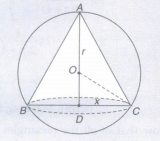
Volume of cone (V)
\(=\frac { 1 }{ 3 } \pi { x }^{ 2 }h\) ...(i)
In \(\Delta OCD,\quad { x }^{ 2 }+({ h-r) }^{ 2 }={ r }^{ 2 }or\quad { x }^{ 2 }={ r }^{ 2 }-{ (h-r) }^{ 2 }\)
\(\therefore V=\frac { 1 }{ 3 } \pi h\{ { r }^{ 2 }-(h-r{ ) }^{ 2 }\} \)
\(=\frac { 1 }{ 3 } \pi (-{ h }^{ 3 }+{ 2h }^{ 2 }r)\)
\(\Rightarrow \frac { dV }{ dh } =\frac { \pi }{ 3 } (-3{ h }^{ 2 }+4hr)\)
\(\therefore \quad \frac { dV }{ dh } =0\Rightarrow h=\frac { 4r }{ 3 } \)
\(\frac { { d }^{ 2 }V }{ { dh }^{ 2 } } =\frac { \pi }{ 3 } (-6h+4r)\)
\(=\frac { \pi }{ 3 } \left( -6\left( \frac { 4r }{ 3 } \right) +4r \right) \)
\(=-\frac { 4\pi r }{ 3 } <0\)
\(\therefore \ at\quad h=\frac { 4r }{ 3 } \), Volume is maximum
Maximum volume
\(=\frac { 1 }{ 3 } \pi .\left\{ -{ \left( \frac { 4r }{ 3 } \right) }^{ 3 }+2{ \left( \frac { 4r }{ 3 } \right) }^{ 2 }r \right\} \)
\(=\frac { 8 }{ 27 } .\left( \frac { 4 }{ 3 } \pi { r }^{ 3 } \right) \)
\(=\frac { 8 }{ 27 } \) (volume of sphere)
17.
(d)
-1
18.
(b)
minimum
19.
We have,\(y^{2}=12 x \Rightarrow 2 y \frac{d y}{d x}=12\)
\(\Rightarrow \quad \frac{d y}{d x}=\frac{6}{y}\)
Let x + y = K be normal to y2 = 12x at point P(x1, y1) then
\(\begin{array}{l}
\left(\frac{-1}{d y / d x}\right)_{\text {at } p}=(\text { Slope of the line } x+y=K) \\
\Rightarrow \quad-\frac{y_{1}}{6}=-1 \Rightarrow y_{1}=6
\end{array}\)
Since, (x1 yI) lies on l = 12x, therefore
\(
y_{1}^{2}=12 x_{1} \Rightarrow 12 x_{1}=36 \\
\Rightarrow x_{1}=3
\)
Also P( x1 y1) lies on x + y = K, therefore
\(x_{1}+y_{1}=K \Rightarrow K=9\)
20.
(c)
1/25 cm/s
21.
(a)
1 m/h
22.
(a)
(2 \(\sqrt2\),4)
23.
(c)
0.09 x3 m3
24.
(a)
(1, 2)
25.
(b)
cos 2x
26.
As 2y \(\frac{dy}{dx}\) = 1
⇒\(\frac{dy}{dx}=\frac{1}{2y}\) (slope of tangent)
⇒ \(\frac{1}{2y}\) = tan(-45o)
⇒ y = \(-\frac{1}{2}\) ⇒ x = \(\frac14\)
∴ Point as \(\left( \frac { 1 }{ 4 } ,-\frac { 1 }{ 2 } \right) \)
27.
(i) (d) : In order to make least expensive water tank, Nitin need to minimize its cost.
(ii) (d) : Let 1ft be the length and h ft be the height of the tank. Since breadth is equal to 5 ft. (Given)
\(\therefore\) Two sides will be 5h sq. feet and two sides will be
1h sq. feet. So, the total area of the sides is (10 h + 2 1h)ft2
Cost of the sides is Rs.10 per sq. foot. So, the cost to build the sides is (10h + 21h) x 10 = Rs.(100h + 20lh)
Also, cost of base = (5l) x 20 = Rs. 100 l
\(\therefore\) Total cost of the tank in Rs. is given by
c = 100 h + 20 I h + 100 l
Since, volume of tank = 80ft3
\(\therefore \quad 5 l h=80 \mathrm{ft}^{3} \quad \therefore l=\frac{80}{5 h}=\frac{16}{h}\)
\(\therefore \quad c(h)=100 h+20\left(\frac{16}{h}\right) h+100\left(\frac{16}{h}\right)\)
\(=100 h+320+\frac{1600}{h}\)
(iii) (b) : Since, all side lengths must be positive
\(\therefore \quad h>0\) and \(\frac{16}{h}>0\)
Since, \(\frac{16}{h}>0, \text { whenever } h>0\)
\(\therefore \text { Range of } h \text { is }(0, \infty)\)
(iv) (a) : To minimize cost, \(\frac{d c}{d h}=0\)
\(\Rightarrow \quad 100-\frac{1600}{h^{2}}=0\)
\(\Rightarrow 100 h^{2}=1600 \Rightarrow h^{2}=16 \Rightarrow h=\pm 4\)
\(\Rightarrow h=4\) [\(\therefore\) height can not be negative]
(v) (c) : Cost of least expensive tank is given by
\(c(4)=400+320+\frac{1600}{4}\)
= 720 + 400 = Rs. 1120
28.
(i) (d) : Given, r cm is the radius and h cm is the height of required cylindrical can
Given that, volume = 3 l= 3000 cm3 \(\left(\because 1 l=1000 \mathrm{~cm}^{3}\right)\)
\(\Rightarrow \pi r^{2} h=3000 \Rightarrow h=\frac{3000}{\pi r^{2}}\)
Now, the surface area, as a function of r is given by
\(S(r)=2 \pi r^{2}+2 \pi r h=2 \pi r^{2}+2 \pi r\left(\frac{3000}{\pi r^{2}}\right)\)
\(=2 \pi r^{2}+\frac{6000}{r}\)
(ii) (c) : Now, \(S(r)=2 \pi r^{2}+\frac{6000}{r}\)
\(\Rightarrow S^{\prime}(r)=4 \pi r-\frac{6000}{r^{2}}\)
To find criti£al points, put S'(r) = 0
\(\Rightarrow \frac{4 \pi r^{3}-6000}{r^{2}}=0\)
\(\Rightarrow r^{3}=\frac{6000}{4 \pi} \Rightarrow r=\left(\frac{1500}{\pi}\right)^{1 / 3}\)
Also, \(\left.S^{\prime \prime}(r)\right|_{r=} \sqrt[3]{\frac{1500}{\pi}}=4 \pi+\frac{12000 \times \pi}{1500}\)
\(=4 \pi+8 \pi=12 \pi>0\)
Thus, the critical point is the point of minima.
(iii) (b) : The cost of material for the tin can is minimized when \(r=\sqrt[3]{\frac{1500}{\pi}} \mathrm{cm}\) and the height is \(\frac{3000}{\pi\left(\sqrt[3]{\frac{1500}{\pi}}\right)^{2}}=2 \sqrt[3]{\frac{1500}{\pi}} \mathrm{cm} .\) .
(iv) (a) : We have,minimum surface area = \(\frac{2 \pi r^{3}+6000}{r}\) .
\(=\frac{2 \pi \cdot \frac{1500}{\pi}+6000}{\sqrt[3]{\frac{1500}{\pi}}}=\frac{9000}{7.8}=1153.84 \mathrm{~cm}^{2}\)
Cost of 1 m2 material = Rs.100
\(\therefore \ \text { Cost of } 1 \mathrm{~cm}^{2} \text { material }=Rs. \frac{1}{100}\)
\(\therefore \ \text { Minimum cost }=Rs. \frac{1153.84}{100}=Rs. 11.538\)
(v) (c) : To minimize the cost we need to minimize the total surface area.
29.
(i) (c) : If P is the rent price per apartment and N is the number of rented apartment, the profit is given by
NP - 500 N = N(P- 500)
[\(\therefore\)Rs. 500/month is the maintenance charges for each occupied unit]
(ii) (c) : Now, if x be the number of non-rented apartments, then N= 50 - x and P = 10000 + 250 x Thus, profit = N(P- 500) = (50 - x ) (10000 + 250x - 500
= (50 - x) (9500 + 250 x) = 250(50 - x) (38 + x)
(iii) (b) : Clearly, if P = 10500, then
\(10500=10000+250 x \Rightarrow x=2 \Rightarrow N=48\)
(iv) (a) : Also, if P = 11000, then
\(11000=10000+250 x \Rightarrow x=4\) and so profit
(v) (b) : We have, P(x) = 250(50 - x) (38 + x)
Now, P'(x) = 250[50 - x - (38 + x)] = 250[12 - 2x]
For maxima/minima, put P'(x) = 0
\(\Rightarrow 12-2 x=0 \Rightarrow x=6\)
Thus, price per apartment is, P = 10000 + 1500 = 11500
Hence, the rent that maximizes the profit is Rs. 11500.
30.
(i) (a) : Let x be the charges per bike per day and n be the number of bikes rented per day.
R(x) = n x x = (2000 - lOx) x = -10x2 + 2000x
(ii) (b) : We have, R(x) = 2000x - 10x2
\(\Rightarrow R^{\prime}(x)=2000-20 x\)
For R(x) to be maximum or minimum, R'(x) = 0
\(\Rightarrow 2000-20 x=0 \Rightarrow x=100\)
Also,\(R^{\prime \prime}(x)=-20<0\)
Thus, R(x) is maximum at x = 100
(iii) (c) : If company charge ~ 200 or more, they will not rent any bike. Therefore, revenue collected by him will be zero.
(iv) (c) : If x = 105, number of bikes rented per day is given by
n = 2000 - 10 x 105 = 950
(v) (d) : At x = 100, R(x) is maximum
\(\therefore\) Maximum revenue = R(100)
= -10(100)2 + 2000(100) = Rs. 1,00,000
31.
(i) (a) : Let x be the number of extra days after 1st July.
\(\therefore\) Price = Rs.(300 - 3Xx) = Rs.(300 - 3x)
Quantity = 80 quintals + x(1 quintal per day)
= (80 + x) quintals
(ii) (b) : R(x) = Quantity x Price
= (80 + x) (300 - 3x) = 24000 - 240x + 300x -3x2
= 24000 + 60x - 3x2
(iii) (a) : We have, R(x) = 24000 + 60x - 3x2
\(\begin{equation} \Rightarrow R^{\prime}(x)=60-6 x \Rightarrow R^{\prime \prime}(x)=-6 \end{equation}\)
For R(x) to be maximum, R'(x) = 0 and R"(x) < 0
\(\begin{equation} \Rightarrow 60-6 x=0 \Rightarrow x=10 \end{equation}\)
(iv) (a) : Shyams father will attain maximum revenue after 10 days.
So, he should harvest the onions after 10 days of 1st July i.e., on 11th July.
(v) (c) : Maximum revenue is collected by Shyams father when x = 10
\(\therefore\) Maximum revenue = R(10)
= 24000 + 60(10) - 3(10)2 = 24000 + 600 - 300 = 24300
32.
(c) Assertion is correct, Reason is incorrect
33.
(a) Assertion is correct, Reason is correct; Reason is a correct explanation for assertion.
34.
(b) Assertion is correct, Reason is correct; Reason is not a correct explanation for Assertion
35.
(a) Assertion is correct, Reason is correct; Reason is a correct explanation for assertion.
36.
(a) Assertion is correct, Reason is correct; Reason is a correct explanation for assertion.

12th Standard CBSE Syllabus & Materials
12th Standard CBSE
CBSE 12th Computer Science Python Revision Tour I - New Previous year Question Papers Study Material - QB365 Set A
NEW12th Standard CBSE
CBSE 12th Business Studies Planning Important Questions And Answers Study Material - QB365 Set A
NEW12th Standard CBSE
CBSE 12th Business Studies Business Environment Important Questions And Answers Study Material - QB365 Set A
NEW12th Standard CBSE
CBSE 12th Business Studies Principles of Management Important Questions And Answers Study Material - QB365 Set A



NCERT Books

Syllabus

Exam Pattern

Sample Question Papers

Previous year Question Papers

Important Notes

MCQ Practice test

NCERT Exemplers

Case study Questions

Image Based Questions

Passage based Questions

HOT Questions

Value Based Questions

Model Questions Papers
NCERT ( Book Back ) Questions

Assertion and Reason
Important Questions And Answers

CBSE 12th Standard CBSE Subjects
CBSE Standards








