
 100% FREE ACCESS
12th Standard CBSE Syllabus & Materials
12th Standard CBSE
CBSE 12th Economics Government Budget and the Economy Previous year Question Papers Study Material - QB365 Set A
NEW12th Standard CBSE
CBSE 12th Computer Science Interface Python with MySQL - New Previous year Question Papers Study Material - QB365 Set A
NEW12th Standard CBSE
CBSE 12th Computer Science Database Concept - New Previous year Question Papers Study Material - QB365 Set A
NEW12th Standard CBSE
CBSE 12th Computer Science Data Communication - New Previous year Question Papers Study Material - QB365 Set A
NEW12th Standard CBSE
CBSE 12th Computer Science Data Structures - New Previous year Question Papers Study Material - QB365 Set A
NEW12th Standard CBSE
CBSE 12th Computer Science Functions - New Previous year Question Papers Study Material - QB365 Set A

Published on: 25/10/2025
Download CBSE Class 12th Standard CBSE Maths question papers, sample papers, important questions, and previous year solved papers in PDF format. Get free study materials, NCERT solutions, and exam preparation resources for Class 12th Standard CBSE Maths
Questions + Answers key
Take MCQ Maths Test
1.
Find the absolute maximum value and the absolute minimum value of the following functions in the given intervals: \(f(x)=\sin x+\cos x, x \in[0, \pi]\)
2.
Show that the right circular cylinder of given volume open at the top has minimum total surface area,provided its height is equal to radius of its base.
3.
Find intervals in which the function given by
\(f(x)=\frac{3}{10} x^4-\frac{4}{5} x^3-3 x^2+\frac{36}{5} x+11\)
is (a) increasing (b) decreasing
4.
Prove that \(y={4sin\theta\over2+cos\theta}-\theta\) is an increasing function of \(\theta\) in \([0,{\pi\over2}]\).
5.
Without using derivatives, find the maximum and minimum value of the function f(x) = cos 2x - 6sin x - 3.
6.
A balloon which always remains spherical is being inflated by pumping in gas at the rate of 800 cm3/s. Find the rate at which the radius of the balloon is increasing, when the radius is 20cm.
7.
A stone is dropped into a quiet lake and waves moves in circles at a speed of 5 cm/ s. At the instant when the radius of the circular wave is 8 cm, how fast is the enclosed area increasing?
8.
Show that the function f given by \(f(x)=x^{3}-3 x^{2}+4 x, x \in R\) is strictly increasing on R.
9.
Find the least value of a such that the function f(x)=x+ax+1 is strictly increasing on(1,2).
10.
Prove that,the function f(x)=x3-3x2+3x+107 is increasing on R.
11.
Find-the intervals in which the function f given by \(f(x)=\sin x+\cos x, 0 \leq x \leq 2 \pi\) is strictly increasing or strictly decreasing.
12.
Find the intervals in which the following function is strictly increasing or strictly decreasing.
\(f(x)=\frac{3}{10} x^{4}-\frac{4}{5} x^{3}-3 x^{2}+\frac{36 x}{5}+11\)
13.
Show that of all the rectangles inscribed in a given fixed circle, the square has the maximum area.
14.
Which of the following function is decreasing on \(\left(0, \frac{\pi}{2}\right)?\)
cos x
-cos 2x
cos 3x
tan x
15.
The functin f(x) = xx has a stationary point at
x =e
\(x=\frac{1}{e}\)
x = 1
\(x=\sqrt{e}\)
16.
The function \(f(x)=4 \sin ^{3} x-6 \sin ^{2} x+12 \sin x\) + 100 is strictly
increasing in \(\left(\pi, \frac{3 \pi}{2}\right)\)
decreasing in \(\left(\frac{\pi}{2}, \pi\right)\)
decreasing in \(\left[\frac{-\pi}{2}, \frac{\pi}{2}\right]\)
decreasing in \(\left[0, \frac{\pi}{2}\right]\)
17.
A cylindrical tank of radius 10 m is being filled with wheat at the rate of 314 cubic metre per hour. Then the depth of the wheat is increasing at the rate of
1 m/h
0.1 m/h
1.1 m/h
0.5 m/h
18.
The maximum value of \({ [x(x-1)+1] }^{ \frac { 1 }{ 3 } }\), \(0\le x\le 1\) is
\({ \left( \frac { 1 }{ 3 } \right) }^{ \frac { 1 }{ 3 } }\)
\(\frac { 1 }{ 2 } \)
1
0
19.
Which of the following functions are decreasing on 0, \(\frac{\pi}{2}\)?
cos x
cos 2x
cos 3x
tan x
20.
Megha wants to prepare a handmade gift box for her friend's birthday at home. For making lower part of box, she takes a square piece of cardboard of side 20 cm.
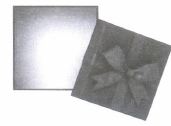
Based on the above information, answer the following questions.
(i) If x cm be the length of each side of the square cardboard which is to be cut off from corners of the square piece of side 20 cm, then possible value of x will be given by the interval
| (a) [0, 20] | (b) (0, 10) | (c) (0, 3) | (d) None of these |
(ii) Volume of the open box formed by folding up the cutting corner can be expressed as
| (a) V = x(20 - 2x)(20 - 2x) | (b) \(\begin{equation} V=\frac{x}{2}(20+x)(20-x) \end{equation}\) |
| (c) \(\begin{equation} V=\frac{x}{3}(20-2 x)(20+2 x) \end{equation}\) | (d) V = x(20 - 2x)(20 - x) |
(iii) The values of x for which \(\begin{equation} \frac{d V}{d x}=0 \end{equation}\) ,are
| (a) 3, 4 | (b) \(\begin{equation} 0, \frac{10}{3} \end{equation}\) | (c) 0, 10 | (d) \(\begin{equation} 10, \frac{10}{3} \end{equation}\) |
(iv) Megha is interested in maximising the volume of the box. So, what should be the side of the square to be cut off so that the volume of the box is maximum?
| (a) 12 cm | (b) 8 cm | (c) \(\begin{equation} \frac{10}{3} \mathrm{~cm} \end{equation}\) | (d) 2 cm |
(v) The maximum value of the volume is
| (a) \(\begin{equation} \frac{17000}{27} \mathrm{~cm}^{3} \end{equation}\) | (b) \(\begin{equation} \frac{11000}{27} \mathrm{~cm}^{3} \end{equation}\) | (c) \(\begin{equation} \frac{8000}{27} \mathrm{~cm}^{3} \end{equation}\) | (d) \(\begin{equation} \frac{16000}{27} \mathrm{~cm}^{3} \end{equation}\) |
21.
Assertion: The minimum value of the function y = cos x in [0,2\(\pi\)] is at x = \(\pi\).
Reason: The first derivative of the function is zero at x = \(\pi\) and second derivative is negative at x = \(\pi\).
(a) Assertion is correct, Reason is correct; Reason is a correct explanation for assertion.
(b) Assertion is correct, Reason is correct; Reason is not a correct explanation for Assertion
(c) Assertion is correct, Reason is incorrect
(d) Assertion is incorrect, Reason is correct.
22.
Assertion: If two positive numbers are such that sum is 16 and sum of their cubes is minimum, then numbers are 8,8.
Reason: If f be a function defined on an interval I and c \(\in\)I and let f be twice differentiable at c, then x = c is a point of local minima if f'(c) = 0 and f''(c) > 0 and f(c) is local minimum value of f.
(a) Assertion is correct, Reason is correct; Reason is a correct explanation for assertion.
(b) Assertion is correct, Reason is correct; Reason is not a correct explanation for Assertion
(c) Assertion is correct, Reason is incorrect
(d) Assertion is incorrect, Reason is correct.
1.
The given function is f(x) = sin x + cos x.
\(\therefore f^{\prime}(x)=\cos x-\sin x\)
\(\text { Now, }f^{\prime}(x)=0 \Rightarrow \sin x=\cos x \Rightarrow \tan x=1 \Rightarrow x=\frac{\pi}{4}\)
Then, we evaluate the value of f at critical point and at the end points\(x=\frac{\pi}{4}\) of the interval [0, π].
\(f\left(\frac{\pi}{4}\right)=\sin \frac{\pi}{4}+\cos \frac{\pi}{4}=\frac{1}{\sqrt{2}}+\frac{1}{\sqrt{2}}=\frac{2}{\sqrt{2}}=\sqrt{2} \)
\(f(0)=\sin 0+\cos 0=0+1=1 \)
\(f(\pi)=\sin \pi+\cos \pi=0-1=-1 \)
Hence, we can conclude that the absolute maximum value of f on [0, π] is \(\sqrt{2}\) occurring at \(x=\frac{\pi}{4}\)and the absolute minimum value of f on [0, π] is −1 occurring at x = π.
2.
Let r and h be the radius and height of the cylinder respectively.
Then, the surface area (S) of the cylinder is given by
\(S= 2 \pi r^{2}+2 \pi r h \)
\(\Rightarrow h =\frac{S-2 \pi r^{2}}{2 \pi r} \)
\(=\frac{S}{2 \pi}\left(\frac{1}{r}\right)-r \)
Let V be the volume of the cylinder. Then,
\(V=\pi r^{2} h=\pi r^{2}\left[\frac{S}{2 \pi}\left(\frac{1}{r}\right)-r\right]=\frac{S r}{2}-\pi r^{3} \)
\(\text { Then, } \frac{d V}{d r}=\frac{S}{2}-3 \pi r^{2}, \frac{d^{2} V}{d r^{2}}=-6 \pi r \)
\(\text { Now, } \frac{d V}{d r}=0 \Rightarrow \frac{S}{2}=3 \pi r^{2} \Rightarrow r^{2}=\frac{S}{6 \pi} \)
\(\text { When } r^{2}=\frac{S}{6 \pi}, \text { then } \frac{d^{2} V}{d r^{2}}=-6 \pi\left(\sqrt{\frac{S}{6 \pi}}\right)<0 \)
∴ By second derivative test, the volume is the maximum when \(r^{2}=\frac{S}{6 \pi}\)
\(\text { Now, when } r^{2}=\frac{S}{6 \pi} \text { , then } h=\frac{6 \pi r^{2}}{2 \pi}\left(\frac{1}{r}\right)-r=3 r-r=2 r \text { . }\)
Hence, the volume is the maximum when the height is twice the radius i.e., when the height is equal to the diameter
3.
We have
\( f(x) =\frac{3}{10} x^4-\frac{4}{5} x^3-3 x^2+\frac{36}{5} x+11 \)
\(f^{\prime}(x) =\frac{3}{10}\left(4 x^3\right)-\frac{4}{5}\left(3 x^2\right)-3(2 x)+\frac{36}{5} \)
\(=\frac{6}{5}(x-1)(x+2)(x-3) \)(on simplification)
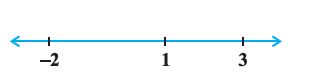
Now f ′(x) = 0 gives x = 1, x = – 2, or x = 3. The points x = 1, – 2, and 3 divide the real line into four disjoint intervals namely, (– ∞, – 2), (– 2, 1), (1, 3) and (3, ∞)
Consider the interval (– ∞, – 2), i.e., when – ∞ < x < – 2. In this case, we have x – 1 < 0, x + 2 < 0 and x – 3 < 0.
(In particular, observe that for x = –3, f ′(x) = (x – 1) (x + 2) (x – 3) = (– 4) (– 1) (– 6) < 0)
Therefore, f ′(x) < 0 when – ∞ < x < – 2. Thus, the function f is decreasing in (– ∞, – 2).
Consider the interval (– 2, 1), i.e., when – 2 < x < 1. In this case, we have x – 1 < 0, x + 2 > 0 and x – 3 < 0
(In particular, observe that for x = 0, f ′(x) = (x – 1) (x + 2) (x – 3) = (–1) (2) (–3) = 6 > 0)
So f ′(x) > 0 when – 2 < x < 1.
Thus, f is increasing in (– 2, 1).
Now consider the interval (1, 3), i.e., when 1 < x < 3. In this case, we have x – 1 > 0, x + 2 > 0 and x – 3 < 0.
So, f ′(x) < 0 when 1 < x < 3.
Thus, f is decreasing in (1, 3).
Finally, consider the interval (3, ∞), i.e., when x > 3. In this case, we have x – 1 > 0, x + 2 > 0 and x – 3 > 0. So f ′(x) > 0 when x > 3.
Thus, f is increasing in the interval (3, ∞).
4.
We have
\(y=\frac{4 \sin \theta}{(2+\cos \theta)}-\theta \)
\(\therefore \frac{d y}{d x} =\frac{(2+\cos \theta)(4 \cos \theta)-4 \sin \theta(-\sin \theta)}{(2+\cos \theta)^{2}}-1 \)
\(=\frac{8 \cos \theta+4 \cos ^{2} \theta+4 \sin ^{2} \theta}{(2+\cos \theta)^{2}}-1 \)
\(=\frac{8 \cos \theta+4}{(2+\cos \theta)^{2}}-1 \)
\(\text { Now, } \frac{d y}{d x}=0 .\)
\(\Rightarrow \frac{8 \cos \theta+4}{(2+\cos \theta)^{2}}=1\)
\(\Rightarrow 8 \cos \theta+4=4+\cos ^{2} \theta+4 \cos \theta \)
\(\Rightarrow \cos ^{2} \theta-4 \cos \theta=0\)
\(\Rightarrow \cos \theta(\cos \theta-4)=0 \)
\(\Rightarrow \cos \theta=0 \text { or } \cos \theta=4\)
\(\text { Since } \cos \theta \neq 4, \cos \theta=0\)
\(\cos \theta=0 \Rightarrow \theta=\frac{\pi}{2}\)
\(\text { Now, }\frac{d y}{d x}=\frac{8 \cos \theta+4-\left(4+\cos ^{2} \theta+4 \cos \theta\right)}{(2+\cos \theta)^{2}}=\frac{4 \cos \theta-\cos ^{2} \theta}{(2+\cos \theta)^{2}}=\frac{\cos \theta(4-\cos \theta)}{(2+\cos \theta)^{2}}\)
\(\text { In interval }\left(0, \frac{\pi}{2}\right), \text { we have } \cos \theta>0 . \text { Also, } 4>\cos \theta \Rightarrow 4-\cos \theta>0 \text { . }\)
\(\therefore \cos \theta(4-\cos \theta)>0 \text { and also }(2+\cos \theta)^{2}>0 \)
\(\Rightarrow \frac{\cos \theta(4-\cos \theta)}{(2+\cos \theta)^{2}}>0 \)
\(\Rightarrow \frac{d y}{d x}>0 \)
Therefore, y is strictly increasing in interval \( \left(0, \frac{\pi}{2}\right) \text { . }\)
Also, the given function is continuous at \( x=0 \text { and } x=\frac{\pi}{2} \text { . }\)
Hence, y is increasing in interval \( \left[0, \frac{\pi}{2}\right] \text { . }\)
5.
Maximum value = 2; Minimum value = -10
6.
\(\frac{1}{2 \pi} \mathrm{cm} / \mathrm{s}\)
7.
The area of a circle (A) with radius (r) is given by .
.
Therefore, the rate of change of area (A) with respect to time (t) is given by,
 [By chain rule]
It is given that .
.
Thus, when r = 8 cm,

Hence, when the radius of the circular wave is 8 cm, the enclosed area is increasing at the rate of 80 π cm2/s.
8.
Note that
f '(x) = 3x2 – 6x + 4
= 3(x2 – 2x + 1) + 1
= 3(x – 1)2 + 1 > 0, in every interval of R
Therefore, the function f is increasing on R.
9.
a=-2
10.
f'(x) 3x2- 6x + 3 = 3(x2 - 2x + 1)
= 3 (x - 1)2 > 0
Hence, function is increasing in R.
11.
We have
f(x) = sin x + cos x,
or f'(x) = cos x – sin x
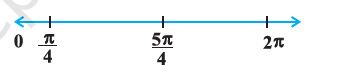
Now f'(x) = 0 gives sin x = cos x which gives that \(x=\frac{\pi}{4}, \frac{5 \pi}{4} \text { as } 0 \leq x \leq 2 \pi\)
The points \(x=\frac{\pi}{4} \text { and } x=\frac{5 \pi}{4}\) divide the interval [0, 2p] into three disjoint intervals namely,
\(\left[0, \frac{\pi}{4}\right),\left(\frac{\pi}{4}, \frac{5 \pi}{4}\right) \text { and }\left(\frac{5 \pi}{4}, 2 \pi\right]\)
\(\text {Note that } f^{\prime}(x)>0 \text {if } x \in\left[0, \frac{\pi}{4}\right) \cup\left(\frac{5 \pi}{4}, 2 \pi\right]\)
or f is increasing in the intervals \(\left[0, \frac{\pi}{4}\right) \text { and }\left(\frac{5 \pi}{4}, 2 \pi\right]\)
\(\text {Also }f^{\prime}(x)<0 \text { if } x \in\left(\frac{\pi}{4}, \frac{5 \pi}{4}\right)\)
or is plecreasing in \( \left(\frac{\pi}{4}, \frac{5 \pi}{4}\right)\)
| Interval | Sign of f'(x) | Nature of function |
| \(\left[0, \frac{\pi}{4}\right)\) | > 0 | f is increasing |
| \(\left(\frac{\pi}{4}, \frac{5 \pi}{4}\right)\) | < 0 | f is decreasing |
| \(\left(\frac{5 \pi}{4}, 2 \pi\right]\) | > 0 | f is increasing |
12.
Given, \(f(x)=\frac{3}{10} x^{4}-\frac{4}{5} x^{3}-3 x^{2}+\frac{36 x}{5}+11\)
On differentiating both sides w.r.t. x, we get
\(f^{\prime}(x)=\frac{12 x^{3}}{10}-\frac{12 x^{2}}{5}-6 x+\frac{36}{5}+0\)
Put \(f^{\prime}(x)=0\)
\(\Rightarrow \frac{12 x^{3}}{10}-\frac{12 x^{2}}{5}-6 x+\frac{36}{5}=0\)
\(\Rightarrow \frac{6 x^{3}-12 x^{2}-30 x+36}{5}=0\)
\(\Rightarrow\)\(x^{3}-2 x^{2}-5 x+6=0\left[\right. divide by \left.\frac{6}{5}\right]\)
\(\Rightarrow (x-1)\left(x^{2}-x-6\right)=0\)
\(\Rightarrow (x-1)(x+2)(x-3)=0\)
\(\Rightarrow\) x - 1 = 0
x + 2 = 0 or x - 3 = 0
x = -2, 1, 3
Now, we find the intervals in which f(x) is strictly increasing or strictly decreasing.
\(\begin{array}{ccc} \hline \text { Interval } & \begin{array}{c} \text { Sign of } f^{\prime}(x) \\ f^{\prime}(x)=(x-1)(x+2)(x-3) \end{array} & \begin{array}{c} \text { Nature of } \\ \text { function } \end{array} \\ \hline(-\infty,-2] & (-)(-)(-)=(-)<0 & \begin{array}{l} \text { Strictly } \\ \text { decreasing } \end{array} \\ \hline[-2,1] & (-)(+)(-)=(+)>0 & \text { Strictly increasing } \\ \hline[1,3] & (+)(+)(-)=(-)<0 & \begin{array}{l} \text { Sthictly } \\ \text { decreasing } \end{array} \\ \hline[3, \infty) & (+)(+)(+)=(+)>0 & \text { Strictly increasing } \\ \hline \end{array}\)
(a) f(x) is strictly increasing in the interval \((-2,1) \cup(3, \infty)\)
(b) f(x) is strictly decreasing in the interval \((-\infty,-2) \cup(1,3)\)
13.
Let ABCD be a rectangle inscribed in a given circle with centre at 0 and radius a.
Let AB = 2x and BC = 2y
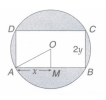
Then, OA2 = OM2 + AM2
\(\Rightarrow a^2=y^2+x^2\)
\(\Rightarrow y=\sqrt{a^2-x^2}\)
Let A be the area of the rectangle.
\(\therefore A=4xy=4x\sqrt{x^2-x^2}\)
\(\Rightarrow \ \ \frac{dA}{dx}=4\{\frac{a^2-2x^2}{\sqrt{a^2-x^2}}\}\)
For maximum or minimum value of A,
\(\frac{dA}{dx}=0\)
\(=4\{\frac{a^2-2x^2}{\sqrt{a^2-x^2}}\}=0\Rightarrow\ \ x=\frac{a}{\sqrt{2}}\)
Now, \(\frac{d^2A}{dx^2}=4\frac{d}{dx}\{(a^2-2x^2)(a^2-x^2)^{-1/2}\}\)
\(\Rightarrow \frac{d^2A}{dx^2}=4[-4x(a^2-x^2)^{-1/2}+(a^2-2x^2)\times(-1/2)(a^2-x^2)^(-3/2)(-2x)]\)
\(=[\frac{-4x}{\sqrt{a^2-x^2}}+\frac{x(a^2-2x^2)}{(a^2-x^2)^{3/2}}]\)
\(\therefore\ (\frac{d^2A}{dx^2})_{x=\frac{a}{\sqrt2}}=-16<0\)
Thus A is maximum when \(x=\frac{a}{\sqrt2}\)
putting \(x=\frac{a}{\sqrt2}\) in (i) \(y=\frac{a}{\sqrt2}\)
Therefore \(x=y=\frac{a}{\sqrt2}\)
Hence area is maximum when x = y ⇒ 2x = 2y
i.e., the rectangle is a square.
14.
(a)
cos x
15.
(b)
\(x=\frac{1}{e}\)
16.
We have,
\(
f(x)=4 \sin ^{3} x-6 \sin ^{2} x+12 \sin x+100 \\
\therefore f^{\prime}(x) =12 \sin ^{2} x \cdot \cos x-12 \sin x \cdot \cos x+12 \cos x \\
=12\left[\sin ^{2} x \cdot \cos x-\sin x \cdot \cos x+\cos x\right] \\
=12 \cos x\left[\sin ^{2} x-\sin x+1\right] \\
\Rightarrow f^{\prime}(x) =12 \cos x\left[\sin ^{2} x+(1-\sin x)\right] \\
\because \quad 1-\sin x \geq 0 \text { and } \sin ^{2} x \geq 0 \\
\therefore \sin ^{2} x +1+\sin x \geq 0
\)
Hence,\(f^{\prime}(x)>0\) when \(x \in\left(-\frac{\pi}{2}, \frac{\pi}{2}\right) \text { and } f^{\prime}(x)<0\)
when \(\cos x<0 \text { i.e., } x \in\left(\frac{\pi}{2}, \frac{3 \pi}{2}\right)\)
Hence, f(x) is decreasing when \(x \in\left(\frac{\pi}{2}, \frac{3 \pi}{2}\right)\)
Since,\(\left(\frac{\pi}{2}, \pi\right) \in\left(\frac{\pi}{2}, \frac{3 \pi}{2}\right)\)
Hence, f(x) is decreasing in \(\left(\frac{\pi}{2}, \pi\right)\)
17.
(a)
1 m/h
18.
(c)
1
19.
(b)
cos 2x
20.
(i) (b) : Since, side of square is of length 20 cm therefore \(\begin{equation} x \in(0,10) \end{equation}\) .
(ii) (a) : Clearly, height of open box = x cm
Length of open box = 20 - 2x
and width of open box = 20 - 2x
\(\therefore\) Volume (V) of the open box
= x x (20 - 2x) x (20 - 2x
(iii) (d) : We have, V = x(20 - 2X)2
\(\begin{equation} \therefore \frac{d V}{d x}=x \cdot 2(20-2 x)(-2)+(20-2 x)^{2} \end{equation}\)
= (20 - 2x)( -4x + 20 - 2x) = (20 - 2x)(20 - 6x)
Now, \(\begin{equation} \frac{d V}{d x}=0 \Rightarrow 20-2 x=0 \text { or } 20-6 x=0 \end{equation}\)
\(\begin{equation} \Rightarrow x=10 \text { or } \frac{10}{3} \end{equation}\)
(iv) (c) : We have, V = x(20 - 2X)2
and \(\begin{equation} \frac{d V}{d x}=(20-2 x)(20-6 x) \end{equation}\)
\(\begin{equation} \Rightarrow \frac{d^{2} V}{d x^{2}}=(20-2 x)(-6)+(20-6 x)(-2) \end{equation}\)
= (-2)[60 - 6x + 20 - 6x] = (-2)[80 - 12x] = 24x - 160
For \(\begin{equation} x=\frac{10}{3}, \frac{d^{2} V}{d x^{2}}<0 \end{equation}\)
and for \(\begin{equation} x=10, \frac{d^{2} V}{d x^{2}}>0 \end{equation}\)
So, volume will be maximum when \(\begin{equation} x=\frac{10}{3} \end{equation}\) .
(v) (d) : We have, V = x(20 - 2x)2,which will be maximum when \(\begin{equation} x=\frac{10}{3} \end{equation}\) .
\(\begin{equation} \therefore \ \text { Maximum volume }=\frac{10}{3}\left(20-2 \times \frac{10}{3}\right)^{2} \end{equation}\)
\(\begin{equation} =\frac{10}{3} \times \frac{40}{3} \times \frac{40}{3}=\frac{16000}{27} \mathrm{~cm}^{3} \end{equation}\)
21.
(c) Assertion is correct, Reason is incorrect
22.
(a) Assertion is correct, Reason is correct; Reason is a correct explanation for assertion.

12th Standard CBSE Syllabus & Materials
12th Standard CBSE
CBSE 12th Computer Science Python Revision Tour I - New Previous year Question Papers Study Material - QB365 Set A
NEW12th Standard CBSE
CBSE 12th Business Studies Planning Important Questions And Answers Study Material - QB365 Set A
NEW12th Standard CBSE
CBSE 12th Business Studies Business Environment Important Questions And Answers Study Material - QB365 Set A
NEW12th Standard CBSE
CBSE 12th Business Studies Principles of Management Important Questions And Answers Study Material - QB365 Set A



NCERT Books

Syllabus

Exam Pattern

Sample Question Papers

Previous year Question Papers

Important Notes

MCQ Practice test

NCERT Exemplers

Case study Questions

Image Based Questions

Passage based Questions

HOT Questions

Value Based Questions

Model Questions Papers
NCERT ( Book Back ) Questions

Assertion and Reason
Important Questions And Answers

CBSE 12th Standard CBSE Subjects
CBSE Standards








