
 100% FREE ACCESS
12th Standard CBSE Syllabus & Materials
12th Standard CBSE
CBSE 12th Economics Government Budget and the Economy Previous year Question Papers Study Material - QB365 Set A
NEW12th Standard CBSE
CBSE 12th Computer Science Interface Python with MySQL - New Previous year Question Papers Study Material - QB365 Set A
NEW12th Standard CBSE
CBSE 12th Computer Science Database Concept - New Previous year Question Papers Study Material - QB365 Set A
NEW12th Standard CBSE
CBSE 12th Computer Science Data Communication - New Previous year Question Papers Study Material - QB365 Set A
NEW12th Standard CBSE
CBSE 12th Computer Science Data Structures - New Previous year Question Papers Study Material - QB365 Set A
NEW12th Standard CBSE
CBSE 12th Computer Science Functions - New Previous year Question Papers Study Material - QB365 Set A

Published on: 25/10/2025
Download CBSE Class 12th Standard CBSE Maths question papers, sample papers, important questions, and previous year solved papers in PDF format. Get free study materials, NCERT solutions, and exam preparation resources for Class 12th Standard CBSE Maths
Questions + Answers key
Take MCQ Maths Test
1.
The general solution of the differential equation ydx - xdy = 0 is
xy = C
x = Cy2
y = Cx
y = Cx2
2.
If m and n respectively, are the order and the degree of the differential equation \(\frac{d}{d x}\left[\left(\frac{d y}{d x}\right)\right]^4=0\), then m + n is equal to
1
2
3
4
3.
What is the product of the order and degree of the differential equation \(\frac{d^2 y}{d x^2} \sin y+\left(\frac{d y}{d x}\right)^3 \cos y=\sqrt{y} ?\)
3
2
6
not defined
4.
The area of a triangle with vertices A, B, C is given by
\(|\overrightarrow{A B} \times \overrightarrow{A C}|\)
\(\frac{1}{2}|\overrightarrow{A B} \times \overrightarrow{A C}|\)
\(\frac{1}{4}|\overrightarrow{A C} \times \overrightarrow{A B}|\)
\(\frac{1}{8}|\overrightarrow{A C} \times \overrightarrow{A B}|\)
5.
ABCD is a rhombus whose diagonals intersect at E. Then, \(\overrightarrow{E A}+\overrightarrow{E B}+\overrightarrow{E C}+\overrightarrow{E D}\) equals to
\(\overrightarrow{0}\)
\(\overrightarrow{A D}\)
2 \(\overrightarrow{B D}\)
2\(\overrightarrow{A D}\)
6.
If a line makes angles of 90°, 135° and 45° with the X, Y and Z-axes respectively, then its direction cosines are
\(0,-\frac{1}{\sqrt{2}}, \frac{1}{\sqrt{2}}\)
\(-\frac{1}{\sqrt{2}}, 0, \frac{1}{\sqrt{2}}\)
\(\frac{1}{\sqrt{2}}, 0,-\frac{1}{\sqrt{2}}\)
\(0, \frac{1}{\sqrt{2}}, \frac{1}{\sqrt{2}}\)
7.
The point (x, y, 0) on the XY-plane divides the line segment joining the points (1, 2, 3) and (3, 2, 1l) in the ratio
1 : 2 internally
2 : 1 internally
3 : 1 internally
3 : 1 externally
8.
The feasible region of a linear programming problem is shown in the figure below:
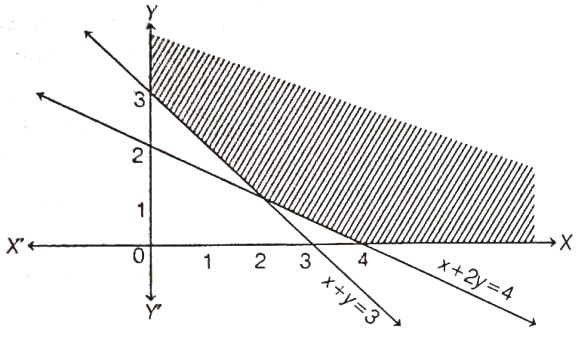
Which of the following are the possible constraints?
\(x+2 y \geq 4, x+y \leq 3, x \geq 0, y \geq 0\)
\(x+2 y \leq 4, x+y \leq 3, x \geq 0, y \geq 0\)
\(x+2 y \geq 4, x+y \geq 3, x \geq 0, y \geq 0\)
\(x+2 y \geq 4, x+y \geq 3, x \leq 0, y \leq 0\)
9.
The objective function Z = ax + by of an LPP if its maximum value 42 at (4, 6) and minimum value 19 at (3, 2). Which of the following is true?
a = 9 and b = 1
a = 5 and b = 2
a = 3 and b = 5
a = 5 and b = 3
10.
The order of the following, differential equation \(\frac{d^3 y}{d x^3}+x\left(\frac{d y}{d x}\right)^5=4 \log \left(\frac{d^4 y}{d x^4}\right)\) is
not defined
3
4
5
11.
The Cartesian equation of the line passing through the point (1, - 3, 2) and parallel to the line \(\vec{r}=(2+\lambda) \hat{i}+\lambda \hat{j}+(2 \lambda-1) \hat{k}\) is
\(\frac{x-1}{2}=\frac{y+3}{0}=\frac{z-2}{-1}\)
\(\frac{x+1}{1}=\frac{y-3}{1}=\frac{z+2}{2}\)
\(\frac{x+1}{2}=\frac{y-3}{0}=\frac{z+2}{-1}\)
\(\frac{x-1}{1}=\frac{y+3}{1}=\frac{z-2}{2}\)
12.
Direction cosines of a unit vector perpendicular to the plane \(\vec{r} \cdot(6 \hat{i}-3 \hat{j}-2 \hat{k})-1=0 \text { are }\)
\(6,-3,-2\)
\(\frac{6}{7},-\frac{3}{7},-\frac{2}{7}\)
\(-\frac{6}{7}, \frac{3}{7},-\frac{2}{7}\)
none of these
13.
\(\text { If }|\vec{a}|=5,|\vec{b}|=\mid 3 \text { and }|\vec{a} \times \vec{b}|=25 \text { , then } \vec{a} \cdot \vec{b} \text { is equal to }\)
12
5
13
60
14.
If \(\vec{a}\) and \(\vec{b}\) are non-zero vectors, such that \(\vec{a}\). \(\vec{b}\) = 0,then
\(\vec{a} \text { is parallel to } \vec{b}\)
\(\vec{a} \text { and } \vec{b} \text { are collinear }\)
\(\vec{a} \text { is perpendicular to } \vec{b}\)
none of these
15.
Differential equation \(x \frac{d y}{d x}=y(\log y-\log x+1)\) can be solved using the method of
separating the variables
homogeneous equations
linear differential equation of first order
none of these
16.
y = e-x + ax + b is a solution of differential equation
\(e^{-x} y^{\prime \prime}=1\)
\(e^{x} y^{\prime \prime}=1\)
\(e^{x}\left(y^{\prime}\right)^{2}=1\)
\(e^{-x}\left(y^{\prime}\right)^{2}=1\)
17.
If the area bounded by the curves y2 = 4ax and y = mx is \(\frac{a^{2}}{3}\) then the value of m is
2
-2
\(\frac{1}{2}\)
none of these
18.
The area enclosed by the circle x2 + y2 = 8 is
\(16 \pi\) sq units
\(2 \sqrt{2} \pi\) sq units
\(8 \pi^{2}\) sq units
\(8 \pi\) sq units
19.
The corner points of the feasible region determined by the system of linear constraints are (0, 10), (5, 5), (15,15), (0, 20). Let Z = px + qy where \(q>0\) .Then, the condition on p and q, so that the maximum of Z occurs at both the
points (15,15) and (0, 20) is
p = q
p = 2q
q = 2p
q = 3p
20.
The linear inequalities or equations or restrictions on the variables of a linear programming problem are called
linear relations
constraints
functions
objective functions
21.
In which of the following problem(s), linear programming can be used
manufacturing problems
diet problems
transportation problems
All of these
22.
The feasible region for an LPP is shown in the following figure. Then, the minimum value of Z = 11x + 7y is
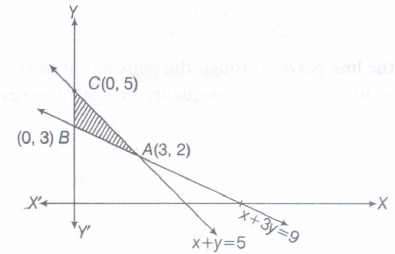
21
47
20
31
23.
Distance of the point \((\alpha, \beta, \gamma) \text { from } Y \text { -axis is }\)
\(\beta\)
\(|\beta|\)
\(|\beta|+|\gamma|\)
\(\sqrt{\alpha^{2}+\gamma^{2}}\)
24.
For any vector \(\vec{a}\) the value of
\(\vec{a}^{2}\)
\(3 \vec{a}^{2}\)
\(4 \vec{a}^{2}\)
\(2 \vec{a}^{2}\)
25.
If \(m_{1}, m_{2}, m_{3} \text { and } m_{4}\) are respectively the magnitudes of the vectors \(\vec{a}_{1}=2 \hat{i}-\hat{j}+\hat{k}\) \(\vec{a}_{2}=3 \hat{i}-4 \hat{j}-4 \hat{k}, \vec{a}_{3}=\hat{i}+\hat{j}-\hat{k}\) and \(\vec{a}_{4}=-\hat{i}+3 \hat{j}+\hat{k}\) then the correct order of \(m_{1}, m_{2}, m_{3} \text { and } m_{4}\) is
\(m_{3}<m_{1}<m_{4}<m_{2}\)
\(m_{3}<m_{1}<m_{2}<m_{4}\)
\(m_{3}<m_{4}<m_{1}<m_{2}\)
\(m_{3}<m_{4}<m_{2}<m_{1}\)
26.
The ratio in which \(\hat{i}+2 \hat{j}+3 \hat{k}\) divides the join of \(-2 \hat{i}+3 \hat{j}+5 \hat{k}\) and \(7 \hat{i}-\hat{k}\) is
1:2
1:4
2:3
3:4
27.
In triangle ABC, which of the following is not true
\(\overrightarrow{A B}+\overrightarrow{B C}+\overrightarrow{C A}=0\)
\(\overrightarrow{A B}+\overrightarrow{B C}-\overrightarrow{A C}=0\)
\(\overrightarrow{A B}+\overrightarrow{B C}-\overrightarrow{C A}=0\)
\(\overrightarrow{A B}-\overrightarrow{C B}+\overrightarrow{C A}=0\)
28.
The vector in the direction of vector \(\hat{i}-2 \hat{j}+2 \hat{k}\) that has magnitude 12 is
\(\hat{i}-2 \hat{j}+2 \hat{k}\)
\(\frac{\hat{i}-2 \hat{j}+2 \hat{k}}{3}\)
\(4(\hat{i}-2 \hat{j}+2 \hat{k})\)
\(9(\hat{i}-2 \hat{j}+2 \hat{k})\)
29.
The solution of \(\frac{d y}{d x}-y=1, y(0)=1\) is given by
xy = -ex
xy = - e-x
xy = -1
\(y=2 e^{x}-1\)
30.
The integrating factor of differential equation \(\left(1-x^{2}\right) \frac{d y}{d x}-x y=1\) is
- x
\(\frac{x}{1+x^{2}}\)
\(\sqrt{1-x^{2}}\)
\(\frac{1}{2} \log \left(1-x^{2}\right)\)
31.
The curve for which the slope of the tangent at any point is equal to the ratio of the abscissa to the ordinate of the point is
an ellipse
parabola
circle
rectangular hyperbola
32.
The number of solutions of \(\frac{d y}{d x}=\frac{y+1}{x-1}\), when y(1) = 2 is
none
one
two
infinite
33.
The general solution of \(\frac{d y}{d x}=2 x e^{x^{2}-y}\) is
\(e^{x^{2}-y}=C\)
\(e^{-y}+e^{x^{2}}=C\)
\(e^{y}=e^{x^{2}}+C\)
\(e^{x^{2}+y}=C\)
34.
Let Z = ax + by is a linear objective function. Variables x and y are called ……… variables.
Independent
Continuous
Decision
Dependent
35.
If l, m , n are the direction cosines of any line, then sum of the squares of the direction cosines of the line is always
-1
\(\sqrt3\)
1
0
36.
What are direction numbers of a line.
numbers which are proportional to the direction cosines of a line
numbers which are proportional to the direction cosines of a line.
numbers which are same as direction angles of a line
numbers which are proportional to the direction angles of a line
37.
If the direction cosines of a line from the positive X-axis and Y-axis are \(\frac { 1 }{ 2 } ,\frac { 1 }{ \sqrt { 2 } } \) . The angle of the line through Z-axis is:
30°
45°
135°
60°
38.
The co-ordinates of the vertices of the triangle are A(-2, 3, 6), B(-4, 4, 9) and C(0, 5, 8). The direction cosines of the median BE are:
1 , 0 , -2/3
3/\(\sqrt{13}\), 0, -2/\(\sqrt{13}\)
3/4, 0, -2/4
-3/\(\sqrt{12}\), 0, -2/\(\sqrt{13}\)
39.
Find the direction cosines of a line which makes an angle with all three the coordinate axes.
± 1/\(\sqrt2\)
1/\(\sqrt3\)
1/\(\sqrt2\)
1/\(\sqrt3\)
40.
If \(\overrightarrow { a } \) and \(\overrightarrow { b } \) are position vectors of the points (- 1, 1) and (m, – 2). then for what value of m, the vectors \(\overrightarrow { a } \) and \(\overrightarrow { b } \) are collinear.
1
2
-1
-2
41.
A vector of magnitude 14 units, which is parallel to the \(\widehat { i } +2\widehat { j } -3\widehat { k } \) vector
\(\frac { (\widehat { i } +2\widehat { j } -3\widehat { k } ) }{ 14 } \)
\(\frac { (\widehat { i } +2\widehat { j } -3\widehat { k } ) }{ \sqrt{14 } }\)
\(\sqrt { 14 } (\widehat { i } +2\widehat { j } -3\widehat { k } )\)
14\((\widehat { i } +2\widehat { j } -3\widehat { k } )\)
42.
The unit vector in the direction of \(\overrightarrow { AB } \), where A and B are the points (2, – 3, 7) and (1, 3, – 4) is:
\(\frac { -\widehat { i } +6\widehat { j } -11\widehat { k } }{ \sqrt { 158 } } \)
\(\frac { \widehat { i } +6\widehat { j } +11\widehat { k } }{ \sqrt { 158 } } \)
\(\frac { \widehat { i } -6\widehat { j } +11\widehat { k } }{ \sqrt { 158 } } \)
\(\frac { -\widehat { i } -11\widehat { k } }{ \sqrt { 122 } } \)
43.
If \(\overrightarrow { a } =\widehat { i } +2\widehat { j } ,\) and \(\overrightarrow { b } =-2\widehat { i } +\widehat { j } \) and \(\overrightarrow { c } =4\widehat { i } +3\widehat { j } \) and \(\overrightarrow { c } =x\overrightarrow { a } +y\overrightarrow { b } \), then the value of scalars x and y are:
x = 1 and y = -2
x = -2 and y = 1
x = 2 and y = -1
x = 2 and y = 1
44.
If a and b are the position vectors of two points A and B and C is a point on AB produced such that AC = 3AB, then position vector of C will be
3b – 2a
3a – b
3a – 2b
3b – a
45.
What is the additive identity of a vector?
zero vector
Negative of the vector
unit vector
The vector itself
46.
For what values of x and y, the vectors \(\overrightarrow { a } =3\widehat { i } +y\widehat { j } -\widehat 3{ k } \) and \(\overrightarrow { b } =2x\widehat { i } +2x\widehat { i } -3\widehat { k } \) are equal?
\(x=3,y=\frac { 3 }{ 2 } \)
x = 3, y = 6
\(x=\frac{3}{2},y=3\)
x = 6, y = 3
47.
The order and degree of the differential equation: (y”)2 + (y”)3 + (y’)4 + y5 = 0 is:
2, 4
3, 5
2, 5
2, 3
48.
Formation of the differential equation corresponding to the ellipse major axis 2a and minor axis 2b is:
\(xy\frac { { d }^{ 2 }y }{ d{ x }^{ 2 } } +x{ \left( \frac { dy }{ dx } \right) }^{ 2 }-y\frac { dy }{ dx } =0\)
\(xy\frac { { d }^{ 2 }y }{ d{ x }^{ 2 } } -x{ \left( \frac { dy }{ dx } \right) }^{ 2 }+y\frac { dy }{ dx } =0\)
\(xy\frac { { d }^{ 2 }y }{ d{ x }^{ 2 } } +x{ \left( \frac { dy }{ dx } \right) }^{ 2 }+y\frac { dy }{ dx } =0\)
\(xy\frac { { d }^{ 2 }y }{ d{ x }^{ 2 } } -x{ \left( \frac { dy }{ dx } \right) }^{ 2 }-y\frac { dy }{ dx } =0\)
49.
The degree of the differential equation \({ \left( \frac { { d }y }{ d{ x } } \right) }^{ 2 }+\frac { 1 }{ (dy/dx) } =1\)
2
1
3
0
50.
The dif \(3\frac { { d }^{ 2 }y }{ d{ x }^{ 2 } } ={ \left[ 1+{ \left( \frac { dy }{ dx } \right) }^{ 2 } \right] }^{ 3/2 }\)
second order, third degree equation.
second order, first degree equation
third order, third degree equation.
second order, second degree equation.
51.
Area of the shaded region in the given figure is:
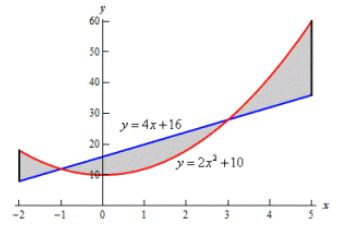
144/3 sq. units
142/3 sq. units
145/3 sq. units
143/2 sq. units
52.
Area under the circle x2 + y2 = 16 is
π sq units
13π sq units
16 π sq units
4 π sq units
53.
If the area of y = f(x) between x = a and x = b is \(\int _{ a }^{ c }{ f(x)dx } +\int _{ c }^{ a }{ f(x)dx } \) then the point c is the point of intersection of the curve with:
Line x = a
Y – axis
X – axis
Line x = b
54.
The area enclosed between the lines x = 2 and x = 7 is
Infinite
7 units
5 units
2 units
55.
The corner points of the feasible region determined by the following system of linear inequalities
2x + y ≤ 10, x + 3 y ≤ 15, x, y ≥ 0 are (0, 0), (5, 0), (3, 4) and (0, 5). Let Z = px + qy, where p, q > 0.
Condition on p and q so that the maximum of Z occurs at both (3, 4) and (0, 5) is
p = q
p = 2q
p = 3q
q = 3p
56.
Which of the following differential equations has y = c1 ex + c2 e–x as the general solution?
\(\frac { { d }^{ 2 }y }{ { dx }^{ 2 } } +y=0\)
\(\frac { { d }^{ 2 }y }{ { dx }^{ 2 } } -y=0\)
\(\frac { { d }^{ 2 }y }{ { dx }^{ 2 } } +1=0\)
\(\frac { { d }^{ 2 }y }{ { dx }^{ 2 } } -1=0\)
57.
The area bounded by the y-axis, y = cos x and y = sin x when 0 ≤ x ≤ \(\frac{\pi}{3}\) is
\(2(\sqrt { 2-1 } )\)
\(\sqrt { 2-1 } \)
\(\sqrt { 2-1 } \)
\(\sqrt { 2 } \)
58.
Area lying between the curves y2 = 4x and y = 2x is
\(\frac23\)
\(\frac13\)
\(\frac14\)
\(\frac34\)
59.
An aeroplane can carry a maximum of 200 passangers. A profit of Rs. 400 is made on each first class ticket and a profit of Rs. 300 is made on each economy class ticket. An airline reserves at least 20 seats for first class. However, at least 4 times as many passengers prefer to travel by economy class than by first class. Find how many tickets of each type must be sold to maximise the profit? The LPP for the given situation is
x → first class, y → economy class
To maximise Z = 400x + 300y
subject to constraints
x ≥ 0, y ≥ 0, x+y ≤ 200
x ≥ 20, y ≥ 80
x → first class, y → economy class
To maximise Z 400x + 300y
subject to constraints
x ≥ 0, y ≥ 0, x+y ≥ 200
x ≥ 20, y ≥ 80
x → first class, y → economy class
To maximise Z = 400x + 300y
subject to constraints
x ≥ 0, y ≥ 0, x ≥ 20
x + y ≤ 200,x ≥ 4y
x → first class, y → economy class
To maximise Z = 400x + 300y
subject to constraints
x ≥ 20, y ≥ 0
x + y ≤ 200, y ≥ 4x
60.
Feasible region is the set of points which satisfy
the objective functions
some of the given constraints
all of the given constraints
none of these
61.
A dealer wishes to purchase a number of fans and sewing machines. He has only Rs. 5,760 to invest and has space for at most 20 items. A fan costs him Rs. 360 and a sewing machine Rs. 240. He expects to sell a fan at a profit of Rs. 22 and a sewing machine at a profit of Rs. 18. Assigning that he can sell all the items that he buys, how should he invests his money to maximise the profit? The LPP for above question is
x → fans, y → sewing machinesTo maximise z = 22x + 18y subject to constraints
x ≥ 0, y ≥ 0, x + y ≤ 20, 360x + 240y ≥ 5760
x → fans, y → sewing machinesTo maximise z = 18x + 22ysubject to constraints
x ≥ 0, y ≥ 0, x + y ≤ 20 360x + 240y ≥ 5760
x → fans, y → sewing machines To maximise Z = 22x + 18y
x ≥ 0, y ≥ 0, x + y ≥ 0, 360x + 240y ≥ 5760
x → fans, y → sewing machines To maximise z = 22x + 18j
x ≥ 0, y ≥ 0, x + y ≤ 20 360x + 240y ≤ 5760
62.
Of all the points of the feasible region, for maximum or minimum of objective function, the point lies
inside the feasible region
at the boundary line of the feasible region
vertex point of the boundary of the feasible region
none of these
63.
P is a point on the line segment joining the points (3, 5, -1) and (6, 3, -2). If y-coordinate of point P is 2, then its x-coordinate will be
2
\(\frac{17}{3}\)
\(\frac{15}{3}\)
-5
64.
The area of a parrallelgram whose one diagonal is \(2\widehat { i } +\widehat { j } -2\widehat { k } \) and one side is \(3\widehat { i } +\widehat { j } -\widehat { k } \) is
\(\widehat { i } -4\widehat { j } -\widehat { k } \)
\(3\sqrt { 2 } \) sq unts
\(6\sqrt { 2 } \) sq units
6 sq units
65.
If for non zero vectors \(\vec { a } \) and \(\vec { b } \), \(\vec { a } \) x \(\vec { b } \) is a unit vector and |\(\vec { a } \)| = |\(\vec { b } \)| = \(\sqrt2\), then angle θ between vectors \(\vec { a } \) and \(\vec { b } \) is
\(\frac { \pi }{ 2 } \)
\(\frac { \pi }{ 3 } \)
\(\frac { \pi }{ 6 } \)
\(-\frac { \pi }{ 2 } \)
66.
If \(\vec { a } \) and \(\vec { b } \) are unit vectors, then what is the angle between \(\vec { a } \) and \(\vec { b } \) for \(\sqrt { 3 } \vec { a } -\vec { b } \) to be a unit vector?
30°
45°
60°
90°
67.
If |\(\vec { a } \)| = 4 and -3 ≤ λ ≤ 2 then the range of |λ\(\vec { a } \)| is
[0, 8]
[-12, 8]
[0, 12]
[8, 12]
68.
The position vector of a point which divides the join of points with position vectors \(\vec { a } +\vec { b } \) and \(2\vec { a } -\vec { b } \) in the ratio 1:2 internally is
\(\frac { 3\vec { a } +a\vec { b } }{ 3 } \)
\(\vec { a } \)
\(\frac { 5\vec { a } -\vec { b } }{ 3 } \)
\(\frac { 4\vec { a } +\vec { b } }{ 3 } \)
69.
The differential equation of the family of lines passing through origin is
y = mx
\(\frac{dy}{dx}=m\)
x dy – y dx = 0
\(\frac{dy}{dx}=0\)
70.
The degree of the differential equation \(\frac { { d }^{ 2 }y }{ d{ x }^{ 2 } } +3{ \left( \frac { dy }{ dx } \right) }^{ 2 }={ x }^{ 2 }log\left( \frac { { d }^{ 2 }y }{ { dx }^{ 2 } } \right) \)
1
2
3
not defined
71.
If P and q are the degree of differential equation \({ \left( \frac { { d }^{ 2 }y }{ { dx }^{ 2 } } \right) }^{ 2 }+3\frac { dy }{ dx } +\frac { { d }^{ 3 }y }{ d{ x }^{ 3 } } =4\), then the value of 2p – 3q is
7
-7
3
-3
72.
Area bounded by the curve y = sin x and the x-axis between x = 0 and x = 2π is
2 sq units
0 sq units
3 sq units
4 sq units
73.
Assertion (A) The points (1, 2, 3), (-2, 3, 4) and (7, 0, 1) are collinear.
Reason (R) If a line makes angles \(\frac{\pi}{2}, \frac{3\pi}{4}\) and \(\frac{\pi}{4}\)with X, Y and Z - axes respectively, then its direction cosines are 0, \(\frac{-1}{\sqrt{2}}\) and \(\frac{1}{\sqrt{2}}\).
(a) Both A and R are correct; R is the correct explanation of A
(b) Both A and R are correct; R is not the correct explanation of A
(c) A is correct; R is incorrect
(d) R is correct; A is incorrect
74.
Assertion (A) The order of the differential equation whose solution is y = c1e2x+c2+c3e2x+c4 is 4.
Reason (R) Order of the differential equation is the order of the highest order derivative occurring in the differential equation.
(a) Both A and R are correct; R is the correct explanation of A
(b) Both A and R are correct; R is not the correct explanation of A
(c) A is correct; R is incorrect
(d) R is correct; A is incorrect
75.
Assertion (A) The general solution of the differential equation x\(\frac{dy}{dx}+2y=x^2(x\neq0)\)is \(y=\frac{x^2}{4}+k{x^{-2}}\).
Reason (R) The number of arbitrary constant in the general solution is equal to the order of the differential equation.
(a) Both A and R are correct; R is the correct explanation of A
(b) Both A and R are correct; R is not the correct explanation of A
(c) A is correct; R is incorrect
(d) R is correct; A is incorrect
76.
Assertion: The number of arbitrary consants in the solution of differential equation \(\frac{d^{2}y}{dx^{2}}=0\)are 2.
Reason: The solution of a differential equation contains as many arbitrary constants as is the order of differential equation.
(a) Assertion is correct, Reason is correct; Reason is a correct explanation for assertion.
(b) Assertion is correct, Reason is correct; Reason is not a correct explanation for Assertion
(c) Assertion is correct, Reason is incorrect
(d) Assertion is incorrect, Reason is correct.
77.
Assertion: The differential equation y3dy +(x+y2)dx =0 becomes homogeneous if we put y2=t.
Reason: All differential equation of first order first degree becomes homogeneous if we put y= tx.
(a) Assertion is correct, Reason is correct; Reason is a correct explanation for assertion.
(b) Assertion is correct, Reason is correct; Reason is not a correct explanation for Assertion
(c) Assertion is correct, Reason is incorrect
(d) Assertion is incorrect, Reason is correct.
78.
Assertion: The projection of the vector a = 2\(\hat{i}+3\hat{j}+2\hat{k}\)on the vector \(\vec{b}=\hat{i}+2\hat{j}+\hat{k}\) is \(\frac{5}{3}\sqrt{6}\)
Reason: The projection of vector a on vector b is \(\frac{1}{|a|}\)(a.b).
(a) Assertion is correct, Reason is correct; Reason is a correct explanation for assertion.
(b) Assertion is correct, Reason is correct; Reason is not a correct explanation for Assertion
(c) Assertion is correct, Reason is incorrect
(d) Assertion is incorrect, Reason is correct.
79.
Assertion: \(\bar{a}\) = i + pj + 2k and \(\bar{b}\) = 2i + 3j + qk are parallel vectors if p = \(\frac{3}{2}\), q = 4
Reason: If \(\vec{a}\)= a1 \(\hat{i}\)+a2 \(\hat{j}\) + a3 \(\hat{k}\) and \(\vec{b}\) = b1\(\hat{i}\)+b2\(\hat{j}\)+b3 \(\hat{k}\) are parallel \(\frac{a_{1}}{b_{1}}=\frac{a_{2}}{b_{2}}=\frac{a_{3}}{b_{3}}\)
(a) Assertion is correct, Reason is correct; Reason is a correct explanation for assertion.
(b) Assertion is correct, Reason is correct; Reason is not a correct explanation for Assertion
(c) Assertion is correct, Reason is incorrect
(d) Assertion is incorrect, Reason is correct.
80.
Assertion: In \(\Delta\)ABC, \(\overline{AB}+\overline{BC}+\overline{CA}=0.\)
Reason: If \(\overline{OA}\) = \(\overline{a}\), \(\overline{OB}\) = \(\overline{b}\), then \(\overline{AB}\) = \(\overline{a}\)+ \(\overline{b}\) (triangle law of addition)
(a) Assertion is correct, Reason is correct; Reason is a correct explanation for assertion.
(b) Assertion is correct, Reason is correct; Reason is not a correct explanation for Assertion
(c) Assertion is correct, Reason is incorrect
(d) Assertion is incorrect, Reason is correct.
1.
(c)
y = Cx
2.
(c)
3
3.
(b)
2
4.
(b)
\(\frac{1}{2}|\overrightarrow{A B} \times \overrightarrow{A C}|\)
5.
(a)
\(\overrightarrow{0}\)
6.
(a)
\(0,-\frac{1}{\sqrt{2}}, \frac{1}{\sqrt{2}}\)
7.
(d)
3 : 1 externally
8.
(c)
\(x+2 y \geq 4, x+y \geq 3, x \geq 0, y \geq 0\)
9.
(c)
a = 3 and b = 5
10.
(c)
4
11.
(d)
\(\frac{x-1}{1}=\frac{y+3}{1}=\frac{z-2}{2}\)
12.
(b)
\(\frac{6}{7},-\frac{3}{7},-\frac{2}{7}\)
13.
(d)
60
14.
(c)
\(\vec{a} \text { is perpendicular to } \vec{b}\)
15.
(b)
homogeneous equations
16.
(b)
\(e^{x} y^{\prime \prime}=1\)
17.
(a)
2
18.
(d)
\(8 \pi\) sq units
19.
(d)
q = 3p
20.
(b)
constraints
21.
(d)
All of these
22.
(a)
21
23.
(d)
\(\sqrt{\alpha^{2}+\gamma^{2}}\)
24.
(d)
\(2 \vec{a}^{2}\)
25.
(a)
\(m_{3}<m_{1}<m_{4}<m_{2}\)
26.
(a)
1:2
27.
(c)
\(\overrightarrow{A B}+\overrightarrow{B C}-\overrightarrow{C A}=0\)
28.
(c)
\(4(\hat{i}-2 \hat{j}+2 \hat{k})\)
29.
(d)
\(y=2 e^{x}-1\)
30.
(c)
\(\sqrt{1-x^{2}}\)
31.
(d)
rectangular hyperbola
32.
(b)
one
33.
(a)
\(e^{x^{2}-y}=C\)
34.
(c)
Decision
35.
(d)
0
36.
(c)
numbers which are same as direction angles of a line
37.
(d)
60°
38.
(b)
3/\(\sqrt{13}\), 0, -2/\(\sqrt{13}\)
39.
(d)
1/\(\sqrt3\)
40.
(b)
2
41.
(c)
\(\sqrt { 14 } (\widehat { i } +2\widehat { j } -3\widehat { k } )\)
42.
(a)
\(\frac { -\widehat { i } +6\widehat { j } -11\widehat { k } }{ \sqrt { 158 } } \)
43.
(c)
x = 2 and y = -1
44.
(a)
3b – 2a
45.
(a)
zero vector
46.
(b)
x = 3, y = 6
47.
(d)
2, 3
48.
(a)
\(xy\frac { { d }^{ 2 }y }{ d{ x }^{ 2 } } +x{ \left( \frac { dy }{ dx } \right) }^{ 2 }-y\frac { dy }{ dx } =0\)
49.
(c)
3
50.
(d)
second order, second degree equation.
51.
(b)
142/3 sq. units
52.
(c)
16 π sq units
53.
(c)
X – axis
54.
(a)
Infinite
55.
(d)
q = 3p
56.
(b)
\(\frac { { d }^{ 2 }y }{ { dx }^{ 2 } } -y=0\)
57.
(b)
\(\sqrt { 2-1 } \)
58.
(b)
\(\frac13\)
59.
(d)
x → first class, y → economy class
To maximise Z = 400x + 300y
subject to constraints
x ≥ 20, y ≥ 0
x + y ≤ 200, y ≥ 4x
60.
(c)
all of the given constraints
61.
(d)
x → fans, y → sewing machines To maximise z = 22x + 18j
x ≥ 0, y ≥ 0, x + y ≤ 20 360x + 240y ≤ 5760
62.
(c)
vertex point of the boundary of the feasible region
63.
As let P divides the join of (3, 5, -1) and (6, 3, -2) in the ratio k : 1
\(\therefore \frac { 3k+5 }{ k+1 } =2\)
\(\Rightarrow 3k+5=2k+2\Rightarrow k=-3\)
∴ x-coordinate is
\(\frac { 6k+3 }{ k+1 } =\frac { -18+3 }{ -3+1 } =\frac { 15 }{ 2 } \)
64.
As area of parallelogram
= \(\left| \begin{matrix} \widehat { i } & \widehat { j } & \widehat { k } \\ 2 & 1 & -2 \\ 3 & 1 & -1 \end{matrix} \right| \)
= \(\left| \widehat { i } -4\widehat { j } -\widehat { k } \right| \)
= \(\sqrt { 1+16+1 } \)
= \(3\sqrt { 2 } \) sq units
65.
As sin \(\theta \) = \(\frac { |\vec { a } \times \vec { b } | }{ |\vec { b } ||\vec { b } | } \)
\(=\frac { 1 }{ \sqrt { 2 } .\sqrt { 2 } } =\frac { 1 }{ 2 } \)
\(\Rightarrow \theta =\frac { \pi }{ 6 } \)
66.
As \({ \left| \sqrt { 3 } \vec { a } -\vec { b } \right| }^{ 2 }=({ \sqrt { 3 } \vec { a } -\vec { b } ) }^{ 2 }\)
\(=3\vec { { a }^{ 2 } } +\vec { { b }^{ 2 } } -2\sqrt { 3 } \vec { a } .\vec { b } \)
\(1=3+1-2\sqrt { 3 } \vec { a } .\vec { b } \)
\(\Rightarrow \vec { a } .\vec { b } =\frac { \sqrt { 3 } }{ 2 } \)
\(\therefore cos\theta =\frac { \vec { a } .\vec { b } }{ |\vec { b } ||\vec { b } | } =\frac { \sqrt { 3 } }{ 2 } \)\(\Rightarrow \theta ={ 30 }^{ 0 }\)
67.
As |λ\(\vec { a } \)| = |λ| |\(\vec { a } \)| = 4|λ|
Also -3 ≤ λ ≤ 2 ⇒ 0 ≤ |λ| ≤ 3
⇒ 0 ≤ 4 |λ| ≤ 12
68.
As position vector = \(\frac { 2(\vec { a } +\vec { b } )+1(2\vec { a } -\vec { b } ) }{ 1+2 } \) = \(\frac { 4\vec { a } +\vec { b } }{ 3 } \)
69.
As general equation of line through origin is
y = mx
⇒ \(\frac{dy}{dx}=m\)
Substituting in (i), we get dy
y = \(\frac{dy}{dx}.x\)
⇒ x dy – y dx = 0
70.
As equation cannot be represented as a polynomial of derivatives.
71.
(b)
-7
72.
As sin x is positive in 1st and 2nd quadrant and negative is 3rd and 4th quadrant.
Area = \(\int _{ 0 }^{ 2\pi }{ |sinx|dx } \)
\(=\int _{ 0 }^{ \pi }{ sinxdx } +\int _{ \pi }^{ 2\pi }{ (-sinx)dx } \)
= 4 sq units
73.
(b) Both A and R are correct; R is not the correct explanation of A
74.
(d) R is correct; A is incorrect
75.
(b) Both A and R are correct; R is not the correct explanation of A
76.
(a) Assertion is correct, Reason is correct; Reason is a correct explanation for assertion.
77.
(c) Assertion is correct, Reason is incorrect
78.
(c) Assertion is correct, Reason is incorrect
79.
(b) Assertion is correct, Reason is correct; Reason is not a correct explanation for Assertion
80.
(d) Assertion is incorrect, Reason is correct.

12th Standard CBSE Syllabus & Materials
12th Standard CBSE
CBSE 12th Computer Science Python Revision Tour I - New Previous year Question Papers Study Material - QB365 Set A
NEW12th Standard CBSE
CBSE 12th Business Studies Planning Important Questions And Answers Study Material - QB365 Set A
NEW12th Standard CBSE
CBSE 12th Business Studies Business Environment Important Questions And Answers Study Material - QB365 Set A
NEW12th Standard CBSE
CBSE 12th Business Studies Principles of Management Important Questions And Answers Study Material - QB365 Set A



NCERT Books

Syllabus

Exam Pattern

Sample Question Papers

Previous year Question Papers

Important Notes

MCQ Practice test

NCERT Exemplers

Case study Questions

Image Based Questions

Passage based Questions

HOT Questions

Value Based Questions

Model Questions Papers
NCERT ( Book Back ) Questions

Assertion and Reason
Important Questions And Answers

CBSE 12th Standard CBSE Subjects
CBSE Standards








