
 100% FREE ACCESS
12th Standard CBSE Syllabus & Materials
12th Standard CBSE
CBSE 12th Economics Government Budget and the Economy Previous year Question Papers Study Material - QB365 Set A
NEW12th Standard CBSE
CBSE 12th Computer Science Interface Python with MySQL - New Previous year Question Papers Study Material - QB365 Set A
NEW12th Standard CBSE
CBSE 12th Computer Science Database Concept - New Previous year Question Papers Study Material - QB365 Set A
NEW12th Standard CBSE
CBSE 12th Computer Science Data Communication - New Previous year Question Papers Study Material - QB365 Set A
NEW12th Standard CBSE
CBSE 12th Computer Science Data Structures - New Previous year Question Papers Study Material - QB365 Set A
NEW12th Standard CBSE
CBSE 12th Computer Science Functions - New Previous year Question Papers Study Material - QB365 Set A

Published on: 25/10/2025
Download CBSE Class 12th Standard CBSE Maths question papers, sample papers, important questions, and previous year solved papers in PDF format. Get free study materials, NCERT solutions, and exam preparation resources for Class 12th Standard CBSE Maths
Questions + Answers key
Take MCQ Maths Test
1.
A coin is tossed three times, where
(i) E : head on third toss, F : heads on first two tosses
(ii) E : at least two heads , F : at most two heads
(iii) E: at most two tails, F : atleast one tail.
2.
Find the integral of the functions in \(\frac { \cos { 2 }{ x } }{ { \left( \cos { x } +\sin { x } \right) }^{ 2 } } \)
3.
Find the angle between two vectors \(\overset { \rightarrow }{ a } \) and \(\overset { \rightarrow }{ b } \) with magnitudes 1 and 2 respectively and when \(\overset { \rightarrow }{ a } \).\(\overset { \rightarrow }{ b } \) = 1.
4.
Find the particular solution of the differential equation:\(\left( x-y \right) \left( dx+dy \right) =dx-dy,\) given that \(y=-1\)when \(x=0.\)(Hint: put x - y = t)
5.
Find the direction cosines of the line passing through the two points (-2, 4, -5) and (1, 2, 3)
6.
Sketch the graph of \(y=\left| x+3 \right| \) and evaluate \(\overset { 0 }{ \underset { -6 }{ \int { } } } \left| x+3 \right| dx\)
7.
Find the image of the point (2, -1, 5) in the line \(\frac{x-11}{10}=\frac{y+2}{-4}=\frac{z+8}{-11}\)
8.
Find the following integrals:
\(\text { (i) } \int \sin ^{3} x \cos ^{2} x d x\)
\(\text { (ii) } \int \frac{\sin x}{\sin (x+a)} d x\)
\(\text { (iii) } \int \frac{1}{1+\tan x} d x\)
9.
Suppose a girl throws a die. If she gets a 5 or 6, she tosses a coin three times and notes the number of heads. If she gets 1, 2, 3 or 4, she tosses a coin once and notes whether a head or tail is obtained. If she obtained exactly one head, then what. is the probability that she threw 1, 2, 3 or 4 with the die?
10.
A cottage industry manufactures pedestal lamps and wooden shades, each requiring the use of a grinding/cutting machine and a sprayer. It takes 2 hours on grinding/cutting machine and 3 hours on the sprayer to manufacture a pedestal lamp. It takes 1 hour on the grinding/cutting machine and 2 hours on the sprayer to manufacture a shade. On any day, the sprayer is available for at the most 20 hours and the grinding/cutting machine for at the most 12 hours. The profit from the sale of a lamp is Rs. 5 and that from a shade is Rs. 3. Assuming that the manufacturer can sell all the lamps and shades that he produces, how should he schedule his daily production in order to maximise his profit? Formulate the above as a LPP and solve it graphically.
11.
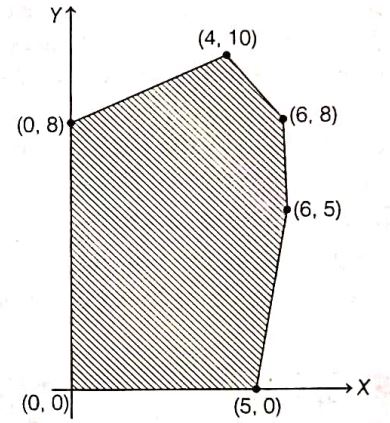
In the given graph, the feasible region for a LPP is shaded. The objective function Z = 2x - 3y will be minimum at
(4, 10)
(6, 8)
(0, 8)
(6, 5)
12.
The solution set of the inequality 3x + 5y < 4 is
an open half plane not containing the origin.
an open half plane containing the origin.
the whole XY-plane not containing the line 3x + 5y = 4.
a closed half plane containing the origin.
13.
If \(\vec{a}\) and \(\vec{b}\) are non-zero vectors, such that \(\vec{a}\). \(\vec{b}\) = 0,then
\(\vec{a} \text { is parallel to } \vec{b}\)
\(\vec{a} \text { and } \vec{b} \text { are collinear }\)
\(\vec{a} \text { is perpendicular to } \vec{b}\)
none of these
14.
The equation of straight line passing through the point (a, b, c) and parallel to Z-axis is
\(\frac{x-a}{1}=\frac{y-b}{1}=\frac{z-c}{0}\)
\(\frac{x-a}{0}=\frac{y-b}{1}=\frac{z-c}{1}\)
\(\frac{x-a}{1}=\frac{y-b}{0}=\frac{z-c}{0}\)
\(\frac{x-a}{0}=\frac{y-b}{0}=\frac{z-c}{1}\)
15.
The solution of \(\frac{d y}{d x}-y=1, y(0)=1\) is given by
xy = -ex
xy = - e-x
xy = -1
\(y=2 e^{x}-1\)
16.
\(\int \frac{e^{x}(1+x)}{\cos ^{2}\left(e^{x} x\right)} d x\) is equal to
\(-\cot \left(e x^{x}\right)+C\)
\(\tan \left(x e^{x}\right)+C\)
\(\tan \left(e^{x}\right)+C\)
\(\cot \left(e^{x}\right)+C\)
17.
The direction cosines of the line equally inclined with the axes are:
1, 1, 1
1/\(\sqrt3\), 1/\(\sqrt3\), 1/\(\sqrt3\)
1, 0, 0
1/3, 1/3, 1/3
18.
A and B are any two events such that P(A) + P(B) – P(A and B) = P(A), then
P(B|A) = 1
P(A|B) = 1
P(B|A) = 0
P(A|B) = 0
19.
The probability that a student is not a swimmer is \(\frac { 1 }{ 5 } \). Then the probability that out of five students, four are swimmers is
\(_{ }^{ 5 }{ { C }_{ 4 } }{ \left( \frac { 4 }{ 5 } \right) }^{ 4 }\frac { 1 }{ 5 } \)
\({ \left( \frac { 4 }{ 5 } \right) }^{ 4 }\frac { 1 }{ 5 } \)
\(_{ }^{ 5 }{ { C }_{ 1 }\frac { 1 }{ 5 } }{ \left( \frac { 4 }{ 5 } \right) }^{ 4 }\)
None of these
20.
If A and B are two events such that A ⊂ B and P(B) ≠ 0, then which of the following is correct?
\(P(A|B)=\frac { P(B) }{ P(A) } \)
P(A|B) < P(A)
P(A|B) ≥ P(A)
None of these
21.
Let \(\overrightarrow { a } \) and \(\overrightarrow { b } \) be two unit vectors and \(\theta\) is the angle between them. Then \(\overrightarrow { a } \)+\(\overrightarrow { b } \) is a unit vector if
\(\theta =\frac { \pi }{ 4 } \)
\(\theta =\frac { \pi }{ 3 } \)
\(\theta =\frac { \pi }{ 2 } \)
\(\theta =\frac { 2\pi }{ 3 } \)
22.
If is \(\overrightarrow { a } \) nonzero vector of magnitude ‘a’ and λ a nonzero scalar, then \(\overrightarrow { a } \)λ is unit vector if
λ = 1
λ = -1
a = |λ|
a = I/|λ|
23.
The Integrating Factor of the differential equation x\(\frac { dy }{ dx } \)- y = 2x2 is
e-x
e-y
\(\frac1x\)
x
24.
The order of the differential equation \({ 2x }^{ 2 }\frac { { d }^{ 2 }y }{ { dx }^{ 2 } } -3\frac { dy }{ dx } +y=0\) is
2
1
0
not defined
25.
Area bounded by the curve y = x3, the x-axis and the ordinates x = – 2 and x = 1 is
-9
\(\frac{-15}{4}\)
\(\frac{15}{4}\)
\(\frac{17}{4}\)
26.
Smaller area enclosed by the circle x2 + y2 = 4 and the line x + y = 2 is
2 (ㅠ – 2)
ㅠ - 2
2ㅠ - 1
2(ㅠ+2)
27.
Area lying in the first quadrant and bounded by the circle x2 + y2 = 4 and the lines x = 0 and x = 2 is
π
\(\frac { \pi }{ 2 } \)
\(\frac { \pi }{ 3 } \)
\(\frac { \pi }{ 3 } \)
28.
\(\int { \sqrt { 1+{ x }^{ 2 } } } dx\) is equal to
\(\frac { x }{ 2 } \sqrt { 1+{ x }^{ 2 } } +\frac { 1 }{ 2 } log\left| (x+\sqrt { 1+{ x }^{ 2 } } \right| +C\)
\(\frac { 2 }{ 3 } ({ { 1+x }^{ 2 }) }^{ \frac { 3 }{ 2 } }+C\)
\(\frac { 2 }{ 3 } x({ { 1+x }^{ 2 }) }^{ \frac { 3 }{ 2 } }+C\)
\(\frac { x }{ 2 } \sqrt { 1+{ x }^{ 2 } } +\frac { 1 }{ 2 } log\left| (x+\sqrt { 1+{ x }^{ 2 } } \right| +C\)
29.
\(\int { \frac { dx }{ { x }^{ 2 }+2x+2 } } \) equals
x tan–1 (x + 1) + C
tan–1 (x + 1) + C
(x + 1) tan–1x + C
tan–1x + C
30.
Direction ratios of a line are 2, 3, -6. Then direction cosines of a line making obtuse angle with the y-axis are
\(\frac { 2 }{ 7 } ,\frac { -3 }{ 7 } ,\frac { -6 }{ 7 } \)
\(\frac { -2 }{ 7 } ,\frac { 3 }{ 7 } ,\frac { -6 }{ 7 } \)
\(\frac { -2 }{ 7 } ,\frac { -3 }{ 7 } ,\frac { 6 }{ 7 } \)
\(\frac { -2 }{ 7 } ,\frac { -3 }{ 7 } ,\frac { -6 }{ 7 } \)
31.
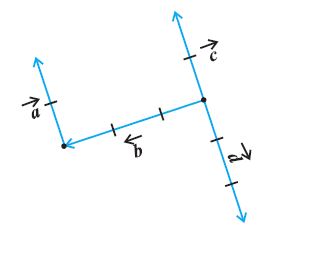
In which of the vectors are:
(i) Collinear
(ii) Equal
(iii) Coinitial
32.
verify that the given functions (explicit or implicit) is a solution of the corresponding differential equation : y = x2 + 2x + C : y′ – 2x – 2 = 0
33.
State whether the following distribution is a probability distribution of a random variable or not.
\(\begin{array}{c|c|c|c|c|c} \hline x & 3 & 2 & 1 & 0 & -1 \\ \hline P(X) & 0.3 & 0.2 & 0.4 & 0.1 & 0.05 \\ \hline \end{array}\)
34.
If a line makes angles 90°, 60° and 30° with the positive direction of x, y and z- axis respectively, then find its direction cosines.
35.
Evaluate thefollowing integral.
\(\int \frac{3 x}{3 x-1} d x\)
36.
A rumour on whatsapp spreads in a population of 5000 people at a rate proportional to the product of the number of people who have heard it and the number of people who have not. Also, it is given that 100 people initiate the rumour and a total of 500 people know the rumour after 2 days.
Based on the above information, answer the following questions
(i) If yet) denote the number of people who know the rumour at an instant t, then maximum value of yet) is
| (a) 500 | (b) 100 | (c) 5000 | (d) none of these |
(ii) \(\frac{d y}{d t}\) is proptional to
| (a) (y - 5000) | (b) y(y - 500) | (c) y(500 - y) | (d) y(5000 - y) |
(iii) The value of y(0) is
| (a) 100 | (b) 500 | (c) 600 | (d) 200 |
(iv) The value of y(2) is
| (a) 100 | (b) 500 | (c) 600 | (d) 200 |
(v) The value of y at any time t is given by
| (a) \(y=\frac{5000}{e^{-5000 k t}+1}\) | (b) \(y=\frac{5000}{1+e^{5000 k t}}\) | (c) \(y=\frac{5000}{49 e^{-5000 k t}+1}\) | (d) \(y=\frac{5000}{49\left(1+e^{-5000 k t}\right)}\) |
37.
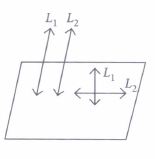
If a1,b1,c1 and a2, b2, c2 are direction ratios of two lines say L1 and L2 respectively. Then L1 II L2 iff
\(\frac{a_{1}}{a_{2}}=\frac{b_{1}}{b_{2}}=\frac{c_{1}}{c_{2}}\) and \( L_{1} \perp L_{2} \text { iff } a_{1} a_{2}+b_{1} b_{2}+c_{1} c_{2}=0\) .
Based on the above information, answer the following questions
(i) If l1,m1,n1 and l2,m2, n2 are the direction cosines of L, and L2 respectively, then L1, will be perpendicular to L2, iff
| (a) \(l_{1} l_{2}+m_{1} m_{2}+n_{1} n_{2}=0\) | (b) \(l_{1} m_{2}+m_{1} l_{2}+n_{1} n_{2}=0\) | (c) \(\frac{l_{1}}{l_{2}}=\frac{m_{1}}{m_{2}}=\frac{n_{1}}{n_{2}}\) | (d) none of these |
(ii) If l1,m1,n1 and l2,m2, n2 are direction cosines of L1, and L2 respectively, then L1, will be parallel to L2, iff
| (a) \( l_{1} l_{2}+m_{1} m_{2}+n_{1} n_{2}=0\) | (b) \(l_{1} m_{2}+m_{1} l_{2}+n_{1} n_{2}=0\) | (c) \( \frac{l_{1}}{l_{2}}=\frac{m_{1}}{m_{2}}=\frac{n_{1}}{n_{2}}\) | (d) \( m_{1} n_{2}+m_{2} n_{2}+l_{1} l_{2}=0\) |
(iii) The coordinates of the foot of the perpendicular drawn from the point A (1, 2, 1) to the line joining B (1, 4, 6) and C (5, 4, 4), are
| (a) (1,2,1) | (b) (2,4,5) | (c) (3,4,5) | (d) (4,3,5) |
(iv) The direction ratios of the line which is perpendicular to the lines with direction ratios proportional to (1, -2, -2) and (0, 2, 1) are
| (a) < 1,2,1> | (b) < 2, -1, 2 > | (c) < -1, 2, 2 > | (d) none of these |
(v) The lines \(\frac{x-2}{3}=\frac{y+1}{-2}=\frac{z-2}{0} \text { and } \frac{x-1}{1}=\frac{y+3 / 2}{3 / 2}=\frac{z+5}{2}\) are
| (a) parallel | (b) perpendicular | (c) skew lines | (d) non-intersecting |
38.
Corner points of the feasible region for an LPP are (0, 3), (5, 0), (6, 8), (0, 8). Let Z = 4x - 6y be the objective function.
Based on the above information, answer the following questions.
(i) The minimum value of Z occurs at
| (a) (6, 8) | (b) (5, 0) | (c) (0, 3) | (d) (0, 8) |
(ii) Maximum value of Z occurs at
| (a) (5, 0) | (b) (0, 8) | (c) (0, 3) | (d) (6, 8) |
(iii) Maximum of Z - Minimumof Z =
| (a) 58 | (b) 68 | (c) 78 | (d) 88 |
(iv) The corner points of the feasible region determined by the system of linear inequalities are
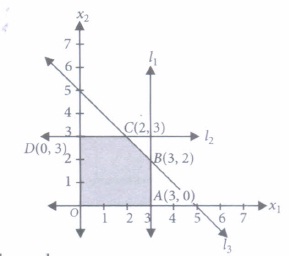
| (a) (0, 0), (-3, 0), (3, 2), (2, 3) | (b) (3, 0), (3, 2), (2, 3), (0, -3) | (c) (0, 0), (3, 0), (3, 2), (2, 3), (0, 3) | (d) None of these |
(v) The feasible solution of LPP belongs to
| (a) first and second quadrant | (b) first and third quadrant | (c) only second quadrant | (d) only first quadrant |
1.
(i) If a coin is tossed three times, then the sample space S is
S = {HHH, HHT, HTH, HTT, THH, THT, TTH, TTT}
It can be seen that the sample space has 8 elements.
E = {HHH, HTH, THH, TTH}
F = {HHH, HHT}
∴ E ∩ F = {HHH}
\(P(F)=\frac{2}{8}=\frac{1}{4} \text { and } P(E \cap F)=\frac{1}{8} \)
\(P(E \mid F)=\frac{P(E \cap E)}{P(F)}=\frac{\frac{1}{8}}{\frac{1}{4}}=\frac{4}{8}=\frac{1}{2} \)
(ii) If a coin is tossed three times, then the sample space S is
S = {HHH, HHT, HTH, HTT, THH, THT, TTH, TTT}
It can be seen that the sample space has 8 elements.
E = {HHH, HTH, THH, TTH}
F = {HHH, HHT}
∴E ∩ F = {HHH}
\(P(A \cap F)=\frac{3}{8}, P(F)=\frac{7}{8} \)
\(P(E / F)=\frac{P(E \cap F)}{P(F)}=\frac{3}{8} \div \frac{7}{8}=\frac{3}{7} \)
(iii) Simple space S = {HHH, HHT, HTH, THH, TTH, THT, HTT, TTT}
Total number of cases = 8
E : at most two tail = { THH, HTH, HHT, TTH, THT, HTT, TTT}
\(P(E)=\frac { 7 }{ 8 } \)
\(P(F)=\frac { 7 }{ 8 } \)
\((E\cap F) =\) { THH, HTH, HHT, TTH, THT, HTT}
\(P(E\cap F)=\frac { 6 }{ 8 } \)
\(\therefore P(P/E)=\frac { P(E\cap F) }{ P(E) } =\frac { \frac { 6 }{ 8 } }{ \frac { 7 }{ 8 } }=\frac { 6 }{ 7 } \)
2.
\(\frac{\cos 2 x}{(\cos x+\sin x)^{2}}=\frac{\cos 2 x}{\cos ^{2} x+\sin ^{2} x+2 \sin x \cos x}=\frac{\cos 2 x}{1+\sin 2 x} \)
\(\therefore \int \frac{\cos 2 x}{(\cos x+\sin x)^{2}} d x=\int \frac{\cos 2 x}{(1+\sin 2 x)} d x \)
\(\text { Let } 1+\sin 2 x=t \)
\(\Rightarrow 2 \cos 2 x d x=d t \)
\(\therefore \int \frac{\cos 2 x}{(\cos x+\sin x)^{2}} d x =\frac{1}{2} \int_{t}^{1} d t \)
\(=\frac{1}{2} \log |t|+\mathrm{C} \)
\(=\frac{1}{2} \log |1+\sin 2 x|+\mathrm{C} \)
\(=\frac{1}{2} \log \left|(\sin x+\cos x)^{2}\right|+\mathrm{C} \)
\(=\log |\sin x+\cos x|+\mathrm{C}\)
3.
We have:
\(\overset { \rightarrow }{ |a| } =1\) , \(\overset { \rightarrow }{ |b| } =2\) and \(\overset { \rightarrow }{ a } \).\(\overset { \rightarrow }{ b } \)=1.
\(\theta=\cos ^{-1}\left(\frac{\vec{a} \cdot \vec{b}}{|\vec{a}||\vec{b}|}\right)=\cos ^{-1}\left(\frac{1}{2}\right)=\frac{\pi}{3}\)
4.
The given equation is:\(\left( x-y \right) \left( dx+dy \right) =dx-dy\)
\(\Rightarrow \left( x-y-1 \right) dx+\left( x-y+1 \right) dy=0\)
\(\Rightarrow\) \(\frac { dy }{ dx } =-\frac { x-y-1 }{ x-y+1 } \)
Put \(x-y=z\)
so that \(1-\frac { dy }{ dx } =\frac { dy }{ dx } \)
\(\Rightarrow\) \(\frac { dy }{ dx } =1-\frac { dz }{ dx } .\)
\(\therefore\) from (1), \(1-\frac { dz }{ dx } =-\frac { 2z }{ z+1 } \)
\(\Rightarrow \frac { dz }{ dx } =1+\frac { z-1 }{ z+1 } \Rightarrow \frac { dz }{ dx } =\frac { 2z }{ z+1 } \)
\(\Rightarrow\) \(\frac { z+1 }{ z } dz=2dx\)
|Variables Separable
Integrating, \(\int { \left( 1+\frac { 1 }{ 2 } \right) } dz=2\int { dx+C } \)
\(\Rightarrow\) \(z+log|z|=2x+C\)
\(\Rightarrow\) \(x-y+log|x-y|=2x+C\) ...(2)
When \(x=0,y=-1.\)
\(\therefore\) \(0+1+log|0+1|2(0)+C\)
\(\Rightarrow\) \(1+0=0+C\Rightarrow C=1.\)
Putting in (2),\(x-y+log|x-y|=2x+1\)
\(\Rightarrow\) \(log|x-y|=x+y+1,\)
Which is required solution.
5.
We know that the direction-cosines of the line joining P(x1, y1, z1) and q(x2, y2, z2) are:
\(\frac{x_{2}-x_{1}}{\mathrm{PQ}}, \frac{y_{2}-y_{1}}{\mathrm{PQ}}, \frac{z_{2}-z_{1}}{\mathrm{PQ}} \)
\(\text {where } \mathrm{PQ}=\sqrt{\left(x_{2}-x_{1}\right)^{2}+\left(y_{2}-y_{1}\right)^{2}+\left(z_{2}-z_{1}\right)^{2}} \)
Here P is (– 2, 4, – 5) and Q is (1, 2, 3).
\(\mathrm{PQ}=\sqrt{(1-(-2))^{2}+(2-4)^{2}+(3-(-5))^{2}}=\sqrt{77}\)
Thus, the direction cosines of the line joining two points is
\(\frac{3}{\sqrt{77}}, \frac{-2}{\sqrt{77}}, \frac{8}{\sqrt{77}}\)
6.
Graph : We have : \(y=\left| x+3 \right| \)
\(=x+3\ ifx\ge -3\)
\(=-x-3\ ifx<-3\)
When \(x\ge -3\)
| x = | -3 | -2 |
| y = | 0 | 1 |
When x < - 3
| x = | -4 | -5 |
| y = | 1 | 2 |
Plot the points A (-3, 0), B (-2, 1) and C (-4, 1), D (-5, 2) and portion of the graph is as shown:
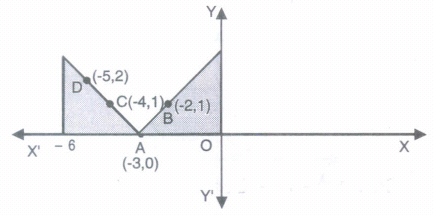
Evaluation:
\(\overset { 0 }{ \underset { -6 }{ \int { } } } \left| x+3 \right| dx\)
\(=\overset { -3 }{ \underset { -6 }{ \int { } } } (-x-3)dx+\overset { 0 }{ \underset { -3 }{ \int { } } } (x+3)dx\)
\(=\left[ -\frac { { x }^{ 2 } }{ 2 } -3x \right] _{ -6 }^{ -3 }+\left[ \frac { { x }^{ 2 } }{ 2 } +3x \right] _{ -3 }^{ 0 }\)
\(=\left[ \left( -\frac { 9 }{ 2 } +9 \right) -\left( -\frac { 36 }{ 2 } +18 \right) \right] +\left[ (0+0)-\left( \frac { 9 }{ 2 } -9 \right) \right] \)
\(=\left( \frac { 9 }{ 2 } +0 \right) +\left( 0+\frac { 9 }{ 2 } \right) =9sq.units.\)
7.
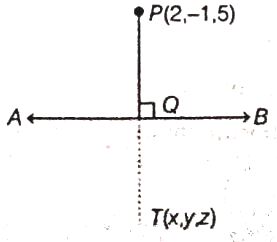
Let T be the image of the point P(2, -1, 5). Q is the foot of perpendicular drawn from point P on the line AB.
Given, equation of line AB is
\(\frac{x-11}{10}=\frac{y+2}{-4}=\frac{z+8}{-11}\) ...(i)
Let \(\frac{x-11}{10}=\frac{y+2}{-4}=\frac{z+8}{-11}=\lambda\) (say)
\(\Rightarrow \quad x=10 \lambda+11, y=-4 \lambda-2\)
and \(z=-11 \lambda-8\)
Then, coordinates of Q are
\(=(10 \lambda+11,-4 \lambda-2,-11 \lambda-8)\) ....(ii)
Now, DR's of line PQ
\(\begin{aligned}
=10 \lambda+11-2-4 \lambda-2+1,-11 \lambda-8-5
\end{aligned}\)
\(\begin{aligned}
=10 \lambda+9,-4 \lambda-1,-11 \lambda-13
\end{aligned}\)
Since, line \(P Q \perp A B\)
\(\therefore\) a1a2 + b1b2 + c1c2 = 0
where \(a_1=10 \lambda+9, b_1=-4 \lambda-1, c_1=-11 \lambda-13\)
and a2 = 10, b2 = -4, c2 = -11
\(\begin{aligned}
\therefore(10 \lambda+9)(10)+(-4 \lambda-1)( & -4) +(-11 \lambda-13)(-11)=0
\end{aligned}\)
\(\begin{aligned}
\Rightarrow & & 100 \lambda+90+16 \lambda+4+121 \lambda+143 & =0
\end{aligned}\)
\(\begin{aligned}
\Rightarrow & & 237 \lambda+237 & =0
\end{aligned}\)
\(\begin{aligned}
\Rightarrow & & \lambda & =-1
\end{aligned}\)
On putting \(\lambda\) = - 1 in Eq. (ii), we get
Q = (10(-1)+11), -4(-1)-2, -11(-1)-8)
=(-10+11, 4-2, 11-8)
= (1, 2, 3)
Let image of a point P be T(x, y, z).
Then, Q will be the mid-point of PT.
By using mid-point formula
Q = Mid-point of P(2, -1,5) and T(x, y, z).
\(=\left(\frac{x+2}{2}, \frac{y-1}{2}, \frac{z+5}{2}\right)\)
But Q = (1, 2, 3)
\(\therefore\left(\frac{x+2}{2}, \frac{y-1}{2}, \frac{z+5}{2}\right)=(1,2,3)\)
On equating corresponding coordinates, we get
\(\begin{aligned}
\frac{x+2}{2} & =1, \frac{y-1}{2}=2, \frac{z+5}{2}=3
\end{aligned}\)
\(\begin{aligned}
\Rightarrow & \quad x =2-2, y=4+1, z=6-5
\end{aligned}\)
\(\therefore\) x = 0, y = 5, z = 1
\(\therefore\) Coordinates of T = (x, y, z) = (0, 5, 1)
Hence, the coordinate image of point P(2, -1, 5) is T(0, 5, 1).
8.
(i) We have
∫sin3 x cos2x dx = ∫sin2 x cos2x (sin x) dx
= ∫(1 – cos2x) cos2x (sin x) dx
Put t = cos x so that dt = – sin x dx
Therefore, ∫sin2x cos2x (sin x) dx = − ∫(1 – t2 ) t2 dt
\(=-\int\left(t^{2}-t^{4}\right) d t=-\left(\frac{t^{3}}{3}-\frac{t^{5}}{5}\right)+\mathrm{C} \)
\(=-\frac{1}{3} \cos ^{3} x+\frac{1}{5} \cos ^{5} x+\mathrm{C} \)
(ii) Put x + a = t. Then dx = dt. Therefore
\(\int \frac{\sin x}{\sin (x+a)} d x =\int \frac{\sin (t-a)}{\sin t} d t \)
\(=\int \frac{\sin t \cos a-\cos t \sin a}{\sin t} d t \)
= cos a ∫dt – sin a ∫cot t dt
= (cos a) t – (sin a) ⎡⎣log sin t + C1⎤⎦
= (cos a) (x + a) – (sin a) ⎡⎣log sin (x + a) + C1⎤⎦
= x cos a + a cos a – (sin a) log sin (x + a) – C1 sin a
\(\text { Hence, } \int \frac{\sin x}{\sin (x+a)} d x=x \cos a-\sin a \log |\sin (x+a)|+\mathrm{C}\)
where, C = – C1 sin a + a cos a, is another arbitrary constant.
\(\text { (iii) } \int \frac{d x}{1+\tan x} =\int \frac{\cos x d x}{\cos x+\sin x} \)
\(=\frac{1}{2} \int \frac{(\cos x+\sin x+\cos x-\sin x) d x}{\cos x+\sin x} \)
\(=\frac{1}{2} \int d x+\frac{1}{2} \int \frac{\cos x-\sin x}{\cos x+\sin x} d x \)
\(=\frac{x}{2}+\frac{C_{1}}{2}+\frac{1}{2} \int \frac{\cos x-\sin x}{\cos x+\sin x} d x \)
\(\text { Now, consider } \mathrm{I}=\int \frac{\cos x-\sin x}{\cos x+\sin x} d x\)
\(\text { Put } \cos x+\sin x=t \text { so that }(\cos x-\sin x) d x=d t\)
\(\text { Therefore } \quad \mathrm{I}=\int \frac{d t}{t}=\log |t|+\mathrm{C}_{2}=\log |\cos x+\sin x|+\mathrm{C}_{2}\)
\(\text { Putting it in (1), we get }\)
\(\int \frac{d x}{1+\tan x} =\frac{x}{2}+\frac{\mathrm{C}_{1}}{2}+\frac{1}{2} \log |\cos x+\sin x|+\frac{\mathrm{C}_{2}}{2} \)
\(=\frac{x}{2}+\frac{1}{2} \log |\cos x+\sin x|+\frac{\mathrm{C}_{1}}{2}+\frac{\mathrm{C}_{2}}{2} \)
\(=\frac{x}{2}+\frac{1}{2} \log |\cos x+\sin x|+\mathrm{C},\left(\mathrm{C}=\frac{\mathrm{C}_{1}}{2}+\frac{\mathrm{C}_{2}}{2}\right) \)
9.
Let E1 = Event that 5 or 6 is shown on die
and E2 = Event that 1, 2, 3 or 4 is shown on die
Here, n(E1) = 2andn(E2) = 4
Also, n(S) = 6
\(\therefore P\left(E_{1}\right)=\frac{2}{6}=\frac{1}{3}\)
and \(P\left(E_{2}\right)=\frac{4}{6}=\frac{2}{3}\)
Let E = The event that exactly one head show up.
\(\therefore P\left(\frac{E}{E_{1}}\right)=P\) (exactly one head show up when coin is tossed thrice)
\(=P\{H T T, T H T, T T H\}=\frac{3}{8}\)
\(\left[\because \text { total number of outcomes }=2^{3}=8\right]\)
\(P\left(\frac{E}{E_{2}}\right)=P\) (head shows up when coin is tossed once) \(=\frac{1}{2}\)
The probability that the girl threw 1, 2, 3 or 4 with the die, if she obtained exactly one head, is given by
\(P\left(\frac{E_{2}}{E}\right)=\frac{P\left(E_{2}\right) \cdot P\left(\frac{E}{E_{2}}\right)}{P\left(E_{1}\right) \cdot P\left(\frac{E}{E_{1}}\right)+P\left(E_{2}\right) \cdot P\left(\frac{E}{E_{2}}\right)}\)
[by Baye's theorem]
\(=\frac{\frac{2}{3} \times \frac{1}{2}}{\frac{1}{3} \times \frac{3}{8}+\frac{2}{3} \times \frac{1}{2}}=\frac{\frac{1}{3}}{\frac{1}{8}+\frac{1}{3}}=\frac{8}{8+3}=\frac{8}{11}\)
10.
Let number of pedestal lamps be x, and wooden shades by y.
LPP is Maximise P = 5x + 3y
Subject to 2x + y \(\le \) 12
3x + 2y \(\le \) 20
x \(\ge \)0, y\(\ge \) 0
Extreme points of feasible region are:A(0, 10), B(4, 4), C(6, 0)
P(A = 30, P(B) = 32, P(C) = 30
\(\therefore\) Max. Profit at B = 32
when pedestal lamps = 4, Wooden shades = 4
11.
(c)
(0, 8)
12.
(b)
an open half plane containing the origin.
13.
(c)
\(\vec{a} \text { is perpendicular to } \vec{b}\)
14.
(c)
\(\frac{x-a}{1}=\frac{y-b}{0}=\frac{z-c}{0}\)
15.
(d)
\(y=2 e^{x}-1\)
16.
17.
(b)
1/\(\sqrt3\), 1/\(\sqrt3\), 1/\(\sqrt3\)
18.
(b)
P(A|B) = 1
19.
(a)
\(_{ }^{ 5 }{ { C }_{ 4 } }{ \left( \frac { 4 }{ 5 } \right) }^{ 4 }\frac { 1 }{ 5 } \)
20.
(c)
P(A|B) ≥ P(A)
21.
(d)
\(\theta =\frac { 2\pi }{ 3 } \)
22.
(d)
a = I/|λ|
23.
(c)
\(\frac1x\)
24.
(a)
2
25.
(d)
\(\frac{17}{4}\)
26.
(b)
ㅠ - 2
27.
(a)
π
28.
(a)
\(\frac { x }{ 2 } \sqrt { 1+{ x }^{ 2 } } +\frac { 1 }{ 2 } log\left| (x+\sqrt { 1+{ x }^{ 2 } } \right| +C\)
29.
(b)
tan–1 (x + 1) + C
30.
As direction cosines of a line whose direction ratio are 2,3, -6 are
\(\frac { -2 }{ 7 } ,\frac { 3 }{ 7 } ,\frac { 6 }{ 7 } \)
As angle with the y-axis is obtuse,
∴ cos β < 0,
Therefore direction ratios are \(\frac { -2 }{ 7 } ,\frac { -3 }{ 7 } ,\frac { 6 }{ 7 } \)
31.
(i) Collinear vectors : \(\vec{a}, \vec{c} \text { and } \vec{d}\)
(ii) Equal vectors : \(\vec{a} \text { and } \vec{c} \text { . }\)
(iii) Coinitial vectors : \(\vec{b}, \vec{c} \text { and } \vec{d}\)
32.
\(y=x^{2}+2 x+C\)
Differentiating both sides of this equation with respect to, we get:
\(y^{\prime}=\frac{d}{d x}\left(x^{2}+2 x+\mathrm{C}\right) \)
\(\Rightarrow y^{\prime}=2 x+2 \)
Substituting the value of y' in the given differential equation, we get:
\(\text {L.H.S. }=y^{\prime}-2 x-2=2 x+2-2 x-2=0=\text { R.H.S. }\)
Hence, the given function is the solution of the corresponding differential equation.
33.
\(\text { : } \sum_{i=1}^n p_i=1.05\)[ Ans. No ]
34.
Let the d.c. 's of the lines be l, m, n.
Then \(\mathrm{I}=\cos 90^{\circ}=0, \mathrm{~m}=\cos 60^{\circ}=\frac{1}{2} n=\cos 30^{\circ}=\frac{\sqrt{3}}{2}\)
35.
Let \(I=\int \frac{3 x}{3 x-1} d x=\int \frac{(3 x-1)+1}{3 x-1} d x \)
\(=\int d x+\int \frac{d x}{3 x-1}=x+\frac{\log |3 x-1|}{3}+C\)
36.
(i) (c) : Since, size of population is 5000.
\(\therefore\) Maximum value of y(t) is 5000.
(ii) (d) : Clearly, according to given information
\(\frac{d y}{d t}=k y(5000-y)\) ,where k is the constant of proportionality.
(iii) (a): Since, rumour is initiated with 100 people.
\(\therefore\) When t = 0, then y = 100
Thus y(O) = 100
(iv) (b) : Since, rumour is spread in 500 people, after
2 days.
\(\therefore\) When t = 2, then y = 500.
Thus, y(2) = 500
(v) (c) : We know that, when t = 0, then y = 100
This condition is satisfied by option (c) only.
37.
(i) (a) : Since, D.R.'s are proportional to D.C.'s, therefore L; will be perpendicular to L2 iff
\(l_{1} l_{2}+m_{1} m_{2}+n_{1} n_{2}=0\)
(ii) (c) : Since, D.R.'s are proportional to D.C.'s, therefore L, will be parallel to L2, iff
\(\frac{l_{1}}{l_{2}}=\frac{m_{1}}{m_{2}}=\frac{n_{1}}{n_{2}}\)
(iii) (c) : Equation of line joining Band C is \(\frac{x-1}{4}=\frac{y-4}{0}=\frac{z-6}{-2}\)
Let coordinates of foot of perpendicular be D(x, y, z).
ஃD.R.'s of AD are < x-1, y-2, z-1 >.
Now, 4(x - 1) + 0(y - 2) -2(z - 1) = 0 ⇒ 4x - 2z = 2
Also, (x, y, z) will satisfy equation of line BC.
Here, (3, 4, 5) satisfy both the conditions.
ஃ Required coordinates are (3, 4, 5).
(iv) (b) : Let a, b, c be the direction ratios of the required line. Since it is perpendicular to the lines
whose direction ratios are (1, -2, -2) and (0, 2, 1) respectively.
ஃ a - 2b - 2c = 0 ..... (i)
0 .a + 2b + c = 0 .......(ii)
On solving (i) and (ii) by cross-multiplication, we get
\(\frac{a}{-2+4}=\frac{b}{0-1}=\frac{c}{2} \Rightarrow \frac{a}{2}=\frac{b}{-1}=\frac{c}{2}\)
Thus, the direction ratios of the required line are < 2, -1, 2 >.
(v) (b) : D.R 's of given lines are < 3, -2, 0 > and < 1, -\(\frac{3}{2}\) ,2 >
Now, as 3.1 + (-2).(\(\frac{3}{2}\)) +0·2 = 3 -3 + 0 = 0
ஃ Given lines are perpendicular to each other.
38.
Construct the following table of values of objective function
| Corner Points | Value of Z = 4x - 6y |
| (0,3) | 4 x 0 - 6 x 3 = -18 |
| (5,0) | 4 x 5 - 6 x 0 = 20 |
| (6,8) | 4 x 6 - 6 x 8 = -24 |
| (0,8) | 4 x 0 - 6 x 8 = -48 |
(i) (d): Minimum value of Z is -48 which occurs at (0,8).
(ii) (a): Maximumvalue of Z is 20, which occurs at (5,0).
(iii) (b): Maximum of Z - Minimum of Z
= 20 - (-48) = 20 + 48 = 68
(iv) (c): The corner points of the feasible region are O(0,0), A(3, 0), B(3, 2), C(2, 3), D(0, 3).
(v) (d)

12th Standard CBSE Syllabus & Materials
12th Standard CBSE
CBSE 12th Computer Science Python Revision Tour I - New Previous year Question Papers Study Material - QB365 Set A
NEW12th Standard CBSE
CBSE 12th Business Studies Planning Important Questions And Answers Study Material - QB365 Set A
NEW12th Standard CBSE
CBSE 12th Business Studies Business Environment Important Questions And Answers Study Material - QB365 Set A
NEW12th Standard CBSE
CBSE 12th Business Studies Principles of Management Important Questions And Answers Study Material - QB365 Set A



NCERT Books

Syllabus

Exam Pattern

Sample Question Papers

Previous year Question Papers

Important Notes

MCQ Practice test

NCERT Exemplers

Case study Questions

Image Based Questions

Passage based Questions

HOT Questions

Value Based Questions

Model Questions Papers
NCERT ( Book Back ) Questions

Assertion and Reason
Important Questions And Answers

CBSE 12th Standard CBSE Subjects
CBSE Standards








