
 100% FREE ACCESS
12th Standard CBSE Syllabus & Materials
12th Standard CBSE
CBSE 12th Economics Government Budget and the Economy Previous year Question Papers Study Material - QB365 Set A
NEW12th Standard CBSE
CBSE 12th Computer Science Interface Python with MySQL - New Previous year Question Papers Study Material - QB365 Set A
NEW12th Standard CBSE
CBSE 12th Computer Science Database Concept - New Previous year Question Papers Study Material - QB365 Set A
NEW12th Standard CBSE
CBSE 12th Computer Science Data Communication - New Previous year Question Papers Study Material - QB365 Set A
NEW12th Standard CBSE
CBSE 12th Computer Science Data Structures - New Previous year Question Papers Study Material - QB365 Set A
NEW12th Standard CBSE
CBSE 12th Computer Science Functions - New Previous year Question Papers Study Material - QB365 Set A

Published on: 25/10/2025
Download CBSE Class 12th Standard CBSE Maths question papers, sample papers, important questions, and previous year solved papers in PDF format. Get free study materials, NCERT solutions, and exam preparation resources for Class 12th Standard CBSE Maths
Questions + Answers key
Take MCQ Maths Test
1.
Discuss the continuity of the function f, where f is defined by
\(f(x)=\left\{\begin{array}{ll} 2 x, & \text { if } x<0 \\ 0, & \text { if } 0 \leq x \leq 1 \\ 4 x, & \text { if } x>1 \end{array}\right.\)
2.
Find-the intervals in which the function f given by \(f(x)=\sin x+\cos x, 0 \leq x \leq 2 \pi\) is strictly increasing or strictly decreasing.
3.
Show that the function defined by g(x) = x - [x] is discontinuous at all integral points. Here, [x] denotes the greatest integer less than or equal to x.
4.
Show that the altitude of the right circular cone of maximum volume that can be inscribed in a sphere of radius r is \(\frac { 4r }{ 3 } \) Also show that the maximum volume of the cone is \(\frac { 8 }{ 27 } \) of the volume of the sphere.
5.
For what value of λ is the function defined by
\(f(x)=\begin{cases} \lambda ({ x }^{ 2 }-2x)\quad ,\ if\ x\le 0 \\ 4x+1\quad \quad \ ,\quad if\ x>0 \end{cases} \) continuous at x = 0?
What about continuity at x = 1?
6.
A stone is dropped into a quiet lake and waves moves in circles at a speed of 5 cm/ s. At the instant when the radius of the circular wave is 8 cm, how fast is the enclosed area increasing?
7.
Show that the function f given by \(f(x)=x^{3}-3 x^{2}+4 x, x \in R\) is strictly increasing on R.
8.
If \(y=\cos ^{-1} x\) , Find \(\frac{d^{2} y}{d x^{2}}\) in terms of y alone.
9.
Examine that sin lxI is a continuous function.
10.
Examine the following functions for continuity.
\(f(x)=\frac{x^{2}-25}{x+5}, x \neq-5\)
11.
Is the function f defined by \(f(x)=\begin{cases} x\quad ,\quad if\quad x\le 1 \\ 5\quad ,\quad if\quad x>1 \end{cases}\) continuous at x = 0? at x = 1? at x = 2?
12.
For what values of a the function f given by f (x) = x2 + ax + 1 is increasing on [1, 2]?
13.
Discuss the continuity of sine function
14.
Find two positive numbers x and y such that their sum is 35 and the product x2 y5 is a maximum.
15.
Differentiate w.r.t. x: \({ sin }^{ 3 }x+{ cos }^{ 6 }x\)
16.
\(If\quad y=3\quad cos\quad (log\quad x)+4\quad sin(log\quad x),\quad show\quad that:\quad { x }^{ 2 }{ y }_{ 2 }+{ y }_{ 1 }+y=0\)
17.
Find dy/dx of the function : \(x={ 2at }^{ 2 },y={ at }^{ 4 }\)
18.
Manufacturer can sell x items at price of Rs. \((5-{x\over100})\) each. The cost price of x items is Rs. \(({x\over5}+500)\). Find the number of items he should sell to earn maximum profit.
19.
The real function f(x) = 2x3 - 3x² - 36x + 7 is
strictly increasing in (-∞, -2) and strictly decreasing in (-2,∞)
strictly decreasing in (-2,3)
strictly decreasing in (-∞,3) and strictly increasing in (3,∞)
strictly decreasing in (-∞, 2) U (3, ∞)
20.
If \(y=\log \left(\cos e^x\right)\), then \(\frac{d y}{d x}\) is
\(\cos e^{x-1}\)
\(e^{-x} \cos e^x\)
\(e^x \sin e^x\)
\(-e^x \tan e^x\)
21.
The value of k for which \(f(x)=\left\{\begin{array}{cc} 3 x+5, & x \geq 2 \\ k x^2, & x<2 \end{array}\right. \) is a continuous function, is
\(-\frac{11}{4}\)
\(\frac{4}{11}\)
11
\(\frac{11}{4}\)
22.
Let f(x) = \(\left|\begin{array}{cc} x^2 & \sin x \\ p & -1 \end{array}\right|\), where p is a constant. Then, the value of p for which f'(0) = 1 is
R
1
0
-1
23.
The function 'f 'defined by \(f(x)=\left\{\begin{array}{cc} \frac{x^{3}-8}{x-2}, & x \neq 2 \\ 12, & x=2 \end{array}\right. \text { is }\)
not continuous at x = 2
continuous at x = 2
not continuous at x = 3
not continuous at x = - 2
24.
Aright circular cylinder which is open at the top and has a given surface area, will have the greatest volume, if its height h and radius rare related by
2h =r
h = 4r
h =2r
h=r
25.
The maximum slope of curve \(y=-x^{3}+3 x^{2}+9 x-27\) is
0
12
16
32
26.
The points at which the tangents to the curve \(y=x^{3}-12 x+18\) are parallel to X-axis are
(2, - 2), (- 2, - 34)
(2, 34), (- 2, 0)
(0, 34), (- 2, 0)
(2,2), (- 2,34)
27.
If \(y=\left(x+\sqrt{1+x^{2}}\right)^{n}\) is
-xcosx -2sinx
xcosx + 2sinx
xsinx + cosx
None of these
28.
If \(y^{x}=e^{y-x}, \text { then } \frac{d y}{d x}\) is equal to
\(\frac{1+\log y}{y \log y}\)
\(\frac{(1+\log y)^{2}}{y \log y}\)
\(\frac{1+\log y}{(\log y)^{2}}\)
\(\frac{(1+\log y)^{2}}{\log y}\)
29.
The number of points at which the function \(f(x)=\frac{1}{x-[x]}[\cdot]\) denotes the greatest integer function is not continuous is
1
2
3
None of these
30.
Find the approximate value of f(10.01) where f(x) = 5x2 + 6x + 3
564.06
564.01
563.00
563.01
31.
Discuss the continuity of function f(x) = |x - 1| + |x + 1|
discontinuous at x = 1
discontinuous at x = ±1
continuous everywhere
discontinuous at x = -1
32.
A cylindrical tank of radius 10 m is being filled with wheat at the rate of 314 cubic metre per hour. Then the depth of the wheat is increasing at the rate of
1 m/h
0.1 m/h
1.1 m/h
0.5 m/h
33.
The rate of change of the area of a circle with respect to its radius r at r = 6 cm is
10π
12π
8π
11π
34.
The point(s) on the curve y = x², at which y-coordinate is changing six times as fast as x-coordinate is/are
(2, 4)
(3, 9)
(3, 9), (9, 3)
(6, 2)
35.
The side of an equilateral triangle is increasing at the rate of 2 cm/s. The rate at which area increases when the side is 10 is
10 cm²/s
\(\sqrt3\) cm²/s
10 \(\sqrt3\) cm²/s
\(\frac{10}{3}\)cm²/s
36.
\(\lim _{ x\rightarrow 0 }{ \frac { \sqrt { \frac { 1 }{ 2 } (1-cosx) } }{ x } } \) is equal to
1
-1
0
none of this
37.
A tank, as shown in the figure below, formed using a combination of a cylinder and a cone, offers better drainage as compared to a flat bottomed tank.
A tap is connected to such a tank whose conical part is full of water. Water is dripping out from a tap of the bottom at the uniform rate of \(2 \mathrm{~cm}^3 / \mathrm{s}\). The semi-vertical angle of the conical tank is \(45^{\circ}\).
Based on the given information, answer the following questions.
(i) Find the volume of water in the tank in terms of its radius.
(ii) Find the rate of change of radius at an constant when \(r=2 \sqrt{2} \mathrm{~cm}\)
(iii) (a) Find the rate at which the wet surface of the conical tank is decreasing at an instant when radius \(r=2 \sqrt{2} \mathrm{~cm}\).Or
(b) Find the rate of change of height ' h ' at an instant when slant height is 4 cm .
38.
Let f(x) be a real valued function, then its
Left Hand Derivative (L.H.D.) : \(\begin{equation} \mathrm{L} f^{\prime}(a)=\lim _{h \rightarrow 0} \frac{f(a-h)-f(a)}{-h} \end{equation}\)
Right Hand Derivative (R.H.D.) : \(\begin{equation} \mathrm{Rf}^{\prime}(a)=\lim _{h \rightarrow 0} \frac{f(a+h)-f(a)}{h} \end{equation}\)
Also, a function jfx) is said to be differentiable at x = a if its L.H.D. and R.H.D. at x = a exist and are equal
For the function \(\begin{equation} f(x)=\left\{\begin{array}{l} |x-3|, x \geq 1 \\ \frac{x^{2}}{4}-\frac{3 x}{2}+\frac{13}{4}, x<1 \end{array}\right. \end{equation}\)
On the basis of above information, answer the following questions.
(i) What is RHD of f(x) at x = 1?
(ii) What is LHD of f(x) at x=1?
(iii) (a) Check if the function f(x) is differentiable at x = 1. Or
(b) Find f' (2) and f'(-1).
39.
If y = f(u) is a differentiable function of u and u = g(x) is a differentiable function of x, then y = f[g(x)] is a differentiable function of x and \(\begin{equation} \frac{d y}{d x}=\frac{d y}{d u} \times \frac{d u}{d x} \end{equation}\). This rule is also known as CHAIN RULE.
Based on the above information, find the derivative of functions w.r.t. x in the following questions
(i) \(\begin{equation} \cos \sqrt{x} \end{equation}\)
| (a) \(\begin{equation} \frac{-\sin \sqrt{x}}{2 \sqrt{x}} \end{equation}\) | (b) \(\begin{equation} \frac{\sin \sqrt{x}}{2 \sqrt{x}} \end{equation}\) | (c) \(\begin{equation} \sin \sqrt{x} \end{equation}\) | (d) \(\begin{equation} -\sin \sqrt{x} \end{equation}\) |
(ii) \(\begin{equation} 7^{x+\frac{1}{x}} \end{equation}\)
| (a) \(\begin{equation} \left(\frac{x^{2}-1}{x^{2}}\right) \cdot 7^{x+\frac{1}{x}} \cdot \log 7 \end{equation}\) | (b) \(\begin{equation} \left(\frac{x^{2}+1}{x^{2}}\right) \cdot 7^{x+\frac{1}{x}} \cdot \log 7 \end{equation}\) | (c) \(\begin{equation} \left(\frac{x^{2}-1}{x^{2}}\right) \cdot 7^{x-\frac{1}{x}} \cdot \log 7 \end{equation}\) | (d) \(\begin{equation} \left(\frac{x^{2}+1}{x^{2}}\right) \cdot 7^{x-\frac{1}{x}} \cdot \log 7 \end{equation}\) |
(iii) \(\begin{equation} \sqrt{\frac{1-\cos x}{1+\cos x}} \end{equation}\)
| (a) \(\begin{equation} \frac{-1}{x^{2}+b^{2}}+\frac{1}{x^{2}+a^{2}} \end{equation}\) | (b) \(\begin{equation} \frac{1}{x^{2}+b^{2}}+\frac{1}{x^{2}+a^{2}} \end{equation}\) | (c) \(\begin{equation} \frac{1}{x^{2}+b^{2}}-\frac{1}{x^{2}+a^{2}} \end{equation}\) | (d) none of these |
(v) (d) :\(\begin{equation} \sec ^{-1} x+\operatorname{cosec}^{-1} \frac{x}{\sqrt{x^{2}-1}} \end{equation}\)
| (a) \(\begin{equation} \frac{2}{\sqrt{x^{2}-1}} \end{equation}\) | (b) \(\begin{equation} \frac{-2}{\sqrt{x^{2}-1}} \end{equation}\) | (c) \(\begin{equation} \frac{1}{|x| \sqrt{x^{2}-1}} \end{equation}\) | (d) \(\begin{equation} \frac{2}{|x| \sqrt{x^{2}-1}} \end{equation}\) |
40.
Assertion (A) The function f(x) = x2 - 4x + 6 is strictly increasing in the interval (2, \(\infty\)).
Reason (R) The function f(x) = x2 - 4x + 6 is strictly decreasing in the interval (-\(\infty\), 2).
(a) Both A and R are correct; R is the correct explanation of A
(b) Both A and R are correct; R is not the correct explanation of A
(c) A is correct; R is incorrect
(d) R is correct; A is incorrect
41.
Assertion: If u = f(tan x), v = g(sec x) and f'(1) = 2, g(\(\sqrt{2}\)) = 4, then \(\left ( \frac{du}{dv} \right )_{s-\pi/4}=\frac{1}{\sqrt{2}}\)
Reason: If u = f(x), v = g(x), then the derivative of f with respect to g is \(\frac{du}{dv}=\frac{du/dx}{dv/dx}\)
(a) Assertion is correct, Reason is correct; Reason is a correct explanation for assertion.
(b) Assertion is correct, Reason is correct; Reason is not a correct explanation for Assertion
(c) Assertion is correct, Reason is incorrect
(d) Assertion is incorrect, Reason is correct.
1.
The given function is \(f(x)=\left\{\begin{array}{ll} 2 x, & \text { if } x<0 \\ 0, & \text { if } 0 \leq x \leq 1 \\ 4 x, & \text { if } x>1 \end{array}\right.\)
The given function is defined at all points of the real line.
Let c be a point on the real line.
Case I: \(\text { If } c<0, \text { then } f(c)=2 c \)
\(\lim _{x \rightarrow c} f(x)=\lim _{x \rightarrow c}(2 x)=2 c \)
\(\therefore \lim _{x \rightarrow c} f(x)=f(c) \)
Therefore, f is continuous at all points x, such that x < 0
Case II:\(\text { If } c=0, \text { then } f(c)=f(0)=0\)
The left hand limit of f at x = 0 is,
\(\lim _{x \rightarrow 0^{-}} f(x)=\lim _{x \rightarrow 0^{-}}(2 x)=2 \times 0=0\)
The right hand limit of f at x = 0 is,
Therefore, f is continuous at x = 0
\(\lim _{x \rightarrow 0^{+}} f(x)=\lim _{x \rightarrow 0^{*}}(0)=0 \)
\(\therefore \lim _{x \rightarrow 0} f(x)=f(0)\)
Case III: \(\text { If } 0
\(\therefore \lim _{x \rightarrow c} f(x)=f(c) \)
Therefore, f is continuous at all points of the interval (0, 1).
Case IV: \(\text { If } c=1, \text { then } f(c)=f(1)=0\)
The left hand limit of f at x = 1 is,
\(\lim _{x \rightarrow 1^{-}} f(x)=\lim _{x \rightarrow 1^{-}}(0)=0\)
The right hand limit of f at x = 1 is,
\(\lim _{x \rightarrow 1^{+}} f(x)=\lim _{x \rightarrow 1^{+}}(4 x)=4 \times 1=4\)
It is observed that the left and right hand limits of f at x = 1 do not coincide.
Therefore, f is not continuous at x = 1
Case V: \(\text { If } c<1, \text { then } f(c)=4 c \text { and } \lim _{x \rightarrow c} f(x)=\lim _{x \rightarrow c}(4 x)=4 c\)
\(\therefore \lim _{x \rightarrow c} f(x)=f(c) \)
Therefore, f is continuous at all points x, such that x > 1
Hence, f is not continuous only at x = 1
2.
We have
f(x) = sin x + cos x,
or f'(x) = cos x – sin x
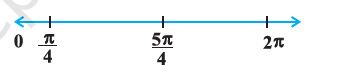
Now f'(x) = 0 gives sin x = cos x which gives that \(x=\frac{\pi}{4}, \frac{5 \pi}{4} \text { as } 0 \leq x \leq 2 \pi\)
The points \(x=\frac{\pi}{4} \text { and } x=\frac{5 \pi}{4}\) divide the interval [0, 2p] into three disjoint intervals namely,
\(\left[0, \frac{\pi}{4}\right),\left(\frac{\pi}{4}, \frac{5 \pi}{4}\right) \text { and }\left(\frac{5 \pi}{4}, 2 \pi\right]\)
\(\text {Note that } f^{\prime}(x)>0 \text {if } x \in\left[0, \frac{\pi}{4}\right) \cup\left(\frac{5 \pi}{4}, 2 \pi\right]\)
or f is increasing in the intervals \(\left[0, \frac{\pi}{4}\right) \text { and }\left(\frac{5 \pi}{4}, 2 \pi\right]\)
\(\text {Also }f^{\prime}(x)<0 \text { if } x \in\left(\frac{\pi}{4}, \frac{5 \pi}{4}\right)\)
or is plecreasing in \( \left(\frac{\pi}{4}, \frac{5 \pi}{4}\right)\)
| Interval | Sign of f'(x) | Nature of function |
| \(\left[0, \frac{\pi}{4}\right)\) | > 0 | f is increasing |
| \(\left(\frac{\pi}{4}, \frac{5 \pi}{4}\right)\) | < 0 | f is decreasing |
| \(\left(\frac{5 \pi}{4}, 2 \pi\right]\) | > 0 | f is increasing |
3.
Here g(x) = x - [x]
Let a be an integer and h is very small h > 0, then
\( [a-h]=a-1,[a+h]=a \)
\(\text {and } [a]=a \)
\(\text {At } x=a, \mathrm{LHL}=\lim _{x \rightarrow a^{-}} g(x)=\lim _{x \rightarrow a^{-}}(x-[x])\)
\(Put x=a-h ; when x \rightarrow a^{-}, then\ h \rightarrow 0\)
\( \mathrm{LHL} =\lim _{h \rightarrow 0}(a-h-[a-h]) \)
\(=\lim _{h \rightarrow 0}(a-h-(a-1)) \)
4.
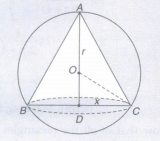
Let radius of cone be x and its height be h.
\(\therefore\) OD = (h - r)
Volume of cone (V)
\(=\frac { 1 }{ 3 } \pi { x }^{ 2 }h\) ...(i)
In \(\Delta OCD,\quad { x }^{ 2 }+({ h-r) }^{ 2 }={ r }^{ 2 }or\quad { x }^{ 2 }={ r }^{ 2 }-{ (h-r) }^{ 2 }\)
\(\therefore V=\frac { 1 }{ 3 } \pi h\{ { r }^{ 2 }-(h-r{ ) }^{ 2 }\} \)
\(=\frac { 1 }{ 3 } \pi (-{ h }^{ 3 }+{ 2h }^{ 2 }r)\)
\(\Rightarrow \frac { dV }{ dh } =\frac { \pi }{ 3 } (-3{ h }^{ 2 }+4hr)\)
\(\therefore \quad \frac { dV }{ dh } =0\Rightarrow h=\frac { 4r }{ 3 } \)
\(\frac { { d }^{ 2 }V }{ { dh }^{ 2 } } =\frac { \pi }{ 3 } (-6h+4r)\)
\(=\frac { \pi }{ 3 } \left( -6\left( \frac { 4r }{ 3 } \right) +4r \right) \)
\(=-\frac { 4\pi r }{ 3 } <0\)
\(\therefore \ at\quad h=\frac { 4r }{ 3 } \), Volume is maximum
Maximum volume
\(=\frac { 1 }{ 3 } \pi .\left\{ -{ \left( \frac { 4r }{ 3 } \right) }^{ 3 }+2{ \left( \frac { 4r }{ 3 } \right) }^{ 2 }r \right\} \)
\(=\frac { 8 }{ 27 } .\left( \frac { 4 }{ 3 } \pi { r }^{ 3 } \right) \)
\(=\frac { 8 }{ 27 } \) (volume of sphere)
5.
Here, \(f(x)=\left\{\begin{array}{cl} \lambda\left(x^{2}-2 x\right), & \text { if } x \leq 0 \\ 4 x+1, & \text { if } x>0 \end{array}\right.\)
At \(x=0, \mathrm{LHL}=\lim _{x \rightarrow 0^{-}} f(x)=\lim _{x \rightarrow 0^{-}} \lambda\left(x^{2}-2 x\right)\)
\(\therefore \mathrm{LHL}=\lim _{h \rightarrow 0} \lambda\left[(0-h)^{2}-2(0-h)\right]=\lim _{h \rightarrow 0}\left[\lambda\left(h^{2}+2 h\right)\right]=0\)
\(\mathrm{RHL}=\lim _{x \rightarrow 0^{+}} f(x)=\lim _{x \rightarrow 0^{+}}(4 x+1)\)
\(\therefore \mathrm{RHL}=\lim _{h \rightarrow 0}[4(0+h)+1]=\lim _{h \rightarrow 0}[4 h+1]=0+1=1\)
\(\text { [put } x=0+h \text { ; when } x \rightarrow 0^{+} \text {, then } \left.h \rightarrow 0\right] \)
\(\therefore \mathrm{LHL} \neq \mathrm{RHL}\)
Thus, f(x) is not continuous at x = 0 for any value of λ.
At x = 1,
\( \mathrm{LHL} =\lim _{x \rightarrow 1^{-}} f(x)=\lim _{x \rightarrow 1^{-}}(4 x+1) \)
\(\therefore \mathrm{LHL} =\lim _{h \rightarrow 0}[4(1-h)+1]=\lim _{h \rightarrow 0}[5-4 h]=5-0=5 \)
[put x=1−h; when x→1−,then h→0]
\( \mathrm{RHL}=\lim _{x \rightarrow 1^{+}} f(x)=\lim _{x \rightarrow 1^{+}}(4 x+1) \)
\(\therefore \lim _{h \rightarrow 0}[4(1+h)+1]=\lim _{h \rightarrow 0}(5+4 h)=5+0=5 \)
[put x=1+h; when x→1, then h→0]
Also, f(1)=4×1+1=5
\([\because f(x)=4 x+1]\)
Thus f(x) is continuous at x=1 for all values of λ.
6.
The area of a circle (A) with radius (r) is given by .
.
Therefore, the rate of change of area (A) with respect to time (t) is given by,
 [By chain rule]
It is given that .
.
Thus, when r = 8 cm,

Hence, when the radius of the circular wave is 8 cm, the enclosed area is increasing at the rate of 80 π cm2/s.
7.
Note that
f '(x) = 3x2 – 6x + 4
= 3(x2 – 2x + 1) + 1
= 3(x – 1)2 + 1 > 0, in every interval of R
Therefore, the function f is increasing on R.
8.
We have,
\(f(x)=x^{2}+2 x-8, x \in[-4,2]\)
Rolle'stheoremis satisfied
\( \therefore f^{\prime}(c)=0 \)
\(\Rightarrow f^{\prime}(c)=2 c+2=0 \)
\(c+1=0 \Rightarrow c=-1 \)
9.
Let g (x) = IxI and h(x) = sin x
Now,\(\operatorname{hog}(x)=h[g(x)]=h(|x|)=\sin |x|=f(x)\)
Since, g (x) and h( x) are both continuous function for all x∈ R,
so composition of g (x) and h( x) is also acontinuous function for all x ∈ R.
Hence, f(x) = sin [x] is a continuous function
10.
Here,
\(f(x) =\frac{x^{2}-25}{x+5}, x \neq-5 \)
\(\therefore f(x) = x - 5\) is a polynomial function, so f(x) is continuous at all values of x, provided \(x \neq-5.\)
11.
For x = 0,
f(x) is continuous and
at x = 1, LHL = 1 and RHL = 5,
hence discontinuous and
at x = 2;
f(x) = 5 which is continuous
12.
We have
\(f(x)=x^{2}+a x+1 \)
\(\therefore f^{\prime}(x)=2 x+a \)
Now, function f will be increasing in \( (1,2) \text { , if } f^{\prime}(x)>0 \text { in }(1,2) \text { . }\)
\(f^{\prime}(x)>0 \)
\(\Rightarrow 2 x+a>0 \)
\(\Rightarrow 2 x>-a \)
\(\Rightarrow x>\frac{-a}{2} \)
\(x>\frac{-a}{2}, \text { when } x \in(1,2) \)
\(\Rightarrow x>\frac{-a}{2}(\text { when } 1
\(\frac{-a}{2}=1 \)
\(\frac{-a}{2}=1 \Rightarrow a=-2 \)
13.
To see this we use the following facts
\(\lim _{x \rightarrow 0} \sin x=0\)
We have not proved it, but is intuitively clear from the graph of sin x near 0.
Now, observe that f (x) = sin x is defined for every real number. Let c be a real number. Put x = c + h. If x \(\rightarrow\) c we know that h \(\rightarrow\) 0. Therefore
\(\lim _{x \rightarrow c} f(x) =\lim _{x \rightarrow c} \sin x \)
\(=\lim _{h \rightarrow 0} \sin (c+h) \)
\(=\lim _{h \rightarrow 0}[\sin c \cos h+\cos c \sin h] \)
\(=\lim _{h \rightarrow 0}[\sin c \cos h]+\lim _{h \rightarrow 0}[\cos c \sin h] \)
\(=\sin c+0=\sin c=f(c) \)
Thus \(\lim _{x \rightarrow c} f(x)=f(c)\) and hence f is a continuous function.
14.
We have : x + y = 35 ...(1)
Let \(P=x^{ 2 }y^{ 5 }\)
\(x^{ 2 }(35-x)^{ 5 }\)
\(\therefore \frac { dP }{ dx } =x^{ 2 }.5(35-x)^{ 4 }(-1)+(35-x)^{ 5 }(2x)\)
\( =(35-x)^{ 4 }[-5x^{ 2 }+70x-2x^{ 2 }]\)
\(=(35-x)^{ 4 }(70x-7x^{ 2 })\)
\(=x(35-x)^{ 4 }(70-7x)\)
\(\frac { dP }{ dx } =0\)
\(\Rightarrow x(35-x)^{ 4 }(7x-70)=0\)
\(\Rightarrow x=0,10,35\)
Only admissible value is x = 0 \([\therefore\) x = 0 and 35 are rejected]
At x = 10
When x < 10 Slightly \(\frac { dP }{ dx } \) = (+) (+) (+) = +ve
When x>10 slightly \(\frac { dP }{ dx } \)= (+) (+) (-) = -ve
\(\Rightarrow \frac { dP }{ dx } \) changes for +ve to -ve
\(\Rightarrow \) P is maximum at x = 10
From (1), y = 35 - 10 = 25
Hence the required numbers are 10 and 25
15.
\(Let\quad y={ sin }^{ 3 }x+{ cos }^{ 6 }x\)
\(\frac { dy }{ dx } ={ 3sin }^{ 2 }x\frac { d }{ dx } \left( sin\quad x \right) +6{ cos }^{ 5 }x\frac { d }{ dx } (cos\quad x)\)
\(={ 3sin }^{ 2 }x(cos\quad x) +6{ cos }^{ 5 }x(-sin\quad x)\)
\(=3\quad sin\quad x.cos\quad x(sin\quad x-2{ cos }^{ 4 }x)\)
16.
\(We\quad have:\quad y=3\quad cos(log\quad x)+4\quad sin(log\quad x)....(1)\)
\(Diff.\quad w.r.t.\quad x,{ y }_{ 1 }=-3\quad sin(log\quad x).\frac { 1 }{ x } +4cos(log\quad x).\frac { 1 }{ x } \)
\({ xy }_{ 1 }=-3\quad sin(log\quad x)+4\quad cos(log\quad x)....(2)\)
\(Again\quad diff.\quad w.r.t.\quad x,\)
\({ xy }_{ 2 }+{ y }_{ 1 }=-3\quad cos(log\quad x).\frac { 1 }{ x } -4\quad sin\quad (log\quad x).\frac { 1 }{ x } \)
\({ x }^{ 2 }{ y }_{ 2 }+{ xy }_{ 1 }=-(3\quad cos(log\quad x)+4sin(log\quad x))\)
\(Hence,{ x }^{ 2 }{ y }_{ 2 }+{ xy }_{ 1 }+y=0\)
17.
\(We\quad have\quad :\quad x={ 2at }^{ 2 },y={ at }^{ 4 }\)
\(\frac { dx }{ dt } =4at,\frac { dy }{ dt } ={ 4at }^{ 3 }\)
\(\frac { dy }{ dx } =\frac { dy/dt }{ dx/dt } =\frac { { 4at }^{ 3 } }{ 4at } ={ t }^{ 2 }\)
18.
Let S(x) be the selling price of x items and let C(x) be the cost price of x items. Then, we have
\(\mathrm{S}(x)=\left(5-\frac{x}{100}\right) x=5 x-\frac{x^{2}}{100} \)
\(\mathrm{C}(x)=\frac{x}{5}+500 \)
Thus, the profit function P(x) is given by
\(\mathrm{P}(x)=\mathrm{S}(x)-\mathrm{C}(x)=5 x-\frac{x^{2}}{100}-\frac{x}{5}-500 \)
\(i.e., \mathrm{P}(x)=\frac{24}{5} x-\frac{x^{2}}{100}-500 \)
\(or \ \mathrm{P}^{\prime}(x)=\frac{24}{5}-\frac{x}{50} \)
\(\text { Now } \mathrm{P}^{\prime}(x)=0 \text { gives } x=240 \text { . Also } \mathrm{P}^{\prime \prime}(x)=\frac{-1}{50} \text { . So } \mathrm{P}^{\prime \prime}(240)=\frac{-1}{50}<0\)
Thus, x = 240 is a point of maxima. Hence, the manufacturer can earn maximum profit, if he sells 240 items.
19.
(b)
strictly decreasing in (-2,3)
20.
(d)
\(-e^x \tan e^x\)
21.
(d)
\(\frac{11}{4}\)
22.
(d)
-1
23.
(b)
continuous at x = 2
24.
(d)
h=r
25.
(b)
12
26.
The given equation of curve is
\(\begin{aligned}
&y=x^{3}-12 x+18\\
&\therefore \quad \frac{d y}{d x}=3 x^{2}-12\\
&\text { [on differentiating w.r.t. } x]
\end{aligned}\)
So, the slope of line parallel to the X-axis.
\(
therefore \quad\left(\frac{d y}{d x}\right)=0\\\Rightarrow \quad 3 x^{2}-12=0\\
\Rightarrow \quad x^{2}=\frac{12}{3}=4\\
\therefore\\
x=\pm 2\\
\text { For } x=2, y=2^{3}-12 \times 2+18=2\\
\text { and for } x=-2, y=(-2)^{3}-12(-2)+18=34\\
\text { So, the points are }(2,2) \text { and }(-2,34)
\)
27.
(a)
-xcosx -2sinx
28.
We have \(y^{x}=e^{y-x}\)
Taking log both sides, we get
\( x \log y =y-x \)
\( \Rightarrow x(\log y+1) =y \)
\(\Rightarrow \frac{y}{1+\log y} =x \)
\(\left(\frac{(1+\log y)-\left(\frac{1}{y}\right) y}{(1+\log y)^{2}}\right) \frac{d y}{d x}=1\)
\( \frac{\log y}{(1+\log y)^{2}} \frac{d y}{d x}=1 \)
\(\Rightarrow \frac{d y}{d x}=\frac{(1+\log y)^{2}}{\log y} \)
29.
x - [x] = 0 when x is an integer, so that f(x) is discontinuous for all x ∈ I i.e. f(x) is discontinuous at infinite number of points.
30.
(a)
564.06
31.
(c)
continuous everywhere
32.
(a)
1 m/h
33.
(b)
12π
34.
As \(\frac{dy}{dt}\) = 2x.\(\frac{dx}{dt}\)
⇒ 6.\(\frac{dx}{dt}\) = 2x.\(\frac{dx}{dt}\) ⇒ x = 3
From curve, y = 9. Point is (3, 9)
35.
As \(\frac { dx }{ dt } =2\) cm/s, x is side of equiolatral triangle.
A = \(\frac { \sqrt { 3 } }{ 4 } { x }^{ 2 }\)
\(\Rightarrow \frac { dA }{ dx } =\frac { \sqrt { 3 } }{ 2 } { x }\frac { dx }{ dt } \)
= \(\frac { \sqrt { 3 } }{ 2 } x2=\sqrt { 3 } x\)
∴\(|\frac{dA}{dx}|\)x=10 = 10\(\sqrt3\) cm2/s
36.
As \(\lim _{ x\rightarrow 0 }{ \frac { \sqrt { \frac { 1 }{ 2 } (1-cosx) } }{ x } } \)
\(=\lim _{ x\rightarrow 0 }{ \frac { |sin \ x| }{ x } } \)
and LHL ≠ RHL at x = 0
37.
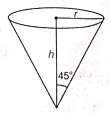
Let r be the radius and h be the height of conical part.
Here, \(\tan 45^{\circ}=\frac{r}{h} \Rightarrow 1=\frac{r}{h} \Rightarrow h=r\)
The volume of water in the tank
\(V=\frac{1}{3} \pi r^2 h=\frac{1}{3} \pi r^3 \mathrm{~cm}^3 \quad[\because h=r]\)
(ii) \( \frac{d V}{d t}=\frac{3}{3} \pi r^2 \frac{d r}{d t} \)
\(\Rightarrow \quad-2=\pi r^2 \frac{d r}{d t} \quad\left[\because \frac{d V}{d t}=-2\right]\)
\( \Rightarrow \quad \frac{d r}{d t}=\frac{-2}{\pi r^2}=\frac{-2}{\pi(2 \sqrt{2})^2}=\frac{-1}{4 \pi}\)
\({[r=2 \sqrt{2} \text { (given) }]}\)
Hence, the rate of decrease of radius is \(\frac{1}{4 \pi} \mathrm{cm} / \mathrm{s}\).
(iii) (b) \(\therefore S=\pi r l \Rightarrow S=\pi h l\) \([\because r=h]\)
\(\Rightarrow \quad S=\pi h \sqrt{h^2+r^2}\)
(a) \(\therefore S=\pi r l \)
\(=\pi r \sqrt{h^2+r^2}=\pi r \sqrt{2 r^2} \)
\({\left[\because l=\sqrt{h^2+r^2} ; \ \because h=r\right]}\)
\(=\sqrt{2} \pi r^2\)
\(\Rightarrow \frac{d S}{d t}=\sqrt{2} \pi(2 r) \frac{d r}{d t}\)
\(\Rightarrow \quad \frac{d S}{d t}=2 \sqrt{2} \pi r \frac{d r}{d t}\)
\(\Rightarrow\left(\frac{d S}{d t}\right)_{r=2 \sqrt{2}}=2 \sqrt{2} \pi(2 \sqrt{2})\left(\frac{-1}{4 \pi}\right)\)
\(=-2 \mathrm{~cm}^2 / \mathrm{s} \)
Or \(\text { (b) } \therefore S=\pi r l \Rightarrow S=\pi h l\) \({[\because r=h]}\)
\( \Rightarrow S=\pi h \sqrt{h^2+r^2} \)
\(\Rightarrow \quad S=\sqrt{2} \pi h^2 \)
\(\Rightarrow \quad \frac{d S}{d t}=\sqrt{2} \pi(2 h) \frac{d h}{d t}\)
\(\Rightarrow \quad \frac{d S}{d t}=2 \sqrt{2} \pi h \frac{d h}{d t}\)
\( \Rightarrow \quad \frac{d S}{d t}=2 \sqrt{2} \pi(2 \sqrt{2}) \frac{d h}{d t}\)
\( \text { [since, } l^2=r^2+h^2 \Rightarrow l^2=2 h^2\)
\(\left.\Rightarrow 16=2 h^2 \Rightarrow h=2 \sqrt{2}\right]\)
\( \Rightarrow \quad-2=8 \pi \frac{d h}{d t}\) \({[\because \text { from Eq. (i) }]}\)
\( \Rightarrow \quad \frac{d h}{d t}=-\frac{1}{4 \pi} \mathrm{cm} / \mathrm{s}\)
\(\text { (b) } \therefore S=\pi r l \Rightarrow S=\pi h l\)
\([\because r=h]\)
\(\Rightarrow S=\pi h \sqrt{h^2+r^2}\)
\(\Rightarrow \quad S=\sqrt{2} \pi h^2\)
\(\Rightarrow \quad \frac{d S}{d t}=\sqrt{2} \pi(2 h) \frac{d h}{d t}\)
\(\Rightarrow \quad \frac{d S}{d t}=2 \sqrt{2} \pi h \frac{d h}{d t}\)
\(\Rightarrow \quad \frac{d S}{d t}=2 \sqrt{2} \pi(2 \sqrt{2}) \frac{d h}{d t}\)
\(\text { [since, } l^2=r^2+h^2 \Rightarrow l^2=2 h^2\)
\(\left.\Rightarrow 16=2 h^2 \Rightarrow h=2 \sqrt{2}\right]\)
\(\Rightarrow \quad-2=8 \pi \frac{d h}{d t}\)
\([\because \text { from Eq. (i) }]\)
\(\Rightarrow \quad \frac{d h}{d t}=-\frac{1}{4 \pi} \mathrm{cm} / \mathrm{s}\)
38.
Given, \(f(x)=\left\{\begin{array}{c}|x-3|, x \geq 1 \\ \frac{x^2}{4}-\frac{3 x}{2}+\frac{13}{4}, x<1\end{array}\right.\)
\(f^{\prime}(x)=\left\{\begin{array}{cc}
-1, & 1<x<3 \\
\frac{x}{2}-\frac{3}{2}, & x<1
\end{array}\right.\)
(i) \(R f^{\prime}(1)=-1\)
(ii) \(L f^{\prime}(1)=\frac{1}{2}-\frac{3}{2}=\frac{-2}{2}=-1\)
(iii) (a) Since, \(L f^{\prime}(1)=R f^{\prime}(1)=-1\)
\(\Rightarrow f(x)\) is differentiable at x = -1
Or
(b) \(f^{\prime}(2)=-1,1 \leq 2<3\)
and \(f^{\prime}(-1)=\frac{-1}{2}-\frac{3}{2}, x<1=\frac{-4}{2}=-2\)
39.
(i) (a) : Let \(\begin{equation} y=\cos \sqrt{x} \end{equation}\)
\(\begin{equation} \therefore \quad \frac{d y}{d x}=\frac{d}{d x}(\cos \sqrt{x})=-\sin \sqrt{x} \cdot \frac{d}{d x}(\sqrt{x}) \end{equation}\)
\(\begin{equation} =-\sin \sqrt{x} \times \frac{1}{2 \sqrt{x}}=\frac{-\sin \sqrt{x}}{2 \sqrt{x}} \end{equation}\)
(ii) (a) : Let \(\begin{equation} y=7^{x+\frac{1}{x}} \quad \therefore \quad \frac{d y}{d x}=\frac{d}{d x}\left(7^{x+\frac{1}{x}}\right) \end{equation}\)
\(\begin{equation} =7^{x+\frac{1}{x}} \cdot \log 7 \cdot \frac{d}{d x}\left(x+\frac{1}{x}\right)=7^{x+\frac{1}{x}} \cdot \log 7 \cdot\left(1-\frac{1}{x^{2}}\right) \end{equation}\)
\(\begin{equation} =\left(\frac{x^{2}-1}{x^{2}}\right) \cdot 7^{x+\frac{1}{x}} \cdot \log 7 \end{equation}\)
(iii) (a) : Let \(\begin{equation} y=\sqrt{\frac{1-\cos x}{1+\cos x}}=\sqrt{\frac{1-1+2 \sin ^{2} \frac{x}{2}}{2 \cos ^{2} \frac{x}{2}-1+1}}=\tan \left(\frac{x}{2}\right) \end{equation}\)
\(\begin{equation} \therefore \frac{d y}{d x}=\sec ^{2} \frac{x}{2} \cdot \frac{1}{2}=\frac{1}{2} \sec ^{2} \frac{x}{2} \end{equation}\)
(iv) (b) : Let \(\begin{equation} y=\frac{1}{b} \tan ^{-1}\left(\frac{x}{b}\right)+\frac{1}{a} \tan ^{-1}\left(\frac{x}{a}\right) \end{equation}\)
\(\begin{equation} \therefore \quad \frac{d y}{d x}=\frac{1}{b} \times \frac{1}{1+\frac{x^{2}}{b^{2}}} \times \frac{1}{b}+\frac{1}{a} \times \frac{1}{1+\frac{x^{2}}{a^{2}}} \times \frac{1}{a} \end{equation}\)
\(\begin{equation} =\frac{1}{b^{2}+x^{2}}+\frac{1}{a^{2}+x^{2}} \end{equation}\)
(v) (d) : Let \(\begin{equation} y=\sec ^{-1} x+\operatorname{cosec}^{-1} \frac{x}{\sqrt{x^{2}-1}} \end{equation}\)
Put \(\begin{equation} x=\sec \theta \Rightarrow \theta=\sec ^{-1} x \end{equation}\)
\(\begin{equation} \therefore \quad y=\sec ^{-1}(\sec \theta)+\operatorname{cosec}^{-1}\left(\frac{\sec \theta}{\sqrt{\sec ^{2} \theta-1}}\right) \end{equation}\)
\(\begin{equation} =\theta+\sin ^{-1}\left[\sqrt{1-\cos ^{2} \theta}\right] \end{equation}\)
\(\begin{equation} =\theta+\sin ^{-1}(\sin \theta)=\theta+\theta=2 \theta=2 \sec ^{-1} x \end{equation}\)
\(\begin{equation} \therefore \quad \frac{d y}{d x}=2 \frac{d}{d x}\left(\sec ^{-1} x\right)=2 \times \frac{1}{|x| \sqrt{x^{2}-1}}=\frac{2}{|x| \sqrt{x^{2}-1}} \end{equation}\)
40.
(b) We have, f(x) = x2 - 4x + 6 or f'(x) = 2x - 4

Therefore, f'(x) = 0 gives x = 2. Now, the point x = 2 divides the real line into two disjoint intervals namely, (- \(\infty\), 2) and (2, \(\infty\)). In the interval ( -\(\infty\), 2), f'(x) = 2x - 4 < 0.
Therefore,f is strictly decreasing in this interval. Also, in the interval (2, \(\infty\)), f'(x) > 0 and so the function f is strictly increasing in this interval.
Both Assertion and Reason are correct but Reason is not the correct explanation of Assertion.
41.
(a) Assertion is correct, Reason is correct; Reason is a correct explanation for assertion.

12th Standard CBSE Syllabus & Materials
12th Standard CBSE
CBSE 12th Computer Science Python Revision Tour I - New Previous year Question Papers Study Material - QB365 Set A
NEW12th Standard CBSE
CBSE 12th Business Studies Planning Important Questions And Answers Study Material - QB365 Set A
NEW12th Standard CBSE
CBSE 12th Business Studies Business Environment Important Questions And Answers Study Material - QB365 Set A
NEW12th Standard CBSE
CBSE 12th Business Studies Principles of Management Important Questions And Answers Study Material - QB365 Set A



NCERT Books

Syllabus

Exam Pattern

Sample Question Papers

Previous year Question Papers

Important Notes

MCQ Practice test

NCERT Exemplers

Case study Questions

Image Based Questions

Passage based Questions

HOT Questions

Value Based Questions

Model Questions Papers
NCERT ( Book Back ) Questions

Assertion and Reason
Important Questions And Answers

CBSE 12th Standard CBSE Subjects
CBSE Standards








