
 100% FREE ACCESS
12th Standard CBSE Syllabus & Materials
12th Standard CBSE
CBSE 12th Economics Government Budget and the Economy Previous year Question Papers Study Material - QB365 Set A
NEW12th Standard CBSE
CBSE 12th Computer Science Interface Python with MySQL - New Previous year Question Papers Study Material - QB365 Set A
NEW12th Standard CBSE
CBSE 12th Computer Science Database Concept - New Previous year Question Papers Study Material - QB365 Set A
NEW12th Standard CBSE
CBSE 12th Computer Science Data Communication - New Previous year Question Papers Study Material - QB365 Set A
NEW12th Standard CBSE
CBSE 12th Computer Science Data Structures - New Previous year Question Papers Study Material - QB365 Set A
NEW12th Standard CBSE
CBSE 12th Computer Science Functions - New Previous year Question Papers Study Material - QB365 Set A

Published on: 25/10/2025
Download CBSE Class 12th Standard CBSE Maths question papers, sample papers, important questions, and previous year solved papers in PDF format. Get free study materials, NCERT solutions, and exam preparation resources for Class 12th Standard CBSE Maths
Questions + Answers key
Take MCQ Maths Test
1.
Find all points of discontinuity of f, where f is defined by
\(f(x)=\left\{\begin{array}{ll} x+1, & \text { if } x \geq 1 \\ x^{2}+1, & \text { if } x<1 \end{array}\right.\)
2.
solve the system of equations \(\frac{2}{x}+\frac{3}{y}+\frac{10}{z}=2, \frac{4}{x}-\frac{6}{y}+\frac{5}{z}=5\) and \(\frac{6}{x}+\frac{9}{y}-\frac{20}{z}=-4\)
3.
Show that of all the rectangles inscribed in a given fixed circle, the square has the maximum area.
4.
Find the values of each of the following:
\(\tan\frac { 1 }{ 2 } \left[ { \sin }^{ -1 }\frac { 2x }{ 1+{ x }^{ 2 } } +{ \cos }^{ -1 }\frac { 1-{ y }^{ 2 } }{ 1+{ y }^{ 2 } } \right] ,\ \left| x \right| <1,\ y>0\) and xy < 1.
5.
Show that the relation R in the set {1, 2, 3} given by R = {(1, 1), (2, 2), (3, 3), (1, 2), (2, 3)} is reflexive but neither symmetric nor transitive.
6.
Show that the function f given by \(f(x)=x^{3}-3 x^{2}+4 x, x \in R\) is strictly increasing on R.
7.
Examine the consistency of the system of equations. x + 3y = 5 and 2x + 6y = 8.
8.
Find the principal values of the following: \({ cos }^{ -1 }\left( \frac { \sqrt { 3 } }{ 2 } \right) \)
9.
Is the function f defined by \(f(x)=\begin{cases} x\quad ,\quad if\quad x\le 1 \\ 5\quad ,\quad if\quad x>1 \end{cases}\) continuous at x = 0? at x = 1? at x = 2?
10.
Find the points at which the function f given by \(f(x)=(x-4)^{4}(x+1)^{3}\)
(i) local maxima.
(ii) local minima.
(iii) point of inflection.
11.
If \(A=\left[\begin{array}{ccc}3 & \sqrt{3} & 2 \\ 4 & 2 & 0\end{array}\right]\ and \ B=\left[\begin{array}{ccc}2 & -1 & 2 \\ 1 & 2 & 4\end{array}\right]\) then verify that
(i)\(\left(A^{\prime}\right)^{\prime}=A\)
(ii) \((A+B)^{\prime}=A^{\prime}+B^{\prime}\)
(iii) \((k B)^{\prime}=k B^{\prime},\) where is any constant.
12.
Find dy/dx of the function : \(xy={ e }^{ (x-y) }\)
13.
Solve the system of linear equations, using matrix method in
2x - y = -2
3x + 4y = 3
14.
Find the principal values of the following: \(\tan ^{-1}(1)+\cos ^{-1}-\frac{1}{2}+\sin ^{-1} \quad-\frac{1}{2}\)
15.
Let A be the set of all 50 students of Class X in a school. Let f : A → N be function defined by f (x) = roll number of the student x. Show that f is one-one but not onto.
16.
If A is a square matrix of onder 3 such that the value of \(|\operatorname{adj} A|=8\), then the value of |\(\mid A^T|\) is
\(\sqrt{2}\)
\(-\sqrt{2}\)
8
\(2 \sqrt{2}\)
17.
If A is a square matrix such that A²=A, then (I + A)3 – 7A is
A
I + A
I - A
I
18.
Derivative of \(\frac{x}{x-1}\) with respect to x, is
2
\(\frac{1}{(x-1)^{2}}\)
\(\frac{2 x-1}{(x-1)^{2}}\)
\(\frac{-1}{(x-1)^{2}}\)
19.
Let Z be the set of integers. Define a binary operation * in Z x Z as (a, b) * (c, d) = (a + c, b +d), then binary operation * is
not commutative
not associative
commutative and associative
does not have identity element
20.
The area of a triangle is computed using the formula \(S=\frac{1}{2} b c \sin A\).If the relative errors made in measuring b,e and calcuting S are respectively 0.02, 0.01 and 013 the approximate error in A when \(A=\pi / 6\) .
0.05 radians
0.01 radians
0.05 degree
0.01 degree
21.
The value of c in Rolle's theorem for the function \(f(x)=x^{3}-3 x\) in the interval \([0, \sqrt{3}]\)
1
-1
\(\frac{3}{2}\)
\(\frac{1}{3}\)
22.
The value of c in Rolle's theorem for the function \(f(x)=x^{2}+2 x-8, x \in[-4,2]\) is
1
-1
2
-2
23.
Which of the given values of x and y make the following pair of matrices equal \(\left[\begin{array}{cc} 3 x+7 & 5 \\ y+1 & 2-3 x \end{array}\right]\left[\begin{array}{cc} 0 & y-2 \\ 8 & 4 \end{array}\right] ?\)
\(x=\frac{-1}{3}, y=7\)
not possible to find
\(y=7, x=\frac{-2}{3}\)
\(x=\frac{-1}{3}, y=\frac{-2}{3}\)
24.
A relation f from C to R is defined by \(x f y \Leftrightarrow|x|=y\).Then, the correct option is
(2+i)f3
3f(-3)
i f 1
(2 +3i) f 13
25.
A cylindrical tank of radius 10 m is being filled with wheat at the rate of 314 cubic metre per hour. Then the depth of the wheat is increasing at the rate of
1 m/h
0.1 m/h
1.1 m/h
0.5 m/h
26.
For all real values of x, the minimum value of \(\frac { 1-x+{ x }^{ 2 } }{ 1+x+{ x }^{ 2 } } \) is
0
1
3
\(\frac { 1 }{ 3 } \)
27.
The point on the curve x2 = 2y which is nearest to the point (0, 5) is
(2 \(\sqrt2\),4)
(2 \(\sqrt2\),0)
(0, 0)
(2, 2)
28.
Which of the following functions are decreasing on 0, \(\frac{\pi}{2}\)?
cos x
cos 2x
cos 3x
tan x
29.
Let A = \(\left[ \begin{matrix} 1 & sin\theta & 1 \\ -sin\theta & 1 & sin\theta \\ -1 & -sin\theta & 1 \end{matrix} \right] \), where 0 ≤ θ ≤2ㅠ.Then
Det (A) = 0
Det (A) ∈ (2, ∞)
Det (A) ∈ (2, 4)
Det (A) ∈ [2, 4]
30.
If \(\begin{vmatrix} x & 2 \\ 18 & x \end{vmatrix}=\begin{vmatrix} 6 & 2 \\ 18 & 6 \end{vmatrix}\) , then x is equal to
6
土6
-6
0
31.
A = [aij]m × n\ is a square matrix, if
m < n
m > n
m = n
None of these
32.
\(\sin\left( \frac { \pi }{ 3 } -{ \sin }^{ -1 }\left( -\frac { 1 }{ 2 } \right) \right) \) is equal to
\(\frac { 1 }{ 2 } \)
\(\frac { 1 }{ 3 } \)
\(\frac { 1 }{ 4 } \)
1
33.
\({ \cos }^{ -1 }\left( \cos\frac { 7\pi }{ 6 } \right) \) is equal to
\(\frac { 7\pi }{ 6 } \)
\(\frac { 5\pi }{ 6 } \)
\(\frac { \pi }{ 3 } \)
\(\frac { \pi }{ 6 } \)
34.
Let f : R ➝ R be defined as f (x) = 3x. Choose the correct answer
f is one-one onto
f is many-one onto
f is one-one but not onto
f is neither one-one nor onto
35.
Principal value of the expression cos-1[cos(-680°)] is
\(\frac{2\pi}{9}\)
-\(\frac{2\pi}{9}\)
\(\frac{34\pi}{9}\)
\(\frac{\pi}{9}\)
36.
A real estate company is going to build a new residential complex. The land they have purchased can hold at most 4500 apartments. Also, if they make x apartments, then the monthly maintenance cost for the whole
complex would be as follows: Fixed cost = Rs. 50,00,000,Variable cost = Rs.(160x - 0.04x2)
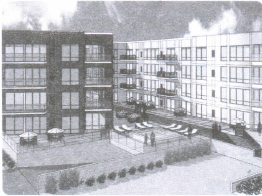
Based on the above information, answer the following questions.
(i) The maintenance cost as a function of x will be
| (a) 160x - 0.04x2 | (b) 5000000 | (c) 5000000 + 160x -0.04x2 | (d) None of these |
(ii) If C(x) denote the maintenance cost function, then maximum value of C(x) occur at x =
| (a) 0 | (b) 2000 | (c) 4500 | (d) 5000 |
(iii) The maximum value of C(x) would be
| (a) Rs. 5225000 | (b) Rs. 5160000 | (c) Rs. 5000000 | (d) Rs. 4000000 |
(iv) The number of apartments, that the complex should have in order to minimize the maintenance cost, is
| (a) 4500 | (b) 5000 | (c) 1750 | (d) 3500 |
(v) If the minimum maintenance cost is attain, then the maintenance cost for each apartment would be
| (a) Rs. 1091.11 | (b) Rs. 1200 | (c) Rs. 1000 | (d) Rs. 2000 |
37.
Let f(x) be a real valued function, then its
Left Hand Derivative (L.H.D.) : \(\begin{equation} \mathrm{L} f^{\prime}(a)=\lim _{h \rightarrow 0} \frac{f(a-h)-f(a)}{-h} \end{equation}\)
Right Hand Derivative (R.H.D.) : \(\begin{equation} \mathrm{Rf}^{\prime}(a)=\lim _{h \rightarrow 0} \frac{f(a+h)-f(a)}{h} \end{equation}\)
Also, a function jfx) is said to be differentiable at x = a if its L.H.D. and R.H.D. at x = a exist and are equal
For the function \(\begin{equation} f(x)=\left\{\begin{array}{l} |x-3|, x \geq 1 \\ \frac{x^{2}}{4}-\frac{3 x}{2}+\frac{13}{4}, x<1 \end{array}\right. \end{equation}\) answer the following questions
(i) R.H.D. of f(x) at x = 1is
| (a) 1 | (b) -1 | (c) 0 | (d) 2 |
(ii) L.H.D. of f(x) at x = 1 is
| (a) 1 | (b) -1 | (c) 0 | (d) 2 |
(iii) f(x) is non-differentiable at
| (a) x = 1 | (b) x = 2 | (c) x = 3 | (d) x = 4 |
(iv) Find the value of f'(2).
| (a) 1 | (b) 2 | (c) 3 | (d) -1 |
(v) The value of f'( -1) is
| (a) 2 | (b) 1 | (c) -2 | (d) -1 |
38.
Consider 2 families A and B. Suppose there are 4 men, 4 women and 4 children in family A and 2 men, 2 womei and 2 children in family B. The recommend daily amount of calories is 2400 for a man, 1900 for a woman, 1801 for a children and 45 grams of proteins for a man, 55 grams for a woman and 33 grams for children.
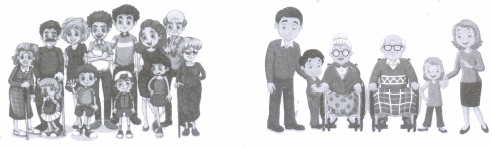
Based on the above information, answer the following questions
(i) The requirement of calories and proteins for each person in matrix form can be represented as

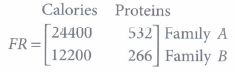
(ii) Requirement of calories of family A is
| (a) 24000 | (b) 24400 | (c) 15000 | (d) 15800 |
(iii) Requirement of proteins for family B is
| (a) 560 grams | (b) 332 grams | (c) 266 grams | (d) 300 grams |
(iv) If A and B are two matrices such that AB = Band BA = A, then A 2 + B2 equals
| (a) 560 grams | (b) 332 grams | (c) 266 grams | (d) 300 grams |
(v) If \(A=\left(a_{i j}\right)_{m \times n}, B=\left(b_{i j}\right)_{n \times p} \text { and } C=\left(c_{i j}\right)_{p \times q^{2}}\) and \(C=\left(c_{i j}\right)_{p \times q},\) then the product (BC)A is possible only when
| (a) m=q | (b) n=q | (c) p=q | (d) m=p |
1.
\(f(x)=\left\{\begin{array}{ll} x+1, & \text { if } x \geq 1 \\ x^{2}+1, & \text { if } x<1 \end{array}\right.\)
The given function f is defined at all the points of the real line.
Let c be a point on the real line.
Case I:\(\text { If } c<1, \text { then } f(c)=c^{2}+1 \text { and } \lim _{x \rightarrow c} f(x)=\lim _{x \rightarrow c}\left(x^{2}+1\right)=c^{2}+1\)
\(\therefore \lim _{x \rightarrow c} f(x)=f(c) \)
Therefore, f is continuous at all points x, such that x < 1
Case II: \(\text { If } c=1, \text { then } f(c)=f(1)=1+1=2\)
The left hand limit of f at x = 1 is,
\(\lim _{x \rightarrow 1^{-}} f(x)=\lim _{x \rightarrow 1^{-}}\left(x^{2}+1\right)=1^{2}+1=2\)
The right hand limit of f at x = 1 is,
\(\lim _{x \rightarrow 1^{+}} f(x)=\lim _{x \rightarrow 1^{+}}(x+1)=1+1=2 \)
\(\therefore \lim _{x \rightarrow 1} f(x)=f(1) \)
Therefore, f is continuous at x = 1
Case III: \(\text { If } c>1, \text { then } f(c)=c+1 \)
\(\lim _{x \rightarrow c} f(x)=\lim _{x \rightarrow c}(x+1)=c+1 \)
\(\therefore \lim _{x \rightarrow c} f(x)=f(c) \)
Therefore, f is continuous at all points x, such that x > 1
Hence, the given function f has no point of discontinuity
2.
Let \(\frac{1}{x}=p, \frac{1}{y}=q\) and \(\frac{1}{z}=r\)
Then, the given equations becomes \(2 p+3 q+10 r=2\)
\(4 p-6 q+5 r=5 \)
6 p+9 q-20 r=-4
This system can be written as AX = B, where
\(A=\left[\begin{array}{ccc} 2 & 3 & 10 \\ 4 & -6 & 5 \\ 6 & 9 & -20 \end{array}\right], X=\left[\begin{array}{l} p \\ q \\ r \end{array}\right], B=\left[\begin{array}{c} 2 \\ 5 \\ -4 \end{array}\right]\)
Here, \(|A|=\left|\begin{array}{ccc}2 & 3 & 10 \\ 4 & -6 & 5 \\ 6 & 9 & -20\end{array}\right|\)
=2(120-45)-3(-80-30)+10(36+36)
\( =150+330+720 =1200 \neq 0\)
Thus, A is non-singular, therefore its inverse exists.
Therefore, the above system has a unique solution given by X=A-1 B
Cofactors of A are
\(C_{11} =75, \quad C_{21}=150, \quad C_{31}=75\)
\(C_{12} =110, C_{22}=-100, \quad C_{32}=30\)
\(C_{13} =72, C_{23}=0 \text { and } C_{33}=-24 \)
\(\therefore \operatorname{adj}(A) =\left[\begin{array}{ccc}
75 & 110 & 72 \\
150 & -100 & 0 \\
75 & 30 & -24
\end{array}\right] \)
\(=\left[\begin{array}{ccc}
75 & 150 & 75 \\
110 & -100 & 30 \\
72 & 0 & -24
\end{array}\right]\)
\(\therefore \quad A^{-1} =\frac{1}{|A|}(\operatorname{adj} A)=\frac{1}{1200}\left[\begin{array}{ccc}
75 & 150 & 75 \\
110 & -100 & 30 \\
72 & 0 & -24
\end{array}\right]\)
Now, X=A-1B
\( \Rightarrow\left[\begin{array}{l}
p \\
q \\
r
\end{array}\right]=\frac{1}{1200}\left[\begin{array}{ccc}
75 & 150 & 75 \\
110 & -100 & 30 \\
72 & 0 & -24
\end{array}\right]\left[\begin{array}{c}
2 \\
5 \\
-4
\end{array}\right] \)
\(=\frac{1}{1200}\left[\begin{array}{c}
150+750-300 \\
220-500-120 \\
144+0+96
\end{array}\right] \)
\(=\frac{1}{1200}\left[\begin{array}{c}
900-300 \\
220-620 \\
144+96
\end{array}\right]=\frac{1}{1200}\left[\begin{array}{c}
600 \\
-400 \\
240
\end{array}\right]=\left[\begin{array}{c}
1 / 2 \\
-1 / 3 \\
1 / 5
\end{array}\right]\)
\(\Rightarrow \quad p=\frac{1}{2}, q=-\frac{1}{3}, r=\frac{1}{5}\)
\(\therefore \quad x =2, y=-3 \text { and } z=5\)
3.
Let ABCD be a rectangle inscribed in a given circle with centre at 0 and radius a.
Let AB = 2x and BC = 2y
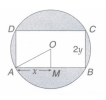
Then, OA2 = OM2 + AM2
\(\Rightarrow a^2=y^2+x^2\)
\(\Rightarrow y=\sqrt{a^2-x^2}\)
Let A be the area of the rectangle.
\(\therefore A=4xy=4x\sqrt{x^2-x^2}\)
\(\Rightarrow \ \ \frac{dA}{dx}=4\{\frac{a^2-2x^2}{\sqrt{a^2-x^2}}\}\)
For maximum or minimum value of A,
\(\frac{dA}{dx}=0\)
\(=4\{\frac{a^2-2x^2}{\sqrt{a^2-x^2}}\}=0\Rightarrow\ \ x=\frac{a}{\sqrt{2}}\)
Now, \(\frac{d^2A}{dx^2}=4\frac{d}{dx}\{(a^2-2x^2)(a^2-x^2)^{-1/2}\}\)
\(\Rightarrow \frac{d^2A}{dx^2}=4[-4x(a^2-x^2)^{-1/2}+(a^2-2x^2)\times(-1/2)(a^2-x^2)^(-3/2)(-2x)]\)
\(=[\frac{-4x}{\sqrt{a^2-x^2}}+\frac{x(a^2-2x^2)}{(a^2-x^2)^{3/2}}]\)
\(\therefore\ (\frac{d^2A}{dx^2})_{x=\frac{a}{\sqrt2}}=-16<0\)
Thus A is maximum when \(x=\frac{a}{\sqrt2}\)
putting \(x=\frac{a}{\sqrt2}\) in (i) \(y=\frac{a}{\sqrt2}\)
Therefore \(x=y=\frac{a}{\sqrt2}\)
Hence area is maximum when x = y ⇒ 2x = 2y
i.e., the rectangle is a square.
4.
\( \text { We have, } \tan \frac{1}{2}\left(\sin ^{-1} \frac{2 x}{1+x^{2}}+\cos ^{-1} \frac{1-y^{2}}{1+y^{2}}\right) \)
\(=\tan \frac{1}{2}\left(2 \tan ^{-1} x+2 \tan ^{-1} y\right) \)
\(\left[\because 2 \tan ^{-1} x=\sin ^{-1}\left(\frac{2 x}{1+x^{2}}\right)=\cos ^{-1}\left(\frac{1-x^{2}}{1+x^{2}}\right)\right] \)
\(= \tan \frac{1}{2} \times 2\left(\tan ^{-1} x+\tan ^{-1} y\right) \)
\(= \tan \left[\tan ^{-1}\left(\frac{x+y}{1-x y}\right)\right] \)
\(= \frac{x+y}{1-x y} \because \tan ^{-1} x+\tan ^{-1} y=\mid \tan ^{-1}\left(\frac{x+y}{1-x y}\right) \)
\(\text { and } \tan \left(\tan ^{-1} \theta\right)=\theta \)
5.
R is reflexive, since (1, 1), (2, 2) and (3, 3) lie in R. Also, R is not symmetric, as (1, 2) \(\in\) R but (2, 1) \(\notin\) R. Similarly, R is not transitive, as (1, 2) \(\in\) R and (2, 3) \(\in\) R but (1, 3) \(\notin\) R.
6.
Note that
f '(x) = 3x2 – 6x + 4
= 3(x2 – 2x + 1) + 1
= 3(x – 1)2 + 1 > 0, in every interval of R
Therefore, the function f is increasing on R.
7.
The given system of equation is
x + 3y = 5 and
2x + 6y = 8.
The given system of equations can be written in the form of A X = B, where
\(A=\left[\begin{array}{ll} 1 & 3 \\ 2 & 6 \end{array}\right], X=\left[\begin{array}{l} x \\ y \end{array}\right] \text { and } B=\left[\begin{array}{l} 5 \\ 8 \end{array}\right] \).
Now, |A| = 1(6) - 3(2) = 6 - 6 = 0
∴ A is a singular matrix.
\(\text { Now, }(\operatorname{adj} A)=\left[\begin{array}{cc} 6 & -3 \\ -2 & 1 \end{array}\right]\)
\((a d j A) B=\left[\begin{array}{cc} 6 & -3 \\ -2 & 1 \end{array}\right]\left[\begin{array}{l} 5 \\ 8 \end{array}\right]=\left[\begin{array}{c} 30-24 \\ -10+8 \end{array}\right]=\left[\begin{array}{l} 6 \\ -2 \end{array}\right] \neq O\)
Thus, the solution of the given system of equations does not exist. Hence, the system of equation is inconsistent
8.
Let \(\cos ^{-1}\left(\frac{\sqrt{3}}{2}\right)=\theta \Rightarrow \cos \theta=\frac{\sqrt{3}}{2}\)
We know that the principal value branch of cos-1 is \( [0, \pi] \)
\(\therefore \quad \cos \theta=\frac{\sqrt{3}}{2}=\cos \frac{\pi}{6} \Rightarrow \theta=\frac{\pi}{6} \)
\(\Rightarrow \cos ^{-1}\left(\frac{\sqrt{3}}{2}\right)=\frac{\pi}{6} \in[0, \pi] \)
Hence, the principal value of \(\cos ^{-1}\left(\frac{\sqrt{3}}{2}\right) \text { is } \frac{\pi}{6}\)
9.
For x = 0,
f(x) is continuous and
at x = 1, LHL = 1 and RHL = 5,
hence discontinuous and
at x = 2;
f(x) = 5 which is continuous
10.
The given function is \( f(x)=(x-2)^{4}(x+1)^{3} \text { . }\)
\(\therefore f^{\prime}(x) =4(x-2)^{3}(x+1)^{3}+3(x+1)^{2}(x-2)^{4} \)
\(=(x-2)^{3}(x+1)^{2}[4(x+1)+3(x-2)] \)
\(=(x-2)^{3}(x+1)^{2}(7 x-2) \)
\(\text { Now, } f^{\prime}(x)=0 \Rightarrow x=-1 \text { and } x=\frac{2}{7} \text { or } x=2\)
Now, for values of x close to \( \frac{2}{7} \)and to the left of \(\frac{2}{7}, f^{\prime}(x)>0\). Also, for values of x close to \(\frac{2}{7}\)and to
\(\text { the right of } \frac{2}{7}, f^{\prime}(x)<0\)
\(\text {Thus, } x=\frac{2}{7} \)is the point of local maxima
11.
(i) We have
\(\mathrm{A}=\left[\begin{array}{lll}
3 & \sqrt{3} & 2 \\
4 & 2 & 0
\end{array}\right] \Rightarrow \mathrm{A}^{\prime}=\left[\begin{array}{cc}
3 & 4 \\
\sqrt{3} & 2 \\
2 & 0
\end{array}\right] \Rightarrow\left(\mathrm{A}^{\prime}\right)^{\prime}=\left[\begin{array}{lll}
3 & \sqrt{3} & 2 \\
4 & 2 & 0
\end{array}\right]=\mathrm{A}\)
Thus \(\left(\mathrm{A}^{\prime}\right)^{\prime}=\mathrm{A}\)
(ii) We have
\(\mathrm{A}=\left[\begin{array}{lll}
3 & \sqrt{3} & 2 \\
4 & 2 & 0
\end{array}\right], \mathrm{B}=\left[\begin{array}{rrr}
2 & -1 & 2 \\
1 & 2 & 4
\end{array}\right] \Rightarrow \mathrm{A}+\mathrm{B}=\left[\begin{array}{ccc}
5 & \sqrt{3}-1 & 4 \\
5 & 4 & 4
\end{array}\right]\)
Therefore \((A+B)^{\prime}=\left[\begin{array}{cc}
5 & 5 \\
\sqrt{3}-1 & 4 \\
4 & 4
\end{array}\right]\)
Now \(\mathrm{A}^{\prime}=\left[\begin{array}{cc}
3 & 4 \\
\sqrt{3} & 2 \\
2 & 0
\end{array}\right], \mathrm{B}^{\prime}=\left[\begin{array}{rr}
2 & 1 \\
-1 & 2 \\
2 & 4
\end{array}\right] \text {, }\)
So \(A^{\prime}+B^{\prime}=\left[\begin{array}{rr}
5 & 5 \\
\sqrt{3}-1 & 4 \\
4 & 4
\end{array}\right]\)
Thus \((\mathrm{A}+\mathrm{B})^{\prime}=\mathrm{A}^{\prime}+\mathrm{B}^{\prime} \)
(iii) We have
\(k B=k\left[\begin{array}{rrr} 2 & -1 & 2 \\ 1 & 2 & 4 \end{array}\right]=\left[\begin{array}{ccc} 2 k & -k & 2 k \\ k & 2 k & 4 k \end{array}\right]\)
and
\((k B)^{\prime} =\left[\begin{array}{ccc} 2 k & -k & 2 k \\ k & 2 k & 4 k \end{array}\right]^{\prime}=\left[\begin{array}{cc} 2 k & k \\ -k & 2 k \\ 2 k & 4 k \end{array}\right].\)
\(=k\left[\begin{array}{rr} 2 & 1 \\ -1 & 2 \\ 2 & 4 \end{array}\right]=k B^{\prime} \)
Thus, (kB)' = kB'
12.
\(We\quad have\quad :\quad xy={ e }^{ (x-y) }\)
\(Taking\quad logs.,log(xy)=log{ e }^{ (x-y) }\)
\(logx+logy=(x-y)log\quad e\)
\(logx+logy=(x-y)\)
\(Diff.w.r.t.x,\quad \frac { 1 }{ x } +\frac { 1 }{ y } \frac { dy }{ dx } =1-\frac { dy }{ dx } \)
\(\Rightarrow \left( \frac { 1 }{ y } +1 \right) \frac { dy }{ dx } =1-\frac { 1 }{ x } \)
\(\Rightarrow \frac { 1+y }{ y } \frac { dy }{ dx } =\frac { x-1 }{ x } \)
\(\Rightarrow \frac { dy }{ dx } =\frac { y(x-1) }{ x(y+1) } \)
13.
The given system of equation is:
2x - y = -2
3x + 4y = 3
these can be written as A X = B
= X = A-1B
where \(A=\begin{bmatrix} 2&-1\\3&4\end{bmatrix}, X=\begin{bmatrix} x\\y\end{bmatrix}\ and\ B=\begin{bmatrix}-2\\3 \end{bmatrix}\)
\(|A|=\begin{bmatrix} 2&-1\\3&4\end{bmatrix}=8+3=11\neq0\Rightarrow A^{-1}\)exists.
Now \(adj\ A=\begin{bmatrix} 4&-3\\1&2\end{bmatrix}=\begin{bmatrix}4&1\\-3&2 \end{bmatrix}\)
\(A^{-1}={1\over |A|}(adj\ A)={1\over11}\begin{bmatrix}4&1\\3&2 \end{bmatrix}\)
\(X={1\over11}\begin{bmatrix}4&1\\-3&2 \end{bmatrix}\begin{bmatrix} -2\\3\end{bmatrix}\)
\(={1\over11}\begin{bmatrix} -8+.3\\6+6\end{bmatrix}={1\over11}\begin{bmatrix} -5\\12\end{bmatrix}\)
\(\Rightarrow \begin{bmatrix} x\\y\end{bmatrix}=\begin{bmatrix} -5/11\\12/11\end{bmatrix}\)
\(x={-5\over11},y={12\over11}\)|
14.
Let's consider \(\tan ^{-1}(1)=x\). Then, \(\tan x=1=\tan \left(\frac{\pi}{4}\right)\). \(\therefore \tan ^{-1}(1)=\frac{\pi}{4}\)
Let's assume,\(\cos ^{-1}\left(-\frac{1}{2}\right)=y\).
Then, \(\cos y=-\frac{1}{2}=-\cos \left(\frac{\pi}{3}\right)=\cos \left(\pi-\frac{\pi}{3}\right)=\cos \left(\frac{2 \pi}{3}\right)\)
\(\therefore \cos ^{-1}\left(-\frac{1}{2}\right)=\frac{2 \pi}{3}\)
Let's again assume that \(\sin ^{-1}\left(-\frac{1}{2}\right)=z\).
Then, \(\sin z=-\frac{1}{2}=-\sin \left(\frac{\pi}{6}\right)=\sin \left(-\frac{\pi}{6}\right)\).
\(\therefore \sin ^{-1}\left(-\frac{1}{2}\right)=-\frac{\pi}{6}\)
\(\therefore \tan ^{-1}(1)+\cos ^{-1}\left(-\frac{1}{2}\right)+\sin ^{-1}\left(-\frac{1}{2}\right)\)
\(=\frac{\pi}{4}+\frac{2 \pi}{3}-\frac{\pi}{6} \)
\(=\frac{3 \pi+8 \pi-2 \pi}{12}=\frac{9 \pi}{12}=\frac{3 \pi}{4}\)
15.
No two different students of the class can have same roll number. Therefore, f must be one-one. We can assume without any loss of generality that roll numbers of students are from 1 to 50. This implies that 51 in N is not roll number of any student of the class, so that 51 can not be image of any element of X under f. Hence, f is not onto.
16.
(d)
\(2 \sqrt{2}\)
17.
(d)
I
18.
(d)
\(\frac{-1}{(x-1)^{2}}\)
19.
(c)
commutative and associative
20.
(a)
0.05 radians
21.
We have,\(f(x)=x^{3}-3 x, x \in[0, \sqrt{3}]\)
For (x), Rolle's theorem is satisfied
\(f^{\prime}(c)=0\) \(\left[\because f^{\prime}(x)=3 x^{2}-3\right]\)
\( \Rightarrow 3 c^{2}-3=0\)
\(\Rightarrow c^{2}=\frac{3}{3}=1\)
\(\Rightarrow c=\pm 1, \text { where } 1 \in(0, \sqrt{3})\)
\(\therefore c=1 \)
22.
We have
\(f(x)=x^{2}+2 x-8, x \in[-4,2]\)
Rolle'stheorem is satisfied
\(\therefore f^{\prime}(c)=0 \)
\(\Rightarrow f^{\prime}(c)=2 c+2=0 \)
\(c+1=0 \Rightarrow c=-1 \)
23.
(b)
not possible to find
24.
(c)
i f 1
25.
(a)
1 m/h
26.
(d)
\(\frac { 1 }{ 3 } \)
27.
(a)
(2 \(\sqrt2\),4)
28.
(b)
cos 2x
29.
(d)
Det (A) ∈ [2, 4]
30.
(b)
土6
31.
(c)
m = n
32.
(d)
1
33.
(b)
\(\frac { 5\pi }{ 6 } \)
34.
(a)
f is one-one onto
35.
As cos(-680°) = cos 680°
= cos(720° – 40°) = cos 40°
∴ cos<sup>-1</sup>[cos(-680°)J = cos<sup>-1</sup> (cos 40°)
= 40° = \(\frac{2\pi}{9}\).
36.
(i) (c) : Let C(x) be the maintenance cost function, then C(x) = 5000000 + 160x - 0.04x2
(ii) (b) : We have, C(x) = 5000000 + 160x - 0.04x2
Now, C(x) = 160 - 0.08x
For maxima/minima, put C'(x) = 0
\(\Rightarrow\) 160 = 0.08x
\(\Rightarrow\) x = 2000
(iii) (b) : Clearly, from the given condition we can see that we only want critical points that are in the interval [0,4500].
Now, we have C(0) = 5000000
C(2000) = 5160000
and C(4500) = 4910000
\(\therefore\) Maximum value of C(x)would be Rs.5160000
(iv) (a) : The complex must have 4500 apartments to minimise the maintenance cost.
(v) (a) : The minimum maintenance cost for each apartment woud be Rs.1091.11
37.
we have,\(\begin{equation} f(x)=\left\{\begin{array}{ll} x-3 & , x \geq 3 \\ 3-x & , 1 \leq x<3 \\ \frac{x^{2}}{4}-\frac{3 x}{2}+\frac{13}{4} & , x<1 \end{array}\right. \end{equation}\)
(i) (b) : \(\begin{equation} \mathrm{R} f^{\prime}(1)=\lim _{h \rightarrow 0} \frac{f(1+h)-f(1)}{h} \end{equation}\)
\(\begin{equation} =\lim _{h \rightarrow 0} \frac{3-(1+h)-2}{h}=\lim _{h \rightarrow 0}-\frac{h}{h}=-1 \end{equation}\)
(ii) (b) : \(\begin{equation} \mathrm{L}_{\mathrm{s}}^{\prime}(1)=\lim _{h \rightarrow 0} \frac{f(1-h)-f(1)}{-h} \end{equation}\)
\(\begin{equation} =\lim _{h \rightarrow 0} \frac{-1}{h}\left[\frac{(1-h)^{2}}{4}-\frac{3(1-h)}{2}+\frac{13}{4}-2\right] \end{equation}\)
\(\begin{equation} =\lim _{h \rightarrow 0}\left(\frac{1+h^{2}-2 h-6+6 h+13-8}{-4 h}\right) \end{equation}\)
\(\begin{equation} =\lim _{h \rightarrow 0}\left(\frac{h^{2}+4 h}{-4 h}\right)=-1 \end{equation}\)
(iii) (c) : Since, R.H.D. at x = 3 is 1 and L.H.D. at x = 3 is-1
\(\therefore\) f(x) is non-differentiable at x = 3.
(iv) (d)
(v) (c) : From above, we have
\(\begin{equation} f^{\prime}(x)=\frac{x}{2}-\frac{3}{2}, x<1 \end{equation}\)
\(\begin{equation} \therefore f^{\prime}(-1)=\frac{-1}{2}-\frac{3}{2}=-2 \end{equation}\)
38.
(i) (a) : Let F be the matrix representing the number of family members and R be the matrix representing the requirement of calories and proteins for each person. Then
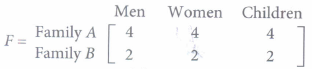
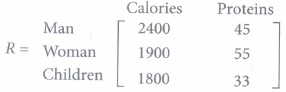
(ii) (b) : The requirement of calories and proteins for each of the two- families is given by the product matrix FR.
\(F R=\left[\begin{array}{lll} 4 & 4 & 4 \\ 2 & 2 & 2 \end{array}\right]\left[\begin{array}{ll} 2400 & 45 \\ 1900 & 55 \\ 1800 & 33 \end{array}\right]\)
\(=\left[\begin{array}{ll} 4(2400+1900+1800) & 4(45+55+33) \\ 2(2400+1900+1800) & 2(45+55+33) \end{array}\right]\)
(iii) (c)
(iv) (c) : Since, AB = B ...(i) and BA = A ...(ii)
\(\therefore\) A2 + B2 = A·A + B·B
= A(BA) + B(AB) [using (i) and (ii)]
= (AB)A + (BA)B [Associative law]
= BA +AB [using (i) and (ii]
= A+B

12th Standard CBSE Syllabus & Materials
12th Standard CBSE
CBSE 12th Computer Science Python Revision Tour I - New Previous year Question Papers Study Material - QB365 Set A
NEW12th Standard CBSE
CBSE 12th Business Studies Planning Important Questions And Answers Study Material - QB365 Set A
NEW12th Standard CBSE
CBSE 12th Business Studies Business Environment Important Questions And Answers Study Material - QB365 Set A
NEW12th Standard CBSE
CBSE 12th Business Studies Principles of Management Important Questions And Answers Study Material - QB365 Set A



NCERT Books

Syllabus

Exam Pattern

Sample Question Papers

Previous year Question Papers

Important Notes

MCQ Practice test

NCERT Exemplers

Case study Questions

Image Based Questions

Passage based Questions

HOT Questions

Value Based Questions

Model Questions Papers
NCERT ( Book Back ) Questions

Assertion and Reason
Important Questions And Answers

CBSE 12th Standard CBSE Subjects
CBSE Standards








