
 100% FREE ACCESS
12th Standard CBSE Syllabus & Materials
12th Standard CBSE
CBSE 12th Economics Government Budget and the Economy Previous year Question Papers Study Material - QB365 Set A
NEW12th Standard CBSE
CBSE 12th Computer Science Interface Python with MySQL - New Previous year Question Papers Study Material - QB365 Set A
NEW12th Standard CBSE
CBSE 12th Computer Science Database Concept - New Previous year Question Papers Study Material - QB365 Set A
NEW12th Standard CBSE
CBSE 12th Computer Science Data Communication - New Previous year Question Papers Study Material - QB365 Set A
NEW12th Standard CBSE
CBSE 12th Computer Science Data Structures - New Previous year Question Papers Study Material - QB365 Set A
NEW12th Standard CBSE
CBSE 12th Computer Science Functions - New Previous year Question Papers Study Material - QB365 Set A

Published on: 25/10/2025
Download CBSE Class 12th Standard CBSE Maths question papers, sample papers, important questions, and previous year solved papers in PDF format. Get free study materials, NCERT solutions, and exam preparation resources for Class 12th Standard CBSE Maths
Questions + Answers key
Take MCQ Maths Test
1.
Among the students in a college, it is known that 60% reside in hostel and 40% are day scholars (not residing in hostel). Previous year results report that 30% of all students who reside in hostel attain A grade and 20% of day scholars attain A grade in their annual exams. At the end of year, one student is chosen at random from the college and he has A grade, what is the probability that the student is a hosteler?
2.
Show that the points A, B, C with position vectors \(2 \hat{i}-\hat{j}+\hat{k}, \hat{i}-3 \hat{j}-5 \hat{k} \text { and } 3 \hat{i}-4 \hat{j}-4 \hat{k}\) respectively, are the vertices of a right-angled triangle. Hence, find the area of the triangle.
3.
If \(A=\left[\begin{array}{ccc}1 & 3 & 2 \\ 2 & 0 & -1 \\ 1 & 2 & 3\end{array}\right]\) then show that \(A^3-4 A^2-3 A+11 I=O\). Hence find \(A^{-1}\).
4.
Find the value of b, so that the lines \(\frac{x-1}{2}=\frac{y-b}{3}=\frac{z-3}{4} \text { and } \frac{x-4}{5}=\frac{y-1}{2}=z\) are intersecting lines. Also, find the point of intersection of these given lines.
5.
Express the matrix \(A=\left[\begin{array}{rrr}2 & 4 & -6 \\ 7 & 3 & 5 \\ 1 & -2 & 4\end{array}\right]\) as the sum of a symmetric and a skew-symmetric matrices.
6.
Find the derivative of each of the following function w.r.t. x, or find \(\frac { dy }{ dx } \):
\({ f(x)=tan }^{ -1 }\left( \frac { 1-x }{ 1+x } \right) -tan^{ -1 }\left( \frac { x+2 }{ 1-2x } \right) .\)
7.
Determine the values of a, b and c for which the function
\(f(x)=\begin{cases} \frac { sin(a+1)x+sin\quad x }{ x } , if\quad x<0 \\ c\qquad \ \ \ \ \ \ \quad \quad \quad ,if\quad x=0\quad may\quad be\quad continuous\quad at\quad x=0 \\ \frac { \sqrt { x+b{ x }^{ 2 } } -\sqrt { x } }{ b\sqrt { { x }^{ 3 } } } \quad \quad ,if\quad x>0 \end{cases}\)
8.
If \(|\vec{a}|=3,|\vec{b}|=5,|\vec{c}|=4 \text { and } \vec{a}+\vec{b}+\vec{c}=\overrightarrow{0}\), then find the value of \((\vec{a} \cdot \vec{b}+\vec{b} \cdot \vec{c}+\vec{c} \cdot \vec{a})\).
9.
An aeroplane is flying along the line \(\vec{r}=\lambda(\hat{i}-\hat{j}+\hat{k})\), where '\(\lambda\)' is a scalar and another aeroplane is flying along the line \(\vec{r}=\hat{i}-\hat{j}+\mu(-2 \hat{j}+\hat{k})\), where '\(\mu\)' is a scalar. At what points on the lines should they reach, so that the distance between them is the shortest? Find the shortest possible distance between them.
10.
Bag I contains 3 red and 4 black balls, Bag II contains 5 red and 2 black balls. Two balls are transferred at random from Bag I to Bag ll and then a ball is drawn at random from Bag II. Find the probability that the drawn ball is red in colour.
11.
Examine the continuity of f, where f is defined by
\(f(x)=\left\{\begin{array}{ll} \sin x-\cos x, & \text { if } x \neq 0 \\ -1, & \text { if } x=0 \end{array}\right.\)
12.
If A = {I, 2, 3} and relation R = {(2, 3)} in A.
Check whether relation R is reflexive, symmetric and transitive.
13.
If \(A=\left[\begin{array}{ccc}3 & \sqrt{3} & 2 \\ 4 & 2 & 0\end{array}\right]\ and \ B=\left[\begin{array}{ccc}2 & -1 & 2 \\ 1 & 2 & 4\end{array}\right]\) then verify that
(i)\(\left(A^{\prime}\right)^{\prime}=A\)
(ii) \((A+B)^{\prime}=A^{\prime}+B^{\prime}\)
(iii) \((k B)^{\prime}=k B^{\prime},\) where is any constant.
14.
Show that the relation R defined in the set A of all polygons as R = {(P1, P2) : P1 and P2 have same number of sides}, is an equivalence relation. What is the set of all elements in A related to the right angle triangle T with sides 3, 4 and 5?
15.
If the area of the triangle is 35sq.units (2, -6), (5, 4) and (k, 4). Find the value of 'k'.
16.
Three bags contain balls as shown in the table below.
| Bag | Number of white balls | Number of black balls | Number of Red balls |
| I | 1 | 2 | 3 |
| II | 2 | 1 | 1 |
| III | 4 | 3 | 2 |
A bag is chosen art random and two balls are drawn from it. They happen to be white and red. What is the probability that they came from the III bag?
17.
Two cards are drawn at random from a pack of 52 cards one-by-one without replacement. What is the probability of getting first card red and second card jack?
18.
Find the projection (vector) of \(2 \hat{i}-\hat{j}+\hat{k} \text { on } \hat{i}-2 \hat{j}+\hat{k}\)
19.
Prove that the function f is surjective, where f : N →N such that
\(f(n)= \begin{cases}\frac{n+1}{2}, & \text { if } n \text { is odd } \\ \frac{n}{2}, & \text { if } n \text { is even }\end{cases}\)
Is the function injective? Justify your answer.
20.
For what value of \(\lambda\),the matrix \(\left[\begin{array}{rrr} 1 & \lambda & 0 \\ 3 & -1 & 2 \\ 4 & 1 & 5 \end{array}\right]\) is singular?
21.
If matrix \(\left[\begin{array}{rrr}0 & a & 3 \\ 2 & b & -1 \\ c & 1 & 0\end{array}\right]\) is a skew-symmetric matrix, then find the values of a, b and c
22.
If \(\Delta =\left| \begin{matrix} 5 & 3 & 8 \\ 2 & 0 & 1 \\ 1 & 2 & 3 \end{matrix} \right| \) write the cofactor of element a32.
23.
A problem in Mathematics is given to three students whose chances of solving it are \(\frac{1}{2}, \frac{1}{3}, \frac{1}{4},\) respectively. If the events of their solving the problem are independent,then the probability that the problem will be solved, is
\(\frac{1}{4}\)
\(\frac{1}{3}\)
\(\frac{1}{2}\)
\(\frac{3}{4}\)
24.
The probability that A speaks the truth is \(\frac{4}{5}\)and that of B speaking the truth is \(\frac{3}{4}\). The probability that they contradict each other in stating the same fact is
\(\frac{7}{20}\)
\(\frac{1}{5}\)
\(\frac{3}{20}\)
\(\frac{4}{5}\)
25.
If \(P(A \cap B)=\frac{1}{8}\) and \(P(\bar{A})=\frac{3}{4} \text {, then } P\left(\frac{B}{A}\right)\) is equal to
\(\frac{1}{2}\)
\(\frac{1}{3}\)
\(\frac{1}{6}\)
\(\frac{2}{3}\)
26.
The function f(x)=|x| is
continuous and differentiable everywhere.
continuous and differentiable nowhere.
continuous everywhere, but differentiable everywhere except at x=0
continuous everywhere, but differentiable nowhere.
27.
Let \(f(x)=\left|\begin{array}{cc}x^2 & \sin x \\ p & -1\end{array}\right|\), where p is a constant. Then, the value of p for which \(f^{\prime}(0)=1\) is
R
1
0
-1
28.
The sine of the angle between the vectors \(\vec{a}=3 \hat{i}+\hat{j}+2 \hat{k} \text { and } \vec{b}=\hat{i}+\hat{j}+2 \hat{k}\) is
\(\sqrt{\frac{5}{21}}\)
\(\frac{5}{\sqrt{21}}\)
\(\sqrt{\frac{3}{21}}\)
\(\frac{4}{\sqrt{21}}\)
29.
If \(\vec{a}+\vec{b}=\hat{i} \text { and } \vec{a}=2 \hat{i}-2 \hat{j}+2 \hat{k}\), then \(|\vec{b}|\) equals
\(\sqrt{14}\)
3
\(\sqrt{12}\)
\(\sqrt{17}\)
30.
If the area of the tríangle with vertices (-3,0), (3, 0) and (0, k) is 9 sq units, then the value's of k will be
9
土3
-9
6
31.
The lines \(\vec{r}=\hat{i}+\hat{j}-\hat{k}+\lambda(2 \hat{i}+3 \hat{j}-6 \hat{k})\) and \(\vec{r}=2 \hat{i}-\hat{j}-\hat{k}+\mu(6 \hat{i}+9 \hat{j}-18 \hat{k})\); (where \(\lambda\) and \(\mu\) are scalars) are
coincident
skew
intersecting
parallel
32.
The value of \(\lambda\) for which the angle between the lines \(\vec{r}=\hat{i}+\hat{j}+\hat{k}+p(2 \hat{i}+\hat{j}+2 \hat{k})\) and \(\vec{r}=(1+q) \hat{i}+(1+q \lambda) \hat{j}+(1+q) \hat{k}\) is \(\frac{\pi}{2}\), is
-4
4
2
-2
33.
If A and B are events such that \(P\left(\frac{A}{B}\right)=P\left(\frac{B}{A}\right) \neq 0 \text {, }\), then
\(A \subset B, \text { but } A \neq B\)
A = B
\(A \cap B=\phi\)
P(A) = P(B)
34.
Derivative of \(e^{\sin ^2 x}\) with respect to cos x is
sin x\(e^{\sin ^2 x}\)
cos x\(e^{\sin ^2 x}\)
- 2 cos x\(e^{\sin ^2 x}\)
-2 sin2 x cos x\(e^{\sin ^2 x}\)
35.
If [x 2 0] \(\left[\begin{array}{c} 5 \\ -1 \\ x \end{array}\right]\)=[3 1] \(\left[\begin{array}{c} -2 \\ x \end{array}\right]\), then value of x is
-1
0
1
2
36.
A function f : R \(\rightarrow\) R defined as f(x) = x2 - 4x + 5 is
injective but not surjective
surjective but not injective.
both injective and surjective.
neither injective nor surjective.
37.
The magnitude of the vector \(6 \hat{i}+2 \hat{j}+3 \hat{k}\) is
5
7
12
1
38.
The product \(\left[\begin{array}{rr} a & b \\ -b & a \end{array}\right]\left[\begin{array}{rr} a & -b \\ b & a \end{array}\right]\) is equal to
\(\left[\begin{array}{cc}a^{2}+b^{2} & 0 \\ 0 & a^{2}+b^{2}\end{array}\right]\)
\(\left[\begin{array}{ll}(a+b)^{2} & 0 \\ (a+b)^{2} & 0\end{array}\right]\)
\(\left[\begin{array}{ll}a^{2}+b^{2} & 0 \\ a^{2}+b^{2} & 0\end{array}\right]\)
\(\left[\begin{array}{ll}a & 0 \\ 0 & b\end{array}\right]\)
39.
Let A = {1, 2, 3}. Then number of equivalence relations containing (1, 2) is
1
2
3
4
40.
If A is a square matrix such that A²=A, then (I + A)² – 3A is
I
2A
3I
A
41.
Assertion (A) If P(A) = \(\frac{3}{5}\)and P(B)=\(\frac{1}{5}\), then P(A\(\cap\)B), if A and B are independent events, is \(\frac{3}{25}\).
Reason (R) Two cards are drawn at random and without replacement from a pack of 52 playing cards. Then, the probability that both the cards are 25 black, is \(\frac{25}{102}\).
(a) Both A and R are correct; R is the correct explanation of A
(b) Both A and R are correct; R is not the correct explanation of A
(c) A is correct; R is incorrect
(d) R is correct; A is incorrect
42.
Assertion (A) The vectors \(\begin{aligned} \vec{a}=6 \hat{i}+2 \hat{j}-8 \hat{k} \end{aligned}\)
\(\begin{aligned} \vec{b}=10 \hat{i}-2 \hat{j}-6 \hat{k} \end{aligned}\)
\(\vec{c}=4 \hat{i}-4 \hat{j}+2 \hat{k}\) represent the sides of a right angled triangle.
Reason (R) Three non-zero vectors of which none of two are collinear forms a triangle, if their resultant is zero vector or sum of any two vectors is equal to the third.
(a) Both Assertion (A) and Reason (R) are true and the Reason (R) is the correct explanation of the Assertion (A).
(b) Both Assertion (A) and Reason (R) are true but Reason (R) is not the correct explanation of the Assertion (A).
(c) Assertion (A) is true but Reason (R) is false.
(d) Assertion (A) is false but Reason (R) is true.
43.
A building contractor undertakes a job to construct 4 flats on a plot along with parking area, Due to strike, the probability of many construction workers not being present for the job is 0.65.
The probability that many are not present and still the work gets completed on time is 0.35. The probability that work will be completed on time when all workers are present is 0.80.
Let E1 : represents the event when many workers were not present for the job;
E2 : represents the event when all workers were present; and
E : represents completing the construction work on time.
Based on the above information, answer the following questions:
(i) What is the probability that all the workers are present for the job?
(ii) What is the probability that construction will be completed on time?
(iii) (a) What is the probability that many workers are not present given that the construction work is completed on time?
Or (b) What is the probability that all workers were present given that the construction job was completed on time?
44.
Read the following passage and answer the questions given below.
Teams A, B, C went for playing a tug of war game. Teams A, B, C have attached a rope to a metal ring and is trying to pull the ring into their own area.
Team A pulls with force \(\vec{F}_1=6 \hat{i}+0 \hat{j} k N\),
Team B pulls with force \(\vec{F}_2=-4 \hat{i}+4 \hat{j} k N,\)
Team C pulls with force \(\vec{F}_3=-3 \hat{i}-3 \hat{j} k N,\)
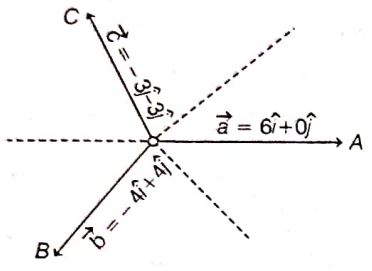
(i) What is the magnitude of the force of team A?
(ii) Which team will win the game?
(iii) Find the magnitude of the resultant force exerted by the teams.
Or
In what direction is the ring getting pulled?
45.
Students of a school are taken to a railway museum to learn about railways heritage and its history.
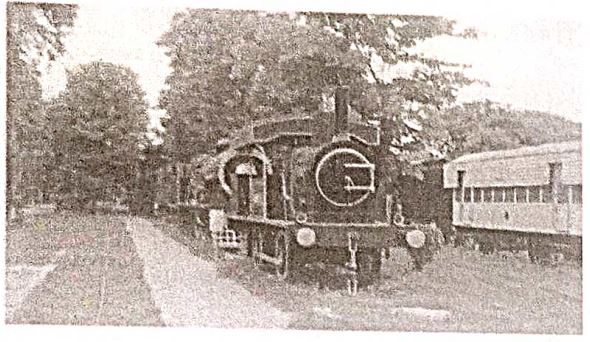
An exhibit in the museum depicted many rail lines on the track near the railway station. Let L be the set of all rail lines on the railway track and R be the relation on L defined by
R = {(l1, l2) : l1 is parallel to l2}
On the basis of the above information, answer the following questions.
(i) Find whether the relation R is symmetric or not.
(ii) Find whether the relation R is transitive or not.
(iii) If one of the rail lines on the railway track is represented by the equation y = 3x + 2, then find the set of rail lines in R related to it.
Or
Let S be the relation defined by S= ((l1,l2) : l1 is perpendicular to l2) check whether the relation S is symmetric and transitive.
1.
Let us detine the events as
E1 : Students reside in a hostel
E2 : Students are day scholars
A : Students get A grade
Then,
P(E1) = Probability that student reside in a hostel
\(=60 \%=\frac{60}{100}\)
and P(E2) = Probability that students are day scholars = 1 - \(\frac{60}{100}=\frac{40}{100}\)
Also, P(A/E1) = Probability that hostelers get A grade
\(=30 \%=\frac{30}{100}\)
and P(A/E2)= Probability that students having day scholars get A grade
\(=20 \%=\frac{20}{100}\)
\(\therefore\) The probability that the selecting student is a hosteler having A grade,
\(P\left(E_1 / A\right)=\frac{P\left(E_1\right) \cdot P\left(A / E_1\right)}{P\left(E_1\right) \cdot P\left(A / E_1\right)+P\left(E_2\right) \cdot P\left(A / E_2\right)}\)
[by Baye's theorem]
\(\begin{aligned}
=\frac{\frac{60}{100} \times \frac{30}{100}}{\left(\frac{60}{100} \times \frac{30}{100}\right)+\left(\frac{40}{100} \times \frac{20}{100}\right)}
\end{aligned}\)
\(\begin{aligned}
=\frac{1800}{1800+800}=\frac{1800}{2600}=\frac{18}{26}=\frac{9}{13}
\end{aligned}\)
2.
We have,
\(\overrightarrow{A B}\) = (position vector of B) - (position vector of A)
\(=(\hat{i}-3 \hat{j}-5 \hat{k})-(2 \hat{i}-\hat{j}+\hat{k})=-\hat{i}-2 \hat{j}-6 \hat{k}\)
\(\begin{aligned}
\overrightarrow{B C}=(3 \hat{i}-4 \hat{j}-4 \hat{k})-(\hat{i}-3 \hat{j}-5 \hat{k})=2 \hat{i}-\hat{j}+\hat{k}
\end{aligned}\)
and \(\begin{aligned}
\overrightarrow{C A}=(2 \hat{i}-\hat{j}+\hat{k})-(3 \hat{i}-4 \hat{j}-4 \hat{k})
\end{aligned}\)
\(=-\hat{i}+3 \hat{j}+5 \hat{k}\)
Here, \(\overrightarrow{A B}+\overrightarrow{B C}+\overrightarrow{C A}=0\)
\(\Rightarrow\) A, B and C are the vertices of a triangle.
Now, \(\overrightarrow{B C} \cdot \overrightarrow{C A}=(2 \hat{i}-\hat{j}+\hat{k}) \cdot(-\hat{i}+3 \hat{j}+5 \hat{k})\)
= - 2 - 3 + 5 = 0
\(\Rightarrow \overrightarrow{B C} \perp \overrightarrow{C A} \Rightarrow \angle C=90^{\circ}\)
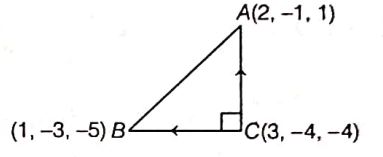
Now, area of \(\Delta A B C=\frac{1}{2}|\overrightarrow{C A} \times \overrightarrow{B C}|\)
\(=\frac{1}{2}\left|\begin{array}{ccc}
\hat{i} & \hat{j} & \hat{k} \\
-1 & 3 & 5 \\
2 & -1 & 1
\end{array}\right|=\frac{1}{2}|(8 \hat{i}-11 \hat{j}-5 \hat{k})|\)
\(=\frac{1}{2} \sqrt{64+121+25}\)
\(=\frac{1}{2} \sqrt{210}\) sq units
3.
We have, \(A=\left[\begin{array}{ccc}1 & 3 & 2 \\ 2 & 0 & -1 \\ 1 & 2 & 3\end{array}\right]\)
Now, \(A^2=A \cdot A=\left[\begin{array}{lll}9 & 7 & 5 \\ 1 & 4 & 1 \\ 8 & 9 & 9\end{array}\right]\)
and \(A^3=A^2 \cdot A=\left[\begin{array}{ccc}
28 & 37 & 26 \\
10 & 5 & 1 \\
35 & 42 & 34
\end{array}\right]\)
Now, consider LHS \(=A^3-4 A^2-3 A+11 I\)
\(=\left[\begin{array}{ccc}
28 & 37 & 26 \\
10 & 5 & 1 \\
35 & 42 & 34
\end{array}\right]-4\left[\begin{array}{ccc}
9 & 7 & 5 \\
1 & 4 & 1 \\
8 & 9 & 9
\end{array}\right] \)
\(-3\left[\begin{array}{ccc}
1 & 3 & 2 \\
2 & 0 & -1 \\
1 & 2 & 3
\end{array}\right]+11\left[\begin{array}{lll}
1 & 0 & 0 \\
0 & 1 & 0 \\
0 & 0 & 1
\end{array}\right]\)
\(=\left[\begin{array}{lll}
0 & 0 & 0 \\
0 & 0 & 0 \\
0 & 0 & 0
\end{array}\right]=O=\mathrm{RHS}\)
Now, \(A^3-4 A^2-3 A+11 I=O\)
Pre-multiplied by \(A^{-1}\), we get \(A^{-1} A^3-4 A^{-1} A^2-3 A^{-1} A+11 A^{-1}=O\)
\(\Rightarrow A^2-4 A-3 I+11 A^{-1}=O \quad\left[\because A^{-1} A=I\right]\)
\(\Rightarrow 11 A^{-1}=3 I+4 A-A^2\)
\(\Rightarrow 11 A^{-1}=\left[\begin{array}{lll}
3 & 0 & 0 \\
0 & 3 & 0 \\
0 & 0 & 3
\end{array}\right]+4\left[\begin{array}{ccc}
1 & 3 & 2 \\
2 & 0 & -1 \\
1 & 2 & 3
\end{array}\right]-\left[\begin{array}{ccc}
9 & 7 & 5 \\
1 & 4 & 1 \\
8 & 9 & 9
\end{array}\right] \)
\(\Rightarrow 11 A^{-1}=\left[\begin{array}{lll}
3 & 0 & 0 \\
0 & 3 & 0 \\
0 & 0 & 3
\end{array}\right]+\left[\begin{array}{ccc}
4 & 12 & 8 \\
8 & 0 & -4 \\
4 & 8 & 12
\end{array}\right]-\left[\begin{array}{ccc}
9 & 7 & 5 \\
1 & 4 & 1 \\
8 & 9 & 9
\end{array}\right] \)
\( \Rightarrow 11 A^{-1}=\left[\begin{array}{ccc}
-2 & 5 & 3 \\
7 & -1 & -5 \\
-4 & -1 & 6
\end{array}\right] \Rightarrow A^{-1}=\frac{1}{11}\left[\begin{array}{ccc}
-2 & 5 & 3 \\
7 & -1 & -5 \\
-4 & -1 & 6
\end{array}\right]\)
4.
Given, equations of lines are
\(\begin{aligned}
\frac{x-1}{2}=\frac{y-b}{3}=\frac{z-3}{4}=\lambda
\end{aligned}\) (say) ....(i)
and \(\begin{aligned}
\frac{x-4}{5}=\frac{y-1}{2}=\frac{z-0}{1}=\mu
\end{aligned}\) (say) ....(ii)
The coordinates of points on line (i) and (ii) will be \((2 \lambda+1,3 \lambda+b, 4 \lambda+3) \text { and }(5 \mu+4,2 \mu+1, \mu) \text {. }\)
If the lines intersect, then point will be common.
So, \(\begin{aligned}
2 \lambda+1=5 \mu+4 \Rightarrow 2 \lambda-5 \mu=3
\end{aligned}\) ....(iii)
\(\begin{aligned}
3 \lambda+b=2 \mu+1 \Rightarrow 3 \lambda-2 \mu=1-b
\end{aligned}\) ....(iv)
and \(\begin{aligned}
4 \lambda+3=\mu \Rightarrow 4 \lambda-\mu=-3
\end{aligned}\) ...(v)
On solving Eqs. (iii) and (v), we get
\(\lambda=-1 \text { and } \mu=-1\)
Since, given lines are intersect to each other.
\(\therefore\) The value of \(\lambda\) and \(\mu\) satisfies the Eq. (iv), we get
3 (-1) - 2(-1) = 1 - b
\(\begin{aligned}
\Rightarrow -3+2 & =1-b
\end{aligned}\)
\(\begin{aligned}
\Rightarrow & b =1+1 \Rightarrow b=2
\end{aligned}\)
Now, putting \(\lambda\) = -1 and b = 2 in coordinates of points on line (i), we get
= (2(-1) + 1, 3(-1) + 2, 4(-1) + 3)
= (-2 + 1, -3 + 2, -4 + 3) = (-1, -1, -1)
Hence, the intersection point is (-1, -1, -1).
5.
We have,
\(A=\left[\begin{array}{rrr} 2 & 4 & -6 \\ 7 & 3 & 5 \\ 1 & -2 & 4 \end{array}\right]\)
\(\begin{array}{l} \Rightarrow A^{\prime}=\left[\begin{array}{rrr} 2 & 7 & 1 \\ 4 & 3 & -2 \\ -6 & 5 & 4 \end{array}\right] \end{array}\)
\(\text { Let } P=\frac{1}{2}\left(A+A^{\prime}\right)=\frac{1}{2}\left\{\left[\begin{array}{rrr} 2 & 4 & -6 \\ 7 & 3 & 5 \\ 1 & -2 & 4 \end{array}\right]+\left[\begin{array}{ccc} 2 & 7 & 1 \\ 4 & 3 & -2 \\ -6 & 5 & 4 \end{array}\right]\right\}\)
\(=\frac{1}{2}\left[\begin{array}{ccc} 4 & 11 & -5 \\ 11 & 6 & 3 \\ -5 & 3 & 8 \end{array}\right]=\left[\begin{array}{ccc} 2 & \frac{11}{2} & -\frac{5}{2} \\ \frac{11}{2} & 3 & \frac{3}{2} \\ -\frac{5}{2} & \frac{3}{2} & 4 \end{array}\right]\)
which is symmetric matrix and
\(Q =\frac{1}{2}\left(A-A^{\prime}\right)=\frac{1}{2}\left\{\left[\begin{array}{rrr} 2 & 4 & -6 \\ 7 & 3 & 5 \\ 1 & -2 & 4 \end{array}\right]-\left[\begin{array}{rrr} 2 & 7 & 1 \\ 4 & 3 & -2 \\ -6 & 5 & 4 \end{array}\right]\right\} \)
\(=\frac{1}{2}\left[\begin{array}{rrr} 0 & -3 & -7 \\ 3 & 0 & 7 \\ 7 & -7 & 0 \end{array}\right]=\left[\begin{array}{rrr} 0 & -\frac{3}{2} & -\frac{7}{2} \\ \frac{3}{2} & 0 & \frac{7}{2} \\ \frac{7}{2} & -\frac{7}{2} & 0 \end{array}\right] \)
which is skew-symmetric matrix
Now,\(P+Q=\frac{1}{2}\left(A+A^{\prime}\right)+\frac{1}{2}\left(A-A^{\prime}\right)\)
\(=\left[\begin{array}{rrr} 2 & \frac{11}{2} & -\frac{5}{2} \\ \frac{11}{2} & 3 & \frac{3}{2} \\ -\frac{5}{2} & \frac{3}{2} & 4 \end{array}\right]+\left[\begin{array}{rrr} 0 & -\frac{3}{2} & -\frac{7}{2} \\ \frac{3}{2} & 0 & \frac{7}{2} \\ \frac{7}{2} & -\frac{7}{2} & 0 \end{array}\right]=\left[\begin{array}{rrr} 2 & 4 & -6 \\ 7 & 3 & 5 \\ 1 & -2 & 4 \end{array}\right]=A\)
Hence, A is represented as sum of symmetric and skew-symmetric matrix.
6.
\(f(x)=\tan ^{-1} 1-\tan ^{-1} x-\tan ^{-1} x-\tan ^{-1} 2 \)
\(=\tan ^{-1} 1-\tan ^{-1} 2-2 \tan ^{-1} x \)
\(\Rightarrow f^{\prime}(x)=0-0-\frac{2}{1+x^{2}} \Rightarrow f^{\prime}(x)=\frac{-2}{1+x^{2}} \)
7.
\(\operatorname{LHL}_{x \rightarrow 0}=\lim _{x \rightarrow 0^{-}}\left\{\frac{\sin (a+1) x}{x}+\frac{\sin x}{x}\right\} \)
\(= \lim _{h \rightarrow 0}\left\{\frac{\sin (a+1)(0-h)}{0-h}+\frac{\sin (0-h)}{0-h}\right\} \)
\(=\lim _{h \rightarrow 0}\left\{\frac{\sin (a+1) h}{(a+1) h} \cdot(a+1)+\frac{\sin h}{h}\right\} \)
\(\Rightarrow a+1+1 =a+2 \)
\(\mathrm{RHL} =\lim _{x \rightarrow 0}\left[\frac{\sqrt{x+b x^{2}}-\sqrt{x}}{b \sqrt{x^{3}}}\right] \)
\(=\lim _{h \rightarrow 0} \frac{\sqrt{h+b h^{2}}-\sqrt{h}}{b \sqrt{h^{3}}} \)
\(=\lim _{h \rightarrow 0} \frac{h+b h^{2}-h}{b h \sqrt{h}\left[\sqrt{h+b h^{2}}+\sqrt{h}\right]} \)
\(=\lim _{h \rightarrow 0} \frac{b h^{2}}{b h \sqrt{h} \sqrt{h}[\sqrt{1+b h}+1]}\)
\(=\lim _{h \rightarrow 0} \frac{1}{\sqrt{1+b h}+1}=\frac{1}{2}\)
For continuity at x = 0,
\(\mathrm{LHL}=\underset{x=0}{\mathrm{RHL}}=f(0) \)
\(\Rightarrow a+2=\frac{1}{2}=c \ \Rightarrow \ c=\frac{1}{2}, a=-\frac{3}{2}[\text { from {i}] } \)
\(\therefore \) Number are \(a=-\frac { 3 }{ 2 } ,b\quad any\quad value\quad (\neq 0),\quad c=\frac { 1 }{ 2 } \)
8.
Given, \(\vec{a}+\vec{b}+\vec{c}=0\)
\((\vec{a}+\vec{b}+\vec{c})^2=|\vec{a}|^2+|\vec{b}|^2+|\vec{c}|^2\)\(+2(\vec{a} \cdot \vec{b}+\vec{b} \cdot \vec{c}+\vec{c} \cdot \vec{a})\)
\(\begin{array}{ll}
\Rightarrow & 0=9+25+16+2(\vec{a} \cdot \vec{b}+\vec{b} \cdot \vec{c}+\vec{c} \cdot \vec{a})
\end{array}\)
\(\begin{array}{ll}
\Rightarrow & -\frac{50}{2}=(\vec{a} \cdot \vec{b}+\vec{b} \cdot \vec{c}+\vec{c} \cdot \vec{a})
\end{array}\)
\(\begin{array}{ll}
\therefore & (\vec{a} \cdot \vec{b}+\vec{b} \cdot \vec{c}+\vec{c} \cdot \vec{a})=-25
\end{array}\)
9.
Given, equations of lines are
\(\begin{aligned} \vec{r} & =\lambda(\hat{i}-\hat{j}+\hat{k}) \end{aligned}\)
and \(\begin{aligned} \vec{r} & =\hat{i}-\hat{j}+\mu(-2 \hat{j}+\hat{k}) \end{aligned}\)
These lines are not parallel as \((\hat{i}-\hat{j}+\hat{k})\) is not parallel to \((-2 \hat{j}+\hat{k})\)
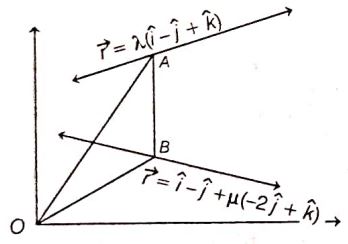
Let AB be the shortest distance between the lines such that AB makes right angle with both the lines.
Let the position vector of the point A lying on the line
\(\vec{r}=\lambda(\hat{i}-\hat{j}+\hat{k})=\lambda(\hat{i}-\hat{j}+\hat{k})\) ...(i)
and let the position vector of the point B lying on the line
\(\vec{r}=\hat{i}-\hat{j}+\mu(-2 \hat{j}+\hat{k})=\hat{i}+(-1-2 \mu) \hat{j}+\mu \hat{k}\) ...(ii)
Now, \(\overrightarrow{A B}=\overrightarrow{O B}-\overrightarrow{O A}\)
\(=(1-\lambda) \hat{i}+(-1-2 \mu+\lambda) \hat{j}+(\mu-\lambda) \hat{k}\)
Now, \(\overrightarrow{A B}\) is perpendicular to both the lines
\(\hat{i}-\hat{j}+\hat{k} \text { and }-2 \hat{j}+\hat{k}\)
\(\begin{array}{lr} \therefore \quad 1(1-\lambda)-1(-1-2 \mu+\lambda)+1(\mu-\lambda) & =0 \end{array}\)
\(\begin{array}{lr} \Rightarrow & 2+3 \mu-3 \lambda=0 \end{array}\) ...(iii)
\(\begin{array}{lr} \text { and } 0(1-\lambda)-2(-1-2 \mu+\lambda)+1(\mu-\lambda) & =0 \end{array}\)
\(\begin{array}{lr} \Rightarrow \quad 2+5 \mu-3 \lambda & =0 \end{array}\) ...(iv)
From Eqs. (iii) and (iv), we get
\(\begin{aligned} 2+3 \mu & =2+5 \mu \Rightarrow 2 \mu=0 \Rightarrow \mu=0 \end{aligned}\)
\(\begin{aligned} \therefore \lambda & =\frac{2}{3} \end{aligned}\)
So, the position vector of the points at which they should be so that the distance between them is the shortest are \(\frac{2}{3}(\hat{i}-\hat{j}+\hat{k}) \text { and } \hat{i}-\hat{j}\)
[using Eqs. (i) and (iii)]
\(\begin{gathered} \overrightarrow{A B}=\overrightarrow{O B}-\overrightarrow{O A}=\frac{1}{3} \hat{i}-\frac{1}{3} \hat{j}-\frac{2}{3} \hat{k} \end{gathered}\)
\(\begin{gathered} \therefore \quad|\overrightarrow{A B}|=\sqrt{\left(\frac{1}{3}\right)^2+\left(\frac{-1}{3}\right)^2+\left(\frac{-2}{3}\right)^2}=\sqrt{\frac{2}{3}} \end{gathered}\)
Hence, the shortest distance AB = \(\sqrt{\frac{2}{3}}\) units
10.
Let E1, E2, E3 and A be events such that
E1 = Two red balls are transferred from Bag I to Bag II
E2 = Two black balls are transferred from Bag I to Bag II
E3 = Out of two transferred ball one is red and other is black.
A = Drawing a red ball from Bag II
Here, \(P\left(\frac{E_1}{A}\right)+P\left(\frac{E_3}{A}\right)\) is required.
Now, \(\begin{aligned} P\left(E_1\right)=\frac{{ }^3 C_2}{{ }^7 C_2}=\frac{3!}{2!1!} \times \frac{2!5!}{7!}=3 \times \frac{2}{7 \times 6}=\frac{1}{7} \end{aligned}\)
\(\begin{aligned} P\left(E_2\right)=\frac{{ }^4 C_2}{{ }^7 C_2}=\frac{4!}{2!2!} \times \frac{2!5!}{7!}=\frac{4 \times 3}{2} \times \frac{2}{7 \times 6}=\frac{2}{7} \end{aligned}\)
\(\begin{aligned} P\left(E_3\right)=\frac{{ }^3 C_1 \times{ }^4 C_1}{C_2}=\frac{3 \times 4}{1} \times \frac{2!5!}{7!}=\frac{4}{7} \end{aligned}\)
\(\begin{aligned} P\left(\frac{A}{E_1}\right)=\frac{7}{9}, P\left(\frac{A}{E_2}\right)=\frac{5}{9}, P\left(\frac{A}{E_3}\right)=\frac{6}{9} \end{aligned}\)
\(\begin{aligned} \therefore P\left(\frac{E_3}{A}\right)+P\left(\frac{E_3}{A}\right) \end{aligned}\)
\(\begin{aligned} =\frac{P\left(E_1\right) \cdot P\frac{A}{E_1}+P\left(E_3\right) \cdot P\left(\frac{A}{E_3}\right)}{P\left(E_1\right) \cdot P\left(\frac{A}{E_1}\right)+P\left(E_2\right) \cdot P\left(\frac{A}{E_2}\right)+P\left(E_3\right) \cdot P\left(\frac{A}{E_3}\right)} \end{aligned}\)
\(\begin{aligned} =\frac{\frac{1}{7} \times \frac{7}{9}+\frac{4}{7} \times \frac{6}{9}}{\frac{1}{7} \times \frac{7}{9}+\frac{2}{7} \times \frac{5}{9}+\frac{4}{7} \times \frac{6}{9}} \end{aligned}\)
\(\begin{aligned} =\frac{\frac{7}{63}+\frac{24}{63}}{\frac{7}{63}+\frac{10}{63}+\frac{24}{63}}=\frac{\frac{31}{63}}{\frac{41}{63}}=\frac{31}{41}=0.75 \end{aligned}\)
11.
\(f(x)=\left\{\begin{array}{ll} \sin x-\cos x, & \text { if } x \neq 0 \\ -1 & \text { if } x=0 \end{array}\right.\)
It is evident that f is defined at all points of the real line.
Let c be a real number.
Case I: \(\text { If } c \neq 0, \text { then } f(c)=\sin c-\cos c \)
\(\lim _{x \rightarrow c} f(x)=\lim _{x \rightarrow c}(\sin x-\cos x)=\sin c-\cos c \)
\(\therefore \lim _{x \rightarrow c} f(x)=f(c) \)
Therefore, f is continuous at all points x, such that x ≠ 0
Case II: \(\text { If } c=0, \text { then } f(0)=-1 \)
\(\lim _{x \rightarrow 0^{-}} f(x)=\lim _{x \rightarrow 0}(\sin x-\cos x)=\sin 0-\cos 0=0-1=-1 \)
\(\lim _{x \rightarrow 0^{+}} f(x)=\lim _{x \rightarrow 0}(\sin x-\cos x)=\sin 0-\cos 0=0-1=-1 \)
\(\therefore \lim _{x \rightarrow 0^{-}} f(x)=\lim _{x \rightarrow 0^{+}} f(x)=f(0)\)
Therefore, f is continuous at x = 0
From the above observations, it can be concluded that f is continuous at every point of the real line.
Thus, f is a continuous function
12.
Not reflexive, as (1, 1) \(\notin\) R.
Not symmetric, as (2, 3) \(\in\) R but (3, 2) \(\notin\) R.
Transitive, as relation R in a non empty set containing one element is transitive
13.
(i) We have
\(\mathrm{A}=\left[\begin{array}{lll}
3 & \sqrt{3} & 2 \\
4 & 2 & 0
\end{array}\right] \Rightarrow \mathrm{A}^{\prime}=\left[\begin{array}{cc}
3 & 4 \\
\sqrt{3} & 2 \\
2 & 0
\end{array}\right] \Rightarrow\left(\mathrm{A}^{\prime}\right)^{\prime}=\left[\begin{array}{lll}
3 & \sqrt{3} & 2 \\
4 & 2 & 0
\end{array}\right]=\mathrm{A}\)
Thus \(\left(\mathrm{A}^{\prime}\right)^{\prime}=\mathrm{A}\)
(ii) We have
\(\mathrm{A}=\left[\begin{array}{lll}
3 & \sqrt{3} & 2 \\
4 & 2 & 0
\end{array}\right], \mathrm{B}=\left[\begin{array}{rrr}
2 & -1 & 2 \\
1 & 2 & 4
\end{array}\right] \Rightarrow \mathrm{A}+\mathrm{B}=\left[\begin{array}{ccc}
5 & \sqrt{3}-1 & 4 \\
5 & 4 & 4
\end{array}\right]\)
Therefore \((A+B)^{\prime}=\left[\begin{array}{cc}
5 & 5 \\
\sqrt{3}-1 & 4 \\
4 & 4
\end{array}\right]\)
Now \(\mathrm{A}^{\prime}=\left[\begin{array}{cc}
3 & 4 \\
\sqrt{3} & 2 \\
2 & 0
\end{array}\right], \mathrm{B}^{\prime}=\left[\begin{array}{rr}
2 & 1 \\
-1 & 2 \\
2 & 4
\end{array}\right] \text {, }\)
So \(A^{\prime}+B^{\prime}=\left[\begin{array}{rr}
5 & 5 \\
\sqrt{3}-1 & 4 \\
4 & 4
\end{array}\right]\)
Thus \((\mathrm{A}+\mathrm{B})^{\prime}=\mathrm{A}^{\prime}+\mathrm{B}^{\prime} \)
(iii) We have
\(k B=k\left[\begin{array}{rrr} 2 & -1 & 2 \\ 1 & 2 & 4 \end{array}\right]=\left[\begin{array}{ccc} 2 k & -k & 2 k \\ k & 2 k & 4 k \end{array}\right]\)
and
\((k B)^{\prime} =\left[\begin{array}{ccc} 2 k & -k & 2 k \\ k & 2 k & 4 k \end{array}\right]^{\prime}=\left[\begin{array}{cc} 2 k & k \\ -k & 2 k \\ 2 k & 4 k \end{array}\right].\)
\(=k\left[\begin{array}{rr} 2 & 1 \\ -1 & 2 \\ 2 & 4 \end{array}\right]=k B^{\prime} \)
Thus, (kB)' = kB'
14.
R = {(P1, P2): P1 and P2 have same the number of sides}
R is reflexive since (P1, P1) ∈ R as the same polygon has the same number of sides with itself.
Let (P1, P2) ∈ R.
⇒ P1 and P2 have the same number of sides.
⇒ P2 and P1 have the same number of sides.
⇒ (P2, P1) ∈ R
∴ R is symmetric.
Now,
Let (P1, P2), (P2, P3) ∈ R.
⇒ P1 and P2 have the same number of sides. Also, P2 and P3 have the same number of sides.
⇒ P1 and P3 have the same number of sides.
⇒ (P1, P3) ∈ R
∴ R is transitive.
Hence, R is an equivalence relation.
The elements in A related to the right-angled triangle (T) with sides 3, 4, and 5 are those polygons which have 3 sides (since T is a polygon with 3 sides).
Hence, the set of all elements in A related to triangle T is the set of all triangles.
15.
By the equation, \(\frac { 1 }{ 2 } \left| \begin{matrix} 2 & -6 & 1 \\ 5 & 4 & 1 \\ k & 4 & 1 \end{matrix} \right| =\pm 35\)
\({1\over2}[2(4-4)+6(5-k)+(1)920-4k)]=\le35\)
\({1\over2}[0+30-6k+20-4k]=\le35\)
\(50-10k=\le70\)
\(10k=50\mp 70\)
10k = -20, 120.
Hence k = -2, 12
16.
| Bag | Number of white balls | Number of black balls | Number of Red balls |
| I | 1 | 2 | 3 |
| II | 2 | 1 | 1 |
| III | 4 | 3 | 2 |
Probability of chosing a bag:
\(P(I)=\frac{1}{3}, P(I I)=\frac{1}{3}, P(I I I)=\frac{1}{3} .\)
E : one white and one red ball is drawn.
\(P(E / I)=\frac{{ }^{1} C_{1} \times{ }^{3} C_{1}}{{ }^{6} C_{2}}=\frac{1 \times 3 \times 2}{6 \times 5}=\frac{1}{5}\)
\(P(E / I I)=\frac{{ }^{2} C_{1} \times{ }^{1} C_{1}}{{ }^{4} C_{2}}=\frac{2 \times 1}{6}=\frac{1}{3} \)
\(P(E / I I)=\frac{{ }^{4} C_{1} \times{ }^{2} C_{1}}{{ }^{9} C_{2}}=\frac{4 \times 2 \times 2}{9 \times 8}=\frac{2}{9} \)
Using Bayes' Theorem,
Probability of drawing one white and one red from bag III is
\(P(I I I E) =\frac{P(I I I) \cdot P(E / I I I)}{P(I) \cdot P(E / I)+P(I I) \cdot P(E / I I)+P(I I I) \cdot P(E / I I I)} \)
\(=\frac{\frac{1}{3} \times \frac{2}{9}}{\frac{1}{3} \times \frac{1}{5}+\frac{1}{3} \times \frac{1}{3}+\frac{1}{3} \times \frac{2}{9}}=\frac{\frac{2}{9}}{\frac{1}{5}+\frac{1}{3}+\frac{2}{9}} \)
\(=\frac{\frac{2}{9}}{\frac{9+15+10}{45}}=\frac{2}{9} \times \frac{45}{34}=\frac{5}{17} \)
17.
\(\because\) Two cards are drawn at random from a pack of 52 cards one-by-one without replacement.
\(\therefore\) The required probability = P {(the first is a red jack card and the second is a jack card) or (the first is a red non-jack card and the second is a jack card)}
\(=\frac{2}{52} \times \frac{3}{51}+\frac{24}{52} \times \frac{4}{51}=\frac{1}{26}\)
18.
Let \(\vec{a}=2 \hat{i}-\hat{j}+\hat{k} \text { and } \vec{b}=\hat{i}-2 \hat{j}+\hat{k}\)
Now, projection vector of \(\vec{a} \text { on } \vec{b}=\frac{\vec{a} \cdot \vec{b}}{|\vec{b}|^2} \vec{b}\)
Here, \(\begin{aligned}
\vec{a} \cdot \vec{b} & =(2 \hat{i}-\hat{j}+\hat{k}) \cdot(\hat{i}-2 \hat{j}+\hat{k})
\end{aligned}\)
\(\begin{aligned}
=2 \times 1+(-1) \times(-2)+1 \times 1
\end{aligned}\)
= 2 + 2 + 1 = 5
and \(|\vec{b}|=\sqrt{(1)^2+(-2)^2+(1)^2}=\sqrt{1+4+1}=\sqrt{6}\)
\(\therefore\) Projection vector of \(\vec{a} \text { on } \vec{b}=\frac{5}{6}(\hat{i}-2 \hat{j}+\hat{k})\)
19.
Consider a natural number n in codomain N.
Case I : When n is odd
Therefore, n = 2r + 1 for some \(r \in N\).
Then, there exists \(4 r+1 \in N\) such that
\(f(4 r+1)=\frac{4 r+1+1}{2}=2 r+1\)
Therefore, f is onto.
Case II : When n is even
Therefore, n =2r for some \(r \in N\)
Then, there exists \(4 r \in N\) such that \(f(4 r)=\frac{4 r}{2}=2 r\)
Hence, f is surjective.
Now, it can be observed that
\(f(1)=\frac{1+1}{2}=\frac{2}{2}=1 \text { and } f(2)=\frac{2}{2}=1\)
Here, f(1) = f(2) but \(1 \neq 2\)
Hence, f is not injective.
20.
Let \(A=\left[\begin{array}{rrr} 1 & \lambda & 0 \\ 3 & -1 & 2 \\ 4 & 1 & 5 \end{array}\right] \)Since the matrix is singular.
\(\therefore |A|=0
\)
\(\Rightarrow\left|\begin{array}{rrr} 1 & \lambda & 0 \\ 3 & -1 & 2 \\ 4 & 1 & 5 \end{array}\right|=0
\)
\(\Rightarrow 1(-5-2)-\lambda(15-8)+0=0
\)
\(\Rightarrow -7-7 \lambda=0
\)
\(\Rightarrow -7 \lambda=7
\)
\(\therefore\lambda=-1\)
21.
a = -2, b = 0 and c = -3
22.
a32 = -11
Alternative Method:
Given \(A =\left| \begin{matrix} 5 & 3 & 8 \\ 2 & 0 & 1 \\ 1 & 2 & 3 \end{matrix} \right|\)
⇒ a32 \(=\left| \begin{matrix} 5 & 8 \\ 2 & 1 \end{matrix} \right|\)
⇒ a32 = 5-16 = -11
23.
(d)
\(\frac{3}{4}\)
24.
(a)
\(\frac{7}{20}\)
25.
(a)
\(\frac{1}{2}\)
26.
(c)
continuous everywhere, but differentiable everywhere except at x=0
27.
(d)
-1
28.
(a)
\(\sqrt{\frac{5}{21}}\)
29.
(b)
3
30.
(b)
土3
31.
(d)
parallel
32.
(a)
-4
33.
(d)
P(A) = P(B)
34.
(c)
- 2 cos x\(e^{\sin ^2 x}\)
35.
(a)
-1
36.
(d)
neither injective nor surjective.
37.
(b)
7
38.
(a)
\(\left[\begin{array}{cc}a^{2}+b^{2} & 0 \\ 0 & a^{2}+b^{2}\end{array}\right]\)
39.
(b)
2
40.
(a)
I
41.
(b) Both A and R are correct; R is not the correct explanation of A
42.
(a) Both Assertion (A) and Reason (R) are true and the Reason (R) is the correct explanation of the Assertion (A).
43.
Given, P(E1) = 0.65, P(E/E1) = 0.35 and \(P\left(\frac{E}{E_2}\right)=0.80\)
(i) P(E2) = 1 - P(E1) = 1 - 0.65 = 0.35
(ii) \(\begin{aligned} P(E) & =P\left(E_1\right) \cdot P\left(\frac{E}{E_1}\right)+P\left(E_2\right) P\left(\frac{E}{E_2}\right) \end{aligned}\)
\(\begin{aligned} =0.65 \times 0.35+0.35 \times 0.80 \end{aligned}\)
\(\approx 0.23+0.28=0.51\)
(iii) (a) \(\begin{aligned} P\left(\frac{E_1}{E}\right) & =\frac{P\left(E_1\right) \cdot P\left(E / E_1\right)}{P\left(E_1\right) \cdot P\left(E / E_1\right)+P\left(E_2\right) P\left(E / E_2\right)} \end{aligned}\)
\(\begin{aligned} =\frac{0.65 \times 0.35}{0.65 \times 0.35+0.35 \times 0.80}=0.45 \end{aligned}\)
or (b) \(\begin{aligned} P\left(\frac{E_2}{E}\right) & =\frac{P\left(E_2\right) P\left(E / E_2\right)}{P\left(E_1\right) \cdot P\left(E / E_1\right)+P\left(E_2\right) P\left(E / E_2\right)} \end{aligned}\)
\(\begin{aligned} =\frac{0.35 \times 0.80}{0.65 \times 0.35+0.35 \times 0.80} \end{aligned}\)
= 0.55
44.
Given, \(\vec{F}_1=6 \hat{i}+0 \hat{j} k N\)
\(\begin{aligned}
\therefore \quad\left|\vec{F}_1\right|=\sqrt{6^2+0^2}=6 \mathrm{kN} \\
\end{aligned}\)
\(\vec{F}_2=-4 \hat{i}+4 \hat{j} k N\)
\(\therefore \quad\left|\vec{F}_2\right|=\sqrt{(-4)^2+4^2}=4 \sqrt{2} k N\)
\(\vec{F}_3=-3 \hat{i}-3 \hat{j} k N\)
\(\Rightarrow\left|\vec{F}_3\right|=\sqrt{(-3)^2+(-3)^2}=3 \sqrt{2} \mathrm{kN}\)
(i) Magnitude of force of team \(A=\left|\vec{F}_1\right|=6 \mathrm{kN}\)
(ii) Since, magnitude of force of team A is greater than other teams, therefore team A will win the game.
(iii) Resultant force,
\( \vec{F}=\vec{F}_1+\vec{F}_2+\vec{F}_3\)
\(=(6 \hat{i}+0 \hat{j})+(-4 \hat{i}+4 \hat{j})+(-3 \hat{i}-3 \hat{j}) \)
\(\vec{F}=(-\hat{i}+\hat{j}) k N
\)
\(\Rightarrow |\vec{F}|=\sqrt{(-1)^2+(1)^2}=\sqrt{2} k N \)
Or
Resultant force \(\vec{F}=-\hat{i}+\hat{j}\)
Let \(\vec{F}\) makes an angle \(\theta\) with the X-axis,then its direction cosine along X-axis is cos \(\theta\).
\(\therefore \cos \theta=\frac{f_x}{\sqrt{f_x^2+f_y^2}} \text { (where } f_x \text { and } f_y\) are direction ratios along X-axis and Y-axis, respectively.)
\(\begin{aligned}
\cos \theta & =\frac{-1}{\sqrt{(-1)^2+(1)^2}}=\frac{-1}{\sqrt{2}}
\end{aligned}\)
\(\begin{aligned}
\Rightarrow & & \theta & =\cos ^{-1}\left(\frac{-1}{\sqrt{2}}\right)
\end{aligned}\)
\(\Rightarrow \theta =\pi-\frac{\pi}{4}=\frac{3 \pi}{4}\)
where '\(\theta\)' is the angle made by the resultant force with the '+' ve direction of the X-axis.
45.
We have, R = {(l1,l2) :l1 is parallel to l2}
(i) If l1 is parallel to l2, then l2 is parallel to l1.
So, if (l1, l2) \(\in R,\) then (l2, l1) \(\in R\)
\(\therefore\) R is symmetric.
(ii) If l1 is parallel to l2 and l2 is parallel to l3, then l1 is parallel to l3.
So, if \(\left(l_1, l_2\right) \in R,\left(l_2, l_3\right) \in R\), then (l1,l3)\(\in R\)
\(\therefore\) R is transitive.
(iii) Let equation of line parallel to y = 3x + 2 be y = mx + c, where m is the slope of line. Since, y = 3x + 2 and y = mx + c are parallel. Slope of (y =3x + 2) = Slope of(y = mx + c)
\(\Rightarrow\) 3 = m i.e. m = 3
Hence, the required line is
y = 3x + c, where c \(\in R\)
Or
We have, S = {(I1, I2) : l1 is perpendicular to l2}
For Symmetric If I1, is perpendicular to I2, then l2 is perpendicular to l1.
So, if (l1,l2) \(\in S\), then (l2, l1) \(\in S\)
\(\therefore\) S is symmetric.
For Transitive If I1, is perpendicular to l2, and l2, is perpendicular to l3, then I1, is not perpendicular to l3, it is parallel to I3.
So, if \(\left(l_1, l_2\right) \in S,\left(l_2, l_3\right) \in S \text {, then }\left(l_1, l_3\right) \notin S \text {. }\)
\(\therefore\) S is not transitive.

12th Standard CBSE Syllabus & Materials
12th Standard CBSE
CBSE 12th Computer Science Python Revision Tour I - New Previous year Question Papers Study Material - QB365 Set A
NEW12th Standard CBSE
CBSE 12th Business Studies Planning Important Questions And Answers Study Material - QB365 Set A
NEW12th Standard CBSE
CBSE 12th Business Studies Business Environment Important Questions And Answers Study Material - QB365 Set A
NEW12th Standard CBSE
CBSE 12th Business Studies Principles of Management Important Questions And Answers Study Material - QB365 Set A



NCERT Books

Syllabus

Exam Pattern

Sample Question Papers

Previous year Question Papers

Important Notes

MCQ Practice test

NCERT Exemplers

Case study Questions

Image Based Questions

Passage based Questions

HOT Questions

Value Based Questions

Model Questions Papers
NCERT ( Book Back ) Questions

Assertion and Reason
Important Questions And Answers

CBSE 12th Standard CBSE Subjects
CBSE Standards








