
 100% FREE ACCESS
12th Standard CBSE Syllabus & Materials
12th Standard CBSE
CBSE 12th Economics Government Budget and the Economy Previous year Question Papers Study Material - QB365 Set A
NEW12th Standard CBSE
CBSE 12th Computer Science Interface Python with MySQL - New Previous year Question Papers Study Material - QB365 Set A
NEW12th Standard CBSE
CBSE 12th Computer Science Database Concept - New Previous year Question Papers Study Material - QB365 Set A
NEW12th Standard CBSE
CBSE 12th Computer Science Data Communication - New Previous year Question Papers Study Material - QB365 Set A
NEW12th Standard CBSE
CBSE 12th Computer Science Data Structures - New Previous year Question Papers Study Material - QB365 Set A
NEW12th Standard CBSE
CBSE 12th Computer Science Functions - New Previous year Question Papers Study Material - QB365 Set A

Published on: 25/10/2025
Download CBSE Class 12th Standard CBSE Maths question papers, sample papers, important questions, and previous year solved papers in PDF format. Get free study materials, NCERT solutions, and exam preparation resources for Class 12th Standard CBSE Maths
Questions + Answers key
Take MCQ Maths Test
1.
Find the order and degree of the differential equation \(\left[1+\left(\frac{d y}{d x}\right)^{2}\right]^{3 / 2}=\frac{d^{2} y}{d x^{2}}\)
2.
Find the sum of the order and degree of the following differential equations :
\(\frac { { d }^{ 2 }y }{ dx^{ 2 } } +\sqrt [ 3 ]{ \frac { dy }{ dx } } +\left( 1+x \right) =0\)
3.
Events E and F are given to be independent. Find P(F) if it is given that P(E) = 0.60 and P(E\(\cap\)F) = 0.35
4.
Given P(A) = 0.4, P(B) = 0.7 and P(B/A) = 0.6, Find \(P(A\cup B)\)
5.
A black and a red die are rolled together. Find the conditional probability of obtaining the sum 8, given that the red die resulted in a number less than 4.
6.
Sketch the graph of \(y=\left| x+3 \right| \) and evaluate \(\overset { 0 }{ \underset { -6 }{ \int { } } } \left| x+3 \right| dx\)
7.
Find the area of the region bounded by the ellipse:
\(\frac { { x }^{ 2 } }{ 4 } +\frac { { y }^{ 2 } }{ 9 } =1\)
8.
A die is thrown three times. Events A and B are defined as below:
A: 4 on the third throw
B: 6 on the first and 5 on the second throw.
Find the probability of A,given that B has already occured.
9.
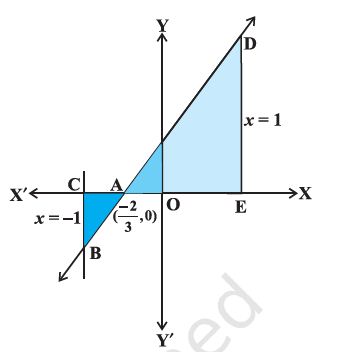
Find the area of the region bounded by the line y = 3x + 2, the x-axis and the ordinates x = -1 and x = 1.
10.
using integration, find the area of the region bounded by the curves y = x2 and y = x.
11.
If A and B are two events such that P(A) =0.2, P(B) =0.4 and P(A U B) = 0.5, then value of P(A /B) is?
0.1
0.25
0.5
0.08
12.
If P(A) = 0.3, P(B) = 0.5 and P(A/B) = 0.4, then P(B/A) is
\(-\frac{2}{3}\)
\(\frac{2}{3}\)
\(\frac{3}{5}\)
none of these
13.
By rule of multiplication of probability \(P(E \cap F)\) is equal to
P(E)· P(F / E)
P(F)· P(E / F)
Both (a) and (b)
None of these
14.
The area of the region bounded by parabola \(y^{2}=x\) and the straight line 2y = x is
\(\frac{4}{3} \text { sq units }\)
1 sq unit
\(\frac{2}{3} \mathrm{squnit}\)
\(\frac{1}{3} \text { sq unit }\)
15.
The area of the region bounded between the line x=9 and the parabola y2=16x is
144 sq units
27 sq units
104 sq units
54 sq units
16.
The area enclosed between the lines x = 2 and x = 7 is
Infinite
7 units
5 units
2 units
17.
The probability of obtaining an even prime number on each die, when a pair of dice is rolled is _____.
0
\(\frac13\)
\(\frac{1}{12}\)
\(\frac{1}{36}\)
18.
If A and B are events such that P(A|B) = P(B|A), then _____.
A ⊂ B but A ≠ B
A = B
A ∩ B = Φ
P(A) = P(B)
19.
The degree of the differential equation
\({ \left( \frac { { d }^{ 2 }y }{ d{ x }^{ 2 } } \right) }^{ 3 }+ { \left( \frac { dy }{ dx } \right) }^{ 2 }+sin{ \left( \frac { dy }{ dx } \right) }+1=0\)
3
2
1
not defined
20.
Two dice are thrown once. If it is known that the sum of the numbers on the dice was less than 6 the probability of getting a sum 3 is
\(\frac{1}{18}\)
\(\frac{5}{18}\)
\(\frac15\)
\(\frac25\)
1.
Given differential equation is \(\left[1+\left(\frac{d y}{d x}\right)^{2}\right]^{3 / 2}=\frac{d^{2} y}{d x^{2}} \)
On squaring both sides, we get
\(\left[1+\left(\frac{d y}{d x}\right)^{2}\right]^{3}=\left(\frac{d^{2} y}{d x^{2}}\right)^{2} \)
Here, highest order derivative is \(\frac{d^{2} y}{d x^{2}}\), whose highest power is 2 .
So, order of differential equation is 2 and degree is also 2.
2.
Given, differential equation is
\(\frac{d^2 y}{d x^2}+\sqrt[3]{\frac{d y}{d x}}+(1+x)=0 \Rightarrow \frac{d^2 y}{d x^2}+(1+x)=-\sqrt[3]{\frac{d y}{d x}}\)
On cubing both sides, we get
\(\left\{\frac{d^2 y}{d x^2}+(1+x)\right\}^3=-\frac{d y}{d x}\)
Hence, the order is 2 and degree is 3. So, the sum is 5.
3.
For independent events,
P(E∩F) = P(E) ⋅ P(F)
\(\Rightarrow 0.35=0.60 \times P(F) \Rightarrow P(F)=\frac{7}{12}=0.58\)
4.
\(
P(B / A)=\frac{P(A \cap B)}{P(A)}
\)
\(\Rightarrow 0.6 \times 0.4=P(A \cap B)
\)
\(\Rightarrow P(A \cap B)=0.24
\)
\( P(A \cup B)=P(A)+P(B)-P(A \cap B)
\)
\(=0.4+0.7-0.24=0.86
\)
5.
Let us denote the numbers on black die by B1, B2'.....,B6 and the numbers on red die by \(R_{1}, R_{2}, \ldots \ldots, R_{6}\)
Then, we get the following sample space
\(S=\left\{\begin{array}{c} \left(B_{1}, R_{1}\right),\left(B_{1}, R_{2}\right), \ldots \ldots,\left(B_{1}, R_{6}\right),\left(B_{2}, R_{1}\right),\left(B_{2}, R_{2}\right), \ldots \ldots \\ \left(B_{2}, R_{6}\right), \ldots \ldots,\left(B_{6}, R_{1}\right),\left(B_{6}, R_{2}\right), \ldots,\left(B_{6}, R_{6}\right) \end{array}\right)\)
Clearly, n(S) = 36
Now, let A be the event that sum of number obtained on the die is 8 and B be the event that red die shows a number less than 4.
Then, \(A=\left\{\left(B_{2}, R_{6}\right),\left(B_{6}, R_{2}\right),\left(B_{3}, R_{5}\right),\left(B_{5}, R_{3}\right),\left(B_{4}, R_{4}\right)\right\}\)
and \(B=\left\{\begin{array}{c} \left(B_{1}, R_{1}\right),\left(B_{1}, R_{2}\right),\left(B_{1}, R_{3}\right),\left(B_{2}, R_{1}\right),\left(B_{2}, R_{2}\right),\left(B_{2}, R_{3}\right) \\ , \ldots . .\left(B_{6}, R_{1}\right),\left(B_{6}, R_{2}\right),\left(B_{6}, R_{3}\right) \end{array}\right\}\)
\(\Rightarrow A \cap B=\left\{\left(B_{6}, R_{2}\right),\left(B_{5}, R_{3}\right)\right\}\)
Now, required probability
\(P\left(\frac{A}{B}\right)=\frac{P(A \cap B)}{P(B)}=\frac{\frac{2}{36}}{\frac{18}{36}}=\frac{2}{18}=\frac{1}{9}\)
6.
Graph : We have : \(y=\left| x+3 \right| \)
\(=x+3\ ifx\ge -3\)
\(=-x-3\ ifx<-3\)
When \(x\ge -3\)
| x = | -3 | -2 |
| y = | 0 | 1 |
When x < - 3
| x = | -4 | -5 |
| y = | 1 | 2 |
Plot the points A (-3, 0), B (-2, 1) and C (-4, 1), D (-5, 2) and portion of the graph is as shown:
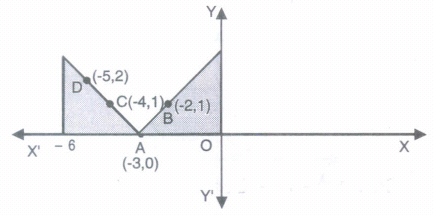
Evaluation:
\(\overset { 0 }{ \underset { -6 }{ \int { } } } \left| x+3 \right| dx\)
\(=\overset { -3 }{ \underset { -6 }{ \int { } } } (-x-3)dx+\overset { 0 }{ \underset { -3 }{ \int { } } } (x+3)dx\)
\(=\left[ -\frac { { x }^{ 2 } }{ 2 } -3x \right] _{ -6 }^{ -3 }+\left[ \frac { { x }^{ 2 } }{ 2 } +3x \right] _{ -3 }^{ 0 }\)
\(=\left[ \left( -\frac { 9 }{ 2 } +9 \right) -\left( -\frac { 36 }{ 2 } +18 \right) \right] +\left[ (0+0)-\left( \frac { 9 }{ 2 } -9 \right) \right] \)
\(=\left( \frac { 9 }{ 2 } +0 \right) +\left( 0+\frac { 9 }{ 2 } \right) =9sq.units.\)
7.
The given ellipse is \(\frac { { x }^{ 2 } }{ 4 } +\frac { { y }^{ 2 } }{ 9 } =1\)
Since (1) is symmetrical about both the axes,
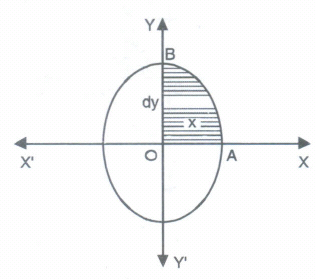
Therefore, area of the ellipse = 4 (Shaded area) = 4 (area OAB)
\(But\ area\ OAB=\overset { 3 }{ \underset { 0 }{ \int { } } } xdy\ [Taking\ horizontal\ strips]\)
\(=\overset { 3 }{ \underset { 0 }{ \int { } } } \frac { 2 }{ 3 } \sqrt { { 9-y }^{ 2 } } dy\)
\([\because \frac { { x }^{ 2 } }{ 4 } +\frac { { y }^{ 2 } }{ 9 } =1\Rightarrow \frac { { x }^{ 2 } }{ 4 } =1-\frac { { y }^{ 2 } }{ 9 } \Rightarrow x=\frac { 2 }{ 3 } \sqrt { 9-{ y }^{ 2 } } (\because x>0)]\)
\(=\frac { 2 }{ 3 } \left[ \frac { y\sqrt { 9-{ y }^{ 2 } } }{ 2 } +\frac { 9 }{ 2 } { sin }^{ -1 }\frac { y }{ 3 } \right] _{ 0 }^{ 3 }\)
\(=\frac { 2 }{ 3 } \left[ \left[ \frac { 3 }{ 2 } (0)+\frac { 9 }{ 2 } { sin }^{ -1 }(1) \right] -[0-0] \right] \)
\(=\frac { 2 }{ 3 } \left[ \frac { 9 }{ 2 } \left( \frac { \pi }{ 2 } \right) \right] =\frac { 3\pi }{ 2 } \)
\(\therefore From(2),\ area\ of\ the\ ellipse=4\left( \frac { 3\pi }{ 2 } \right) =6\pi sq.units\)
8.
The sample space has 216 outcomes.
\(\text { Now } \quad \mathrm{A}=\left\{\begin{array}{lllll} (1,1,4) & (1,2,4) & \ldots & (1,6,4) & (2,1,4) & (2,2,4) & \ldots (2,6,4) \\ (3,1,4) & (3,2,4) & \ldots &(3,6,4) & (4,1,4) & (4,2,4) & \ldots(4,6,4) \\ (5,1,4) & (5,2,4) & \ldots & (5,6,4) & (6,1,4) & (6,2,4) & \ldots(6,6,4) \end{array}\right\}\)
B = {(6,5,1), (6,5,2), (6,5,3), (6,5,4), (6,5,5), (6,5,6)} and A ∩ B = {(6,5,4)}.
\(\text { Now }P(B)=\frac{6}{216} \text { and } P(A \cap B)=\frac{1}{216} \)
Then \(P(A|B)=\frac { P(A\cap B) }{ P(B) } =\frac { \frac { 1 }{ 216 } }{ \frac { 6 }{ 216 } } =\frac { 1 }{ 6 }\)
9.
As shown in the Figure, the line y = 3x + 2 meets x-axis at x\(=\frac{-2}{3}\) and its graph lies below x-axis for \(x \in\left(-1, \frac{-2}{3}\right)\) and above x-axis for \(x \in\left(\frac{-2}{3}, 1\right)\)
The required area = Area of the region ACBA + Area of the region ADEA
\(=\left|\int_{-1}^{\frac{-2}{3}}(3 x+2) d x\right|+\int_{\frac{-2}{3}}^1(3 x+2) d x\)
\(=\left|\left[\frac{3 x^2}{2}+2 x\right]_{-1}^{\frac{-2}{3}}\right|+\left[\frac{3 x^2}{2}+2 x\right]_{\frac{-2}{3}}^1=\frac{1}{6}+\frac{25}{6}=\frac{13}{3}\)
10.
The given curves are
y = x2 (parabola)
y = x (line)
These intersect at
O(0, 0) and A(1, 1).
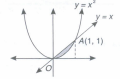
The area bounded by the curves = Shaded area
\(=\int _{ 0 }^{ 1 }{ \left( { y }_{ 2 }-{ y }_{ 1 } \right) } dx\)
\(=\int _{ 0 }^{ 1 }{ \left( x-{ x }^{ 2 } \right) } dx\)
\(=\left[ \frac { { x }^{ 2 } }{ 2 } -\frac { { x }^{ 3 } }{ 3 } \right] _{ 0 }^{ 1 }\)
\(=\frac { 1 }{ 2 } -\frac { 1 }{ 3 } =\frac { 1 }{ 6 } sq.units\)
11.
(b)
0.25
12.
(b)
\(\frac{2}{3}\)
13.
(c)
Both (a) and (b)
14.
(a)
\(\frac{4}{3} \text { sq units }\)
15.
(a)
144 sq units
16.
(a)
Infinite
17.
(d)
\(\frac{1}{36}\)
18.
(d)
P(A) = P(B)
19.
(d)
not defined
20.
As favourable cases for sum less than 6 are 10 and favourable for a total of 3 is 2.

12th Standard CBSE Syllabus & Materials
12th Standard CBSE
CBSE 12th Computer Science Python Revision Tour I - New Previous year Question Papers Study Material - QB365 Set A
NEW12th Standard CBSE
CBSE 12th Business Studies Planning Important Questions And Answers Study Material - QB365 Set A
NEW12th Standard CBSE
CBSE 12th Business Studies Business Environment Important Questions And Answers Study Material - QB365 Set A
NEW12th Standard CBSE
CBSE 12th Business Studies Principles of Management Important Questions And Answers Study Material - QB365 Set A



NCERT Books

Syllabus

Exam Pattern

Sample Question Papers

Previous year Question Papers

Important Notes

MCQ Practice test

NCERT Exemplers

Case study Questions

Image Based Questions

Passage based Questions

HOT Questions

Value Based Questions

Model Questions Papers
NCERT ( Book Back ) Questions

Assertion and Reason
Important Questions And Answers

CBSE 12th Standard CBSE Subjects
CBSE Standards








