
 100% FREE ACCESS
12th Standard CBSE Syllabus & Materials
12th Standard CBSE
CBSE 12th Economics Government Budget and the Economy Previous year Question Papers Study Material - QB365 Set A
NEW12th Standard CBSE
CBSE 12th Computer Science Interface Python with MySQL - New Previous year Question Papers Study Material - QB365 Set A
NEW12th Standard CBSE
CBSE 12th Computer Science Database Concept - New Previous year Question Papers Study Material - QB365 Set A
NEW12th Standard CBSE
CBSE 12th Computer Science Data Communication - New Previous year Question Papers Study Material - QB365 Set A
NEW12th Standard CBSE
CBSE 12th Computer Science Data Structures - New Previous year Question Papers Study Material - QB365 Set A
NEW12th Standard CBSE
CBSE 12th Computer Science Functions - New Previous year Question Papers Study Material - QB365 Set A

Published on: 25/10/2025
Download CBSE Class 12th Standard CBSE Maths question papers, sample papers, important questions, and previous year solved papers in PDF format. Get free study materials, NCERT solutions, and exam preparation resources for Class 12th Standard CBSE Maths
Questions + Answers key
Take MCQ Maths Test
1.
Write the sum of the order and the degree of the following differential equation \(\frac{d}{d x}\left(\frac{d y}{d x}\right)=5\)
2.
Write the value of the following \(\hat{i} \times(\hat{j}+\hat{k})+\hat{j} \times(\hat{k}+\hat{i})+\hat{k} \times(\hat{i}+\hat{j})\)
3.
Evaluate : \(\int _{ 0 }^{ \pi /4 }{ sin2x } dx\)
4.
A line passes through the point with position vector \(2\overset { \wedge }{ i } -3\overset { \wedge }{ j } +4\overset { \wedge }{ k } \) and makes angles 60°, 120°, and 45° with z, y and z-axis respectively. Find the equation of the line in the Cartesian from.
5.
Evaluate the integral: \(\int {1\over x\ +\ x\ log\ x}dx\)
6.
Find the general solution of the differential equations: \(ydx-\left( x+2{ y }^{ 2 } \right) dy=0.\)
7.
Find the vector equation of the plane passing through the points R(2, 5, -3), S(-2, -3, 5) and T(5, 3, -3)
8.
If \(\overrightarrow { a } ,\overrightarrow { b } ,\overrightarrow { c } \) are unit vectors. Such that \(\overrightarrow { a } +\overrightarrow { b } +\overrightarrow { c } =\overrightarrow { 0 } \) then find the value of \(\overrightarrow { a } .\overrightarrow { b } +\overrightarrow { b } .\overrightarrow { c } +\overrightarrow { c } .\overrightarrow { a } \)
9.
Show that the vectors \(2 \hat{i}-3 \hat{j}+4 \hat{k} \text { and }-4 \hat{i}+6 \hat{j}-8 \hat{k}\) are collinear.
10.
Dot product of a vector \(\hat { i } -\hat { j } +\hat { k } ,2\hat { i } +\hat { j } -3\hat { k } \ and\ \hat { i } +\hat { j } +\hat { k } \) are respectively 4, 0 and 2. Find the vector.
11.
Evaluate the integral: \(\int {x+2\over \sqrt{(x-2)(x-3)}}dx\)
12.
If \(\frac{d}{d x} f(x)=\log x\), then f(x) equals
\(-\frac{1}{x}+C\)
\(x(\log x-1)+C\)
\(x(\log x+x)+C\)
\(\frac{1}{x}+C\)
13.
ABCD is a rhombus whose diagonals intersect at E. Then, \(\overrightarrow{E A}+\overrightarrow{E B}+\overrightarrow{E C}+\overrightarrow{E D}\) equals to
\(\overrightarrow{0}\)
\(\overrightarrow{A D}\)
2 \(\overrightarrow{B D}\)
2\(\overrightarrow{A D}\)
14.
The position vectors of points P and Q are \(\vec{p}\) and \(\vec{q}\), respectively. The point R divides line segment PQ in the ratio 3 : 1 and S is the mid-point of line segment PR. The position vector of S is
\(\frac{\vec{p}+3 \vec{q}}{4}\)
\(\frac{\vec{p}+3 \vec{q}}{8}\)
\(\frac{5 \vec{p}+3 \vec{q}}{4}\)
\(\frac{5 \vec{p}+3 \vec{q}}{8}\)
15.
Two lines \(L_{1}: x=5, \frac{y}{3-\alpha}=\frac{z}{-2} \text { and } L_{2}: x=\alpha\) \(\frac{y}{-1}=\frac{z}{2-\alpha}\) are coplanar. Then \(\alpha\) can take values
1, 4, 5
1, 2, 5
3, 4, 5
2, 4, 5
16.
Let F be the family of ellipses whose centre is the origin and major axis is the Y-axis.Then the differential equation of family F is
\(\frac{d^{2} y}{d x^{2}}+\frac{d y}{d x}\left(x \frac{d y}{d x}-y\right)=0\)
\(x y \frac{d^{2} y}{d x^{2}}-\frac{d y}{d x}\left(x \frac{d y}{d x}-y\right)=0\)
\(x y \frac{d^{2} y}{d x^{2}}+\frac{d y}{d x}\left(x \frac{d y}{d x}-y\right)=0\)
\(\frac{d^{2} y}{d x^{2}}-\frac{d y}{d x}\left(x \frac{d y}{d x}-y\right)=0\)
17.
The solution of \(x \frac{d y}{d x}+y=e^{x}\) is
\(y=\frac{e^{x}}{x}+\frac{k}{x}\)
\(y=x e^{x}+c x\)
\(y=x e^{x}+k\)
\(x=\frac{e^{y}}{y}+\frac{k}{y}\)
18.
The area of the region bounded by parabola \(y^{2}=x\) and the straight line 2y = x is
\(\frac{4}{3} \text { sq units }\)
1 sq unit
\(\frac{2}{3} \mathrm{squnit}\)
\(\frac{1}{3} \text { sq unit }\)
19.
\(\int \frac{x+\sin x}{1+\cos x} d x\) is equal to
\(\log |1+\cos x|+C\)
\(\log |x+\sin x|+C\)
\(x-\tan \frac{x}{2}+C\)
\(x \cdot \tan \frac{x}{2}+C\)
20.
Let Z = ax + by is a linear objective function. Variables x and y are called ……… variables.
Independent
Continuous
Decision
Dependent
21.
If l, m , n are the direction cosines of any line, then sum of the squares of the direction cosines of the line is always
-1
\(\sqrt3\)
1
0
22.
Three planes, viz the XY Plane, XZ Plane and the YZ Plane divide the space into eight parts. Each part is called an OCTANT. What is the relation between these three planes
They form the angles α, β & γ with each other
Any two must be perpendicular to each other
All three are mutually perpendicular
no relation between these three planes
23.
The value of \(\widehat { i } .(\widehat { j } \times \widehat { k } )\) + \(\widehat { j } .(\widehat { i } \times \widehat { k } )\)+\(\widehat { k } .(\widehat { i } \times \widehat { j } )\) is
0
-1
1
3
24.
If is \(\overrightarrow { a } \) nonzero vector of magnitude ‘a’ and λ a nonzero scalar, then \(\overrightarrow { a } \)λ is unit vector if
λ = 1
λ = -1
a = |λ|
a = I/|λ|
25.
Which of the following is a homogeneous differential equation?
(4x + 6y + 5) dy – (3y + 2x + 4) dx = 0
(xy) dx – (x3 + y3) dy = 0
(x3 + 2y2) dx + 2xy dy = 0
y2 dx + (x2 – xy – y2) dy = 0
26.
The order of the differential equation \({ 2x }^{ 2 }\frac { { d }^{ 2 }y }{ { dx }^{ 2 } } -3\frac { dy }{ dx } +y=0\) is
2
1
0
not defined
27.
Area bounded by the curve y = x3, the x-axis and the ordinates x = – 2 and x = 1 is
-9
\(\frac{-15}{4}\)
\(\frac{15}{4}\)
\(\frac{17}{4}\)
28.
∫ ex sec x(1+ tan x) dx equals
ex cos x + C
ex sec x + C
ex sin x + C
ex tan x + C
29.
\(\int { \frac { { e }^{ x }(1+x) }{ { cos }^{ 2 }({ e }^{ x }x) } } \)dx equals
– cot (exx) + C
tan (xex) + C
tan (ex) + C
cot (ex) + C
30.
The anti derivative of \(\left( \sqrt { x } +\frac { 1 }{ \sqrt { x } } \right) \) equals
\(\frac { 1 }{ 3 } { x }^{ \frac { 1 }{ 3 } }+{ 2x }^{ \frac { 1 }{ 2 } }+C\)
\(\frac { 2 }{ 3 } { x }^{ \frac { 2 }{ 3 } }+{ \frac { 1 }{ 2 } { x }^{ 2 } }+C\)
\(\frac { 2 }{ 3 } { x }^{ \frac { 3 }{ 2 } }+{ 2x }^{ \frac { 1 }{ 2 } }+C\)
\(\frac { 3 }{ 2 } { x }^{ \frac { 3 }{ 2 } }+{ \frac { 1 }{ 2 } x }^{ \frac { 1 }{ 2 } }+C\)
31.
An aeroplane can carry a maximum of 200 passangers. A profit of Rs. 400 is made on each first class ticket and a profit of Rs. 300 is made on each economy class ticket. An airline reserves at least 20 seats for first class. However, at least 4 times as many passengers prefer to travel by economy class than by first class. Find how many tickets of each type must be sold to maximise the profit? The LPP for the given situation is
x → first class, y → economy class
To maximise Z = 400x + 300y
subject to constraints
x ≥ 0, y ≥ 0, x+y ≤ 200
x ≥ 20, y ≥ 80
x → first class, y → economy class
To maximise Z 400x + 300y
subject to constraints
x ≥ 0, y ≥ 0, x+y ≥ 200
x ≥ 20, y ≥ 80
x → first class, y → economy class
To maximise Z = 400x + 300y
subject to constraints
x ≥ 0, y ≥ 0, x ≥ 20
x + y ≤ 200,x ≥ 4y
x → first class, y → economy class
To maximise Z = 400x + 300y
subject to constraints
x ≥ 20, y ≥ 0
x + y ≤ 200, y ≥ 4x
32.
Find \(\int \frac{2 x}{\left(x^2+1\right)\left(x^4+4\right)} d x\)
33.
Find the shortest distance between the lines
\(\vec{r}=3 \hat{i}+2 \hat{j}-4 \hat{k}+\lambda(\hat{i}+2 \hat{j}+2 \hat{k})\)
and \(\vec{r}=5 \hat{i}-2 \hat{j}+\mu(3 \hat{i}+2 \hat{j}+6 \hat{k})\)
If the lines intersect, find their point of intersection.
34.
Solve the following differential equation (1 + x2)dy + 2xy dx = cot x dx, where x \(\neq\) 0.
35.
Find the area of the region bounded by the line y = 3x + 2, the x-axis and the ordinates x = -1 and x = 1.
36.
A rumour on whatsapp spreads in a population of 5000 people at a rate proportional to the product of the number of people who have heard it and the number of people who have not. Also, it is given that 100 people initiate the rumour and a total of 500 people know the rumour after 2 days.
Based on the above information, answer the following questions
(i) If yet) denote the number of people who know the rumour at an instant t, then maximum value of yet) is
| (a) 500 | (b) 100 | (c) 5000 | (d) none of these |
(ii) \(\frac{d y}{d t}\) is proptional to
| (a) (y - 5000) | (b) y(y - 500) | (c) y(500 - y) | (d) y(5000 - y) |
(iii) The value of y(0) is
| (a) 100 | (b) 500 | (c) 600 | (d) 200 |
(iv) The value of y(2) is
| (a) 100 | (b) 500 | (c) 600 | (d) 200 |
(v) The value of y at any time t is given by
| (a) \(y=\frac{5000}{e^{-5000 k t}+1}\) | (b) \(y=\frac{5000}{1+e^{5000 k t}}\) | (c) \(y=\frac{5000}{49 e^{-5000 k t}+1}\) | (d) \(y=\frac{5000}{49\left(1+e^{-5000 k t}\right)}\) |
37.
In a diamond exhibition, a diamond is covered in cubical glass box having coordinates 0(0, 0, 0), A(1, 0, 0), B(1, 2, 0), C(0, 2, 0), O'(0,0,3), A'(1, 0, 3), B'(1, 2, 3) and C(0, 2, 3).
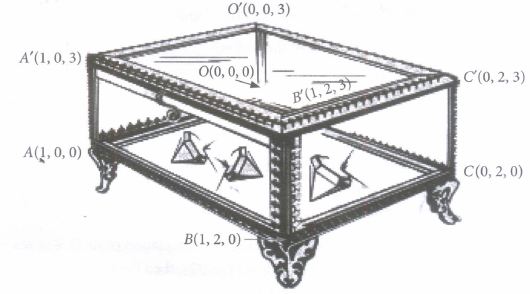
Based on the above information, answer the following questions.
(i) Direction ratios of OA are
| (a) < 0, 1, 0 > | (b) <1, 0, 0> | (c) < 0, 0, 1 > | (d) none of these |
(ii) Equation of diagonal OB' is
| (a) \(\frac{x}{1}=\frac{y}{2}=\frac{z}{3}\) | (b) \(\frac{x}{0}=\frac{y}{1}=\frac{z}{2}\) | (c) \(\frac{x}{1}=\frac{y}{0}=\frac{z}{2}\) | (d) none of these |
(iii) Equation of plane OABC is
| (a) x = 0 | (b) y = 0 | (c) z = 0 | (d) none of these |
(iv) Equation of plane O' A' B' C is
| (a) x = 3 | (b) y = 3 | (c) z = 3 | (d) z = 2 |
(v) Equation of plane ABB' A' is
| (a) x = 1 | (b) y = 1 | (c) z = 2 | (d) x = 3 |
38.
Corner points of the feasible region for an LPP are (0, 3), (5, 0), (6, 8), (0, 8). Let Z = 4x - 6y be the objective function.
Based on the above information, answer the following questions.
(i) The minimum value of Z occurs at
| (a) (6, 8) | (b) (5, 0) | (c) (0, 3) | (d) (0, 8) |
(ii) Maximum value of Z occurs at
| (a) (5, 0) | (b) (0, 8) | (c) (0, 3) | (d) (6, 8) |
(iii) Maximum of Z - Minimumof Z =
| (a) 58 | (b) 68 | (c) 78 | (d) 88 |
(iv) The corner points of the feasible region determined by the system of linear inequalities are
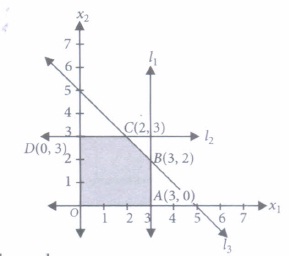
| (a) (0, 0), (-3, 0), (3, 2), (2, 3) | (b) (3, 0), (3, 2), (2, 3), (0, -3) | (c) (0, 0), (3, 0), (3, 2), (2, 3), (0, 3) | (d) None of these |
(v) The feasible solution of LPP belongs to
| (a) first and second quadrant | (b) first and third quadrant | (c) only second quadrant | (d) only first quadrant |
1.
Given, differential equation is \(\frac{d}{d x}\left(\frac{d y}{d x}\right)=5\)
\(\therefore \quad \frac{d^2 y}{d x^2}=5\) ....(i)
Now, from Eq. (i),highest order derivative present in the given differential equation is 2.
\(\therefore\) Order = 2
and the exponent of highest order derivative is 1.
\(\therefore\) Degree = 1
So, the required sum is 2 + 1 = 3
2.
We have, \(\hat{i} \times(\hat{j}+\hat{k})+\hat{j} \times(\hat{k}+\hat{i})+\hat{k} \times(\hat{i}+\hat{j})\)
\(=\hat{i} \times \hat{j}+\hat{i} \times \hat{k}+\hat{j} \times \hat{k}+\hat{j} \times \hat{i}+\hat{k} \times \hat{i}+\hat{k} \times \hat{j}\)
[\(\because\) cross product is distributive over addition]
\(=\hat{k}-\hat{j}+\hat{i}-\hat{k}+\hat{j}-\hat{i}=0\)
[\(\because\) \(\hat{i} \times \hat{j}=\hat{k}, \hat{i} \times \hat{k}=-\hat{j}, \hat{j} \times \hat{k}=\hat{i}, \hat{j} \times \hat{i}=-\hat{k}, \hat{k} \times \hat{i}=\hat{j}, \hat{k} \times \hat{j}=-\hat{i}]\)
3.
\(\int _{ 0 }^{ \pi /4 }{ sin2x } dx=-\frac { 1 }{ 2 } \left[ cos2x \right] ^{ \pi /4 }_{ 0 }\)
\(=-\frac { 1 }{ 2 } \left[ cos(\pi /2)-cos(0) \right] =\frac { 1 }{ 2 } \)
4.
D-Co·smes af line are \(\frac { 1 }{ 2 } ,\frac { 1 }{ 2 } ,\frac { 1 }{ \sqrt { 2 } } \)
Equation of line is :
\(\frac { x-2 }{ 1/2 } =\frac { y+3 }{ -1/2 } =\frac { z+4 }{ 1/2 } \)
2x-4=-2y-6
\(\quad \quad \quad \quad =\sqrt { 2 } (z-4)\)
5.
\(\int \frac{1}{x(1+\log x)} d x =\int \frac{1}{t} d t
\)
\(=\log |t|+C
\)
= log |1 + log x| + c
6.
The given equation is \(ydx-\left( x+2{ y }^{ 2 } \right) dy=0\)
\(\Rightarrow\)\(\frac { dx }{ dy } -\frac { x }{ y } =2y\)
Linear Equation in x
Computing with \(\frac { dx }{ dy } +Px=Q,\)
we have: \('P'\quad =-\frac { 1 }{ y } and\quad 'Q'=2y.\)
\(\therefore\) \(I.F.={ e }^{ \int { Pdy } }={ e }^{ \int { -\frac { 1 }{ y } dy } }={ e }^{ -log|y| }\)
\(={ e }^{ { log }^{ -1 } }={ y }^{ -1 }=\frac { 1 }{ y } .\)
Multiplying (1) by,\(\frac { 1 }{ y } \) we get
\(\frac { 1 }{ y } \frac { dx }{ dy } -\frac { x }{ { y }^{ 2 } } =2\Rightarrow \frac { d }{ dy } \left( x.\frac { 1 }{ y } \right) =2.\)
Integrating,\(x.\frac { 1 }{ y } =\int { 2.dy+c \Rightarrow } \frac { x }{ y } =2y+c\)
\(\Rightarrow \) \(x=2{ y }^{ 2 }+cy\)
Which is the reqd. general solution.
7.
\(\text {Let } \vec{a}=2 \hat{i}+5 \hat{j}-3 \hat{k}, \vec{b}=-2 \hat{i}-3 \hat{j}+5 \hat{k}, \vec{c}=5 \hat{i}+3 \hat{j}-3 \hat{k}\)
Then the vector equation of the plane passing through \(\vec{a},\vec{b}\) and \(\vec{c}\) and is given by
\((\vec{r}-\vec{a}) \cdot(\overrightarrow{\mathrm{RS}} \times \overrightarrow{\mathrm{R} \mathrm{T}})=0 \quad \text { (Why?) } \)
\((\vec{r}-\vec{a}) \cdot[(\vec{b}-\vec{a}) \times(\vec{c}-\vec{a})]=0 \)
\({[\vec{r}-(2 \hat{i}+5 \hat{j}-3 \hat{k})] \cdot[(-4 \hat{i}-8 \hat{j}+8 \hat{k}) \times(3 \hat{i}-2 \hat{j})]=0} \)
8.
We have : \(\overset { \rightarrow }{ |a| } =\overset { \rightarrow }{ |b| } =\overset { \rightarrow }{ |c| } =1\) ..(1)
Now \(\overrightarrow { a } +\overrightarrow { b } +\overrightarrow { c } =\overrightarrow { 0 } \)..(2)
Squaring, \({ \left( \overset { \rightarrow }{ a } +\overset { \rightarrow }{ b } +\overset { \rightarrow }{ c } \right) }^{ 2 }=0\)
\(\Rightarrow \) \(\overset { \rightarrow }{ { |a| }^{ 2 } } +\overset { \rightarrow }{ { |b| }^{ 2 } } +\overset { \rightarrow }{ { |c| }^{ 2 } } +2\left( \overset { \rightarrow }{ a } .\overset { \rightarrow }{ b } +\overset { \rightarrow }{ b } .\overset { \rightarrow }{ c } +\overset { \rightarrow }{ c } .\overset { \rightarrow }{ a } \right) =0\)
\(\Rightarrow \) \({ (1) }^{ 2 }+{ (2) }^{ 2 }+{ (3) }^{ 2 }+2\left( \overset { \rightarrow }{ a } .\overset { \rightarrow }{ b } +\overset { \rightarrow }{ b } .\overset { \rightarrow }{ c } +\overset { \rightarrow }{ c } .\overset { \rightarrow }{ a } \right) =0\)
hence, \(\overset { \rightarrow }{ a } .\overset { \rightarrow }{ b } +\overset { \rightarrow }{ b } .\overset { \rightarrow }{ c } +\overset { \rightarrow }{ c } .\overset { \rightarrow }{ a } =-\frac { 3 }{ 2 } \) .
9.
\(Let\ \vec{a}=2 \hat{i}-3 \hat{j}+4 \hat{k} \text { and } \vec{b}=-4 \hat{i}+6 \hat{j}-8 \hat{k} \text { . }\)
It is observed that \( \vec{b}=-4 \hat{i}+6 \hat{j}-8 \hat{k}=-2(2 \hat{i}-3 \hat{j}+4 \hat{k})=-2 \vec{a}\)
\(\therefore \vec{b}=\lambda \vec{a}\)
\(where, \lambda=-2 \)
Hence, the given vectors are collinear.
10.
\(\text {Let vector be } \vec{r}=x \hat{i}+y \hat{j}+z \hat{k}\)
According to given condition \( x-y+z=4 \text { ; }\)
\(2 x+y-3 z=0 ; x+y+z=2 \)
\(x-y+z=4 \)
\(2 x+y-3 z=0 \)
\(x+y+z=2 \)
From (ii), y = 3z − 2x
Substituting in (i) and (iii), we get
\(x-3 z+2 x+z=4 \Rightarrow 3 x-2 z=4 \)
\(x+3 z-2 x+z=2 \Rightarrow-x+4 z=2 \)
Solving (v) and (vi), we get
\(x=2, z=1\)
Substituting in (iv), we get
\(y=-1\)
\(\therefore \text { Vector is } 2 \hat{i}-\hat{j}+\hat{k} \)
11.
\(\int \frac{x+2}{\sqrt{(x-2)(x-3)}}=\int \frac{x+2}{\sqrt{x^{2}-5 x+6}} d x\)
Let x + 2 = A (2x - 5) + B
Comparing coefficients of x and constant term, we get
\(2 A=1,-5 A+B=2 \Rightarrow A=\frac{1}{2}, B=\frac{9}{2} \)
\(\int \frac{x+2}{\sqrt{x^{2}-5 x+6}} d x=\frac{1}{2} \int \frac{2 x-5}{\sqrt{x^{2}-5 x+6}} d x+\frac{9}{2} \int \frac{1}{\sqrt{x^{2}-5 x+6}} d x\)
For first integral. substitute x2 - 5x + 6 = I, for second integral make it a perfect square.
\(=\frac{1}{2} \int \frac{1}{t} d t+\frac{9}{2} \int \frac{1}{\sqrt{\left(x-\frac{5}{2}\right)^{2}-\left(\frac{1}{2}\right)^{2}}} d x \)
\(=\frac{1}{2} \log |t|+\frac{9}{2} \log \left|\left(x-\frac{5}{2}\right)+\sqrt{x^{2}-5 x+6}\right|+C \)
\(=\log \left|\sqrt{x^{2}-5 x+6}\right|+\frac{9}{2} \log \left|\left(x-\frac{5}{2}\right)+\sqrt{x^{2}-5 x+6}\right|+C
\)
12.
(b)
\(x(\log x-1)+C\)
13.
(a)
\(\overrightarrow{0}\)
14.
(d)
\(\frac{5 \vec{p}+3 \vec{q}}{8}\)
15.
(a)
1, 4, 5
16.
(c)
\(x y \frac{d^{2} y}{d x^{2}}+\frac{d y}{d x}\left(x \frac{d y}{d x}-y\right)=0\)
17.
(a)
\(y=\frac{e^{x}}{x}+\frac{k}{x}\)
18.
(a)
\(\frac{4}{3} \text { sq units }\)
19.
20.
(c)
Decision
21.
(d)
0
22.
(c)
All three are mutually perpendicular
23.
(c)
1
24.
(d)
a = I/|λ|
25.
(d)
y2 dx + (x2 – xy – y2) dy = 0
26.
(a)
2
27.
(d)
\(\frac{17}{4}\)
28.
(b)
ex sec x + C
29.
(b)
tan (xex) + C
30.
(c)
\(\frac { 2 }{ 3 } { x }^{ \frac { 3 }{ 2 } }+{ 2x }^{ \frac { 1 }{ 2 } }+C\)
31.
(d)
x → first class, y → economy class
To maximise Z = 400x + 300y
subject to constraints
x ≥ 20, y ≥ 0
x + y ≤ 200, y ≥ 4x
32.
Let \(I=\int \frac{2 x}{\left(x^2+1\right)\left(x^4+4\right)} d x\)
Put \(x^2=t \Rightarrow 2 x d x=d t\)
\(\therefore \quad I=\int \frac{d t}{(t+1)\left(t^2+4\right)}\)
Now, \(\frac{1}{(t+1)\left(t^2+4\right)}=\frac{A}{t+1}+\frac{B t+C}{t^2+4}\)
\(\Rightarrow 1=A\left(t^2+4\right)+(B t+C)(t+1)\)
\(\Rightarrow 1=A\left(t^2+4\right)+\left(B t^2+B t+C t+C\right)\)
\(\Rightarrow 1=t^2(A+B)+t(B+C)+(4 A+C)\)
On comparing the coefficients of \(t^2, t\) and constant terms from both sides, we get
A+B=0 ...(i)
B+C=0 ...(ii)
4 A+C=1 ...(iii)
From Eqs. (i) and (ii), we get
A-C=0 ..(iv)
From Eqs. (iii) and (iv), we get
\(5A=1 \Rightarrow A=\frac{1}{5}\)
Then, \(C=\frac{1}{5}\) and \(B=-\frac{1}{5}\)
Now, \(=\frac{1}{5} \int \frac{d t}{t+1}-\frac{1}{5} \int \frac{t-1}{t^2+4} d t \)
\(=\frac{1}{5} \log |t+1|-\frac{1}{5}\left[\int \frac{t}{t^2+4} d t-\int \frac{1}{t^2+4} d t\right]\)
\(=\frac{1}{5} \log |t+1|-\frac{1}{5}\left[\frac{1}{2} \log \left|t^2+4\right|-\frac{1}{2} \tan ^{-1}\left(\frac{t}{2}\right)\right]+C\)
\(=\frac{1}{5} \log \left|x^2+1\right|-\frac{1}{5}\left[\frac{1}{2} \log \left|x^4+4\right|\right.\left.\quad-\frac{1}{2} \tan ^{-1}\left(\frac{x^2}{2}\right)\right]+C \quad\left[\because t=x^2\right]\)
33.
The vector equations of given lines are
\(\begin{aligned}
\vec{r}=3 \hat{i}+2 \hat{j}-4 \hat{k}+\lambda(\hat{i}+2 \hat{j}+2 \hat{k})
\end{aligned}\)
and \(\begin{aligned}
\vec{r}=5 \hat{i}-2 \hat{j}+\mu(3 \hat{i}+2 \hat{j}+6 \hat{k})
\end{aligned}\)
On comparing them with \(\vec{r}=\overrightarrow{a_1}+\lambda \overrightarrow{b_1}\) and \(\vec{r}=\overrightarrow{a_2}+\mu \overrightarrow{b_2}\), we get
\(\overrightarrow{a_1}=3 \hat{i}+2 \hat{j}-4 \hat{k}, \overrightarrow{a_2}=5 \hat{i}-2 \hat{j}, \vec{b}_1=\hat{i}+2 \hat{j}+2 \hat{k}\)
and \(\vec{b}_2=3 \hat{i}+2 \hat{j}+6 \hat{k}\)
\(\therefore \quad \overrightarrow{a_2}-\overrightarrow{a_1}=(5 \hat{i}-2 \hat{j})-(3 \hat{i}+2 \hat{j}-4 \hat{k})\)
\(=2 \hat{i}-4 \hat{j}+4 \hat{k}\)
\(\begin{aligned}
\therefore \quad \vec{b}_1 \times \vec{b}_2 & =\left|\begin{array}{lll}
\hat{i} & \hat{j} & \hat{k} \\
1 & 2 & 2 \\
3 & 2 & 6
\end{array}\right|
\end{aligned}\)
\(\begin{aligned}
=\hat{i}(12-4)-\hat{j}(6-6)+\hat{k}(2-6)
\end{aligned}\)
\(\begin{aligned}
=8 \hat{i}-4 \hat{k}
\end{aligned}\)
\(\therefore\left(\vec{a}_2-\vec{a}_1\right) \cdot\left(\vec{b}_1 \times \vec{b}_2\right)=(2 \hat{i}-4 \hat{j}+4 \hat{k}) \cdot(8 \hat{i}-4 \hat{k})\)
= 16 + 0 - 16 = 0
\(\therefore\) The lines are intersecting and the shortest distance between the lines is 0.
Now, the position vectors of arbitrary points on the given lines are \((3+\lambda) \hat{i}+(2+2 \lambda) \hat{j}+(-4+2 \lambda) \hat{k}\) and \((5+3 \mu) \hat{i}+(-2+2 \mu) \hat{j}+6 \mu \hat{k}\), respectively.
Since, lines intersect then they have a common point.
\(\therefore \begin{aligned}
3+\lambda & =5+3 \mu
\end{aligned}\) ...(i)
\(\begin{aligned}
2+2 \lambda & =-2+2 \mu
\end{aligned}\) ...(ii)
\(\begin{aligned}
-4+2 \lambda & =6 \mu
\end{aligned}\) ...(iii)
On solving Eqs. (i) and (ii), we get
\(\lambda=-4 \text { and } \mu=-2\)
\(\therefore\) Point of intersection is (3 - 4, 2 - 8, -4 - 8)
i.e. (-1, -6, -12).
34.
Given differential equation is
\(\left(1+x^{2}\right) d y+2 x y d x=\cot x d x \quad[\because x \neq 0]\)
Above equation can be rewritten as,
\(\left(1+x^{2}\right) d y+(2 x y-\cot x) d x=0\)
\(\Rightarrow\left(1+x^{2}\right) d y=(\cot x-2 x y) d x\)
On dividing both sides by \(1+x^{2}\) ,we get
\(d y=\frac{\cot x-2 x y}{1+x^{2}} d x\)
\(\Rightarrow \frac{d y}{d x}=\frac{\cot x}{1+x^{2}}-\frac{2 x y}{1+x^{2}}\)
\(\Rightarrow \frac{d y}{d x}+\frac{2 x}{1+x^{2}} y=\frac{\cot x}{1+x^{2}}\)
which is a linear differential equation of the form of
\(\frac{d y}{d x}+P y=Q\)
Here, \(P=\frac{2 x}{1+x^{2}} \text { and } Q=\frac{\cot x}{1+x^{2}}\)
Now,\(\mathrm{IF}=e^{\int P d x}=e^{\frac{1}{1+x^{2}} d x}=e^{\log \left|1+x^{2}\right|}=1+x^{2}\)
\(\left[\because I_{1}=\int \frac{2 x}{1+x^{2}} d x,\right. \text { put } 1+x^{2}=t \Rightarrow 2 x d x=d t\)
\(\left.\Rightarrow I_{1}=\int \frac{d t}{t}=\log |t|=\log \left|1+x^{2}\right|\right]\)
and the solution of linear differential equation is given by
\(y \times I F=\int(Q \times I F) d x+C\)
\(\Rightarrow y\left(1+x^{2}\right)=\int \frac{\cot x}{1+x^{2}} \times\left(1+x^{2}\right) d x+C\)
\(\Rightarrow y\left(1+x^{2}\right)=\int \cot x d x+C\)
\(\Rightarrow y\left(1+x^{2}\right)=\log |\sin x|+C\)
\(\Rightarrow y=\frac{\log |\sin x|}{1+x^{2}}+\frac{C}{1+x^{2}}\)
which is the required solution.
35.
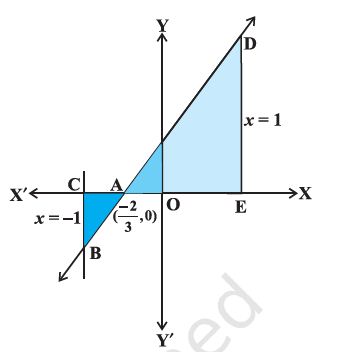
As shown in the Figure, the line y = 3x + 2 meets x-axis at x\(=\frac{-2}{3}\) and its graph lies below x-axis for \(x \in\left(-1, \frac{-2}{3}\right)\) and above x-axis for \(x \in\left(\frac{-2}{3}, 1\right)\)
The required area = Area of the region ACBA + Area of the region ADEA
\(=\left|\int_{-1}^{\frac{-2}{3}}(3 x+2) d x\right|+\int_{\frac{-2}{3}}^1(3 x+2) d x\)
\(=\left|\left[\frac{3 x^2}{2}+2 x\right]_{-1}^{\frac{-2}{3}}\right|+\left[\frac{3 x^2}{2}+2 x\right]_{\frac{-2}{3}}^1=\frac{1}{6}+\frac{25}{6}=\frac{13}{3}\)
36.
(i) (c) : Since, size of population is 5000.
\(\therefore\) Maximum value of y(t) is 5000.
(ii) (d) : Clearly, according to given information
\(\frac{d y}{d t}=k y(5000-y)\) ,where k is the constant of proportionality.
(iii) (a): Since, rumour is initiated with 100 people.
\(\therefore\) When t = 0, then y = 100
Thus y(O) = 100
(iv) (b) : Since, rumour is spread in 500 people, after
2 days.
\(\therefore\) When t = 2, then y = 500.
Thus, y(2) = 500
(v) (c) : We know that, when t = 0, then y = 100
This condition is satisfied by option (c) only.
37.
(i) (b) : D.R:s of OA are < 1-0, 0-0, 0-0 >, i.e., < 1, 0, 0 >.
(ii) (a) : Equation of diagonal OB' is \(\frac{x-0}{1}=\frac{y-0}{2}=\frac{z-0}{3} \text { i.e., } \frac{x}{1}=\frac{y}{2}=\frac{z}{3}\)
(iii) (c) : OABC is xy-plane, therefore its equation is z = 0.
(iv) (c) : Plane O'A'B'C is parallel to xy-plane passing through (0, 0, 3), therefore its equation is z = 3.
(v) (a) : Plane ABB' A' is parallel to yz-plane passing through (1, 0, 0), therefore its equation is x = 1.
38.
Construct the following table of values of objective function
| Corner Points | Value of Z = 4x - 6y |
| (0,3) | 4 x 0 - 6 x 3 = -18 |
| (5,0) | 4 x 5 - 6 x 0 = 20 |
| (6,8) | 4 x 6 - 6 x 8 = -24 |
| (0,8) | 4 x 0 - 6 x 8 = -48 |
(i) (d): Minimum value of Z is -48 which occurs at (0,8).
(ii) (a): Maximumvalue of Z is 20, which occurs at (5,0).
(iii) (b): Maximum of Z - Minimum of Z
= 20 - (-48) = 20 + 48 = 68
(iv) (c): The corner points of the feasible region are O(0,0), A(3, 0), B(3, 2), C(2, 3), D(0, 3).
(v) (d)

12th Standard CBSE Syllabus & Materials
12th Standard CBSE
CBSE 12th Computer Science Python Revision Tour I - New Previous year Question Papers Study Material - QB365 Set A
NEW12th Standard CBSE
CBSE 12th Business Studies Planning Important Questions And Answers Study Material - QB365 Set A
NEW12th Standard CBSE
CBSE 12th Business Studies Business Environment Important Questions And Answers Study Material - QB365 Set A
NEW12th Standard CBSE
CBSE 12th Business Studies Principles of Management Important Questions And Answers Study Material - QB365 Set A



NCERT Books

Syllabus

Exam Pattern

Sample Question Papers

Previous year Question Papers

Important Notes

MCQ Practice test

NCERT Exemplers

Case study Questions

Image Based Questions

Passage based Questions

HOT Questions

Value Based Questions

Model Questions Papers
NCERT ( Book Back ) Questions

Assertion and Reason
Important Questions And Answers

CBSE 12th Standard CBSE Subjects
CBSE Standards








