
 100% FREE ACCESS
12th Standard CBSE Syllabus & Materials
12th Standard CBSE
CBSE 12th Economics Government Budget and the Economy Previous year Question Papers Study Material - QB365 Set A
NEW12th Standard CBSE
CBSE 12th Computer Science Interface Python with MySQL - New Previous year Question Papers Study Material - QB365 Set A
NEW12th Standard CBSE
CBSE 12th Computer Science Database Concept - New Previous year Question Papers Study Material - QB365 Set A
NEW12th Standard CBSE
CBSE 12th Computer Science Data Communication - New Previous year Question Papers Study Material - QB365 Set A
NEW12th Standard CBSE
CBSE 12th Computer Science Data Structures - New Previous year Question Papers Study Material - QB365 Set A
NEW12th Standard CBSE
CBSE 12th Computer Science Functions - New Previous year Question Papers Study Material - QB365 Set A

Published on: 25/10/2025
Download CBSE Class 12th Standard CBSE Maths question papers, sample papers, important questions, and previous year solved papers in PDF format. Get free study materials, NCERT solutions, and exam preparation resources for Class 12th Standard CBSE Maths
Questions + Answers key
Take MCQ Maths Test
1.
Find the area of the ellipse x2 + 9y2 = 36 using integration.
2.
Verify that the function \(y=\sqrt{a^{2}-x^{2}}, x \in(-a, a)\) is a solution of differential equation \(x+y \frac{d y}{d x}=0(y \neq 0)\).
3.
Find the order and degree, of each of the following differential equation, if defined
\(x \sqrt{1-y^{2}} d x+y \sqrt{1-x^{2}} d y=0\)
4.
Evaluate the integral: \(\int {e^{tan^{-1}x}\over1 + x^2}dx\)
5.
What will be the integrating factor of given differential equation \(y d x+\left(x-y^{2}\right) d y=0 ?\)
6.
Integrate the functions in \(\sqrt { 1-4x-{ x }^{ 2 } } \)
7.
Determine the area enclosed between the curve \(y=4x-{ x }^{ 2 }\) and the x-axis.
8.
Find the following integrals :
\(\text { (i) } \int \frac{d x}{x^{2}-6 x+13}\)
\(\text { (ii) } \int \frac{d x}{3 x^{2}+13 x-10}\)
\(\text { (iii) } \int \frac{d x}{\sqrt{5 x^{2}-2 x}}\)
9.
Find the particular solution satisfying the given condition : \({ x }^{ 2 }dy+\left( xy+{ y }^{ 2 } \right) dx=0\); y = 1, when x = 1.
10.
The value of \(\int_{0}^{\frac{\pi}{2}} \log \left(\frac{4+3 \sin x}{4+3 \cos x}\right) d x \text { is }\)
2
\(\frac{3}{4}\)
0
-2
11.
The order of the differential equation satisfying \(\sqrt{1-x^{2}}+\sqrt{1-y^{2}}=a(x-y)\) is
1
2
3
None of these
12.
\(\int \frac{e^{x}(1+x)}{\cos ^{2}\left(e^{x} x\right)} d x\) is equal to
\(-\cot \left(e x^{x}\right)+C\)
\(\tan \left(x e^{x}\right)+C\)
\(\tan \left(e^{x}\right)+C\)
\(\cot \left(e^{x}\right)+C\)
13.
The general solution of the differential equation \(\frac { ydx-xdy }{ y } =0\) is
xy = C
x = Cy2
y = Cx
y = Cx2
14.
The number of arbitrary constants in the general solution of a differential equation of fourth order are:
0
2
3
4
15.
Area bounded by the curve y = x3, the x-axis and the ordinates x = – 2 and x = 1 is
-9
\(\frac{-15}{4}\)
\(\frac{15}{4}\)
\(\frac{17}{4}\)
16.
\(\int { \frac { dx }{ { e }^{ x }+{ e }^{ -x } } } \) is equal to
tan–1 (ex) + C
tan–1 (e–x) + C
log (ex – e–x) + C
log (ex + e–x) + C
17.
Area of the region bounded by the curve y = \(\sqrt { 49-{ x }^{ 2 } } \) and the x-axis is
\(\frac { 49 }{ 2 } \pi \) sq units
98π sq units
49π sq units
240π sq units
18.
An equation involving derivatives of the dependent variable with respect to the independent variables is called a differential equation. A differential equation of the form \(\frac{d y}{d x}=F(x, y)\) is said to be homogeneous if F(x, y) is a homogeneous function of degree zero. whereas a function F(x, y) is a homogenous function of degree n if \(F\left(\lambda x \cdot \lambda_y\right)=\lambda_0 F(x, y)\). To solve a homogeneous differential equation of the type \(\frac{d y}{d x}=F(x, y)=g\left(\frac{y}{x}\right)\) we make the substitution y = vx and then separate the variables.
Based on the above answer the following questions.
(i) Show that (x2 - y2)dx + 2xy dy = 0 is a differential equation of the type \(\frac{d y}{d x}=g\left(\frac{y}{x}\right)\)
(ii) Solve the above equation to find the general solution.
19.
Assertion (A) The area bounded by y2 = 4x and y = x is \(\frac{8}{3}\) sq units.
Reason (R) The area bounded by y2 = 4ax and y = mx is \(\frac{8a^2}{3m^3}\)sq units.
(a) Both A and R are correct; R is the correct explanation of A
(b) Both A and R are correct; R is not the correct explanation of A
(c) A is correct; R is incorrect
(d) R is correct; A is incorrect
1.
We have, the equation of the ellipse
x2 + 9y2 = 36
\(\Rightarrow \frac{x^2}{36}+\frac{y^2}{4}=1 \Rightarrow \frac{x^2}{6^2}+\frac{y^2}{2^2}=1\)
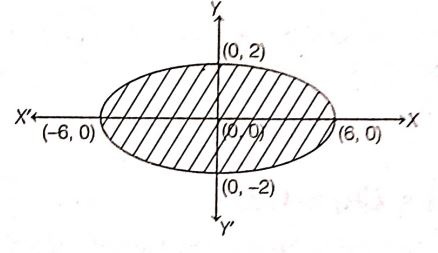
\(\therefore\) Required area \(=4 \int_0^6 y d x\)
\(\begin{aligned} & =4 \int_0^6 \frac{2}{6} \sqrt{36-x^2} d x=\frac{4}{3} \int_0^6 \sqrt{36-x^2} d x \end{aligned}\)
\(\begin{aligned} =\frac{4}{3}\left[\frac{x}{2} \sqrt{36-x^2}+\frac{36}{2} \sin ^{-1} \frac{x}{6}\right]_0^6 \end{aligned}\)
\(\begin{aligned} & =\frac{4}{3}\left[0+\frac{36}{2} \sin ^{-1} 1-0\right]=\frac{4}{3} \times 18 \times \frac{\pi}{2} \end{aligned}\)
= 12 \(\pi\) sq units
2.
\(y=\sqrt{a^{2}-x^{2}}\)
Differentiating both sides of this equation with respect to x, we get:
\(\frac{d y}{d x}=\frac{d}{d x}\left(\sqrt{a^{2}-x^{2}}\right) \)
\(\Rightarrow \frac{d y}{d x}=\frac{1}{2 \sqrt{a^{2}-x^{2}}} \cdot \frac{d}{d x}\left(a^{2}-x^{2}\right) \)
\(=\frac{1}{2 \sqrt{a^{2}-x^{2}}}(-2 x) \)
\(=\frac{-x}{\sqrt{a^{2}-x^{2}}}\)
Substituting the value of \( \frac{d y}{d x}\) in the given differential equation, we get:
\(\text { L.H.S. } =x+y \frac{d y}{d x} =x+\sqrt{a^{2}-x^{2}} \times \frac{-x}{\sqrt{a^{2}-x^{2}}} \)
\(=x-x =0 =\text { R.H.S }\)
Hence, the given function is the solution of the corresponding differential equation. \(\)
3.
The given equation can be rewritten as
\(x \sqrt{1-y^{2}} d x=-y \sqrt{1-x^{2}} d y \Rightarrow \frac{d y}{d x}=\frac{-x \sqrt{1-y^{2}}}{y \sqrt{1-x^{2}}} \)
Since, the highest order derivative is \( \frac{d y}{d x}.\)is 1. So, its degree is 1.
4.
\(\int \frac{e^{\tan ^{4} x}}{1+x^{2}} d x=\int e^{t} d t=e^{t}+C=e^{\tan ^{-1} x}+C \)
5.
Given differential equation is
\(y d x+\left(x-y^{2}\right) d y=0\)
\(\Rightarrow y \frac{d x}{d y}+\left(x-y^{2}\right)=0\)
\(\Rightarrow y \frac{d x}{d y}+x=y^{2}\)
\(\Rightarrow \frac{d x}{d y}+\frac{1}{y} x=y\) [dividing both sides by y ]
which is of the form \(\frac{d x}{d y}+P x=Q\)
Here,\(P=\frac{1}{y} \text { and } Q=y\)
\(\therefore\) Integrating Factor \(\mathrm{IF}=e^{\int P d y}=e^{\int \frac{1}{y} d y}\)
\(=e^{\log y}=y \quad\left[\because e^{\log f(x)}=f(x)\right]\)
6.
\(I= \int { \sqrt { 1-4x-{ x }^{ 2 } } } dx\)
\(=\int { \sqrt { 1-({ x }^{ 2 }+4x) } } dx\)
\(=\int { \sqrt { 1+4-({ x }^{ 2 }+4x+x) } } dx\)
\(=\int { \sqrt { 5-{ (x+2) }^{ 2 } } } dx.\)
Put x+2=t so that dx=dt
\(\therefore I=\int { \sqrt { 5-{ t }^{ 2 } } } dt\)
\(=\int { \sqrt { 5-{ t }^{ 2 } } } dt \left[ From:\int { \sqrt { { a }^{ 2 }-{ x }^{ 2 } } dx } \right] \)
\(=\frac { t\sqrt { 5-{ t }^{ 2 } } }{ 2 } +\frac { 5 }{ 2 } \sin ^{ -1 }{ \frac { t }{ \sqrt { 5 } } } +C\)
\( =\frac { (x+2)\sqrt { 5-{ (x+2) }^{ 2 } } }{ 2 } +\frac { 5 }{ 2 } \sin ^{ -1 }{ \frac { x+2 }{ \sqrt { 5 } } } +C\)
\(=\frac { (x+2) }{ 2 } \sqrt { 1-4x-{ x }^{ 2 } } +\frac { 5 }{ 2 } \sin ^{ -1 }{ \left( \frac { x+2 }{ \sqrt { 5 } } \right) } +C\)
7.
\(y =0 \Rightarrow x=0,4 \)
\(\text { Area } =\int_{0}^{4}\left(4 x-x^{2}\right) d x \)
\(\text { Area } =\left[2 x^{2}-\frac{x^{3}}{3}\right]_{0}^{4}=\left(32-\frac{64}{3}\right) \text { sq units } \)
\(=\frac{32}{3} \text { sq units }
\)
8.
(i) We have x2 – 6x + 13 = x 2– 6x + 32 – 32 + 13 = (x – 3)2 + 4
\(\text { So, } \ \int \frac{d x}{x^{2}-6 x+13}=\int \frac{1}{(x-3)^{2}+2^{2}} d x\)
Let x – 3 = t. Then dx = dt
\(\int \frac{d x}{x^{2}-6 x+13}=\int \frac{d t}{t^{2}+2^{2}}=\frac{1}{2} \tan ^{-1} \frac{t}{2}+C\)
\(=\frac{1}{2} \tan ^{-1} \frac{x-3}{2}+\mathrm{C}\)
(ii) The given integral is of the form 7.4 (7). We write the denominator of the integrand,
\(3 x^{2}+13 x-10=3\left(x^{2}+\frac{13 x}{3}-\frac{10}{3}\right)\)
\(=3\left[\left(x+\frac{13}{6}\right)^{2}-\left(\frac{17}{6}\right)^{2}\right] \text { (completing the square) }\)
\(\text { Thus } \int \frac{d x}{3 x^{2}+13 x-10}=\frac{1}{3} \int \frac{d x}{\left(x+\frac{13}{6}\right)^{2}-\left(\frac{17}{6}\right)^{2}} \)
\(\text { Put } x+\frac{13}{6}=t \text { . Then } d x=d t . \)
\(\text { Therefore, } \quad \int \frac{d x}{3 x^{2}+13 x-10}=\frac{1}{3} \int \frac{d t}{t^{2}-\left(\frac{17}{6}\right)^{2}} \)
\(=\frac{1}{3 \times 2 \times \frac{17}{6}} \log \left|\frac{t-\frac{17}{6}}{t+\frac{17}{6}}\right|+C_{1} \)
\(=\frac{1}{17} \log \left|\frac{x+\frac{13}{6}-\frac{17}{6}}{x+\frac{13}{6}+\frac{17}{6}}\right|+C_{1} \)
\(=\frac{1}{17} \log \left|\frac{6 x-4}{6 x+30}\right|+C_{1} \)
\(=\frac{1}{17} \log \left|\frac{3 x-2}{x+5}\right|+C_{1}+\frac{1}{17} \log \frac{1}{3} \)
\(=\frac{1}{17} \log \left|\frac{3 x-2}{x+5}\right|+C, \text { where } C=C_{1}+\frac{1}{17} \log \frac{1}{3} \)
\(\text { (iii) We have } \int \frac{d x}{\sqrt{5 x^{2}-2 x}}=\int \frac{d x}{\sqrt{5\left(x^{2}-\frac{2 x}{5}\right)}}\)
\(=\frac{1}{\sqrt{5}} \int \frac{d x}{\sqrt{\left(x-\frac{1}{5}\right)^{2}-\left(\frac{1}{5}\right)^{2}}} \text { (completing the square) }\)
\(\text { Put } x-\frac{1}{5}=t . \text { Then } d x=d t \text { . }\)
\(\text { Therefore, } \quad \int \frac{d x}{\sqrt{5 x^{2}-2 x}}=\frac{1}{\sqrt{5}} \int \frac{d t}{\sqrt{t^{2}-\left(\frac{1}{5}\right)^{2}}}\)
\(=\frac{1}{\sqrt{5}} \log \left|t+\sqrt{t^{2}-\left(\frac{1}{5}\right)^{2}}\right|+\mathrm{C}\)
\(=\frac{1}{\sqrt{5}} \log \left|x-\frac{1}{5}+\sqrt{x^{2}-\frac{2 x}{5}}\right|+\mathrm{C}\)
9.
Given, \({ x }^{ 2 }dy+\left( xy+{ y }^{ 2 } \right) dx=0\)
\(\therefore \ \frac { dy }{ dx } =\frac { -\left( xy+{ y }^{ 2 } \right) }{ { x }^{ 2 } } \)
Put y = vx
\(\Rightarrow \frac { dy }{ dx } =v+x\frac { dv }{ dx } \)
\(\therefore \) The differential equation becomes
\(v+x\frac { dv }{ dx } =-\left( v+{ v }^{ 2 } \right) \)
\(\Rightarrow \frac { dv }{ { v }^{ 2 }+2v } =\frac { dx }{ x } \)
\(\Rightarrow \int { \frac { dv }{ \left( v+1 \right) ^{ 2 }-{ 1 }^{ 2 } } } =-\int { \frac { dx }{ x } } \)
\(\Rightarrow \frac { 1 }{ 2 } \log { \frac { v }{ v+2 } } =-\log { x } +\log { C } \)
\(\Rightarrow \frac { C }{ x } =\sqrt { \frac { y }{ y+2x } } \)
If x = 1, y = 1 then \(c=\frac { 1 }{ \sqrt { 3 } } \)
\(\Rightarrow \frac { 1 }{ \sqrt { 3 } x } =\sqrt { \frac { y }{ y+2x } } \)
10.
(c)
0
11.
(a)
1
12.
13.
(c)
y = Cx
14.
(d)
4
15.
(d)
\(\frac{17}{4}\)
16.
(a)
tan–1 (ex) + C
17.
As area is above the x-axis
∴ area = \(2\int _{ 0 }^{ 7 }{ \sqrt { 49-{ x }^{ 2 } } } \)
= \({ \left[ \frac { x }{ 2 } \sqrt { 49-{ x }^{ 2 } } +\frac { 49 }{ 2 } { sin }^{ -1 }\frac { x }{ 7 } \right] }_{ 0 }^{ 7 }\)
= \(2\left[ \left( \frac { 7 }{ 2 } \times 0+\frac { 49 }{ 2 } { sin }^{ -1 }1 \right) -(0) \right] \)
= \(\frac { 49 }{ 2 } \pi \) sq units
18.
(i) Given, differential equation is (x2 - y2)dx + 2xydy = 0
\(\begin{aligned}
\Rightarrow \frac{d y}{d x} & =\frac{-\left(x^2-y^2\right)}{2 x y}=\frac{y^2-x^2}{2 x y}
\end{aligned}\)
\(\begin{aligned}
=\frac{x^2\left(\frac{y^2}{x^2}-1\right)}{2 x y}=\frac{\left(\frac{y}{x}\right)^2-1}{2\left(\frac{y}{x}\right)}
\end{aligned}\)
\(\therefore\) In RHS, degree of numerator and denominator is same
\(\therefore\) It is a homogeneous differential equation and can be written as
\(\frac{d y}{d x}=g\left(\frac{y}{x}\right)\)
(ii) Given, differential equation is (x2 - y2)dx + 2xy dy = 0
\(\Rightarrow \quad \frac{d y}{d x}=-\frac{\left(x^2-y^2\right)}{2 x y}=\frac{y^2-x^2}{2 x y}\) ...(i)
This is a homogeneous differential equation
On putting y = vx \(\Rightarrow \frac{d y}{d x}=v+x \cdot \frac{d v}{d x}\)
\(\therefore\) From Eq (i), we get
\(\begin{aligned}
v+x \cdot \frac{d v}{d x} & =\frac{v^2-1}{2 v}
\end{aligned}\)
\(\begin{aligned}
\Rightarrow \quad x \frac{d v}{d x} & =\frac{v^2-1}{2 v}-v
\end{aligned}\)
\(\begin{aligned}
=\frac{v^2-1-2 v^2}{2 v}=\frac{-v^2-1}{2 v}
\end{aligned}\)
\(\Rightarrow \frac{2 v}{v^2+1} d v=\frac{-d x}{x}\)
on integrating both sides, we get
log |v2 + 1| = -log x + log c
\(\begin{aligned}
& \Rightarrow \quad \log \left|\frac{y^2}{x^2}+1\right|=-\log x+\log c
\end{aligned}\)
\(\begin{aligned}
& \Rightarrow \quad \log \left|\frac{y^2+x^2}{x^2} \cdot x\right|=\log c \\
\end{aligned}\)
\(\begin{aligned}
& \Rightarrow \quad \frac{y^2+x^2}{x}=c
\end{aligned}\)
\(\Rightarrow\) y2 + x2 = cx
which is the required solution.
19.
(a) Both A and R are correct; R is the correct explanation of A

12th Standard CBSE Syllabus & Materials
12th Standard CBSE
CBSE 12th Computer Science Python Revision Tour I - New Previous year Question Papers Study Material - QB365 Set A
NEW12th Standard CBSE
CBSE 12th Business Studies Planning Important Questions And Answers Study Material - QB365 Set A
NEW12th Standard CBSE
CBSE 12th Business Studies Business Environment Important Questions And Answers Study Material - QB365 Set A
NEW12th Standard CBSE
CBSE 12th Business Studies Principles of Management Important Questions And Answers Study Material - QB365 Set A



NCERT Books

Syllabus

Exam Pattern

Sample Question Papers

Previous year Question Papers

Important Notes

MCQ Practice test

NCERT Exemplers

Case study Questions

Image Based Questions

Passage based Questions

HOT Questions

Value Based Questions

Model Questions Papers
NCERT ( Book Back ) Questions

Assertion and Reason
Important Questions And Answers

CBSE 12th Standard CBSE Subjects
CBSE Standards








