
 100% FREE ACCESS
12th Standard CBSE Syllabus & Materials
12th Standard CBSE
CBSE 12th Economics Government Budget and the Economy Previous year Question Papers Study Material - QB365 Set A
NEW12th Standard CBSE
CBSE 12th Computer Science Interface Python with MySQL - New Previous year Question Papers Study Material - QB365 Set A
NEW12th Standard CBSE
CBSE 12th Computer Science Database Concept - New Previous year Question Papers Study Material - QB365 Set A
NEW12th Standard CBSE
CBSE 12th Computer Science Data Communication - New Previous year Question Papers Study Material - QB365 Set A
NEW12th Standard CBSE
CBSE 12th Computer Science Data Structures - New Previous year Question Papers Study Material - QB365 Set A
NEW12th Standard CBSE
CBSE 12th Computer Science Functions - New Previous year Question Papers Study Material - QB365 Set A

Published on: 25/10/2025
Download CBSE Class 12th Standard CBSE Maths question papers, sample papers, important questions, and previous year solved papers in PDF format. Get free study materials, NCERT solutions, and exam preparation resources for Class 12th Standard CBSE Maths
Questions + Answers key
Take MCQ Maths Test
1.
Computing the shortest distance between the following pair of lines, determine whether they intersect or not?
\(\vec{r}=(\hat{i}-\hat{j})+\lambda(2 \hat{i}-\hat{k}) \text { and } \vec{r}=2 \hat{i}-\hat{j}+\mu(\hat{i}-\hat{j}-\hat{k})\)
2.
Find the area of the region bounded by the line y = 3x + 2, the x-axis and the ordinates x = -1 and x = 1.
3.
Let A = (-1, 0, 1, 2) B = (-4, -2, 0, 2) and f.g:A \(\rightarrow\)B be function defined by f(x) = x2 -x, x ∈ A and g(x) = 2 |x - \(\frac { 1 }{ 2 } \)|-1 x ∈ A. Are f and g equal? Justify your answer. (Hint: One may note that two functions f : A → B and g : A → B such that f(a) = g(a) ∀ a ∈ A, are called equal functions).
4.
Evaluate : \(\text { }\left|\begin{array}{ccc} \cos \alpha \cos \beta & \cos \alpha \sin \beta & -\sin \alpha \\ -\sin \beta & \cos \beta & 0 \\ \sin \alpha \cos \beta & \sin \alpha \sin \beta & \cos \alpha \end{array}\right|\)
5.
Find the values of k for which \(f(x)=k x^{3}-9 k x^{2}+9 x+3\) is increasing on R.
6.
A stone is dropped into a quiet lake and waves moves in circles at a speed of 5 cm/ s. At the instant when the radius of the circular wave is 8 cm, how fast is the enclosed area increasing?
7.
Show that the function f given by \(f(x)=x^{3}-3 x^{2}+4 x, x \in R\) is strictly increasing on R.
8.
Evaluate the integral: \(\int {(ax\ +\ b)^3}dx\)
9.
Find the principal values of the following:
\({ \cot}^{ -1 }( \sqrt 3)\)
10.
There are three coins. One is a two headed coin (having head on both faces), another is a biased coin that comes up heads 75% of the time and third is an unbiased coin. One of the three coins is chosen at random and tossed, it shows heads, what is the probability that it was the two headed coin ?
11.
Evaluate the definite integral in \(\int _{ 0 }^{ 2 }{ \frac { 6x+3 }{ { x }^{ 2 }+4 } } dx\)
12.
Solve the following Linear Programming Problems graphically:
Minimise Z = 3x + 5y
such that x + 3y ≥ 3, x + y ≥ 2, x, y ≥ 0.
13.
Integrate \(\frac { x }{ 9-{ 4x }^{ 2 } } \)
14.
In a bank, principal increases continuously at the rate of r% per year. Find the value of r if Rs 100 double itself in 10 years \(\left( { log }_{ e }2=0.6931 \right) .\)
15.
Differentiate the following with respect to x:
\((i)\ { e }^{ -x } \)
\((ii)\ sin(log\quad x),\ x>0\)
\((iii)\ { cos }^{ -1 }({ e }^{ x }) \)
\((iv)\ { e }^{ cos\quad x }\)
16.
The objective function Z = ax + by of an LPP if its maximum value 42 at (4, 6) and minimum value 19 at (3, 2). Which of the following is true?
a = 9 and b = 1
a = 5 and b = 2
a = 3 and b = 5
a = 5 and b = 3
17.
If \(P(A)=0.4, P(B)=0.8 \text { and } P(B / A)=0.6\) then \(P(A \cup B)\) is equal to
0.24
0.3
0.48
0.96
18.
The variables x and y in a linear programming problem are called
decision variables
linear variables
optimal variables
None of these
19.
If \(y=\left(x+\sqrt{1+x^{2}}\right)^{n}\) is
-xcosx -2sinx
xcosx + 2sinx
xsinx + cosx
None of these
20.
Derivate of \(\cot ^{-1}\left[\frac{\sqrt{1+\sin x}+\sqrt{1-\sin x}}{\sqrt{1+\sin x}-\sqrt{1-\sin x}}\right]\) \(0<x<\frac{\pi}{2}\) is
\(\frac{1}{2}\)
1
2
None of these
21.
Given,2x - y + 2z = 2, x - 2y + Z = - 4 and x + y + λz= 4, then the value of Asuch that the given system of equation has no solution is
3
1
0
-3
22.
If θ is the angle between any vectors \(\overrightarrow { a } \) and \(\overrightarrow { b } \) then |\(\overrightarrow { a } \).\(\overrightarrow { b } \)| = |\(\overrightarrow { a } \) x \(\overrightarrow { b } \)| when θ is equal to
0
\(\frac { \pi }{ 4 } \)
\(\frac { \pi }{ 2 } \)
π
23.
If is \(\overrightarrow { a } \) nonzero vector of magnitude ‘a’ and λ a nonzero scalar, then \(\overrightarrow { a } \)λ is unit vector if
λ = 1
λ = -1
a = |λ|
a = I/|λ|
24.
Which of the following is a homogeneous differential equation?
(4x + 6y + 5) dy – (3y + 2x + 4) dx = 0
(xy) dx – (x3 + y3) dy = 0
(x3 + 2y2) dx + 2xy dy = 0
y2 dx + (x2 – xy – y2) dy = 0
25.
The general solution of the differential equation \(\frac{dy}{dx}\) = ex+y is
ex + e–y = C
ex + ey = C
e–x + ey = C
e–x + e–y = C
26.
\(\int _{ 0 }^{ \frac { 2 }{ 3 } }{ \frac { dx }{ 4+9{ x }^{ 2 } } } \) equals
\(\frac { \pi }{ 6 } \)
\(\frac { \pi }{ 12 } \)
\(\frac { \pi }{ 12 } \)
\(\frac { \pi }{ 4 } \)
27.
Which of the following functions are decreasing on 0, \(\frac{\pi}{2}\)?
cos x
cos 2x
cos 3x
tan x
28.
Let A = \(\left[ \begin{matrix} 1 & sin\theta & 1 \\ -sin\theta & 1 & sin\theta \\ -1 & -sin\theta & 1 \end{matrix} \right] \), where 0 ≤ θ ≤2ㅠ.Then
Det (A) = 0
Det (A) ∈ (2, ∞)
Det (A) ∈ (2, 4)
Det (A) ∈ [2, 4]
29.
If Δ = \(\left| \begin{matrix} { a }_{ 11 } & { a }_{ 12 } & { a }_{ 13 } \\ { a }_{ 21 } & { a }_{ 22 } & { a }_{ 23 } \\ { a }_{ 31 } & { a }_{ 32 } & { a }_{ 33 } \end{matrix} \right| \) and Aij is Cofactors of aij, then value of Δ is given by
a11 A31+ a12 A32 + a13 A33
a11 A11+ a12 A21 + a13 A31
a21 A11+ a22 A12 + a23 A13
a11 A11+ a21 A21 + a31 A31
30.
If \(\begin{vmatrix} x & 2 \\ 18 & x \end{vmatrix}=\begin{vmatrix} 6 & 2 \\ 18 & 6 \end{vmatrix}\) , then x is equal to
6
土6
-6
0
31.
The number of all possible matrices of order 3 × 3 with each entry
27
18
81
512
32.
Let R be the relation in the set N given by R = {(a, b): a = b − 2, b > 6}. Choose the correct answer.
(2, 4)∈ R
(3, 8) ∈ R
(6, 8)∈ R
(8, 7) ∈ R
33.
Distance between planes \(\overrightarrow { r } .(2\widehat { i } +\widehat { j } -2\widehat { k } )+5=0\) and \(\overrightarrow { r } .(6\widehat { i } +3\widehat { j } -6\widehat { k } )+2=0\) is
\(\frac { 9 }{ 13 } \)
\(\frac { 15 }{ 4 } \)
\(\frac { 13 }{ 9 } \)
\(\frac { 1 }{ 13 } \)
34.
Direction ratios of a line are 2, 3, -6. Then direction cosines of a line making obtuse angle with the y-axis are
\(\frac { 2 }{ 7 } ,\frac { -3 }{ 7 } ,\frac { -6 }{ 7 } \)
\(\frac { -2 }{ 7 } ,\frac { 3 }{ 7 } ,\frac { -6 }{ 7 } \)
\(\frac { -2 }{ 7 } ,\frac { -3 }{ 7 } ,\frac { 6 }{ 7 } \)
\(\frac { -2 }{ 7 } ,\frac { -3 }{ 7 } ,\frac { -6 }{ 7 } \)
35.
Let the vectors \(\vec{a} \text { and } \vec{b} \text { be such that }|a| \overrightarrow{=} 3 \text { and } \overrightarrow{|b|}=\frac{\sqrt{2}}{3} \text { then } \vec{a} \times \vec{b}\) is a unit is a vector, if the angle between is:
\(\frac { \pi }{ 6 } \)
\(\frac { \pi }{ 4 } \)
\(\frac { \pi }{ 3 } \)
\(\frac { \pi }{ 2 } \)
36.
A tank, as shown in the figure below, formed using a combination of a cylinder and a cone, offers better drainage as compared to a flat bottomed tank.
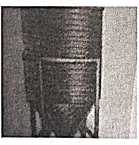
A tap is connected to such a tank whose conical part is full of water. Water is dripping out from a tap of the bottom at the uniform rate of \(2 \mathrm{~cm}^3 / \mathrm{s}\). The semi-vertical angle of the conical tank is \(45^{\circ}\).
Based on the given information, answer the following questions.
(i) Find the volume of water in the tank in terms of its radius.
(ii) Find the rate of change of radius at an constant when \(r=2 \sqrt{2} \mathrm{~cm}\)
(iii) (a) Find the rate at which the wet surface of the conical tank is decreasing at an instant when radius \(r=2 \sqrt{2} \mathrm{~cm}\).Or
(b) Find the rate of change of height ' h ' at an instant when slant height is 4 cm .
37.
A building contractor undertakes a job to construct 4 flats on a plot along with parking area, Due to strike, the probability of many construction workers not being present for the job is 0.65.
The probability that many are not present and still the work gets completed on time is 0.35. The probability that work will be completed on time when all workers are present is 0.80.
Let E1 : represents the event when many workers were not present for the job;
E2 : represents the event when all workers were present; and
E : represents completing the construction work on time.
Based on the above information, answer the following questions:
(i) What is the probability that all the workers are present for the job?
(ii) What is the probability that construction will be completed on time?
(iii) (a) What is the probability that many workers are not present given that the construction work is completed on time?
Or (b) What is the probability that all workers were present given that the construction job was completed on time?
38.
If two vectors are represented by the two sides of a triangle taken in order, then their sum is represented by the third side of the triangle taken in opposite order and this is known as triangle law of vector addition. lased on the above information, answer the following questions.
(i) If \(\vec{p}, \vec{q}, \vec{r}\)are the vectors represented by the sides of a triangle taken in order, then \( \vec{q} +\vec{r}\) =
| (a) \(\vec{p}\) | (b) \(2 \vec{p}\) | (c) \(-\vec{p}\) | (d) None of these |
(ii) If ABCD is a parallelogram and AC and BD are its diagonals, then\( \vec{AC} +\vec{BD}\) =
| (a) \(2 \vec{DA}\) | (b) \(2 \vec{AB}\) | (c) \(2\overrightarrow{BC}\) | (d) \(2\vec{BD}\) |
(iii) If ABCD is a parallelogram, where \(\overrightarrow{A B}\)\(=2\overrightarrow{a}\) and \(\overrightarrow{BC}\) \(=2\overrightarrow{b}\), then \( \vec{AC} -\vec{BD}\) =
| (a) \(3\vec{a}\) | (b) \(4\vec{a}\) | (c) \(2\vec{b}\) | (d) \(4\vec{b}\) |
(iv) If ABCD is a quadrilateral whose diagonals are \( \vec{AC}\) and \(\vec{BD}\), then \( \vec{BA} +\vec{CD}\) =
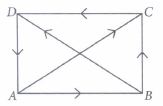
| (a) \(\overrightarrow{A C}+\overrightarrow{D B}\) | (b) \(\overrightarrow{A C}+\overrightarrow{B D}\) | (c) \(\overrightarrow{B C}+\overrightarrow{A D}\) | (d) \(\overrightarrow{B D}+\overrightarrow{C A}\) |
(v) If T is the mid point of side YZ of \(\triangle\)XYZ, then\(\overrightarrow{XY}\) + \(\overrightarrow{XZ}\) =
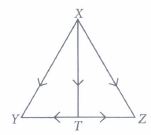
| (a) \(2\vec{YT}\) | (b) \(2\vec{XT}\) | (c) \(2\vec{TZ}\) | (d) None of these |
1.
\(\frac{1}{\sqrt{6}},\) lines do not intersect
Hint: A pair of lines will intersect, if the shortest distance between them is zero.
2.
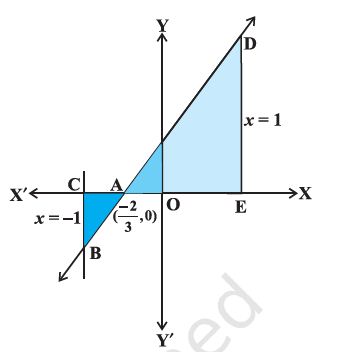
As shown in the Figure, the line y = 3x + 2 meets x-axis at x\(=\frac{-2}{3}\) and its graph lies below x-axis for \(x \in\left(-1, \frac{-2}{3}\right)\) and above x-axis for \(x \in\left(\frac{-2}{3}, 1\right)\)
The required area = Area of the region ACBA + Area of the region ADEA
\(=\left|\int_{-1}^{\frac{-2}{3}}(3 x+2) d x\right|+\int_{\frac{-2}{3}}^1(3 x+2) d x\)
\(=\left|\left[\frac{3 x^2}{2}+2 x\right]_{-1}^{\frac{-2}{3}}\right|+\left[\frac{3 x^2}{2}+2 x\right]_{\frac{-2}{3}}^1=\frac{1}{6}+\frac{25}{6}=\frac{13}{3}\)
3.
It is given that A = {−1, 0, 1, 2}, B = {−4, −2, 0, 2}.
Also, it is given that f, g : A → B are defined by f(x) = x2 − x, x ∈ A and \(g(x)=2\left|x-\frac{1}{2}\right|-1, x \in A\)
It is observed that:
\(f(-1)=\left(1^{2}\right)-(-1)=1+1=2 \)
\(g(-1)=2\left|(-1)-\frac{1}{2}\right|-1=2\left(\frac{3}{2}\right)-1=3-1=2 \)
⇒ f(-1) = g(-1)
f(0) = (0)^2 - 0 = 0
\(g(0)=2\left|0-\frac{1}{2}\right|-1=2\left(\frac{1}{2}\right)-1=1-1=0\)
⇒ f(0) = g(0)
f(1) = (1)^2 - 1 = 1 - 1 = 0
\(g(1)=2\left|a-\frac{1}{2}\right|-1=2\left(\frac{1}{2}\right)-1=1-1=0\)
⇒ f(1) = g(1)
f(2) = (2)^2 - 2 = 4 - 2 = 2
\(g(2)=2\left|2-\frac{1}{2}\right|-1=2\left(\frac{3}{2}\right)-1=3-1=2\)
⇒ f(2) = g(2)
f(a) = g(a) ∀ a ∈ A
Hence, the functions f and g are equal.
4.
\( \Delta=\left|\begin{array}{ccc} \cos \alpha \cos \beta & \cos \alpha \sin \beta & -\sin \alpha \\ -\sin \beta & \cos \beta & 0 \\ \sin \alpha \cos \beta & \sin \alpha \sin \beta & \cos \alpha \end{array}\right| \)
Expanding along \(\mathrm{C}_3\),
we have:
\( \Delta =-\sin \alpha\left(-\sin \alpha \sin ^2 \beta-\cos ^2 \beta \sin \alpha\right)+\cos \alpha\left(\cos \alpha \cos ^2 \beta+\cos \alpha \sin ^2 \beta\right) \)
\(=\sin ^2 \alpha\left(\sin ^2 \beta+\cos ^2 \beta\right)+\cos ^2 \alpha\left(\cos ^2 \beta+\sin ^2 \beta\right) \)
\(=\sin ^2 \alpha(1)+\cos ^2 \alpha(1) =1 \)
5.
\(k \in\left(0, \frac{1}{3}\right)\)
6.
The area of a circle (A) with radius (r) is given by .
.
Therefore, the rate of change of area (A) with respect to time (t) is given by,
 [By chain rule]
It is given that .
.
Thus, when r = 8 cm,

Hence, when the radius of the circular wave is 8 cm, the enclosed area is increasing at the rate of 80 π cm2/s.
7.
Note that
f '(x) = 3x2 – 6x + 4
= 3(x2 – 2x + 1) + 1
= 3(x – 1)2 + 1 > 0, in every interval of R
Therefore, the function f is increasing on R.
8.
\({(ax +b)^4\over 4a}+c\)
9.
\( \cot ^{-1}(\sqrt{3})=y \)
\(\Rightarrow \sqrt{3}=\cot y\left[\because \cot ^{-1} \mathbf{x}=\mathbf{y} \Rightarrow \mathbf{x}=\cot \mathbf{y}\right] \)
\(\Rightarrow \cot y=\sqrt{3} \)
\(\Rightarrow \cot y=\cot \frac{\pi}{6}\left[\because \cot \frac{\pi}{6}=\sqrt{\mathbf{3}}\right] \ \)
\(\Rightarrow y=\frac{\pi}{6}\)
So, the principal value of \(\cot ^{-1}(\sqrt{3}) \text { is } \frac{\pi}{6} \text {. }\)
10.
Let us defme the events as
E1 = selecting a two headed coin
E2 = selecting a biased coin,
E 3 = selecting an unbiased coin
A = head comes up.
Here, \(P\left(E_{1}\right)=P\left(E_{2}\right)=P\left(E_{3}\right)=1 / 3\)
\([\because \) all coins have equal chances]
P(A / E1) = Probability that head comes up on a two headed coin = 1
P(A / E2) = Probability that head comes up on a biased coin.
= 75% = 75/100
and P(A / E3) = Probability that head comes up on an unbiased coin = 1/2
Now, by Baye's theorem, we get
\(P\left(E_{1} / A\right)=\frac{P\left(E_{1}\right) \cdot P\left(A / E_{1}\right)}{\left[\begin{array}{c} P\left(E_{1}\right) \cdot P\left(A / E_{1}\right)+P\left(E_{2}\right) \cdot P\left(A / E_{2}\right) \\ +P\left(E_{3}\right) \cdot P\left(A / E_{3}\right) \end{array}\right]}\)
\(\therefore P\left(E_{1} / A\right)=\frac{\frac{1}{3} \times 1}{\left(\frac{1}{3} \times 1\right)+\left(\frac{1}{3} \times \frac{75}{100}\right)+\left(\frac{1}{3} \times \frac{1}{2}\right)}\)
\(=\frac{1}{1+\frac{75}{100}+\frac{1}{2}}=\frac{1}{\frac{100+75+50}{100}}=\frac{100}{225}=\frac{4}{9}\)
Hence, the required probability is \(\frac{4}{9}\).
11.
\(\int _{ 0 }^{ 2 }{ \frac { 6x+3 }{ { x }^{ 2 }+4 } } dx\)
\(=\int _{ 0 }^{ 2 }{ \frac { 6x }{ { x }^{ 2 }+4 } } dx+\int _{ 0 }^{ 2 }{ \frac { 3 }{ { x }^{ 2 }+4 } } dx\)
\(=3\int _{ 0 }^{ 2 }{ \frac { 2x }{ { x }^{ 2 }+4 } } dx+3\int _{ 0 }^{ 2 }{ \frac { 1 }{ { 2 }^{ 2 }+{ x }^{ 2 } } } dx\)
\(=3{ \left[ \log { \left| { x }^{ 2 }+4 \right| } \right] }_{ 0 }^{ 2 }+\frac { 3 }{ 2 } { \left[ \tan ^{ -1 }{ \frac { x }{ 2 } } \right] }_{ 0 }^{ 2 }\)
\(=3\left[ \log { \left| 8 \right| -\log { \left| 4 \right| } +\frac { 3 }{ 2 } } \left[ \tan ^{ -1 }{ (1)-\tan ^{ -1 }{ (0) } } \right] \right] \)
\(=3\left[ \log { 8 } -\log { 4 } \right] +\frac { 3 }{ 2 } \left[ \frac { \pi }{ 4 } -0 \right] \)
\(=3\log { \frac { 8 }{ 4 } } +\frac { 3\pi }{ 8 } =3\log { 2 } +\frac { 3\pi }{ 8 } .\)
12.
The feasible region determined by the system of constraints, x + 3y ≥ 3, x + y ≥ 2, and x, y ≥ 0, is as follows.
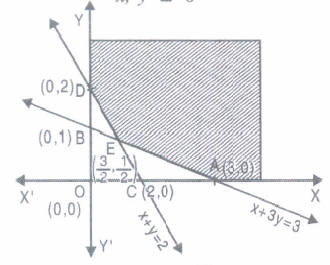
It can be seen that the feasible region is unbounded.
The corner points of the feasible region are A (3, 0) B \(\left( \frac { 3 }{ 2 } ,\frac { 1 }{ 2 } \right) \) and C (0, 2).
The values of Z at these corner points are as follows.
| Corner Point | Corresponding Value of Z |
| A : (3,0) | 9 |
| E : \(\left( \frac { 3 }{ 2 } ,\frac { 1 }{ 2 } \right) \) | 7 (Minimum) |
| D : (0,2) | 10 |
As the feasible region is unbounded, therefore, 7 may or may not be the minimum value of Z.
For this, we draw the graph of the inequality, 3x + 5y < 7, and check whether the resulting half plane has points in common with the feasible region or not.
It can be seen that the feasible region has no common point with 3x + 5y < 7. Therefore, the minimum value of Z is 7 at (3/2,1/2).
13.
\(\text { Let } \log x=t \)
\(\therefore \frac{1}{x} d x=d t \)
\(\Rightarrow \int \frac{1}{x(\log x)^{m}} d x=\int \frac{d t}{(t)^{m}} \)
\(=\left(\frac{t^{-m+1}}{1-m}\right)+\mathrm{C} \)
\(=\frac{(\log x)^{1-m}}{(1-m)}+\mathrm{C}\)
14.
Let 'P' be the principal at any time t.
By the question, \(\frac { dP }{ dt } =\frac { r }{ 100 } \times P\)
\(\Rightarrow\) \(\frac { dP }{ P } =\frac { r }{ 100 } dt\)
Variables Separable
Integrating, \(\int { \frac { dP }{ P } =\frac { r }{ 100 } \int { 1.dt+C } } \)
\(\Rightarrow\) \(log\quad P=\frac { rt }{ 100 } +C\) ...... (1) [ \(\because \)P > 0]
When t = 0, P = 100, \(\therefore\)log 100 = C.
Putting in (1),\(log\quad P=\frac { rt }{ 100 } +log\quad 100\)... (2)
When \(t=10,P=200,\)
\(log\quad 200=\frac { 10r }{ 100 } +log\quad 100\)
\(\Rightarrow\) \(log\frac { 200 }{ 100 } =\frac { r }{ 10 } \Rightarrow r=10\quad log\quad 2\)
\(=10\left( .6931 \right) =6.931\)
Hence, \(r=6.93%\)
15.
\((i)\quad { e }^{ -x }\)
\(By\quad Chain\quad Rule,\quad \frac { dy }{ dx } ={ e }^{ -x }.\frac { d }{ dx } (-x)={ e }^{ -x }\quad (-1)=-{ e }^{ -x }\)
\((ii)\quad Let\quad y=sin(log\quad x)\)
\(By\quad Chain\quad Rule,\quad \frac { dy }{ dx } =cos(log\quad x).\frac { d }{ dx } (log\quad x)\)
\(=cos(log\quad x).\frac { 1 }{ x } =\frac { cos(log\quad x) }{ x } ,x>0\)
\((iii)\quad Let\quad y={ cos }^{ -1 }({ e }^{ x })\)
\(By\quad Chain\quad Rule,\quad \frac { dy }{ dx } =\frac { -1 }{ \sqrt { 1-{ \left( { e }^{ x } \right) }^{ 2 } } } .\frac { d }{ dx } ({ e }^{ x })\)
\(=-\frac { 1 }{ \sqrt { 1-{ e }^{ 2x } } } .{ e }^{ x }=\frac { -{ e }^{ x } }{ \sqrt { 1-{ e }^{ 2x } } } \)
\((iv)\quad Let\quad y={ e }^{ cos\quad x }\)
\(By\quad Chain\quad Rule,\quad \frac { dy }{ dx } ={ e }^{ cos\quad x }\frac { d }{ dx } (cos\quad x)\)
\(={ e }^{ cos\quad x }(-sin\quad x)=-(sin\quad x){ e }^{ cos\quad x }\)
16.
(c)
a = 3 and b = 5
17.
(d)
0.96
18.
(a)
decision variables
19.
(a)
-xcosx -2sinx
20.
\( \sqrt{1+\sin x}=\cos \frac{x}{2}+\sin \frac{x}{2} \text { and }\\ \sqrt{1-\sin x}=\cos \frac{x}{2}-\sin \frac{x}{2} \)
21.
The given system of equations will have no solution, if \(|A|=0\)
\(\Rightarrow \left|\begin{array}{ccc} 2 & -1 & 2 \\ 1 & -2 & 1 \\ 1 & 1 & \lambda \end{array}\right|=0\)
\(\Rightarrow 2(-2 \lambda-1)+(\lambda-1)+2(1+2)=0\)
\(\Rightarrow-3 \lambda+3=0 \Rightarrow \lambda=1 \)
22.
(b)
\(\frac { \pi }{ 4 } \)
23.
(d)
a = I/|λ|
24.
(d)
y2 dx + (x2 – xy – y2) dy = 0
25.
(a)
ex + e–y = C
26.
(c)
\(\frac { \pi }{ 12 } \)
27.
(b)
cos 2x
28.
(d)
Det (A) ∈ [2, 4]
29.
(d)
a11 A11+ a21 A21 + a31 A31
30.
(b)
土6
31.
(d)
512
32.
(c)
(6, 8)∈ R
33.
As distance = \(\left| \frac { 5-\frac { 2 }{ 3 } }{ \sqrt { 4+1+4 } } \right| =\frac { 13 }{ 9 } \) units
34.
As direction cosines of a line whose direction ratio are 2,3, -6 are
\(\frac { -2 }{ 7 } ,\frac { 3 }{ 7 } ,\frac { 6 }{ 7 } \)
As angle with the y-axis is obtuse,
∴ cos β < 0,
Therefore direction ratios are \(\frac { -2 }{ 7 } ,\frac { -3 }{ 7 } ,\frac { 6 }{ 7 } \)
35.
(b)
\(\frac { \pi }{ 4 } \)
36.
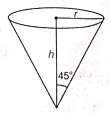
Let r be the radius and h be the height of conical part.
Here, \(\tan 45^{\circ}=\frac{r}{h} \Rightarrow 1=\frac{r}{h} \Rightarrow h=r\)
The volume of water in the tank
\(V=\frac{1}{3} \pi r^2 h=\frac{1}{3} \pi r^3 \mathrm{~cm}^3 \quad[\because h=r]\)
(ii) \( \frac{d V}{d t}=\frac{3}{3} \pi r^2 \frac{d r}{d t} \)
\(\Rightarrow \quad-2=\pi r^2 \frac{d r}{d t} \quad\left[\because \frac{d V}{d t}=-2\right]\)
\( \Rightarrow \quad \frac{d r}{d t}=\frac{-2}{\pi r^2}=\frac{-2}{\pi(2 \sqrt{2})^2}=\frac{-1}{4 \pi}\)
\({[r=2 \sqrt{2} \text { (given) }]}\)
Hence, the rate of decrease of radius is \(\frac{1}{4 \pi} \mathrm{cm} / \mathrm{s}\).
(iii) (b) \(\therefore S=\pi r l \Rightarrow S=\pi h l\) \([\because r=h]\)
\(\Rightarrow \quad S=\pi h \sqrt{h^2+r^2}\)
(a) \(\therefore S=\pi r l \)
\(=\pi r \sqrt{h^2+r^2}=\pi r \sqrt{2 r^2} \)
\({\left[\because l=\sqrt{h^2+r^2} ; \ \because h=r\right]}\)
\(=\sqrt{2} \pi r^2\)
\(\Rightarrow \frac{d S}{d t}=\sqrt{2} \pi(2 r) \frac{d r}{d t}\)
\(\Rightarrow \quad \frac{d S}{d t}=2 \sqrt{2} \pi r \frac{d r}{d t}\)
\(\Rightarrow\left(\frac{d S}{d t}\right)_{r=2 \sqrt{2}}=2 \sqrt{2} \pi(2 \sqrt{2})\left(\frac{-1}{4 \pi}\right)\)
\(=-2 \mathrm{~cm}^2 / \mathrm{s} \)
Or \(\text { (b) } \therefore S=\pi r l \Rightarrow S=\pi h l\) \({[\because r=h]}\)
\( \Rightarrow S=\pi h \sqrt{h^2+r^2} \)
\(\Rightarrow \quad S=\sqrt{2} \pi h^2 \)
\(\Rightarrow \quad \frac{d S}{d t}=\sqrt{2} \pi(2 h) \frac{d h}{d t}\)
\(\Rightarrow \quad \frac{d S}{d t}=2 \sqrt{2} \pi h \frac{d h}{d t}\)
\( \Rightarrow \quad \frac{d S}{d t}=2 \sqrt{2} \pi(2 \sqrt{2}) \frac{d h}{d t}\)
\( \text { [since, } l^2=r^2+h^2 \Rightarrow l^2=2 h^2\)
\(\left.\Rightarrow 16=2 h^2 \Rightarrow h=2 \sqrt{2}\right]\)
\( \Rightarrow \quad-2=8 \pi \frac{d h}{d t}\) \({[\because \text { from Eq. (i) }]}\)
\( \Rightarrow \quad \frac{d h}{d t}=-\frac{1}{4 \pi} \mathrm{cm} / \mathrm{s}\)
\(\text { (b) } \therefore S=\pi r l \Rightarrow S=\pi h l\)
\([\because r=h]\)
\(\Rightarrow S=\pi h \sqrt{h^2+r^2}\)
\(\Rightarrow \quad S=\sqrt{2} \pi h^2\)
\(\Rightarrow \quad \frac{d S}{d t}=\sqrt{2} \pi(2 h) \frac{d h}{d t}\)
\(\Rightarrow \quad \frac{d S}{d t}=2 \sqrt{2} \pi h \frac{d h}{d t}\)
\(\Rightarrow \quad \frac{d S}{d t}=2 \sqrt{2} \pi(2 \sqrt{2}) \frac{d h}{d t}\)
\(\text { [since, } l^2=r^2+h^2 \Rightarrow l^2=2 h^2\)
\(\left.\Rightarrow 16=2 h^2 \Rightarrow h=2 \sqrt{2}\right]\)
\(\Rightarrow \quad-2=8 \pi \frac{d h}{d t}\)
\([\because \text { from Eq. (i) }]\)
\(\Rightarrow \quad \frac{d h}{d t}=-\frac{1}{4 \pi} \mathrm{cm} / \mathrm{s}\)
37.
Given, P(E1) = 0.65, P(E/E1) = 0.35 and \(P\left(\frac{E}{E_2}\right)=0.80\)
(i) P(E2) = 1 - P(E1) = 1 - 0.65 = 0.35
(ii) \(\begin{aligned} P(E) & =P\left(E_1\right) \cdot P\left(\frac{E}{E_1}\right)+P\left(E_2\right) P\left(\frac{E}{E_2}\right) \end{aligned}\)
\(\begin{aligned} =0.65 \times 0.35+0.35 \times 0.80 \end{aligned}\)
\(\approx 0.23+0.28=0.51\)
(iii) (a) \(\begin{aligned} P\left(\frac{E_1}{E}\right) & =\frac{P\left(E_1\right) \cdot P\left(E / E_1\right)}{P\left(E_1\right) \cdot P\left(E / E_1\right)+P\left(E_2\right) P\left(E / E_2\right)} \end{aligned}\)
\(\begin{aligned} =\frac{0.65 \times 0.35}{0.65 \times 0.35+0.35 \times 0.80}=0.45 \end{aligned}\)
or (b) \(\begin{aligned} P\left(\frac{E_2}{E}\right) & =\frac{P\left(E_2\right) P\left(E / E_2\right)}{P\left(E_1\right) \cdot P\left(E / E_1\right)+P\left(E_2\right) P\left(E / E_2\right)} \end{aligned}\)
\(\begin{aligned} =\frac{0.35 \times 0.80}{0.65 \times 0.35+0.35 \times 0.80} \end{aligned}\)
= 0.55
38.
(i) (c) : Let OAB be a triangle such that
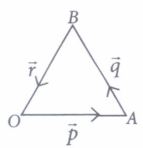
\(\overrightarrow{A O}=-\vec{p}, \overrightarrow{A B}=\vec{q}, \)\(\overrightarrow{B O}=\vec{r}\)
Now, \(\vec{q}+\vec{r} =\overrightarrow{A B}+\overrightarrow{B O}\)
\(=\overrightarrow{A O} =-\vec{p}\)
(ii) (c) : From triangle law of vector addition,
\(\overrightarrow{A C}+\overrightarrow{B D}=\overrightarrow{A B}+\overrightarrow{B C}+\overrightarrow{B C}+\overrightarrow{C D}\)
\( =\overrightarrow{A B}+2 \overrightarrow{B C}+\overrightarrow{C D}\)
\(=\overrightarrow{A B}+2 \overrightarrow{B C}-\overrightarrow{A B}=2 \overrightarrow{B C} \)
(iii) (b) : \(\operatorname{In} \Delta A B C, \overrightarrow{A C}=2 \vec{a}+2 \vec{b}\)
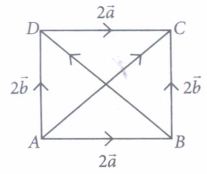
and in \(\Delta A B D, 2 \vec{b}=2 \vec{a}+\overrightarrow{B D}\)..(ii)
[By triangle law of addition]
Adding (i) and (ii), we have
\( \overrightarrow{A C}+2 \vec{b}=4 \vec{a}+\overrightarrow{B D}+2 \vec{b} \)
⇒\( \overrightarrow{A C}-\overrightarrow{B D}=4 \vec{a} \)
(iv) (d) : \(\text { In } \Delta A B C, \overrightarrow{B A}+\overrightarrow{A C}=\overrightarrow{B C}\)... (i)
[By triangle law]
In \(\Delta B C D, \overrightarrow{B C}+\overrightarrow{C D}=\overrightarrow{B D}\) ..(i)
From (i) and (ii), \(\overrightarrow{B A}+\overrightarrow{A C}=\overrightarrow{B D}-\overrightarrow{C D}\)
\(\Rightarrow \overrightarrow{B A}+\overrightarrow{C D}=\overrightarrow{B D}-\overrightarrow{A C}=\overrightarrow{B D}+\overrightarrow{C A}\)
(v) (b): Since T is the mid point of YZ.
So,\(\overrightarrow{Y T}=\overrightarrow{T Z}\)
Now,\(\overrightarrow{X Y}+\overrightarrow{X Z}=(\overrightarrow{X T}+\overrightarrow{T Y})+(\overrightarrow{X T}+\overrightarrow{T Z})\)
[By triangle law]
\(=2 \overrightarrow{X T}+\overrightarrow{T Y}+\overrightarrow{T Z}=2 \overrightarrow{X T} \quad[\because \overrightarrow{T Y}=-\overrightarrow{Y T}]\)

12th Standard CBSE Syllabus & Materials
12th Standard CBSE
CBSE 12th Computer Science Python Revision Tour I - New Previous year Question Papers Study Material - QB365 Set A
NEW12th Standard CBSE
CBSE 12th Business Studies Planning Important Questions And Answers Study Material - QB365 Set A
NEW12th Standard CBSE
CBSE 12th Business Studies Business Environment Important Questions And Answers Study Material - QB365 Set A
NEW12th Standard CBSE
CBSE 12th Business Studies Principles of Management Important Questions And Answers Study Material - QB365 Set A



NCERT Books

Syllabus

Exam Pattern

Sample Question Papers

Previous year Question Papers

Important Notes

MCQ Practice test

NCERT Exemplers

Case study Questions

Image Based Questions

Passage based Questions

HOT Questions

Value Based Questions

Model Questions Papers
NCERT ( Book Back ) Questions

Assertion and Reason
Important Questions And Answers

CBSE 12th Standard CBSE Subjects
CBSE Standards








