
 100% FREE ACCESS
12th Standard CBSE Syllabus & Materials
12th Standard CBSE
CBSE 12th Economics Government Budget and the Economy Previous year Question Papers Study Material - QB365 Set A
NEW12th Standard CBSE
CBSE 12th Computer Science Interface Python with MySQL - New Previous year Question Papers Study Material - QB365 Set A
NEW12th Standard CBSE
CBSE 12th Computer Science Database Concept - New Previous year Question Papers Study Material - QB365 Set A
NEW12th Standard CBSE
CBSE 12th Computer Science Data Communication - New Previous year Question Papers Study Material - QB365 Set A
NEW12th Standard CBSE
CBSE 12th Computer Science Data Structures - New Previous year Question Papers Study Material - QB365 Set A
NEW12th Standard CBSE
CBSE 12th Computer Science Functions - New Previous year Question Papers Study Material - QB365 Set A

Published on: 25/10/2025
Download CBSE Class 12th Standard CBSE Maths question papers, sample papers, important questions, and previous year solved papers in PDF format. Get free study materials, NCERT solutions, and exam preparation resources for Class 12th Standard CBSE Maths
Questions + Answers key
Take MCQ Maths Test
1.
If \(y=\sin ^{-1}(3 x+2), \text { then find } d y / d x\)
2.
show that : \({ tan }^{ -1 }\frac { 1 }{ 4 } +{ tan }^{ -1 }\frac { 2 }{ 9 } =\frac { 1 }{ 2 } { tan }^{ -1 }\frac { 4 }{ 3 } \)
3.
How many equivalence relations on the set {1,2, 3} containing (1, 2) and (2, 1) are there in all? Justify your answer.
4.
Is the function f defined by \(f(x)=\begin{cases} x\quad ,\quad if\quad x\le 1 \\ 5\quad ,\quad if\quad x>1 \end{cases}\) continuous at x = 0? at x = 1? at x = 2?
5.
Given I2. Find |I2| . Also find |3 I2|.
6.
If \(\left[ \begin{matrix} y & +2x & 5 \\ & -x & 3 \end{matrix} \right] =\begin{bmatrix} 7 & 5 \\ -2 & 3 \end{bmatrix}\), find the value of y.
7.
Find \(\frac{d y}{d x}\), if \(y=e^{\sin ^2 x}\left\{2 \tan ^{-1} \sqrt{\frac{1-x}{1+x}}\right\}\)
8.
Prove that the greatest integer function defined by f(x) = [x], 0 < x < 2 is not differentiable at x = 1.
9.
Prove that the area of the triangle whose vertices are: \(\left( { at }_{ 1 }^{ 2 },{ 2at }_{ 1 } \right) :({ at5 }_{ 2 }^{ 2 },{ 2at }_{ 2 });({ at }_{ 3 }^{ 2 },{ 2at }_{ 3 })\quad is\quad { a }^{ 2 }(t_1-t_2)(t_2-t_3)(t_3-t_2).\)
10.
solve the system of equations:
2x + 5y = 1
3x + 2y = 7
11.
If \(x\left[ \begin{matrix} 2 \\ 3 \end{matrix} \right] +y\left[ \begin{matrix} -1 \\ 1 \end{matrix} \right] =\left[ \begin{matrix} 10 \\ 5 \end{matrix} \right]\) find the values of x and y.
12.
In the matrix,\(A=\left[ \begin{matrix} 2 \\ 35 \\ \sqrt { 3 } \end{matrix}\begin{matrix} 5 \\ -2 \\ 1 \end{matrix}\begin{matrix} 19 \\ { 5 }/{ 2 } \\ -5 \end{matrix}\begin{matrix} -7 \\ 12 \\ 17 \end{matrix} \right] \) write:
(i) The order of the matrix.
(ii) The number of elements.
(iii) Write the elements \({ a }_{ 13 },{ a }_{ 21 },{ a }_{ 33 },{ a }_{ 24 },{ a }_{ 23 }.\)
13.
Differentiate the functions given in Exercises
\((\sin x)^x+\sin ^{-1} \sqrt{x}\)
14.
Show that the altitude of the right circular cone of maximum volume that can be inscribed in a sphere of radius r is \(\frac{4 r}{3}\). Also, find the maximum volume in terms of volume of the sphere.
15.
If \(y=\left[x+\sqrt{x^{2}+a^{2}}\right]^{n}\) then prove that \(\frac{d y}{d x}=\frac{n y}{\sqrt{x^{2}+a^{2}}}\)
16.
If \((tan^{ -1 }x)^{ 2 }+\left( { cot }^{ -1 }x \right) ^{ 2 }=\frac { 5\pi ^{ 2 } }{ 8 } \) , find x.
17.
Prove that: \(2ta{ n }^{ -1 }\left( \frac { 1 }{ 2 } \right) +{ tan }^{ -1 }\left( \frac { 1 }{ 7 } \right) ={ sin }^{ -1 }\left( \frac { 31 }{ 25\sqrt { 2 } } \right) \)
18.
The monthly incomes of Aryan and Babban are in the rartio 3:4 and their monthly expenditure are in the ratio 5:7, If each saves Rs. 15,000 per month, find their monthly incomes using matrix method. This problem reflects which value?
19.
If \(A=\left[ \begin{matrix} 0 & 4 & 3 \\ 1 & -3 & -3 \\ -1 & 4 & 4 \end{matrix} \right] \), show that: A2 = I and hence, find A-1
20.
If for a square matrix A, A2 - A + l = 0, then A-1 equals
A
A + l
l - A
A - l
21.
If inverse of matrix \(\left[\begin{array}{ccc}7 & -3 & -3 \\ -1 & 1 & 0 \\ -1 & 0 & 1\end{array}\right]\) is the matrix \(\left[\begin{array}{lll}1 & 3 & 3 \\ 1 & \lambda & 3 \\ 1 & 3 & 4\end{array}\right]\) then the value of \(\lambda\) is
-4
1
3
4
22.
If \(\left|\begin{array}{lll}\alpha & 3 & 4 \\ 1 & 2 & 1 \\ 1 & 4 & 1\end{array}\right|=0\), then the value of \(\alpha\) is
1
2
3
4
23.
The function f : R→ R defined as f(x) = x³ is
one-one but not onto
not one-one but onto
neither one-one nor onto
both one-one and onto
24.
If A = \(\left[\begin{array}{ccc} a & c & -1 \\ b & 0 & 5 \\ 1 & -5 & 0 \end{array}\right]\) is a skew-symmetric matrix, then the value of 2a - (b + c) is
0
1
-10
10
25.
A matrix has 18 elements, then possible number of orders of a matrix are
3
4
6
5
26.
The radius of the base of a cone is increasing at the rate of 3 cm/min and the altitude is decreasing at the rate of 4 cm/min. The rate of change of lateral surface when the , radius = 7 cm and altitude 24 cm, is
\(54 \pi \mathrm{cm}^{2} / \mathrm{min}\)
\(7 \pi \mathrm{cm}^{2} / \mathrm{min}\)
\(27 \mathrm{~cm}^{2} / \mathrm{min}\)
None of the above
27.
A ladder, 5 m long, standing on a horizontal floor, leans against a vertical wall. If the top of the ladder slides downwards at the rate of 10 cm/s, then the rate at which the angle between the floor and the ladder is decreasing when lower end of ladder is 2 m from the wall is
\(\frac{1}{10} \mathrm{rad} / \mathrm{s}\)
\(\frac{1}{20} \mathrm{rad} / \mathrm{s}\)
\(20 \mathrm{rad} / \mathrm{s}\)
10 rad/s
28.
If the sides of an equilateral triangle are increasing at the rate of 4 cm/s, then the rate at which the area increases, when side is 5 cm, is
\(10 \mathrm{~cm}^{2} / \mathrm{s}\)
\(\sqrt{3} \mathrm{~cm}^{2} / \mathrm{s}\)
\(10 \sqrt{3} \mathrm{~cm}^{2} / \mathrm{s}\)
\(\frac{10}{3} \mathrm{~cm}^{2} / \mathrm{s}\)
29.
If \(x=e^{x / y}, \text { then } \frac{d y}{d x}\) is equal to
\(\frac{x-y}{x \log x}\)
\(\frac{y-x}{\log x}\)
\(\frac{y-x}{x \log x}\)
\(\frac{x-y}{\log x}\)
30.
The function \(f(x)=\left\{\begin{array}{cl} \frac{k \cos x}{\pi-2 x}, & \text { if } x \neq \frac{\pi}{2} \text { is } \\ 3, & \text { if } x=\frac{\pi}{2} \end{array}\right.\) continuous at \(x=\frac{\pi}{2}\)
-6
6
5
-5
31.
Iff \(f(x)=\left|\begin{array}{ccc} 0 & x-a & x-b \\ x+a & 0 & x-c \\ x+b & x+c & 0 \end{array}\right|\) then
f(a) = 0
f(b) = 0
f(0) = 0
f(1) = 0
32.
Matrices A and B will be inverse of each other only if
AB = BA
AB = BA = 0
AB = 0,
AB = BA = I
33.
The value of \(\cos \left[\tan ^{-1}\left\{\sin \left(\cot ^{-1} x\right)\right\}\right]\) is
\(\frac{1}{\sqrt{x^{2}+2}}\)
\(\sqrt{\frac{x^{2}+2}{x^{2}+1}}\)
\(\sqrt{\frac{x^{2}+1}{x^{2}+2}}\)
\(\frac{1}{\sqrt{x^{2}+1}}\)
34.
Let A = {1, 2, 3, ... , n} and B = {a, b}. Then the number of surjections from A into B is
nP2
2n-2
2n -1
None of these
35.
f : X⟶Y is onto, if and only if
range of f = Y
range of f ≠ Y
range of f < Y
range of f ≥Y
36.
The function f(x) = \(\begin{cases} \frac { { e }^{ 1/x }-1 }{ { e }^{ 1/x }+1 } ,x\neq 0 \\ 0\quad \quad x=0 \end{cases}\)
is continuous at x = 0
Continuous everywhere
Not continuous at x = 0 but can be made continuous
Not continuous at x = 0
37.
If \(\begin{vmatrix} x & 2 \\ 18 & x \end{vmatrix}=\begin{vmatrix} 6 & 2 \\ 18 & 6 \end{vmatrix}\) , then x is equal to
6
土6
-6
0
38.
If sin–1 x = y, then
0 ≤ y ≤ ㅠ
\(-\frac { \pi }{ 2 } \le y\le \frac { \pi }{ 2 } \)
0 < y < π
\(-\frac { \pi }{ 2 } < y < \frac { \pi }{ 2 }\)
39.
Derivative of cot x° with respect to x is
cosec x°
cosec x° cot x°
-1° cosec2 x°
-1° cosec x° cot x°
40.
Two men on either side of a temple of 30 m high observe its top at the angles of elevation = α and ẞ respectively. (as shown in the figure below).
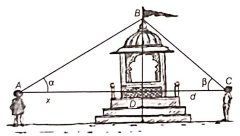
The distance between the two men is 40√3 m and the distance between the first person A and the temple is 30√3 m. Based on the above information answer the following questions.
∠CAB = α =
| a) sin-1 (2/√3) | b) sin-1 (1/2) | c) sin-1 (2) | d) sin-1 (√3/2) |
(ii) \(\angle C A B=\alpha=\)
| a) \(\cos ^{-1}\left(\frac{1}{5}\right)\) | b) \(\cos ^{-1}\left(\frac{2}{5}\right)\) | c) \(\cos ^{-1}\left(\frac{\sqrt{3}}{2}\right)\) | d) \(\cos ^{-1}\left(\frac{4}{5}\right)\) |
(iii) \(\angle B C A=\beta=\)
| a) \(\tan ^{-1}\left(\frac{1}{2}\right)\) | b) \(\tan ^{-1} (2)\) | c) \(\tan ^{-1}\left(\frac{1}{\sqrt{3}}\right)\) | d) \(\tan ^{-1}(\sqrt{3})\) |
(iv) \(\angle A B C=\)
| a) \(\frac{\pi}{4}\) | b) \(\frac{\pi}{6}\) | c) \(\frac{\pi}{2}\) | d) \(\frac{\pi}{3}\) |
(v) Domain and range of \(\cos ^{-1} x=\)
| a) \((-1,1),(0, \pi)\) | b) \([-1,1],(0, \pi)\) | c) \([-1,1],[0, \pi]\) | d) \((-1,1),\left[-\frac{\pi}{2}, \frac{\pi}{2}\right]\) |
41.
Two farmers Shyam and Balwan Singh cultivate only three varieties of pulses namely Urad, Masoor and Mung. The sale (in Rs.) of these varieties of pulses by both the farmers in the month of September and October are given by the following matrices A and B.

Using algebra of matrices, answer the following questions.
(i) The combined sales of Masoor in September and October, for farmer Balwan Singh, is
| (a) Rs. 80000 | (b) Rs. 90000 | (c) Rs. 40000 | (d) Rs. 135000 |
(ii) The combined sales of Urad in September and October, for farmer Shyam is
| (a) Rs. 20000 | (b) Rs. 30000 | (c) Rs. 36000 | (d) Rs. 15000 |
(iii) Find the decrease in sales of Mung from September to October, for the farmer Shyam.
| (a) Rs. 24000 | (b) Rs. 10000 | (c) Rs. 30000 | (d) No change |
(iv) If both farmers receive 2% profit on gross sales, compute the profit for each farmer and for each variety sold in October.

(v) Which variety of pulse has the highest selling value in the month of September for the farmer Balwan Singh?
| (a) Urad | (b) Masoor | (c) Mung | (d) All of these have the same price |
42.
Consider the mapping \(f: A \rightarrow B\) is defined by \(f(x)=\frac{x-1}{x-2}\) such that f is a bijection.
Based on the above information, answer the following questions.
(i) Domain of f is
| (a) R - {2} | (b) R | (C) R-{1,2} | (d) R-{0} |
(ii) Range of f is
| (a) R | (b) R -{1} | (C) R-{0} | (d) R-{1,2} |
(iii) If g: \(R-\{2\} \rightarrow R-\{1\}\) is defined by g(x) = 2f(x) - I, then g(x) in terms of x is
| (a) \(\frac{x+2}{x}\) | (b) \(\frac{x+1}{x-2}\) | (c) \(\frac{x-2}{x}\) | (d) \(\frac{x}{x-2}\) |
(iv) The function g defined above, is
| (a) | One-one | (b) Many-one | (c) into | (d) None of these |
(v) A function J(x) is said to be one-one iff
| (a) \(f\left(x_{1}\right)=f\left(x_{2}\right) \Rightarrow-x_{1}=x_{2}\) | (b) \(f\left(-x_{1}\right)=f\left(-x_{2}\right) \Rightarrow-x_{1}=x_{2}\) | (c) \(f\left(x_{1}\right)=f\left(x_{2}\right) \Rightarrow x_{1}=x_{2}\) | (d) None of these |
1.
We have,\(y=\sin ^{-1}(3 x+2)\)
On differentiatingboth sides w.r.t.x, we get
\(\frac{d y}{d x}=\frac{1}{\sqrt{1-(3 x+2)^{2}}} \frac{d}{d x}(3 x+2)\)
\(\left[\because \frac{d}{d x}\left(\sin ^{-1} x\right)=\frac{1}{\sqrt{1-x^{2}}}\right]\)
\(=\frac{3}{\sqrt{1-(3 x+2)^{2}}}\)
2.
\(LHS={ tan }^{ -1 }\frac { 1 }{ 4 } +{ tan }^{ -1 }\frac { 2 }{ 9 } \)
\(={ tan }^{ -1 }\left[ \frac { \frac { 1 }{ 4 } +\frac { 2 }{ 9 } }{ 1-\frac { 1\times 2 }{ 4\times 9 } } \right] \)
\(\left[ { tan }^{ -1 }x+{ tan }^{ -1 }y={ tan }^{ -1 }\frac { x+y }{ 1-xy } \right] \)
\(={ tan }^{ -1 }\left[ \frac { \frac { 9+8 }{ 36 } }{ \frac { 36-2 }{ 36 } } \right] \)
\(={ tan }^{ -1 }\left( \frac { 17 }{ 34 } \right) ={ tan }^{ -1 }\left( \frac { 1 }{ 2 } \right) \)
\(=\frac { 1 }{ 2 } \left( 2{ tan }^{ -1 }\frac { 1 }{ 2 } \right) =\frac { 1 }{ 2 } { tan }^{ -1 }\left( \frac { 2\times \frac { 1 }{ 2 } }{ 1-\frac { 1 }{ 4 } } \right) \)
\(\because \left[ 2{ tan }^{ -1 }={ tan }^{ -1 }\left( \frac { 2x }{ 1-{ x }^{ 2 } } \right) \right] \)
\(=\frac { 1 }{ 2 } { tan }^{ -1 }\left( \frac { 1 }{ 3/4 } \right) =\frac { 1 }{ 2 } { tan }^{ -1 }\left( \frac { 4 }{ 3 } \right) \)
3.
Equivalence relations could be the following:
{(1, 1), (2, 2), (3, 3), (1,2), (2, 1)} and
{(1, I), (2, 2), (3, 3), (1, 2), (1, 3), (2,1), (2, 3), (3, 1), (3,2)}
So, only two equivalence relations.
4.
For x = 0,
f(x) is continuous and
at x = 1, LHL = 1 and RHL = 5,
hence discontinuous and
at x = 2;
f(x) = 5 which is continuous
5.
9
6.
\(y+2x=7,-x=-2\Rightarrow x=2,y=3\)
7.
We have, \(y=e^{\sin ^2 x}\left\{2 \tan ^{-1} \sqrt{\frac{1-x}{1+x}}\right\}\)
On putting \(x=\cos 2 \theta\) in \(\left\{2 \tan ^{-1} \sqrt{\frac{1-x}{1+x}}\right\}\), we get
\(2 \tan ^{-1} \sqrt{\frac{1-\cos 2 \theta}{1+\cos 2 \theta}} =2 \tan ^{-1} \sqrt{\frac{2 \sin ^2 \theta}{2 \cos ^2 \theta}}\)
\( =2 \tan ^{-1}(\tan \theta)=2 \theta=\cos ^{-1} x\)
Then, from Eq. (i), we get
\(y=e^{\sin ^2 x} \cos ^{-1} x\)
On taking log both sides, we get
\(\log y=\sin ^2 x+\log \left(\cos ^{-1} x\right)\)
On differentiating both sides w.r.t. x, we get
\(\frac{1}{y} \times \frac{d y}{d x}=2 \sin x \cos x+\frac{1}{\cos ^{-1} x} \times \frac{-1}{\sqrt{1-x^2}}
\)
\(=\sin 2 x-\frac{1}{\cos ^{-1} x \sqrt{1-x^2}} \\
\)
\(\therefore \frac{d y}{d x}=e^{\sin ^2 x} \cos ^{-1} x\left[\sin 2 x-\frac{1}{\cos ^{-1} x \sqrt{1-x^2}}\right]\)
8.
We have, \(f(x)=[x], 0<x<2\)
\(\therefore \text { LHL(at } x=1)=\lim _{x \rightarrow 1^{-}} f(x) \)
\(= \lim _{x \rightarrow 1^{-}}[x]=\lim _{h \rightarrow 0}[1-h] \)
\(=\lim _{h \rightarrow 0} 0=0\)
RHL (at x = 1) \(=\lim _{x \rightarrow 1^{+}} f(x)\)
\(=\lim _{x \rightarrow 1^{+}}[x]\)
\(=\lim _{h \rightarrow 0}[1+h]=\lim _{h \rightarrow 0} 1=1\)
and f(1) = [1] = 1
Since, LHL \(\neq \mathrm{RHL}\)
\(\therefore f(x)\) is discontinuous at x = 1
Hence, f(x) is not differentiable at x = 1.
9.
Area of the triangle = \(\frac { 1 }{ 2 } \left| \begin{matrix} { at }_{ 1 }^{ 2 } & { 2at }_{ 1 } & 1 \\ { at }_{ 2 }^{ 2 } & { 2at }_{ 2 } & 1 \\ { at }_{ 3 }^{ 2 } & { t }_{ 3 } & 1 \end{matrix} \right| \)
= \(\frac { 1 }{ 2 } (a)(2a)\left| \begin{matrix} { t }_{ 1 }^{ 2 } & { t }_{ 1 } & 1 \\ { t }_{ 2 }^{ 2 } & { t }_{ 2 } & 1 \\ { t }_{ 3 }^{ 2 } & { t }_{ 3 } & 1 \end{matrix} \right| \)
= \({ a }^{ 2 }\left| \begin{matrix} { t }_{ 1 }^{ 2 }-{ t }_{ 2 }^{ 2 } & { t }_{ 1 }-{ t }_{ 2 } & 0 \\ { t }_{ 2 }^{ 2 }-{ t }_{ 3 }^{ 2 } & { t }_{ 2 }-{ t }_{ 3 } & 0 \\ { t }_{ 3 }^{ 2 } & { t }_{ 3 } & 0 \end{matrix} \right| \)
= \(a^2(t_2-t_2(t_2-t_3)\left| \begin{matrix} { t }_{ 1 }+{ t }_{ 2 } & 1 & 0 \\ { t }_{ 2 }+{ t }_{ 3 } & 1 & 0 \\ t_{ 3 }^{ 2 } & { t }_{ 3 } & 1 \end{matrix} \right| \)
= \(a^2(t_1-t_2)(t_2-t_3)(1)\left| \begin{matrix} { t }_{ 1 }+{ t }_{ 2 } & 1 \\ { t }_{ 2 }+{ t }_{ 3 } & 1 \end{matrix} \right| \)
= \(a^2(t_1-t_2)(t_2-t_3)(t_1+t_2-t_2-t_3)\)
= \(a^2(t_1-t_2)(t_2-t_3)(t_3-t_1)\)
10.
The given system of equations can be expressed in the matrix form as AX=B
Where \(A=\begin{bmatrix}2&5\\3&2 \end{bmatrix}, X=\begin{bmatrix}x\\y \end{bmatrix}and \ B=\begin{bmatrix}1\\7 \end{bmatrix}\)
Now \(|A|=\begin{vmatrix} 2&5\\3&2\end{vmatrix}=4-15=-11\neq0\)
A is non-singular matrix \(\Rightarrow\) A-1exists
From (1), A-1(AX) = A-1B \(\Rightarrow\)(A-1A)X = A-1B
\(\Rightarrow\)IX = A-1 B \(\Rightarrow\)X = A-1B
Now A11 = 2; A12=-3; A21 = -5 and A22 = 2
\(adj\ A=\begin{bmatrix}A_{11}&A_{12}\\A_{21}&A_{22} \end{bmatrix}=\begin{bmatrix} 2&-3\\-5&2\end{bmatrix}\)
\(=\begin{bmatrix} 2&-5\\-3&2\end{bmatrix}\)
\(A^{-1}={adj\ A\over|A|}={1\over-11}\begin{bmatrix} 2&-5\\-3&2\end{bmatrix}\)
\(=\begin{bmatrix}-2/11&5/11\\3/11&-2/11 \end{bmatrix}\)
\(\therefore From(2), \begin{bmatrix}x\\y \end{bmatrix}=\begin{bmatrix} -2/11&5/11\\ 3/11&-2/11\end{bmatrix}\begin{bmatrix} 1\\7\end{bmatrix}\)
\(=\begin{bmatrix} {-2\over11}+{35\over11}\\{3\over11}-{14\over11}\end{bmatrix}=\begin{bmatrix}3\\-1 \end{bmatrix}\)
Hence, x = 3, y = -1
11.
\(We\quad have:\quad x\left[ \begin{matrix} 2 \\ 3 \end{matrix} \right] +y\left[ \begin{matrix} -1 \\ 1 \end{matrix} \right] =\left[ \begin{matrix} 10 \\ 5 \end{matrix} \right]\)
\(\Rightarrow \left[ \begin{matrix} 2x \\ 3x \end{matrix} \right] +\left[ \begin{matrix} -y \\ y \end{matrix} \right] =\left[ \begin{matrix} 10 \\ 5 \end{matrix} \right]\)
\(\Rightarrow \left[ \begin{matrix} 2x-y \\ 3x+y \end{matrix} \right] =\left[ \begin{matrix} 10 \\ 5 \end{matrix} \right] .\)
Equating corresponding elements:
2x - y = 10...(1)
and 3x + y = 5....(2)
Adding (1) and (2), 5x = 15 \(\Rightarrow \) x = 3.
Putting in (1), 2, (3) - y = 10 \(\Rightarrow\) y = 6-10 = -4.
Hence, x = 3 and y = -4.
12.
(i) In the given matrix, the number of rows is 3 and the number of columns is 4. Therefore, the order of the matrix is 3 x 4.
(ii) Since the order of the matrix is 3 x 4, there are 3 x 4 = 12 elements in it.
(iii) \({ a }_{ 13 }=19,{ a }_{ 21 }=35,{ a }_{ 33 }=-5,{ a }_{ 24 }=12,{ a }_{ 23 }=\frac { 5 }{ 2 } .\)
13.
Let \(y=(\sin x)^x+\sin ^{-1} \sqrt{x}\)
Let \(u=(\sin x)^x \ v=\sin ^{-1} \sqrt{x}\)
y=u+v
Differentiating both sides w.r.t. x.
\( \frac{d y}{d x}=\frac{d(u+v)}{d x} \)
\( \frac{d y}{d x}=\frac{d u}{d x}+\frac{d v}{d x}\)
14.
Let radius of cone be x and its height be h.
\(\therefore\) OD = (h - r)
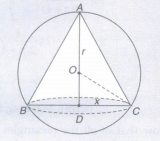
Volume of cone (V)
\(=\frac { 1 }{ 3 } \pi { x }^{ 2 }h\) ...(i)
In \(\Delta OCD,\quad { x }^{ 2 }+({ h-r) }^{ 2 }={ r }^{ 2 }or\quad { x }^{ 2 }={ r }^{ 2 }-{ (h-r) }^{ 2 }\)
\(\therefore V=\frac { 1 }{ 3 } \pi h\{ { r }^{ 2 }-(h-r{ ) }^{ 2 }\} \)
\(=\frac { 1 }{ 3 } \pi (-{ h }^{ 3 }+{ 2h }^{ 2 }r)\)
\(\Rightarrow \frac { dV }{ dh } =\frac { \pi }{ 3 } (-3{ h }^{ 2 }+4hr)\)
\(\therefore \quad \frac { dV }{ dh } =0\Rightarrow h=\frac { 4r }{ 3 } \)
\(\frac { { d }^{ 2 }V }{ { dh }^{ 2 } } =\frac { \pi }{ 3 } (-6h+4r)\)
\(=\frac { \pi }{ 3 } \left( -6\left( \frac { 4r }{ 3 } \right) +4r \right) \)
\(=-\frac { 4\pi r }{ 3 } <0\)
\(\therefore \ at\quad h=\frac { 4r }{ 3 } \), Volume is maximum
Maximum volume
\(=\frac { 1 }{ 3 } \pi .\left\{ -{ \left( \frac { 4r }{ 3 } \right) }^{ 3 }+2{ \left( \frac { 4r }{ 3 } \right) }^{ 2 }r \right\} \)
\(=\frac { 8 }{ 27 } .\left( \frac { 4 }{ 3 } \pi { r }^{ 3 } \right) \)
\(=\frac { 8 }{ 27 } \) (volume of sphere)
15.
We have \(y=\left[x+\sqrt{x^{2}+a^{2}}\right]^{n}\)
On differentiating both sides w.r.t. x, we get
\(\frac{d y}{d x}=n\left[x+\sqrt{x^{2}+a^{2}}\right]^{n-1} \cdot \frac{d}{d x}\left[x+\sqrt{x^{2}+a^{2}}\right]\)
[by chain rule of derivative]
\(=n\left[x+\sqrt{x^{2}+a^{2}}\right]^{n-1}\left[1+\frac{1}{2 \sqrt{x^{2}+a^{2}}} \frac{d}{d x}\left(x^{2}+a^{2}\right)\right]\)
[by chain nile of derivative]
\(=n\left[x+\sqrt{x^{2}+a^{2}}\right]^{n-1}\left[1+\frac{1}{2 \sqrt{x^{2}+a^{2}}} \cdot 2 x\right]\)
\(=n\left[x+\sqrt{x^{2}+a^{2}}\right]^{n-1}\left[\frac{\sqrt{x^{2}+a^{2}}+x}{\sqrt{x^{2}+a^{2}}}\right]\)
\(=\frac{n\left[x+\sqrt{x^{2}+a^{2}}\right]^{n}}{\sqrt{x^{2}+a^{2}}}\)
\(\Rightarrow \frac{d y}{d x}=\frac{n y}{\sqrt{x^{2}+a^{2}}} \quad\left[\because y=\left(x+\sqrt{x^{2}+a^{2}}\right)^{n}\right][1]\)
Hence proved.
16.
\({ \left( { tan }^{ -1 }x \right) }^{ 2 }+{ \left( { cot }^{ -1 }x \right) }^{ 2 }=\frac { 5{ \pi }^{ 2 } }{ 8 } \)
\(\Rightarrow { \left( { tan }^{ -1 }x \right) }^{ 2 }+{ \left( \frac { \pi }{ 2 } -{ tan }^{ -1 }x \right) }^{ 2 }=\frac { 5\pi ^{ 2 } }{ 8 } \)
\(\Rightarrow 2{ \left( { tan }^{ -1 }x \right) }^{ 2 }-\pi { tan }^{ -1 }x+\frac { { \pi }^{ 2 } }{ 4 } -\frac { { 5\pi }^{ 2 } }{ 8 } =0\)
\(\Rightarrow 2{ \left( { tan }^{ -1 }x \right) }^{ 2 }-\pi { tan }^{ -1 }x-\frac { 3{ \pi }^{ 2 } }{ 8 } =0\)
\(\Rightarrow { tan }^{ -1 }x=\frac { \pi \pm \sqrt { { \pi }^{ 2 }+3{ \pi }^{ 2 } } }{ 4 } \)
\(\Rightarrow { tan }^{ -1 }x=\frac { 3\pi }{ 4 } ,\frac { -\pi }{ 4 } \)
\(\Rightarrow x=-1\)
17.
\(LHS=2{ tan }^{ -1 }\left( \frac { 1 }{ 2 } \right) +{ tan }^{ -1 }\left( \frac { 1 }{ 7 } \right) \)
\(={ tan }^{ -1 }\frac { 2\times \frac { 1 }{ 2 } }{ 1-\frac { 1 }{ 4 } } +tan^{ -1 }\frac { 1 }{ 7 } \)
\(={ tan }^{ -1 }\left( \frac { 4 }{ 3 } \right) +{ tan }^{ -1 }\left( \frac { 1 }{ 7 } \right) \)
\(={ tan }^{ -1 }\frac { \frac { 4 }{ 3 } +\frac { 1 }{ 7 } }{ 1-\frac { 4 }{ 3 } .\frac { 1 }{ 7 } } \)
\(={ tan }^{ -1 }\frac { 31 }{ 17 } \)
Using the above triangle, we get
\({ tan }^{ -1 }\frac { 31 }{ 17 } ={ sin }^{ -1 }\left( \frac { 31 }{ 25\sqrt { 2 } } \right) \)
=RHS
Hence LHS = RHS
18.
Let Rs. 3x and Rs. 4x bee the month;y income of Aryan and Babban respectively.
Let Rs. 5y7 and Rs. 7y be the monthly expenditure of Aryan and Babban respectively.
By the equation 3x-5y = 15000
and 4x-7y = 15000
where \(A=\begin{bmatrix}3&-5\\4&-7 \end{bmatrix}, X=\begin{bmatrix} x\\y\end{bmatrix},B=\begin{bmatrix} 15000\\15000\end{bmatrix}\)
Now \(|A|=\begin{bmatrix}3&-5\\4&-7 \end{bmatrix}=-21+20=-1\neq0\)
⇒ A-1exists.
\(\therefore\ adj\ A=\begin{bmatrix} -7&-4\\5&3\end{bmatrix}=\begin{bmatrix} -7&5\\-4&3\end{bmatrix}\)
\(\therefore\ A^{-1}={1\over-1}\begin{bmatrix}-7&5\\-4&3 \end{bmatrix}=\begin{bmatrix}7&-5\\4&-3 \end{bmatrix}\)
From (1), \(X=A^{-1}B\Rightarrow X=\begin{bmatrix}7&-5\\4&-3 \end{bmatrix}=\begin{bmatrix}15000\\15000\end{bmatrix}\)
\(\Rightarrow\begin{bmatrix} x\\y\end{bmatrix}=\begin{bmatrix} 105000-75000\\60000-450000\end{bmatrix}=\begin{bmatrix}30000\\15000 \end{bmatrix}\)
⇒ x = 30,000 and y = 15,000
Hence, monthly income of Aryan = 3 x 30000 = Rs. 90,000
and of Babban = 4 x 30000 = Rs. 1,20,000
19.
(i) A2 = AA
= \(\begin{vmatrix} 0&4&3\\1&-3&^-3\\-1&4&4\end{vmatrix}\begin{vmatrix}0&4&3\\1&-3&-3\\-1&4&4 \end{vmatrix}\)
= \(\begin{vmatrix}0+4-3&0-12+12&0-12+12\\0-3+3&4+9-12&3+9-12\\-0+4-4&-4-12+16&-3-12+16 \end{vmatrix}\)
= \(\begin{vmatrix}1&0&0\\0&1&0\\0&0&1 \end{vmatrix}=I\)
(ii) \(A^2=I\Rightarrow A^{-1}A^2=A^{-1}I\)
\(\Rightarrow A^{-1}(A)=A^{-1}I\)
\(\Rightarrow (A^{-1}A)A=A^{-1}I\Rightarrow IA=A^{-1}I\)
\(\Rightarrow A=A^{-1}\)
Hence, \(A^{-1}=A\)
20.
(c)
l - A
21.
(d)
4
22.
(d)
4
23.
(d)
both one-one and onto
24.
(a)
0
25.
(c)
6
26.
Let r, l and h denote respectively the radius, slant height and height of the cone at any time t. Then,
\(\begin{aligned}
l^{2} &=r^{2}+h^{2} \\
\Rightarrow & 2 l \frac{d l}{d t}=2 r \frac{d r}{d t}+2 h \frac{d h}{d t} \\
\Rightarrow & l \frac{d l}{d t}=r \frac{d r}{d t}+h \frac{d h}{d t}
\end{aligned}\)
\(\begin{array}{ll}
\Rightarrow & l \frac{d l}{d t}=7 \times 3+24 \times(-4) \quad\left[\because \frac{d h}{d t}=-4 \text { and } \frac{d r}{d t}=3\right] \\
\Rightarrow & l \frac{d l}{d t}=-75
\end{array}\)
When r = 7 and h = 24, then we have
\(
l^{2} =7^{2}+24^{2} \\
\Rightarrow \quad l =25 \\
\therefore \quad l \frac{d l}{d t} =-75 \Rightarrow \frac{d l}{d t}=-3
\)
Let S denote the lateral surface area, then
\(
S=\pi r l \\
\Rightarrow \frac{d S}{d t}=\pi\left(\frac{d r}{d t} l+r \frac{d l}{d t}\right)=\pi(3 \times 25+7 \times(-3)) \\
\Rightarrow 54 \pi \mathrm{cm}^{2} / \mathrm{min}
\)
27.
(b)
\(\frac{1}{20} \mathrm{rad} / \mathrm{s}\)
28.
Let the side of an equilateral triangle be x cm.
\(\therefore\) Area of equilateral triangle \(A=\frac{\sqrt{3}}{4} x^{2}\)
Also,\(\frac{d x}{d t}=4 \mathrm{~cm} / \mathrm{s}\)
On differentiating Eq. (i) w.r.t. t, we get
\(\frac{d A}{d t}=\frac{\sqrt{3}}{4} \cdot 2 x \cdot \frac{d x}{d t}\)
\(
=\frac{\sqrt{3}}{4} \cdot 2 \cdot 5 \cdot 4 {\left[\because x=5 \text { and } \frac{d x}{d t}=4\right]} \\
= 10 \sqrt{3} \mathrm{~cm}^{2} / \mathrm{s}
\)
29.
Given that \(x=e^{x / y}\)
Taking log on both sides, we get
\( \log x =\frac{x}{y} \cdot \log e=\frac{x}{y} \)
\(\Rightarrow=y \log x \)
Now, differentiating w.r.t. x, we get
\(\Rightarrow 1=y \cdot \frac{1}{x}+\log x \cdot \frac{d y}{d x}\)
\( \Rightarrow \frac{d y}{d x}=\frac{x-y}{x \log x} \)
30.
We have \(f(x)=\left\{\begin{array}{cl} \frac{k \cos x}{\pi-2 x}, & \text { if } x \neq \frac{\pi}{2} \\ 3, & \text { if } x=\frac{\pi}{2} \end{array}\right.\)
f(x) is continuous at \(x=\frac{\pi}{2}\)
\(\therefore \ \lim _{x \rightarrow \frac{\pi^{-}}{2}} \frac{k \cos x}{\pi-2 x}=3 \)
\(\Rightarrow \lim _{h \rightarrow 0} \frac{k \cos \left(\frac{\pi}{2}-h\right)}{\pi-2\left(\frac{\pi}{2}-h\right)}=3 \)
\(\Rightarrow \lim _{h \rightarrow 0} \frac{k \sin h}{2 h}=3 \)
\(\therefore \frac{k}{2}=3 \Rightarrow k=6 \)
31.
Clearly,
\( f(a) =\left|\begin{array}{ccc} 0 & 0 & a-b \\ 2 a & 0 & a-c \\ a+b & a+c & 0 \end{array}\right| \)
\(=[(a-b)\{2 a \cdot(a+c)\}] \neq 0 \)
\( \therefore \ f(b) =\left|\begin{array}{ccc} 0 & b-a & 0 \\ b+a & 0 & b-c \\ 2 b & b+c & 0 \end{array}\right|\)
\( =-(b-a)[2 b(b-c)] \)
\( =-2 b(b-a)(b-c) \neq 0 \)
32.
By definition of invertible matrix
33.
(c)
\(\sqrt{\frac{x^{2}+1}{x^{2}+2}}\)
34.
Total number of functions = (n(B)n(A) = 2n. Clearly a function will not be onto if all elements of A map to either a or b.
35.
A function f : A ➝ B is said to be onto, if for every b ∈ B, there exists an element a in A such that f(a) = b
36.
(d)
Not continuous at x = 0
37.
(b)
土6
38.
(b)
\(-\frac { \pi }{ 2 } \le y\le \frac { \pi }{ 2 } \)
39.
As xo = \(\frac { \pi }{ 180 } { x }^{ c }\)
\(\therefore \frac { d }{ dx } (cot{ x }^{ o })=\)\(\frac { d }{ dx } \left( cot\frac { \pi }{ 180 } x \right) \)
\(=-\frac { \pi }{ 180 } { cosec }^{ 2 }\frac { \pi }{ 180 } x\)
\(=-{ 1 }^{ o }{ cosec }^{ 2 }\frac { \pi }{ 180 } x\)
\(=-{ 1 }^{ o }{ cosec }^{ 2 }{ x }^{ 0 }\)
40.
(i) (b) \(\ln \triangle A B D\)
\(\tan \alpha =\frac{B D}{A D}\)
\( =\frac{30}{30 \sqrt{3}}=\frac{1}{\sqrt{3}} \)
\(\Rightarrow \alpha =30^{\circ}\)
\(\therefore \sin \alpha =\sin 30^{\circ}=\frac{1}{2}\)
\(\Rightarrow \alpha =\sin ^{-1}\left(\frac{1}{2}\right)\)
(ii) (c) \(\cos \alpha=\cos 30^{\circ}=\frac{\sqrt{3}}{2}\)
\(\Rightarrow \alpha =\cos ^{-1}\left(\frac{\sqrt{3}}{2})\right.\)
(iii) (d) \(\ln \triangle B DC\)
\(\tan \beta =\frac{(BD)}{(C D)}\)
\(=\frac{30}{10 \sqrt{3}}=\sqrt{3} \)
\(\Rightarrow \beta =\tan ^{-1}(\sqrt{3})\)
(iv) \( \text { (c) Since, } \alpha=\sin ^{-1}\left(\frac{1}{2}\right)=\frac{\pi}{6} \text {, } \)
\(\beta=\tan ^{-1}(\sqrt{3})=\frac{\pi}{3} \)
\(\therefore \quad \angle A B C=\pi-\left(\frac{\pi}{6}+\frac{\pi}{3}\right)\)
\( =\pi-\frac{\pi}{2}=\frac{\pi}{2}\)
(v) (c) We know that domain and range of \(\cos ^{-1} x\) are [-1,1] and \([0, \pi]\) respectively.
41.
Combined sales in September and October for each farmer in each variety is given by
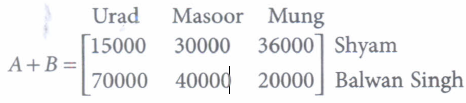
(i) (c) : Combined sales of Masoor in September and October for farmer Balwan Singh = Rs. 40000
(ii) (d) : Combined sales of Urad in September and October for farmer Shyam = Rs. 15000
(iii) (a) : Change in sales from September to October is given by
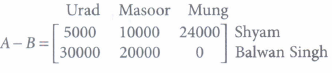
\(\therefore\) Decrease in sales of Mung from September to October for farmer Shyam = Rs. 24000.
(iv) (b) : Required profit is given by
\(2 \% \text { of } B=\frac{2}{100} \times B=0.02 \times B\)
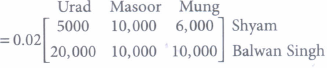
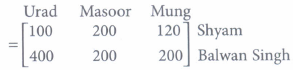
thus,in October Shyam receives Rs. 100, Rs. 200 and Rs. 120 as profit in the sale of each variety of pulses, respectively and Balwan Singh receives a profit of Rs. 400, Rs. 200 and Rs. 200 in the sale of each variety of pulses respectively.
42.
(i) (a) : For f(x) to be defined \(x-2 \neq 0\) i.e.,\(x \neq 2\)
\(\therefore\) Domain of f = R - {2}
(ii) (b) : Let y =J(x), then \(y=\frac{x-1}{x-2}\)
\(\Rightarrow x y-2 y=x-1 \Rightarrow x y-x=2 y-1 \Rightarrow x=\frac{2 y-1}{y-1}\)
Since, \(x \in R-\{2\}\),therefore \(y \neq 1\)
Hence, range of f = R-{1}
(iii) (d): We have,g(x) = 2f(x) - 1
\(=2\left(\frac{x-1}{x-2}\right)-1=\frac{2 x-2-x+2}{x-2}=\frac{x}{x-2}\)
(iv) (a) : We have, \(g(x)=\frac{x}{x-2}\) ,
Let \(g\left(x_{1}\right)=g\left(x_{2}\right) \Rightarrow \frac{x_{1}}{x_{1}-2}=\frac{x_{2}}{x_{2}-2}\)
\(\Rightarrow x_{1} x_{2}-2 x_{1}=x_{1} x_{2}-2 x_{2} \Rightarrow 2 x_{1}=2 x_{2} \Rightarrow x_{1}=x_{2}\)
Thus, \(g\left(x_{1}\right)=g\left(x_{2}\right) \Rightarrow x_{1}=x_{2}\)
Hence, g(x) is one-one.
(v) (c)

12th Standard CBSE Syllabus & Materials
12th Standard CBSE
CBSE 12th Computer Science Python Revision Tour I - New Previous year Question Papers Study Material - QB365 Set A
NEW12th Standard CBSE
CBSE 12th Business Studies Planning Important Questions And Answers Study Material - QB365 Set A
NEW12th Standard CBSE
CBSE 12th Business Studies Business Environment Important Questions And Answers Study Material - QB365 Set A
NEW12th Standard CBSE
CBSE 12th Business Studies Principles of Management Important Questions And Answers Study Material - QB365 Set A



NCERT Books

Syllabus

Exam Pattern

Sample Question Papers

Previous year Question Papers

Important Notes

MCQ Practice test

NCERT Exemplers

Case study Questions

Image Based Questions

Passage based Questions

HOT Questions

Value Based Questions

Model Questions Papers
NCERT ( Book Back ) Questions

Assertion and Reason
Important Questions And Answers

CBSE 12th Standard CBSE Subjects
CBSE Standards








