
 100% FREE ACCESS
12th Standard CBSE Syllabus & Materials
12th Standard CBSE
CBSE 12th Economics Government Budget and the Economy Previous year Question Papers Study Material - QB365 Set A
NEW12th Standard CBSE
CBSE 12th Computer Science Interface Python with MySQL - New Previous year Question Papers Study Material - QB365 Set A
NEW12th Standard CBSE
CBSE 12th Computer Science Database Concept - New Previous year Question Papers Study Material - QB365 Set A
NEW12th Standard CBSE
CBSE 12th Computer Science Data Communication - New Previous year Question Papers Study Material - QB365 Set A
NEW12th Standard CBSE
CBSE 12th Computer Science Data Structures - New Previous year Question Papers Study Material - QB365 Set A
NEW12th Standard CBSE
CBSE 12th Computer Science Functions - New Previous year Question Papers Study Material - QB365 Set A

Published on: 25/10/2025
Download CBSE Class 12th Standard CBSE Maths question papers, sample papers, important questions, and previous year solved papers in PDF format. Get free study materials, NCERT solutions, and exam preparation resources for Class 12th Standard CBSE Maths
Questions + Answers key
Take MCQ Maths Test
1.
Solve the following LPP graphically: Maximise and minimise Z = x + 2y Subject to the constraints
\(\begin{aligned}
x+2 y & \geq 100
\end{aligned}\),
\(\begin{aligned}
2 x-y & \leq 0
\end{aligned}\),
\(\begin{aligned}
2 x+y & \leq 200
\end{aligned}\),
and \(\begin{aligned}
x, y & \geq 0
\end{aligned}\)
2.
Determine graphically the minimum value of the objective function
Z = – 50x + 20y
subject to constraints
\(2 x-y \geq-5,\)
\(3 x+y \geq 3\)
\(2 x-3 y \leq 12\)
\(x \geq 0, y \geq 0\).
3.
Solve the following Linear Programming Problems graphically:
Minimise Z = x + 2y
subject to 2x + y ≥ 3, x + 2y ≥ 6, x, y ≥ 0.
4.
Solve the following Linear Programming Problems graphically:
Maximise Z = 5x + 3y
subject to 3x + 5y ≤ 15, 5x + 2y ≤ 10, x ≥ 0, y ≥ 0
5.
Solve the following Linear Programming Problem graphically:
Minimise Z = – 3x + 4 y
subject to constraints
\(x+2 y \leq 8,3 x+2 y \leq 12\)
and \(x, y \geq 0 \text {. }\)
6.
Solve the following Linear Programming Problems graphically:
Maximise Z = 3x + 4y
subject to the constraints:
\(x+y\le 4,x\ge 0,y\ge 0.\)
7.
(Manufacturing Problem) A manufacturer has Three machines I,II and III installed in his factory. Machines I and II are capable of being operated for at most 12 hours whereas machine III must be operated for at least 5 hours a day. She produces only two items M and N each on the three machines are given in the following table:
| Items | Number of hours required on machines | ||
| I | II | III | |
| M | 1 | 2 | 1 |
| N | 2 | 1 | 1.25 |
She makes a profit of RS.600 and Rs 400 on items M and N respectively. How many of each item should she produce so as to maximise her profit assuming that she can sell all the items that she produced? What will be the maximum profit?
8.
A firm can produce three types of cloth; say 'A', 'B' and 'C'. Three kinds of wool are required for it, say red wool, green wool and blue wool. One unit length of type 'A' cloth needs 2 yards of red wool, 2 yards of green wool and 2 yards of blue wool, one unit length of type 'C' cloth needs 5 yards of green wool and 4 yards of blue wool. The firm has only a stock of 8 yards of red wool, 10 yards of green wool and 15 yards of blue wool. It is assumed that the income obtained from one unit of type 'A' cloth is Rs. 3, for type 'B' cloth is Rs. 5 and for type 'C' cloth is Rs. 4 Formulate the problem as a LPP so as to maximize the profit of the firm by using the available materials.
9.
A furniture firm manufactures chairs and tables, each requiring the use of three machines 'A', 'B' and 1 hour on machine 'C'. Each table requires 1 hour each on machines 'A' and 'B' and 3 hours on machine 'C'. The profit realized by selling one chair is RS. 30 while for a table is Rs. 60. The total time available per week o machine 'A' is 70 hours, on machine 'B' is 40 hours and on machine 'C' is 90 hours. Find the mathematical formulation so as to find the number of chairs and tables that should be made per week so as to maximize the profit.
10.
A dietician wishes to mix two types of food in such a way that the vitamin contents of the mixture contain at least 8 units of vitamin A and 10 units of vitamin C. Food / contains 2 unit/ kg of vitamin A and 1 unit/kg of vitamin C while food contains 1 unit/kg of vitamin A and 2 units/kg of vitamin C. It costs Rs. 50 per kg to produce Food / and Rs. 70 per kg to produce food. Find the minimum cost of such a mixture. Formulate the above LPP mathematically and then solve it.
11.
Suppose every gram of wheat produces 0.1 g of protein and 0.25 g of carbohydrates and corresponding values for rice are 0.05 g and 0.5 g respectively. Wheat cost Rs. 25 and rice Rs. 100 per kilogram. The minimum daily requirements of proteins and carbohydrates for an mixed in a daily diet to provide minimum daily requirements of proteins and carbohydrates at minimum cost, assuming that both wheat and rice are to be taken in a diet? What is your opinion about healthy diet? Name few ingredients necessary for a healthy diet.
12.
A ……… of a feasible region is a point in the region, which is the intersection of two boundary lines.
Section point
Corner point
Reasonable point
Vertex point
13.
An aeroplane can carry a maximum of 200 passangers. A profit of Rs. 400 is made on each first class ticket and a profit of Rs. 300 is made on each economy class ticket. An airline reserves at least 20 seats for first class. However, at least 4 times as many passengers prefer to travel by economy class than by first class. Find how many tickets of each type must be sold to maximise the profit? The LPP for the given situation is
x → first class, y → economy class
To maximise Z = 400x + 300y
subject to constraints
x ≥ 0, y ≥ 0, x+y ≤ 200
x ≥ 20, y ≥ 80
x → first class, y → economy class
To maximise Z 400x + 300y
subject to constraints
x ≥ 0, y ≥ 0, x+y ≥ 200
x ≥ 20, y ≥ 80
x → first class, y → economy class
To maximise Z = 400x + 300y
subject to constraints
x ≥ 0, y ≥ 0, x ≥ 20
x + y ≤ 200,x ≥ 4y
x → first class, y → economy class
To maximise Z = 400x + 300y
subject to constraints
x ≥ 20, y ≥ 0
x + y ≤ 200, y ≥ 4x
14.
Feasible region is the set of points which satisfy
the objective functions
some of the given constraints
all of the given constraints
none of these
15.
A dealer wishes to purchase a number of fans and sewing machines. He has only Rs. 5,760 to invest and has space for at most 20 items. A fan costs him Rs. 360 and a sewing machine Rs. 240. He expects to sell a fan at a profit of Rs. 22 and a sewing machine at a profit of Rs. 18. Assigning that he can sell all the items that he buys, how should he invests his money to maximise the profit? The LPP for above question is
x → fans, y → sewing machinesTo maximise z = 22x + 18y subject to constraints
x ≥ 0, y ≥ 0, x + y ≤ 20, 360x + 240y ≥ 5760
x → fans, y → sewing machinesTo maximise z = 18x + 22ysubject to constraints
x ≥ 0, y ≥ 0, x + y ≤ 20 360x + 240y ≥ 5760
x → fans, y → sewing machines To maximise Z = 22x + 18y
x ≥ 0, y ≥ 0, x + y ≥ 0, 360x + 240y ≥ 5760
x → fans, y → sewing machines To maximise z = 22x + 18j
x ≥ 0, y ≥ 0, x + y ≤ 20 360x + 240y ≤ 5760
16.
Of all the points of the feasible region, for maximum or minimum of objective function, the point lies
inside the feasible region
at the boundary line of the feasible region
vertex point of the boundary of the feasible region
none of these
17.
Corner points of the feasible region for an LPP are (0, 3), (5, 0), (6, 8), (0, 8). Let Z = 4x - 6y be the objective function.
Based on the above information, answer the following questions.
(i) The minimum value of Z occurs at
| (a) (6, 8) | (b) (5, 0) | (c) (0, 3) | (d) (0, 8) |
(ii) Maximum value of Z occurs at
| (a) (5, 0) | (b) (0, 8) | (c) (0, 3) | (d) (6, 8) |
(iii) Maximum of Z - Minimumof Z =
| (a) 58 | (b) 68 | (c) 78 | (d) 88 |
(iv) The corner points of the feasible region determined by the system of linear inequalities are
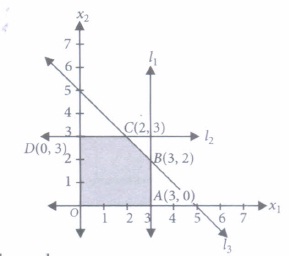
| (a) (0, 0), (-3, 0), (3, 2), (2, 3) | (b) (3, 0), (3, 2), (2, 3), (0, -3) | (c) (0, 0), (3, 0), (3, 2), (2, 3), (0, 3) | (d) None of these |
(v) The feasible solution of LPP belongs to
| (a) first and second quadrant | (b) first and third quadrant | (c) only second quadrant | (d) only first quadrant |
18.
Deepa rides her car at 25 km/hr, She has to spend Rs. 2 per km on diesel and if she rides it at a faster speed of 40 km/hr, the diesel cost increases to Rs. 5 per km. She has Rs. 100 to spend on diesel. Let she travels x kms with speed 25 km/hr and y kms with speed 40 km/hr. The feasible region for the LPP is shown below:
Based on the above information, answer the following questions
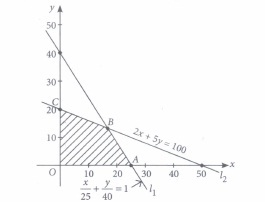
Based on the above information, answer the following questions.
(i) What is the point of intersection of line l1 and l2,
| \(\text { (a) }\left(\frac{40}{3}, \frac{50}{3}\right)\) | \(\text { (b) }\left(\frac{50}{3}, \frac{40}{3}\right)\) | \(\text { (c) }\left(\frac{-50}{3}, \frac{40}{3}\right)\) | \(\text { (d) }\left(\frac{-50}{3}, \frac{-40}{3}\right)\) |
(ii) The corner points of the feasible region shown in above graph are
| \(\text { (a) }(0,25),(20,0),\left(\frac{40}{3}, \frac{50}{3}\right)\) | \(\text { (b) }(0,0),(25,0),(0,20)\) | \(\text { (c) }(0,0),\left(\frac{40}{3}, \frac{50}{3}\right),(0,20)\) | \(\text { (d) }(0,0),(25,0),\left(\frac{50}{3}, \frac{40}{3}\right),(0,20)\) |
(iii) If Z = x + y be the objective function and max Z = 30. The maximum value occurs at point
| \(\text { (a) }\left(\frac{50}{3}, \frac{40}{3}\right)\) | (b) (0, 0) | (c) (25, 0) | (d) (0, 20) |
(iv) If Z = 6x - 9y be the objective function, then maximum value of Z is
| (a) -20 | (b) 150 | (c) 180 | (d) 20 |
(v) If Z = 6x + 3y be the objective function, then what is the minimum value of Z?
| (a) 120 | (b) 130 | (c) 0 | (d) 150 |
19.
Linear programming is a method for finding the optimal values (maximum or minimum) of quantities subject to the constraints when relationship is expressed as linear equations or inequations.
Based on the above information, answer the following questions.
(i) The optimal value of the objective function is attained at the points
| (a) on X-axis | (b) on Y-axis | (c) which are corner points of the feasible region | (d) none of these |
(ii) The graph of the inequality 3x + 4y < 12 is
| (a) half plane that contains the origin | (b) half plane that neither contains the origin nor the points of the line 3x + 4y =12. | (c) whole XOY-plane excluding the points on line 3x + 4y = 12 | (d) none of these |
(iii) The feasible region for an LPP is shown in the figure. Let Z = 2x + 5y be the objective function. Maximum of Z occurs at
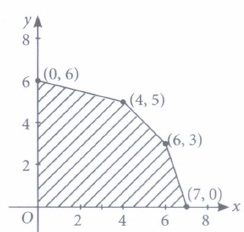
| (a) (7,0) | (b) (6,3) | (c) (0,6) | (d) (4,5) |
(iv) The corner points of the feasible region determined by the system of linear constraints are (0, 10), (5, 5), (15, 15), (0, 20). Let Z = px + qy, where p, q > 0. Condition on p and q so that the maximum of Z occurs at both the points (15, 15) and (0, 20) is
| (a) p = q | (b) p = 2q | (c) q=2p | (d) q=3p |
(v) The corner points of the feasible region determined by the system of linear constraints are (0, 0), (0, 40), (20,40), (60,20), (60, 0). The objective function is Z = 4x + 3y. Compare the quantity in Column A and Column B
| Column A | Column B |
| Maximum of Z | 325 |
| (a) The quantity in column A is greater | (b) The quantity in column B is greater | (c) The two quantities are equal | (d) The relationship cannot be determined on the basis of the information supplied |
1.
Our problem is to minimise and maximise
Z = x + 2y ....(i)
Subject to constraints
\(\begin{aligned}
& x+2 y \geq 100
\end{aligned}\) ....(ii)
\(\begin{aligned}
2 x-y \leq 0
\end{aligned}\) ....(iii)
\(\begin{aligned}
2 x+y \leq 200
\end{aligned}\) ....(iv)
and \(\begin{aligned}
x \geq 0, y \geq 0
\end{aligned}\) ....(v)
Table for line x + 2y = 100 is
| x | 0 | 100 |
| y | 50 | 0 |
So, the line x + 2y = 100 is passing through the points (0, 50) and (100, 0).
On putting (0, 0) in the inequality x + 2y \(\geq\) 100, we get
0 + 2 \(\times\) 0 \(\geq\) 100
\(\Rightarrow\) 0 \(\geq\) 100 (which is false)
So, the half plane is away from the origin.
Table for line 2x - y = 0 is
| x | 0 | 10 |
| y | 0 | 20 |
So, the line 2x - y = 0 is passing through the points (0, 0) and (10, 20).
On putting (5, 0) in the inequality 2x - y \(\leq\) 0,
we get
2 \(\times\) 5 - 0 \(\leq\) 0
\(\Rightarrow\) 10 \(\leq\) 0 (which is false)
So,the half-plane is towards Y-axis.
Table for line 2x + y = 200 is
| x | 0 | 100 |
| y | 200 | 0 |
So, the line 2x + y = 200 is passing through the points (0, 200) and (100, 0).
On putting (0, 0) in the inequality 2x + y \(\leq\) 200, we get 2 \(\times\) 0 + 0 \(\leq\) 200 \(\Rightarrow\) 0 \(\leq\) 200 (which is true).
So, the half plane is towards the origin.
Also, x, y \(\geq\) 0.
So, the region lies in the lst quadrant.
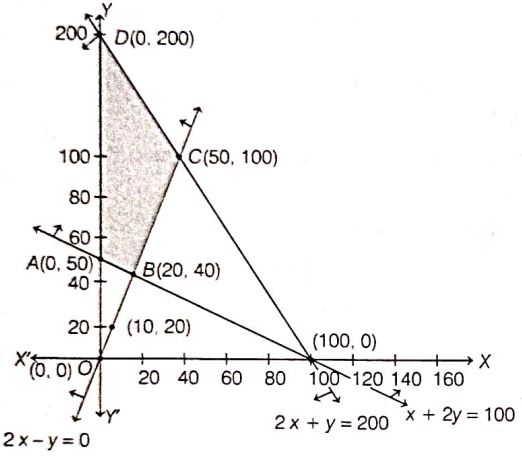
Clearly, feasible region is ABCDA.
On solving equations 2x - y=0 and x + 2y=100,
we get B(20, 40).
Again, solving the equations 2x - y = 0 and 2x + y = 200, we get C(50, 100).
The corner points of the feasible region are A(0, 50), B(20, 40), C(50, 100) and D(0, 200).
The values of Z at corner points are given below
| Corner points | Value of Z = x + 2y |
| A (0, 50) | 0 + 2 \(\times\) 50 = 100 |
| B(20, 40) | 20 + 2 \(\times\) 40 = 100 |
| C(50, 100) | 50 + 2 \(\times\)100 = 250 |
| D(0, 200) | 0 + 2 \(\times\) 200 = 400 (Maximum) |
The maximum value of Z is 400 at D(0, 200) and the minimum value of Z is 100 at all the points on the line segment joining A(0, 50) and B(20, 40).
2.
First of all, let us graph the feasible region of the system of inequalities (2) to (5). The feasible region (shaded). Observe that the feasible region is unbounded.
We now evaluate Z at the corner points.
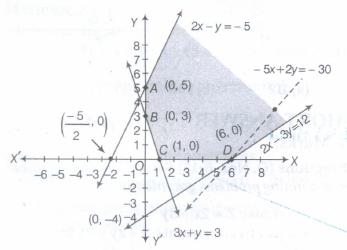
| Corner Point | Z = – 50x + 20y |
| (0, 5) | 100 |
| (0, 3) | 60 |
| (1, 0) | –50 |
| (6, 0) | – 300 (smallest) |
From this table, we find that – 300 is the smallest value of Z at the corner point (6, 0). Can we say that minimum value of Z is – 300? Note that if the region would have been bounded, this smallest value of Z is the minimum value of Z (Theorem 2). But here we see that the feasible region is unbounded. Therefore, – 300 may or may not be the minimum value of Z. To decide this issue, we graph the inequality
– 50x + 20y < – 300 (see Step 3(ii) of corner Point Method.)
i.e., – 5x + 2y < – 30
and check whether the resulting open half plane has points in common with feasible region or not. If it has common points, then –300 will not be the minimum value of Z.
Otherwise, –300 will be the minimum value of Z.
It has common points. Therefore, Z = –50 x + 20 y has no minimum value subject to the given constraints.
In the above example, can you say whether z = – 50 x + 20 y has the maximum value 100 at (0, 5)? For this, check whether the graph of – 50 x + 20 y > 100 has points in common with the feasible region.
3.
The feasible region determined by the constraints, 2x + y ≥ 3, x + 2y ≥ 6, x ≥ 0, and y ≥ 0, is as follows.
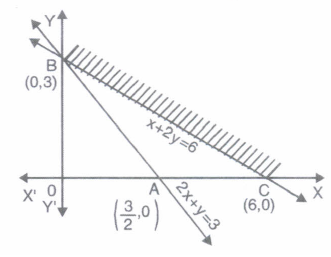
The corner points of the feasible region are A (6, 0) and B (0, 3).
The values of Z at these corner points are as follows.
| Corner point | Z = x + 2y |
| A(6, 0) | 6 |
| B(0, 3 | 6 |
It can be seen that the value of Z at points A and B is same. If we take any other point such as (2, 2) on line x + 2y = 6, then Z = 6
Thus, the minimum value of Z occurs for more than 2 points.
Therefore, the value of Z is minimum at every point on the line, x + 2y = 6
4.
The feasible region determined by the system of constraints, 3x + 5y ≤ 15, 5x + 2y ≤ 10, x ≥ 0, and y ≥ 0, are as follows.
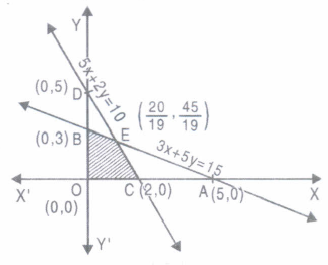
The corner points of the feasible region are O (0, 0), A (2, 0), B (0, 3), and C\(\left( \frac { 20 }{ 19 } ,\frac { 45 }{ 19 } \right) \)
The values of Z at these corner points are as follows.
Corner Point |
Corresponding Value of Z |
| C : (2,0) | 10 |
| E : \(\left( \frac { 20 }{ 19 } ,\frac { 45 }{ 19 } \right) \) | \(\frac { 235 }{ 19 } \) (Maximum) |
| B : (0,3) | 9 |
| O : (0,0) | 0 |
Therefore, the maximum value of Z is \(\frac { 235 }{ 19 } \) at \(\left( \frac { 20 }{ 19 } ,\frac { 45 }{ 19 } \right) \).
5.
Given, Z = -3x + 4y
Subject to the constraints
x + 2y \( \leq\) 8; 3x + 2y \( \leq\) 12 and x \(\geq\)0, y \(\geq\) 0
Now, considering the inequations as equations, we get
x + 2y = 8 ...(i)
3x + 2y = 12 ...(ii)
Table for line x + 2y = 8 is
| x | 8 | 0 |
| y | 0 | 4 |
On putting (0, 0) in the inequality x + 2y \( \leq\) 8
0 \( \leq\) 8 (which is true)
So, half plane is towards the origin.
Table for line 3x + 2y = 12
| x | 4 | 0 |
| y | 0 | 6 |
On putting (0, 0) in the inequality 3x + 2y \( \leq\)12
0 \( \leq\) 12 (which is true)
So, half plane is towards the origin.
Also, x \(\geq\) 0 and y \(\geq\) 0, so the feasible region lies in the Ist quadrant.
The point of intersection of Eqs. (i) and (ii) is (2, 3).
The graphical representation of the above system of inequations is given below.
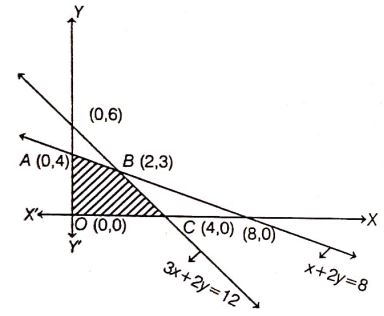
| Corner points | Value of Z = -3x + 4y |
| A(0, 4) | 16 |
| B(2, 3) | 6 |
| C(4, 0) | -12 (Minimum) |
| O(0, 0) | 0 |
Hence, Z = -12 is minimum at (4, 0).
6.
The system of constraints is:
\(x+y\le 4\) ..(1)
and \(x\ge 0,y\ge 0.\) ...(2)
The shaded region in the following figure is the feasible region determined by the system of constraints (1)-(2)
It is observed that the feasible region OAB is bounded.
Thus we use Corner Point Method to determine the maximum value of Z, where:
Z = 3x + 4y...(3)
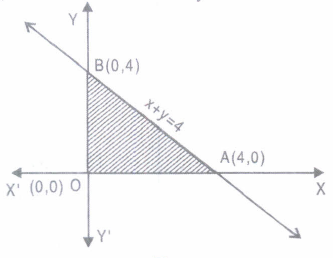
The co-ordinates of O, A and B are (0, 0), (4, 0) and (0, 4) respectively.
We evaluate Z at each corner point.
| Corner Point | Corresponding Value of Z |
| O : (0,0) | 0 |
| A : (4,0) | 12 |
| B : (0,4) | 16 (Maximum) |
Hence, \(Z_{ max }=16\) at the point (0, 4)
7.
Let x and y be the number of items M and N respectively.
Total profit on the production = Rs. (600 x + 400 y)
Mathematical formulation of the given problem is as follows:
Maximise Z = 600 x + 400 y
subject to the constraints:
x + 2y ≤ 12 (constraint on Machine I) ... (1)
2x + y ≤ 12 (constraint on Machine II) ... (2)
\(x+\frac{5}{4} y \geq 5 \) (constraint on Machine III) ...(3)
x ≥ 0, y ≥ 0 ... (4)
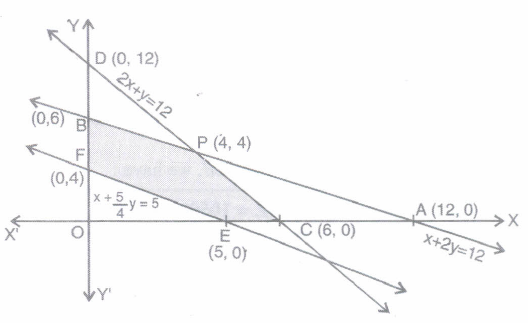
Let us draw the graph of constraints (1) to (4). ABCDE is the feasible region (shaded) as shown in Figure determined by the constraints (1) to (4). Observe that the feasible region is bounded, coordinates of the corner points A, B, C, D and E are (5, 0) (6, 0), (4, 4), (0, 6) and (0, 4) respectively.
Let us evaluate Z = 600 x + 400 y at these corner points.
| Corner Point | Z=600x+400y |
| C : (6,0) | 3600 |
| D : (4,4) | 4000 (Maximum) |
| B : (0,6) | 2400 |
| F : (0,4) | 1600 |
| E : (5,0) | 3000 |
We see that the point (4, 4) is giving the maximum value of Z. Hence, the manufacturer has to produce 4 units of each item to get the maximum profit of Rs. 4000.
8.
Maximize P = 3x + 4y + 5z subject to:
\(2x+3y \le 8,2y+5z\le 10,3x+2y+4z\le 15,x\ge 0,y\ge 0,z\ge 0.\)
9.
Maximize Z = 30x + 60y subject to:
\(2x+y\le 70,x+y\le 40,x+3y\le 90,x,y\ge 0.\)
10.
Let x kg of food I and y kg of food II are mixed.
LPP is, Minimise Z = 50 x + 70 y
subject to the constraints
\(x \geq 0, y \geq 0,2 x+y \geq 8, x+2 y \geq 10\)
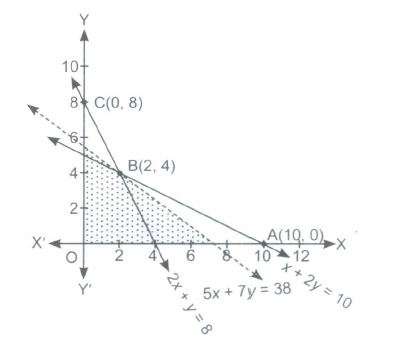
On plotting the graph of inequations we notice shaded portion is optimum solution.
Possible points for minimum Z are A( 10, 0), B(2, 4),C(0, 8).
\(\begin{array}{|c|c|c|} \hline \text { Points } & Z=50 x+70 y & \text { Values } \\ \hline A(10,0) & 500+0 & 500 \\ \hline B(2,4) & 100+280 & 380 \\ \hline C(0,8) & 0+560 & 560 \\ \hline \end{array}\)
As region is unbounded, we draw the solution region for 50x+ 70y < 380 or 5x + 7y < 38 and notice no point of solution region (dotted) lies in the feasible region,
Hence, we notice Z is minimum for B(2, 4), i.e. x = 2, y = 4. Hence, 2 kg of food 1 and 4 kg of food 11 must be mixed for a minimum cost of Rs. 380.
11.
Wheat 400 g and rice 200 g at a minimum cost of Rs. 30. We must take balanced healthy diet for good health. Wheat, rice, milk, fruits, nut etc.
We must take balanced healthy diet for good health; Wheat, rice, milk, fruits, nut etc.
12.
(b)
Corner point
13.
(d)
x → first class, y → economy class
To maximise Z = 400x + 300y
subject to constraints
x ≥ 20, y ≥ 0
x + y ≤ 200, y ≥ 4x
14.
(c)
all of the given constraints
15.
(d)
x → fans, y → sewing machines To maximise z = 22x + 18j
x ≥ 0, y ≥ 0, x + y ≤ 20 360x + 240y ≤ 5760
16.
(c)
vertex point of the boundary of the feasible region
17.
Construct the following table of values of objective function
| Corner Points | Value of Z = 4x - 6y |
| (0,3) | 4 x 0 - 6 x 3 = -18 |
| (5,0) | 4 x 5 - 6 x 0 = 20 |
| (6,8) | 4 x 6 - 6 x 8 = -24 |
| (0,8) | 4 x 0 - 6 x 8 = -48 |
(i) (d): Minimum value of Z is -48 which occurs at (0,8).
(ii) (a): Maximumvalue of Z is 20, which occurs at (5,0).
(iii) (b): Maximum of Z - Minimum of Z
= 20 - (-48) = 20 + 48 = 68
(iv) (c): The corner points of the feasible region are O(0,0), A(3, 0), B(3, 2), C(2, 3), D(0, 3).
(v) (d)
18.
(i) (b): Let B(x, y) be the point of intersection of the given lines
2x + 5y = 100 ....(i)
and \(\frac{x}{25}+\frac{y}{40}=1 \Rightarrow 8 x+5 y=20\)...(ii)
Solving (i) and (ii), we get
\(x=\frac{50}{3}, y=\frac{40}{3}\)
ஃ The point of intersection \(B(x, y)=\left(\frac{50}{3}, \frac{40}{3}\right)\)
(ii) (d): The corner points of the feasible region shown in the given graph are
\((0,0), A(25,0), B\left(\frac{50}{3}, \frac{40}{3}\right), C(0,20)\)
(iii) (a): Here Z = x + y
| Corner Points | Value of Z = x + y |
| (0,0) | 0 |
| (25,0) | 25 |
| \(\left(\frac{50}{3}, \frac{40}{3}\right)\) | 30 ⇠ Maximum |
| (0,20) | 20 |
Thus, max Z = 30 occurs at point \(\left(\frac{50}{3}, \frac{40}{3}\right)\)
(iv) (b):
| Corner Points | Value of Z = 6x - 9y |
| (0,0) | 0 |
| (25,0) | 150 ⇠ Maximum |
| \(\left(\frac{50}{3}, \frac{40}{3}\right)\) | -20 |
| (0,20) | -180 |
(v) (c):
| Corner Points | Value of Z = 6x + 3y |
| (0,0) | 0 ⇠ Maximum |
| (25,0) | 150 |
| \(\left(\frac{50}{3}, \frac{40}{3}\right)\) | 140 |
| (0,20) | 60 |
19.
(i) (c): When we solve an L.P.P. graphically, the optimal (or optimum) value of the objective function is attained at corner points of the feasible region.
(ii) (d): From the graph of 3x + 4y < 12 it is clear that it contains the origin but not the points on the line 3x + 4y = 12.
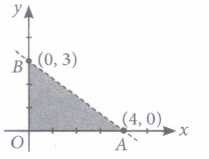
(iii) (d): Maximum of objective function occurs at corner points.
| Corner Points | Value of Z = 2x + 5y |
| (0,0) | 0 |
| (7,0) | 14 |
| (6,3) | 27 |
| (4,5) | 33 ⇠ Maximum |
| (0,6) | 30 |
(iv) (d): Value of Z = px + qy at (15, 15) = 15p + 15q and that at (0, 20) = 20 q. According to given condition, we have
15p + 15q = 20q \(\Rightarrow\) 15p = 5q \(\Rightarrow\) q = 3p
(v) (b): Construct the following table of values of the objective function:
| Corner Points | Value of Z = 4x + 3y |
| (0,0) | 4 × 0 + 3 × 0 = 0 |
| (0,40) | 4 x 0 + 3 x 40 = 120 |
| (20,40) | 4 x 20 + 3 x 40 = 200 |
| (60,20) | 4 x 60 + 3 x 20 = 300 ⇠ Maximum |
| (60,0) | 4 x 60 + 3 x 0 = 240 |

12th Standard CBSE Syllabus & Materials
12th Standard CBSE
CBSE 12th Computer Science Python Revision Tour I - New Previous year Question Papers Study Material - QB365 Set A
NEW12th Standard CBSE
CBSE 12th Business Studies Planning Important Questions And Answers Study Material - QB365 Set A
NEW12th Standard CBSE
CBSE 12th Business Studies Business Environment Important Questions And Answers Study Material - QB365 Set A
NEW12th Standard CBSE
CBSE 12th Business Studies Principles of Management Important Questions And Answers Study Material - QB365 Set A



NCERT Books

Syllabus

Exam Pattern

Sample Question Papers

Previous year Question Papers

Important Notes

MCQ Practice test

NCERT Exemplers

Case study Questions

Image Based Questions

Passage based Questions

HOT Questions

Value Based Questions

Model Questions Papers
NCERT ( Book Back ) Questions

Assertion and Reason
Important Questions And Answers

CBSE 12th Standard CBSE Subjects
CBSE Standards








