
 100% FREE ACCESS
12th Standard CBSE Syllabus & Materials
12th Standard CBSE
CBSE 12th Economics Government Budget and the Economy Previous year Question Papers Study Material - QB365 Set A
NEW12th Standard CBSE
CBSE 12th Computer Science Interface Python with MySQL - New Previous year Question Papers Study Material - QB365 Set A
NEW12th Standard CBSE
CBSE 12th Computer Science Database Concept - New Previous year Question Papers Study Material - QB365 Set A
NEW12th Standard CBSE
CBSE 12th Computer Science Data Communication - New Previous year Question Papers Study Material - QB365 Set A
NEW12th Standard CBSE
CBSE 12th Computer Science Data Structures - New Previous year Question Papers Study Material - QB365 Set A
NEW12th Standard CBSE
CBSE 12th Computer Science Functions - New Previous year Question Papers Study Material - QB365 Set A

Published on: 25/10/2025
Download CBSE Class 12th Standard CBSE Maths question papers, sample papers, important questions, and previous year solved papers in PDF format. Get free study materials, NCERT solutions, and exam preparation resources for Class 12th Standard CBSE Maths
Questions + Answers key
Take MCQ Maths Test
1.
Differential equations given, find the general solution:
\(\left(x+3 y^2\right) \frac{d y}{d x}=y \quad(y>0) .\)
2.
Two tailors A and B earn Rs. 300 and Rs. 400 per day, respectively. A can stitch 6 shirts and 4 pairs of trousers while B can stitch 10 shirts and 4 pairs of trousers per day. To find how many days should each of them work and if it is desired to produce at least 60 shirts and 32 pairs of trousers at a minimum labour cost, formulate this as an LPP.
3.
Solve \(y d x+\left(x-y^{3}\right) d y=0\)
4.
Using cofactors of elements of third column, evaluate \(\Delta=\left|\begin{array}{lll} 1 & x & y z \\ 1 & y & z x \\ 1 & z & x y \end{array}\right|\)
5.
For what value of x, the given matrix \(A=\left| \begin{matrix} 3-2x & x+1 \\ 2 & 4 \end{matrix} \right| \) is a singular matrix?
6.
Find X, if \(X+\begin{bmatrix} 2 & -1 \\ 3 & -1 \end{bmatrix}=\begin{bmatrix} 2 & 4 \\ 5 & 0 \end{bmatrix}\).
7.
Find the inverse of each of the matrices
\(\left[\begin{array}{lll} 1 & 2 & 3 \\ 0 & 2 & 4 \\ 0 & 0 & 5 \end{array}\right]\)
8.
Verify that the following problem has no feasible solution:
Maximize Z = 4x1 + 4x2, subject to the constraints:
\(2x_{ 1 }3x_{ 2 }\le 18,x_{ 1 }+x_{ 2 }\ge 12,x_{ 1 },x_{ 2 }\ge 0.\)
9.
Solve \(x d y-y d x=\sqrt{x^{2}+y^{2}} d x\)
10.
If \(A=\left[ \begin{matrix} 1 & 2 & 3 \\ 2 & 3 & 1 \end{matrix} \right] \)and \(B=\left[ \begin{matrix} 3 & -1 & 3 \\ -1 & 0 & 2 \end{matrix} \right] \), then find 2A-B.
11.
Evaluate: \(\left| \begin{matrix} 1 & x & y \\ 1 & x+y & y \\ 1 & x & x+y \end{matrix} \right| \)
12.
Solve the differential equation : \({ e }^{ x }\sqrt { 1-{ y }^{ 2 } } dx+\frac { y }{ x } dy=0,x=0,y=1.\)
13.
Solve the differential equation \(\frac{d y}{d x}+y \cot x=2 \cos x\), given that y=0, when \(x=\frac{\pi}{2} .\)
14.
Find the minimum and maximum values of the objective function.
Z = 3x + 9y
Subject to constraints
\(\begin{aligned} x+3 y \leq 60, x+y \geq 10, x \leq y \end{aligned}\)
and \(\begin{aligned} x \geq 0, y \geq 0 \end{aligned}\)
15.
Find A2 – 5A + 6I, if \(A=\left[\begin{array}{rrr} 2 & 0 & 1 \\ 2 & 1 & 3 \\ 1 & -1 & 0 \end{array}\right]\)
16.
Solve the following differential equation (1 + x2)dy + 2xy dx = cot x dx, where x \(\neq\) 0.
17.
Using the properties of determinants, prove the following: \(\left| \begin{matrix} a & b-c & c+b \\ a+c & b & c-a \\ a-b & b+a & c \end{matrix} \right| =(a+b+c)({ a }^{ 2 }+{ b }^{ 2 }+{ c }^{ 2 })\)
18.
The integrating factor of the differential equation. \(\left(1-y^2\right) \frac{d x}{d y}+y x=ay\)
\(\frac{1}{y^2-1}\)
\(\frac{1}{\sqrt{y^2-1}}\)
\(\frac{1}{1-y^2}\)
\(\frac{1}{\sqrt{1-y^2}}\)
19.
The order and degree (if defined) of the differential equation, \(\left(\frac{d^2 y}{d x^2}\right)^2+\left(\frac{d y}{d x}\right)^3=x \sin \left(\frac{d y}{d x}\right)\) respectively are
2, 2
1, 3
2, 3
2, degree not defined
20.
Let A be a skew- symmetric matrix of order 3 . If |A| = x, then (2023)x is equal to
2023
\(\frac{1}{2023}\)
\((2023)^2\)
1
21.
The graph of the inequality 2x + 3y > 6 is
half plane that contains the origin
half plane that neither contains the origin nor the points of the line 2x + 3y = 6
whole XOY-plane excluding the points on the line 2x + 3y = 6
entire XOY-plane
22.
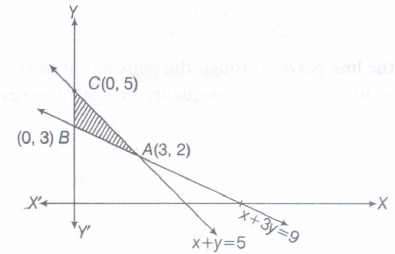
The feasible region for an LPP is shown in the following figure. Then, the minimum value of Z = 11x + 7y is
21
47
20
31
23.
Every point of feasible region is called a ……… to the problem.
Simple solution
Normal solution
Difficult solution
Feasible solution
24.
The general solution of the differential equation ex dy + (y ex + 2x) dx = 0 is
x ey + x2 = C
x ey + y2 = C
y ex + x2 = C
y ey + x2 = C
25.
Let A = \(\left[ \begin{matrix} 1 & sin\theta & 1 \\ -sin\theta & 1 & sin\theta \\ -1 & -sin\theta & 1 \end{matrix} \right] \), where 0 ≤ θ ≤2ㅠ.Then
Det (A) = 0
Det (A) ∈ (2, ∞)
Det (A) ∈ (2, 4)
Det (A) ∈ [2, 4]
26.
If A = \(\begin{bmatrix} \alpha & \beta \\ \gamma & -\alpha \end{bmatrix}\) is such that A² = I, then
1 + α² + βγ = 0
1 - α² + βγ = 0
1 - α² - βγ = 0
1 + α² - βγ = 0
27.
If the equation is of the form \(\frac{d y}{d x}=\frac{f(x, y)}{g(x, y)} \text { or } \frac{d y}{d x}=F\left(\frac{y}{x}\right)\) ,wheref (x, y), g(x, y) are homogeneous functions of the same degree in x and y, then put y = vx and \(\frac{d y}{d x}=v+x \frac{d v}{d x}\), so that the dependent variable y is changed to another variable v and then apply variable separable method. Based on the above information, answer the following questions.
(i) The general solution of \(x^{2} \frac{d y}{d x}=x^{2}+x y+y^{2}\) is
| (a) \(\tan ^{-1} \frac{x}{y}=\log |x|+c \) | (b) \( \tan ^{-1} \frac{y}{x}=\log |x|+c\) | (c) \(y=x \log |x|+c\) | (d) \(x=y \log |y|+c\) |
(ii) Solution of the differential equation \(2 x y \frac{d y}{d x}=x^{2}+3 y^{2} \) is
| (a) \( x^{3}+y^{2}=c x^{2}\) | (b) \( \frac{x^{2}}{2}+\frac{y^{3}}{3}=y^{2}+c\) | (c) \(x^{2}+y^{3}=c x^{2}\) | (d) \( x^{2}+y^{2}=c x^{3}\) |
(iii) Solution of the differential equation \(\left(x^{2}+3 x y+y^{2}\right) d x-x^{2} d y=0\) is
| (a) \(\frac{x+y}{x}-\log x=c\) | (b) \( \frac{x+y}{x}+\log x=c\) | (c) \(\frac{x}{x+y}-\log x=c\) | (d) \(\frac{x}{x+y}+\log x=c\) |
(iv) General solution ofthe differential equation \(\frac{d y}{d x}=\frac{y}{x}\left\{\log \left(\frac{y}{x}\right)+1\right\}\) is
| (a) \(\log (x y)=c\) | (b) \( \log y=c x\) | (c) \(\log \left(\frac{y}{x}\right)=c x\) | (d) \(\log x=c y\) |
(v) Solution ofthe differential equation \(\left(x \frac{d y}{d x}-y\right) e^{\frac{y}{x}}=x^{2} \cos x\) is
| (a) \(e^{\frac{y}{x}}-\sin x=c\) | (b) \(e^{\frac{y}{x}}+\sin x=c\) | (c) \(e^{\frac{-y}{x}}-\sin x=c \) | (d) \( e^{\frac{-y}{x}}+\sin x=c\) |
28.
Assertion If A is a non-singular matrix, then A-1 exist.
Reason Determinant of a non-singular matrix is zero.
(a) Both A and R are correct; R is the correct explanation of A
(b) Both A and R are correct; R is not the correct explanation of A
(c) A is correct; R is incorrect
(d) R is correct; A is incorrect
29.
Assertion: \(\frac{dy}{dx}=\frac{x^{3}-xy^{2}+y^{3}}{x^{2}y-x^{3}}\) is a homogeneous differential equation.
Reason: The function F(x, y)=\(\frac{x^{3}-xy^{2}+y^{3}}{x^{2}y-x^{3}}\)is homogeneous.
(a) Assertion is correct, Reason is correct; Reason is a correct explanation for assertion.
(b) Assertion is correct, Reason is correct; Reason is not a correct explanation for Assertion
(c) Assertion is correct, Reason is incorrect
(d) Assertion is incorrect, Reason is correct.
1.
x = 3y2 + Cy
2.
Suppose tailor A work for x days and tailor B work for y days.
The given data can be written in the tabular form as follows
\(\begin{array}{c|c|c|c} \hline \text { Tailor } & \begin{array}{c} \text { Number } \\ \text { of shirts } \end{array} & \begin{array}{c} \text { Number of } \\ \text { trousers } \end{array} & \text { Cost/day } \\ \hline A & 6 & 4 & Rs. 300 \\ B & 10 & 4 & \text { Rs. } 400 \\ \hline \text { Minimum requirement } & 60 & 32 & \\ \hline \end{array}\)
Required linear programming problem is
Min (Z) = 300x + 400y
subject to constraints
\(6 x+10 y \geq 60\)
\(4 x+4 y \geq 32\) and \(x \geq 0, y \geq 0\)
3.
(i) Write the given differential equation as
\(\frac{d x}{d y}+\frac{x}{y}=y^{2}\)
(ii) Similar as Example
\(=x y=\frac{y^{4}}{4}+C\)
4.
The given determinant is \(\left|\begin{array}{lll}
1 & x & y z \\
1 & y & z x \\
1 & z & x y
\end{array}\right|\)
Minors of third column is given as
\(\mathrm{M}_{13}=\left|\begin{array}{ll}
1 & y \\
1 & z
\end{array}\right|=z-y ; \quad \mathrm{M}_{23}=\left|\begin{array}{ll}
1 & x \\
1 & z
\end{array}\right|=z-x\)
\(\mathrm{M}_{33}=\left|\begin{array}{ll}
1 & x \\
1 & y
\end{array}\right|=y-x\)
Cofactors of third column are given as
\(A_{13}=\text { cofactor of } a_{13}=(-1)^{1+3} M_{13}=z-y \)
\(A_{23}=\text { cofactor of } a_{23}=(-1)^{2+3} M_{23}=-(z-x)=x-z \)
\(A_{33}=\text { cofactor of } a_{33}=(-1)^{3+3} M_{33}=y-x
\)
\(\Delta\) = sum of the product of the elements of the third column with their corresponding cofactors
\(\Delta =a_{13} A_{13}+a_{23} A_{23}+a_{33} A_{33} \)
\(=y z(z-y)+z x(x-z)+x y(y-x) \)
\(=y z^{2}-y^{2} z+z x^{2}-x z^{2}+x y^{2}-x^{2} y \)
\(=\left(x^{2} z-y^{2} z\right)+\left(y z^{2}-x z^{2}\right)+\left(x y^{2}-x^{2} y\right) \)
\(=z\left(x^{2}-y^{2}\right)+z^{2}(y-x)+x y(y-x) \)
\(=(x-y)\left[z x+z y-z^{2}-x y\right] \)
\(=(x-y)[z(x-z)+y(z-x)] \)
\(=(x-y)(y-z)(z-x)
\)
5.
\(x=1 \)
Alternative Method:
\(A=\left| \begin{matrix} 3-2x & x+1 \\ 2 & 4 \end{matrix} \right|\)
Since A is a singular matrix. i.e., |A|=0
\(\left| \begin{matrix} 3-2x & x+1 \\ 2 & 4 \end{matrix} \right| =0 \)
\(\Rightarrow 4(3-2x)-2(x+1)=0 \)
\(\Rightarrow 12-8x-2x-2=0 \)
\(\Rightarrow -10x+10=0 \)
\(\Rightarrow x-1\)
6.
\(X=\begin{bmatrix} 2 & 4 \\ 5 & 0 \end{bmatrix}-\begin{bmatrix} 2 & -1 \\ 3 & -1 \end{bmatrix}
\)
\(=\begin{bmatrix} 2-2 & 4+1 \\ 5-3 & 0+1 \end{bmatrix}=\begin{bmatrix} 0 & 5 \\ 2 & 1 \end{bmatrix}.
\)
7.
\(\text { Let } A=\left[\begin{array}{lll} 1 & 2 & 3 \\ 0 & 2 & 4 \\ 0 & 0 & 5 \end{array}\right]\)
\(\text { We have, }|A|=1(10-0)-2(0-0)+3(0-0)=10\)
\(\text { Now, }A_{11}=10-0=10, A_{12}=-(0-0)=0, A_{13}=0-0=0\)
\(A_{21}=-(10-0)=-10, A_{22}=5-0=5, A_{23}=-(0-0)=0\)
\(A_{31}=8-6=2, A_{32}=-(4-0)=-4, A_{33}=2-0=2 \)
\(\therefore \operatorname{adj} A=\left[\begin{array}{ccc} 10 & -10 & 2 \\ 0 & 5 & -4 \\ 0 & 0 & 2 \end{array}\right] \)
\(\therefore A^{-1}=\frac{1}{|A|} \text { adj } A=\frac{1}{10}\left[\begin{array}{ccc} 10 & -10 & 2 \\ 0 & 5 & -4 \\ 0 & 0 & 2 \end{array}\right]\)
8.
The given system of constraints is:
\(2x_{ 1 }3x_{ 2 }\le 18\) ...(1)
\(x_{ 1 }+x_{ 2 }\ge 12\)..(2)
\(x_{ 1 },x_{ 2 }\ge 0\) ...(3)
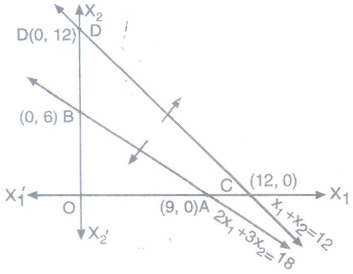
Since there is no shaded portion, which is feasible region of the given constraints,
∴ the problem has no feasible solution.
9.
The given equation is:
\(x d y-y d x=\sqrt{x^{2}+y^{2}} d x\)
\(\Rightarrow\) \(x dy=\left( y+\sqrt { { x }^{ 2 }+{ y }^{ 2 } } \right) dx\)
\(\Rightarrow\) \(\frac { dy }{ dx } =\frac { y+\sqrt { { x }^{ 2 }+{ y }^{ 2 } } }{ x } \)....(1)
| Homogeneous
Put \(y=vx\) so that \(\frac { dy }{ dx } =v+x\frac { dc }{ dx } .\)
\(\therefore\) (1) beomes: \(v+x\frac { dv }{ dx } \)
\(=\frac { vx+\sqrt { { x }^{ 2 }+{ v }^{ 2 }{ x }^{ 2 } } }{ x } \)
\(\Rightarrow\) \(v+x\frac { dv }{ dx } =v+\sqrt { 1+{ v }^{ 2 } } \)
\(\Rightarrow\) \(x\frac { dv }{ dx } =\sqrt { 1+{ v }^{ 2 } } \)
\(\Rightarrow\) \(\frac { d }{ \sqrt { 1+{ v }^{ 2 } } } =\frac { dx }{ x } \)
| Variables Separable
Integrating, \(\int { \frac { dv }{ \sqrt { 1+{ v }^{ 2 } } } } =\int { \frac { dx }{ x } +log|c| } \)
\(\Rightarrow\) \(log|v+\sqrt { 1+{ v }^{ 2 } } |=log|x|+log|c|\)
\(\Rightarrow\) \(log|v+\sqrt { 1+{ v }^{ 2 } } |=log|cx|\)
\(\Rightarrow\) \(v+\sqrt { 1+{ v }^{ 2 } } =cx\)
\(\Rightarrow\) \(\frac { y }{ x } +\sqrt { 1+\frac { { y }^{ 2 } }{ { x }^{ 2 } } } =cx\)
\(\Rightarrow\) \(y+\sqrt { { x }^{ 2 }+{ y }^{ 2 }=c{ x }^{ 2 } } \)
10.
We have
\(2 A-B=2\left[\begin{array}{lll} 1 & 2 & 3 \\ 2 & 3 & 1 \end{array}\right]-\left[\begin{array}{ccc} 3 & -1 & 3 \\ -1 & 0 & 2 \end{array}\right]\)
\(=\left[\begin{array}{lll} 2 & 4 & 6 \\ 4 & 6 & 2 \end{array}\right]+\left[\begin{array}{ccc} -3 & 1 & -3 \\ 1 & 0 & -2 \end{array}\right]\)
\(=\left[\begin{array}{lll} 2-3 & 4+1 & 6-3 \\ 4+1 & 6+0 & 2-2 \end{array}\right]=\left[\begin{array}{ccc} -1 & 5 & 3 \\ 5 & 6 & 0 \end{array}\right]\)
11.
=\(\left| \begin{matrix} 1 & x & y \\ 1 & x+y & y \\ 1 & x & x+y \end{matrix} \right| \)
=\(=\begin{vmatrix} 1&x&y\\0&y&0\\0&0&x\end{vmatrix}\)
(1)[xy-0] = xy
12.
\(\therefore\) Solution is \({ e }^{ 2\sqrt { x } }.\int { { e }^{ 2\sqrt { x } } } .\frac { { e }^{ 2\sqrt { x } } }{ \sqrt { x } } dx \Rightarrow { e }^{ 2\sqrt { x } }.y=\int { \frac { 1 }{ x } } dx\Rightarrow { e }^{ 2\sqrt { x } }.y=2\sqrt { x } +c\)
13.
Given, differential equation is \(\frac{d y}{d x}+y \cot x=2 \cos x\)
which is a linear differential equation of the form \(\frac{d y}{d x}+P y=Q\)
Here, P = cot x and Q = 2 cos x
\(\therefore \mathrm{IF}=e^{\int P d x}=e^{\int \cot x d x}=e^{\log |\sin x|} \Rightarrow \mathrm{IF}=\sin x\)
The general solution is given by
\(\begin{array}{ll}
y \times \mathrm{IF}=\int(\mathrm{IF} \times Q) d x+C
\end{array}\)
\(\begin{array}{ll}
\Rightarrow & y \sin x=\int 2 \sin x \cos x d x+C
\end{array}\)
\(\begin{array}{ll}
\Rightarrow \quad & y \sin x=\int \sin 2 x d x+C
\end{array}\)
\(\begin{array}{ll}
\Rightarrow & y \sin x=-\frac{\cos 2 x}{2}+C
\end{array}\) ....(i)
Also, given that y = 0, when x = \(\frac{\pi}{2}\).
On putting x = \(\frac{\pi}{2}\) and y = 0 in Eq. (i), we get
\(0 \sin \frac{\pi}{2}=-\frac{\cos \left(2 \frac{\pi}{2}\right)}{2}+C\)
\(\Rightarrow C-\frac{\cos \pi}{2}=0 \Rightarrow C+\frac{1}{2}=0 \quad[\because \cos \pi=-1]\)
\(\therefore \quad C=-\frac{1}{2}\)
On putting the value of C in Eq. (i), we get
\(y \sin x=-\frac{\cos 2 x}{2}-\frac{1}{2}\)
\(\therefore\) 2ysin x + cos 2x + 1 = 0
which is the required solution.
14.
Given that,
Minimise and Maximise Z = 3x + 9y ...(i)
Subject to the constraints are
\(\begin{aligned} x+3 y & \leq 60 \end{aligned}\) ...(ii)
\(\begin{aligned} x+y & \geq 10 \end{aligned}\) ...(iii)
\(\begin{aligned} x & \leq y \end{aligned}\) ...(iv)
\(\begin{aligned} x \geq 0, y & \geq 0 \end{aligned}\) ...(v)
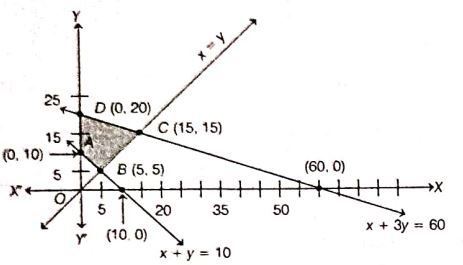
First of all,let us plot the graph of the feasible region of the system of linear inequalities (ii) to (v). The feasible region ABCDA is shown in the figure.
Note That the region is bounded. The coordinates of the corner points A, B, C and D are (0, 10), (5, 5), (15, 15) and (0, 20), respectively.
| Corner points | Corresponding value of Z = 3x + 9y |
| A (0, 10) | 90 |
| B(5, 5) | 60 (Minimum) |
| C(15, 15) | 180 (Maximum) Multiple optimal solutions) |
| D(0, 20) | 180 |
We, now find the minimum and maximum value of Z. From the table, we find that the minimum value of Z is 60 at the point B(5, 5) of the feasible region.
The maximum value of Z on the feasible region occurs at the two corner points C (15, 15) and D (0, 20) and it is 180 in each case.
Remark Observe that in the above example, the problem has multiple optimal solutions at the corner points C and D, i.e. the both points produce same maximum value 180.
In such cases, you can see that every point on the line segment CD joining the two corner points C and D also give the same maximum value. Same is also true in the case, if the two points produce same minimum value.
15.
We have A2 = A x A
\(A^{2}=A A=\left[\begin{array}{lcl} 2 & 0 & 1 \\ 2 & 1 & 3 \\ 1 & -1 & 0 \end{array}\right]\left[\begin{array}{lll} 2 & 0 & 1 \\ 2 & 1 & 3 \\ 1 & -1 & 0 \end{array}\right]\)
\(=\left[\begin{array}{lll} 2(2)+0(2)+1(1) & 2(0)+0(1)+1(-1) & 2(1)+0(3)+1(0) \\ 2(2)+1(2)+3(1) & 2(0)+1(1)+3(-1) & 2(1)+1(3)+3(0) \\ 1(2)+(-1)(2)+0(1) & 1(0)+(-1)(1)+0(-1) & 1(1)+(-1)(3)+0(0) \end{array}\right]\)
\(=\left[\begin{array}{lll} 4+0+1 & 0+0-1 & 2+0+0 \\ 4+2+3 & 0+1-3 & 2+3+0 \\ 2-2+0 & 0-1+0 & 1-3+0 \end{array}\right]\)
\(=\left[\begin{array}{rrr} 5 & -1 & 2 \\ 9 & -2 & 5 \\ 0 & -1 & -2 \end{array}\right]\)
\(\therefore A^{2}-5 A+6 I\)
\(=\left[\begin{array}{rrr} 5 & -1 & 2 \\ 9 & -2 & 5 \\ 0 & -1 & -2 \end{array}\right]-5\left[\begin{array}{rrr} 2 & 0 & 1 \\ 2 & 1 & 3 \\ 1 & -1 & 0 \end{array}\right]+6\left[\begin{array}{lll} 1 & 0 & 0 \\ 0 & 1 & 0 \\ 0 & 0 & 1 \end{array}\right]\)
\(=\left[\begin{array}{rrr} 5 & -1 & 2 \\ 9 & -2 & 5 \\ 0 & -1 & -2 \end{array}\right]-\left[\begin{array}{llr} 10 & 0 & 5 \\ 10 & 5 & 15 \\ 5 & -5 & 0 \end{array}\right]+\left[\begin{array}{lll} 6 & 0 & 0 \\ 0 & 6 & 0 \\ 0 & 0 & 6 \end{array}\right]\)
\(=\left[\begin{array}{ccc} 5-10 & -1-0 & 2-5 \\ 9-10 & -2-5 & 5-15 \\ 0-5 & -1+5 & -2-0 \end{array}\right]+\left[\begin{array}{lll} 6 & 0 & 0 \\ 0 & 6 & 0 \\ 0 & 0 & 6 \end{array}\right]\)
\(=\left[\begin{array}{ccc} -5 & -1 & -3 \\ -1 & -7 & -10 \\ -5 & 4 & -2 \end{array}\right]+\left[\begin{array}{lll} 6 & 0 & 0 \\ 0 & 6 & 0 \\ 0 & 0 & 6 \end{array}\right]\)
\(=\left[\begin{array}{ccc} -5+6 & -1+0 & -3+0 \\ -1+0 & -7+6 & -10+0 \\ -5+0 & 4+0 & -2+6 \end{array}\right]\)
\(=\left[\begin{array}{rrr} 1 & -1 & -3 \\ -1 & -1 & -10 \\ -5 & 4 & 4 \end{array}\right]\)
16.
Given differential equation is
\(\left(1+x^{2}\right) d y+2 x y d x=\cot x d x \quad[\because x \neq 0]\)
Above equation can be rewritten as,
\(\left(1+x^{2}\right) d y+(2 x y-\cot x) d x=0\)
\(\Rightarrow\left(1+x^{2}\right) d y=(\cot x-2 x y) d x\)
On dividing both sides by \(1+x^{2}\) ,we get
\(d y=\frac{\cot x-2 x y}{1+x^{2}} d x\)
\(\Rightarrow \frac{d y}{d x}=\frac{\cot x}{1+x^{2}}-\frac{2 x y}{1+x^{2}}\)
\(\Rightarrow \frac{d y}{d x}+\frac{2 x}{1+x^{2}} y=\frac{\cot x}{1+x^{2}}\)
which is a linear differential equation of the form of
\(\frac{d y}{d x}+P y=Q\)
Here, \(P=\frac{2 x}{1+x^{2}} \text { and } Q=\frac{\cot x}{1+x^{2}}\)
Now,\(\mathrm{IF}=e^{\int P d x}=e^{\frac{1}{1+x^{2}} d x}=e^{\log \left|1+x^{2}\right|}=1+x^{2}\)
\(\left[\because I_{1}=\int \frac{2 x}{1+x^{2}} d x,\right. \text { put } 1+x^{2}=t \Rightarrow 2 x d x=d t\)
\(\left.\Rightarrow I_{1}=\int \frac{d t}{t}=\log |t|=\log \left|1+x^{2}\right|\right]\)
and the solution of linear differential equation is given by
\(y \times I F=\int(Q \times I F) d x+C\)
\(\Rightarrow y\left(1+x^{2}\right)=\int \frac{\cot x}{1+x^{2}} \times\left(1+x^{2}\right) d x+C\)
\(\Rightarrow y\left(1+x^{2}\right)=\int \cot x d x+C\)
\(\Rightarrow y\left(1+x^{2}\right)=\log |\sin x|+C\)
\(\Rightarrow y=\frac{\log |\sin x|}{1+x^{2}}+\frac{C}{1+x^{2}}\)
which is the required solution.
17.
\(\triangle =\left| \begin{matrix} a & b-c & c+b \\ a+c & b & c-a \\ a-b & b+a & c \end{matrix} \right| \)
Multiplying C1 by a,
\(=\frac { 1 }{ a } \left| \begin{matrix} { a }^{ 2 } & b-c & c+b \\ { a }^{ 2 }+ac & b & c-a \\ { a }^{ 2 }-ab & b+a & c \end{matrix} \right| \)
\(C_{ 1 }\rightarrow C_{ 1 }+{ bC }_{ 2 }+cC_{ 3 },\)
\(=\frac { 1 }{ a } \left| \begin{matrix} { a }^{ 2 }+{ b }^{ 2 }+{ c }^{ 2 } & b-c & c+b \\ { a }^{ 2 }+{ b }^{ 2 }+{ c }^{ 2 } & b & c-a \\ { a }^{ 2 }+{ b }^{ 2 }+{ c }^{ 2 } & b+a & c \end{matrix} \right| \)
Taking \(({ a }^{ 2 }+{ b }^{ 2 }+{ c }^{ 2 })\) common from C1
\(=\frac { 1 }{ a } ({ a }^{ 2 }+{ b }^{ 2 }+{ c }^{ 2 })\left| \begin{matrix} 1 & b-c & c+b \\ 1 & b & c-a \\ 1 & b+a & c \end{matrix} \right| \)
Applying \(R_{ 2 }\rightarrow { R }_{ 2 }-R_{ 1 }\quad and\quad R_{ 3 }\rightarrow { R }_{ 3 }-R_{ 1 }\)
\(=\frac { 1 }{ a } ({ a }^{ 2 }+{ b }^{ 2 }+{ c }^{ 2 })\left| \begin{matrix} 1 & b-c & c+b \\ 0 & b & -(a+b) \\ 1 & a+c & -b \end{matrix} \right| \)
Now expanding along C1 , we get
\(=\frac { 1 }{ a } \times a({ a }^{ 2 }+{ b }^{ 2 }+{ c }^{ 2 })(a+b+c)\)
\(=(a+b+c)({ a }^{ 2 }+{ b }^{ 2 }+{ c }^{ 2 })\)
18.
(d)
\(\frac{1}{\sqrt{1-y^2}}\)
19.
(d)
2, degree not defined
20.
(d)
1
21.
(b)
half plane that neither contains the origin nor the points of the line 2x + 3y = 6
22.
(a)
21
23.
(d)
Feasible solution
24.
(c)
y ex + x2 = C
25.
(d)
Det (A) ∈ [2, 4]
26.
(c)
1 - α² - βγ = 0
27.
(i) (b): We have, \(\frac{d y}{d x}=\frac{x^{2}+x y+y^{2}}{x^{2}}\)
Put y = vx and \(\frac{d y}{d x}=v+x \frac{d v}{d x}\)
\(\therefore v+x \frac{d v}{d x}=\frac{x^{2}+x \cdot v x+v^{2} x^{2}}{x^{2}}=1+v+v^{2}\)
\(\Rightarrow x \frac{d v}{d x}=1+v^{2} \Rightarrow \int \frac{d v}{1+v^{2}}=\int \frac{d x}{x}+c\)
\(\Rightarrow \tan ^{-1} v=\log |x|+c \Rightarrow \tan ^{-1} \frac{y}{x}=\log |x|+c\)
(ii) (d): We have, \( 2 x y \frac{d y}{d x}=x^{2}+3 y^{2} \Rightarrow \frac{d y}{d x}=\frac{x^{2}+3 y^{2}}{2 x y}\)
Put y = vx and \(\frac{d y}{d x}=v+x \frac{d v}{d x}\)
\(\therefore v+x \frac{d v}{d x}=\frac{x^{2}+3 v^{2} x^{2}}{2 v x^{2}} \Rightarrow x \frac{d v}{d x}=\frac{1+3 v^{2}}{2 v}-v\)
\(\Rightarrow x \frac{d v}{d x}=\frac{1+v^{2}}{2 v_{*}} \Rightarrow \int \frac{2 v}{1+v^{2}} d v=\int \frac{d x}{x}+\log c\)
\(\Rightarrow \log \left|1+v^{2}\right|=\log |x|+\log |c| \Rightarrow \log \left|v^{2}+1\right|=\log |x c|\)
\(\Rightarrow \quad v^{2}+1=x c \Rightarrow \frac{y^{2}}{2}+1=x c \Rightarrow x^{2}+y^{2}=x^{3} c\)
(iii) (d): We have, \(\left(x^{2}+3 x y+y^{2}\right) d x-x^{2} d y=0\)
\(\Rightarrow \frac{x^{2}+3 x y+y^{2}}{x^{2}}=\frac{d y}{d x}\)
Put y = vx and \(\frac{d y}{d x}=v+x \frac{d v}{d x}\)
\(\therefore \frac{x^{2}+3 x^{2} v+x^{2} v^{2}}{x^{2}}=\left(v+x \frac{d v}{d x}\right)\)
\(\Rightarrow 1+3 v+v^{2}=v+x \frac{d v}{d x} \Rightarrow 1+2 v+v^{2}=x \frac{d v}{d x}\)
\(\Rightarrow \int \frac{d x}{x}-\int(v+1)^{-2} d v=c \Rightarrow \log x+\frac{1}{v+1}=c\)
\(\Rightarrow \log x+\frac{x}{x+y}=c\)
(iv) (c): We have, \(\frac{d y}{d x}=\frac{y}{x}\left\{\log \left(\frac{y}{x}\right)+1\right\}\)
Put y = vx and \(\frac{d y}{d x}=v+x \frac{d v}{d x}\)
\(\therefore v+x \frac{d v}{d x}=v\{\log (v)+1\} \Rightarrow x \frac{d v}{d x}=v \log v\)
\(\Rightarrow \int \frac{d v}{v \log v}=\int \frac{d x}{x} \Rightarrow \log |\log v|=\log |x|+\log |c|\)
\(\Rightarrow \log \left(\frac{y}{x}\right)=c x\)
(v) (a): We have,\(\left(x \frac{d y}{d x}-y\right) e^{\frac{y}{x}}=x^{2} \cos x\)
\(\Rightarrow\left(\frac{d y}{d x}-\frac{y}{x}\right) e^{\frac{y}{x}}=x \cos x\)
\(\text { Put } y=v x \text { and } \frac{d y}{d x}=v+x \frac{d v}{d x}\)
\(\Rightarrow\left(v+x \frac{d v}{d x}-v\right) e^{v}=x \cos x \Rightarrow x e^{v} \frac{d v}{d x}=x \cos x\)
\(\Rightarrow \int e^{v} d v=\int \cos x d x \Rightarrow e^{v}=\sin x+c\)
\(\Rightarrow e^{\frac{y}{x}}-\sin x=c\)
28.
(c) A is correct; R is incorrect
29.
(a) Assertion is correct, Reason is correct; Reason is a correct explanation for assertion.

12th Standard CBSE Syllabus & Materials
12th Standard CBSE
CBSE 12th Computer Science Python Revision Tour I - New Previous year Question Papers Study Material - QB365 Set A
NEW12th Standard CBSE
CBSE 12th Business Studies Planning Important Questions And Answers Study Material - QB365 Set A
NEW12th Standard CBSE
CBSE 12th Business Studies Business Environment Important Questions And Answers Study Material - QB365 Set A
NEW12th Standard CBSE
CBSE 12th Business Studies Principles of Management Important Questions And Answers Study Material - QB365 Set A



NCERT Books

Syllabus

Exam Pattern

Sample Question Papers

Previous year Question Papers

Important Notes

MCQ Practice test

NCERT Exemplers

Case study Questions

Image Based Questions

Passage based Questions

HOT Questions

Value Based Questions

Model Questions Papers
NCERT ( Book Back ) Questions

Assertion and Reason
Important Questions And Answers

CBSE 12th Standard CBSE Subjects
CBSE Standards








