
 100% FREE ACCESS
12th Standard CBSE Syllabus & Materials
12th Standard CBSE
CBSE 12th Economics Government Budget and the Economy Previous year Question Papers Study Material - QB365 Set A
NEW12th Standard CBSE
CBSE 12th Computer Science Interface Python with MySQL - New Previous year Question Papers Study Material - QB365 Set A
NEW12th Standard CBSE
CBSE 12th Computer Science Database Concept - New Previous year Question Papers Study Material - QB365 Set A
NEW12th Standard CBSE
CBSE 12th Computer Science Data Communication - New Previous year Question Papers Study Material - QB365 Set A
NEW12th Standard CBSE
CBSE 12th Computer Science Data Structures - New Previous year Question Papers Study Material - QB365 Set A
NEW12th Standard CBSE
CBSE 12th Computer Science Functions - New Previous year Question Papers Study Material - QB365 Set A

Published on: 25/10/2025
Download CBSE Class 12th Standard CBSE Maths question papers, sample papers, important questions, and previous year solved papers in PDF format. Get free study materials, NCERT solutions, and exam preparation resources for Class 12th Standard CBSE Maths
Questions + Answers key
Take MCQ Maths Test
1.
The feasible region of a linear programming problem is shown in the figure below:
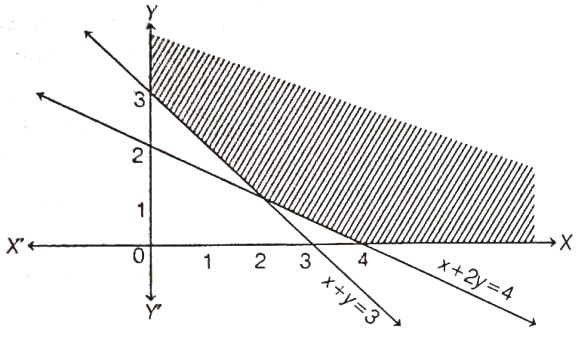
Which of the following are the possible constraints?
\(x+2 y \geq 4, x+y \leq 3, x \geq 0, y \geq 0\)
\(x+2 y \leq 4, x+y \leq 3, x \geq 0, y \geq 0\)
\(x+2 y \geq 4, x+y \geq 3, x \geq 0, y \geq 0\)
\(x+2 y \geq 4, x+y \geq 3, x \leq 0, y \leq 0\)
2.
If P(A) = 0.3, P(B) = 0.5 and P(A/B) = 0.4, then P(B/A) is
\(-\frac{2}{3}\)
\(\frac{2}{3}\)
\(\frac{3}{5}\)
none of these
3.
Bag A contains 3 red and 5 black balls and bag B contains 2 red and 4 black balls. A ball is drawn from one of the bags. The probability that ball drawn is red is
\(\frac{17}{24}\)
\(\frac{17}{48}\)
\(\frac{3}{8}\)
\(\frac{1}{3}\)
4.
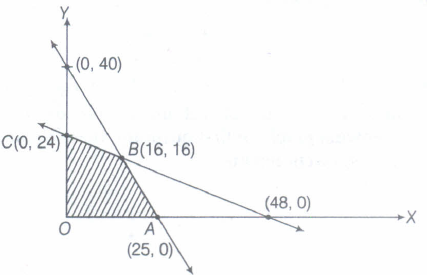
The maximum value of z= 4x + 3y, if the feasible region for an LPP is as shown below, is
112
100
72
110
5.
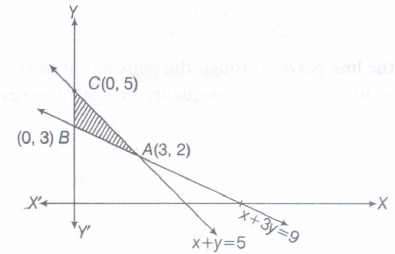
The feasible region for an LPP is shown in the following figure. Then, the minimum value of Z = 11x + 7y is
21
47
20
31
6.
If \(y=(\cos x)^{(\cos x)^{(\cos x) \ldots \infty}}\),then \(\frac{d y}{d x}\) is equal to
\(\frac{y \tan x}{y \log \cos x-1}\)
\(\frac{y^{2} \tan x}{y \log \cos x-1}\)
\(\frac{y \tan x}{1+y \log \cos x}\)
None ofthese
7.
The derivative of \(\cos ^{-1}\left(2 x^{2}-1\right) \text { w.r.t. } \cos ^{-1} x\)
2
\(\frac{-1}{2 \sqrt{1-x^{2}}}\)
\(\frac{2}{x}\)
1- x2
8.
If y = log xx, then the value of \(\frac{d y}{d x}\) is
\(x^{x}(1+\log x)\)
log (ex)
\(\log \frac{e}{x}\)
\(\log \left(\frac{x}{e}\right)\)
9.
If y + siny = cosx, then \(\frac{d y}{d x}\) is equal to
\(-\frac{\sin x}{1+\cos y}, y=(2 n+1) \pi\)
\(\frac{\sin x}{1+\cos y}, y \neq(2 n+1) \pi\)
\(\frac{\sin x}{1+\cos y}, y \neq(2 n+1) \pi\)
None of the above
10.
If \(f(x)=\left\{\begin{array}{ll} \lambda\left(x^{2}-2 x\right), & \text { if } x \leq 0 \\ 4 x+1, & \text { if } x>0 \end{array}\right.\) then which one of the following is correct.
f(x) is continuous at x = 0 for any value of λ
f(x) is discontinuous at x = 0 for any value of λ
f(x) is discontinuous at x = 1for any value of
None of the above
11.
The linear inequalities or equations or restrictions on the variables of a linear programming problem are called …… The conditions x ≥ 0 , y ≥ 0 are called …….
Objective functions, optimal value
Constraints, non-negative restrictions
Objective functions, non-negative restrictions
Constraints, negative restrictions
12.
Problems which seek to maximise or, minimise profit or, cost form a general class of problems called ………
Simple problems
Difficult problems
Non-linear problems
Optimisation problems
13.
What is the point of discontinuity for signum function?
x = 1
x = -1
x = 0
function is continuous on R
14.
Two events A and B will be independent, if ______.
A and B are mutually exclusive
P(A'B') = [1 – P(A)] [1 – P(B)]
P(A) = P(B)
P(A) + P(B) = 1
15.
If A and B are events such that P(A|B) = P(B|A), then _____.
A ⊂ B but A ≠ B
A = B
A ∩ B = Φ
P(A) = P(B)
16.
If P(A) = \(\frac12\), P(B) = 0, then P(A|B) is ______.
0
\(\frac12\)
not defined
1
17.
Of all the points of the feasible region, for maximum or minimum of objective function, the point lies
inside the feasible region
at the boundary line of the feasible region
vertex point of the boundary of the feasible region
none of these
18.
The derivative of sin x with respect to log x is
cos x
x cos x
\(\frac{cosx \ x}{log \ x}\)
\(\frac{1}{x} cos \ x\)
19.
Write the number of points where f(x) = |x + 2| + |x – 3| is not differentiable
2
3
0
1
20.
A function f is said to be continuous for x ∈ R, if
it is continuous at x = 0
differentiable at x = 0
continuous at two points
differentiable for x ∈ R
21.
Ajay enrolled himself in an online practice test portal provided by his school for better practice. Out of 5 questions in a set-I, he was able to solve 4 of them and got stuck in the one which is as shown below.

If A and B are independent events, P(A) = 0.6 and P(B) = 0.8, then answer the following questions.
(i) P (A \(\cap\) B) =
| (a) 0.2 | (b) 0.9 | (c) 0.48 | (d) 0.6 |
(ii) P (A \(\cup\) B) =
| (a) 0.92 | (b) 0.08 | (c) 0.48 | (d) 0.64 |
(iii) P (B | A) =
| (a) 0.14 | (b) 0.2 | (c) 0.6 | (d) 0.8 |
(iv) P (A | B) =
| (a) 0.6 | (b) 0.9 | (c) 0.19 | (d) 0.11 |
(v) P ( not A and not B ) =
| (a) 0.01 | (b) 0.48 | (c) 0.08 | (d) 0.91 |
22.
Corner points of the feasible region for an LPP are (0, 3), (5, 0), (6, 8), (0, 8). Let Z = 4x - 6y be the objective function.
Based on the above information, answer the following questions.
(i) The minimum value of Z occurs at
| (a) (6, 8) | (b) (5, 0) | (c) (0, 3) | (d) (0, 8) |
(ii) Maximum value of Z occurs at
| (a) (5, 0) | (b) (0, 8) | (c) (0, 3) | (d) (6, 8) |
(iii) Maximum of Z - Minimumof Z =
| (a) 58 | (b) 68 | (c) 78 | (d) 88 |
(iv) The corner points of the feasible region determined by the system of linear inequalities are
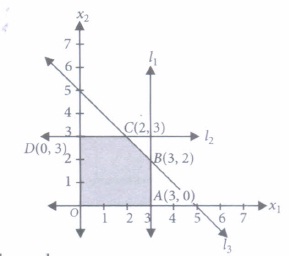
| (a) (0, 0), (-3, 0), (3, 2), (2, 3) | (b) (3, 0), (3, 2), (2, 3), (0, -3) | (c) (0, 0), (3, 0), (3, 2), (2, 3), (0, 3) | (d) None of these |
(v) The feasible solution of LPP belongs to
| (a) first and second quadrant | (b) first and third quadrant | (c) only second quadrant | (d) only first quadrant |
23.
(a) A function f(x) is said to be continuous in an open interval (a, b), if it is continuous at every point in this interval.
(b) A function f(x) is said to be continuous in the closed interval [a, b], if f(x) is continuous in (a, b) and \(\begin{equation} \lim _{h \rightarrow 0} f(a+h)=f(a) \text { and } \lim _{h \rightarrow 0} f(b-h)=f(b) \end{equation}\)
If function \(\begin{equation} f(x)=\left\{\begin{array}{ll} \frac{\sin (a+1) x+\sin x}{x} & , x<0 \\ c & , x=0 \\ \frac{\sqrt{x+b x^{2}}-\sqrt{x}}{b x^{3 / 2}} & , x>0 \end{array}\right. \end{equation}\) is continuous at x = 0, then answer the following questions.
(i) The value of a is
| (a) -3/2 | (b) 0 | (c) 1/2 | (d) -1/2 |
(ii) The value of b is
| (a) 1 | (b) -1 | (c) 0 | (d) any real number |
(iii) The value of c is
| (a) 1 | (b) 1/2 | (c) -1 | (d) -1/2 |
(iv) The value of a + c is
| (a) 1 | (b) 0 | (c) -1 | (d) -2 |
(v) The value oi c - a is
| (a) 1 | (b) 0 | (c) -1 | (d) 2 |
24.
Let f(x) be a real valued function, then its
Left Hand Derivative (L.H.D.) : \(\begin{equation} \mathrm{L} f^{\prime}(a)=\lim _{h \rightarrow 0} \frac{f(a-h)-f(a)}{-h} \end{equation}\)
Right Hand Derivative (R.H.D.) : \(\begin{equation} \mathrm{Rf}^{\prime}(a)=\lim _{h \rightarrow 0} \frac{f(a+h)-f(a)}{h} \end{equation}\)
Also, a function jfx) is said to be differentiable at x = a if its L.H.D. and R.H.D. at x = a exist and are equal
For the function \(\begin{equation} f(x)=\left\{\begin{array}{l} |x-3|, x \geq 1 \\ \frac{x^{2}}{4}-\frac{3 x}{2}+\frac{13}{4}, x<1 \end{array}\right. \end{equation}\) answer the following questions
(i) R.H.D. of f(x) at x = 1is
| (a) 1 | (b) -1 | (c) 0 | (d) 2 |
(ii) L.H.D. of f(x) at x = 1 is
| (a) 1 | (b) -1 | (c) 0 | (d) 2 |
(iii) f(x) is non-differentiable at
| (a) x = 1 | (b) x = 2 | (c) x = 3 | (d) x = 4 |
(iv) Find the value of f'(2).
| (a) 1 | (b) 2 | (c) 3 | (d) -1 |
(v) The value of f'( -1) is
| (a) 2 | (b) 1 | (c) -2 | (d) -1 |
1.
(c)
\(x+2 y \geq 4, x+y \geq 3, x \geq 0, y \geq 0\)
2.
(b)
\(\frac{2}{3}\)
3.
(b)
\(\frac{17}{48}\)
4.
(a)
112
5.
(a)
21
6.
Given that,\(y=(\cos x)^{(\cos x)^{(\cos x)} \cdots^{\infty}}\)
\(\Rightarrow \quad y=(\cos x)^{y}\)
Taking log on both sides, we get
log y = y log(cos x)
Now, differentiating w.r.t. x, we get
\(\frac{1}{y} \cdot \frac{d y}{d x}=y \cdot \frac{1}{\cos x}(-\sin x)+\log (\cos x) \cdot \frac{d y}{d x}\)
\(\Rightarrow \frac{d y}{d x}=y\left\{-y \tan x+\log \cos x \cdot \frac{d y}{d x}\right\} \)
\(\Rightarrow(1-y \log \cos x) \frac{d y}{d x}=-y^{2} \tan x \)
\(\Rightarrow \frac{d y}{d x}=\frac{y^{2} \tan x}{(y \log \cos x-1)} \)
7.
Let \(u=\cos ^{-1}\left(2 x^{2}-1\right) \text { and } v=\cos ^{-1} x\)
\( \therefore \frac{d u}{d x} =-\frac{1}{\sqrt{1-\left(2 x^{2}-1\right)^{2}}} \cdot 4 x=\frac{-4 x}{\sqrt{1-\left(4 x^{4}+1-4 x^{2}\right.}} \)
\(=\frac{-4 x}{\sqrt{-4 x^{4}+4 x^{2}}}=\frac{-4 x}{\sqrt{4 x^{2}\left(1-x^{2}\right)}}=\frac{-2}{\sqrt{1-x^{2}}} \)
and \(\frac{d v}{d x}=\frac{-1}{\sqrt{1-x^{2}}}\)
\(\therefore \frac{d u}{d v}=\frac{d u / d x}{d v / d x}=\frac{-2 / \sqrt{1-x^{2}}}{-1 / \sqrt{1-x^{2}}}=2\)
8.
Given y = x log x
\(\frac{d y}{d x}=\frac{x}{x}+\log x\)
\(\begin{array}{ll} \Rightarrow & \frac{d y}{d x}=\log e+\log x \\ \Rightarrow & \frac{d y}{d x}=\log (e x) \end{array}\)
9.
We differentiate the relationship directly with respect to x,we get
\(\frac{d y}{d x}+\frac{d}{d x}(\sin y)=\frac{d}{d x}(\cos x)\)
[by chain rule of derivative]
\(\frac{d y}{d x}+\cos y \cdot \frac{d y}{d x}=-\sin x\)
This gives \(\frac{d y}{d x}=-\frac{\sin x}{1+\cos y}\)
where \(y \neq(2 n+1) \pi\)
10.
\( \lim _{x \rightarrow 0^{-}} f(x)=0 \text { and } \lim _{x \rightarrow 0^{+}} f(x)=1\)
11.
(b)
Constraints, non-negative restrictions
12.
(d)
Optimisation problems
13.
(c)
x = 0
14.
(b)
P(A'B') = [1 – P(A)] [1 – P(B)]
15.
(d)
P(A) = P(B)
16.
(c)
not defined
17.
(c)
vertex point of the boundary of the feasible region
18.
As y = sin x, t
= log \(x\frac { dy }{ dx } =\frac { dy }{ dx } \div \frac { dt }{ dx } \)
\(=\frac { dy }{ dx } (sin \ x)\div \frac { dt }{ dx } (log \ x)\)
= cos x \(\div \) \(\frac1x\) = x cos x
19.
As f(x) = |x – a| is continuous at x = a but not differentiable thereat.
20.
As differentiable functions is continuous also
21.
Here, P(A) = 0.6 and P(B) = 0.8
\(\text { (i) } \ (c): P(A \cap B)=P(A) \cdot P(B)=(0.6)(0.8)=0.48\)
\(\text { (ii) }(\text { a) }: P(A \cup B)=P(A)+P(B)-P(A \cap B)\)
= 0.6 + 0.8 - 0.48 = 0.92
(iii) (d): P(B I A) = P(B) (\(\because\)A and B are independent)
= 0.8
(iv) (a): p (A I B) = p(A) (\(\because\)A and B are independent)
= 0.6
(v) (c) : P(not A and not B) = \(P\left(A^{\prime} \cap B^{\prime}\right)=P(A \cup B)^{\prime}\)
\(=1-P(A \cup B)=1-0.92=0.08\)
22.
Construct the following table of values of objective function
| Corner Points | Value of Z = 4x - 6y |
| (0,3) | 4 x 0 - 6 x 3 = -18 |
| (5,0) | 4 x 5 - 6 x 0 = 20 |
| (6,8) | 4 x 6 - 6 x 8 = -24 |
| (0,8) | 4 x 0 - 6 x 8 = -48 |
(i) (d): Minimum value of Z is -48 which occurs at (0,8).
(ii) (a): Maximumvalue of Z is 20, which occurs at (5,0).
(iii) (b): Maximum of Z - Minimum of Z
= 20 - (-48) = 20 + 48 = 68
(iv) (c): The corner points of the feasible region are O(0,0), A(3, 0), B(3, 2), C(2, 3), D(0, 3).
(v) (d)
23.
L.H.L (at x = 0) = \(\begin{equation} \lim _{x \rightarrow 0} \frac{\sin (a+1) x+\sin x}{x}\left(\frac{0}{0} \text { form }\right) \end{equation}\)
Using L' Hospital rule, we get
L.H.L.(at x = 0)
\(\begin{equation} =\lim _{x \rightarrow 0}(a+1) \cos (a+1) x+\cos x=a+2 \end{equation}\)
R.H.L \(\begin{equation} \text { (at } x=0)=\lim _{x \rightarrow 0} \frac{\sqrt{x+b x^{2}}-\sqrt{x}}{b x^{3 / 2}}=\lim _{x \rightarrow 0} \frac{\sqrt{1+b x}-1}{b x} \end{equation}\)
\(\begin{equation} =\lim _{x \rightarrow 0} \frac{1}{\sqrt{1+b x}+1}=\frac{1}{2} \end{equation}\)
Since,f(x) is continuous at x = 0.
\(\therefore\) From (i) and (ii), we get
\(\begin{equation} a+2=c=\frac{1}{2} \Rightarrow a=-\frac{3}{2}, c=\frac{1}{2} \end{equation}\)
Also, value of b does not affect the continuity of f(x), so b can be any real number.
(i) (a)
(ii) (d)
(iii) (b)
(iv) (c) : \(\begin{equation} a+c=-\frac{3}{2}+\frac{1}{2}=-1 \end{equation}\)
(v) (d) : \(\begin{equation} c-a=\frac{1}{2}+\frac{3}{2}=2 \end{equation}\)
24.
we have,\(\begin{equation} f(x)=\left\{\begin{array}{ll} x-3 & , x \geq 3 \\ 3-x & , 1 \leq x<3 \\ \frac{x^{2}}{4}-\frac{3 x}{2}+\frac{13}{4} & , x<1 \end{array}\right. \end{equation}\)
(i) (b) : \(\begin{equation} \mathrm{R} f^{\prime}(1)=\lim _{h \rightarrow 0} \frac{f(1+h)-f(1)}{h} \end{equation}\)
\(\begin{equation} =\lim _{h \rightarrow 0} \frac{3-(1+h)-2}{h}=\lim _{h \rightarrow 0}-\frac{h}{h}=-1 \end{equation}\)
(ii) (b) : \(\begin{equation} \mathrm{L}_{\mathrm{s}}^{\prime}(1)=\lim _{h \rightarrow 0} \frac{f(1-h)-f(1)}{-h} \end{equation}\)
\(\begin{equation} =\lim _{h \rightarrow 0} \frac{-1}{h}\left[\frac{(1-h)^{2}}{4}-\frac{3(1-h)}{2}+\frac{13}{4}-2\right] \end{equation}\)
\(\begin{equation} =\lim _{h \rightarrow 0}\left(\frac{1+h^{2}-2 h-6+6 h+13-8}{-4 h}\right) \end{equation}\)
\(\begin{equation} =\lim _{h \rightarrow 0}\left(\frac{h^{2}+4 h}{-4 h}\right)=-1 \end{equation}\)
(iii) (c) : Since, R.H.D. at x = 3 is 1 and L.H.D. at x = 3 is-1
\(\therefore\) f(x) is non-differentiable at x = 3.
(iv) (d)
(v) (c) : From above, we have
\(\begin{equation} f^{\prime}(x)=\frac{x}{2}-\frac{3}{2}, x<1 \end{equation}\)
\(\begin{equation} \therefore f^{\prime}(-1)=\frac{-1}{2}-\frac{3}{2}=-2 \end{equation}\)

12th Standard CBSE Syllabus & Materials
12th Standard CBSE
CBSE 12th Computer Science Python Revision Tour I - New Previous year Question Papers Study Material - QB365 Set A
NEW12th Standard CBSE
CBSE 12th Business Studies Planning Important Questions And Answers Study Material - QB365 Set A
NEW12th Standard CBSE
CBSE 12th Business Studies Business Environment Important Questions And Answers Study Material - QB365 Set A
NEW12th Standard CBSE
CBSE 12th Business Studies Principles of Management Important Questions And Answers Study Material - QB365 Set A



NCERT Books

Syllabus

Exam Pattern

Sample Question Papers

Previous year Question Papers

Important Notes

MCQ Practice test

NCERT Exemplers

Case study Questions

Image Based Questions

Passage based Questions

HOT Questions

Value Based Questions

Model Questions Papers
NCERT ( Book Back ) Questions

Assertion and Reason
Important Questions And Answers

CBSE 12th Standard CBSE Subjects
CBSE Standards








