
 100% FREE ACCESS
12th Standard CBSE Syllabus & Materials
12th Standard CBSE
CBSE 12th Economics Government Budget and the Economy Previous year Question Papers Study Material - QB365 Set A
NEW12th Standard CBSE
CBSE 12th Computer Science Interface Python with MySQL - New Previous year Question Papers Study Material - QB365 Set A
NEW12th Standard CBSE
CBSE 12th Computer Science Database Concept - New Previous year Question Papers Study Material - QB365 Set A
NEW12th Standard CBSE
CBSE 12th Computer Science Data Communication - New Previous year Question Papers Study Material - QB365 Set A
NEW12th Standard CBSE
CBSE 12th Computer Science Data Structures - New Previous year Question Papers Study Material - QB365 Set A
NEW12th Standard CBSE
CBSE 12th Computer Science Functions - New Previous year Question Papers Study Material - QB365 Set A

Published on: 25/10/2025
Download CBSE Class 12th Standard CBSE Maths question papers, sample papers, important questions, and previous year solved papers in PDF format. Get free study materials, NCERT solutions, and exam preparation resources for Class 12th Standard CBSE Maths
Questions + Answers key
Take MCQ Maths Test
1.
For the system of equations 5x + 2y = 4; 7x +3y = 5 the values of x and yare respectively.
x = 2, y = -3
x = 2, y = 3
x = -2, y = -3
x = -2, y = 3
2.
If \(A=\left[\begin{array}{cc} 2 & 3 \\ -4 & -6 \end{array}\right]\) then which of the following is true?
\(A(\operatorname{adj} A) \neq|A| I\)
\(A(\operatorname{adj} A) \neq(\operatorname{adj} A) A\)
\(A(\operatorname{adj} A)=(\operatorname{adj} A) A=|A| I=\left[\begin{array}{ll} 0 & 0 \\ 0 & 0 \end{array}\right]\)
None of the above
3.
If \(\Delta=\left|\begin{array}{lll} a & h & g \\ h & b & f \\ g & f & c \end{array}\right|\) then the cofactor A21 is
-(he + fg)
fg -hc
fg + hc
hc-fg
4.
Area of the triangle whose vertices are (a, b + c), (b, c + a) and (c, a + b), is
2 sq units
3 sq unit
0 sq unit
None of the above
5.
The value of x such that
\(\left[\begin{array}{lll}
1 & 2 & 1
\end{array}\right]\left[\begin{array}{lll}
1 & 2 & 0 \\
2 & 0 & 1 \\
1 & 0 & 2
\end{array}\right]\left[\begin{array}{l}
0 \\
2 \\
x
\end{array}\right]=O, \mathrm{i}\)
1
0
-1
3
6.
The volume of cube is increasing at the constant rate of 3cm3/s. Find the rate of change of edge of the cube when its edge is 5 cm.
25 cm3/sec
25 cm/s
1/25 cm/s
1/25 cm3/s
7.
\(\begin{bmatrix} x+10 & { y }^{ 2 }+2y \\ 0 & -4 \end{bmatrix} =\begin{bmatrix} 3x+4 & 3 \\ 0 & { y }^{ 2 }-5y \end{bmatrix}\) Then the value of x is ________
6
3
2
0
8.
A cylindrical tank of radius 10 m is being filled with wheat at the rate of 314 cubic metre per hour. Then the depth of the wheat is increasing at the rate of
1 m/h
0.1 m/h
1.1 m/h
0.5 m/h
9.
The interval in which y = x2 e–x is increasing is
(– ∞, ∞)
(– 2, 0)
(2, ∞)
(0, 2)
10.
The total revenue in Rupees received from the sale of x units of a product is given by
R(x) = 3x2 + 36x + 5. The marginal revenue, when x = 15 is
116
96
90
126
11.
If A is an invertible matrix of order 2, then det (A–1) is equal to
det (A)
\(\frac{1}{det(A)}\)
1
0
12.
If the matrix A is both symmetric and skew symmetric, then
A is a diagonal matrix
A is a zero matrix
A is a square matrix
None of these
13.
Assume X, Y, Z, W and P are matrices of order 2 × n, 3 × k, 2 × p, n × 3 and p × k, respectively.
The restriction on n, k and p so that PY + WY will be defined are:
k = 3, p = n
k is arbitrary, p = 2
p is arbitrary, k = 3
k = 2, p = 3
14.
The absolute maximum value of y = x3 – 3x + 2 in 0 ≤ x ≤ 2 is
4
6
2
0
15.
The side of an equilateral triangle is increasing at the rate of 2 cm/s. The rate at which area increases when the side is 10 is
10 cm²/s
\(\sqrt3\) cm²/s
10 \(\sqrt3\) cm²/s
\(\frac{10}{3}\)cm²/s
16.
A and B are invertible matrices of the same order such that |(AB)-1| = 8, If |A| = 2, then |B| is
16
4
6
\(\frac{1}{16}\)
17.
The value \(\left| \begin{matrix} 6 & 0 & -1 \\ 2 & 1 & 4 \\ 1 & 1 & 3 \end{matrix} \right| \) is
-7
7
8
10
18.
If A = \(\begin{bmatrix} 5 & x \\ y & 0 \end{bmatrix}\) and A = A’ then
x = 0, y = 5
x = y
x + y = 5
x – y = 5
19.
If A is a square matrix such that A²=A, then (I + A)² – 3A is
I
2A
3I
A
20.
If a matrix has 6 elements, then number of possible orders of the matrix can be
2
4
3
6
21.
Gaurav purchased 5 pens, 3 bags and 1 instrument box and pays Rs. 16. From the same shop, Dheeraj purchased 2 pens, 1 bag and 3 instrument boxes and pays Rs. 19, while Ankur purchased 1 pen, 2 bags and 4 instrument boxes and pays Rs. 25.
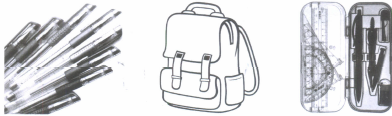
Using the concept of matrices and determinants, answer the following questions.
(i) The cost of one pen is
| (a) Rs. 2 | (b) Rs. 5 | (c) Rs. 1 | (d) Rs. 3 |
(ii) What is the cost of one pen and one bag?
| (a) Rs. 3 | (b) Rs. 5 | (c) Rs. 7 | (d) Rs. 8 |
(iii) What is the cost of one pen and one instrument box?
| (a) Rs. 7 | (b) Rs. 6 | (c) Rs. 8 | (d) Rs. 9 |
(iv) Which of the following is correct?
| (a) Determinant is a square matrix. | (b) Determinant is a number associated to a matrix |
| (c) Determinant is a number associated to a square matrix | (d) All of the above |
(v) From the matrix equation AB = AC, it can be concluded that B = C provided
| (a) A is singular | (b) A is non-singular | (c) A is symmetric | (d) A is square |
22.
An owner of an electric bi~e rental company have determined that if they charge customers Rs. x per day to rent a bike, where 50 Rs. x Rs. 200, then number of bikes (n), they rent per day can be shown by linear function n(x) = 2000 - 10x. If they charge Rs. 50 per day or less, they will rent all their bikes. If they charge Rs. 200 or more per day, they will not rent any bike. Based on the above information, answer the following questions.
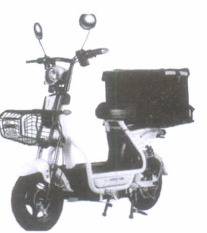
Based on the above information, answer the following questions
(i) Total revenue R as a function of x can be represented as
| (a) 2000x - 10x2 | (b) 2000x + 10x2 | (c) 2000 - 10x | (d) 2000 - 5x2 |
(ii) If R(x) denote the revenue, then maximum value of R(x) occur when x equals
| (a) 10 | (b) 100 | (c) 1000 | (d) 50 |
(iii) At x = 260, the revenue collected by the company is
| (a) Rs. 10 | (b) Rs. 500 | (c) Rs. 0 | (d) Rs. 1000 |
(iv) The number of bikes rented per day, if x = 105 is
| (a) 850 | (b) 900 | (c) 950 | (d) 1000 |
(v) Maximum revenue collected by company is
| (a) Rs. 40,000 | (b) Rs. 50,000 | (c) Rs. 75,000 | (d) Rs. 1,00,000 |
23.
Area of a triangle whose vertices are (x1, y1), (x2' y2) and (x3, y3) is given by thedeterminant
\(\begin{equation} \Delta=\frac{1}{2}\left|\begin{array}{lll} x_{1} & y_{1} & 1 \\ x_{2} & y_{2} & 1 \\ x_{3} & y_{3} & 1 \end{array}\right| \end{equation}\)
Since, area is a positive quantity, so we always take the absolute value of the determinant Δ. Also, the area of the triangle formed by three collinear points is zero.
Based on the above information, answer the following questions
(i) Find the area of the triangle whose vertices are (-2, 6), (3, -6) and (1, 5).
| (a) 30 sq. units | (b) 35 sq. units | (c) 40 sq. units | (d) 15.5 sq. units |
(ii) If the points (2, -3), (k, -1) and (0, 4) are collinear, then find the value of 4k
| (a) 4 | (b) \(\begin{equation} \frac{7}{140} \end{equation}\) | (c) 4 | (d) \(\begin{equation} \frac{40}{7} \end{equation}\) |
(iii) If the area of a triangle ABC, with vertices A(1, 3), B(O, 0) and C(k, 0) is 3 sq. units, then a value of k is
| (a) 2 | (b) 3 | (c) 4 | (d) 5 |
(iv) Using determinants, find the equation of the line joining the points A(1, 2) and B(3, 6).
| (a) y = 2x | (b) x = 3y | (c) y = x | (d) 4x-y = 5 |
(v) If A = (11, 7), B = (5, 5) and C = (-1, 3), then
| (a) \(\begin{equation} \Delta A B C \end{equation}\) is scalene triangle | (b) \(\begin{equation} \Delta A B C \end{equation}\) is equilateral triangle |
| (c) A, B and C are collinear | (d) None of these |
24.
To promote the making of toilets for women, an organisation tried to generate awareness through (i) house calls (ii) emails and (iii) announcements. The cost for each mode per attempt is given below:
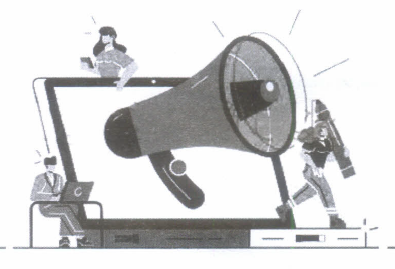
(i) Rs.50 (ii) Rs.20 (iii) Rs.40
The number of attempts made in the villages X, Y and Z are given below:
\(\begin{array}{llll} & (\mathrm{i}) & (\mathrm{ii}) & (\mathrm{iii}) \\ X & 400 & 300 & 100 \\ Y & 300 & 250 & 75 \\ Z & 500 & 400 & 150 \end{array}\)
Also, the chance of making of toilets corresponding to one attempt of given modes is
(i) 2% (ii) 4% (iii) 20%
Based on the above information, answer the following questions.
(i) The cost incurred by the organisation on village X is
| (a) 10000 | (b) Rs.15000 | (c) 30000 | (d) Rs.20000 |
(ii) The cost incurred by the organisation on village Y is
| (a) Rs.25000 | (b) Rs.18000 | (c) Rs.23000 | (d) Rs.28000 |
(iii) The cost incurred by the organisation on village Z is
| (a) Rs.19000 | (b) Rs.39000 | (c) Rs.4500 | (d) Rs.5000 |
(iv) The total number of toilets that can be expected after the promotion in village X, is
| (a) 20 | (b) 30 | (c) 40 | (d) 50 |
(v) The total number of toilets that can be expected after the promotion in village Z, is
| (a) 26 | (b) 36 | (c) 46 | (d) 56 |
1.
From the option, we can see only option (a) satisfy both the equations
2.
(c)
\(A(\operatorname{adj} A)=(\operatorname{adj} A) A=|A| I=\left[\begin{array}{ll} 0 & 0 \\ 0 & 0 \end{array}\right]\)
3.
\(A_{21}=(-1)^{2+1} M_{21}=-M_{21}=-\left|\begin{array}{ll} h & g \\ f & c \end{array}\right|\)
4.
Area of triangle, \(\Delta=\frac{1}{2}\left|\begin{array}{lll} a & b+c & 1 \\ b & c+a & 1 \\ c & a+b & 1 \end{array}\right|\)
5.
(c)
-1
6.
(c)
1/25 cm/s
7.
(b)
3
8.
(a)
1 m/h
9.
(d)
(0, 2)
10.
(d)
126
11.
(b)
\(\frac{1}{det(A)}\)
12.
(b)
A is a zero matrix
13.
(a)
k = 3, p = n
14.
As y’ = 3x² – 3, for a point of absolute maximum or minimum y’=0 ⇒ x = ± 1.
y]x=0 = 2,
y]x=1 = 1 – 3 + 2 = 0,
y]x=-1 = -1 +3+ 2 = 4,
y]x=2 = 8 – 6 + 2 = 4
15.
As \(\frac { dx }{ dt } =2\) cm/s, x is side of equiolatral triangle.
A = \(\frac { \sqrt { 3 } }{ 4 } { x }^{ 2 }\)
\(\Rightarrow \frac { dA }{ dx } =\frac { \sqrt { 3 } }{ 2 } { x }\frac { dx }{ dt } \)
= \(\frac { \sqrt { 3 } }{ 2 } x2=\sqrt { 3 } x\)
∴\(|\frac{dA}{dx}|\)x=10 = 10\(\sqrt3\) cm2/s
16.
As \(\left| { (AB) }^{ -1 } \right| =\frac { 1 }{ |AB| } =\frac { 1 }{ |A||B| } \)
\(\Rightarrow 8=\frac { 1 }{ 2|B| } \Rightarrow B=\frac { 1 }{ 16 } \)
17.
Δ = 6(-1)- 1(1) = -7
18.
As \(\begin{bmatrix} 5 & x \\ y & 0 \end{bmatrix}=\begin{bmatrix} 5 & x \\ y & 0 \end{bmatrix}\Rightarrow x=y\)
19.
(a)
I
20.
As 6 → 1 × 6, 2 × 3, 3 × 2, 6 × 1.
21.
Let the cost of 1 pen = Rs. x, the cost of 1 bag = Rs. y, and the cost of 1 instrument box = Rs. z
According to the question, we have
5x + 3y + z = 16, 2x + Y + 3z = 19, x + 2y + 4z = 25
This system of equation can be written as AX = B,
where \(A=\left[\begin{array}{lll} 5 & 3 & 1 \\ 2 & 1 & 3 \\ 1 & 2 & 4 \end{array}\right], B=\left[\begin{array}{l} 16 \\ 19 \\ 25 \end{array}\right] \) and \(X=\left[\begin{array}{l} x \\ y \\ z \end{array}\right]\)
IAI = 5(4 - 6) - 3(8 - 3) + 1(4 - 1)
\(=-10-3(5)+3=-22 \neq 0\)
\(\therefore\) A -1 exists.
Now, X = A-1B, where \(A^{-1}=\frac{1}{|A|} \operatorname{adj} A\)
Here, \(\operatorname{adj} A=\left[\begin{array}{ccc} -2 & -5 & 3 \\ -10 & 19 & -7 \\ 8 & -13 & -1 \end{array}\right]^{\prime}=\left[\begin{array}{ccc} -2 & -10 & 8 \\ -5 & 19 & -13 \\ 3 & -7 & -1 \end{array}\right]\)
\(\therefore \quad A^{-1}=\frac{1}{-22}\left[\begin{array}{ccc} -2 & -10 & 8 \\ -5 & 19 & -13 \\ 3 & -7 & -1 \end{array}\right]\)
\(\therefore \quad X=\left[\begin{array}{l} x \\ y \\ z \end{array}\right]=\frac{1}{-22}\left[\begin{array}{ccc} -2 & -10 & 8 \\ -5 & 19 & -13 \\ 3 & -7 & -1 \end{array}\right]\left[\begin{array}{c} 16 \\ 19 \\ 25 \end{array}\right]\)
\(=\frac{1}{-22}\left[\begin{array}{c} -32-190+200 \\ -80+361-325 \\ 48-133-25 \end{array}\right]=\frac{-1}{22}\left[\begin{array}{c} -22 \\ -44 \\ -110 \end{array}\right]=\left[\begin{array}{l} 1 \\ 2 \\ 5 \end{array}\right]\)
\(\therefore\) x = 1, y = 2, z = 5
Hence, cost of one pen, one bag and an instrument box isRs. 1, Rs. 2 and Rs. 5 respectively.
(i) (c) : Cost of one pen is Rs. 1.
(ii) (a) : Cost of one pen. and one bag = Rs. (1 + 2) = Rs. 3
(iii) (b) : Cost of one pen and one instrument box
= Rs. (1 + 5) = Rs. 6
(iv) (c) : According to the definition of determinant, determinartt is a number associated to a square matrix.
(v) (b) : Given matrix equation is AB = AC Pre-multiplying by A-I on both sides, we get
\(A^{-1} A B=A^{-1} A C \Rightarrow\left(A^{-1} A\right) B=\left(A^{-1} A\right) C\)
\(\Rightarrow \quad I B=I C \quad\left(\because A A^{-1}=A^{-1} A=I\right)\)
\(\Rightarrow B=C\)
Since A-1 exists only if A i's non-singular
\(\therefore\) For B = C, A should be non-singular
22.
(i) (a) : Let x be the charges per bike per day and n be the number of bikes rented per day.
R(x) = n x x = (2000 - lOx) x = -10x2 + 2000x
(ii) (b) : We have, R(x) = 2000x - 10x2
\(\Rightarrow R^{\prime}(x)=2000-20 x\)
For R(x) to be maximum or minimum, R'(x) = 0
\(\Rightarrow 2000-20 x=0 \Rightarrow x=100\)
Also,\(R^{\prime \prime}(x)=-20<0\)
Thus, R(x) is maximum at x = 100
(iii) (c) : If company charge ~ 200 or more, they will not rent any bike. Therefore, revenue collected by him will be zero.
(iv) (c) : If x = 105, number of bikes rented per day is given by
n = 2000 - 10 x 105 = 950
(v) (d) : At x = 100, R(x) is maximum
\(\therefore\) Maximum revenue = R(100)
= -10(100)2 + 2000(100) = Rs. 1,00,000
23.
(i) (d) : Let be the area of the triangle then,
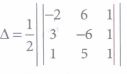
\(\begin{equation} =\frac{1}{2}|-2(-6-5)-6(3-1)+1(15+6)| \end{equation}\) [Expanding along R1]
\(\begin{equation} \Rightarrow \quad \Delta=\frac{1}{2}|43-12|=15.5 \mathrm{sq} . \text { units } \end{equation}\)
(ii) (d) : The given points are collinear.
\(\begin{equation} \therefore \frac{1}{2}\left|\begin{array}{ccc} 2 & -3 & 1 \\ k & -1 & 1 \\ 0 & 4 & 1 \end{array}\right|=0 \end{equation}\)
Expanding along R1',we get
\(\begin{equation} 2(-1-4)+3(k)+1(4 k)=0 \end{equation}\)
\(\begin{equation} \Rightarrow 7 k-10=0 \Rightarrow k=\frac{10}{7} \Rightarrow 4 k=\frac{40}{7} \end{equation}\)
(iii) (a) : Area of \(\begin{equation} \Delta A B C=3 \text { sq. units } \end{equation}\) [Given]
\(\begin{equation} \Rightarrow \frac{1}{2}\left|\begin{array}{lll} 1 & 3 & 1 \\ 0 & 0 & 1 \\ k & 0 & 1 \end{array}\right|=\pm 3 \Rightarrow\left|\begin{array}{lll} 1 & 3 & 1 \\ 0 & 0 & 1 \\ k & 0 & 1 \end{array}\right|=\pm 6 \end{equation}\)
\(\begin{equation} \Rightarrow 1(0-0)-3(0-k)+1(0-0)=\pm 6 \end{equation}\)
\(\begin{equation} \Rightarrow 3 k=\pm 6 \Rightarrow k=\pm 2 . \end{equation}\)
(iv) (a) : Let Q(x, y) be any point on the line joining
A(1, 2) and B(3, 6). Then, area of \(\begin{equation} \Delta A B Q=0 \end{equation}\)
\(\begin{equation} \Rightarrow \frac{1}{2}\left|\begin{array}{lll} 1 & 2 & 1 \\ 3 & 6 & 1 \\ x & y & 1 \end{array}\right|=0 \end{equation}\)
\(\begin{equation} \Rightarrow 1(6-y)-2(3-x)+1(3 y-6 x)=0 \end{equation}\)
\(\begin{equation} \Rightarrow 6-y-6+2 x+3 y-6 x=0 \end{equation}\)
\(\begin{equation} \Rightarrow-4 x=-2 y \Rightarrow 2 x=y \end{equation}\)
(v) (c) : Area of ΔABC is given by
\(\begin{equation} \frac{1}{2}\left|\begin{array}{rrr} 11 & 7 & 1 \\ 5 & 5 & 1 \\ -1 & 3 & 1 \end{array}\right|=\frac{1}{2}[11(5-3)-7(5+1)+1(15+5)] \end{equation}\)
\(\begin{equation} =\frac{1}{2}[22-42+20]=0 \end{equation}\)
\(\therefore\) Points are collinear
24.
(i) (c) : Let Rs. A, Rs. B and Rs.C be the cost incurred by the organisation for villages X, Y and Z respectively. Then A, B, C will be given by the following matrix equation.
\(\left[\begin{array}{ccc} 400 & 300 & 100 \\ 300 & 250 & 75 \\ 500 & 400 & 150 \end{array}\right]\left[\begin{array}{l} 50 \\ 20 \\ 40 \end{array}\right]=\left[\begin{array}{c} A \\ B \\ C \end{array}\right]\)
\(\Rightarrow\left[\begin{array}{l} A \\ B \\ C \end{array}\right]=\left[\begin{array}{c} 400 \times 50+300 \times 20+100 \times 40 \\ 300 \times 50+250 \times 20+75 \times 40 \\ 500 \times 50+400 \times 20+150 \times 40 \end{array}\right]\)
(ii) (c)
(iii) (b)
(iv) (c) : Total number of toilets that can be expected in each village is given by the following matrix.
\(\begin{array}{l} X \\ Y \\ Z \end{array}\left[\begin{array}{ccc} 400 & 300 & 100 \\ 300 & 250 & 75 \\ 500 & 400 & 150 \end{array}\right]\)\(\left[\begin{array}{c} 2 / 100 \\ 4 / 100 \\ 20 / 100 \end{array}\right]\)
\(\begin{array}{l} X \\ Y \\ Z \end{array}\)\(\left[\begin{array}{c} 8+12+20 \\ 6+10+15 \\ 10+16+30 \end{array}\right]\)=\(\begin{array}{l} X \\ Y \\ Z \end{array}\)\(\left[\begin{array}{c} 40 \\ 31 \\ 56 \end{array}\right]\)
(v) (d)

12th Standard CBSE Syllabus & Materials
12th Standard CBSE
CBSE 12th Computer Science Python Revision Tour I - New Previous year Question Papers Study Material - QB365 Set A
NEW12th Standard CBSE
CBSE 12th Business Studies Planning Important Questions And Answers Study Material - QB365 Set A
NEW12th Standard CBSE
CBSE 12th Business Studies Business Environment Important Questions And Answers Study Material - QB365 Set A
NEW12th Standard CBSE
CBSE 12th Business Studies Principles of Management Important Questions And Answers Study Material - QB365 Set A



NCERT Books

Syllabus

Exam Pattern

Sample Question Papers

Previous year Question Papers

Important Notes

MCQ Practice test

NCERT Exemplers

Case study Questions

Image Based Questions

Passage based Questions

HOT Questions

Value Based Questions

Model Questions Papers
NCERT ( Book Back ) Questions

Assertion and Reason
Important Questions And Answers

CBSE 12th Standard CBSE Subjects
CBSE Standards








