
 100% FREE ACCESS
12th Standard CBSE Syllabus & Materials
12th Standard CBSE
CBSE 12th Economics Government Budget and the Economy Previous year Question Papers Study Material - QB365 Set A
NEW12th Standard CBSE
CBSE 12th Computer Science Interface Python with MySQL - New Previous year Question Papers Study Material - QB365 Set A
NEW12th Standard CBSE
CBSE 12th Computer Science Database Concept - New Previous year Question Papers Study Material - QB365 Set A
NEW12th Standard CBSE
CBSE 12th Computer Science Data Communication - New Previous year Question Papers Study Material - QB365 Set A
NEW12th Standard CBSE
CBSE 12th Computer Science Data Structures - New Previous year Question Papers Study Material - QB365 Set A
NEW12th Standard CBSE
CBSE 12th Computer Science Functions - New Previous year Question Papers Study Material - QB365 Set A

Published on: 25/10/2025
Download CBSE Class 12th Standard CBSE Maths question papers, sample papers, important questions, and previous year solved papers in PDF format. Get free study materials, NCERT solutions, and exam preparation resources for Class 12th Standard CBSE Maths
Questions + Answers key
Take MCQ Maths Test
1.
Let the vectors \(\vec{a}, \vec{b}, \vec{c}\) be given as \(a_1 \hat{i}+a_2 \hat{j}+a_3 \hat{k}, b_1 \hat{i}+b_2 \hat{j}+b_3 \hat{k},\) \(c_1 \hat{i}+c_2 \hat{j}+c_3 \hat{k}\). Then show that \(\vec{a} \times(\vec{b}+\vec{c})=\vec{a} \times \vec{b}+\vec{a} \times \vec{c} .\)
2.
Find the following integrals :
\(\text { (i) } \int \frac{d x}{x^{2}-6 x+13}\)
\(\text { (ii) } \int \frac{d x}{3 x^{2}+13 x-10}\)
\(\text { (iii) } \int \frac{d x}{\sqrt{5 x^{2}-2 x}}\)
3.
Compute the indicated products.
\(\text { (i) }\left[\begin{array}{rr} a & b \\ -b & a \end{array}\right]\left[\begin{array}{cc} a & -b \\ b & a \end{array}\right]\)
\(\text { (ii) }\left[\begin{array}{l} 1 \\ 2 \\ 3 \end{array}\right]\left[\begin{array}{lll} 2 & 3 & 4 \end{array}\right]\)
\(\text { (iii) }\left[\begin{array}{ll} 1 & -2 \\ 2 & 3 \end{array}\right]\left[\begin{array}{lll} 1 & 2 & 3 \\ 2 & 3 & 1 \end{array}\right]\)
\(\text { (iv) }\left[\begin{array}{lll} 2 & 3 & 4 \\ 3 & 4 & 5 \\ 4 & 5 & 6 \end{array}\right]\left[\begin{array}{rrr} 1 & -3 & 5 \\ 0 & 2 & 4 \\ 3 & 0 & 5 \end{array}\right]\)
\(\text { (v) }\left[\begin{array}{rr} 2 & 1 \\ 3 & 2 \\ -1 & 1 \end{array}\right]\left[\begin{array}{rrr} 1 & 0 & 1 \\ -1 & 2 & 1 \end{array}\right]\)
\(\text { (vi) }\left[\begin{array}{rrr} 3 & -1 & 3 \\ -1 & 0 & 2 \end{array}\right]\left[\begin{array}{cc} 2 & -3 \\ 1 & 0 \\ 3 & 1 \end{array}\right]\)
4.
Find the area of the region bounded by the line y = 3x + 2, the x-axis and the ordinates x = -1 and x = 1.
5.
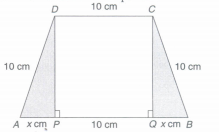
If length of three sides of a trapezium other than base are equal to 10 cm, then find the area of the trapezium when it is maximum.
6.
Let \(A=\left[\begin{array}{rrr}1 & -2 & 1 \\ -2 & 3 & 1 \\ 1 & 1 & 5\end{array}\right]\) verify that
(i) \([\operatorname{adj} A]^{-1}=\operatorname{adj}\left(A^{-1}\right) \)
(ii) \(\left(A^{-1}\right)^{-1}=A\)
7.
Find the area enclosed by the ellipse \(\frac{x^{2}}{a^{2}}+\frac{y^{2}}{b^{2}}=1\)
8.
Evaluate:\(\int _{ -1 }^{ 1 }{ \sin ^{ 5 }{ x } } \cos ^{ 4 }{ xdx } .\)
9.
Find: \(\int { \frac { { x }^{ 2 }+1 }{ { x }^{ 2 }-5x+6 } dx } \)
10.
Write an anti derivative for each of the followings functions, using method of inspection :
(i) \(\cos { 2x } \)
(ii) \({ 3x }^{ 2 }+{ 4x }^{ 3 }\)
(iii) \(\frac { 1 }{ x } ,x\neq 0\)
11.
Find the area of the region bounded by the ellipse \(\frac { { x }^{ 2 } }{ 16 } +\frac { { y }^{ 2 } }{ 9 } =1\)
12.
\(f(x)=x^{ 2 }-x+1\) is neither increasing nor decreasing strictly on (-1, 1)
13.
Find area of the triangle with vertices at the point given in each of the following :
(i) (1, 0), (6, 0), (4, 3)
(ii) (2, 7), (1, 1), (10, 8)
(iii) (–2, –3), (3, 2), (–1, –8)
14.
Find the minor of element 6 in the determinant \(\Delta =\left| \begin{matrix} 1 & 2 & 3 \\ 4 & 5 & 6 \\ 7 & 8 & 9 \end{matrix} \right| .\)
15.
Given:\(3\begin{bmatrix} x & y \\ z & w \end{bmatrix}=\begin{bmatrix} x & 6 \\ -1 & 2w \end{bmatrix}+\begin{bmatrix} 4 & x+y \\ z+w & 3 \end{bmatrix},\) find the values of x, y, z and w.
16.
Evaluate:\(\begin{vmatrix} x & x+1 \\ x-1 & x \end{vmatrix}\)
17.
Construct a \(3\times 4\) matrix whose elements are given by:
\((i)\ { a }_{ ij }=\frac { 1 }{ 2 } \left| -3i+j \right| \)
\((ii)\ { a }_{ ij }=2i-j\)
18.
Let \(\overrightarrow { a } =\hat { i } +4\hat { j } +2\hat { k } ,\overrightarrow { b } =3\hat { i } -2\hat { j } +7\hat { k } \) and \(\overrightarrow { c } =2\hat { i } -\hat { j } +4\hat { k } ,\) find a vector \(\overrightarrow { d } \) which is perpendicular to both \(\overrightarrow { a } \quad and\quad \overrightarrow { b } \quad and\quad \overrightarrow { c } .\overrightarrow { d } =15\)
19.
If the vertices A, B, C of a \(\Delta ABC\) have position vectors (1, 2, 3), (-1, 0, 0) and (0, 1, 2) respectively, what is the magnitude of \(\angle ABC\)?
20.
Prove that \(y={4sin\theta\over2+cos\theta}-\theta\) is an increasing function of \(\theta\) in \([0,{\pi\over2}]\).
21.
A balloon which always remains spherical has a variable diameter \({3\over2}(2x+1)\). Find the rate of change of its volume with respect to x.
22.
Sand is pouring from a pipe at the rate of 12 cm3/sec. The falling sand forms a cone on the ground in such a way that the height of the cone is always one-sixth of the radius of the base. How fast is the height of the sand-cone increasing, when the height is 4 cm?
23.
Simplify \(\cos { \theta \begin{bmatrix} \cos { \theta } & \sin { \theta } \\ -\sin { \theta } & \cos { \theta } \end{bmatrix}+\sin { \theta \begin{bmatrix} \sin { \theta } & -\cos { \theta } \\ \cos { \theta } & \sin { \theta } \end{bmatrix} } } \).
1.
2.
(i) We have x2 – 6x + 13 = x 2– 6x + 32 – 32 + 13 = (x – 3)2 + 4
\(\text { So, } \ \int \frac{d x}{x^{2}-6 x+13}=\int \frac{1}{(x-3)^{2}+2^{2}} d x\)
Let x – 3 = t. Then dx = dt
\(\int \frac{d x}{x^{2}-6 x+13}=\int \frac{d t}{t^{2}+2^{2}}=\frac{1}{2} \tan ^{-1} \frac{t}{2}+C\)
\(=\frac{1}{2} \tan ^{-1} \frac{x-3}{2}+\mathrm{C}\)
(ii) The given integral is of the form 7.4 (7). We write the denominator of the integrand,
\(3 x^{2}+13 x-10=3\left(x^{2}+\frac{13 x}{3}-\frac{10}{3}\right)\)
\(=3\left[\left(x+\frac{13}{6}\right)^{2}-\left(\frac{17}{6}\right)^{2}\right] \text { (completing the square) }\)
\(\text { Thus } \int \frac{d x}{3 x^{2}+13 x-10}=\frac{1}{3} \int \frac{d x}{\left(x+\frac{13}{6}\right)^{2}-\left(\frac{17}{6}\right)^{2}} \)
\(\text { Put } x+\frac{13}{6}=t \text { . Then } d x=d t . \)
\(\text { Therefore, } \quad \int \frac{d x}{3 x^{2}+13 x-10}=\frac{1}{3} \int \frac{d t}{t^{2}-\left(\frac{17}{6}\right)^{2}} \)
\(=\frac{1}{3 \times 2 \times \frac{17}{6}} \log \left|\frac{t-\frac{17}{6}}{t+\frac{17}{6}}\right|+C_{1} \)
\(=\frac{1}{17} \log \left|\frac{x+\frac{13}{6}-\frac{17}{6}}{x+\frac{13}{6}+\frac{17}{6}}\right|+C_{1} \)
\(=\frac{1}{17} \log \left|\frac{6 x-4}{6 x+30}\right|+C_{1} \)
\(=\frac{1}{17} \log \left|\frac{3 x-2}{x+5}\right|+C_{1}+\frac{1}{17} \log \frac{1}{3} \)
\(=\frac{1}{17} \log \left|\frac{3 x-2}{x+5}\right|+C, \text { where } C=C_{1}+\frac{1}{17} \log \frac{1}{3} \)
\(\text { (iii) We have } \int \frac{d x}{\sqrt{5 x^{2}-2 x}}=\int \frac{d x}{\sqrt{5\left(x^{2}-\frac{2 x}{5}\right)}}\)
\(=\frac{1}{\sqrt{5}} \int \frac{d x}{\sqrt{\left(x-\frac{1}{5}\right)^{2}-\left(\frac{1}{5}\right)^{2}}} \text { (completing the square) }\)
\(\text { Put } x-\frac{1}{5}=t . \text { Then } d x=d t \text { . }\)
\(\text { Therefore, } \quad \int \frac{d x}{\sqrt{5 x^{2}-2 x}}=\frac{1}{\sqrt{5}} \int \frac{d t}{\sqrt{t^{2}-\left(\frac{1}{5}\right)^{2}}}\)
\(=\frac{1}{\sqrt{5}} \log \left|t+\sqrt{t^{2}-\left(\frac{1}{5}\right)^{2}}\right|+\mathrm{C}\)
\(=\frac{1}{\sqrt{5}} \log \left|x-\frac{1}{5}+\sqrt{x^{2}-\frac{2 x}{5}}\right|+\mathrm{C}\)
3.
(i) \({\left[\begin{array}{cc} a & b \\ -b & a \end{array}\right]\left[\begin{array}{cc} a & -b \\ b & a \end{array}\right]} \)
\({\left[\begin{array}{cc} a & b \\ -b & a \end{array}\right]\left[\begin{array}{cc} a & -b \\ b & a \end{array}\right]} \)
\(=\left[\begin{array}{cc} a(a)+b(b) & a(-b)+b(a) \\ -b(a)+a(b) & -b(-b)+a(a) \end{array}\right] \)
\(=\left[\begin{array}{cc} a^{2}+b^{2} & -a b+a b \\ -a b+a b & b^{2}+a^{2} \end{array}\right]=\left[\begin{array}{cc} a^{2}+b^{2} & 0 \\ 0 & a^{2}+b^{2} \end{array}\right]\)
(ii)
\({\left[\begin{array}{l} 1 \\ 2 \\ 3 \end{array}\right][2,3,4]} \)
\(=\left[\begin{array}{lll} 1(2) & 1(3) & 1(4) \\ 2(3) & 2(3) & 2(4) \\ 3(2) & 3(3) & 3(4) \end{array}\right]=\left[\begin{array}{llc} 2 & 3 & 4 \\ 4 & 6 & 8 \\ 6 & 9 & 12 \end{array}\right]\)
(iii)
\({\left[\begin{array}{cc} 1 & -2 \\ 2 & 3 \end{array}\right]\left[\begin{array}{lll} 1 & 2 & 3 \\ 2 & 3 & 1 \end{array}\right]} \)
\(=\left[\begin{array}{lll} 1(1)-2(2) & 1(2)-2(3) & 1(3)-2(1) \\ 2(1)+3(2) & 2(2)+3(3) & 2(3)+3(1) \end{array}\right] \)
\(=\left[\begin{array}{ccc} 1-4 & 2-6 & 3-2 \\ 2+6 & 4+9 & 6+3 \end{array}\right]=\left[\begin{array}{ccc} -3 & -4 & 1 \\ 8 & 13 & 9 \end{array}\right]\)
(iv)
\({\left[\begin{array}{lcc} 2 & 3 & 4 \\ 3 & 4 & 5 \\ 4 & 5 & 6 \end{array}\right]\left[\begin{array}{ccc} 1 & -3 & 5 \\ 0 & 2 & 4 \\ 3 & 0 & 5 \end{array}\right]} \)
\(=\left[\begin{array}{lll} 2(1)+3(0)+4(3) & 2(-3)+3(2)+4(0) & 2(5)+3(4)+4(5) \\ 3(1)+4(0)+5(3) & 3(-3)+4(2)+5(0) & 3(5)+4(4)+5(5) \\ 4(1)+5(0)+6(3) & 4(-3)+5(2)+6(0) & 4(5)+5(4)+6(5) \end{array}\right] \)
\(=\left[\begin{array}{lccc} 2+0+12 & -6+6+0 & 10+12+20 \\ 3+0+15 & -9+8+0 & 15+16+25 \\ 4+0+18 & -12+10+0 & 20+20+30 \end{array}\right]=\left[\begin{array}{ccc} 14 & 0 & 42 \\ 18 & -1 & 56 \\ 22 & -2 & 70 \end{array}\right]\)
(v)
\({\left[\begin{array}{cc} 2 & 1 \\ 3 & 2 \\ -1 & 1 \end{array}\right]\left[\begin{array}{ccc} 1 & 0 & 1 \\ -1 & 2 & 1 \end{array}\right]} \)
\(=\left[\begin{array}{ccc} 2(1)+1(-1) & 2(0)+1(2) & 2(1)+1(1) \\ 3(1)+2(-1) & 3(0)+2(2) & 3(1)+2(1) \\ -1(1)+1(-1) & -1(0)+1(2) & -1(1)+1(1) \end{array}\right] \)
\(=\left[\begin{array}{ccc} 2-1 & 0+2 & 2+1 \\ 3-2 & 0+4 & 3+2 \\ -1-1 & 0+2 & -1+1 \end{array}\right]=\left[\begin{array}{ccc} 1 & 2 & 3 \\ 1 & 4 & 5 \\ -2 & 2 & 0 \end{array}\right]\)
(vi)
\({\left[\begin{array}{ccc} 3 & -1 & 3 \\ -1 & 0 & 2 \end{array}\right]\left[\begin{array}{cc} 2 & -3 \\ 1 & 0 \\ 3 & 1 \end{array}\right]} \)
\(=\left[\begin{array}{cc} 3(2)-1(1)+3(3) & 3(-3)-1(0)+3(1) \\ -1(2)+0(1)+2(3) & -1(-3)+0(0)+2(1) \end{array}\right] \)
\(=\left[\begin{array}{cc} 6-1+9 & -9-0+3 \\ -2+0+6 & 3+0+2 \end{array}\right]=\left[\begin{array}{cc} 14 & -6 \\ 4 & 5 \end{array}\right]\)
4.
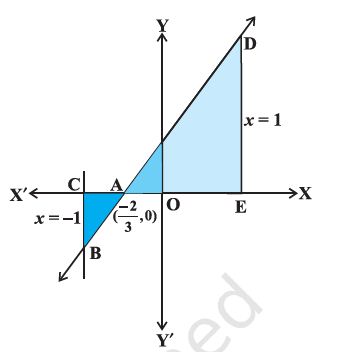
As shown in the Figure, the line y = 3x + 2 meets x-axis at x\(=\frac{-2}{3}\) and its graph lies below x-axis for \(x \in\left(-1, \frac{-2}{3}\right)\) and above x-axis for \(x \in\left(\frac{-2}{3}, 1\right)\)
The required area = Area of the region ACBA + Area of the region ADEA
\(=\left|\int_{-1}^{\frac{-2}{3}}(3 x+2) d x\right|+\int_{\frac{-2}{3}}^1(3 x+2) d x\)
\(=\left|\left[\frac{3 x^2}{2}+2 x\right]_{-1}^{\frac{-2}{3}}\right|+\left[\frac{3 x^2}{2}+2 x\right]_{\frac{-2}{3}}^1=\frac{1}{6}+\frac{25}{6}=\frac{13}{3}\)
5.
the required trapezium is as given in figure. Draw perpendiculars DP and CQ on AB. Let AP = x cm. Note that \(\Delta \)APD \(\cong \) \(\Delta \) BQC.
Therefore, QB = x cm. Also, by pythagoras theorem DP = QC = \(\sqrt { 100-{ x }^{ 2 } } \)
Let A be the area of the trapezium.
Then, A \(\equiv \) A(x)
\(=\frac { 1 }{ 2 } (sum\ of\ parallel\ sides)\times (height)\)
\(=\frac { 1 }{ 2 } (2x+10+10)\sqrt { 100-{ x }^{ 2 } } \)
= (x + 10)\(\sqrt { 100-{ x }^{ 2 } } \)
\(or\ A'(x)=(x+10)\frac { (-2x) }{ 2\sqrt { 100-{ x }^{ 2 } } } +(\sqrt { 100-{ x }^{ 2 }) } \)
\(=\frac { -2{ x }^{ 2 }-10x+100 }{ \sqrt { 100-{ x }^{ 2 } } } \)
Now, A'(x) = 0 gives 2x2 + 10x - 100 = 0,
i.e., x = 5 and x = -10
So, x = 5.
Now, A''(x) = \(\frac { \sqrt { 100-{ x }^{ 2 } } (-4x-10)-(-2x^{ 2 }-10x+100)\frac { (-2x) }{ 2\sqrt { 100-{ x }^{ 2 } } } }{ 100-{ x }^{ 2 } } \)
\(=\frac { { 2x }^{ 3 }-300x-1000 }{ { (100-{ x }^{ 2 }) }^{ \frac { 1 }{ 2 } } } \)
(on simplification)
or \(A''(5)=\frac { { 2(5) }^{ 3 }-300(5)-1,000 }{ (100-(5{ ) }^{ 2 })^{ \frac { 3 }{ 2 } } } \)
\(=\frac { -2,250 }{ 75\sqrt { 75 } } =\frac { -30 }{ \sqrt { 75 } } <0\)
Thus, area of trapezium is maximum at x = 5 and the maximum area is given by
A(5) = (5 + 10)\(\sqrt { 100-{ (5) }^{ 2 } } \)
= 15\(\sqrt { 75 } =75\sqrt { 3 } { cm }^{ 2 }\)
6.
\(A=\left[\begin{array}{rrr} 1 & -2 & 1 \\ -2 & 3 & 1 \\ 1 & 1 & 5 \end{array}\right]\)
|A|=1(15-1)+2(-10-1)+1(-2-3)=14-22-5=-13
Now,
\(A_{11}=14, A_{12}=11, A_{13}=-5 \)
\(A_{21}=11, A_{22}=4, A_{23}=-3 \)
\(A_{31}=-5, A_{32}=-3, A_{13}=-1\)
\(\operatorname{adj} A =\left[\begin{array}{lll} 14 & 11 & -5 \\ 11 & 4 & -3 \\ -5 & -3 & -1 \end{array}\right]\)
\(A^{-1} =\frac{1}{|A|}(\operatorname{adj} A) \)
\(=-\frac{1}{13}\left[\begin{array}{lll} 14 & 11 & -5 \\ 11 & 4 & -3 \\ -5 & -3 & -1 \end{array}\right]=\frac{1}{13}\left[\begin{array}{lll} -14 & -11 & 5 \\ -11 & -4 & 3 \\ 5 & 3 & 1 \end{array}\right]\)
\(\mid \text { adj } A \mid =14(-4-9)-11(-11-15)-5(-33+20) \)
=14(-13)-11(-26)-5(-13)
=-182+286+65=169
We have,
\( \operatorname{adj}(\operatorname{adj} A)=\left[\begin{array}{ccc} -13 & 26 & -13 \\ 26 & -39 & -13 \\ -13 & -13 & -65 \end{array}\right]\)
\( \therefore[\operatorname{adj} A]^{-1}=\frac{1}{|\operatorname{adj} A|}(\operatorname{adj}(\operatorname{adj} A))\)
\(=\frac{1}{169}\left[\begin{array}{lll} -13 & 26 & -13 \\ 26 & -39 & -13 \\ -13 & -13 & -65 \end{array}\right]\)
\(=\frac{1}{13}\left[\begin{array}{lll} -1 & 2 & -1 \\ 2 & -3 & -1 \\ -1 & -1 & -5 \end{array}\right]\)
Now, \(A^{-1}=\frac{1}{13}\left[\begin{array}{lll}-14 & -11 & 5 \\ -11 & -4 & 3 \\ 5 & 3 & 1\end{array}\right]=\left[\begin{array}{ccc}-\frac{14}{13} & -\frac{11}{13} & \frac{5}{13} \\ -\frac{11}{13} & -\frac{4}{13} & \frac{3}{13} \\ \frac{5}{13} & \frac{3}{13} & \frac{1}{13}\end{array}\right]\)
\(\therefore \operatorname{adj}\left(A^{-1}\right) =\left[\begin{array}{lll} -\frac{4}{169}-\frac{9}{169} & -\left(-\frac{11}{169}-\frac{15}{169}\right) & -\frac{33}{169}+\frac{20}{169} \\ -\left(-\frac{11}{169}-\frac{15}{169}\right) & -\frac{14}{169}-\frac{25}{169} & -\left(-\frac{42}{169}+\frac{55}{169}\right) \\ -\frac{33}{169}+\frac{20}{169} & -\left(-\frac{42}{169}+\frac{55}{169}\right) & \frac{56}{169}-\frac{121}{169} \end{array}\right]\)
\( =\frac{1}{169}\left[\begin{array}{lll} -13 & 26 & -13 \\ 26 & -39 & -13 \\ -13 & -13 & -65 \end{array}\right]=\frac{1}{13}\left[\begin{array}{lll} -1 & 2 & -1 \\ 2 & -3 & -1 \\ -1 & -1 & -5 \end{array}\right]\)
Hence, \([\operatorname{adj} A]^{-1}=\operatorname{adj}\left(A^{-1}\right)\).
We have shown that:
\(A^{-1}=\frac{1}{13}\left[\begin{array}{lll} -14 & -11 & 5 \\ -11 & -4 & 3 \\ 5 & 3 & 1 \end{array}\right]\)
And, \(\operatorname{adj} A^{-1}=\frac{1}{13}\left[\begin{array}{lll}-1 & 2 & -1 \\ 2 & -3 & -1 \\ -1 & -1 & -5\end{array}\right]\)
Now,
\( \left|A^{-1}\right|=\left(\frac{1}{13}\right)^3[-14 \times(-13)+11 \times(-26)+5 \times(-13)]=\left(\frac{1}{13}\right)^3 \times(-169)=-\frac{1}{13} \)
\(\therefore\left(A^{-1}\right)^{-1}=\frac{\operatorname{adj} A^{-1}}{\left|A^{-1}\right|}=\frac{1}{\left(-\frac{1}{13}\right)} \times \frac{1}{13}\left[\begin{array}{lll} -1 & 2 & -1 \\ 2 & -3 & -1 \\ -1 & -1 & -5 \end{array}\right]=\left[\begin{array}{lll} 1 & -2 & 1 \\ -2 & 3 & 1 \\ 1 & 1 & 5 \end{array}\right]=A\)
\(\left(A^{-1}\right)^{-1}=A\)
7.
From the figure, the area of the region ABA′B′A bounded by the ellipse
\(=4\left(\begin{array}{l} \text { area of the region AOBAin the first quadrantbounded } \\ \text { by thecurve, } x-\text { axis and the ordinates } x=0, x=a \end{array}\right)\)
(as the ellipse is symmetrical about both x-axis and y-axis)
\(=4 \int_{0}^{a} y d x \text { (taking verticalstrips) }\)
\(\text { Now } \frac{x^{2}}{a^{2}}+\frac{y^{2}}{b^{2}}=1 \text { gives } y=\pm \frac{b}{a} \sqrt{a^{2}-x^{2}} \text { , }\)but as the region AOBA lies in the first quadrant, y is taken as positive. So, the required area is
\(=4 \int_{0}^{a} \frac{b}{a} \sqrt{a^{2}-x^{2}} d x \)
\(=\frac{4 b}{a}\left[\frac{x}{2} \sqrt{a^{2}-x^{2}}+\frac{a^{2}}{2} \sin ^{-1} \frac{x}{a}\right]_{0}^{a} \)
\(=\frac{4 b}{a}\left[\left(\frac{a}{2} \times 0+\frac{a^{2}}{2} \sin ^{-1} 1\right)-0\right] \)
\(=\frac{4 b}{a} \frac{a^{2}}{2} \frac{\pi}{2}=\pi a b \)
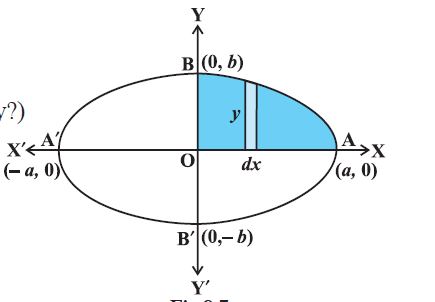
Alternatively, considering horizontal strips as shown in the Figure, the area of the ellipse is
\(=4 \int_0^b x d y=4 \frac{a}{b} \int_0^b \sqrt{b^2-y^2} d y\)
\(=\frac{4 a}{b}\left[\frac{y}{2} \sqrt{b^2-y^2}+\frac{b^2}{2} \sin ^{-1} \frac{y}{b}\right]_0^b\)
\( =\frac{4 a}{b}\left[\left(\frac{b}{2} \times 0+\frac{b^2}{2} \sin ^{-1} 1\right)-0\right] \\ =\frac{4 a}{b} \frac{b^2}{2} \frac{\pi}{2}=\pi a b \)
8.
\(\text { Let } \mathrm{I}=\int_{-1}^{1} \sin ^{5} x \cos ^{4} x d x \text { . Let } f(x)=\sin ^{5} x \cos ^{4} x \text { . Then }\)
f (– x) = sin5 (– x) cos4 (– x) = – sin5 x cos4 x = – f (x), i.e., f is an odd function.
Therefore, by P7 (ii), I = 0
9.
Here the integrand \(\frac { { x }^{ 2 }+1 }{ { x }^{ 2 }-5x+6 } \)is not a proper rational function, so dividing \(({ x }^{ 2 }+1)by{ (x }^{ 2 }-5x+6)\), we devide \(x^2+1 \text { by } x^2-5 x+6\) and find that
\(\frac{x^{2}+1}{x^{2}-5 x+6} =1+\frac{5 x-5}{x^{2}-5 x+6}=1+\frac{5 x-5}{(x-2)(x-3)} \)
\(\frac{5 x-5}{(x-2)(x-3)} =\frac{\mathrm{A}}{x-2}+\frac{\mathrm{B}}{x-3}\)
So that 5x – 5 = A (x – 3) + B (x – 2)
Equating the coefficients of x and constant terms on both sides, we get A + B = 5 and 3A + 2B = 5. Solving these equations, we get A = – 5 and B = 10
\(\text {Thus,} \frac{x^{2}+1}{x^{2}-5 x+6}=1-\frac{5}{x-2}+\frac{10}{x-3}\)
\(\therefore \int \frac{x^{2}+1}{x^{2}-5 x+6} d x=\int d x-5 \int \frac{1}{x-2} d x+10 \int \frac{d x}{x-3}\)
= x – 5 log | x – 2 | + 10 log | x – 3 | + C.
10.
(i) We know that \(\frac { d }{ dx } (\sin { 2x) } =2\cos { 2x } \)
\(\Rightarrow \cos { 2x } =\frac { 1 }{ 2 } \frac { d }{ dx } (\sin { 2x) } =\frac { d }{ dx } (\frac { 1 }{ 2 } \sin { 2x) } \)
Hence, antiderivative of \(\cos { 2x } =\frac { 1 }{ 2 } \sin { 2x } \)
(ii) We know that \(\frac { d }{ dx } ({ x }^{ 3 }+{ x }^{ 4 })={ 3x }^{ 2 }+{ 4x }^{ 3 }.\)
Hence, antiderivative of \({ 3x }^{ 2 }+{ 4x }^{ 3 }+{ x }^{ 3 }+{ x }^{ 4 }\)
(iii) We know that \(\frac { d }{ dx } (\log { x } )=\frac { 1 }{ x } ,x>0\) and \(\frac { d }{ dx } [\log { (-x) } ]=\frac { 1 }{ -x } (-1)=\frac { 1 }{ x } ,x>0.\)
combining, \(\frac { d }{ dx } (\log { 1\quad x1 } )=\frac { 1 }{ x } ,x\neq 0.\)
\(\Rightarrow \int { \frac { 1 }{ x } } dx=\log { 1\quad x1 } .\)
which is one of antiderivative of \(\frac { 1 }{ x } \).
11.
The given ellipse is \(\frac { { x }^{ 2 } }{ 16 } +\frac { { y }^{ 2 } }{ 9 } =1\)
Since (1) is symmetrical about both axes,
Therefore, area of the ellipse = 4 (Shaped area).
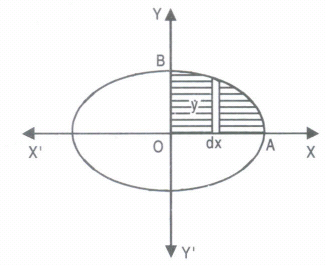
\(=4(area\ OAB)\)
\(But\ area\ OAB=\overset { 4 }{ \underset { 0 }{ \int { } } } ydx\quad [Taking\ vertical\ strips]\)
\(=\overset { 4 }{ \underset { 0 }{ \int { } } } \frac { 3 }{ 4 } \sqrt { 16-{ x }^{ 2 } } dx\)
\([\because \frac { { x }^{ 2 } }{ 16 } +\frac { { y }^{ 2 } }{ 9 } =1\Rightarrow \frac { { y }^{ 2 } }{ 9 } =1-\frac { { x }^{ 2 } }{ 16 } \Rightarrow y=\frac { 3 }{ 4 } \sqrt { 16-{ x }^{ 2 } } (\because y>0)]\)
\(=\frac { 3 }{ 4 } \left[ \frac { x\sqrt { 16-{ x }^{ 2 } } }{ 2 } +\frac { 16 }{ 2 } { sin }^{ -1 }\frac { x }{ 4 } \right] _{ 0 }^{ 4 }\)
\(=\frac { 3 }{ 4 } [[2(0)+8{ sin }^{ -1 }(1)]-[0-0]]\)
\(=\frac { 3 }{ 4 } \left[ 8\frac { \pi }{ 2 } \right] =3\pi \)
\(\therefore From\ (2),area\ of\ the\ ellipse =4(3\pi )=12\pi sq.units.\)
12.
\(\text { The given function is } f(x)=x^{2}-x+1 \text { . }\)
\(\therefore f^{\prime}(x)=2 x-1 \)
\(\text {Now, } f^{\prime}(x)=0 \Rightarrow x=\frac{1}{2} . \)
\(\text {The point } \frac{1}{2} \text { divides the interval ( }-1,1 \text { ) into two disjoint intervals i.e., }\left(-1, \frac{1}{2}\right) \text { and }\left(\frac{1}{2}, 1\right) \text { . }\)
\(\text {Now, in interval }\left(-1, \frac{1}{2}\right), f^{\prime}(x)=2 x-1<0 \text { . }\)
\(\text {However, in interval }\left(\frac{1}{2}, 1\right), f^{\prime}(x)=2 x-1>0 \text { . }\)
Hence, f is neither strictly increasing nor decreasing in interval (-1,1)
13.
(i) Area of the triangle
\({1\over2}\begin{vmatrix}x_1&y_1&1\\x_2&y_2&1\\x_3&y_3&1 \end{vmatrix}={1\over2}\begin{vmatrix}1&0&1\\6&0&1\\4&3&1 \end{vmatrix}\)
= \({1\over2}(-3)[1-6]\)
= \({1\over2}(15)=7{1\over7}\)
(ii) Area of the triangle
\({1\over2}\begin{vmatrix} x_1&y_1&1\\x_2&y_2&1\\x_3&y_3&1\end{vmatrix}={1\over2}\begin{vmatrix} 2&7&1\\1&1&1\\10&8&1\end{vmatrix} \)
\({1\over2}[2(1-8)-7(1-10)+(8-10)]\)
\({1\over2}[-14+63-2]={1\over2}(47 )\)
\(23{1\over2}\) sq.units
(iii) Area of the triangle
\({1\over2}\begin{vmatrix} x_1&y_1&1\\x_2&y_2&1\\x_3&y_3&1\end{vmatrix}={1\over2}\begin{vmatrix}-2&-3&1\\3&2&1\\-1&8&1 \end{vmatrix}\)
\({1\over2}[(-2)(2+8)+3(3+1)+1(-24+2)]\)
\({1\over2}[-20+12-22]=-{30\over2}=-15\)
Area if the triangle = 15 sq.units.
14.
Since 6 lies in the second row and third column, its minor M23 is given by
\(M_{23}=\left|\begin{array}{ll} 1 & 2 \\ 7 & 8 \end{array}\right|=8-14=-6\)(obtained by deleting R2 and C3 in Δ).
15.
We have: \(3\begin{bmatrix} x & y \\ z & w \end{bmatrix}=\begin{bmatrix} x & 6 \\ -1 & 2w \end{bmatrix}+\begin{bmatrix} 4 & x+y \\ z+w & 3 \end{bmatrix},\)
\(\Rightarrow \begin{bmatrix} 3x & 3y \\ 3z & 3w \end{bmatrix}=\begin{bmatrix} x+4 & x+y+6 \\ z+w-1 & 2w+3 \end{bmatrix},\)
Equating corresponding elements:
3x = x + y \(\Rightarrow \) 2x = 4 \(\Rightarrow \) x = 2
3y = x + y + 6 \(\Rightarrow \) 2y = 2 + 6 \(\Rightarrow \) 2y = 8 \(\Rightarrow \) y = 4
3w = 2w + 3 \(\Rightarrow \) w = 3 and
3z = z + w - 1\(\Rightarrow \) 2z = 3 - 1 = 2 \(\Rightarrow \) z = 1.
Hence, x = 2, y = 4, z = 1 and w = 3.
16.
We have
\(\begin{vmatrix} x & x+1 \\ x-1 & x \end{vmatrix}=(x)(x)-(x-1)(x-1)\)
\(=x^{2}-\left(x^{2}-1\right)=x^{2}-x^{2}+1=1\)
17.
(i) We have : \({ a }_{ ij }=\frac { 1 }{ 2 } \left| -3i+j \right| \)
\(\therefore \ { a }_{ 11 }=\frac { 1 }{ 2 } \left| -3+1 \right| =\frac { 2 }{ 2 } =1;\quad { a }_{ 12 }=\frac { 1 }{ 2 } \left| -3+2 \right| =\frac { 1 }{ 2 } =1;\)
\({ a }_{ 13 }=\frac { 1 }{ 2 } \left| -3+3 \right| =0;\quad { a }_{ 14 }=\frac { 1 }{ 2 } \left| -3+4 \right| =\frac { 1 }{ 2 } ;\)
\({ a }_{ 21 }=\frac { 1 }{ 2 } \left| -6+1 \right| =\frac { 5 }{ 2 } ;\quad { a }_{ 22 }=\frac { 1 }{ 2 } \left| -6+2 \right| =2;\)
\( { a }_{ 23 }=\frac { 1 }{ 2 } \left| -6+3 \right| =\frac { 3 }{ 2 } ;\quad { a }_{ 24 }=\frac { 1 }{ 2 } \left| -6+4 \right| =1;\)
\({ a }_{ 31 }=\frac { 1 }{ 2 } \left| -9+1 \right| =4;\quad { a }_{ 32 }=\frac { 1 }{ 2 } \left| -9+2 \right| =\frac { 7 }{ 2 } ;\)
\({ a }_{ 33 }=\frac { 1 }{ 2 } \left| -9+3 \right| =3;\quad { a }_{ 32 }=\frac { 1 }{ 2 } \left| -9+4 \right| =\frac { 5 }{ 2 } ;\)
Hence, \(A=\left[ \begin{matrix} 1 & \frac { 1 }{ 2 } & 0 & \frac { 1 }{ 2 } \\ \frac { 5 }{ 2 } & 2 & \frac { 3 }{ 2 } & 1 \\ 4 & \frac { 7 }{ 2 } & 3 & \frac { 5 }{ 2 } \end{matrix} \right] \)
(ii) We have: \({ a }_{ ij }=2i-j.\)
\(\therefore {a }_{ 11 }=2-1=1;\quad { a }_{ 12 }=2-2=0;\)
\({ a }_{ 13 }=2-3=-1;\quad { a }_{ 14 }=2-4=-2;\)
\({ a }_{ 21 }=4-1=3;\quad { a }_{ 22 }=4-2=2;\)
\({ a }_{ 23 }=4-3=1;\quad { a }_{ 24 }=4-4=0;\)
\({ a }_{ 31 }=6-1=5;\quad { a }_{ 32 }=6-2=4;\)
\({ a }_{ 33 }=6-3=3;\quad { a }_{ 32 }=6-4=2;\)
Hence, \(A=\left[ \begin{matrix} 1 & 0 & -1 & -2 \\ 3 & 2 & 1 & 0 \\ 5 & 4 & 3 & 2 \end{matrix} \right] .\)
18.
Let \(\overset { \rightarrow }{ d } =x\overset { \wedge }{ i } +y\overset { \wedge }{ j } +z\overset { \wedge }{ k } \) ..(1)
Now \(\overset { \rightarrow }{ d } \) is perp.to \(\overset { \rightarrow }{ a } \)
\(\therefore\) \(\overset { \rightarrow }{ d } \).\(\overset { \rightarrow }{ a } \) = 0
\(\Rightarrow (x\overset { \wedge }{ i } +y\overset { \wedge }{ j } +z\overset { \wedge }{ k } ).(\overset { \wedge }{ i } +4\overset { \wedge }{ j } +2\overset { \wedge }{ k } )=0\) ...(2)
\(\Rightarrow x+4y+2z=0\)
and \(\overset { \rightarrow }{ d } \) is prep.to \(\overset { \rightarrow }{ b } \)
\(\therefore\) \(\overset { \rightarrow }{ d } \).\(\overset { \rightarrow }{ b } \) = 0
\(\therefore(\hat{i} \hat{i}+\hat{j}+z \hat{k}) \cdot(3 \hat{i}-2 \hat{j}+7 \hat{k})=0\)
\(\Rightarrow\) 3x - 2y + 7z = 0..(3)
Also \(\overset { \rightarrow }{ c } \).\(\overset { \rightarrow }{ d } \) = 15
\(\Rightarrow\) \((2\overset { \wedge }{ i } -\overset { \wedge }{ j } +4\overset { \wedge }{ k } ).(x\overset { \wedge }{ i } +y\overset { \wedge }{ j } +z\overset { \wedge }{ k } )=15\)
2x - y + 4z = 15 ......(4)
(3)-3(2) gives: -14y + z = 0 ..(5)
(4)-2(2) gives : -9y = 15 ....(6)
from (6). y = -\(\frac { 5 }{ 3 } \)
putting in (5), -14(\(\frac {- 5 }{ 3 } \)) + z = 0
\(\Rightarrow\) z = -\(\frac {- 70 }{ 3 } \)
Putting in (2), \(x -\frac {- 20 }{ 3 } -\frac {140}{3}=0 \rightarrow x =\frac {160}{3}\)
putting in (1)
\(\vec{d} =\frac{160}{3} \hat{i}-\frac{5}{3} \hat{j}-\frac{70}{8} \hat{k} \)
\(=\frac{5}{3}(32 \hat{i}-\hat{j}-14 \hat{k}) \)
19.
The vertices of △ABC are given as A(1, 2, 3), B(−1, 0, 0), and C(0, 1, 2) .
Also, it is aiven that \( \square \mathrm{ABC} \text { is the anale between the vectors } \overrightarrow{\mathrm{BA}} \text { and } \overrightarrow{\mathrm{BC}}\)
\(\overrightarrow{\mathrm{BA}}=\{1-(-1)\} \hat{i}+(2-0) \hat{j}+(3-0) \hat{k}=2 \hat{i}+2 \hat{j}+3 \hat{k} \)
\(\overrightarrow{\mathrm{BC}}=\{0-(-1)\} \hat{i}+(1-0) \hat{j}+(2-0) \hat{k}=\hat{i}+\hat{j}+2 \hat{k} \)
\(\therefore \overrightarrow{\mathrm{BA}} \cdot \overrightarrow{\mathrm{BC}}=(2 \hat{i}+2 \hat{j}+3 \hat{k}) \cdot(\hat{i}+\hat{j}+2 \hat{k})=2 \times 1+2 \times 1+3 \times 2=2+2+6=10 \)
\(|\overrightarrow{\mathrm{BA}}|=\sqrt{2^{2}+2^{2}+3^{2}}=\sqrt{4+4+9}=\sqrt{17} \)
\(|\overrightarrow{\mathrm{BC}}|=\sqrt{1+1+2^{2}}=\sqrt{6} \)
Now, it is known that:
\(\overrightarrow{\mathrm{BA}} \cdot \overrightarrow{\mathrm{BC}}=|\overrightarrow{\mathrm{BA}} \| \overrightarrow{\mathrm{BC}}| \cos (\angle \mathrm{ABC}) \)
\(\therefore 10=\sqrt{17} \times \sqrt{6} \cos (\angle \mathrm{ABC}) \)
\(\Rightarrow \cos (\angle \mathrm{ABC})=\frac{10}{\sqrt{17} \times \sqrt{6}} \)
\(\Rightarrow \angle \mathrm{ABC}=\cos ^{-1}\left(\frac{10}{\sqrt{102}}\right) \)
20.
We have
\(y=\frac{4 \sin \theta}{(2+\cos \theta)}-\theta \)
\(\therefore \frac{d y}{d x} =\frac{(2+\cos \theta)(4 \cos \theta)-4 \sin \theta(-\sin \theta)}{(2+\cos \theta)^{2}}-1 \)
\(=\frac{8 \cos \theta+4 \cos ^{2} \theta+4 \sin ^{2} \theta}{(2+\cos \theta)^{2}}-1 \)
\(=\frac{8 \cos \theta+4}{(2+\cos \theta)^{2}}-1 \)
\(\text { Now, } \frac{d y}{d x}=0 .\)
\(\Rightarrow \frac{8 \cos \theta+4}{(2+\cos \theta)^{2}}=1\)
\(\Rightarrow 8 \cos \theta+4=4+\cos ^{2} \theta+4 \cos \theta \)
\(\Rightarrow \cos ^{2} \theta-4 \cos \theta=0\)
\(\Rightarrow \cos \theta(\cos \theta-4)=0 \)
\(\Rightarrow \cos \theta=0 \text { or } \cos \theta=4\)
\(\text { Since } \cos \theta \neq 4, \cos \theta=0\)
\(\cos \theta=0 \Rightarrow \theta=\frac{\pi}{2}\)
\(\text { Now, }\frac{d y}{d x}=\frac{8 \cos \theta+4-\left(4+\cos ^{2} \theta+4 \cos \theta\right)}{(2+\cos \theta)^{2}}=\frac{4 \cos \theta-\cos ^{2} \theta}{(2+\cos \theta)^{2}}=\frac{\cos \theta(4-\cos \theta)}{(2+\cos \theta)^{2}}\)
\(\text { In interval }\left(0, \frac{\pi}{2}\right), \text { we have } \cos \theta>0 . \text { Also, } 4>\cos \theta \Rightarrow 4-\cos \theta>0 \text { . }\)
\(\therefore \cos \theta(4-\cos \theta)>0 \text { and also }(2+\cos \theta)^{2}>0 \)
\(\Rightarrow \frac{\cos \theta(4-\cos \theta)}{(2+\cos \theta)^{2}}>0 \)
\(\Rightarrow \frac{d y}{d x}>0 \)
Therefore, y is strictly increasing in interval \( \left(0, \frac{\pi}{2}\right) \text { . }\)
Also, the given function is continuous at \( x=0 \text { and } x=\frac{\pi}{2} \text { . }\)
Hence, y is increasing in interval \( \left[0, \frac{\pi}{2}\right] \text { . }\)
21.
Radius (say r) of sphere
\(=\frac { 1 }{ 2 } (diameter)\)
\(=\frac { 1 }{ 2 } ,\frac { 3 }{ 2 } (2x+3)\)
\(=\frac { 3 }{ 4 } (2x+3)\)
Let V be the volume of the sphere
Then\(V=\frac { 4 }{ 3 } \pi r^{ 3 }=\frac { 4 }{ 3 } \pi \left( \frac { 3 }{ 4 } (2x+3 \right) ^{ 3 }\)
\(=\frac { 9 }{ 16 } \pi (2x+3)^{ 3 }\)
\(\therefore \) Rate of change of volume w,r.t.x
\(=\frac { dv }{ dx } =\frac { 9 }{ 16 } \pi .3(2x+3)^{ 2 }.2\)
\(=\frac { 27 }{ 8 } \pi (2x+3)^{ 2 }\)
22.
Let r be the radius, h be the height and V be the volume of the sand cone
Also given that, \(\frac{d V}{d t}=12 \mathrm{~cm}^{3} / \mathrm{s}, h=\frac{1}{6} r\)
\(\Rightarrow r=6 h \text { and } h=4 \mathrm{~cm}\)
Volume of sand cone,
\(V=\frac{1}{3} \pi r^{2} h\)
\( \Rightarrow V=\frac{1}{3} \pi(6 h)^{2} h \)
\(\Rightarrow V=\frac{1}{3} \pi \times 36 h^{2} \times h=12 \pi h^{3} \)
On differentiating both sides w.r.t. t, we get
\( \frac{d V}{d t}=12 \pi \times 3 h^{2} \frac{d h}{d t}=36 \pi h^{2} \frac{d h}{d t} \)
\(\Rightarrow 12=36 \pi(4)^{2} \frac{d h}{d t} \)
\(\Rightarrow \frac{d h}{d t}=\frac{12}{36 \pi \times 16}=\frac{1}{48 \pi} \mathrm{cm} / \mathrm{s} \)
Hence, the height of the sand cone is increasing at the rate of \(\frac{1}{48 \pi} \mathrm{cm} / \mathrm{s}\). when the height is 4 cm,
23.
\(cos\theta \begin{bmatrix} cos\theta & sin\theta \\ -sin\theta & cos\theta \end{bmatrix}+sin\theta \begin{bmatrix} sin\theta & -cos\theta \\ cos\theta & sin\theta \end{bmatrix}\)
\(=\begin{bmatrix} { cos }^{ 2 }\theta & cos\theta sin\theta \\ -cos\theta sin\theta & { cos }^{ 2 }\theta \end{bmatrix}+\begin{bmatrix} { sin }^{ 2 }\theta & -sin\theta cos\theta \\ sin\theta cos\theta & { sin }^{ 2 }\theta \end{bmatrix}\)
\(=\begin{bmatrix} { cos }^{ 2 }\theta +{ sin }^{ 2 }\theta & cos\theta sin\theta -sin\theta cos\theta \\ -cos\theta sin\theta +sin\theta cos\theta & { cos }^{ 2 }\theta +{ sin }^{ 2 }\theta \end{bmatrix}\)
\(=\begin{bmatrix} 1 & 0 \\ 0 & 1 \end{bmatrix}\).

12th Standard CBSE Syllabus & Materials
12th Standard CBSE
CBSE 12th Computer Science Python Revision Tour I - New Previous year Question Papers Study Material - QB365 Set A
NEW12th Standard CBSE
CBSE 12th Business Studies Planning Important Questions And Answers Study Material - QB365 Set A
NEW12th Standard CBSE
CBSE 12th Business Studies Business Environment Important Questions And Answers Study Material - QB365 Set A
NEW12th Standard CBSE
CBSE 12th Business Studies Principles of Management Important Questions And Answers Study Material - QB365 Set A



NCERT Books

Syllabus

Exam Pattern

Sample Question Papers

Previous year Question Papers

Important Notes

MCQ Practice test

NCERT Exemplers

Case study Questions

Image Based Questions

Passage based Questions

HOT Questions

Value Based Questions

Model Questions Papers
NCERT ( Book Back ) Questions

Assertion and Reason
Important Questions And Answers

CBSE 12th Standard CBSE Subjects
CBSE Standards








