
 100% FREE ACCESS
12th Standard CBSE Syllabus & Materials
12th Standard CBSE
CBSE 12th Economics Government Budget and the Economy Previous year Question Papers Study Material - QB365 Set A
NEW12th Standard CBSE
CBSE 12th Computer Science Interface Python with MySQL - New Previous year Question Papers Study Material - QB365 Set A
NEW12th Standard CBSE
CBSE 12th Computer Science Database Concept - New Previous year Question Papers Study Material - QB365 Set A
NEW12th Standard CBSE
CBSE 12th Computer Science Data Communication - New Previous year Question Papers Study Material - QB365 Set A
NEW12th Standard CBSE
CBSE 12th Computer Science Data Structures - New Previous year Question Papers Study Material - QB365 Set A
NEW12th Standard CBSE
CBSE 12th Computer Science Functions - New Previous year Question Papers Study Material - QB365 Set A

Published on: 25/10/2025
Download CBSE Class 12th Standard CBSE Maths question papers, sample papers, important questions, and previous year solved papers in PDF format. Get free study materials, NCERT solutions, and exam preparation resources for Class 12th Standard CBSE Maths
Questions + Answers key
Take MCQ Maths Test
1.
Determine whether the following relations are reflective, symmetric and transitive:
Relation R in the set A = {1, 2, 3...13, 14} defined as R = {(x, y) : 3x - y = 0}
2.
Prove the following: \(3 \sin ^{-1} x=\sin ^{-1}\left(3 x-4 x^{3}\right), x \in\left[-\frac{1}{2}, \frac{1}{2}\right]\)
3.
Discuss the continuity of the cosine, cosecant, secant and cotangent functions.
4.
For the matrix A, show that A+AT is a symmetric matrix.
5.
The total cost C(x) associated with provision of free mid-day meals to x students of a school in primary classes is given by C(x)=0.005x3-0.02x2+30x+50
If the marginal cost is given by rate of change \(dC\over dX\)of total cost,write the marginal cost of food for 300students.What value is shown here?
6.
If \(A=\left[\begin{array}{ccc} \cos \alpha & -\sin \alpha & 0 \\ \sin \alpha & \cos \alpha & 0 \\ 0 & 0 & 1 \end{array}\right]\) find adi A and verify that A (adjA) =(adj A) A =|A|l3.
7.
If length of three sides of a trapezium other than base are equal to 10 cm, then find the area of the trapezium when it is maximum.
8.
If \(tan^{-1}\left(x-2\over x-4\right)+tan^{-1}\left(x+2 \over x+4\right)={\pi\over4},\) then find the value f 'x'
9.
If y= sin-1 x, show that \(\left( { 1-x }^{ 2 } \right) ^{ 2 }\frac { { d }^{ 2 }y }{ d{ x }^{ 2 } } -x\frac { { d }y }{ d{ x } } =0\)
10.
Ametal box with a square base and vertical sides is to contain 1024cm2. If the material for the top and bottom costs Rs. 5 per cm2 and the material for the sides costs Rs.2.50 per cm2. Then, find the least cost of the box.
11.
If the points \((2,-3),(\lambda,-1) \text { and }(0,4)\) are collinear, then find the value of λ.
12.
If f : [−5, 5]→R is differentiable function and if f′(X) does not vanish any where,then prove that f(−5) ≠ f(5)
13.
Find the number of all one-one functions from the set of A = {1, 2, 3} to itself
14.
The bookshop of a particular school has 10 dozen Chemistry books, 8 dozen Physics books, 10 dozen Economics books.The selling prices are Rs. 80, Rs. 60 and Rs. 40 each respectively. Find the total amount, the bookshop will receive from selling all the books, using matrix algebra.
15.
Find the principal values of the following: \({ cos }^{ -1 }\left( -\frac { 1 }{ \sqrt { 2 } } \right) \)
16.
If for a square matrix A, A2 - A + l = 0, then A-1 equals
A
A + l
l - A
A - l
17.
\(\sin \left(\tan ^{-1} x\right)\), where |x| < 1 is equal to
\(\frac{x}{\sqrt{1-x^2}}\)
\(\frac{1}{\sqrt{1-x^2}}\)
\(\frac{1}{\sqrt{1+x^2}}\)
\(\frac{x}{\sqrt{1+x^2}}\)
18.
Let the function 'f' : N \(\rightarrow\) N be defined by \(f(x)= {2} x+3, \forall x \in N \text { . Then } f^{\prime \prime} \text { is }\)
not onto
bijective function
many-one, into function
none of these
19.
The number of points at which the function \(f(x)=\frac{1}{x-[x]}[\cdot]\) denotes the greatest integer function is not continuous is
1
2
3
None of these
20.
The matrix \(P=\left[\begin{array}{lll} 0 & 0 & 4 \\ 0 & 4 & 0 \\ 4 & 0 & 0 \end{array}\right]\) is not A.
square matrix
diagonal matrix
unit matrix
None of these
21.
The value of \(\sin \left(2 \tan ^{-1} \frac{2}{3}\right)-\cos \left(2 \tan ^{-1} \sqrt{3}\right)\) is
\(\frac{26}{37}\)
\(\frac{37}{26}\)
\(\frac{12}{13}\)
\(\frac{13}{15}\)
22.
Let \(f(y)=\frac{a y}{y+1}, y \neq-1 .\)Then, for what value of a is \(f(f(y))=y ?\)
1
-1
0
2
23.
The interval in which y = x2 e–x is increasing is
(– ∞, ∞)
(– 2, 0)
(2, ∞)
(0, 2)
24.
On which of the following intervals is the function f given by f (x) = x100 + sin x–1 decreasing?
(0, 1)
\(\frac{\pi}{2}\), ㅠ
0, \(\frac{\pi}{2}\)
None of these
25.
If A is an invertible matrix of order 2, then det (A–1) is equal to
det (A)
\(\frac{1}{det(A)}\)
1
0
26.
If \(\begin{vmatrix} x & 2 \\ 18 & x \end{vmatrix}=\begin{vmatrix} 6 & 2 \\ 18 & 6 \end{vmatrix}\) , then x is equal to
6
土6
-6
0
27.
If A = \(\begin{bmatrix} \alpha & \beta \\ \gamma & -\alpha \end{bmatrix}\) is such that A² = I, then
1 + α² + βγ = 0
1 - α² + βγ = 0
1 - α² - βγ = 0
1 + α² - βγ = 0
28.
Assume X, Y, Z, W and P are matrices of order 2 × n, 3 × k, 2 × p, n × 3 and p × k, respectively.
The restriction on n, k and p so that PY + WY will be defined are:
k = 3, p = n
k is arbitrary, p = 2
p is arbitrary, k = 3
k = 2, p = 3
29.
\({ \tan }^{ -1 }\sqrt { 3 } -{ \cot }^{ -1 }(-\sqrt { 3 } )\) is equal to
\(\pi \)
\(-\frac { \pi }{ 2 } \)
0
\(2\sqrt { 3 } \)
30.
tan–1 \(\sqrt3\) sec-1(-2) is equal to
π
\(-\frac { \pi }{ 3} \)
\(\frac { \pi }{ 3} \)
\(\frac { 2\pi }{ 3} \)
31.
Let A = {1, 2, 3}. Then number of equivalence relations containing (1, 2) is
1
2
3
4
32.
Let f : R ➝ R be defined as f (x) = 3x. Choose the correct answer
f is one-one onto
f is many-one onto
f is one-one but not onto
f is neither one-one nor onto
33.
The point(s) on the curve y = x², at which y-coordinate is changing six times as fast as x-coordinate is/are
(2, 4)
(3, 9)
(3, 9), (9, 3)
(6, 2)
34.
A tank, as shown in the figure below, formed using a combination of a cylinder and a cone, offers better drainage as compared to a flat bottomed tank.
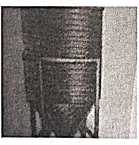
A tap is connected to such a tank whose conical part is full of water. Water is dripping out from a tap of the bottom at the uniform rate of \(2 \mathrm{~cm}^3 / \mathrm{s}\). The semi-vertical angle of the conical tank is \(45^{\circ}\).
Based on the given information, answer the following questions.
(i) Find the volume of water in the tank in terms of its radius.
(ii) Find the rate of change of radius at an constant when \(r=2 \sqrt{2} \mathrm{~cm}\)
(iii) (a) Find the rate at which the wet surface of the conical tank is decreasing at an instant when radius \(r=2 \sqrt{2} \mathrm{~cm}\).Or
(b) Find the rate of change of height ' h ' at an instant when slant height is 4 cm .
35.
Two men on either side of a temple of 30 m high observe its top at the angles of elevation = α and ẞ respectively. (as shown in the figure below).
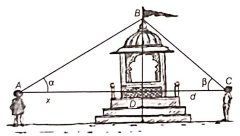
The distance between the two men is 40√3 m and the distance between the first person A and the temple is 30√3 m. Based on the above information answer the following questions.
∠CAB = α =
| a) sin-1 (2/√3) | b) sin-1 (1/2) | c) sin-1 (2) | d) sin-1 (√3/2) |
(ii) \(\angle C A B=\alpha=\)
| a) \(\cos ^{-1}\left(\frac{1}{5}\right)\) | b) \(\cos ^{-1}\left(\frac{2}{5}\right)\) | c) \(\cos ^{-1}\left(\frac{\sqrt{3}}{2}\right)\) | d) \(\cos ^{-1}\left(\frac{4}{5}\right)\) |
(iii) \(\angle B C A=\beta=\)
| a) \(\tan ^{-1}\left(\frac{1}{2}\right)\) | b) \(\tan ^{-1} (2)\) | c) \(\tan ^{-1}\left(\frac{1}{\sqrt{3}}\right)\) | d) \(\tan ^{-1}(\sqrt{3})\) |
(iv) \(\angle A B C=\)
| a) \(\frac{\pi}{4}\) | b) \(\frac{\pi}{6}\) | c) \(\frac{\pi}{2}\) | d) \(\frac{\pi}{3}\) |
(v) Domain and range of \(\cos ^{-1} x=\)
| a) \((-1,1),(0, \pi)\) | b) \([-1,1],(0, \pi)\) | c) \([-1,1],[0, \pi]\) | d) \((-1,1),\left[-\frac{\pi}{2}, \frac{\pi}{2}\right]\) |
36.
Let \(\begin{equation} f: A \rightarrow B \end{equation}\) and \(\begin{equation} g: B \rightarrow C \end{equation}\) be two functions defined on non-empty sets A, B, C,
then \(\begin{equation} \text { gof }: A \rightarrow C \end{equation}\) be is called the composition off and g defined as, \(\begin{equation} g o f(x)=g\{f(x)\} \forall x \in A \end{equation}\) .
Consider the functions \(\begin{equation} f(x)=\left\{\begin{array}{ll} \sin x, & x \geq 0 \\ 1-\cos x, & x \leq 0 \end{array}, g(x)=e^{x}\right. \end{equation}\) and
then answer the following questions.
(i) The function gof(x) is defined as
| (a) \(\begin{equation} g o f(x)=\left\{\begin{array}{ll} e^{x} & , x \geq 0 \\ 1-e^{\cos x} & , x \leq 0 \end{array}\right. \end{equation}\) | (b) \(\begin{equation} \operatorname{gof}(x)=\left\{\begin{array}{ll} e^{\sin x} & , x \leq 0 \\ e^{1-\cos x} & , x \geq 0 \end{array}\right. \end{equation}\) |
| (c) \(\begin{equation} g o f(x)=\left\{\begin{array}{ll} e^{\sin x} & , x \leq 0 \\ 1-e^{\cos x} & , x \geq 0 \end{array}\right. \end{equation}\) | (d) \(\begin{equation} g o f(x)=\left\{\begin{array}{ll} e^{\sin x} & , x \geq 0 \\ e^{1-\cos x} & , x \leq 0 \end{array}\right. \end{equation}\) |
(ii) \(\begin{equation} \frac{d}{d x}\{\operatorname{gof}(x)\}= \end{equation}\)
| (a) \(\begin{equation} [g o f(x)]^{\prime}=\left\{\begin{array}{ll} \cos x \cdot e^{\sin x} & , x \geq 0 \\ e^{1-\cos x} \cdot \sin x & , x \leq 0 \end{array}\right. \end{equation}\) | (b) \(\begin{equation} [g o f(x)]^{\prime}=\left\{\begin{array}{ll} \cos x \cdot e^{\sin x} & , x \geq 0 \\ -\sin x \cdot e^{1-\cos x} & , x \leq 0 \end{array}\right. \end{equation}\) |
| (c) \(\begin{equation} [g o f(x)]^{\prime}=\left\{\begin{array}{ll} \cos x \cdot e^{\sin x} & , x \geq 0 \\ \sin x \cdot(1-\cos x) & , x \leq 0 \end{array}\right. \end{equation}\) | (d) \(\begin{equation} [g o f(x)]^{\prime}=\left\{\begin{array}{ll} \cos x \cdot e^{\sin x} & , x \geq 0 \\ (1-\sin x) \cdot e^{1-\cos x} & , x \leq 0 \end{array}\right. \end{equation}\) |
(iii) R.H.D. of gof(x) at x = 0 is
| (a) 0 | (b) 1 | (c) -1 | (d) 2 |
(iv) L.H.D. of gof(x) at x = 0 is
| (a) 0 | (b) 1 | (c) -1 | (d) 2 |
(v) The value of \(\begin{equation} f^{\prime}(x) \text { at } x=\frac{\pi}{4} \end{equation}\) is
| (a) 1/9 | (b) \(\begin{equation} 1 / \sqrt{2} \end{equation}\) | (c) 1/2 | (d) not defined |
37.
Assertion: The domain of the function sec-1 x is the set of all real numbers.
Reason: For the function sec-1 x, x can take all real values except in the interval (-1, 1).
(a) Assertion is correct, reason is correct; reason is a correct explanation for assertion.
(b) Assertion is correct, reason is correct; reason is not a correct explanation for assertion
(c) Assertion is correct, reason is incorrect
(d) Assertion is incorrect, reason is correct.
38.
Assertion: For x < 0, \(\frac{d}{dx}\)(In |x| = -\(\frac{1}{x}\)
Reason: For x < 0, |x| = -x
(a) Assertion is correct, Reason is correct; Reason is a correct explanation for assertion.
(b) Assertion is correct, Reason is correct; Reason is not a correct explanation for Assertion
(c) Assertion is correct, Reason is incorrect
(d) Assertion is incorrect, Reason is correct.
1.
A = {1, 2, 3 ...13, 14}
R = {(x, y) : 3x - y = 0}
∴ R = {(1, 3), (2, 6), (3, 9),(4, 12)}
R is not reflexive since (1, 2), (2, 2)...(14, 14) ∉ R
Also, R is not symmetric as (1, 3) ∈R, but (3, 1) ∉ R.[3(3) - 1 ≠ 0]
Also, R is not transitive as (1, 3), (3, 9) ∈R, but (1, 9) ∉ R.
[3(1) - 9 ≠ 0]
Hence R is neither reflexive, nor symmetric, nor transitive.
2.
\(\text {Consider, } \mathrm{RHS}=\sin ^{-1}\left(3 x-4 x^{3}\right) \)
\(\text {Let } x=\sin \theta\)
\(\text {then } \theta=\sin ^{-1} x\)
Now, from Eq. (i), we get
\(\mathrm{RHS}=\sin ^{-1}\left(3 \sin \theta-4 \sin ^{3} \theta\right) \)
\(=\sin ^{-1}(\sin 3 \theta) \quad\left[\because \sin 3 x=3 \sin x-4 \sin ^{3} x\right] \)
\(=3 \theta \because \sin ^{-1}(\sin \theta)=\theta, \forall \theta \in\left[\frac{-\pi}{2}, \frac{\pi}{2}\right] \)
\(\text { and here } \left.-\frac{1}{2} \leq x \leq \frac{1}{2} \Rightarrow-\frac{\pi}{6} \leq x \leq \frac{\pi}{6}\right] \)
\(=3 \sin ^{-1} x {\left[\because \theta=\sin ^{-1} x\right]} =\mathrm{LHS}\)
3.
\(=\lim _{h \rightarrow 0} f(x)=\lim _{h \rightarrow 0} \cos x=\cos a[\therefore f(x)=\cos x]\)
f(a) = cos a
\(\therefore \lim _{x \rightarrow a} f(x)=f(a)\)
Thus, f(x) is continuous at x=a. But a is an arbitrary points so f(x) is continuous at all points.
So, f(x) is continuous at all points.
(ii) Here, f(x) = cosec x. Since, f(x) is not defined at × = nπ, nϵZ.Thus, f(x) is continuous at all points except x = nπ, n ϵ Z(iii) Here, f(x)sec x
Since, f(x) is not defined at \(x=(2 n+1) \frac{\pi}{2^{\prime}}, n \in Z .\)
Thus, f(x) is continuous at all points except \(x=(2 n+1) \frac{\pi}{2}, n \in Z\)
(iv) Here, f(x) = cotx
SInce, f(x) is not defined at x = n π, nϵZ.
Thus, f(x) is continuous at all points excepts x = nπ, nϵZ
4.
\((A+{ A }^{ T })^{ T }={ A }^{ T }+({ A }^{ T })^{ T }={ A }^{ T }+A=A+{ A }^{ T }. \) Hence, symmetric.
5.
1368 Concern for children health and nutrient food for every child.
6.
We have, \(A=\left[\begin{array}{ccc}\cos \alpha & -\sin \alpha & 0 \\ \sin \alpha & \cos \alpha & 0 \\ 0 & 0 & 1\end{array}\right]\)
Clearly, the cofactors of elements of |A| are given by
\(A_{11}=\cos \alpha ; A_{12}=-\sin \alpha ; A_{13}=0 ; \)
\( A_{21}=\sin \alpha ; A_{22}=\cos \alpha ; A_{23}=0\)
\( A_{31}=0 ; A_{32}=0 \text { and } A_{33}=1\)
\(\therefore \operatorname{adj}(A)=\left[\begin{array}{lll} A_{11} & A_{12} & A_{13} \\ A_{21} & A_{22} & A_{23} \\ A_{31} & A_{32} & A_{33} \end{array}\right]^T\)
\(=\left[\begin{array}{ccc} \cos \alpha & -\sin \alpha & 0 \\ \sin \alpha & \cos \alpha & 0 \\ 0 & 0 & 1 \end{array}\right]^T=\left[\begin{array}{ccc} \cos \alpha & \sin \alpha & 0 \\ -\sin \alpha & \cos \alpha & 0 \\ 0 & 0 & 1 \end{array}\right]\)
7.
the required trapezium is as given in figure. Draw perpendiculars DP and CQ on AB. Let AP = x cm. Note that \(\Delta \)APD \(\cong \) \(\Delta \) BQC.
Therefore, QB = x cm. Also, by pythagoras theorem DP = QC = \(\sqrt { 100-{ x }^{ 2 } } \)
Let A be the area of the trapezium.
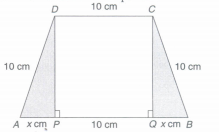
Then, A \(\equiv \) A(x)
\(=\frac { 1 }{ 2 } (sum\ of\ parallel\ sides)\times (height)\)
\(=\frac { 1 }{ 2 } (2x+10+10)\sqrt { 100-{ x }^{ 2 } } \)
= (x + 10)\(\sqrt { 100-{ x }^{ 2 } } \)
\(or\ A'(x)=(x+10)\frac { (-2x) }{ 2\sqrt { 100-{ x }^{ 2 } } } +(\sqrt { 100-{ x }^{ 2 }) } \)
\(=\frac { -2{ x }^{ 2 }-10x+100 }{ \sqrt { 100-{ x }^{ 2 } } } \)
Now, A'(x) = 0 gives 2x2 + 10x - 100 = 0,
i.e., x = 5 and x = -10
So, x = 5.
Now, A''(x) = \(\frac { \sqrt { 100-{ x }^{ 2 } } (-4x-10)-(-2x^{ 2 }-10x+100)\frac { (-2x) }{ 2\sqrt { 100-{ x }^{ 2 } } } }{ 100-{ x }^{ 2 } } \)
\(=\frac { { 2x }^{ 3 }-300x-1000 }{ { (100-{ x }^{ 2 }) }^{ \frac { 1 }{ 2 } } } \)
(on simplification)
or \(A''(5)=\frac { { 2(5) }^{ 3 }-300(5)-1,000 }{ (100-(5{ ) }^{ 2 })^{ \frac { 3 }{ 2 } } } \)
\(=\frac { -2,250 }{ 75\sqrt { 75 } } =\frac { -30 }{ \sqrt { 75 } } <0\)
Thus, area of trapezium is maximum at x = 5 and the maximum area is given by
A(5) = (5 + 10)\(\sqrt { 100-{ (5) }^{ 2 } } \)
= 15\(\sqrt { 75 } =75\sqrt { 3 } { cm }^{ 2 }\)
8.
Given
\( \tan ^{-1}\left(\frac{x-2}{x-4}\right)+\tan ^{-1}\left(\frac{x+2}{x+4}\right)=\frac{\pi}{4} \)
\(\Rightarrow \tan ^{-1}\left[\frac{\frac{x-2}{x-4}+\frac{x+2}{x+4}}{1-\left(\frac{x-2}{x-4}\right)\left(\frac{x+2}{x+4}\right)}\right]=\frac{\pi}{4} \)
\(\Rightarrow \tan ^{-1}\left[\begin{array}{l} \because \tan ^{-1} x+\tan ^{-1} y=\tan ^{-1}\left(\frac{x+y}{1-x y}\right) \\ {\left[\frac{(x-2)(x+4)+(x+2)(x-4)}{\frac{(x-4)(x+4)}{(x-4)(x+4)-(x-2)(x+2)}}{(x-4)(x+4)}\right]} \end{array}\right]=\frac{\pi}{4} \)
\(\Rightarrow \frac{x^{2}-2 x+4 x-8+x^{2}-4 x+2 x-8}{\left(x^{2}-16\right)-\left(x^{2}-4\right)}=\tan \frac{\pi}{4} \)
\( \Rightarrow \frac{x^{2}-2 x+4 x-8+x^{2}-4 x+2 x-8}{\left(x^{2}-16\right)-\left(x^{2}-4\right)}=\tan \frac{\pi}{4} \)
\(\Rightarrow \frac{2 x^{2}-16}{-12}=1 \)
\(\Rightarrow 2 x^{2}-16=-12 \)
\(\Rightarrow 2 x^{2}=-12+16 \)
\(\Rightarrow 2 x^{2}=4 \Rightarrow x^{2}=2 \ \therefore \ x=\pm \sqrt{2}\)
\(\text {Hence, } \sqrt{2} \text { and }-\sqrt{2} \text { are the required value } \)
9.
\(\Rightarrow \) \(\left( { 1-x }^{ 2 } \right) ^{ 2 }\frac { { d }^{ 2 }y }{ d{ x }^{ 2 } } -x\frac { { d }y }{ d{ x } } =0\)\(\left[ On\quad dividing\quad by\quad 2\left( \frac { dy }{ dx } \right) \right] \)
10.
Side of a square base is x and height is y.
\(V=x^{2} y \text { and cost }=2 x^{2} \times 5+4 x y \times 2.50 \text { [Ans. Rs } \left.1920\right]\)
11.
Given points \((2,-3),(\lambda,-1) \text { and }(0,4)\) are collinear So, area of triangle formed by these three points will be zero.
\(\therefore \left|\begin{array}{rrr} 2 & -3 & 1 \\ \lambda & -1 & 1 \\ 0 & 4 & 1 \end{array}\right|=0\)
Applying \(R_{2} \rightarrow R_{2}-R_{1}\) and \(R_{3} \rightarrow R_{3}-R_{1}\) we get
\(\left|\begin{array}{ccc} 2 & -3 & 1 \\ \lambda-2 & 2 & 0 \\ -2 & 7 & 0 \end{array}\right|=0\)
Now, expanding along C3, we get \(\left|\begin{array}{cc} \lambda-2 & 2 \\ -2 & 7 \end{array}\right|=0\)
\( \Rightarrow 7(\lambda-2)-2(-2)=0 \)
\(\Rightarrow 7 \lambda-14+4=0 \)
\(\Rightarrow 7 \lambda-10=0 \Rightarrow \lambda \mid=\frac{10}{7} \)
Hence, required value of \(\lambda \text { is } \frac{10}{7}\).
12.
Let us assume that f(−5) = f(5).
Then ′f′ satisfies all the conditions of Rolle′s Theorem in [−5, 5].
Then there must exist atleast once cϵ(−5, 5) such that f′(c) = 0 Thus our supposition is wrong.
Hence, f(−5) ≠ f(5)
13.
One-one function from {1, 2, 3} to itself is simply a permutation on three symbols 1, 2, 3. Therefore, total number of one-one maps from {1, 2, 3} to itself is same as total number of permutations on three symbols 1, 2, 3 which is 3! = 6.
14.
\(Chem.\quad \quad \quad Phy.\quad \quad \quad Eco.\\ A=\left[ 10\times 12\quad \quad 8\times 12\quad \quad 10\times 12 \right] \)
\(Selling\ Price\ matrix,\ B=\left[ \begin{matrix} 80 \\ 60 \\ 40 \end{matrix} \right] .\)
\(\therefore \ Reqd.\ amount=AB\)
\(=\left[ 120\quad 96\quad 120 \right] \left[ \begin{matrix} 80 \\ 60 \\ 40 \end{matrix} \right] \)
\(=\left[ 120\times 80+96\times 60+120\times 40 \right] \)
\(=\left[ 9600+5760+4800 \right] =\left[ 20160 \right] .\)
Hence, the bookshop will receive Rs. 20, 160 by selling all the books.
15.
Let \({ cos }^{ -1 }\left( -\frac { 1 }{ \sqrt { 2 } } \right) =y\), where \(y\in [0,\pi ]\)
\(\Rightarrow cosy=\frac { 1 }{ \sqrt { 2 } } \)
\(\Rightarrow cosy=-cos\frac { \pi }{ 4 } =cos\left( \pi -\frac { \pi }{ 4 } \right) \)
\(\Rightarrow cosy=cos\frac { 3\pi }{ 4 } \Rightarrow y=\frac { 3\pi }{ 4 } \)
Hence, the required principal value = \(\frac { 3\pi }{ 4 } \)
16.
(c)
l - A
17.
(d)
\(\frac{x}{\sqrt{1+x^2}}\)
18.
(a)
not onto
19.
x - [x] = 0 when x is an integer, so that f(x) is discontinuous for all x ∈ I i.e. f(x) is discontinuous at infinite number of points.
20.
If square matrix in which all diagonals elements are 1 and rest are 0, is called unit matrix.
21.
\( 2 \tan ^{-1} x=\sin ^{-1} \frac{2 x}{1+x^{2}}\)
\(\therefore \ 2 \tan ^{-1} \frac{2}{3}=\sin ^{-1} \frac{2\left(\frac{2}{3}\right)}{1+\left(\frac{2}{3}\right)^{2}}=\sin ^{-1} \frac{12}{13}\)
\(\cos \left(2 \tan ^{-1} x\right)=\cos \left(\cos ^{-1}\left(\frac{1-x^{2}}{1+x^{2}}\right)\right) \)
22.
Let \(f(f(y))=y\), for all \(y \neq-1\) \(\Rightarrow f\left(\frac{a y}{y+1}\right)=y\), for all \(y \neq-1\)
\(\Rightarrow \frac{a\left(\frac{a y}{y+1}\right)}{\frac{a y}{y+1}+1}=y,for\ all\ y \neq-1\)
\(\Rightarrow \frac{a^{2} y}{a y+y+1}=y, for\ all \ y \neq-1\)
\(\Rightarrow a^{2} y=(a+1) y^{2}+y, for\ all \ y \neq-1\)
\(\Rightarrow (a+1) y^{2}+\left(1-a^{2}\right) y=0, for \ all \ y \neq-1\)
\(\Rightarrow a+1=0 and 1-a^{2}=0 \Rightarrow a=-1\)
23.
(d)
(0, 2)
24.
(d)
None of these
25.
(b)
\(\frac{1}{det(A)}\)
26.
(b)
土6
27.
(c)
1 - α² - βγ = 0
28.
(a)
k = 3, p = n
29.
(b)
\(-\frac { \pi }{ 2 } \)
30.
(b)
\(-\frac { \pi }{ 3} \)
31.
(b)
2
32.
(a)
f is one-one onto
33.
As \(\frac{dy}{dt}\) = 2x.\(\frac{dx}{dt}\)
⇒ 6.\(\frac{dx}{dt}\) = 2x.\(\frac{dx}{dt}\) ⇒ x = 3
From curve, y = 9. Point is (3, 9)
34.
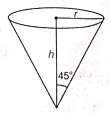
Let r be the radius and h be the height of conical part.
Here, \(\tan 45^{\circ}=\frac{r}{h} \Rightarrow 1=\frac{r}{h} \Rightarrow h=r\)
The volume of water in the tank
\(V=\frac{1}{3} \pi r^2 h=\frac{1}{3} \pi r^3 \mathrm{~cm}^3 \quad[\because h=r]\)
(ii) \( \frac{d V}{d t}=\frac{3}{3} \pi r^2 \frac{d r}{d t} \)
\(\Rightarrow \quad-2=\pi r^2 \frac{d r}{d t} \quad\left[\because \frac{d V}{d t}=-2\right]\)
\( \Rightarrow \quad \frac{d r}{d t}=\frac{-2}{\pi r^2}=\frac{-2}{\pi(2 \sqrt{2})^2}=\frac{-1}{4 \pi}\)
\({[r=2 \sqrt{2} \text { (given) }]}\)
Hence, the rate of decrease of radius is \(\frac{1}{4 \pi} \mathrm{cm} / \mathrm{s}\).
(iii) (b) \(\therefore S=\pi r l \Rightarrow S=\pi h l\) \([\because r=h]\)
\(\Rightarrow \quad S=\pi h \sqrt{h^2+r^2}\)
(a) \(\therefore S=\pi r l \)
\(=\pi r \sqrt{h^2+r^2}=\pi r \sqrt{2 r^2} \)
\({\left[\because l=\sqrt{h^2+r^2} ; \ \because h=r\right]}\)
\(=\sqrt{2} \pi r^2\)
\(\Rightarrow \frac{d S}{d t}=\sqrt{2} \pi(2 r) \frac{d r}{d t}\)
\(\Rightarrow \quad \frac{d S}{d t}=2 \sqrt{2} \pi r \frac{d r}{d t}\)
\(\Rightarrow\left(\frac{d S}{d t}\right)_{r=2 \sqrt{2}}=2 \sqrt{2} \pi(2 \sqrt{2})\left(\frac{-1}{4 \pi}\right)\)
\(=-2 \mathrm{~cm}^2 / \mathrm{s} \)
Or \(\text { (b) } \therefore S=\pi r l \Rightarrow S=\pi h l\) \({[\because r=h]}\)
\( \Rightarrow S=\pi h \sqrt{h^2+r^2} \)
\(\Rightarrow \quad S=\sqrt{2} \pi h^2 \)
\(\Rightarrow \quad \frac{d S}{d t}=\sqrt{2} \pi(2 h) \frac{d h}{d t}\)
\(\Rightarrow \quad \frac{d S}{d t}=2 \sqrt{2} \pi h \frac{d h}{d t}\)
\( \Rightarrow \quad \frac{d S}{d t}=2 \sqrt{2} \pi(2 \sqrt{2}) \frac{d h}{d t}\)
\( \text { [since, } l^2=r^2+h^2 \Rightarrow l^2=2 h^2\)
\(\left.\Rightarrow 16=2 h^2 \Rightarrow h=2 \sqrt{2}\right]\)
\( \Rightarrow \quad-2=8 \pi \frac{d h}{d t}\) \({[\because \text { from Eq. (i) }]}\)
\( \Rightarrow \quad \frac{d h}{d t}=-\frac{1}{4 \pi} \mathrm{cm} / \mathrm{s}\)
\(\text { (b) } \therefore S=\pi r l \Rightarrow S=\pi h l\)
\([\because r=h]\)
\(\Rightarrow S=\pi h \sqrt{h^2+r^2}\)
\(\Rightarrow \quad S=\sqrt{2} \pi h^2\)
\(\Rightarrow \quad \frac{d S}{d t}=\sqrt{2} \pi(2 h) \frac{d h}{d t}\)
\(\Rightarrow \quad \frac{d S}{d t}=2 \sqrt{2} \pi h \frac{d h}{d t}\)
\(\Rightarrow \quad \frac{d S}{d t}=2 \sqrt{2} \pi(2 \sqrt{2}) \frac{d h}{d t}\)
\(\text { [since, } l^2=r^2+h^2 \Rightarrow l^2=2 h^2\)
\(\left.\Rightarrow 16=2 h^2 \Rightarrow h=2 \sqrt{2}\right]\)
\(\Rightarrow \quad-2=8 \pi \frac{d h}{d t}\)
\([\because \text { from Eq. (i) }]\)
\(\Rightarrow \quad \frac{d h}{d t}=-\frac{1}{4 \pi} \mathrm{cm} / \mathrm{s}\)
35.
(i) (b) \(\ln \triangle A B D\)
\(\tan \alpha =\frac{B D}{A D}\)
\( =\frac{30}{30 \sqrt{3}}=\frac{1}{\sqrt{3}} \)
\(\Rightarrow \alpha =30^{\circ}\)
\(\therefore \sin \alpha =\sin 30^{\circ}=\frac{1}{2}\)
\(\Rightarrow \alpha =\sin ^{-1}\left(\frac{1}{2}\right)\)
(ii) (c) \(\cos \alpha=\cos 30^{\circ}=\frac{\sqrt{3}}{2}\)
\(\Rightarrow \alpha =\cos ^{-1}\left(\frac{\sqrt{3}}{2})\right.\)
(iii) (d) \(\ln \triangle B DC\)
\(\tan \beta =\frac{(BD)}{(C D)}\)
\(=\frac{30}{10 \sqrt{3}}=\sqrt{3} \)
\(\Rightarrow \beta =\tan ^{-1}(\sqrt{3})\)
(iv) \( \text { (c) Since, } \alpha=\sin ^{-1}\left(\frac{1}{2}\right)=\frac{\pi}{6} \text {, } \)
\(\beta=\tan ^{-1}(\sqrt{3})=\frac{\pi}{3} \)
\(\therefore \quad \angle A B C=\pi-\left(\frac{\pi}{6}+\frac{\pi}{3}\right)\)
\( =\pi-\frac{\pi}{2}=\frac{\pi}{2}\)
(v) (c) We know that domain and range of \(\cos ^{-1} x\) are [-1,1] and \([0, \pi]\) respectively.
36.
(i) (d)
(ii) (a)
(iii) (b) ,
(iv) (a)
(v) (b)
37.
(d) Assertion is incorrect, reason is correct.
38.
(d) Assertion is incorrect, Reason is correct.

12th Standard CBSE Syllabus & Materials
12th Standard CBSE
CBSE 12th Computer Science Python Revision Tour I - New Previous year Question Papers Study Material - QB365 Set A
NEW12th Standard CBSE
CBSE 12th Business Studies Planning Important Questions And Answers Study Material - QB365 Set A
NEW12th Standard CBSE
CBSE 12th Business Studies Business Environment Important Questions And Answers Study Material - QB365 Set A
NEW12th Standard CBSE
CBSE 12th Business Studies Principles of Management Important Questions And Answers Study Material - QB365 Set A



NCERT Books

Syllabus

Exam Pattern

Sample Question Papers

Previous year Question Papers

Important Notes

MCQ Practice test

NCERT Exemplers

Case study Questions

Image Based Questions

Passage based Questions

HOT Questions

Value Based Questions

Model Questions Papers
NCERT ( Book Back ) Questions

Assertion and Reason
Important Questions And Answers

CBSE 12th Standard CBSE Subjects
CBSE Standards








