
 100% FREE ACCESS
12th Standard CBSE Syllabus & Materials
12th Standard CBSE
CBSE 12th Economics Government Budget and the Economy Previous year Question Papers Study Material - QB365 Set A
NEW12th Standard CBSE
CBSE 12th Computer Science Interface Python with MySQL - New Previous year Question Papers Study Material - QB365 Set A
NEW12th Standard CBSE
CBSE 12th Computer Science Database Concept - New Previous year Question Papers Study Material - QB365 Set A
NEW12th Standard CBSE
CBSE 12th Computer Science Data Communication - New Previous year Question Papers Study Material - QB365 Set A
NEW12th Standard CBSE
CBSE 12th Computer Science Data Structures - New Previous year Question Papers Study Material - QB365 Set A
NEW12th Standard CBSE
CBSE 12th Computer Science Functions - New Previous year Question Papers Study Material - QB365 Set A

Published on: 25/10/2025
Download CBSE Class 12th Standard CBSE Maths question papers, sample papers, important questions, and previous year solved papers in PDF format. Get free study materials, NCERT solutions, and exam preparation resources for Class 12th Standard CBSE Maths
Questions + Answers key
Take MCQ Maths Test
1.
Let f be the function defined as \(f(x)=\left\{\begin{array}{cl} \frac{\log (1+3 x)-\log (1-5 x)}{x} & , \text { if } x \neq 0 \\ 2 k & , \text { if } x=0 \end{array}\right.\) is continuous at x = 0. Find the value of k.
2.
Find the inverse of the matrix \(\left[\begin{array}{rr} \cos \theta & \sin \theta \\ -\sin \theta & \cos \theta \end{array}\right]\)
3.
Give one example of skew-symmetric matrix of order 2 and order 3.
4.
Let \(\begin{vmatrix} 3 & y \\ x & 1 \end{vmatrix}=\begin{vmatrix} 3 & 2 \\ 4 & 1 \end{vmatrix}\) find the possible values of x,y \(\in\)N. Also find the values if x=y.
5.
Show that,the function f(x) = log(cos x) is decreasing, in \([0,{\pi\over2}]\).
6.
Show that the relation R:{1, 2, 3}\(\rightarrow\){1, 2, 3} given by R={(1, 1), (2, 2), (3, 3), (1, 2), (2, 3)} is reflexive but neither symmetric nor transitive.
7.
Show that the semi-vertical angle of the cone of the maximum volume and of given slant height is \(\cos ^{-1} 1 / \sqrt{3}\).
8.
A wire of length 34 m is to be cut into two pieces. One of the pieces is to be made into a square and the other into a rectangle whose length is twice its breadth. What should be the lengths of the two pieces, so that the combined area of the square and the rectangle is minimum?
9.
\(\text { If } \tan ^{-1} x+\tan ^{-1} y+\tan ^{-1} z=\frac{\pi}{2}, x, y, z,>0, \) then find the value of xy, yz, zx
10.
Show that \(f(x)=3 x+5\) is a strictly increasing function on R.
11.
If \(A=\left[ \begin{matrix} 1 & 2 & 1 \\ -1 & 1 & 1 \\ 1 & -3 & 1 \end{matrix} \right] ,\) find A-1. Hence solve the system of equations : x + 2y + z = 4, -x + y+ z = 0, x - 3y + z = 4.
12.
Let \(f(x)=\begin{cases} \frac { 1-sin^{ 3 }x }{ 3cos^{ 2 }x }\ \quad \quad \quad ,if\quad x<\frac { \pi }{ 2 }\\ a\qquad \qquad \ \ \ \quad,if\quad x=\frac {\pi }{ 2 } \\ \frac { b(1-sin\quad x) }{ (\pi -2x)^{ 2 } } \ \ \ \ \ \ \ \ ,if\quad x>\frac { \pi }{ 2 } \end{cases}\) If f(x) be a continuous function at x = \(\pi\over{2}\), find a and b.
13.
In the given determinant \(\begin{array}{rr} \cos \theta & -\sin \theta \\ \sin \theta & \cos \theta \end{array} \mid, \text { find } A_{12}+A_{21}\)
14.
If \(x=a \cos \theta+b \sin \theta\) and \(y=a \sin \theta-b \cos \theta\) then show that \(y^{2} \frac{d^{2} y}{d x^{2}}-x \frac{d y}{d x}+y=0\)
15.
If \(x=a(\theta+\sin \theta) \text { and } y=a(1-\cos \theta)\) then find \(\frac{d^{2} y}{d x^{2}} \text { at } \theta=\frac{\pi}{2}\).
16.
Find the value of \(\sin ^{-1}\left(\frac{\sqrt{3}}{2}\right)+\tan ^{-1}(\sqrt{3})\)
17.
A man 2 meters high walks at a uniform speed of 5km/h away from a lamp-post 6 meters high. Find the rate at which length of his shadow increases.
18.
Find the equations of the tangent and normal to the curve x = 1-\(cos\theta ,y-=\theta -sin\theta \) at \(\theta =\frac { \pi }{ 4 } \)
19.
If \(A(\operatorname{adj} A)=\left[\begin{array}{lll}3 & 0 & 0 \\ 0 & 3 & 0 \\ 0 & 0 & 3\end{array}\right]\) then the value of \(|A|+|\operatorname{adj} A|\) is equal to
12
9
3
27
20.
If an error of 10 is made. in measuring the angle of a sector of radius 30 cm, then the approximate error in its area is
450 cm2
\(25 \pi \mathrm{cm}^{2}\)
\(2.5 \pi \mathrm{cm}^{2}\)
None of these
21.
The value of c in Rolle's theorem for the function \(f(x)=x^{2}+2 x-8, x \in[-4,2]\) is
1
-1
2
-2
22.
If \(y=\left(x+\sqrt{1+x^{2}}\right)^{n}, \text { then }\left(1+x^{2}\right) \frac{d^{2} y}{d x^{2}}+x \frac{d y}{d x}\) is equal to
n2y
-nZy
-y
2x2y
23.
Asquare matrix A is said to be non-singular, if
\(|A|=0\)
\(|A| \neq 0\)
\(|A|=-1\)
\(|A|=1\)
24.
The equation \(\tan ^{-1} x-\cot ^{-1} x=\tan ^{-1}\left(\frac{1}{\sqrt{3}}\right)\) has
no solution
unique solution
infinite number of solutions
two solutions
25.
If \(\tan ^{-1} 2 x+\tan ^{-1} 3 x=\frac{\pi}{4},\) then x is equal to
1
\(-1, \frac{1}{10}\)
\(\frac{1}{6}\)
None of these
26.
Let f, g and h be functions from R to R. Then,
\((f+g) oh =\operatorname{fog}+\mathrm{goh}\)
\( (f+g) o h=f o h+g o h\)
\((f \cdot g) oh =( foh )+( goh )\)
\((f \cdot g) oh =(f o g) \cdot( goh )\)
27.
If, \({ a }_{ ij }=\frac { 1 }{ 2 } |i-3j|\) the value of a22 is
0
-2
2
3
28.
The normal at the point (1,1) on the curve 2y + x2 = 3 is
x + y = 0
x – y = 0
x + y +1 = 0
x – y = 1
29.
If y = f(u) is a differentiable function of u and u = g(x) is a differentiable function of x, then y = f[g(x)] is a differentiable function of x and \(\begin{equation} \frac{d y}{d x}=\frac{d y}{d u} \times \frac{d u}{d x} \end{equation}\). This rule is also known as CHAIN RULE.
Based on the above information, find the derivative of functions w.r.t. x in the following questions
(i) \(\begin{equation} \cos \sqrt{x} \end{equation}\)
| (a) \(\begin{equation} \frac{-\sin \sqrt{x}}{2 \sqrt{x}} \end{equation}\) | (b) \(\begin{equation} \frac{\sin \sqrt{x}}{2 \sqrt{x}} \end{equation}\) | (c) \(\begin{equation} \sin \sqrt{x} \end{equation}\) | (d) \(\begin{equation} -\sin \sqrt{x} \end{equation}\) |
(ii) \(\begin{equation} 7^{x+\frac{1}{x}} \end{equation}\)
| (a) \(\begin{equation} \left(\frac{x^{2}-1}{x^{2}}\right) \cdot 7^{x+\frac{1}{x}} \cdot \log 7 \end{equation}\) | (b) \(\begin{equation} \left(\frac{x^{2}+1}{x^{2}}\right) \cdot 7^{x+\frac{1}{x}} \cdot \log 7 \end{equation}\) | (c) \(\begin{equation} \left(\frac{x^{2}-1}{x^{2}}\right) \cdot 7^{x-\frac{1}{x}} \cdot \log 7 \end{equation}\) | (d) \(\begin{equation} \left(\frac{x^{2}+1}{x^{2}}\right) \cdot 7^{x-\frac{1}{x}} \cdot \log 7 \end{equation}\) |
(iii) \(\begin{equation} \sqrt{\frac{1-\cos x}{1+\cos x}} \end{equation}\)
| (a) \(\begin{equation} \frac{-1}{x^{2}+b^{2}}+\frac{1}{x^{2}+a^{2}} \end{equation}\) | (b) \(\begin{equation} \frac{1}{x^{2}+b^{2}}+\frac{1}{x^{2}+a^{2}} \end{equation}\) | (c) \(\begin{equation} \frac{1}{x^{2}+b^{2}}-\frac{1}{x^{2}+a^{2}} \end{equation}\) | (d) none of these |
(v) (d) :\(\begin{equation} \sec ^{-1} x+\operatorname{cosec}^{-1} \frac{x}{\sqrt{x^{2}-1}} \end{equation}\)
| (a) \(\begin{equation} \frac{2}{\sqrt{x^{2}-1}} \end{equation}\) | (b) \(\begin{equation} \frac{-2}{\sqrt{x^{2}-1}} \end{equation}\) | (c) \(\begin{equation} \frac{1}{|x| \sqrt{x^{2}-1}} \end{equation}\) | (d) \(\begin{equation} \frac{2}{|x| \sqrt{x^{2}-1}} \end{equation}\) |
30.
Area of a triangle whose vertices are (x1, y1), (x2' y2) and (x3, y3) is given by thedeterminant
\(\begin{equation} \Delta=\frac{1}{2}\left|\begin{array}{lll} x_{1} & y_{1} & 1 \\ x_{2} & y_{2} & 1 \\ x_{3} & y_{3} & 1 \end{array}\right| \end{equation}\)
Since, area is a positive quantity, so we always take the absolute value of the determinant Δ. Also, the area of the triangle formed by three collinear points is zero.
Based on the above information, answer the following questions
(i) Find the area of the triangle whose vertices are (-2, 6), (3, -6) and (1, 5).
| (a) 30 sq. units | (b) 35 sq. units | (c) 40 sq. units | (d) 15.5 sq. units |
(ii) If the points (2, -3), (k, -1) and (0, 4) are collinear, then find the value of 4k
| (a) 4 | (b) \(\begin{equation} \frac{7}{140} \end{equation}\) | (c) 4 | (d) \(\begin{equation} \frac{40}{7} \end{equation}\) |
(iii) If the area of a triangle ABC, with vertices A(1, 3), B(O, 0) and C(k, 0) is 3 sq. units, then a value of k is
| (a) 2 | (b) 3 | (c) 4 | (d) 5 |
(iv) Using determinants, find the equation of the line joining the points A(1, 2) and B(3, 6).
| (a) y = 2x | (b) x = 3y | (c) y = x | (d) 4x-y = 5 |
(v) If A = (11, 7), B = (5, 5) and C = (-1, 3), then
| (a) \(\begin{equation} \Delta A B C \end{equation}\) is scalene triangle | (b) \(\begin{equation} \Delta A B C \end{equation}\) is equilateral triangle |
| (c) A, B and C are collinear | (d) None of these |
1.
k = 4
2.
Let \(A=\left[\begin{array}{rr} \cos \theta & \sin \theta \\ -\sin \theta & \cos \theta \end{array}\right]\) then
\(|A|=\left|\begin{array}{cc} \cos \theta & \sin \theta \\ -\sin \theta & \cos \theta \end{array}\right|=\cos ^{2} \theta+\sin ^{2} \theta=1 \neq 0 \)
\(\therefore A^{-1} \text {exists. } \)
\(\text { Also, } \operatorname{adj}(A)=\left[\begin{array}{cc} \cos \theta & -\sin \theta \\ \sin \theta & \cos \theta \end{array}\right] \)
\(\left[\begin{array}{ll} \because \text { adj } \end{array}\left[\begin{array}{ll} a & b \\ c & d \end{array}\right]=\left[\begin{array}{cc} d & -b \\ -c & a \end{array}\right]\right]\)
Now,\(A^{-1}=\frac{1}{|A|} \operatorname{adj}(A)=\left[\begin{array}{cr} \cos \theta & -\sin \theta \\ \sin \theta & \cos \theta \end{array}\right]\)
3.
\(\left[\begin{array}{cc} 0 & 2 \\ -2 & 0 \end{array}\right] ;\left[\begin{array}{ccc} 0 & -1 & 3 \\ 1 & 0 & 4 \\ -3 & -4 & 0 \end{array}\right]\)
4.
±2√2
5.
\(f^{\prime}(x)=\frac{1}{\cos x} \cdot(-\sin x)=-\tan x, \tan x>0 \text { for }\left(0, \frac{\pi}{2}\right)\)
f′(x) < 0. Hence, function is strictly decreasing
6.
For reflexive : As (1, 1), (2, 2), (3, 3) ∈ R. Hence, reflexive
For Symmetric: (1, 2) ∈ R but (2, 1) ∉ R. Hence, not symmetric
For transitive: (1, 2) ∈ R and (2, 3) ∈ R but (1, 3) ∉ R.Hence, not transitive
Hence, R is not an equivalence relation
7.
Let \(\theta\) be the semi-vertical angle of the cone.

It is clear that \(\theta \in\left(0, \frac{\pi}{2}\right)\).
Let r, h and l be the radius, height and the slant height of the cone, respectively.
Since, slant height of the cone is given, so consider it as constant.
Now, in \(\triangle A B C, r=l \sin \theta\) and \(h=l \cos \theta\)
Let V be the volume of the cone.
Then, \(V=\frac{\pi}{3} r^2 h \Rightarrow V=\frac{1}{3} \pi\left(l^2 \sin ^2 \theta\right)(l \cos \theta)\)
\(\Rightarrow \quad V=\frac{1}{3} \pi l^3 \sin ^2 \theta \cos \theta\)
On differentiating both sides w.r.t. \(\theta\) two times, we get
\(\frac{d V}{d \theta} =\frac{l^3 \pi}{3}\left[\sin ^2 \theta(-\sin \theta)+\cos \theta(2 \sin \theta \cos \theta)\right] \)
\(=\frac{l^3 \pi}{3}\left(-\sin ^3 \theta+2 \sin \theta \cos ^2 \theta\right)\)
\( \text { and } \frac{d^2 V}{d \theta^2}=\frac{l^3 \pi}{3}\left(-3 \sin ^2 \theta \cos \theta+2 \cos ^3 \theta\right. - 4 \sin^2 \theta \cos \theta)\)
\(\Rightarrow \frac{d^2 V}{d \theta^2}=\frac{l^3 \pi}{3}\left(2 \cos ^3 \theta-7 \sin ^2 \theta \cos \theta\right)\)
For maxima or minima, put\(\frac{d V}{d \theta}=0\)
\(\Rightarrow \quad \sin ^3 \theta=2 \sin \theta \cos ^2 \theta \Rightarrow \tan ^2 \theta=2 \)
\( \Rightarrow \quad \tan \theta=\sqrt{2} \Rightarrow \theta=\tan ^{-1} \sqrt{2}\)
Now, when \(\theta=\tan ^{-1} \sqrt{2}\), then \(\tan ^2 \theta=2\)
\(\Rightarrow \quad \sin ^2 \theta=2 \cos ^2 \theta\)
Now, we have \(\frac{d^2 V}{d \theta^2} =\frac{l^3 \pi}{3}\left(2 \cos ^3 \theta-14 \cos ^3 \theta\right)\)
\(=-4 \pi l^3 \cos ^3 \theta<0, \text { for } \theta \in\left(0, \frac{\pi}{2}\right)\)
\(\therefore V\) is maximum, when \(\theta=\tan ^{-1} \sqrt{2}\) or
\(\theta =\cos ^{-1} \frac{1}{\sqrt{3}} \)
\({[\because \cos \theta} \left.=\frac{1}{\sqrt{1+\tan ^2 \theta}}=\frac{1}{\sqrt{1+2}}=\frac{1}{\sqrt{3}}\right]\)
Hence, for given slant height, the semi-vertical angle of the cone of maximum volume is \(\cos ^{-1} \frac{1}{\sqrt{3}}\).
8.
Let wire is cut at x m and made into a rectangle,
whose breadth is a and length 2a.
For rectangle,
\(\therefore 2(a+2 a)=x \Rightarrow 6 a=x \)
\(\Rightarrow a=\frac{x}{6} \mathrm{~m} \)
\(\therefore \text { Area of rectangle }=a(2 a)=2 a^{2}=2\left(\frac{x}{6}\right)^{2}=\frac{x^{2}}{18} \)
For square,
\(4 \times \text { side }=(34-x) \Rightarrow \text { side }=\frac{34-x}{4} \mathrm{~m} \)
\(\therefore \text { Area of square }=\frac{1}{16}(34-x)^{2}\)
\(\text { Combined area }(A)=\frac{x^{2}}{18}+\frac{1}{16}(34-x)^{2} \)
\(\frac{d A}{d x} =\frac{2 x}{18}+\frac{2}{16}(34-x) \cdot(-1) \)
\(=\frac{x}{9}-\left(\frac{34-x}{8}\right)=\frac{8 x-306+9 x}{72} \)
\(\frac{d A}{d x} =\frac{17 x-306}{72}\)
\(\text { For minimum area, } \frac{d A}{d x}=0\)
\(\Rightarrow 17 x-306=0 \)
\(\Rightarrow x=\frac{306}{17}=18 \)
\(\frac{d^{2} A}{d x^{2}} =\frac{17}{72} \)
\(\left.\frac{d^{2} A}{d x^{2}}\right|_{x=18} =\frac{17}{72}>0\)
For x = 18, A is minimum. Hence, wire must be cut at 18 m to made into a rectangle and remaining 16 m piece to made into a square for a minimum combined area.
9.
\(\tan ^{-1} x+\tan ^{-1} y+\tan ^{-1} z=\frac{\pi}{2} \)
\(\Rightarrow \tan ^{-1} x+\tan ^{-1} y=\frac{\pi}{2}-\tan ^{-1} z \)
\(\Rightarrow \tan ^{-1}\left(\frac{x+y}{1-x y}\right)=\frac{\pi}{2}-\tan ^{-1} z \)
\(\Rightarrow \frac{x+y}{1-x y}=\tan \left(\frac{\pi}{2}-\tan ^{-1} z\right) \)
\(\Rightarrow \frac{x+y}{1-x y}=\cot \left(\tan ^{-1} z\right)=\cot \left(\cot ^{-1} \frac{1}{z}\right) \)
\(\Rightarrow \frac{x+y}{1-x y}=\frac{1}{z} \)
\(\Rightarrow x z+y z=1-x y \)
\(\Rightarrow x y+y z+z x=1 \)
10.
We have, f(x) = 3x + 5
Let \(x_{1}, x_{2} \in R\) ,such that \(x_{1}
Then, \(x_{1}
\(\Rightarrow 3 x_{1}<3 x_{2}\) [multiplying both sides by 3]
\(\Rightarrow 3 x_{1}+5<3 x_{2}+5\) [adding 5 on both sides]
\(\Rightarrow \quad f\left(x_{1}\right)
\(\Rightarrow \quad f\left(x_{1}\right)
Hence, f (x) is strictly increasing on R.
11.
Given \(A=\left[ \begin{matrix} 1 & 2 & 1 \\ -1 & 1 & 1 \\ 1 & -3 & 1 \end{matrix} \right] \)
|A| = 1(1+3)-2(-1-1)+1(3-1)
= 4 + 4 + 2 = 10
Co-factor Matrix is :
\(=\left[ \begin{matrix} 4 & 2 & 2 \\ -5 & 0 & 5 \\ 1 & -2 & 3 \end{matrix} \right] \)
\(\therefore\) adj A = transpose of above matrix
\(=\left[ \begin{matrix} 4 & -5 & 2 \\ 2 & 0 & -2 \\ 2 & 5 & 3 \end{matrix} \right] \quad \)
\(\therefore { A }^{ -1 }=\frac { adj\quad A }{ |A| } \)
\(=\frac { 1 }{ 10 } \left[ \begin{matrix} 4 & -5 & 2 \\ 2 & 0 & -2 \\ 2 & 5 & 3 \end{matrix} \right] \quad \)
\(\Rightarrow { A }^{ -1 }=\left[ \begin{matrix} 2/5 & -1/2 & 1/10 \\ 1/5 & 0 & -1/5 \\ 1/5 & 1/2 & 3/10 \end{matrix} \right] \)
Given set of equations are:
x + 2y + z = 4
-x + y + z = 0
x - 3y + z = 4
\(\Rightarrow \quad \left[ \begin{matrix} 1 & 2 & 1 \\ -1 & 1 & 1 \\ 1 & -3 & 1 \end{matrix} \right] \left[ \begin{matrix} x \\ y \\ z \end{matrix} \right] =\left[ \begin{matrix} 4 \\ 0 \\ 4 \end{matrix} \right] \)
\(\Rightarrow \quad A.X=B\)
Multiplying both sides by A-1 , we get
\({ A }^{ -1 }AX={ A }^{ -1 }B\)
\(\Rightarrow X={ A }^{ -1 }B\)
\(\Rightarrow \left[ \begin{matrix} x \\ y \\ z \end{matrix} \right] =\left[ \begin{matrix} 2/5 & -1/2 & 1/10 \\ 1/5 & 0 & -1/5 \\ 1/5 & 1/2 & 3/10 \end{matrix} \right] \left[ \begin{matrix} 4 \\ 0 \\ 4 \end{matrix} \right] \)
\(\Rightarrow \left[ \begin{matrix} x \\ y \\ z \end{matrix} \right] =\left[ \begin{matrix} \frac { 8 }{ 5 } +\frac { 2 }{ 5 } \\ \frac { 4 }{ 5 } -\frac { 4 }{ 5 } \\ \frac { 4 }{ 5 } +\frac { 6 }{ 5 } \end{matrix} \right] \)
\(\Rightarrow \left[ \begin{matrix} x \\ y \\ z \end{matrix} \right] =\left[ \begin{matrix} 2 \\ 0 \\ 2 \end{matrix} \right] \)
\(\therefore \ x=2,y=0,z=2\)
12.
If function is continuous at \(x=\frac{\pi}{2}, \text { then }\)
\(\mathrm{LHL}_{x=\frac{\pi}{2}}=\mathrm{RHL}=f\left(\frac{\pi}{2}\right)\)
\(\mathrm{LHL}_{x=\frac{\pi}{2}}=\lim _{h \rightarrow 0} f\left(\frac{\pi}{2}-h\right) \)
\(=\lim _{h \rightarrow 0} \frac{1-\sin ^{3}\left(\frac{\pi}{2}-h\right)}{3 \cos ^{2}\left(\frac{\pi}{2}-h\right)}=\lim _{h-0} \frac{1-\cos ^{3} h}{3 \sin ^{2} h} \)
\(=\lim _{h \rightarrow 0} \frac{(1-\cos h)\left(1+\cos ^{2} h+\cos h\right)}{3(1-\cos h)(1+\cos h)} \)
\(=\lim _{h \rightarrow 0} \frac{1+\cos ^{2} h+\cos h}{3(1+\cos h)}=\frac{1+1+1}{3(1+1)}=\frac{1}{2} \ldots .(i i) \)
\(\operatorname{RHL} =\lim _{h=\frac{\pi}{2}} f\left(\frac{\pi}{2}+h\right)=\lim _{h \rightarrow 0} \frac{b\left\{1-\sin \left(\frac{\pi}{2}+h\right)\right\}}{\left\{\pi-2\left(\frac{\pi}{2}+h\right)\right\}^{2}} \)
\(=\lim _{h \rightarrow 0} \frac{b(1-\cos h)}{(\pi-\pi-2 h)^{2}}=\lim _{h \rightarrow 0} \frac{b(1-\cos h)}{4 h^{2}} \)
\(=\lim _{h \rightarrow 0} \frac{b \cdot 2 \sin ^{2} \frac{h}{2}}{4 h^{2}}=\lim _{h \rightarrow 0} \frac{b}{8}\left(\frac{\sin \frac{h}{2}}{\frac{h}{2}}\right)^{2} \)
\(=\frac{b}{8} \times 1=\frac{b}{8} \)
Substituting from (ii) and (iii) in (i), we get
\(\frac{1}{2}=\frac{b}{8}=a \Rightarrow a=\frac{1}{2}, b=4\)
Hence, for \(a=\frac { 1 }{ 2 } ,\quad b=4 \text { function is continuous at} x=\frac { \pi }{ 2 } .\)
13.
\(A_{12}=(-1)^{1+2} \sin \theta=-\sin \theta \)
\(A_{21}=(-1)^{1+2}(-\sin \theta)=\sin \theta \)
\(A_{12}+A_{21}=-\sin \theta+\sin \theta=0
\)
14.
Given \(x=a \cos \theta+b \sin \theta\) ...(i)
and \(y=a \sin \theta-b \cos \theta\) ...(ii)
Here,\(\theta\) is the parameter
On differentiating Eqs. (i) and (ii), respectively w.r.t. θ, we get
\( \frac{d x}{d \theta}=\frac{d}{d \theta}(a \cos \theta+b \sin \theta) \)
\(\Rightarrow \frac{d x}{d \theta}=-a \sin \theta+b \cos \theta \)
and \(\frac{d y}{d \theta}=\frac{d}{d \theta}(a \sin \theta-b \cos \theta)\)
\(\Rightarrow \frac{d y}{d \theta}=a \cos \theta+b \sin \theta\)
Now,\(\frac{d y}{d x}=\frac{(d y / d \theta)}{(d x / d \theta)}=\frac{a \cos \theta+b \sin \theta}{-(a \sin \theta-b \cos \theta)}=-\frac{x}{y}\)
Again, differentiating both sides w.r.t. x, we get
\( \frac{d^{2} y}{d x^{2}} =-\left[\frac{y \frac{d}{d x}(x)-x \frac{d y}{d x}}{y^{2}}\right] \)
\(\Rightarrow y^{2} \frac{d^{2} y}{d x^{2}} =-y+x \frac{d y}{d x} \Rightarrow y^{2} \frac{d^{2} y}{d x^{2}}-x \frac{d y}{d x}+y=0 \)
15.
We have, \(x=a(\theta+\sin \theta)\)
and \(y=a(1-\cos \theta)\)
Here, \(\theta\) is the parameter
On differentiating Eqs. (i) and (ii), respectively w.r.t. \(\theta\) we get
\(\frac{d x}{d \theta}=\frac{d}{d \theta}[a(\theta+\sin \theta)]=a(1+\cos \theta)\) .. (iii)
and \(\frac{d y}{d \theta}=\frac{d}{d \theta}[a(1-\cos \theta)]=a(0+\sin \theta)=a \sin \theta\) ...(iv)
On putting the values from Eqs. (iii) and (iv) in the formula \(\frac{d y}{d x}=\frac{d y / d \theta}{d x / d \theta}\) we get
\( \frac{d y}{d x}=\frac{a \sin \theta}{a(1+\cos \theta)} \)
\(\Rightarrow \frac{d y}{d x}=\frac{\sin \theta}{1+\cos \theta}=\frac{2 \sin \left(\frac{\theta}{2}\right) \cos \left(\frac{\theta}{2}\right)}{2 \cos ^{2}\left(\frac{\theta}{2}\right)}=\tan \frac{\theta}{2} \)
Now, differentiating both sides w.r.t. x, we get
\(\frac{d^{2} y}{d x^{2}}=\frac{d}{d x}\left(\tan \frac{\theta}{2}\right)=\frac{d}{d \theta}\left(\tan \frac{\theta}{2}\right) \cdot \frac{d \theta}{d x}\)
\(=\frac{1}{2} \sec ^{2} \frac{\theta}{2} \cdot \frac{1}{a(1+\cos \theta)}\) \(=\frac{\sec ^{2} \frac{\theta}{2}}{2 a(1+\cos \theta)}\)
Now, at \(\theta=\frac{\pi}{2}\)
\(\frac{d^{2} y}{d x^{2}}=\frac{\sec ^{2} \frac{\pi}{4}}{2 a\left(1+\cos \frac{\pi}{2}\right)}=\frac{2}{2 a(1+0)}=\frac{1}{a}\)
16.
For principal value of \(sin ^{-1}\left(\frac{\sqrt{3}}{2}\right)\)
Let \(y=\sin ^{-1} \frac{\sqrt{3}}{2} \Rightarrow \sin y=\frac{\sqrt{3}}{2}\)
\(\Rightarrow \sin y=\sin \frac{\pi}{3}\)
\(\left[\because \sin \frac{\pi}{3}=\frac{\sqrt{3}}{2}\right]\)
\(\Rightarrow y=\frac{\pi}{3} \in\left[-\frac{\pi}{2}, \frac{\pi}{2}\right]\)
\(\left[\because\right.\) principal value branch of \(\sin ^{-1}\) is \(\left[\frac{-\pi}{2}, \frac{\pi}{2}\right]\)
\(\therefore \sin ^{-1}\left(\frac{\sqrt{3}}{2}\right)=\frac{\pi}{3}\)
For principal value of \(\tan ^{-1}(\sqrt{3})\)
Again, let \(x=\tan ^{-1}(\sqrt{3}) \Rightarrow \tan x=\sqrt{3}\)
\(\Rightarrow \tan x=\tan \left(\frac{\pi}{3}\right) \quad\left[\because \tan \frac{\pi}{3}=\sqrt{3}\right]\)
\( \Rightarrow x=\frac{\pi}{3} \in\left(-\frac{\pi}{2}, \frac{\pi}{2}\right)\)
\( \Rightarrow\left[\quad \because \tan ^{-1} \text {is }\left(\frac{-\pi}{2}, \frac{\pi}{2}\right)\right] \)
\(\therefore \sin ^{-1}\left(\frac{\sqrt{3}}{2}\right)+\tan ^{-1}(\sqrt{3})=\frac{\pi}{3}+\frac{\pi}{3}=\frac{2 \pi}{3} \)
17.
Let AB be the lamp post and a man CD be at a distance x
from the lamp post and let CE = y be his shadow
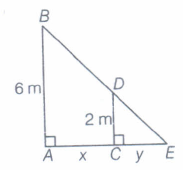
Given that
\( \frac{d x}{d t}=6 \mathrm{~km} / \mathrm{h}, A B=6 \mathrm{~m}=\frac{6}{1000} \mathrm{~km} \text { and }\)
\( C D=2 \mathrm{~m}=\frac{2}{1000} \mathrm{~km}[\because 1 \mathrm{~km}=1000 \mathrm{~m}] \)
Here,\(\Delta B A E \sim \Delta D C E\)
\( \Rightarrow \frac{6}{\frac{1000}{2}}{\frac{1000}{y}}=\frac{x+y}{y} \Rightarrow 3=\frac{x+y}{y}\)
\( \Rightarrow 3 y =x+y \Rightarrow 3 y-y=x \Rightarrow 2 y=x \)
On differentiating both sides w.r.t. t, we get
\(2 \frac{d y}{d t}=\frac{d x}{d t} \)
\( \Rightarrow 2 \frac{d y}{d t}=6 \quad\left[\because \frac{d x}{d t}=6\right] \)
\(\Rightarrow \frac{d y}{d t}=\frac{6}{2}=3 \mathrm{~km} / \mathrm{h}\)
18.
The given curve is : x = 1 \(cos\theta ,y-=\theta -sin\theta \)
\(\therefore \frac { dx }{ d\theta } =sin\theta ,\frac { dy }{ d\theta } =1-cos\theta \)
\(\therefore \frac { dy }{ dx } =\frac { dy/d\theta }{ dx/d\theta } =\frac { 1-cos\theta }{ sin\theta } =\frac { 2sin^{ 2 }\frac { \theta }{ 2 } }{ 2sin\frac { \theta }{ 2 } cos\frac { \theta }{ 2 } } \)
\(=\frac { sin\frac { \theta }{ 2 } }{ cos\frac { \theta }{ 2 } } =tan\frac { \theta }{ 2 } \)
At \(\theta \) \(=\frac { \pi }{ 4 } \) \(x=1-cos\frac { \pi }{ 4 } =1-\frac { 1 }{ \sqrt { 2 } } \)
\(y=\frac { \pi }{ 4 } -sin\frac { \pi }{ 4 } =\frac { 1 }{ \sqrt { 2 } } \)
and \(\frac { dy }{ dx } =tan\frac { \pi }{ 8 } \)
19.
(a)
12
20.
Let A be the area and \(\theta\) be the sector angle. Then
\(
A=\frac{1}{2} \times 30^{2} \times \theta=450 \theta \\
\frac{d A}{d \theta}=450
\)
Let \(\Delta \theta\) be an error in \(\theta \text { and } \Delta A\) be the corresponding error in A.
Then,\(\Delta A=\frac{d A}{d \theta} \Delta \theta\)
\(\begin{array}{ll}
\Rightarrow & \Delta A=450 \times \frac{\pi}{180} \quad\left[\because \Delta \theta=1^{\circ}=\frac{\pi}{180} \text { radians }\right] \\
\Rightarrow & \Delta A=2.5 \pi \mathrm{cm}^{2}
\end{array}\)
21.
We have
\(f(x)=x^{2}+2 x-8, x \in[-4,2]\)
Rolle'stheorem is satisfied
\(\therefore f^{\prime}(c)=0 \)
\(\Rightarrow f^{\prime}(c)=2 c+2=0 \)
\(c+1=0 \Rightarrow c=-1 \)
22.
(a)
n2y
23.
(b)
\(|A| \neq 0\)
24.
(b)
unique solution
25.
\(\tan ^{-1} x+\tan ^{-1} y=\tan ^{-1}\left(\frac{x+y}{1-x y}\right)\)
26.
Consider \(((f \cdot g) o h)(x)\)
\(=(f \cdot g)(h(x))=f(h(x)) \cdot g(h(x))\)
\(=(f o h)(x) \cdot(g o h)(x)\)
\(=\{(f o h) \cdot(g o h)\}(x)\)
\(\text { Hence, }(f \cdot g) o h=(f o h) \cdot(g o h)\)
Now, consider \(((f+g) o h)(x)=(f+g)(h(x))\)
\(=f(h(x))+g(h(x))=(\text { foh })(x)+(\text { goh })(x)\)
\(=\{(f o h)+(g o h)\}(x) \)
Hence \((f+g) o h=f o h+g o h\)
27.
(b)
-2
28.
(b)
x – y = 0
29.
(i) (a) : Let \(\begin{equation} y=\cos \sqrt{x} \end{equation}\)
\(\begin{equation} \therefore \quad \frac{d y}{d x}=\frac{d}{d x}(\cos \sqrt{x})=-\sin \sqrt{x} \cdot \frac{d}{d x}(\sqrt{x}) \end{equation}\)
\(\begin{equation} =-\sin \sqrt{x} \times \frac{1}{2 \sqrt{x}}=\frac{-\sin \sqrt{x}}{2 \sqrt{x}} \end{equation}\)
(ii) (a) : Let \(\begin{equation} y=7^{x+\frac{1}{x}} \quad \therefore \quad \frac{d y}{d x}=\frac{d}{d x}\left(7^{x+\frac{1}{x}}\right) \end{equation}\)
\(\begin{equation} =7^{x+\frac{1}{x}} \cdot \log 7 \cdot \frac{d}{d x}\left(x+\frac{1}{x}\right)=7^{x+\frac{1}{x}} \cdot \log 7 \cdot\left(1-\frac{1}{x^{2}}\right) \end{equation}\)
\(\begin{equation} =\left(\frac{x^{2}-1}{x^{2}}\right) \cdot 7^{x+\frac{1}{x}} \cdot \log 7 \end{equation}\)
(iii) (a) : Let \(\begin{equation} y=\sqrt{\frac{1-\cos x}{1+\cos x}}=\sqrt{\frac{1-1+2 \sin ^{2} \frac{x}{2}}{2 \cos ^{2} \frac{x}{2}-1+1}}=\tan \left(\frac{x}{2}\right) \end{equation}\)
\(\begin{equation} \therefore \frac{d y}{d x}=\sec ^{2} \frac{x}{2} \cdot \frac{1}{2}=\frac{1}{2} \sec ^{2} \frac{x}{2} \end{equation}\)
(iv) (b) : Let \(\begin{equation} y=\frac{1}{b} \tan ^{-1}\left(\frac{x}{b}\right)+\frac{1}{a} \tan ^{-1}\left(\frac{x}{a}\right) \end{equation}\)
\(\begin{equation} \therefore \quad \frac{d y}{d x}=\frac{1}{b} \times \frac{1}{1+\frac{x^{2}}{b^{2}}} \times \frac{1}{b}+\frac{1}{a} \times \frac{1}{1+\frac{x^{2}}{a^{2}}} \times \frac{1}{a} \end{equation}\)
\(\begin{equation} =\frac{1}{b^{2}+x^{2}}+\frac{1}{a^{2}+x^{2}} \end{equation}\)
(v) (d) : Let \(\begin{equation} y=\sec ^{-1} x+\operatorname{cosec}^{-1} \frac{x}{\sqrt{x^{2}-1}} \end{equation}\)
Put \(\begin{equation} x=\sec \theta \Rightarrow \theta=\sec ^{-1} x \end{equation}\)
\(\begin{equation} \therefore \quad y=\sec ^{-1}(\sec \theta)+\operatorname{cosec}^{-1}\left(\frac{\sec \theta}{\sqrt{\sec ^{2} \theta-1}}\right) \end{equation}\)
\(\begin{equation} =\theta+\sin ^{-1}\left[\sqrt{1-\cos ^{2} \theta}\right] \end{equation}\)
\(\begin{equation} =\theta+\sin ^{-1}(\sin \theta)=\theta+\theta=2 \theta=2 \sec ^{-1} x \end{equation}\)
\(\begin{equation} \therefore \quad \frac{d y}{d x}=2 \frac{d}{d x}\left(\sec ^{-1} x\right)=2 \times \frac{1}{|x| \sqrt{x^{2}-1}}=\frac{2}{|x| \sqrt{x^{2}-1}} \end{equation}\)
30.
(i) (d) : Let be the area of the triangle then,
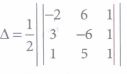
\(\begin{equation} =\frac{1}{2}|-2(-6-5)-6(3-1)+1(15+6)| \end{equation}\) [Expanding along R1]
\(\begin{equation} \Rightarrow \quad \Delta=\frac{1}{2}|43-12|=15.5 \mathrm{sq} . \text { units } \end{equation}\)
(ii) (d) : The given points are collinear.
\(\begin{equation} \therefore \frac{1}{2}\left|\begin{array}{ccc} 2 & -3 & 1 \\ k & -1 & 1 \\ 0 & 4 & 1 \end{array}\right|=0 \end{equation}\)
Expanding along R1',we get
\(\begin{equation} 2(-1-4)+3(k)+1(4 k)=0 \end{equation}\)
\(\begin{equation} \Rightarrow 7 k-10=0 \Rightarrow k=\frac{10}{7} \Rightarrow 4 k=\frac{40}{7} \end{equation}\)
(iii) (a) : Area of \(\begin{equation} \Delta A B C=3 \text { sq. units } \end{equation}\) [Given]
\(\begin{equation} \Rightarrow \frac{1}{2}\left|\begin{array}{lll} 1 & 3 & 1 \\ 0 & 0 & 1 \\ k & 0 & 1 \end{array}\right|=\pm 3 \Rightarrow\left|\begin{array}{lll} 1 & 3 & 1 \\ 0 & 0 & 1 \\ k & 0 & 1 \end{array}\right|=\pm 6 \end{equation}\)
\(\begin{equation} \Rightarrow 1(0-0)-3(0-k)+1(0-0)=\pm 6 \end{equation}\)
\(\begin{equation} \Rightarrow 3 k=\pm 6 \Rightarrow k=\pm 2 . \end{equation}\)
(iv) (a) : Let Q(x, y) be any point on the line joining
A(1, 2) and B(3, 6). Then, area of \(\begin{equation} \Delta A B Q=0 \end{equation}\)
\(\begin{equation} \Rightarrow \frac{1}{2}\left|\begin{array}{lll} 1 & 2 & 1 \\ 3 & 6 & 1 \\ x & y & 1 \end{array}\right|=0 \end{equation}\)
\(\begin{equation} \Rightarrow 1(6-y)-2(3-x)+1(3 y-6 x)=0 \end{equation}\)
\(\begin{equation} \Rightarrow 6-y-6+2 x+3 y-6 x=0 \end{equation}\)
\(\begin{equation} \Rightarrow-4 x=-2 y \Rightarrow 2 x=y \end{equation}\)
(v) (c) : Area of ΔABC is given by
\(\begin{equation} \frac{1}{2}\left|\begin{array}{rrr} 11 & 7 & 1 \\ 5 & 5 & 1 \\ -1 & 3 & 1 \end{array}\right|=\frac{1}{2}[11(5-3)-7(5+1)+1(15+5)] \end{equation}\)
\(\begin{equation} =\frac{1}{2}[22-42+20]=0 \end{equation}\)
\(\therefore\) Points are collinear

12th Standard CBSE Syllabus & Materials
12th Standard CBSE
CBSE 12th Computer Science Python Revision Tour I - New Previous year Question Papers Study Material - QB365 Set A
NEW12th Standard CBSE
CBSE 12th Business Studies Planning Important Questions And Answers Study Material - QB365 Set A
NEW12th Standard CBSE
CBSE 12th Business Studies Business Environment Important Questions And Answers Study Material - QB365 Set A
NEW12th Standard CBSE
CBSE 12th Business Studies Principles of Management Important Questions And Answers Study Material - QB365 Set A



NCERT Books

Syllabus

Exam Pattern

Sample Question Papers

Previous year Question Papers

Important Notes

MCQ Practice test

NCERT Exemplers

Case study Questions

Image Based Questions

Passage based Questions

HOT Questions

Value Based Questions

Model Questions Papers
NCERT ( Book Back ) Questions

Assertion and Reason
Important Questions And Answers

CBSE 12th Standard CBSE Subjects
CBSE Standards








