
 100% FREE ACCESS
12th Standard CBSE Syllabus & Materials
12th Standard CBSE
CBSE 12th Economics Government Budget and the Economy Previous year Question Papers Study Material - QB365 Set A
NEW12th Standard CBSE
CBSE 12th Computer Science Interface Python with MySQL - New Previous year Question Papers Study Material - QB365 Set A
NEW12th Standard CBSE
CBSE 12th Computer Science Database Concept - New Previous year Question Papers Study Material - QB365 Set A
NEW12th Standard CBSE
CBSE 12th Computer Science Data Communication - New Previous year Question Papers Study Material - QB365 Set A
NEW12th Standard CBSE
CBSE 12th Computer Science Data Structures - New Previous year Question Papers Study Material - QB365 Set A
NEW12th Standard CBSE
CBSE 12th Computer Science Functions - New Previous year Question Papers Study Material - QB365 Set A

Published on: 25/10/2025
Download CBSE Class 12th Standard CBSE Maths question papers, sample papers, important questions, and previous year solved papers in PDF format. Get free study materials, NCERT solutions, and exam preparation resources for Class 12th Standard CBSE Maths
Questions + Answers key
Take MCQ Maths Test
1.
A speaks truth in 80% cases and B speaks truth in 90% cases, In what percentage of cases are they likely to agree with each other in stating the same fact?
2.
Given two independent events A and B such that P(A) = 0.3 and P(B) = 0.6, find \(P\left(A^{\prime} \cap B^{\prime}\right)\).
3.
Find the projection of the vector \(\hat{i}+3 \hat{j}+7 \hat{k}\) on the vector \(2 \hat{i}-3 \hat{j}+6 \hat{k}\).
4.
Give an example of two non - Zero matrices A and B such that AB =0 but BA \(\neq \) 0
5.
Write the direction cosines of a line equally inclined to the three coordinate axes.
6.
For what value of \(\lambda\) are the vectors \(\overrightarrow { a } =2\overrightarrow { i } +\lambda \overrightarrow { j } +\overrightarrow { k } \) and \(\overrightarrow { b } =\overrightarrow { i } -2\overrightarrow { j } +3\overrightarrow { k } \) perpendicular to each other?
7.
Write the adjoint of the following matrix \(\begin{bmatrix} 2 & -1 \\ 4 & 3 \end{bmatrix}\)
8.
Find the value of x, y, z and w which satisfy the matrix equation \(\left[\begin{array}{cc} x+2 & 2 y+x \\ z-4 & 4 w-6 \end{array}\right]=\left[\begin{array}{cc} 0 & -7 \\ 3 & w \end{array}\right]\)
9.
If \(P(A)=\frac{6}{11}, P(B)=\frac{5}{11}\) and \(P(A \cup B)=\frac{7}{11}\), then find \( P(A \cap B)\)
10.
Find the shortest distance between the lines \(r=(4 \hat{i}-\hat{j})+\lambda(\hat{i}+2 \hat{j}-3 k)\) and \(r=(\hat{i}-\hat{j}+2 \hat{k})+\mu(2 \hat{i}+4 \hat{j}-5 \hat{k})\)
11.
Find the angle between the pair of lines given by:
\(\vec { r } =3\hat { i } +2\hat { j } -4\hat { k } +\lambda (\hat { i } +2\hat { j } +2\hat { k } )\ and \ \vec { r } =5\hat { i } -2\hat { j } +\lambda (3\hat { i } +2\hat { j } +6\hat { k } )\)
12.
Given that E and F are events such that:
P(E) = 0.6, P(F) = 0.3 and \(P(E\cap F)\) = 0.2 find P(E|F) and P(F|E).
13.
Find the co - factors of the elements of the determinant: \(\left| \begin{matrix} 2 & -3 & 5 \\ 6 & 0 & 4 \\ 1 & 5 & -7 \end{matrix} \right| \) and verify that a11 A31 + a12 A32 + a13 A33 = 0.
14.
If \(\overrightarrow { a } =\hat { i } +\hat { j } +2\hat { k } \quad \overrightarrow { b } =3\hat { i } +2\hat { j } -\hat { k }\) find \( (\hat { a } +3\hat { b } ).(2\hat { a } -\hat { b } )\)
15.
Show that the points A, B, C with position vectors \(2 \hat{i}-\hat{j}+\hat{k}, \hat{i}-3 \hat{j}-5 \hat{k} \text { and } 3 \hat{i}-4 \hat{j}-4 \hat{k}\) respectively, are the vertices of a right-angled triangle. Hence, find the area of the triangle.
16.
If \(\vec{a}=\hat{i}+2 \hat{j}+3 \hat{k} \text { and } \vec{b}=2 \hat{i}+4 \hat{j}-5 \hat{k}\) represent two adjacent sides of a parallelogram, find unit vectors parallel to the diagonals of the parallelogram.
17.
Find the vector and cartesian equation of the line through the point (1, 2, -4) and perpendicular to the two lines
\(\begin{aligned}
& \vec{r}=(8 \hat{i}-19 \hat{j}+10 \hat{k})+\lambda(3 \hat{i}-16 \hat{j}+7 \hat{k})
\end{aligned}\)
and \(\begin{aligned}
\vec{r}=(15 \hat{i}+29 \hat{j}+5 \hat{k})+\mu(3 \hat{i}+8 \hat{j}-5 \hat{k})
\end{aligned}\)
18.
Find the product of the matrices \(\left[\begin{array}{ccc}
1 & 2 & -3 \\
2 & 3 & 2 \\
3 & -3 & -4
\end{array}\right]\left[\begin{array}{ccc}
-6 & 17 & 13 \\
14 & 5 & -8 \\
-15 & 9 & -1
\end{array}\right]\) and hence solve the system of linear equations
x + 2y - 3z = -4
2x + 3y + 2z = 2
3x - 3y - 4z = 11
19.
Define skew lines. Using only vector approach, find the shortest distance between the following two skew lines
\(\overset { \rightarrow }{ r } =(8+3\lambda )\hat { i } -(9+16\lambda )\hat { j } +(10+7\lambda )\hat { k } \)
and \(\overset { \rightarrow }{ r } =15\hat { i } +29\hat { j } +5\hat { k } +\mu (3\hat { i } +8\hat { j } -5\hat { k } )\)
20.
A bag contains 4 red and 4 black balls, another bag contains 2 red and 6 black balls. One of the two bags is selected at random and two balls are drawn at random (without replacement) from the bag which are both found to be red. Find the probability that the balls are drawn from the first bag.
21.
An amount of Rs. 6500 is invested in three investments at the rate of 6%, 8% and 9% per annum respectively.The total annual income is Rs. 4800.The income from the third instalment is Rs.600 more than the income from the second investment.
(i) Represent the above situation by matrix equation and form linear equations using matrix multiplication.
(ii) Is it possible to solve the system of equations, so obtained, using matrices?
(iii) A company invites investments.It promises to return double the money after a period of 3 years.Will you like to invest in the company
22.
An urn contains 6 balls of which two are red and four are black. Two balls are drawn at random. Probability that they are of the different colours is
\(\frac{2}{5}\)
\(\frac{1}{15}\)
\(\frac{8}{15}\)
\(\frac{4}{15}\)
23.
If A and B are two events such that P(A) =0.2, P(B) =0.4 and P(A U B) = 0.5, then value of P(A /B) is?
0.1
0.25
0.5
0.08
24.
The scalar projection of the vector \(3 \hat{i}-\hat{j}-2 \hat{k}\) on the vector \(\hat{i}+2 \hat{j}-3 \hat{k}\) is
\(\frac{7}{\sqrt{14}}\)
\(\frac{7}{14}\)
\(\frac{6}{13}\)
\(\frac{7}{2}\)
25.
In \(\Delta\)ABC, \(\overrightarrow{A B}=\hat{i}+\hat{j}+2 \hat{k}\) and \(\overrightarrow{A C}=3 \hat{i}-\hat{j}+4 \hat{k}\). If D is mid-point of BC, then vector \(\overrightarrow{A D}\) is equal to
\(4 \hat{i}+6 \hat{k}\)
\(2 \hat{i}-2 \hat{j}+2 \hat{k}\)
\(\hat{i}-\hat{j}+\hat{k}\)
\(2 \hat{i}+3 \hat{k}\)
26.
If A and B are invertible square matrices of the same order, then which of the following is not correct?
\(adj A=|A| \cdot A^{-1}\)
\(\operatorname{det}\left(A^{-1}\right)=[\operatorname{det}(A)]^{-1}\)
\((A B)^{-1}=B^{-1} A^{-1}\)
\((A+B)^{-1}=B^{-1}+A^{-1}\)
27.
The events \(E_{1}, E_{2}, \ldots, E_{n}\) represent a partition of the sample space S, if
\(E_{i} \cap E_{j}=\phi, i \neq j, i, j=1,2,3, \ldots, n\)
\(E_{1} \cup E_{2} \cup \ldots \cup E_{n}=S\)
\(P\left(E_{i}\right)>0 \text { for all } i=1,2,3, \ldots, n\)
All of the above
28.
By rule of multiplication of probability \(P(E \cap F)\) is equal to
P(E)· P(F / E)
P(F)· P(E / F)
Both (a) and (b)
None of these
29.
If \(\vec{a} \cdot \vec{b}=0 \text { and } \vec{a} \times \vec{b}=0\), then
\(|\vec{a}|=0\)
\(|\vec{b}|=0\)
Both (a) and (b) are true
Either \(|\vec{a}|=0 \text { or }|\vec{b}|=0\)
30.
If area of a triangle is 35 sq. units with vertices (2, - 6), (5, 4) and (k, 4),then k is
12
-2
-12, -2
12, -2
31.
If \(\left[\begin{array}{cc}2 x+y & 4 x \\ 5 x-7 & 4 x\end{array}\right]=\left[\begin{array}{cc}7 & 7 y-13 \\ y & x+6\end{array}\right]\), then
x = 3, y = 1
x = 2, y = 3
x = 2, y = 4
x = 3, y = 3
32.
The product \(\left[\begin{array}{rr} a & b \\ -b & a \end{array}\right]\left[\begin{array}{rr} a & -b \\ b & a \end{array}\right]\) is equal to
\(\left[\begin{array}{cc}a^{2}+b^{2} & 0 \\ 0 & a^{2}+b^{2}\end{array}\right]\)
\(\left[\begin{array}{ll}(a+b)^{2} & 0 \\ (a+b)^{2} & 0\end{array}\right]\)
\(\left[\begin{array}{ll}a^{2}+b^{2} & 0 \\ a^{2}+b^{2} & 0\end{array}\right]\)
\(\left[\begin{array}{ll}a & 0 \\ 0 & b\end{array}\right]\)
33.
If a line makes angles 45°, 150°, 135°, with x, y and z-axes respectively, find its direction cosines.
\(\frac { 1 }{ \sqrt { 2 } } ,-\frac { \sqrt { 3 } }{ 2 } ,\frac { 1 }{ \sqrt { 2 } } \)
\(\frac { 1 }{ \sqrt { 2 } } ,\frac { \sqrt { 3 } }{ 2 } ,\frac { 1 }{ \sqrt { 2 } } \)
\(\frac { 1 }{ \sqrt { 2 } } ,-\frac { 1 }{ 2 } ,-\frac { \sqrt { 3 } }{ \sqrt { 2 } } \)
\(\frac { 1 }{ \sqrt { 2 } } ,\frac { \sqrt { 3 } }{ 2 } ,-\frac { 1 }{ \sqrt { 2 } } \)
34.
A vector of magnitude 14 units, which is parallel to the \(\widehat { i } +2\widehat { j } -3\widehat { k } \) vector
\(\frac { (\widehat { i } +2\widehat { j } -3\widehat { k } ) }{ 14 } \)
\(\frac { (\widehat { i } +2\widehat { j } -3\widehat { k } ) }{ \sqrt{14 } }\)
\(\sqrt { 14 } (\widehat { i } +2\widehat { j } -3\widehat { k } )\)
14\((\widehat { i } +2\widehat { j } -3\widehat { k } )\)
35.
The unit vector in the direction of \(\overrightarrow { AB } \), where A and B are the points (2, – 3, 7) and (1, 3, – 4) is:
\(\frac { -\widehat { i } +6\widehat { j } -11\widehat { k } }{ \sqrt { 158 } } \)
\(\frac { \widehat { i } +6\widehat { j } +11\widehat { k } }{ \sqrt { 158 } } \)
\(\frac { \widehat { i } -6\widehat { j } +11\widehat { k } }{ \sqrt { 158 } } \)
\(\frac { -\widehat { i } -11\widehat { k } }{ \sqrt { 122 } } \)
36.
The value of \(\widehat { i } .(\widehat { j } \times \widehat { k } )\) + \(\widehat { j } .(\widehat { i } \times \widehat { k } )\)+\(\widehat { k } .(\widehat { i } \times \widehat { j } )\) is
0
-1
1
3
37.
If the direction cosines of a line are \(\frac{k}{3}\), \(\frac{k}{3}\), \(\frac{k}{3}\) then value of k is
k > 0
0 < k < 1.
k = \(\frac13\)
k = ± 73
38.
If \(\begin{vmatrix} 2x & -1 \\ 4 & 2 \end{vmatrix}=\begin{vmatrix} 3 & 0 \\ 2 & 1 \end{vmatrix}\) then x is
3
\(\frac { 2 }{ 3 } \)
\(\frac { 3 }{ 2 } \)
\(-\frac { 1 }{ 4 } \)
39.
If A is a square matrix such that A²=A, then (I + A)² – 3A is
I
2A
3I
A
40.
Gaurav purchased 5 pens, 3 bags and 1 instrument box and pays Rs. 16. From the same shop, Dheeraj purchased 2 pens, 1 bag and 3 instrument boxes and pays Rs. 19, while Ankur purchased 1 pen, 2 bags and 4 instrument boxes and pays Rs. 25.
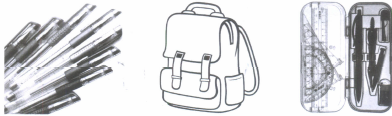
Using the concept of matrices and determinants, answer the following questions.
(i) The cost of one pen is
| (a) Rs. 2 | (b) Rs. 5 | (c) Rs. 1 | (d) Rs. 3 |
(ii) What is the cost of one pen and one bag?
| (a) Rs. 3 | (b) Rs. 5 | (c) Rs. 7 | (d) Rs. 8 |
(iii) What is the cost of one pen and one instrument box?
| (a) Rs. 7 | (b) Rs. 6 | (c) Rs. 8 | (d) Rs. 9 |
(iv) Which of the following is correct?
| (a) Determinant is a square matrix. | (b) Determinant is a number associated to a matrix |
| (c) Determinant is a number associated to a square matrix | (d) All of the above |
(v) From the matrix equation AB = AC, it can be concluded that B = C provided
| (a) A is singular | (b) A is non-singular | (c) A is symmetric | (d) A is square |
41.
Consider the following diagram, where the forces in the cable are given.
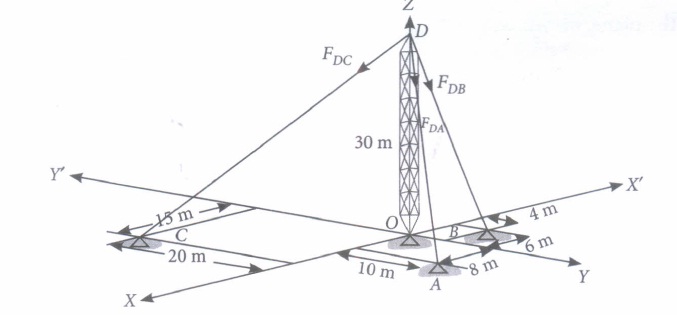
(i) The equation of line along the cable AD is
| (a) \(\frac{x}{5}=\frac{y}{4}=\frac{z-30}{15}\) | (b) \(\frac{x}{4}=\frac{y}{5}=\frac{z-30}{15}\) | (c) \(\frac{x}{5}=\frac{y}{4}=\frac{30-z}{15}\) | (d) \(\frac{x}{4}=\frac{y}{5}=\frac{30-z}{15}\) |
(ii) The length of cable DC is
| (a) \(4 \sqrt{61} \mathrm{~m}\) | (b) \(5 \sqrt{61} \mathrm{~m}\) | (c) \(6\sqrt{61} \mathrm{~m}\) | (d) \(7 \sqrt{61} \mathrm{~m}\) |
(iii) The vector DB is
| (a) \(-6 \hat{i}+4 \hat{j}-30 \hat{k}\) | (b) \(6 \hat{i}-4 \hat{j}-30 \hat{k}\) | (c) \(6 \hat{i}+4 \hat{j}+30 \hat{k}\) | (d) none of these |
(iv) The sum of vectors along the cables, is
| (a) \(17 \hat{i}+6 \hat{j}+90 \hat{k}\) | (b) \(17 \hat{i}-6 \hat{j}-90 \hat{k}\) | (c) \(17 \hat{i}+6 \hat{j}-90 \hat{k}\) | (d) none of these |
(v) The sum of distances of points A, Band C from the origin, i.e., OA + OB + OC, is
| (a) \(\sqrt{164}+\sqrt{52}+\sqrt{625}\) | (b) \(\sqrt{52}+\sqrt{625}+\sqrt{48}\) | (c) \(\sqrt{164}+\sqrt{625}+\sqrt{49}\) | (d) none of these |
42.
In a wedding ceremony, consists of father, mother, daughter and son line up at random for a family photograph, as shown in figure.
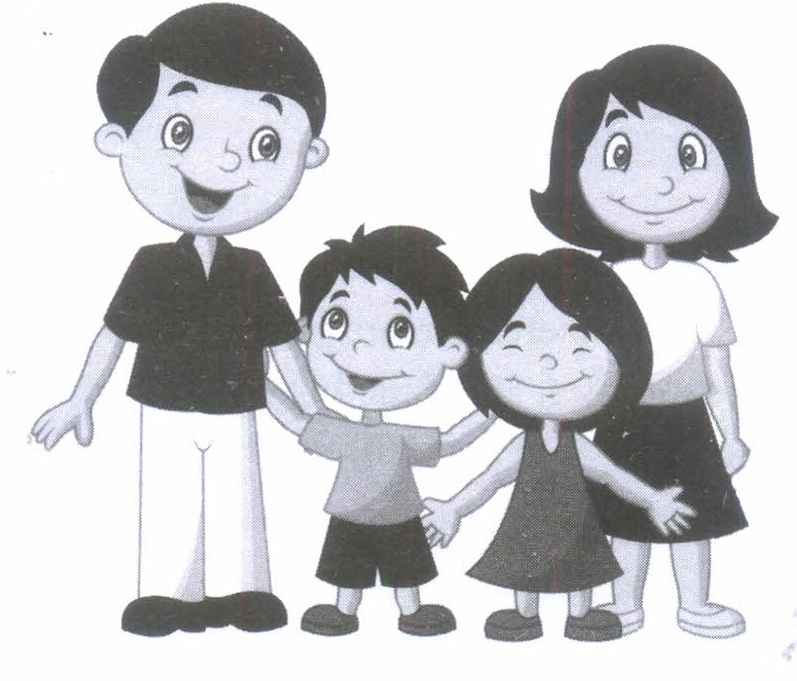
Based on the above information, answer the following questions.
(i) Find the probability that daughter is at one end, given that father and mother are in the middle.
| (a) 1 | (b) \(\frac{1}{2}\) | (c) \(\frac{1}{3}\) | (d) \(\frac{2}{3}\) |
(ii) Find the probability that mother is at right end, given that son and daughter are together.
| (a) \(\frac{1}{2}\) | (b) \(\frac{1}{3}\) | (c) \(\frac{1}{4}\) | (d) 0 |
(iii) Find the probability that father and mother are in the middle, given that son is at right end.
| (a) \(\frac{1}{4}\) | (b) \(\frac{1}{2}\) | (c) \(\frac{1}{3}\) | (d) \(\frac{2}{3}\) |
(iv) Find the probability that father and son are standing together, given that mother and daughter are standing together.
| (a) 0 | (b) 1 | (c) \(\frac{1}{2}\) | (d) \(\frac{2}{3}\) |
(v) Find the probability that father and mother are on either of the ends, given that son is at second position from the right end.
| (a) \(\frac{1}{3}\) | (b) \(\frac{2}{3}\) | (c) \(\frac{1}{4}\) | (d) \(\frac{2}{5}\) |
43.
Two coins are tossed once.
Assertion (A) If E : tail appears on one coin and F : one coin shows head, then P(E/F) is 1.
Reason (R) If E : no tail appears and F : no head appears, then P(E/F) is 0.
(a) Both A and R are correct; R is the correct explanation of A
(b) Both A and R are correct; R is not the correct explanation of A
(c) A is correct; R is incorrect
(d) R is correct; A is incorrect
44.
Assertion: The adjacent sides of a parallelogram are along \(\vec{a}=\hat{i}+2\hat{j}\) and \(\vec{b}=2\hat{i}+\hat{j}\). The angle between the diagonal is 150°.
Reason: Two vectors are perpendicular to each other if their dot product is zero.
(a) Assertion is correct, Reason is correct; Reason is a correct explanation for assertion.
(b) Assertion is correct, Reason is correct; Reason is not a correct explanation for Assertion
(c) Assertion is correct, Reason is incorrect
(d) Assertion is incorrect, Reason is correct.
1.
Let AT : Event that A speaks truth
and BT : Event that B speaks truth.
Given, \(\begin{aligned} P\left(A_T\right)=\frac{80}{100}=\frac{4}{5} \end{aligned}\)
\(\begin{aligned} P\left(B_T\right)=\frac{90}{100}=\frac{9}{10} \end{aligned}\)
P(agree) = P(both speaking truth or both telling lie)
\(\begin{aligned} =P\left(A_T B_T \text { or } \bar{A}_T \bar{B}_T\right) \end{aligned}\)
\(\begin{aligned} =P\left(A_T\right) P\left(B_T\right) \text { or } P\left(\bar{A}_T\right) P\left(\bar{B}_T\right) \end{aligned}\)
\(\begin{aligned} =\left(\frac{4}{5}\right)\left(\frac{9}{10}\right)+\left(\frac{1}{5}\right)\left(\frac{1}{10}\right) \end{aligned}\)
\(\begin{aligned} =\frac{36+1}{50}=\frac{37}{50}=\frac{74}{100}=74 \% \end{aligned}\)
2.
Given, P(A) = 0.3 and P(B) = 0.6
Now, \(\begin{aligned}
P\left(A^{\prime} \cap B^{\prime}\right) & =P(A \cup B)^{\prime}
\end{aligned}\)
\(\begin{aligned}
=1-P[A \cup B]
\end{aligned}\)
\(\begin{aligned}
=1-[P(A)+P(B)-P(A \cap B)]
\end{aligned}\)
\(\begin{aligned}
=1-\{0.3+0.6-0.3 \times 0.6\}
\end{aligned}\)
[\(\because\) A and B are independent events \(\therefore P(A \cap B)=P(A) P(B)]\)
= 1- {0.9 - 0.18}
= 1 - {0.72} = 0.28
3.
= 5
4.
\(A=\left[ \begin{matrix} 1 & 0 \\ 0 & 1 \end{matrix} \right] \ B=\left[ \begin{matrix} 0 & 0 \\ 1 & 0 \end{matrix} \right] \)
5.
Direction cosines are \({\pm {1\over \sqrt3}},{\pm {1\over \sqrt3}},{\pm {1\over \sqrt3}}\)
6.
\(\text { If } a \text { and } \vec{b} \text { are perpendicular, then } \vec{a} \cdot \vec{b}=0\)
\(\Rightarrow 2-2 \lambda+3=0 \Rightarrow \lambda=\frac{5}{2}\)
7.
\(\text { If } A=\left[\begin{array}{ll} a & b \\ c & d \end{array}\right], \text { then adj } A=\left[\begin{array}{rr} d & -b \\ -c & a \end{array}\right] \text { . }\)
So, Adj \(A=\begin{bmatrix} 3 & 1 \\ -4 & 2 \end{bmatrix}\)
8.
Using equality of matrices, we have
\(x+2=0, \quad 2 y+x=-7, \quad z-4=3 \text { and } 4 w-6=w \)
\(\Rightarrow x=-2, \quad 2 y-2=-7 \)
\(\Rightarrow y=-\frac{5}{2}, z=7 \text { and } w=2 \)
9.
\(P(A \cup B)=P(A)+P(B)-P(A \cap B)\)
\(\Rightarrow \frac{7}{11}=\frac{6}{11}+\frac{5}{11}-P(A \cap B)\)
\(\Rightarrow P(A \cap B)=\frac{6}{11}+\frac{5}{11}-\frac{7}{11}\)
\(\therefore P(A \cap B)=\frac{4}{11}\)
10.
Given equation of lines are
\(r=(4 \hat{i}-\hat{j})+\lambda(\hat{i}+2 \hat{j}-3 \hat{k})\) ..(i)
and \(r=(\hat{i}-\hat{j}+2 \hat{k})+\mu(2 \hat{i}+4 \hat{j}-5 \hat{k})\) ...(ii)
On comparing Eqs. (i) and (ii) with \(r=a_{1}+\lambda b_{1}\) and \(r=a_{2}+\mu b_{2}\) respectively, we get
and \(a_{2}=\hat{i}-\hat{j}+2 \hat{k}, b_{2}=2 \hat{i}+4 \hat{j}-5 \hat{k}\)
Here \(a_{2}-a_{1}=-3 \hat{i}+2 \hat{k}\)
and \(b_{1} \times b_{2}=\left|\begin{array}{ccc} \hat{i} & \hat{j} & \hat{k} \\ 1 & 2 & -3 \\ 2 & 4 & -5 \end{array}\right|\)
\(=\hat{i}(-10+12)-\hat{j}(-5+6)+\hat{k}(4-4)\)
\(=2 \hat{i}-\hat{j}\)
\(\Rightarrow \left|b_{1} \times b_{2}\right|=\sqrt{2^{2}+(-1)^{2}}=\sqrt{4+1}=\sqrt{5}\)
Now, the shortest distance between the given lines is given by
\(d=\frac{\left|\left(b_{1} \times b_{2}\right) \cdot\left(a_{2}-a_{1}\right)\right|}{\left|b_{1} \times b_{2}\right|}=\frac{|(2 \hat{i}-\hat{j}) \cdot(-3 \hat{i}+2 \hat{k})|}{\sqrt{5}}\)
\(=\frac{|-6|}{\sqrt{5}}=\frac{6}{\sqrt{5}} \text { units }\)
11.
\(\text { Here } \vec{b}_{1}=\hat{i}+2 \hat{j}+2 \hat{k} \text { and } \vec{b}_{2}=3 \hat{i}+2 \hat{j}+6 \hat{k}\)
\(\text { The angle } \theta \text { between the two lines is given by }\)
\(\cos \theta =\left|\frac{\vec{b}_{1} \cdot \vec{b}_{2}}{\left|\vec{b}_{1}\right|\left|\vec{b}_{2}\right|}\right|=\left|\frac{(\hat{i}+2 \hat{j}+2 \hat{k}) \cdot(3 \hat{i}+2 \hat{j}+6 \hat{k})}{\sqrt{1+4+4} \sqrt{9+4+36}}\right| \\ \)
\(=\left|\frac{3+4+12}{3 \times 7}\right|=\frac{19}{21} \)
\(\text { Hence }\theta=\cos ^{-1}\left(\frac{19}{21}\right) \)
12.
(i) \(P(E/F)=\frac { P(E\cap F) }{ P(F) } =\frac { 0.2 }{ 0.3 } =\frac { 2 }{ 3 } \)
(ii) \(P(F/E)=\frac { P(E\cap F) }{ P(E) } =\frac { 0.2 }{ 0.6 } =\frac { 1 }{ 3 }\)
13.
\(M_{11}=\begin{vmatrix} 0&4\\5&-7\end{vmatrix}=-0-20=-20\)
\(A_{11}=(-1)^{1+1}M_{11}=(-1)^2(-20)=-20\)
\(M_{12}=\begin{vmatrix}6&4\\1&-7 \end{vmatrix}=-42-4=-46\)
\(A_{12}=(-1)^{1+2}M_{12}=(-1)^3(-46)=(-1)(-46)=46\)
\(M_{13}=\begin{vmatrix}6&0\\1&5 \end{vmatrix}=30-0=30\)
\(A_{13}=(-1)^{1+3}M_{13}=(-1)^4(30)=30\)
\(M_{21}=\begin{vmatrix} -3&5\\5&-7\end{vmatrix}=21-25=-4\)
\(A_{21}=(-1)^{ 2+1}M_{21}=(-1)^3(-4=(-1 )(-4)=4)\)
\(M_{22}=\begin{vmatrix} 2&5\\1&-7\end{vmatrix}=-14-15=-19\)
\(A_{22}=(-1)^{2+2}M_{22}=(1)^4(-19)=-19\)
\(M_{23}=\begin{vmatrix} 2&-3\\1&5\end{vmatrix}=10+3=13\)
\(A_{23}=(-1)^{2+3}M_{23}=(-1)^513=-13\)
\(M_{31}=\begin{vmatrix}-3&5\\0&4 \end{vmatrix}=-12-0=-12\)
\(A_{31}=(-1)^{3+1}M_{31}=(-1)^4(-12)=-12\)
\(M_{32}=\begin{vmatrix} 2&5\\6&4\end{vmatrix}=8-30=-22\)
\(A_{32}=(-1)^{3+2}M_{32}=(-1)^5(-22)=(-1)(-22)=22\)
\(M_{33}=\begin{vmatrix} 2&-3\\6&0\end{vmatrix}=0+18=18\)
\(A_{33}=(-1)^{3+3}M_{33}=(-1)^6(18)=18\)
(ii)\(a_{11}A_{31}+a_{12}A_{32}+a_{13}A_{32}\)
\(=(2)(-12)+(-3)(22)+(5)(18)=-24-66+90=0\)
14.
-15
15.
We have,
\(\overrightarrow{A B}\) = (position vector of B) - (position vector of A)
\(=(\hat{i}-3 \hat{j}-5 \hat{k})-(2 \hat{i}-\hat{j}+\hat{k})=-\hat{i}-2 \hat{j}-6 \hat{k}\)
\(\begin{aligned}
\overrightarrow{B C}=(3 \hat{i}-4 \hat{j}-4 \hat{k})-(\hat{i}-3 \hat{j}-5 \hat{k})=2 \hat{i}-\hat{j}+\hat{k}
\end{aligned}\)
and \(\begin{aligned}
\overrightarrow{C A}=(2 \hat{i}-\hat{j}+\hat{k})-(3 \hat{i}-4 \hat{j}-4 \hat{k})
\end{aligned}\)
\(=-\hat{i}+3 \hat{j}+5 \hat{k}\)
Here, \(\overrightarrow{A B}+\overrightarrow{B C}+\overrightarrow{C A}=0\)
\(\Rightarrow\) A, B and C are the vertices of a triangle.
Now, \(\overrightarrow{B C} \cdot \overrightarrow{C A}=(2 \hat{i}-\hat{j}+\hat{k}) \cdot(-\hat{i}+3 \hat{j}+5 \hat{k})\)
= - 2 - 3 + 5 = 0
\(\Rightarrow \overrightarrow{B C} \perp \overrightarrow{C A} \Rightarrow \angle C=90^{\circ}\)
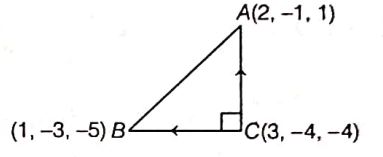
Now, area of \(\Delta A B C=\frac{1}{2}|\overrightarrow{C A} \times \overrightarrow{B C}|\)
\(=\frac{1}{2}\left|\begin{array}{ccc}
\hat{i} & \hat{j} & \hat{k} \\
-1 & 3 & 5 \\
2 & -1 & 1
\end{array}\right|=\frac{1}{2}|(8 \hat{i}-11 \hat{j}-5 \hat{k})|\)
\(=\frac{1}{2} \sqrt{64+121+25}\)
\(=\frac{1}{2} \sqrt{210}\) sq units
16.
We have, \(\vec{a}=\hat{i}+2 \hat{\jmath}+3 \hat{k} \text { and } \vec{b}=2 \hat{i}+4 \hat{\jmath}-5 \hat{k}\)
So, the diagonals of the parallelogram whose adjacent sides are \(\vec{a} \text { and } \vec{b}\) are given by
\(\begin{aligned}
\vec{p} & =\vec{a}+\vec{b} \text { and } \vec{q}=\vec{a}-\vec{b}
\end{aligned}\)
Now, \(\begin{aligned}
\vec{p} & =(\hat{i}+2 \hat{j}+3 \hat{k})+(2 \hat{i}+4 \hat{j}-5 \hat{k})
\end{aligned}\)
\(\begin{aligned}
=3 \hat{i}+6 \hat{j}-2 \hat{k}
\end{aligned}\)
and \(\begin{aligned}
\vec{q} & =(\hat{i}+2 \hat{j}+3 \hat{k})-(2 \hat{i}+4 \hat{j}-5 \hat{k})
\end{aligned}\)
\(\begin{aligned}
=-\hat{i}-2 \hat{j}+8 \hat{k}
\end{aligned}\)
\(\begin{aligned}
\therefore \quad \hat{p} & =\frac{\vec{p}}{|\vec{p}|}=\frac{3 \hat{i}+6 \hat{j}-2 \hat{k}}{\sqrt{9+36+4}}
\end{aligned}\)
\(\begin{aligned}
=\frac{3 \hat{i}+6 \hat{j}-2 \hat{k}}{7}=\frac{3}{7} \hat{i}+\frac{6}{7} \hat{j}-\frac{2}{7} \hat{k}
\end{aligned}\)
and \(\begin{aligned}
\hat{q} & =\frac{\vec{q}}{|\vec{q}|}=\frac{-\hat{i}-2 \hat{j}+8 \hat{k}}{\sqrt{1+4+64}}=\frac{-\hat{i}-2 \hat{j}+8 \hat{k}}{\sqrt{69}}
\end{aligned}\)
\(\begin{aligned}
=\frac{-1}{\sqrt{69}} \hat{i}-\frac{2}{\sqrt{69}} \hat{j}+\frac{8}{\sqrt{69}} \hat{k}
\end{aligned}\)
17.
Given, equations of lines are
\(\begin{aligned}
\vec{r}=(8 \hat{i}-19 \hat{j}+10 \hat{k})+\lambda(3 \hat{i}-16 \hat{j}+7 \hat{k})
\end{aligned}\)
and \(\begin{aligned}
\vec{r}=(15 \hat{i}+29 \hat{j}+5 \hat{k})+\mu(3 \hat{i}+8 \hat{j}-5 \hat{k})
\end{aligned}\)
On comparing with vector form of equation of a line,
i.e., \(\vec{r}=\vec{a}+\lambda \vec{b}\) we get
\(\vec{b}_1=3 \hat{i}-16 \hat{j}+7 \hat{k} \text { and } \vec{b}_2=3 \hat{i}+8 \hat{j}-5 \hat{k}\)
Now, we determine
\(\begin{aligned}
\vec{b} & =\vec{b}_1 \times \vec{b}_2=\left|\begin{array}{rrr}
\hat{i} & \hat{j} & \hat{k} \\
3 & -16 & 7 \\
3 & 8 & -5
\end{array}\right|
\end{aligned}\)
\(=\hat{i}(80-56)-\hat{j}(-15-21)+\hat{k}(24+48) \)
\(=24 \hat{i}+36 \hat{j}+72 \hat{k}=12(2 \hat{i}+3 \hat{j}+6 \hat{k})\)
Since, the required line is perpendicular to the given lines. So, it is parallel to \(\vec{b}_1 \times \vec{b}_2\). Now, the equation of a line passing through the point (1, 2, -4) and parallel to \(24 \hat{i}+36 \hat{j}+72 \hat{k} \text { or }(2 \hat{i}+3 \hat{j}+6 \hat{k})\) is
\(\vec{r}=(\hat{i}+2 \hat{j}-4 \hat{k})+\lambda(2 \hat{i}+3 \hat{j}+6 \hat{k})\)
which is required vector equation of a line.
For cartesian equation, put \(\vec{r}=x \hat{i}+y \hat{j}+z \hat{k}\), we get
\(x \hat{i}+y \hat{j}+z \hat{k}=(1+2 \lambda) \hat{i}+(2+3 \lambda) \hat{j}+(-4+6 \lambda) \hat{k}\)
On comparing the coefficients of \(\hat{i}, \hat{j} \text { and } \hat{k}\), we get
\(\begin{aligned}
x=1+2 \lambda, y=2+3 \lambda \text { and } z=-4+6 \lambda
\end{aligned}\)
\(\begin{aligned}
\Rightarrow \quad \frac{x-1}{2}=\lambda, \frac{y-2}{3}=\lambda \text { and } \frac{z+4}{6}=\lambda
\end{aligned}\)
\(\begin{aligned}
\therefore \quad \frac{x-1}{2}=\frac{y-2}{3}=\frac{z+4}{6}
\end{aligned}\)
which is the required cartesian equation of a line.
Alternate Method
Let the equation of line passing through (1, 2, -4) is
\(\vec{r}=(\hat{i}+2 \hat{j}-4 \hat{k})+\lambda_1\left(b_1 \hat{i}+b_2 \hat{j}+b_3 \hat{k}\right)\) ...(i)
Since, the line (i) is perpendicular to the given lines
\(\begin{aligned}
\vec{r}=(8 \hat{i}-19 \hat{j}+10 \hat{k})+\lambda(3 \hat{i}-16 \hat{j}+7 \hat{k})
\end{aligned}\)
and \(\begin{aligned}
\vec{r}=(15 \hat{i}+29 \hat{j}+5 \hat{k})+\mu(3 \hat{i}+8 \hat{j}-5 \hat{k})
\end{aligned}\)
Therefore, we have
\(\begin{aligned}
\Rightarrow \quad\left(b_1 \hat{i}+b_2 \hat{j}+b_3 \hat{k}\right) \cdot(3 \hat{i}-16 \hat{j}+7 \hat{k})=0
\end{aligned}\)
\(\begin{aligned}
\Rightarrow \quad 3 b_1-16 b_2+7 b_3=0
\end{aligned}\) ...(ii)
\(\begin{aligned}
\text { and } \quad\left(b_1 \hat{i}+b_2 \hat{j}+b_3 \hat{k}\right) \cdot(3 \hat{i}+8 \hat{j}-5 \hat{k})=0 \\
\end{aligned}\)
\(\begin{aligned}
\Rightarrow \quad 3 b_1+8 b_2-5 b_3=0
\end{aligned}\) ...(iii)
[\(\because\) if two lines \(\vec{r}=\vec{a}_1+\lambda \vec{b}_1 \text { and } \vec{r}=\vec{a}_2+\lambda \vec{b}_2\) are perpendicular, then \(\vec{b}_1 \cdot \vec{b}_2=0 .\)]
Now, on solving Eqs. (ii) and (iii), we get
\(\begin{array}{rlrl}
\frac{b_1}{80-56}= \frac{b_2}{21+15}=\frac{b_3}{24+48}
\end{array}\)
\(\begin{array}{rlrl}
\Rightarrow & \frac{b_1}{24} & =\frac{b_2}{36}=\frac{b_3}{72}
\end{array}\)
\(\begin{array}{rlrl}
\Rightarrow & \frac{b_1}{2} & =\frac{b_2}{3}=\frac{b_3}{6}
\end{array}\) [multiplying by 12]
\(\Rightarrow\) b1 = 2k, b2 = 3k and b3 = 6k, for some constant k.
Thus, the required vector equation of line is
\(\vec{r}=(\hat{i}+2 \hat{j}-4 \hat{k})+\lambda(2 \hat{i}+3 \hat{j}+6 \hat{k})\),
where \(\lambda=\lambda_1 k\) is any constant.
Now, for cartesian equation do same as in above method.
18.
Let \(B=\left[\begin{array}{ccc}
1 & 2 & -3 \\
2 & 3 & 2 \\
3 & -3 & -4
\end{array}\right] \text { and } A=\left[\begin{array}{crc}
-6 & 17 & 13 \\
14 & 5 & -8 \\
-15 & 9 & -1
\end{array}\right]\)
\(\therefore \quad B A=\left[\begin{array}{ccc}
1 & 2 & -3 \\
2 & 3 & 2 \\
3 & -3 & -4
\end{array}\right]\left[\begin{array}{ccc}
-6 & 17 & 13 \\
14 & 5 & -8 \\
-15 & 9 & -1
\end{array}\right]\)
\(=\left[\begin{array}{lll}
-6+28+45 & 17+10-27 & 13-16+3 \\
-12+42-30 & 34+15+18 & 26-24-2 \\
-18-42+60 & 51-15-36 & 39+24+4
\end{array}\right]\)
\(=\left[\begin{array}{ccc}
67 & 0 & 0 \\
0 & 67 & 0 \\
0 & 0 & 67
\end{array}\right]=67\left[\begin{array}{lll}
1 & 0 & 0 \\
0 & 1 & 0 \\
0 & 0 & 1
\end{array}\right]=67 I\)
\(\Rightarrow\) BA = 67 I
B-1BA = B-167 [Pre-multiplying both sides by B-1]
\(\Rightarrow\) A = B-167 [\(\because\) B-1 = B = I]
\(\Rightarrow \quad B^{-1}=\frac{1}{67} A=\frac{1}{67}\left[\begin{array}{ccc}
-6 & 17 & 13 \\
14 & 5 & -8 \\
-15 & 9 & -1
\end{array}\right]\)
Given system of equations can be written in matrix form as
BX = C
\(\Rightarrow\) X = B-1C
where \(\beta=\left[\begin{array}{ccc}
1 & 2 & -3 \\
2 & 3 & 2 \\
3 & -3 & -4
\end{array}\right], C=\left[\begin{array}{c}
-4 \\
2 \\
11
\end{array}\right] \text { and } X=\left[\begin{array}{l}
x \\
y \\
z
\end{array}\right]\)
\(\therefore \quad X=\frac{1}{67}\left[\begin{array}{ccc}
-6 & 17 & 13 \\
14 & 5 & -8 \\
15 & 9 & -1
\end{array}\right]\left[\begin{array}{c}
-4 \\
2 \\
11
\end{array}\right]\)
\(\left[\begin{array}{l}
x \\
y \\
z
\end{array}\right]=\frac{1}{67}\left[\begin{array}{l}
24+34+143 \\
-56+10-88 \\
+60+18-11
\end{array}\right]\)
\(=\frac{1}{67}\left[\begin{array}{c}
201 \\
-134 \\
+67
\end{array}\right]=\left[\begin{array}{c}
3 \\
-2 \\
1
\end{array}\right]\)
On comparing corresponding elements, we get
x = 3, y = -2, z = 1
19.
The lines which are neither intersecting nor parallel are called skew lines.
The given vector equations of two skew lines are
\(\vec{r}=8 \hat{i}-9 \hat{j}+10 \hat{k}+\lambda(3 \hat{i}-16 \hat{j}+7 \hat{k})\) ...(i)
and \(\vec{r}=15 \hat{i}+29 \hat{j}+5 \hat{k}+\mu(3 \hat{i}+8 \hat{j}-5 \hat{k})\) ...(ii)
Here, \(\vec{a}_1=8 \hat{i}-9 \hat{j}+10 \hat{k} ; \vec{a}_2=15 \hat{i}+29 \hat{j}+5 \hat{k}\)
and \(\overrightarrow{b_1}=3 \hat{i}-16 \hat{j}+7 \hat{k} ; \quad \overrightarrow{b_2}=3 \hat{i}+8 \hat{j}-5 \hat{k}\)
Now, \(\overrightarrow{a_2}-\overrightarrow{a_1}=(15-8) \hat{i}+(29+9) \hat{j}+(5-10) \hat{k}\)
\(\begin{aligned}
&=7 \hat{i}+38 \hat{j}-5 \hat{k}
\end{aligned}\)
\(\begin{aligned}
\therefore \quad \vec{b}_1 \times \vec{b}_2=\left|\begin{array}{ccc}
\hat{i} & \hat{j} & \hat{k} \\
3 & -16 & 7 \\
3 & 8 & -5
\end{array}\right|
\end{aligned}\)
\(\begin{aligned}
=\hat{i}(80-56)-\hat{j}(-15-21)+\hat{k}(24+48)
\end{aligned}\)
\(\begin{aligned}
=24 \hat{i}+36 \hat{j}+72 \hat{k}
\end{aligned}\)
\(\begin{aligned}
\text { and }\left(\vec{b}_1\right. & \left.\times \vec{b}_2\right) \cdot\left(\overrightarrow{a_2}-\vec{a}_1\right)
\end{aligned}\)
\(\begin{aligned}
=(24 \hat{i}+36 \hat{j}+72 \hat{k}) \cdot(7 \hat{i}+38 \hat{j}-5 \hat{k})
\end{aligned}\)
= 168 + 1368 - 360 = 1176
\(\therefore\) Required shortest distance
\(\begin{aligned}
d & =\left|\frac{\left(\overrightarrow{b_1} \times \vec{b}_2\right) \cdot\left(\overrightarrow{a_2}-\vec{a}_1\right)}{\left|\vec{b}_1 \times \vec{b}_2\right|}\right|
\end{aligned}\)
\(\begin{aligned}
=\left|\frac{1176}{\sqrt{24^2+36^2+72^2}}\right|
\end{aligned}\)
\(\begin{aligned}
=\frac{1176}{\sqrt{7056}}
\end{aligned}\)
\(\begin{aligned}
d & =\frac{1176}{84}=14 \text { units }
\end{aligned}\)
20.
Let E1: Event selecting bag with 4 red & 4 black balls
E2: Event selecting bag with 2 red & 6 black balls
A: Event selecting 2 red balls without replacement
Then, P(E1) = P(E2) = \(\frac { 1 }{ 2 } \)
\(P(A/{ E }_{ 1 })=\frac { 4_{ C_{ 2 } } }{ { 8 }_{ C_{ 2 } } } =\frac { 3 }{ 14 } ,\)
\(P(A/{ E }_{ 2 })=\frac { { 2 }_{ { C }_{ 2 } } }{ { 8 }_{ { C }_{ 2 } } } =\frac { 1 }{ 28 } .\)
\(P\left( \frac { { E }_{ 1 } }{ A } \right) =\frac { P({ E }_{ 1 }).P(A/{ E }_{ 1 }) }{ P({ E }_{ 1 }).P(A/{ E }_{ 1 })+P({ E }_{ 2 }).P(A/{ E }_{ 2 }) } \)
\(=\frac { \frac { 1 }{ 2 } .\frac { 3 }{ 14 } }{ \frac { 1 }{ 2 } .\frac { 3 }{ 14 } +\frac { 1 }{ 2 } .\frac { 1 }{ 28 } } =\frac { 6 }{ 7 } \)
21.
(i)Let 'x', 'y' and 'z' be the amount invested in three investments.
Then
x + y + z = 65000 ......(1)
\({6x\over100}+{8y\over100}+{9z\over100}=4800\)
\(\Rightarrow\) 6x + 8y + 9z = 480000 ...(2)
\({9z\over100}=600+{8y\over100}\)
\(\Rightarrow\) 0x - 8y + 9z = 60000
These can be written as AX = B where:
\(A=\begin{bmatrix} 1&1&1\\6&8&9\\0&-8&9\end{bmatrix},X=\begin{bmatrix} x\\y\\z\end{bmatrix}\)
and \(B=\begin{bmatrix} 650000\\480000\\60000\end{bmatrix}\)
(ii) Now \(|A|=\begin{bmatrix}1&1&1\\6&8&9\\0&-8&9 \end{bmatrix}\)
= 1.(72 + 72) - 6(9+8)
= 144 - 102 = 42 ≠ 0
Hence, the equations have a unique solution.
(iii) No.We are not fools because most of such companies are frauds.
22.
(c)
\(\frac{8}{15}\)
23.
(b)
0.25
24.
(a)
\(\frac{7}{\sqrt{14}}\)
25.
(d)
\(2 \hat{i}+3 \hat{k}\)
26.
(d)
\((A+B)^{-1}=B^{-1}+A^{-1}\)
27.
(d)
All of the above
28.
(c)
Both (a) and (b)
29.
(d)
Either \(|\vec{a}|=0 \text { or }|\vec{b}|=0\)
30.
\(\frac{1}{2}\left|\begin{array}{ccc} 2 & -6 & 1 \\ 5 & 4 & 1 \\ k & 4 & 1 \end{array}\right|=\pm 35\)
31.
(b)
x = 2, y = 3
32.
(a)
\(\left[\begin{array}{cc}a^{2}+b^{2} & 0 \\ 0 & a^{2}+b^{2}\end{array}\right]\)
33.
(b)
\(\frac { 1 }{ \sqrt { 2 } } ,\frac { \sqrt { 3 } }{ 2 } ,\frac { 1 }{ \sqrt { 2 } } \)
34.
(c)
\(\sqrt { 14 } (\widehat { i } +2\widehat { j } -3\widehat { k } )\)
35.
(a)
\(\frac { -\widehat { i } +6\widehat { j } -11\widehat { k } }{ \sqrt { 158 } } \)
36.
(c)
1
37.
As 3 x \(\frac{k^2}{9}\) = 1 ⇒ k 土\(\sqrt3\)
38.
As \(\begin{vmatrix} 2x & -1 \\ 4 & 2 \end{vmatrix}=\begin{vmatrix} 3 & 0 \\ 2 & 1 \end{vmatrix}\)
⇒ 4x + 4 = 3 - 0
⇒ x = \(-\frac { 1 }{ 4 } \)
39.
(a)
I
40.
Let the cost of 1 pen = Rs. x, the cost of 1 bag = Rs. y, and the cost of 1 instrument box = Rs. z
According to the question, we have
5x + 3y + z = 16, 2x + Y + 3z = 19, x + 2y + 4z = 25
This system of equation can be written as AX = B,
where \(A=\left[\begin{array}{lll} 5 & 3 & 1 \\ 2 & 1 & 3 \\ 1 & 2 & 4 \end{array}\right], B=\left[\begin{array}{l} 16 \\ 19 \\ 25 \end{array}\right] \) and \(X=\left[\begin{array}{l} x \\ y \\ z \end{array}\right]\)
IAI = 5(4 - 6) - 3(8 - 3) + 1(4 - 1)
\(=-10-3(5)+3=-22 \neq 0\)
\(\therefore\) A -1 exists.
Now, X = A-1B, where \(A^{-1}=\frac{1}{|A|} \operatorname{adj} A\)
Here, \(\operatorname{adj} A=\left[\begin{array}{ccc} -2 & -5 & 3 \\ -10 & 19 & -7 \\ 8 & -13 & -1 \end{array}\right]^{\prime}=\left[\begin{array}{ccc} -2 & -10 & 8 \\ -5 & 19 & -13 \\ 3 & -7 & -1 \end{array}\right]\)
\(\therefore \quad A^{-1}=\frac{1}{-22}\left[\begin{array}{ccc} -2 & -10 & 8 \\ -5 & 19 & -13 \\ 3 & -7 & -1 \end{array}\right]\)
\(\therefore \quad X=\left[\begin{array}{l} x \\ y \\ z \end{array}\right]=\frac{1}{-22}\left[\begin{array}{ccc} -2 & -10 & 8 \\ -5 & 19 & -13 \\ 3 & -7 & -1 \end{array}\right]\left[\begin{array}{c} 16 \\ 19 \\ 25 \end{array}\right]\)
\(=\frac{1}{-22}\left[\begin{array}{c} -32-190+200 \\ -80+361-325 \\ 48-133-25 \end{array}\right]=\frac{-1}{22}\left[\begin{array}{c} -22 \\ -44 \\ -110 \end{array}\right]=\left[\begin{array}{l} 1 \\ 2 \\ 5 \end{array}\right]\)
\(\therefore\) x = 1, y = 2, z = 5
Hence, cost of one pen, one bag and an instrument box isRs. 1, Rs. 2 and Rs. 5 respectively.
(i) (c) : Cost of one pen is Rs. 1.
(ii) (a) : Cost of one pen. and one bag = Rs. (1 + 2) = Rs. 3
(iii) (b) : Cost of one pen and one instrument box
= Rs. (1 + 5) = Rs. 6
(iv) (c) : According to the definition of determinant, determinartt is a number associated to a square matrix.
(v) (b) : Given matrix equation is AB = AC Pre-multiplying by A-I on both sides, we get
\(A^{-1} A B=A^{-1} A C \Rightarrow\left(A^{-1} A\right) B=\left(A^{-1} A\right) C\)
\(\Rightarrow \quad I B=I C \quad\left(\because A A^{-1}=A^{-1} A=I\right)\)
\(\Rightarrow B=C\)
Since A-1 exists only if A i's non-singular
\(\therefore\) For B = C, A should be non-singular
41.
(i) (d) : Clearly, the coordinates of A are (8,10, 0) and Dare (0, 0, 30)
∴ Equation of AD is given by
\(\frac{x-0}{8-0}=\frac{y-0}{10-0}=\frac{z-30}{-30} \)
\(\Rightarrow \quad \frac{x}{4}=\frac{y}{5}=\frac{30-z}{15}\)
(ii) (b): The coordinates of point Care (15, -20, 0) and Dare (0, 0, 30)
∴ Length of the cable DC
\(=\sqrt{(0-15)^{2}+(0+20)^{2}+(30-0)^{2}}\)
\(=\sqrt{225+400+900}=\sqrt{1525}=5 \sqrt{61} \mathrm{~m}\)
(iii) (a) : Since, the coordinates of point Bare (-6, 4, 0) and Dare (0, 0, 30), therefore vector DB is
\((-6-0) \hat{i}+(4-0) \hat{j}+(0-30) \hat{k}, \text { i.e., }-6 \hat{i}+4 \hat{j}-30 \hat{k}\)
(iv) (b) : Required sum
\(=(\hat{i}+10 \hat{j}-30 \hat{k})+(-6 \hat{i}+4 \hat{j}-30 \hat{k})+(15 \hat{i}-20 \hat{j}-30 \hat{k}) \)
\(=17 \hat{i}-6 \hat{i}-90 \hat{k}\)
(v) (a): Clearly, OA = \(\sqrt{8^{2}+10^{2}}=\sqrt{164}\)
\(O B=\sqrt{6^{2}+4^{2}}=\sqrt{36+16}=\sqrt{52} \ \text { and } O C=\sqrt{15^{2}+20^{2}}=\sqrt{225+400}=\sqrt{625} \)
42.
Sample space is given by {MFSD, MFDS, MSFD, MSDF, MDFS, MDSF, FMSD, FMDS, FSMD, FSDM, FDMS, FDSM, SFMD, SFDM, SMFD, SMDF, SDMF, SDFM DFMS, DFSM, DMSF, DMFS, DSMF, DSFM}, where F, M, D and S represent father, mother, daughter and son respectively.
∴ n(S) = 24
(i) (a): Let A denotes the event that daughter is at one end.
∴ n(A) = 12
and B denotes the event that father and mother are in the middle.
∴ n(B) = 4
Also, n(A \(\cap\) B) = 4
\(\therefore \ P(A \mid B)=\frac{P(A \cap B)}{P(B)}=\frac{4 / 24}{4 / 24}=1\)
(ii) (b): Let A denotes the event that mother is at right end.
∴ n(A) = 6
and B denotes the event that son and daughter are together.
∴ n(B) = 12
Also, n(A \(\cap\) B) = 4
\(\therefore \ P(A \mid B)=\frac{P(A \cap B)}{P(B)}=\frac{4 / 24}{12 / 24}=\frac{1}{3}\)
(iii) (c) : Let A denotes the event that father and mother are in the middle.
∴ n(A) = 4
and B denotes the event that son is at right end.
∴ n(B) = 6
Also, n(A \(\cap\) B) = 2
\(\therefore \ P(A \mid B)=\frac{P(A \cap B)}{P(B)}=\frac{2 / 24}{6 / 24}=\frac{1}{3}\)
(iv) (d): Let A denotes the event that father and son are standing tbgether.
∴ n(A) = 12
and B denotes the event that mother and daughter are standing together.
∴ n(B) = 12
Also, n(A \(\cap\) B) = 8
\(\therefore \ P(A \mid B)=\frac{P(A \cap B)}{P(B)}=\frac{8 / 24}{12 / 24}=\frac{2}{3}\)
(v) (a): Let A denotes the event that father and mother are on either of the ends.
∴ n(A) = 4
and B denotes the event that son is at second position from the right end.
∴ n(B) = 6
Also, n(A \(\cap\) B) = 2
\(\therefore \ P(A \mid B)=\frac{P(A \cap B)}{P(B)}=\frac{2 / 24}{6 / 24}=\frac{1}{3}\)
43.
(b) Both A and R are correct; R is not the correct explanation of A
44.
(d) Assertion is incorrect, Reason is correct.

12th Standard CBSE Syllabus & Materials
12th Standard CBSE
CBSE 12th Computer Science Python Revision Tour I - New Previous year Question Papers Study Material - QB365 Set A
NEW12th Standard CBSE
CBSE 12th Business Studies Planning Important Questions And Answers Study Material - QB365 Set A
NEW12th Standard CBSE
CBSE 12th Business Studies Business Environment Important Questions And Answers Study Material - QB365 Set A
NEW12th Standard CBSE
CBSE 12th Business Studies Principles of Management Important Questions And Answers Study Material - QB365 Set A



NCERT Books

Syllabus

Exam Pattern

Sample Question Papers

Previous year Question Papers

Important Notes

MCQ Practice test

NCERT Exemplers

Case study Questions

Image Based Questions

Passage based Questions

HOT Questions

Value Based Questions

Model Questions Papers
NCERT ( Book Back ) Questions

Assertion and Reason
Important Questions And Answers

CBSE 12th Standard CBSE Subjects
CBSE Standards








