
 100% FREE ACCESS
12th Standard CBSE Syllabus & Materials
12th Standard CBSE
CBSE 12th Economics Government Budget and the Economy Previous year Question Papers Study Material - QB365 Set A
NEW12th Standard CBSE
CBSE 12th Computer Science Interface Python with MySQL - New Previous year Question Papers Study Material - QB365 Set A
NEW12th Standard CBSE
CBSE 12th Computer Science Database Concept - New Previous year Question Papers Study Material - QB365 Set A
NEW12th Standard CBSE
CBSE 12th Computer Science Data Communication - New Previous year Question Papers Study Material - QB365 Set A
NEW12th Standard CBSE
CBSE 12th Computer Science Data Structures - New Previous year Question Papers Study Material - QB365 Set A
NEW12th Standard CBSE
CBSE 12th Computer Science Functions - New Previous year Question Papers Study Material - QB365 Set A

Published on: 25/10/2025
Download CBSE Class 12th Standard CBSE Maths question papers, sample papers, important questions, and previous year solved papers in PDF format. Get free study materials, NCERT solutions, and exam preparation resources for Class 12th Standard CBSE Maths
Questions + Answers key
Take MCQ Maths Test
1.
Let A = {1,2,3}, B = {4,5,6, 7) and let f = {(1, 4), (2, 5), (3,6)} be a function from A to B. Based on the given information f is best defined as
surjective function
injective function
bijective function
None of the above
2.
The function f : R→ R defined as f(x) = x³ is
one-one but not onto
not one-one but onto
neither one-one nor onto
both one-one and onto
3.
\(\int \frac{1}{\sqrt{9 x-4 x^{2}}} d x\) is equal to
\(\frac{1}{9} \sin ^{-1}\left(\frac{9 x-8}{8}\right)+C\)
\(\frac{1}{2} \sin ^{-1}\left(\frac{8 x-9}{9}\right)+C\)
\(\frac{1}{3} \sin ^{-1}\left(\frac{9 x-8}{8}\right)+C\)
\(\frac{1}{2} \sin ^{-1}\left(\frac{9 x-8}{9}\right)+C\)
4.
\(\int \sin (\log x)+\cos (\log x) d x\) equals
\(x \sin (\log x)+C\)
\(x \cos (\log x)+C\)
\(\frac{1}{x} \cos (\log x)+C\)
\(\frac{1}{x} \sin (\log x)+C\)
5.
If \(\frac{d}{d x} f(x)=4 x^{3}-\frac{3}{x^{4}}\) such that f(2) = 0, then f(x) is
\(x^{4}+\frac{1}{x^{3}}-\frac{129}{8}\)
\(x^{3}+\frac{1}{x^{4}}+\frac{129}{8}\)
\(x^{4}+\frac{1}{x^{3}}+\frac{129}{8}\)
\(x^{3}+\frac{1}{x^{4}}-\frac{129}{8}\)
6.
The area of the region bounded between the line x=9 and the parabola y2=16x is
144 sq units
27 sq units
104 sq units
54 sq units
7.
Evaluate \(cosec\left( { cosec }^{ -1 }\left( \frac { -\sqrt { 3 } }{ 2 } \right) +\frac { \pi }{ 6 } \right) \)
π/3
π
1
not defined
8.
Let R be a relation on a finite set A having n elements. Then, the number of relations on A is
n x n
2n
n2
2nxn
9.
Let R be a relation on N, set of natural numbers such that m R n ⇔ m divides n. Then R is
Reflexive and symmetric
Neither reflexive nor transitive
Reflexive and transitive
Symmetric and transitive
10.
Let A = {1,2,3,4,5,6,7}. P={1,2}, Q = {3, 7}. Write the elements of the set R so that P, Q and R form a partition that results in equivalence relation
{4,5,6}
{0}
{1,2,3,4,5,6,7}
{ }
11.
In the set N x N the relation R is defined by (a, b) R (c, d) ⇔ ad = bc. Then R is
symmetric and transitive but not reflexive
reflexive and transitive but not symmetric
Equivalence relation
Partial order relation
12.
If A = {1,3,5,7} and define a relation, such that R = { (a,b) a,b ∈ A : |a+b| = 8}. Then how many elements are there in the relation R
8
16
1
4
13.
Area of the region bounded by the curve y = \(\sqrt { 49-{ x }^{ 2 } } \) and the x-axis is
\(\frac { 49 }{ 2 } \pi \) sq units
98π sq units
49π sq units
240π sq units
14.
\(\int _{ 0 }^{ \frac { \pi }{ 2 } }{ \frac { dx }{ 1+sinx } } \) equals to
0
\(\frac12\)
0
\(\frac32\)
15.
If \(\int { \frac { 1 }{ \sqrt { 4-{ 9x }^{ 2 } } } dx } =\frac { 1 }{ 3 } { sin }^{ -1 }(ax)+C\), then value of a is
2
4
\(\frac32\)
\(\frac23\)
16.
Given ∫ 2x dx = f(x) + C, then f(x) is
2x
2x loge2
\(\frac { { 2 }^{ x } }{ { log }_{ e }2 } \)
\(\frac { { 2 }^{ x } }{ { log }_{ e }2 } \)
17.
The domain of y = cos-1(x² – 4) is
[3, 5]
[0, π]
[-\(\sqrt5\) ,-\(\sqrt3\)] ∩ [-\(\sqrt5\),\(\sqrt3\)]
[-\(\sqrt5\) ,-\(\sqrt3\)] ∪ [-\(\sqrt5\),\(\sqrt3\)]
18.
Principal value of sin-1 \(-\frac{1}{2}\) is
\(\frac{\pi}{3}\)
-\(\frac{\pi}{3}\)
\(\frac{5\pi}{3}\)
\(-\frac{\pi}{6}\)
19.
Given set A = {a, b, c). An identity relation in set A is
R = {(a, b), (a, c)}
R = {(a, a), (b, b), (c, c)}
R = {(a, a), (b, b), (c, c), (a, c)}
R= {(c, a), (b, a), (a, a)}
20.
Given triangles with sides T1 : 3, 4, 5; T2 : 5, 12, 13; T3 : 6, 8, 10; T4 : 4, 7, 9 and a relation R in set of triangles defined as R = {(Δ1, Δ2) : Δ1 is similar to Δ2}. Which triangles belong to the same equivalence class?
T1 and T2
T2 and T3
T1 and T3
T1 and T4
21.
Consider the following equations of curves y = cos x, y = x + 1 and y = 0. On the basis of above information, answer the following questions.
(i) The curves y = cos x and y = x + 1 meet at
| (a) (1, 0) | (b) (0, 1) | (c) (1, 1) | (d) (0,0) |
(ii) y = cos x meet the x-axis at
| (a) \(\left(\frac{-\pi}{2}, 0\right)\) | (b) \(\left(\frac{\pi}{2}, 0\right)\) | (c) both (a) and (b) | (d) None of these |
(iii) Value of the integral \(\int_{-1}^{0}(x+1) d x\) is
| (a) \(\frac{1}{2}\) | (b) \(\frac{2}{3}\) | (c) \(\frac{3}{4}\) | (d) \(\frac{1}{3}\) |
(iv) Value of the integral \(\int_{0}^{\pi / 2} \cos x d x\) is
| (a) 0 | (b) -1 | (c) 2 | (d) 1 |
(v) Area bounded by the given curves is
| (a) \(\frac{1}{2} \mathrm{sq} . \text { unit }\) | (b) \(\frac{3}{2} \text { sq. units }\) | (c) \(\frac{3}{4} \text { sq. unit }\) | (d) \(\frac{1}{4} \text { sq. unit }\) |
22.
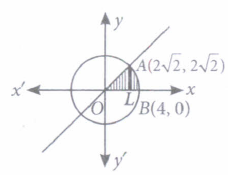
Consider the curve x2 +y2 = 16 and line y = x in the first quadrant. Based on the above information, answer the following questions.
(i) Point of intersection of both the given curves is
| (a) (0, 4) | (b) \((0,2 \sqrt{2})\) | (c) \((2 \sqrt{2}, 2 \sqrt{2})\) | (d) \((2 \sqrt{2}, 4)\) |
(ii) Which of the following shaded portion represent the area bounded by given two curves?

(iii) The value of the integral \(\int_{0}^{2 \sqrt{2}} x d x\) is
| (a) 0 | (b) 1 | (c) 2 | (d).4 |
(iv) The value of the integral \(\int_{2 \sqrt{2}}^{4} \sqrt{16-x^{2}} d x\) is
| (a) \(2(\pi-2)\) | (b) \(2(\pi-8)\) | (c) \(4(\pi-2)\) | (d) \(4(\pi+2)\) |
(v) Area bounded by the two given curves is
| (a) \(3 \pi \text { sq. units }\) | (b) \(\frac{\pi}{2} \text { sq. units }\) | (c) \(\pi \text { sq. units }\) | (d) \(2 \pi \text { sq. units }\) |
23.
Consider the mapping \(f: A \rightarrow B\) is defined by \(f(x)=\frac{x-1}{x-2}\) such that f is a bijection.
Based on the above information, answer the following questions.
(i) Domain of f is
| (a) R - {2} | (b) R | (C) R-{1,2} | (d) R-{0} |
(ii) Range of f is
| (a) R | (b) R -{1} | (C) R-{0} | (d) R-{1,2} |
(iii) If g: \(R-\{2\} \rightarrow R-\{1\}\) is defined by g(x) = 2f(x) - I, then g(x) in terms of x is
| (a) \(\frac{x+2}{x}\) | (b) \(\frac{x+1}{x-2}\) | (c) \(\frac{x-2}{x}\) | (d) \(\frac{x}{x-2}\) |
(iv) The function g defined above, is
| (a) | One-one | (b) Many-one | (c) into | (d) None of these |
(v) A function J(x) is said to be one-one iff
| (a) \(f\left(x_{1}\right)=f\left(x_{2}\right) \Rightarrow-x_{1}=x_{2}\) | (b) \(f\left(-x_{1}\right)=f\left(-x_{2}\right) \Rightarrow-x_{1}=x_{2}\) | (c) \(f\left(x_{1}\right)=f\left(x_{2}\right) \Rightarrow x_{1}=x_{2}\) | (d) None of these |
24.
A relation R on a set A is said to be an equivalence relation on A iff it is
(a) Reflexive i.e.., \((a, a) \in R \ \forall \ a \in A\)
(b) Symmetric i.e., \((a, b) \in R \Rightarrow(b, a) \in R \ \forall \ a, b \in A\)
(c) Transitive i.e., \((a, b) \in R\) and \((b, c) \in R \Rightarrow(a, c) \in R\ \forall\ a, b, c \in A\)
Based on the above information, answer the following questions.
(i) If the relation R = {(1, 1), (1, 2), (1, 3), (2,2), (2, 3), (3,1), (3, 2), (3, 3)} defined on the set A = {1, 2, 3}, then R is
| (a) | reflexive | (b) | symmetric | (c) | transitive | (d) | equivalence |
(ii) If the relation R = {(1, 2), (2,1), (1, 3), (3, I)} defined on the setA = {1, 2, 3}, then R is
| (a) | reflexive | (b) | symmetric | (c) | transitive | (d) | equivalence |
(iii) If the relation R on the set N of all natural numbers defined as R = {(x, y) : y = x + 5 and x < 4}, then R is
| (a) | reflexive | (b) | symmetric | (c) | transitive | (d) | equivalence |
(iv) If the relation R on the set A = {1, 2, 3, , 13, 14}defined as R = {(x, y) : 3x - y = 0}, then R is
| (a) | reflexive | (b) | symmetric | (c) | transitive | (d) | equivalence |
1.
(b)
injective function
2.
(d)
both one-one and onto
3.
4.
(a)
\(x \sin (\log x)+C\)
5.
(a)
\(x^{4}+\frac{1}{x^{3}}-\frac{129}{8}\)
6.
(a)
144 sq units
7.
(d)
not defined
8.
(d)
2nxn
9.
(c)
Reflexive and transitive
10.
(a)
{4,5,6}
11.
(c)
Equivalence relation
12.
(d)
4
13.
As area is above the x-axis
∴ area = \(2\int _{ 0 }^{ 7 }{ \sqrt { 49-{ x }^{ 2 } } } \)
= \({ \left[ \frac { x }{ 2 } \sqrt { 49-{ x }^{ 2 } } +\frac { 49 }{ 2 } { sin }^{ -1 }\frac { x }{ 7 } \right] }_{ 0 }^{ 7 }\)
= \(2\left[ \left( \frac { 7 }{ 2 } \times 0+\frac { 49 }{ 2 } { sin }^{ -1 }1 \right) -(0) \right] \)
= \(\frac { 49 }{ 2 } \pi \) sq units
14.
As \(\int _{ 0 }^{ \frac { \pi }{ 2 } }{ \frac { dx }{ 1+cos\left( \frac { \pi }{ 2 } -x \right) } } \)
= \(\int _{ 0 }^{ \frac { \pi }{ 2 } }{ \frac { 1 }{ 2 } { sec }^{ 2 }\left( \frac { \pi }{ 4 } -\frac { x }{ 2 } \right) dx } \)
\(=\frac { 1 }{ 2 } .{ \left[ \frac { tan\left( \frac { \pi }{ 4 } -\frac { x }{ 2 } \right) }{ -\frac { 1 }{ 2 } } \right] }_{ 0 }^{ \frac { \pi }{ 2 } }\)
\(=-tan\left( \frac { \pi }{ 4 } -\frac { \pi }{ 4 } \right) +tan\left( \frac { \pi }{ 4 } -0 \right) =1\)
15.
As \(\int { \frac { 1 }{ \sqrt { 4-{ 9x }^{ 2 } } } dx } \)
\(=\frac { 1 }{ 3 } \int { \frac { 1 }{ \sqrt { { \left( \frac { 2 }{ 3 } \right) }^{ 2 }-{ x }^{ 2 } } } dx } \)
\(=\frac { 1 }{ 3 } \int { \frac { 1 }{ \sqrt { { \left( \frac { 2 }{ 3 } \right) }^{ 2 }-{ x }^{ 2 } } } dx } \)
⇒ a = \(\frac32\)
16.
As \(\frac { d }{ dx } \left( \frac { { 2 }^{ x } }{ { log }_{ e }2 } \right) \)
\(=\frac { 1 }{ { log }_{ e }2 } .{ 2 }^{ x }.{ log }_{ e }2 ={ 2 }^{ x }\)
17.
As y = cos-1 (x2 - 4)
⇒ cos y = x2 - 4
Since - 1 ≤ cos y ≤ 1
i.e - 1 ≤ x2 -4 ≤1
⇒ 3 ≤ x2 ≤ 5
⇒ \(\sqrt3\)≤ |x|≤ \(\sqrt5\)
⇒ x ∈ [-\(\sqrt5\) ,-\(\sqrt3\)] ∪ [-\(\sqrt5\),\(\sqrt3\)]
18.
Let θ = sin-1 \(-(\frac12)\)
⇒ sin-1 = \(-\frac12\) = sin \((-\frac{\pi}{6})\) = θ = \(-\frac{\pi}{6}\)
19.
A relation R is an identity relation in set A if for all a ∈ A, (a, a) ∈ R.
20.
T1 and T3 are similar as their sides are proportional.
21.
(i) b : Curves y = cos x and y = x + 1 meet at point C(O, 1).
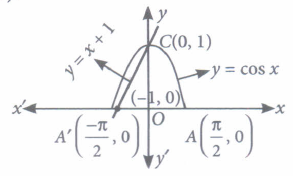
(ii) C : curve y=cosx meet the x axis at \(A^{\prime}\left(\frac{-\pi}{2}, 0\right)\) and \(A\left(\frac{\pi}{2}, 0\right)\) .
(iii) (a) : \(\int_{-1}^{0}(x+1) d x=\left[\frac{x^{2}}{2}+x\right]_{-1}^{0}=0-\left(\frac{1}{2}-1\right)=\frac{1}{2}\)
(iv) (d) : \(\int_{0}^{\pi / 2} \cos x d x=[\sin x]_{0}^{\pi / 2}=\sin \frac{\pi}{2}-\sin 0=1\)
(v) (b) : Required area \(\int_{-1}^{0}(x+1) d x+\int_{0}^{\pi / 2} \cos x d x\)
\(=\frac{1}{2}+1=\frac{3}{2} \text { sq. units }\)
22.
(i) (c) : We have, x2 +y2= 16 ..(i)
and y = x ...(ii)
From (i) and (ii), \(2 x^{2}=16 \Rightarrow x^{2}=8 \Rightarrow x=2 \sqrt{2}\) (\(\therefore\) x lies in first quadrant)
\(\therefore\) Point of intersection of (i) and (ii) in first quadrant is \((2 \sqrt{2}, 2 \sqrt{2})\) .
(ii) (b) : The shaded region which represent the areabounded by two given curves in first quadrant is shown below.
(iii)( d) : \(\int_{0}^{2 \sqrt{2}} x d x=\left[\frac{x^{2}}{2}\right]_{0}^{2 \sqrt{2}}=\frac{(2 \sqrt{2})^{2}}{2}=\frac{8}{2}=4\)
(iv) (a) : \(\int_{2 \sqrt{2}}^{4} \sqrt{16-x^{2}} d x=\left[\frac{x}{2} \sqrt{16-x^{2}}+\frac{16}{2} \cdot \sin ^{-1}\left(\frac{x}{4}\right)\right]_{2 \sqrt{2}}^{4}\)
\(=8 \sin ^{-1}(1)-4-8 \sin ^{-1}\left(\frac{1}{\sqrt{2}}\right)\)
\(=8\left(\frac{\pi}{2}\right)-4-8\left(\frac{\pi}{4}\right)=4 \pi-4-2 \pi=2 \pi-4=2(\pi-2)\)
(v) (d) : Required area = Area (OLA) + Area (BAL)
\(=\int_{0}^{2 \sqrt{2}} x d x+\int_{2 \sqrt{2}}^{4} \sqrt{16-x^{2}} d x\)
\(=4+2(\pi-2)=2 \pi \text { sq. units. }\)
23.
(i) (a) : For f(x) to be defined \(x-2 \neq 0\) i.e.,\(x \neq 2\)
\(\therefore\) Domain of f = R - {2}
(ii) (b) : Let y =J(x), then \(y=\frac{x-1}{x-2}\)
\(\Rightarrow x y-2 y=x-1 \Rightarrow x y-x=2 y-1 \Rightarrow x=\frac{2 y-1}{y-1}\)
Since, \(x \in R-\{2\}\),therefore \(y \neq 1\)
Hence, range of f = R-{1}
(iii) (d): We have,g(x) = 2f(x) - 1
\(=2\left(\frac{x-1}{x-2}\right)-1=\frac{2 x-2-x+2}{x-2}=\frac{x}{x-2}\)
(iv) (a) : We have, \(g(x)=\frac{x}{x-2}\) ,
Let \(g\left(x_{1}\right)=g\left(x_{2}\right) \Rightarrow \frac{x_{1}}{x_{1}-2}=\frac{x_{2}}{x_{2}-2}\)
\(\Rightarrow x_{1} x_{2}-2 x_{1}=x_{1} x_{2}-2 x_{2} \Rightarrow 2 x_{1}=2 x_{2} \Rightarrow x_{1}=x_{2}\)
Thus, \(g\left(x_{1}\right)=g\left(x_{2}\right) \Rightarrow x_{1}=x_{2}\)
Hence, g(x) is one-one.
(v) (c)
24.
(i) (a) : Clearly (1, 1), (2, 2), (3, 3), \(\in\) R. So, R is reflexive on A.
Since, \((1,2) \in R \text { but }(2,1) \notin R\) So, R is not symmetric on A.
Since, \((2,3), \in R\) and \((3,1) \in R\) but \((2,1) \notin R\) .So, R is not transitive on A.
(ii) (b) : Since, (1,1), (2, 2) and (3, 3) are not in R. So, R is not reflexive on A.
Now, \((1,2) \in R \Rightarrow(2,1) \in R\)
and \((1,3) \in R \Rightarrow(3,1) \in R\)
So, R is symmetric
Clearly,\((1,2) \in R \text { and }(2,1) \in R \text { but }(1,1) \notin R\)
So, R is not transitive on A.
(iii) (c) : We have, \(R=\{(x, y): y=x+5 \text { and } x<4\}\) ,where \(x, y \in N\) .
\(\therefore R=\{(1,6),(2,7),(3,8)\}\)
Clearly, (1, 1), (2, 2) etc. are not in R. So, R is not reflexive.
Since, \((1,6) \in R\) but \((6,1) \notin R\) So, R is not symmetric.
Since, \((1,6) \in R\) R and there is no order pair in R which has 6 as the first element. Same is the case for (2, 7) and (3, 8). So, R is transitive.
(iv) (d) : We have,R = {(x, y) : 3x - y = 0}, where \(x, y \in A=\{1,2, \ldots \ldots, 14\}\) .
\(\therefore\) R = {(I, 3), (2, 6), (3, 9), (4, 12)}
Clearly,\((1,1) \notin R\) So, R is not reflexive on A.
Since, \((1,3) \in R\) but \((3,1) \notin R\) .So, R is not symmetric on A.
Since, \((1,3) \in R\) and \((3,9) \in R\) but \((1,9) \notin R\) So, R is not transitive on A.
(v) (d) : Clearly, (1, 1), (2, 2), (3, 3) ∈ R. So, R is reflexive on A.
We find that the ordered pairs obtained by interchanging the components of ordered pairs in R are also in R. So, R is symmetric on A.
For \(1,2,3 \in A\) such that (1, 2) and (2, 3) are in Rimplies that (1, 3) is also, in R. So, R is transitive on A. Thus, R is an equivalence relation.

12th Standard CBSE Syllabus & Materials
12th Standard CBSE
CBSE 12th Computer Science Python Revision Tour I - New Previous year Question Papers Study Material - QB365 Set A
NEW12th Standard CBSE
CBSE 12th Business Studies Planning Important Questions And Answers Study Material - QB365 Set A
NEW12th Standard CBSE
CBSE 12th Business Studies Business Environment Important Questions And Answers Study Material - QB365 Set A
NEW12th Standard CBSE
CBSE 12th Business Studies Principles of Management Important Questions And Answers Study Material - QB365 Set A



NCERT Books

Syllabus

Exam Pattern

Sample Question Papers

Previous year Question Papers

Important Notes

MCQ Practice test

NCERT Exemplers

Case study Questions

Image Based Questions

Passage based Questions

HOT Questions

Value Based Questions

Model Questions Papers
NCERT ( Book Back ) Questions

Assertion and Reason
Important Questions And Answers

CBSE 12th Standard CBSE Subjects
CBSE Standards








