
 100% FREE ACCESS
12th Standard CBSE Syllabus & Materials
12th Standard CBSE
CBSE 12th Economics Government Budget and the Economy Previous year Question Papers Study Material - QB365 Set A
NEW12th Standard CBSE
CBSE 12th Computer Science Interface Python with MySQL - New Previous year Question Papers Study Material - QB365 Set A
NEW12th Standard CBSE
CBSE 12th Computer Science Database Concept - New Previous year Question Papers Study Material - QB365 Set A
NEW12th Standard CBSE
CBSE 12th Computer Science Data Communication - New Previous year Question Papers Study Material - QB365 Set A
NEW12th Standard CBSE
CBSE 12th Computer Science Data Structures - New Previous year Question Papers Study Material - QB365 Set A
NEW12th Standard CBSE
CBSE 12th Computer Science Functions - New Previous year Question Papers Study Material - QB365 Set A

Published on: 25/10/2025
Download CBSE Class 12th Standard CBSE Maths question papers, sample papers, important questions, and previous year solved papers in PDF format. Get free study materials, NCERT solutions, and exam preparation resources for Class 12th Standard CBSE Maths
Questions + Answers key
Take MCQ Maths Test
1.
Sketch the region bounded by the lines 2x + y = 8, y = 2, y = 4 and the Y-axis. Hence, obtain its area using integration.
2.
Check whether the function f:R ➝ R defined as f(x) = x³ is one-one or not.
3.
Find \(\int \frac{1}{5+4 x-x^2} d x\)
4.
Determine whether the following relations are reflective, symmetric and transitive:
Relation R in the set A = {1, 2, 3...13, 14} defined as R = {(x, y) : 3x - y = 0}
5.
Sketch the region lying in the first quadrant and bounded by \(\begin{equation} y=9 x^{2}, x=0, y=1 \end{equation}\) and y = 4. Find the area of region using integration.
6.
\(\int {1\over(2-x)^2+1}dx.\)
7.
Solve the following LPP graphically: Maximise and minimise Z = x + 2y Subject to the constraints
\(\begin{aligned}
x+2 y & \geq 100
\end{aligned}\),
\(\begin{aligned}
2 x-y & \leq 0
\end{aligned}\),
\(\begin{aligned}
2 x+y & \leq 200
\end{aligned}\),
and \(\begin{aligned}
x, y & \geq 0
\end{aligned}\)
8.
Solve the following linear programming problem graphically :
Minimise Z = x + 2y
Subject to the constraints
\(\begin{aligned} 2 x+y & \geq 3, x+2 y \geq 6 \end{aligned}\)
and \(\begin{aligned} x & \geq 0, \quad y \geq 0 . \end{aligned}\)
9.
If f: R → R is the function defined by f (x) = 4x³ +7, then show that f is a bijection.
10.
Evaluate \(\int \sqrt{x^{2}-8 x+7} d x\)
11.
Integrate the rational functions in \(\frac { 2 }{ (1-x)(1+{ x }^{ 2 }) } \)
12.
Consider \(f:R\rightarrow R\) given by f (x) = 4x + 3. Show that f is invertible. Find the inverse of f.
13.
Find the area under the given curves and given lines :
(i) y = x2, x = 1, x = 2 and x - axis
(ii) y = x4, x = 1, x = 5 and x - axis.
14.
Evaluate the integral: \(\int^{4}_0[\ {|x-1|+|x-2|+|x-4|}]dx\)
15.
\(\int_0^4\left(e^{2 x}+x\right) d x\) is equal to
\(\frac{15+e^8}{2}\)
\(\frac{16-e^8}{2}\)
\(\frac{e^8-15}{2}\)
\(\frac{-e^8-15}{2}\)
16.
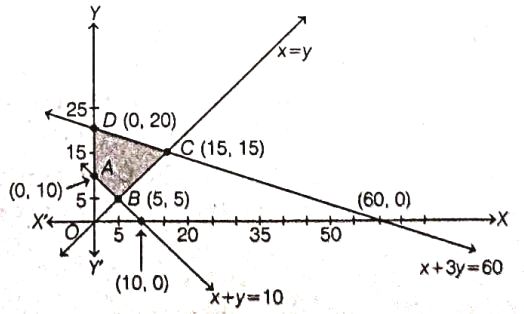
Based on the given shaded region as the feasible region in the graph, at which point (s) is the objective function Z = 3x + 9y maximum.
Point B
Point C
Point D
Every point on the line segment CD
17.
The corner points of the feasible region in the graphical representation of a linear programming problem are (2, 72), (15, 20) and (40,15). If Z = 18x + 9y be the objective function, then
Z is maximum at (2, 72), minimum at (15, 20).
Z is maximum at (15, 20), minimum at (40, 15).
Z is maximum at (40, 15), minimum at (15, 20).
Z is maximum at (40,15), minimum at (2, 72).
18.
If the area bounded by the curves y2 = 4ax and y = mx is \(\frac{a^{2}}{3}\) then the value of m is
2
-2
\(\frac{1}{2}\)
none of these
19.
The feasible region for an LPP is shown in the following figure. Then, the minimum value of Z = 11x + 7y is
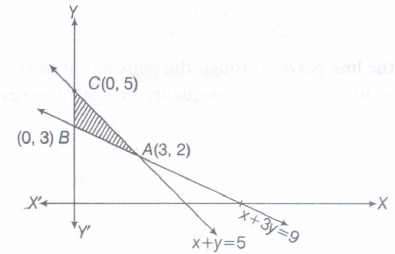
21
47
20
31
20.
\(\int_{0}^{2 / 3} \frac{1}{4+9 x^{2}} d x\) is equal to
\(\frac{\pi}{6}\)
\(\frac{\pi}{12}\)
\(\frac{\pi}{24}\)
\(\frac{\pi}{4}\)
21.
The feasible solution of a L.P.P. belongs to
First and second quadrant
Second quadrant
Only first quadrant
First and third quadrant
22.
How many of the following points satisfy the inequality 2x – 3y > -5?
(1, 1), (-1, 1), (1, -1), (-1, -1), (-2, 1), (2, -1), (-1, 2) and (-2, -1)
2
4
6
5
23.
Write the shaded region as an integral
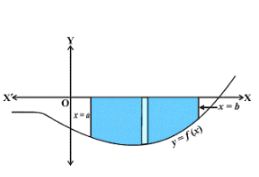
\(-\left| \int _{ a }^{ b }{ f(x)dx } \right| \)
\(\int _{ a }^{ b }{ \left| f(x)dx \right| } \)
\(\left| \int _{ a }^{ b }{ f(x)dx } \right| \)
\(-\int _{ a }^{ b }{ \left| f(x)dx \right| } \)
24.
The area of the region bounded between the line x=9 and the parabola y2=16x is
144 sq units
27 sq units
104 sq units
54 sq units
25.
Area under the circle x2 + y2 = 16 is
π sq units
13π sq units
16 π sq units
4 π sq units
26.
∫ax dx =
ax log a+c, where C is the constant of integration
ax + c, where C is the constant of integration,
\(\frac{a^x}{log_a e}+c\), where c is the constant of integration
\(\frac{a^x}{log a}+c\), where c is the constant of integration
27.
Let A = {1,2,3,4} and B = {x,y,z}. Then R = {(1,x) , ( 2,z), (1,y), (3,x)} is
relation from B to A
Is not a relation
relation from A to B
relation from B to B
28.
If A = {1,3,5,7} and we define a relation R = {(a,b), a,b ∈ A:|a - b| = 8} Then the number of elements in the relation R is
2
1
3
0
29.
Of all the points of the feasible region, for maximum or minimum of objective function, the point lies
inside the feasible region
at the boundary line of the feasible region
vertex point of the boundary of the feasible region
none of these
30.
Area bounded by the curve y = sin x and the x-axis between x = 0 and x = 2π is
2 sq units
0 sq units
3 sq units
4 sq units
31.
If ∫sec²(7 – 4x)dx = a tan (7 – 4x) + C, then value of a is
7
-4
3
\(-\frac { 1 }{ 4 } \)
32.
Given triangles with sides T1 : 3, 4, 5; T2 : 5, 12, 13; T3 : 6, 8, 10; T4 : 4, 7, 9 and a relation R in set of triangles defined as R = {(Δ1, Δ2) : Δ1 is similar to Δ2}. Which triangles belong to the same equivalence class?
T1 and T2
T2 and T3
T1 and T3
T1 and T4
33.
Evaluate \(\int_{-2}^1 \sqrt{5-4 x-x^2} d x\)
34.
Find \(\int \frac{x^2}{\left(x^2+1\right)\left(3 x^2+4\right)} d x\)
35.
Find the maximum value of the objective function Z = 3x + 4y
Subject to constraints
\(x+y \leq 4 ; x \geq 0 \text { and } y \geq 0\)
36.
Solve the following Linear Programming Problem graphically:
Maximise Z = 70x + 40y
subject to constraints
\(3 x+2 y \leq 9,3 x+y \leq 9 \text { and } x \geq 0, y \geq 0\)
37.
Draw the graphs of y = sin x and y = cos x. Find the area of the region bounded by the X-axis \(y=\cos x \text { and } y=\sin x, \text { where } 0 \leq x \leq \frac{\pi}{2}\)
38.
If N denotes the set of all natural numbers and R is the relation on N x N defined by (a, b) R (c, d), if ad(b + c) = bc (a + d). Show that R is an equivalence relation.
39.
Consider the following equations of curves y = cos x, y = x + 1 and y = 0. On the basis of above information, answer the following questions.
(i) The curves y = cos x and y = x + 1 meet at
| (a) (1, 0) | (b) (0, 1) | (c) (1, 1) | (d) (0,0) |
(ii) y = cos x meet the x-axis at
| (a) \(\left(\frac{-\pi}{2}, 0\right)\) | (b) \(\left(\frac{\pi}{2}, 0\right)\) | (c) both (a) and (b) | (d) None of these |
(iii) Value of the integral \(\int_{-1}^{0}(x+1) d x\) is
| (a) \(\frac{1}{2}\) | (b) \(\frac{2}{3}\) | (c) \(\frac{3}{4}\) | (d) \(\frac{1}{3}\) |
(iv) Value of the integral \(\int_{0}^{\pi / 2} \cos x d x\) is
| (a) 0 | (b) -1 | (c) 2 | (d) 1 |
(v) Area bounded by the given curves is
| (a) \(\frac{1}{2} \mathrm{sq} . \text { unit }\) | (b) \(\frac{3}{2} \text { sq. units }\) | (c) \(\frac{3}{4} \text { sq. unit }\) | (d) \(\frac{1}{4} \text { sq. unit }\) |
40.
Let R be the feasible region (convex polygon) for a linear programming problem and let Z = ax + by be the objective function. When Z has an optimal value (maximum or minimum), where the variables x and y are subject to, constraints described by linear inequalities, this optimal value must occur at a corner point (vertex) of the feasible region.
Based on the above information, answer the following questions.
(i) Objective function of a L.P.P. is
| (a) a constant | (b) a function to be optimised | (c) a relation between the variables | (d) none of these |
(ii) Which of the following statement is correct?
| (a) Every LPP has at least one optimal solution. | (b) Every LPP has a unique optimal solution. | (c) If an LPP has two optimal solutions, then it has infinitely many solutions | (d) none of these |
(iii) In solving the LPP : "minimize f = 6x + 10y subject to constraints x ≥ 6, Y ≥ 2, 2x + y ≥ 10,x ≥ 0,y ≥ 0" redundant constraints are
| (a) x ≥ 6, y ≥ 2 | (b) 2x + y ≥ 10, x ≥ 0, y ≥ 0 | (c) x ≥ 6 | (d) none of these |
(iv) The feasible region for a LPP is shown shaded in the figure. Let Z = 3x - 4y be the objective function. Minimum of Z occurs at
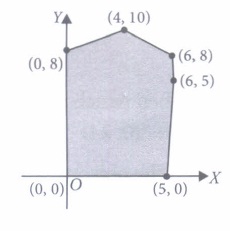
| (a) (0, 0) | (b) (0, 8) | (c) (5, 0) | (d) (4, 10) |
(v) The feasible region for a LPP is shown shaded in the figure. Let F = 3x - 4y be the objective function. Maximum value of F is
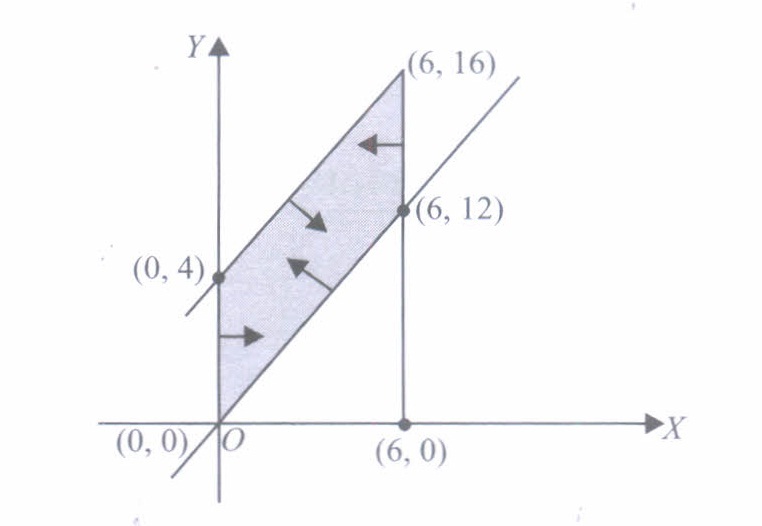
| (a) 0 | (b) 8 | (c) 12 | (d) -18 |
41.
Consider the mapping \(f: A \rightarrow B\) is defined by \(f(x)=\frac{x-1}{x-2}\) such that f is a bijection.
Based on the above information, answer the following questions.
(i) Domain of f is
| (a) R - {2} | (b) R | (C) R-{1,2} | (d) R-{0} |
(ii) Range of f is
| (a) R | (b) R -{1} | (C) R-{0} | (d) R-{1,2} |
(iii) If g: \(R-\{2\} \rightarrow R-\{1\}\) is defined by g(x) = 2f(x) - I, then g(x) in terms of x is
| (a) \(\frac{x+2}{x}\) | (b) \(\frac{x+1}{x-2}\) | (c) \(\frac{x-2}{x}\) | (d) \(\frac{x}{x-2}\) |
(iv) The function g defined above, is
| (a) | One-one | (b) Many-one | (c) into | (d) None of these |
(v) A function J(x) is said to be one-one iff
| (a) \(f\left(x_{1}\right)=f\left(x_{2}\right) \Rightarrow-x_{1}=x_{2}\) | (b) \(f\left(-x_{1}\right)=f\left(-x_{2}\right) \Rightarrow-x_{1}=x_{2}\) | (c) \(f\left(x_{1}\right)=f\left(x_{2}\right) \Rightarrow x_{1}=x_{2}\) | (d) None of these |
42.
Assertion (A) The area bounded by the curve y = sin x between x =0 and x = 4\(\pi\) is 4 sq units.
Reason (R) \(\int_0^{{\pi}/{2}}sin x \space dx = 1\)
(a) Both A and R are correct; R is the correct explanation of A
(b) Both A and R are correct; R is not the correct explanation of A
(c) A is correct; R is incorrect
(d) R is correct; A is incorrect
43.
Assertion (A) : \(\int_2^8 \frac{\sqrt{10-x}}{\sqrt{x}+\sqrt{10-x}} d x=3\)
Reason (R) : \(\int_a^b f(x) d x=\int_a^b f(a+b-x) d x\)
(a) Both (A) and (R) are correct and (R) is the correct explanation of (A).
(b) Both (A) and (R) are correct but (R) is not the correct explanation of (A).
(c) (A) is correct but (R) is incorrect.
(d) Both (A) and (R) are incorrect.
1.
Given lines 2x + y = 8, y = 2, y = 4
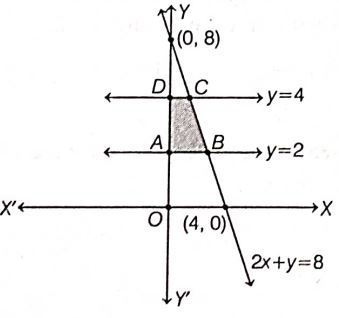
\(\therefore\) Required area
= Area of the region ABCDA
\(\begin{aligned} & =\int_2^4 x d y=\int_2^4\left(\frac{8-y}{2}\right) d y=\frac{1}{2} \int_2^4(8-y) d y \end{aligned}\)
\(\begin{aligned} & =\frac{1}{2}\left[8 y-\frac{y^2}{2}\right]_2^4 \\ \end{aligned}\)
\(\begin{aligned} & =\frac{1}{2}\left[\left(8 \times 4-\frac{16}{2}\right)-\left(8 \times 2-\frac{2^2}{2}\right)\right] \end{aligned}\)
\(=\frac{1}{2}[32-8-16+2]=\frac{1}{2}(10)\) = 5 sq units
2.
We have, f(x) = x³
Let x1, x2 ∈ R such that
f(x1) = f(x2)
⇒ x13 = x23
⇒ x1 = x2
∴ f(x) is one-one function.
3.
Let \(\begin{aligned} I & =\int \frac{1}{5+4 x-x^2} d x \end{aligned}\)
\(\begin{aligned} =\int \frac{1}{5+2 \cdot 2 x-x^2-(2)^2+(2)^2} d x \end{aligned}\)
\(\begin{aligned} =\int \frac{1}{5+4-\left(x^2+(2)^2-2 \cdot 2 \cdot x\right)} d x \end{aligned}\)
\(\begin{aligned} =\int \frac{1}{9-(x-2)^2} d x=\int \frac{1}{(3)^2-(x-2)^2} \end{aligned}\)
\(\begin{aligned} =\frac{1}{2 \times 3} \log \left|\frac{3+x-2}{3-x+2}\right|+C \end{aligned}\)
\(\begin{aligned} \left[\because \int \frac{d x}{a^2-x^2}=\frac{1}{2 a} \log \left|\frac{a+x}{a-x}\right|+C\right] \end{aligned}\)
\(=\frac{1}{6} \log \left|\frac{1+x}{5-x}\right|+C\)
4.
A = {1, 2, 3 ...13, 14}
R = {(x, y) : 3x - y = 0}
∴ R = {(1, 3), (2, 6), (3, 9),(4, 12)}
R is not reflexive since (1, 2), (2, 2)...(14, 14) ∉ R
Also, R is not symmetric as (1, 3) ∈R, but (3, 1) ∉ R.[3(3) - 1 ≠ 0]
Also, R is not transitive as (1, 3), (3, 9) ∈R, but (1, 9) ∉ R.
[3(1) - 9 ≠ 0]
Hence R is neither reflexive, nor symmetric, nor transitive.
5.
Given curve is \(\begin{equation} y=9 x^{2} \end{equation} \)
\(\Rightarrow x^{2}=\frac{1}{9} y\)
It is a parabolic curve, which open upwards, symmetrical about y-axis and passes through the origin.

∴ Required area = Area of bounded region ABCDA
\(\begin{equation} \left.=\int_{1}^{4} x d y=\frac{1}{3} \int_{1}^{4} \sqrt{y} d y \quad \because x^{2}=\frac{1}{9} y \Rightarrow x=\frac{1}{3} \sqrt{y}\right] \end{equation}
\)
\(=\frac{1}{3}\left[\frac{y^{3 / 2}}{3 / 2}\right]_{1}^{4}=\frac{1}{3} \times \frac{2}{3}\left[(4)^{3 / 2}-(1)^{3 / 2}\right]
\)
\(=\frac{2}{9}\left[(2)^{3}-1\right]=\frac{14}{9} \text { sq units } \)
Hence, the required area is \(\frac{14}{9} \)sq units.
6.
\(\int \frac{1}{(2-x)^{2}+1} d x=-\int \frac{1}{t^{2}+1} d t=-\tan ^{-1} t+C=-\tan ^{-1}(2-x)+C\)
7.
Our problem is to minimise and maximise
Z = x + 2y ....(i)
Subject to constraints
\(\begin{aligned}
& x+2 y \geq 100
\end{aligned}\) ....(ii)
\(\begin{aligned}
2 x-y \leq 0
\end{aligned}\) ....(iii)
\(\begin{aligned}
2 x+y \leq 200
\end{aligned}\) ....(iv)
and \(\begin{aligned}
x \geq 0, y \geq 0
\end{aligned}\) ....(v)
Table for line x + 2y = 100 is
| x | 0 | 100 |
| y | 50 | 0 |
So, the line x + 2y = 100 is passing through the points (0, 50) and (100, 0).
On putting (0, 0) in the inequality x + 2y \(\geq\) 100, we get
0 + 2 \(\times\) 0 \(\geq\) 100
\(\Rightarrow\) 0 \(\geq\) 100 (which is false)
So, the half plane is away from the origin.
Table for line 2x - y = 0 is
| x | 0 | 10 |
| y | 0 | 20 |
So, the line 2x - y = 0 is passing through the points (0, 0) and (10, 20).
On putting (5, 0) in the inequality 2x - y \(\leq\) 0,
we get
2 \(\times\) 5 - 0 \(\leq\) 0
\(\Rightarrow\) 10 \(\leq\) 0 (which is false)
So,the half-plane is towards Y-axis.
Table for line 2x + y = 200 is
| x | 0 | 100 |
| y | 200 | 0 |
So, the line 2x + y = 200 is passing through the points (0, 200) and (100, 0).
On putting (0, 0) in the inequality 2x + y \(\leq\) 200, we get 2 \(\times\) 0 + 0 \(\leq\) 200 \(\Rightarrow\) 0 \(\leq\) 200 (which is true).
So, the half plane is towards the origin.
Also, x, y \(\geq\) 0.
So, the region lies in the lst quadrant.
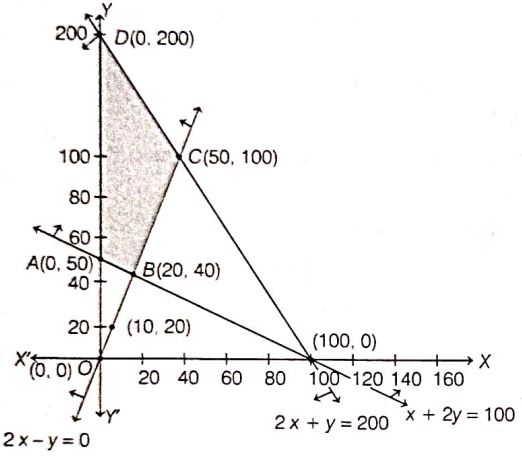
Clearly, feasible region is ABCDA.
On solving equations 2x - y=0 and x + 2y=100,
we get B(20, 40).
Again, solving the equations 2x - y = 0 and 2x + y = 200, we get C(50, 100).
The corner points of the feasible region are A(0, 50), B(20, 40), C(50, 100) and D(0, 200).
The values of Z at corner points are given below
| Corner points | Value of Z = x + 2y |
| A (0, 50) | 0 + 2 \(\times\) 50 = 100 |
| B(20, 40) | 20 + 2 \(\times\) 40 = 100 |
| C(50, 100) | 50 + 2 \(\times\)100 = 250 |
| D(0, 200) | 0 + 2 \(\times\) 200 = 400 (Maximum) |
The maximum value of Z is 400 at D(0, 200) and the minimum value of Z is 100 at all the points on the line segment joining A(0, 50) and B(20, 40).
8.
Given, Z = x + 2y
Subject to the constraints
\(2 x+y \geq 3 ; x+2 y \geq 6 \text { and } x \geq 0, y \geq 0\)
Now, considering the inequations as equations, we get
2x + y = 3 ....(i)
x + 2y = 6 ....(ii)
Table for line 2x + y = 3 is
| x | 1.5 | 0 |
| y | 0 | 3 |
On putting (0, 0) in the inequality \(2 x+y \geq 3\) 0 \(\geq 3\) (which is false)
So, the half plane, is away from the origin
Table for line x + 2y = 6
| x | 6 | 0 |
| y | 0 | 3 |
On putting (0, 0) in the inequality x + 2y \(\geq\) 6 0 \(\geq\) 6 (which is false)
So, the half plane is away from the origin.
Also, x \(\geq\) 0 and y \(\geq\) 0, so the feasible region lies in the Ist quadrant.
The point of intersection of Eqs. (i) and (ii) is (0, 3).
The graphical representation of the above system of inequations is given below.
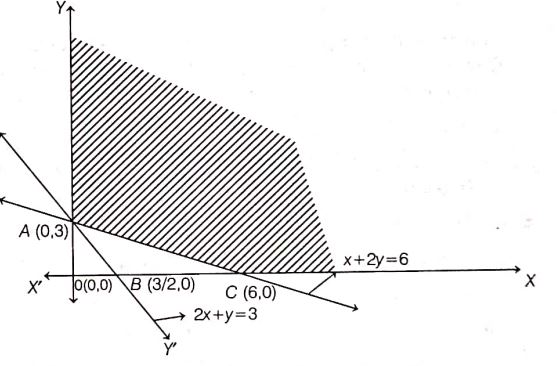
\(\therefore\) Feasible region is shaded region above.
| Corner points | Value of Z = x + 2y |
| A(0, 3) | 6 (Minimum) |
| B(6, 0) | 6 (Minimum) |
Here, the feasible region is unbounded and the open half plane determined by x + 2y < 6 has no point in common with the feasible region. Hence, Z = 6 is minimum at A(0, 3) and C(6, 0) and also on the line segment AC.
9.
The given function is f: \(R \rightarrow R\) such that
\(f(x)=4 x^3+7\)
To show f is bijective, we have to show that f is one-one and onto.
One-One function Let \(x_1, x_2 \in R\) such that
\(f\left(x_1\right)= f\left(x_2\right)\)
\(\Rightarrow 4 x_1^3+7=4 x_2^3+7\)
\(\Rightarrow 4 x_1^3=4 x_2^3 \)
\(\Rightarrow x_1^3-x_2^3=0\)
\(\Rightarrow \left(x_1-x_2\right)\left(x_1^2+x_1 x_2+x_2^2\right)=0\)
\(\Rightarrow {\left[\because a^3-b^3=(a-b)\left(a^2+a b+b^2\right)\right]} \)
\(\Rightarrow \left(x_1-x_2\right)\left[\left(x_1+\frac{x_2}{2}\right)^2+\frac{3}{4} x_2^2\right]=0\)
⇒ Either \(x_1-x_2=0\)
or \(\left(x_1+\frac{x_2}{2}\right)^2+\frac{3}{4} x_2^2=0\)
But Eq. (ii) gives complex roots as \(x_1, x_2 \in R\)
\(\therefore x_1-x_2 =0 \)
\(\Rightarrow x_1 =x_2 \)
\(\text { Thus, } f\left(x_1\right) =f\left(x_2\right) \)
\(\Rightarrow x_1 =x_2, \forall x_1, x_2 \in R\)
Therefore, f(x) is a one-one function.
Onto function Let ve R (codomain) be any arbitraty number.
\(\text { Then, } f(x)=y \)
\(\Rightarrow 4 x^3+7=y\)
\(\Rightarrow 4 x^3=y-7\)
\(\Rightarrow x^3=\frac{y-7}{4}\)
\(\Rightarrow x=\left(\frac{y-7}{4}\right)^{1 /3}\)
which is a real number.
[\(\because y \in R\)]
Thus, for every \(y \in R\) (codomain), there exists
\(\mathrm{x} =\left(\frac{y-7}{4}\right)^{1 / 3} \in R \text { (domain) such that } \)
\(f(x) =f\left[\left(\frac{y-7}{4}\right)^{1 / 3}\right]=4\left[\left(\frac{y-7}{4}\right)^{1 / 3}\right]^3+7\)
\(=4\left(\frac{y-7}{4}\right)+7=y-7+7=y\)
\(\Rightarrow f(x)\) is an onto function.
Since, f(x) is both one-one and onto, so it is a bijective.
10.
Let \(I=\int \sqrt{x^{2}-8 x+7} d x\)
Here, the coefficient of x2 is unity.
\(\therefore I=\int \sqrt{x^{2}-8 x+7} d x=\int \sqrt{x^{2}-8 x+7+4^{2}-(4)^{2}} d x\)
[ here a = 1and b = -8, adding and subtracting \(\left(\frac{b}{2 a}\right)^{2}=\left(\frac{-8}{2}\right)^{2}=(4)^{2}\) under, the square root]
\(=\int \sqrt{(x-4)^{2}+7-16} d x=\int \sqrt{(x-4)^{2}-(3)^{2}} d x\)
Now, put \(x-4=t \Rightarrow d x=d t\)
\(\therefore \ I=\int \sqrt{t^{2}-3^{2}} d t\)
\(=\frac{t}{2} \sqrt{t^{2}-3^{2}}-\frac{(3)^{2}}{2} \log \left|t+\sqrt{t^{2}-3^{2}}\right|+C\)
\(\left[\because \int \sqrt{x^{2}-a^{2}} d x=\frac{x}{2} \sqrt{x^{2}-a^{2}}-\frac{a^{2}}{2} \log \left|x+\sqrt{x^{2}-a^{2}}\right|\right]\)
\( =\frac{(x-4)}{2} \sqrt{(x-4)^{2}-(3)^{2}} -\frac{(3)^{2}}{2} \log \left|x-4+\sqrt{(x-4)^{2}-(3)^{2}}\right|+C \)
11.
\(I=\int { \frac { 2 }{ (1-x)(1+{ x }^{ 2 }) } } dx\)
Let \(\frac { 2 }{ (1-x)(1+{ x }^{ 2 }) } \equiv \frac { A }{ 1-x } +\frac { Bc+C }{ 1+{ x }^{ 2 } } ....(1)\)
Multiplying by \((1-x)\quad (1+{ x }^{ 2 }),\)
we get : \(2\equiv A(1+{ x }^{ 2 })+(Bx+C)(1-x).\)
Putting \(x-1,2=A(2) \Rightarrow A=1.\)
Putting \(x=0,=A+C\Rightarrow C=2-1=1.\)
Comparing coeffs. of \({ x }^{ 2 },0=A-B\)
\(\Rightarrow B=A-1.\)
ஃ From (1), \(\frac { 2 }{ (1-x)(1+{ x }^{ 2 }) } =\frac { 1 }{ 1-x } +\frac { x+1 }{ 1+{ x }^{ 2 } } .\)
\(\therefore I= \int { \frac { 2 }{ (1-x)(1+{ x }^{ 2 }) } } dx\)
\(=\int { \frac { 1 }{ 1-x } } dx+\frac { 1 }{ 2 } \int { \frac { 2x }{ 1+{ x }^{ 2 } } dx } +\int { \frac { 1 }{ 1+{ x }^{ 2 } } } \)
\(=\int { \frac { \log { \left| 1-x \right| } }{ -1 } } +\frac { 1 }{ 2 } \log { \left| 1+{ x }^{ 2 } \right| } +\tan ^{ -1 }{ x+C } \)
\(=-\log { \left| 1-x \right| } +\frac { 1 }{ 2 } \log { \left| 1+{ x }^{ 2 } \right| } +\tan ^{ -1 }{ x+C } \)
\(\left[ \because { x }^{ 2 }\ge 0\Rightarrow 1+{ x }^{ 2 }>0\Rightarrow \left| 1+{ x }^{ 2 } \right| =1+{ x }^{ 2 } \right] \)
12.
We have: f(x) = 4x + 3
Now \(f(x_{ 1 })=f(x_{ 2 })\)
\(\Rightarrow \) \(4x_{ 1 }+3=4x_{ 2 }+3\)
\(\Rightarrow \) \(x_{ 1 }=x_{ 2 }\) \(\Rightarrow \) \(f\) is one-one.
\(\Rightarrow \) \(f\) is invertible.
Let y = f(x) = 4x + 3
\(\Rightarrow \) \(x=\frac { y-3 }{ 4 } \)
Now f(x) = y \(\Rightarrow \) \(f^{ -1 }(y)=x\)
\(\Rightarrow \) \(f^{ -1 }(y)=\frac { x-3 }{ 4 } \)
\(\Rightarrow \) \(f^{ -1 }(x)=\frac { y-3 }{ 4 } \).
13.
(i) Required area = \(\overset { 2 }{ \underset { 1 }{ \int { } } } ydx\) [Taking vertical strips]
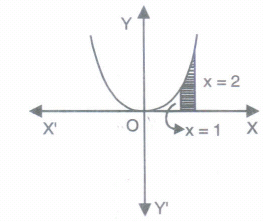
\(=\overset { 2 }{ \underset { 1 }{ \int { } } } { x }^{ 2 }dx=\left[ \frac { { x }^{ 3 } }{ 3 } \right] _{ 1 }^{ 2 }\)
\(=\frac { 8 }{ 3 } -\frac { 1 }{ 3 } =\frac { 7 }{ 3 } sq.units.\)
(ii) Required. area
\(=\overset { 5 }{ \underset { 1 }{ \int { } } } ydx=\overset { 5 }{ \underset { 1 }{ \int { } } } { x }^{ 4 }dx\)
\(=\left[ \frac { { x }^{ 5 } }{ 5 } \right] _{ 1 }^{ 5 }=\frac { { 5 }^{ 5 } }{ 5 } -\frac { 1 }{ 5 } =625-\frac { 1 }{ 5 } \)
\(=\frac { 3125-1 }{ 5 } =\frac { 3124 }{ 5 } \)
\(=624.8sq.units\)
14.
\(23\over2\)
15.
(a)
\(\frac{15+e^8}{2}\)
16.
(d)
Every point on the line segment CD
17.
(c)
Z is maximum at (40, 15), minimum at (15, 20).
18.
(a)
2
19.
(a)
21
20.
(d)
\(\frac{\pi}{4}\)
21.
(c)
Only first quadrant
22.
(d)
5
23.
(c)
\(\left| \int _{ a }^{ b }{ f(x)dx } \right| \)
24.
(a)
144 sq units
25.
(c)
16 π sq units
26.
(d)
\(\frac{a^x}{log a}+c\), where c is the constant of integration
27.
(c)
relation from A to B
28.
(d)
0
29.
(c)
vertex point of the boundary of the feasible region
30.
As sin x is positive in 1st and 2nd quadrant and negative is 3rd and 4th quadrant.
Area = \(\int _{ 0 }^{ 2\pi }{ |sinx|dx } \)
\(=\int _{ 0 }^{ \pi }{ sinxdx } +\int _{ \pi }^{ 2\pi }{ (-sinx)dx } \)
= 4 sq units
31.
∫sec²(7 – 4x)dx =\(\frac { tan(7-4x) }{ -4 } +C=-\frac { 1 }{ 4 } \)tan(7 - 4x) + C
32.
T1 and T3 are similar as their sides are proportional.
33.
\(l =\int_{-2}^1 \sqrt{5-4 x-x^2} d x\)
\(=\int_{-2}^1 \sqrt{5-\left(x^2+4 x+4\right)+4} d x\)
\(=\int_{-2}^1 \sqrt{9-(x+2)^2} d x\)
Let \(x+2=t \Rightarrow d x=d t\)
Lower limit When x=-2, then t=0
Upper limit When x=1, then t=3
\(\therefore l =\int_0^3 \sqrt{3^2-t^2} d t\)
\(=\left[\frac{1}{2} t \sqrt{3^2-t^2}+\frac{1}{2} 3^2 \sin ^{-1}\left(\frac{t}{3}\right)\right]_0^3\)
\(=0+\frac{9}{2} \sin ^{-1} 1-0=\frac{9}{2} \cdot \frac{\pi}{2}=\frac{9 \pi}{4}\)
34.
We will solve this integral by partial fraction.
\(\text { Let } \frac{x^2}{\left(x^2+1\right)\left(3 x^2+4\right)}=\frac{A x+B}{\left(x^2+1\right)}+\frac{C x+D}{\left(3 x^2+4\right)} \)
\( \Rightarrow x^2=(A x+B)\left(3 x^2+4\right)+(C x+D)\left(x^2+1\right) \)
\(=(3 A+C) x^3+(3 B+D) x^2+(4 A+C) x+4 B+D\)
Equating similar terms, we get
3 A+C=0,3 B+D=1,4 A+C=0 and 4 B+D=0
On solving, we get A=0, B =-1, C=0 and D=4
Thus, \(I =\int \frac{-d x}{\left(x^2+1\right)}+\int \frac{4 d x}{\left(3 x^2+4\right)}\)
\(=\int-\frac{d x}{\left(x^2+1\right)}+\frac{4}{3} \int \frac{d x}{\left(x^2+\frac{4}{3}\right)}\)
\(=\int-\frac{d x}{x^2+1}+\frac{4}{3} \int \frac{d x}{x^2+\left(\frac{2}{\sqrt{3}}\right)^2}\)
\(=-\tan ^{-1} x+\frac{4}{3} \cdot \frac{\sqrt{3}}{2} \tan ^{-1}\left(\frac{\sqrt{3} x}{2}\right)+C\)
35.
Our problem is to maximise
Z = 3x + 4y ...(i)
Subject to the constraints are
\(\begin{aligned} x+y & \leq 4 \end{aligned}\) ...(ii)
\(\begin{aligned} x & \geq 0, y \geq 0 \end{aligned}\) ...(iii)
Table for the line x + y = 4 is
| x | 0 | 4 |
| y | 4 | 0 |
On putting (0, 0) in the inequality x+ y \(\leq\) 4, we have
0 + 0 \(\leq\) 4
\(\Rightarrow\) 0 \(\leq\) 4 (which is true)
So, the half plane is towards the origin
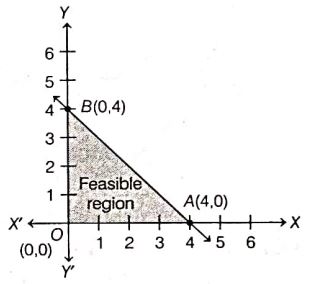
So, the feasible region lies in the Ist quadrant.
\(\therefore\) Feasible region is OABO.
The corner points of the feasible region are O(0, 0), A(4, 0) and B(0, 4). The values of Z at these points are as follows
| Corner points | Value of Z = 3x + 4y |
| O(0, 0) | 0 |
| A(4, 0) | 12 |
| B(0, 4) | 16 (Maximum) |
Therefore, the maximum value of Z is 16 at the point B(0, 4).
36.
Maximise Z = 70x + 40y
Subject to the constraints
\(\begin{array}{r} 3 x+2 y \leq 9 \end{array}\),
\(\begin{array}{r} 3 x+y \leq 9 \end{array}\)
and \(\begin{array}{r} x \geq 0, y \geq 0 \end{array}\)
Now, considering the inequations as equations, we get
3x + 2y = 9 .....(i)
3x + y =9 ....(ii)
Table for line 3x + 2y = 9 is
| x | 3 | 0 |
| y | 0 | 9/2 |
So, it passes through the points (3, 0) and (0, 9/2) on putting (0, 0) in the inequality 3x + 2y \(\leq\) 9.
0 \(\leq\) 9 (which is true)
So, the half plane is towards the origin.
Table for line 3x + y = 9 is
| x | 3 | 0 |
| y | 0 | 9 |
On putting (0, 0) in the inequality 3x + y \(\leq\) 9
0\(\leq\)9 (which is true)
So, the half plane is towards the origin.
Also, x \(\geq\) 0,y \(\geq\) 0, so the feasible region lies in the Ist quadrant.
The point of intersection of Eqs. (i) and (ii) is (3, 0).
The graphical representation of the above system of inequations is given below
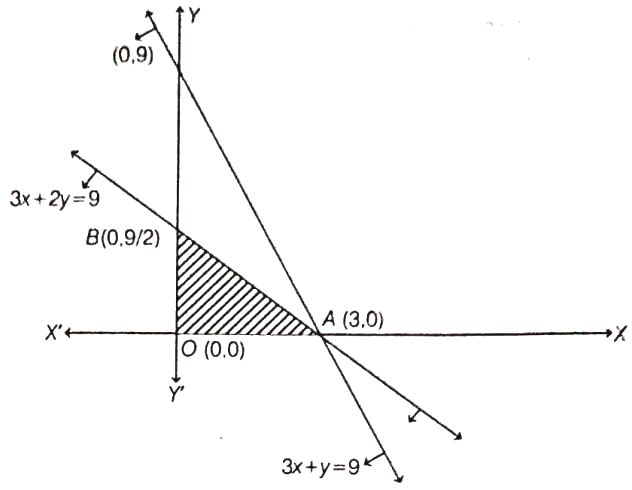
Clearly, feasible region is OABO, whose corner points are O(0, 0), A(3, 0) and B (0, 9/2).
| Corner points | Value of Z = 70 x + 40 y |
| O(0, 0) | 0 |
| A(3, 0) | 210 (Maximum) |
| B(0, 9/2) | 180 |
In the table, we find that maximum value of Z is 210 at the point A(3, 0).
37.
The graph of y = sin x and y = cos x are given below
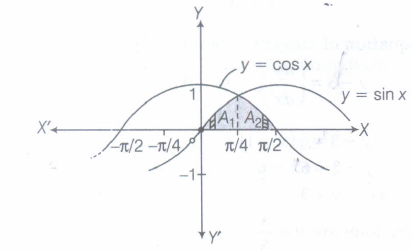
It is clear from the graph that the common region bounded by the X-axis, y = cos x, y = sin x and \(0 \leq x \leq \frac{\pi}{2}\) is the shaded region.
For point of intersection, consider cos x = sin x
\(\Rightarrow \tan x=1 \)
\(\Rightarrow x=\frac{\pi}{4} \)
\(\therefore\) Required bounded area = Area of shaded region \(\left(A_{1}+A_{2}\right)\)
\(=\int_{0}^{\pi / 4} \sin x d x+\int_{\pi / 4}^{\pi / 2} \cos x d x\)
\(=[-\cos x]_{0}^{\pi / 4}+[\sin x]_{\pi / 4}^{\pi / 2}\)
\(=-\left[\cos \frac{\pi}{4}-\cos 0\right]+\left[\sin \frac{\pi}{2}-\sin \frac{\pi}{4}\right]\)
\(=-\left[\frac{1}{\sqrt{2}}-1\right]+\left[1-\frac{1}{\sqrt{2}}\right]\)
\(=-\frac{1}{\sqrt{2}}+1+1-\frac{1}{\sqrt{2}}\)
\(=2-\frac{2}{\sqrt{2}}\)
\(=(2-\sqrt{2}) \text { sq units }\)
Hence, the required area is \((2-\sqrt{2}) \text { sq units }\).
38.
We .have a relation R on N x N defined by (a, b)R(c, d), if
ad(b + c) = bc(a + d) .
Reflexive Let (a, b) ∈ N x N be any arbitrary element.
We have to show that (a, b) R (a, b), i.e.
ab(b + a) = ba(a + b), which is always true, as natural numbers are commutative under usual multiplication and addition .•
Since, (a, b) ∈ N x N was arbitrary, so R is reflexive.
Symmetric Let (a, b), (c, d) ∈ N x N
such that (a, b) R (c, d), i.e. ad(b + c) = bc(a + d)
We have to show that (c, d) R (a, b),
i.e. cb(d + a) = da(c + b)
From Equation (i), we have ad( b + c) = bc( a + d)
⇒ da(c + b) = eb(d + a)
[natural numbers are commutative under
usual addition and multiplication] [1]
⇒ cb(d+a) = da(c+b)
⇒ (c, d)R(a, b)
So, R is symmetric.
Transitive Let (a, b), (c, d) and (e, f) ∈N x N such that (a, b) R (c, d) and (c, d) R (e, f).
⇒ (a, b)R(c, d) ⇒ ad(b+c) = be(a+d)
\( \Rightarrow \frac{b+c}{b c}=\frac{a+d}{a d} \)
\(\Rightarrow \frac{1}{c}+\frac{1}{b}=\frac{1}{d}+\frac{1}{a}\)
and \((c, d) R(e, f) \Rightarrow c f(d+e)=d e(c+f)\)
\(\Rightarrow \frac{d+e}{d e}=\frac{c+f}{c f} \)
\( \Rightarrow \frac{1}{e}+\frac{1}{d}=\frac{1}{f}+\frac{1}{c}\)
Now, adding Equation (ii) and (iii), we get
\(\left(\frac{1}{c}+\frac{1}{b}\right)+\left(\frac{1}{e}+\frac{1}{d}\right)=\left(\frac{1}{d}+\frac{1}{a}\right)+\left(\frac{1}{f}+\frac{1}{c}\right) \)
\(\Rightarrow \frac{1}{b}+\frac{1}{e}=\frac{1}{a}+\frac{1}{f}\)
\(\Rightarrow \frac{e+b}{b e}=\frac{f+a}{a f}\)
\(\Rightarrow a f(e+b)=b e(f+a)\)
\(\Rightarrow a f(b+e)=b e(a+f) \)
\(\Rightarrow (a, b) R(e, f)\)
So, R is transitive.
Hence, R is an equivalence relation.
39.
(i) b : Curves y = cos x and y = x + 1 meet at point C(O, 1).
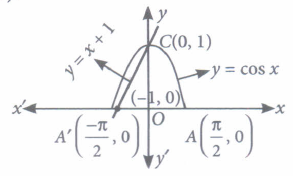
(ii) C : curve y=cosx meet the x axis at \(A^{\prime}\left(\frac{-\pi}{2}, 0\right)\) and \(A\left(\frac{\pi}{2}, 0\right)\) .
(iii) (a) : \(\int_{-1}^{0}(x+1) d x=\left[\frac{x^{2}}{2}+x\right]_{-1}^{0}=0-\left(\frac{1}{2}-1\right)=\frac{1}{2}\)
(iv) (d) : \(\int_{0}^{\pi / 2} \cos x d x=[\sin x]_{0}^{\pi / 2}=\sin \frac{\pi}{2}-\sin 0=1\)
(v) (b) : Required area \(\int_{-1}^{0}(x+1) d x+\int_{0}^{\pi / 2} \cos x d x\)
\(=\frac{1}{2}+1=\frac{3}{2} \text { sq. units }\)
40.
(i) (b): Objective function is a linear function (involve variable) whose maximum or minimum value is to be found.
(ii) (c): If optimal solution is obtained at two distinct points A and B (corners of the feasible region), then optimal solution is obtained at every point of segment [AB].
(iii) (b): When x ≥ 6 and y ≥ 2, then
2x + y ≥ 2 x 6 + 2, i.e., 2x + y ≥ 14
Hence, x ≥ 0, Y ≥ 0 and 2x + y ≥ 10 are automatically satisfied by every point of the region.
\(\{(x, y): x \geq 6\} \cap\{(x, y): y \geq 2\}\)
(iv) (b): Construct the following table of values of the objective function:
| Corner Points | Value of Z = 3x - 4y |
| (0,0) | 3 x 0 - 4 x 0 = 0 |
| (5,0) | 3 x 5 - 4 x 0 = 15 |
| (6, 5) | 3 x 6 - 4 x 5 =-2 |
| (6,8) | 3 x 6 - 4 x 8 = -14 |
| (4,10) | 3 x 4 - 4 x 10 = -28 |
| (0,8) | 3 x 0 - 4 x 8 = - 32 ⇠Minimum |
Minimum of Z = - 32 at (0, 8)
(v) (a): Construct the following table of values of the objective function F
| Corner Points | Value of F = 3x - 4y |
| (0,0) | 3 x 0 - 4 x 0 = 0 ⇠ Maximum |
| (6,12) | 3 x 6 - 4 x 12 = -30 |
| (6, 16) | 3 x 6 - 4 x 16 = - 46 |
| (0,4) | 3 x 0 - 4 x 4 = - 16 |
Hence, maximum of F = 0
41.
(i) (a) : For f(x) to be defined \(x-2 \neq 0\) i.e.,\(x \neq 2\)
\(\therefore\) Domain of f = R - {2}
(ii) (b) : Let y =J(x), then \(y=\frac{x-1}{x-2}\)
\(\Rightarrow x y-2 y=x-1 \Rightarrow x y-x=2 y-1 \Rightarrow x=\frac{2 y-1}{y-1}\)
Since, \(x \in R-\{2\}\),therefore \(y \neq 1\)
Hence, range of f = R-{1}
(iii) (d): We have,g(x) = 2f(x) - 1
\(=2\left(\frac{x-1}{x-2}\right)-1=\frac{2 x-2-x+2}{x-2}=\frac{x}{x-2}\)
(iv) (a) : We have, \(g(x)=\frac{x}{x-2}\) ,
Let \(g\left(x_{1}\right)=g\left(x_{2}\right) \Rightarrow \frac{x_{1}}{x_{1}-2}=\frac{x_{2}}{x_{2}-2}\)
\(\Rightarrow x_{1} x_{2}-2 x_{1}=x_{1} x_{2}-2 x_{2} \Rightarrow 2 x_{1}=2 x_{2} \Rightarrow x_{1}=x_{2}\)
Thus, \(g\left(x_{1}\right)=g\left(x_{2}\right) \Rightarrow x_{1}=x_{2}\)
Hence, g(x) is one-one.
(v) (c)
42.
(d) R is correct; A is incorrect
43.
(a) Both (A) and (R) are correct and (R) is the correct explanation of (A).
Let \(I =\int_2^8 \frac{\sqrt{10-x}}{\sqrt{x}+\sqrt{10-x}} d x\)
\(=\int_2^8 \frac{\sqrt{10-(10-x)}}{\sqrt{10-x}+\sqrt{10-(10-x)}} d x\)
\(=\int_2^8 \frac{\sqrt{x}}{\sqrt{10-x}+\sqrt{x}} d x\)
On adding Eqs. (i) and (ii), we get
\(2 I =\int_2^8 \frac{\sqrt{10-x}+\sqrt{x}}{\sqrt{10-x}+\sqrt{x}} d x=\int_2^8 1 d x\)
\(\Rightarrow \quad 2 I =[x]_2^8=8-2=6 \Rightarrow I=3
\)
Thus, Assertion and Reason both are correct and Reason is the correct explanation of Assertion.

12th Standard CBSE Syllabus & Materials
12th Standard CBSE
CBSE 12th Computer Science Python Revision Tour I - New Previous year Question Papers Study Material - QB365 Set A
NEW12th Standard CBSE
CBSE 12th Business Studies Planning Important Questions And Answers Study Material - QB365 Set A
NEW12th Standard CBSE
CBSE 12th Business Studies Business Environment Important Questions And Answers Study Material - QB365 Set A
NEW12th Standard CBSE
CBSE 12th Business Studies Principles of Management Important Questions And Answers Study Material - QB365 Set A



NCERT Books

Syllabus

Exam Pattern

Sample Question Papers

Previous year Question Papers

Important Notes

MCQ Practice test

NCERT Exemplers

Case study Questions

Image Based Questions

Passage based Questions

HOT Questions

Value Based Questions

Model Questions Papers
NCERT ( Book Back ) Questions

Assertion and Reason
Important Questions And Answers

CBSE 12th Standard CBSE Subjects
CBSE Standards








