
 100% FREE ACCESS
12th Standard CBSE Syllabus & Materials
12th Standard CBSE
CBSE 12th Economics Government Budget and the Economy Previous year Question Papers Study Material - QB365 Set A
NEW12th Standard CBSE
CBSE 12th Computer Science Interface Python with MySQL - New Previous year Question Papers Study Material - QB365 Set A
NEW12th Standard CBSE
CBSE 12th Computer Science Database Concept - New Previous year Question Papers Study Material - QB365 Set A
NEW12th Standard CBSE
CBSE 12th Computer Science Data Communication - New Previous year Question Papers Study Material - QB365 Set A
NEW12th Standard CBSE
CBSE 12th Computer Science Data Structures - New Previous year Question Papers Study Material - QB365 Set A
NEW12th Standard CBSE
CBSE 12th Computer Science Functions - New Previous year Question Papers Study Material - QB365 Set A

Published on: 25/10/2025
Download CBSE Class 12th Standard CBSE Maths question papers, sample papers, important questions, and previous year solved papers in PDF format. Get free study materials, NCERT solutions, and exam preparation resources for Class 12th Standard CBSE Maths
Questions + Answers key
Take MCQ Maths Test
1.
Bayes’ Theorem
If E1, E2 ,..., En are n non empty events which constitute a partition of sample space S, i.e. E1, E2 ,..., En are pairwise disjoint and \(\mathrm{E}_1 \cup \mathrm{E}_2 \cup \ldots \cup \mathrm{E}_n=S\) and A is any event of nonzero probability, then
\(\mathrm{P}\left(\mathrm{E}_i \mid \mathrm{A}\right)=\frac{\mathrm{P}\left(\mathrm{E}_i\right) \mathrm{P}\left(\mathrm{A} \mid \mathrm{E}_i\right)}{\sum_{j=1}^n \mathrm{P}\left(\mathrm{E}_j\right) \mathrm{P}\left(\mathrm{AlE}_j\right)} \text { for any } i=1,2,3, \ldots, n\)
2.
Differentiate each of the following with respect to x \(\left(x^{x}\right)^{x}\)
3.
Differentiate aX w.r.t. x, where a is a positive constant.
4.
If E and F be two events such that P(E) = \(\frac { 1 }{ 3 } ,P(F)=\frac { 1 }{ 4 } ,\) find \(P(E\cup F)\) if E and F are independent events.
5.
Show that : \({ sin }^{ -1 }\frac { 5 }{ 13 } +{ cos }^{ -1 }\frac { 3 }{ 5 } ={ tan }^{ -1 }\frac { 63 }{ 16 } \)
6.
Let R=[(a,\(a^{ 2 }\) ) : a is a prime number less than 5) be a relation Find the range of R
7.
Prove that,the function f(x)=x3-3x2+3x+107 is increasing on R.
8.
Differentiate \(\sec ^{-1}\left(\frac{1}{\sqrt{1-x^2}}\right)\) with respect to \(\sin ^{-1}\left[2 x \sqrt{1-x^2}\right]\)
9.
If A = {I, 2, 3} and relation R = {(2, 3)} in A.
Check whether relation R is reflexive, symmetric and transitive.
10.
Two dice are thrown, find the probability of getting an odd number on the first die and a multiple of 3 on the other die. Also, show that both events are dependent.
11.
Given that E and F are events such that P(E) = 0.6, P(F) = 0.3 and P(E ∩ F) = 0.2, find P(E|F) and P(F|E) .
12.
Evaluate \(\cos \left(\tan ^{-1} \frac{3}{4}\right)\)
13.
Show that of all the rectangles of given area the square has the smallest perimeter.
14.
A coin is biased so that the head is 4 times as likely to occur as tail. If the coin is tossed thrice, find the probability distribution of number of tails. Hence, find the mean and variance of the distribution.
15.
Find the intervals in which the following function is strictly increasing or strictly decreasing.
\(f(x)=\frac{3}{10} x^{4}-\frac{4}{5} x^{3}-3 x^{2}+\frac{36 x}{5}+11\)
16.
Show that the function defined by g(x) = x - [x] is discontinuous at all integral points. Here, [x] denotes the greatest integer less than or equal to x.
17.
If x = a \(\left( cost+log\quad tan\frac { t }{ 2 } \right) \) and y = sin t, then find \(\frac { d^{ 2 }y }{ dx^{ 2 } } t=\frac { \pi }{ 3 } \)
18.
Consider a relation R in the set A of people in a colony. Defined as aRb if a and b are members of joint family. Is R an equivalence relation? VBQ : Staying with Grandparents in a joint family imbibes the moral values in us. Can you elicit two such values?
19.
If \(sin\left( { sin }^{ -1 }\frac { 1 }{ 5 } +{ cos }^{ -1 }x \right) =1\), then find the value of x.
20.
If \(P(A \cap B)=\frac{1}{8}\) and \(P(\bar{A})=\frac{3}{4} \text {, then } P\left(\frac{B}{A}\right)\) is equal to
\(\frac{1}{2}\)
\(\frac{1}{3}\)
\(\frac{1}{6}\)
\(\frac{2}{3}\)
21.
The value of \(\tan \left(\cos ^{-1} \frac{3}{5}+\tan ^{-1} \frac{1}{4}\right)\)is
\(\frac{19}{8}\)
\(\frac{8}{19}\)
\(\frac{19}{12}\)
\(\frac{3}{4}\)
22.
If the set A contains 5 elements and the set B contains 6 elements, then the number of one-one and onto mappings from A to B is
720
120
0
None of these
23.
Using approximation find the value of \(y=\sqrt{4.01}\)
2.025
2.001
2.01
2.0025
24.
If A and B are events such that P(A|B) = P(B|A), then _____.
A ⊂ B but A ≠ B
A = B
A ∩ B = Φ
P(A) = P(B)
25.
Which of the following functions are decreasing on 0, \(\frac{\pi}{2}\)?
cos x
cos 2x
cos 3x
tan x
26.
tan–1 \(\sqrt3\) sec-1(-2) is equal to
π
\(-\frac { \pi }{ 3} \)
\(\frac { \pi }{ 3} \)
\(\frac { 2\pi }{ 3} \)
27.
Let R be the relation in the set N given by R = {(a, b): a = b − 2, b > 6}. Choose the correct answer.
(2, 4)∈ R
(3, 8) ∈ R
(6, 8)∈ R
(8, 7) ∈ R
28.
Rohan, a student of class XII, visited his uncle's flat with his father. He observe that the window of the house is in the form of a rectangle surmounted by a semicircular opening having perimeter 10m as shown in the figure.
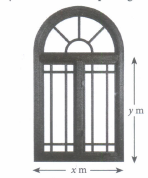
(i) If x and y represents the length and breadth of the rectangular region, then relation between x and y can be represented as
| (a) \(x+y+\frac{\pi}{2}=10\) | \(x+2 y+\frac{\pi x}{2}=10\) | (c) 2x + 2y = 10 | (d) \(x+2 y+\frac{\pi}{2}=10\) |
(ii) The area (A) of the window can be given by
| (a) \(A=x-\frac{x^{3}}{8}-\frac{x^{2}}{2}\) | (b) \(A=5 x-\frac{x^{2}}{2}-\frac{\pi x^{2}}{8}\) | (c) \(A=x+\frac{\pi x^{3}}{8}-\frac{3 x^{2}}{8}\) | (d) \(A=5 x+\frac{x^{2}}{2}+\frac{\pi x^{2}}{8}\) |
(iii) Rohan is interested in maximizing the area of the whole window, for this to happen, the value of x should be
| (a) \(\frac{10}{2-\pi}\) | (b) \(\frac{20}{4-\pi}\) | (c) \(\frac{20}{4+\pi}\) | (d) \(\frac{10}{2+\pi}\) |
(iv) Maximum area of the window is
| (a) \(\frac{30}{4-\pi}\) | (b) \(\frac{30}{4+\pi}\) | (c) \(\frac{50}{4-\pi}\) | (d) \(\frac{50}{4+\pi}\) |
(v) For maximum value of A, the breadth of rectangular part of the window is
| (a) \(\frac{10}{4+\pi}\) | (b) \(\frac{10}{4-\pi}\) | (c) \(\frac{20}{4+\pi}\) | (d) \(\frac{20}{4-\pi}\) |
29.
A relation R on a set A is said to be an equivalence relation on A iff it is
(a) Reflexive i.e.., \((a, a) \in R \ \forall \ a \in A\)
(b) Symmetric i.e., \((a, b) \in R \Rightarrow(b, a) \in R \ \forall \ a, b \in A\)
(c) Transitive i.e., \((a, b) \in R\) and \((b, c) \in R \Rightarrow(a, c) \in R\ \forall\ a, b, c \in A\)
Based on the above information, answer the following questions.
(i) If the relation R = {(1, 1), (1, 2), (1, 3), (2,2), (2, 3), (3,1), (3, 2), (3, 3)} defined on the set A = {1, 2, 3}, then R is
| (a) | reflexive | (b) | symmetric | (c) | transitive | (d) | equivalence |
(ii) If the relation R = {(1, 2), (2,1), (1, 3), (3, I)} defined on the setA = {1, 2, 3}, then R is
| (a) | reflexive | (b) | symmetric | (c) | transitive | (d) | equivalence |
(iii) If the relation R on the set N of all natural numbers defined as R = {(x, y) : y = x + 5 and x < 4}, then R is
| (a) | reflexive | (b) | symmetric | (c) | transitive | (d) | equivalence |
(iv) If the relation R on the set A = {1, 2, 3, , 13, 14}defined as R = {(x, y) : 3x - y = 0}, then R is
| (a) | reflexive | (b) | symmetric | (c) | transitive | (d) | equivalence |
30.
Assertion (A) : Maximum value of \(\left(\cos ^{-1} x\right)^2\) is \(\pi^2\)
Reason (R) : Range of the principal value branch of \(\cos ^{-1} x\) is \(\left[\frac{-\pi}{2}, \frac{\pi}{2}\right]\)
(a) Both Assertion and Reason are correct and Reason is the correct explanation of Assertion.
(b) Both Assertion and Reason are correct but Reason is not the correct explanation of Assertion.
(c) Assertion is correct but Reason is incorrect.
(d) Assertion is incorrect but Reason is correct.
31.
Assertion: If a function f is discontinuous at c, then c is called a point of discontinuity.
Reason: A function is continuous at x = c, if the function is defined at x = c and the value of the function at x = c equals the limit of the function at x = c.
(a) Assertion is correct, Reason is correct; Reason is a correct explanation for assertion.
(b) Assertion is correct, Reason is correct; Reason is not a correct explanation for Assertion
(c) Assertion is correct, Reason is incorrect
(d) Assertion is incorrect, Reason is correct.
1.
By formula of conditional probability, we know that
\( \mathrm{P}\left(\mathrm{E}_i \mid \mathrm{A}\right)=\frac{\mathrm{P}\left(\mathrm{A} \cap \mathrm{E}_i\right)}{\mathrm{P}(\mathrm{A})}\)
\( =\frac{\mathrm{P}\left(\mathrm{E}_i\right) \mathrm{P}\left(\mathrm{A|E}_i\right)}{\mathrm{P}(\mathrm{A})} \)(by multiplication rule of probability)
\(=\frac{\mathrm{P}\left(\mathrm{E}_i\right) \mathrm{P}\left(\mathrm{A|E}_i\right)}{\sum_{j=1}^n \mathrm{P}\left(\mathrm{E}_j\right) \mathrm{P}\left(\mathrm{A|E}_j\right)}\) (by the result of theorem of total probability)
2.
\(\left(x^{x}\right)^{x}(x+2 x \log x)\)
3.
Let y = ax.
Taking log on both sides, we get log y = x log a
On differentiating both sides w.r.t. x, we get
\(\frac{1}{y} \frac{d y}{d x}=\log a \Rightarrow \frac{d y}{d x}=y \log a\)
Thus,\(\frac{d}{d x}\left(a^{x}\right)=a^{x} \log a\)
4.
If E and F are independent events, then \(P\left( E\cap F \right) =P(E)\times P(F)\)
Now \(P(E\cup \bar { F } )=P(E)+P(F)-P(E\cap F)\)
\(\Rightarrow P(E\cup F)=P(E)+P(F)-P(E)\times P(F)\)
\(\Rightarrow P(E\cup F)=\frac { 1 }{ 3 } +\frac { 1 }{ 4 } -\frac { 1 }{ 3 } \times \frac { 1 }{ 4 } \)
\(\Rightarrow P(E\cup F)=\frac { 1 }{ 3 } +\frac { 1 }{ 4 } -\frac { 1 }{ 12 } =\frac { 4+3-1 }{ 12 } \)
\(\Rightarrow P(E\cup F)=\frac { 6 }{ 12 } \)
\(\therefore P(E\cup F)=\frac { 1 }{ 2 } \)
5.
\(L.H.S.={ sin }^{ -1 }\frac { 5 }{ 13 } +{ cos }^{ -1 }\frac { 3 }{ 5 } \)
\(\because { sin }^{ -1 }x={ tan }^{ -1 }\left( \frac { x }{ \sqrt { 1-{ x }^{ 2 } } } \right) \)
\({ sin }^{ -1 }\frac { 5 }{ 13 } ={ tan }^{ -1 }\left( \frac { 5/13 }{ \sqrt { 1-25/169 } } \right) \)
\(={ tan }^{ -1 }\frac { (5/13) }{ \sqrt { \frac { 144 }{ 169 } } } ={ tan }^{ -1 }\frac { 5 }{ 12 } \)
\(and\quad { cos }^{ -1 }x={ tan }^{ -1 }\left( \frac { \sqrt { 1-{ x }^{ 2 } } }{ x } \right) \)
\(\therefore \quad { cos }^{ -1 }\frac { 3 }{ 5 } ={ tan }^{ -1 }\left( \frac { \sqrt { 1-\frac { 9 }{ 25 } } }{ \frac { 3 }{ 5 } } \right) \)
\(={ tan }^{ -1 }\left( \frac { \sqrt { \frac { 16 }{ 25 } } }{ \frac { 3 }{ 5 } } \right) ={ tan }^{ -1 }\left( \frac { 4 }{ 3 } \right) \)
\({ tan }^{ -1 }\frac { 5 }{ 12 } +{ tan }^{ -1 }\frac { 4 }{ 3 } ={ tan }^{ -1 }\left[ \frac { \frac { 5 }{ 12 } +\frac { 4 }{ 2 } }{ 1-\frac { 5\times 4 }{ 12\times 3 } } \right] \)
\(\left[ { tan }^{ -1 }x+{ tan }^{ -1 }y={ tan }^{ -1 }\frac { x+y }{ 1-xy } \right] \)
\(={ tan }^{ -1 }\left| \frac { \frac { 15+48 }{ 36 } }{ \frac { 36-20 }{ 36 } } \right| \)
\(={ tan }^{ -1 }\left( \frac { 63 }{ 16 } \right) =R.H.S.\)
6.
Given R=[(a,a2 ) : a is a prime number less than 5}
⇒ R =[(2,8),(3,27)]
Range=[8,27]
7.
f'(x) 3x2- 6x + 3 = 3(x2 - 2x + 1)
= 3 (x - 1)2 > 0
Hence, function is increasing in R.
8.
Let \(u=\sec ^{-1}\left(\frac{1}{\sqrt{1-x^2}}\right)\)
On putting \(x=\sin \theta\)
and let \(v=\sin ^{-1}\left(2 x \sqrt{1-x^2}\right)\)
On putting \(x=\sin \theta\)
\(\Rightarrow \theta=\sin ^{-1} x\)
\( \therefore u=\sec ^{-1}\left(\frac{1}{\sqrt{1-\sin ^2 \theta}}\right)=\sec ^{-1}\left(\frac{1}{\sqrt{\cos ^2 \theta}}\right) \)
\(=\sec ^{-1}(\sec \theta)=\theta=\sin ^{-1} x\)
\(\therefore \frac{d u}{d x}=\frac{1}{\sqrt{1-x^2}}\)
\(\Rightarrow \quad \theta=\sin ^{-1} x \)
\(\therefore \quad v=\sin ^{-1}\left(2 \sin \theta \sqrt{1-\sin ^2 \theta}\right)\)
\(=\sin ^{-1}(2 \sin \theta \cdot \cos \theta) \)
\(=\sin ^{-1}(\sin 2 \theta)=2 \theta=2 \sin ^{-1} x\)
\(\therefore \frac{d v}{d x}=\frac{d}{d x}\left(2 \sin ^{-1} x\right)=\frac{2}{\sqrt{1-x^2}}\)
\(\therefore \frac{d u}{d v}=\frac{d u / d x}{d v / d x}=\frac{1 / \sqrt{1-x^2}}{2 / \sqrt{1-x^2}} \Rightarrow \frac{d u}{d v}=\frac{1}{2}\)
9.
Not reflexive, as (1, 1) \(\notin\) R.
Not symmetric, as (2, 3) \(\in\) R but (3, 2) \(\notin\) R.
Transitive, as relation R in a non empty set containing one element is transitive
10.
Let A be the event of getting an odd number on the first die and B be the event of getting a multiple of 3 on the second die.
On throwing two dice, total outcomes = 36
Outcomes favourable to \(A \cap B\) i.e an odd number on first die and a multiple of 3 on the other die are
\( \{(1,3),(1,6),(3,3),(3,6),(5,3),(5,6)\} \therefore \quad n(A \cap B)=6 \)
Then, required probability \(P(A \cap B)=\frac{6}{36}=\frac{1}{6}\)
Now, A = {1, 3, 5}, B = {3, 6}
So, n (A) = 3, n (B) = 2
\(\therefore \quad P(A)=\frac{n(A)}{n(S)}=\frac{3}{36}=\frac{1}{12}\)
and \(P(B)=\frac{2}{36}=\frac{1}{18}\)
Here, \(P(A) \cdot P(B)=\frac{1}{12} \times \frac{1}{18}=\frac{1}{216} \neq P(A \cap B)\)
Hence, A and B are dependent events.
11.
\(\text { Given: } P(E)=0.6, P(F)=0.3, P(E \cap F)=0.2 \)
\(P(E \mid F)=\frac{P(E \cap F)}{P(E)}=\frac{0.2}{0.3}=\frac{2}{3} \)
\(P(F \mid E)=\frac{P(E \cap F)}{P(E)}=\frac{0.2}{0.6}=\frac{1}{3}\)
12.
We have, \(\cos \left(\tan ^{-1} \frac{3}{4}\right)\)
Let \(x=\tan ^{-1} \frac{3}{4}, then \tan x=\frac{3}{4}\)
\(\because \sec x=\sqrt{1+\tan ^{2} x}=\sqrt{1+\left(\frac{3}{4}\right)^{2}}=\sqrt{1+\frac{9}{16}} \)\(=\sqrt{\frac{25}{16}}=\frac{5}{4}\)
\(\Rightarrow \cos x=\frac{4}{5} \quad\left[\because \cos x=\frac{1}{\sec x}\right]\)
\(\Rightarrow x=\cos ^{-1}\left(\frac{4}{5}\right)\)
\(\Rightarrow \quad \tan ^{-1}\left(\frac{3}{4}\right)=\cos ^{-1}\left(\frac{4}{5}\right) \quad\left[\because x=\tan ^{-1} \frac{3}{4}\right]\\ \therefore \cos \left(\tan ^{-1} \frac{3}{4}\right)=\cos \left(\cos ^{-1} \frac{4}{5}\right)=\frac{4}{5} \)
\( \left[\because \cos \left(\cos ^{-1} x\right)=x, \forall x \in[-1,1]\right]\)
13.
X=Y
14.
\(P(\text { head })=4 P(\text { tail }) \Rightarrow P(H)=\frac{4}{5}, P(T)=\frac{1}{5}\)
\(\begin{array}{c|c|c|c|c} \hline \begin{array}{c} X \\ \text { (Number of tails) } \end{array} & 0 & 1 & 2 & 3 \\ \hline P(X) & \frac{64}{125} & \frac{48}{125} & \frac{12}{125} & \frac{1}{125} \\ \hline X P(X) & 0 & \frac{48}{125} & \frac{24}{125} & \frac{3}{125} \\ \hline X^{2} P(X) & 0 & \frac{48}{125} & \frac{48}{125} & \frac{9}{125} \\ \hline \end{array}\)
\(\therefore \text { Mean }=\Sigma X P(X)=\frac{75}{125}\)
\(\text { Variance }=\Sigma X^{2} P(X)-\left[\sum X P(X)\right]^{2}=\frac{105}{125}-\frac{9}{25}\)
\(\text { Mean }=\frac{3}{5}, \text { variance }=\frac{12}{25}\)
15.
Given, \(f(x)=\frac{3}{10} x^{4}-\frac{4}{5} x^{3}-3 x^{2}+\frac{36 x}{5}+11\)
On differentiating both sides w.r.t. x, we get
\(f^{\prime}(x)=\frac{12 x^{3}}{10}-\frac{12 x^{2}}{5}-6 x+\frac{36}{5}+0\)
Put \(f^{\prime}(x)=0\)
\(\Rightarrow \frac{12 x^{3}}{10}-\frac{12 x^{2}}{5}-6 x+\frac{36}{5}=0\)
\(\Rightarrow \frac{6 x^{3}-12 x^{2}-30 x+36}{5}=0\)
\(\Rightarrow\)\(x^{3}-2 x^{2}-5 x+6=0\left[\right. divide by \left.\frac{6}{5}\right]\)
\(\Rightarrow (x-1)\left(x^{2}-x-6\right)=0\)
\(\Rightarrow (x-1)(x+2)(x-3)=0\)
\(\Rightarrow\) x - 1 = 0
x + 2 = 0 or x - 3 = 0
x = -2, 1, 3
Now, we find the intervals in which f(x) is strictly increasing or strictly decreasing.
\(\begin{array}{ccc} \hline \text { Interval } & \begin{array}{c} \text { Sign of } f^{\prime}(x) \\ f^{\prime}(x)=(x-1)(x+2)(x-3) \end{array} & \begin{array}{c} \text { Nature of } \\ \text { function } \end{array} \\ \hline(-\infty,-2] & (-)(-)(-)=(-)<0 & \begin{array}{l} \text { Strictly } \\ \text { decreasing } \end{array} \\ \hline[-2,1] & (-)(+)(-)=(+)>0 & \text { Strictly increasing } \\ \hline[1,3] & (+)(+)(-)=(-)<0 & \begin{array}{l} \text { Sthictly } \\ \text { decreasing } \end{array} \\ \hline[3, \infty) & (+)(+)(+)=(+)>0 & \text { Strictly increasing } \\ \hline \end{array}\)
(a) f(x) is strictly increasing in the interval \((-2,1) \cup(3, \infty)\)
(b) f(x) is strictly decreasing in the interval \((-\infty,-2) \cup(1,3)\)
16.
Here g(x) = x - [x]
Let a be an integer and h is very small h > 0, then
\( [a-h]=a-1,[a+h]=a \)
\(\text {and } [a]=a \)
\(\text {At } x=a, \mathrm{LHL}=\lim _{x \rightarrow a^{-}} g(x)=\lim _{x \rightarrow a^{-}}(x-[x])\)
\(Put x=a-h ; when x \rightarrow a^{-}, then\ h \rightarrow 0\)
\( \mathrm{LHL} =\lim _{h \rightarrow 0}(a-h-[a-h]) \)
\(=\lim _{h \rightarrow 0}(a-h-(a-1)) \)
17.
y = a sin t
\(\frac { dy }{ dt } =a\quad cost\)
\(x=a\left( -sint+\frac { sec^{ 2 }\frac { t }{ 2 } }{ 2tan\frac { 1 }{ 2 } } \right) \)
\(\Rightarrow \frac { dx }{ dt } =a\left( -sint+\frac { 1 }{ sint } \right) \)
\(\Rightarrow \frac { dx }{ dt } =\frac { a(1-sin^{ 2 }t) }{ sint } \)
\(=\frac { acos^{ 2 }t }{ sint } \)
\(\frac { dy }{ dx } =\frac { dy }{ dt } x\frac { dt }{ dx } \)
=acost \(\times \frac { sint }{ acos^{ 2 }t } =tant\)
\(\frac { d^{ 2 }y }{ dx^{ 2 } } =sec^{ 2 }\times \frac { dt }{ dx } \)
\(\frac { sect\times sint }{ acost } =\frac { 1 }{ a } sec^{ 3 }t-tant\)
\(\left\lfloor \frac { d^{ 2 }y }{ dx^{ 2 } } \right\rfloor =\frac { 1 }{ a } sec^{ 3 }\frac { \pi }{ 3 } tan\frac { \pi }{ 3 } \)
\(=\frac { 1 }{ a } 8\sqrt { 3 } =\frac { 8\sqrt { 3 } }{ a } \)
18.
Let (a, a) \(\in \) R and a are members of joint family, \(\forall a\in A\)
\(\therefore\) R is reflexive.
Let (a, b) \(\in \) R \(\rightarrow \) a and b are members of joint family
\(\Rightarrow \) b and a are members of joint family
\(\Rightarrow (b,a)\in R,\forall a,b\in A\)
R is symmetric
Let (a, b) \(\in \) R \(\Rightarrow \) a and b are members of joint family ...(i)
And (b, c) \(\in \) R \(\Rightarrow \) band c are members of joint family ...(ii)
from (i) and (ii) \(\Rightarrow \) a, band c are members of joint family
\(\Rightarrow (a,c)\in R,\forall a,b,c\in A\)
R is transitive
R is an equivalence relation
Values:
(i) Love and concern for Grandparents,
(ii) Respect for Grandparents,
(iii) Tolerance
19.
\(\sin \left(\sin ^{-1} \frac{1}{5}+\cos ^{-1} x\right)=1\)
\(\Rightarrow \sin \left(\sin ^{-1} \frac{1}{5}\right) \cos \left(\cos ^{-1} x\right)+\cos \left(\sin ^{-1} \frac{1}{5}\right) \sin \left(\cos ^{-1} x\right)=1\)
\([\sin (A+B)=\sin A \cos B+\cos A \sin B]\)
\(\Rightarrow \frac{1}{5} \times x+\cos \left(\sin ^{-1} \frac{1}{5}\right) \sin \left(\cos ^{-1} x\right)=1\)
\(\Rightarrow \frac{x}{5}+\cos \left(\sin ^{-1} \frac{1}{5}\right) \sin \left(\cos ^{-1} x\right)=1\)
\(\text {Now let } \sin ^{-1} \frac{1}{5}=y \)
\(\text {Then, } \sin y=\frac{1}{5} \Rightarrow \cos y=\sqrt{1-\left(\frac{1}{5}\right)^{2}}=\frac{2 \sqrt{6}}{5} \Rightarrow y=\cos ^{-1}\left(\frac{2 \sqrt{6}}{5}\right)\)
\(\therefore \sin ^{-1} \frac{1}{5}=\cos ^{-1}\left(\frac{2 \sqrt{6}}{5}\right) \ldots .(2)\)
\(\text {Let } \cos ^{-1} x=z\)
\(\text {Then } \cos z=x \Rightarrow \sin z=\sqrt{1-x^{2}} \Rightarrow z=\sin ^{-1}\left(\sqrt{1-x^{2}}\right)\)
\(\therefore \cos ^{-1} x=\sin ^{-1}\left(\sqrt{1-x^{2}}\right)\)
From 1, 2 and 3 we have
\(\frac{x}{5}+\cos \left(\frac{\cos ^{-1}(2 \sqrt{6})}{5}\right) \cdot \sin \left(\sin ^{-1} \sqrt{1-x^{2}}\right)=1 \)
\(\Rightarrow \frac{x}{5}+\frac{2 \sqrt{6}}{5} \cdot \sqrt{1-x^{2}}=1\)
\(\Rightarrow x+2 \sqrt{6} \sqrt{1-x^{2}}=5\)
\(=2 \sqrt{6} \sqrt{1-x^{2}}=5-x\)
On squaring both sides, we get:
\((4)(6)\left(1-x^{2}\right)=25+x^{2}-10 x\)
\(\Rightarrow 24-24 x^{2}=25+x^{2}-10 x\)
\(\Rightarrow 25 x^{2}-10 x+1=0\)
\(\Rightarrow(5 x-1)^{2}=0\)
\(\Rightarrow(5 x-1)=0\)
\(\Rightarrow x=\frac{1}{5}\)
Hence, the value of x is \( \frac{1}{5}\)
20.
(a)
\(\frac{1}{2}\)
21.
\( \tan \left(\cos ^{-1} \frac{3}{5}+\tan ^{-1} \frac{1}{4}\right) \)
\(\text { Let } \cos ^{-1} \frac{3}{5}=x \Rightarrow \cos x=\frac{3}{5} \)
\(\therefore \ \tan x=\frac{4}{3} \Rightarrow x=\tan ^{-1} \frac{4}{3} \)
\(\therefore \ \tan \left(\tan ^{-1} \frac{4}{3}+\tan ^{-1} \frac{1}{4}\right) \)
\(\therefore \ \tan \left[\tan ^{-1}\left\{\frac{\left(\frac{4}{3}+\frac{1}{4}\right)}{1-\frac{4}{3} \times \frac{1}{4}}\right\}\right]=\frac{19}{8}\)
22.
One-one onto mapping is possible only ifn(A) = n(B)
23.
(d)
2.0025
24.
(d)
P(A) = P(B)
25.
(b)
cos 2x
26.
(b)
\(-\frac { \pi }{ 3} \)
27.
(c)
(6, 8)∈ R
28.
(i) (b) : Given, perimeter of window = 10 m
\(\therefore\) x + y + y + perimeter of semicircle = 10
\(\Rightarrow x+2 y+\pi \frac{x}{2}=10\)
(ii) (b) : \(A=x \cdot y+\frac{1}{2} \pi\left(\frac{x}{2}\right)^{2}\)
\(=x\left(5-\frac{x}{2}-\frac{\pi x}{4}\right)+\frac{1}{2} \frac{\pi x^{2}}{4}\left[\because \text { From }(\mathrm{i}), y=5-\frac{x}{2}-\frac{\pi x}{4}\right]\)
\(=5 x-\frac{x^{2}}{2}-\frac{\pi x^{2}}{4}+\frac{\pi x^{2}}{8}=5 x-\frac{x^{2}}{2}-\frac{\pi x^{2}}{8}\)
(iii) (c) : We have, \(A=5 x-\frac{x^{2}}{2}-\frac{\pi x^{2}}{8}\)
\(\Rightarrow \quad \frac{d A}{d x}=5-x-\frac{\pi x}{4}\)
Now, \(\frac{d A}{d x}=0 \Rightarrow 5=x+\frac{\pi x}{4}\)
\(\Rightarrow x(4+\pi)=20 \Rightarrow x=\frac{20}{4+\pi}\)
\(\left[\text { Clearly, } \frac{d^{2} A}{d x^{2}}<0 \text { at } x=\frac{20}{4+\pi}\right]\)
(iv) (d) : At \(x=\frac{20}{4+\pi}\)
\(A=5\left(\frac{20}{4+\pi}\right)-\left(\frac{20}{4+\pi}\right)^{2} \frac{1}{2}-\frac{\pi}{8}\left(\frac{20}{4+\pi}\right)^{2}\)
\(=\frac{100}{4+\pi}-\frac{200}{(4+\pi)^{2}}-\frac{50 \pi}{(4+\pi)^{2}}\)
\(=\frac{(4+\pi)(100)-200-50 \pi}{(4+\pi)^{2}}=\frac{400+100 \pi-200-50 \pi}{(4+\pi)^{2}}\)
\(=\frac{200+50 \pi}{(4+\pi)^{2}}=\frac{50(4+\pi)}{(4+\pi)^{2}}=\frac{50}{4+\pi}\)
(v) (a) : We have, \(y=5-\frac{x}{2}-\frac{\pi x}{4}=5-x\left(\frac{1}{2}+\frac{\pi}{4}\right)\)
\(=5-x\left(\frac{2+\pi}{4}\right)=5-\left(\frac{20}{4+\pi}\right)\left(\frac{2+\pi}{4}\right)\)
\(=5-5 \frac{(2+\pi)}{4+\pi}=\frac{20+5 \pi-10-5 \pi}{4+\pi}=\frac{10}{4+\pi}\)
29.
(i) (a) : Clearly (1, 1), (2, 2), (3, 3), \(\in\) R. So, R is reflexive on A.
Since, \((1,2) \in R \text { but }(2,1) \notin R\) So, R is not symmetric on A.
Since, \((2,3), \in R\) and \((3,1) \in R\) but \((2,1) \notin R\) .So, R is not transitive on A.
(ii) (b) : Since, (1,1), (2, 2) and (3, 3) are not in R. So, R is not reflexive on A.
Now, \((1,2) \in R \Rightarrow(2,1) \in R\)
and \((1,3) \in R \Rightarrow(3,1) \in R\)
So, R is symmetric
Clearly,\((1,2) \in R \text { and }(2,1) \in R \text { but }(1,1) \notin R\)
So, R is not transitive on A.
(iii) (c) : We have, \(R=\{(x, y): y=x+5 \text { and } x<4\}\) ,where \(x, y \in N\) .
\(\therefore R=\{(1,6),(2,7),(3,8)\}\)
Clearly, (1, 1), (2, 2) etc. are not in R. So, R is not reflexive.
Since, \((1,6) \in R\) but \((6,1) \notin R\) So, R is not symmetric.
Since, \((1,6) \in R\) R and there is no order pair in R which has 6 as the first element. Same is the case for (2, 7) and (3, 8). So, R is transitive.
(iv) (d) : We have,R = {(x, y) : 3x - y = 0}, where \(x, y \in A=\{1,2, \ldots \ldots, 14\}\) .
\(\therefore\) R = {(I, 3), (2, 6), (3, 9), (4, 12)}
Clearly,\((1,1) \notin R\) So, R is not reflexive on A.
Since, \((1,3) \in R\) but \((3,1) \notin R\) .So, R is not symmetric on A.
Since, \((1,3) \in R\) and \((3,9) \in R\) but \((1,9) \notin R\) So, R is not transitive on A.
(v) (d) : Clearly, (1, 1), (2, 2), (3, 3) ∈ R. So, R is reflexive on A.
We find that the ordered pairs obtained by interchanging the components of ordered pairs in R are also in R. So, R is symmetric on A.
For \(1,2,3 \in A\) such that (1, 2) and (2, 3) are in Rimplies that (1, 3) is also, in R. So, R is transitive on A. Thus, R is an equivalence relation.
30.
(c) Assertion (A) Maximum value of \(\cos ^{-1} x\) is \(\pi\), which occurs at x = -1
Therefore Maximum value of \(\left(\cos ^{-1} x\right)^2\) is \(\pi^2\).
So, assertion is correct.
Reason (R) The principal value branch of \(\cos ^{-1} x\) is [0, \(\pi\)]
So, reason is incorrect.
31.
(b) Assertion is correct, Reason is correct; Reason is not a correct explanation for Assertion

12th Standard CBSE Syllabus & Materials
12th Standard CBSE
CBSE 12th Computer Science Python Revision Tour I - New Previous year Question Papers Study Material - QB365 Set A
NEW12th Standard CBSE
CBSE 12th Business Studies Planning Important Questions And Answers Study Material - QB365 Set A
NEW12th Standard CBSE
CBSE 12th Business Studies Business Environment Important Questions And Answers Study Material - QB365 Set A
NEW12th Standard CBSE
CBSE 12th Business Studies Principles of Management Important Questions And Answers Study Material - QB365 Set A



NCERT Books

Syllabus

Exam Pattern

Sample Question Papers

Previous year Question Papers

Important Notes

MCQ Practice test

NCERT Exemplers

Case study Questions

Image Based Questions

Passage based Questions

HOT Questions

Value Based Questions

Model Questions Papers
NCERT ( Book Back ) Questions

Assertion and Reason
Important Questions And Answers

CBSE 12th Standard CBSE Subjects
CBSE Standards








