
 100% FREE ACCESS
12th Standard CBSE Syllabus & Materials
12th Standard CBSE
CBSE 12th Economics Government Budget and the Economy Previous year Question Papers Study Material - QB365 Set A
NEW12th Standard CBSE
CBSE 12th Computer Science Interface Python with MySQL - New Previous year Question Papers Study Material - QB365 Set A
NEW12th Standard CBSE
CBSE 12th Computer Science Database Concept - New Previous year Question Papers Study Material - QB365 Set A
NEW12th Standard CBSE
CBSE 12th Computer Science Data Communication - New Previous year Question Papers Study Material - QB365 Set A
NEW12th Standard CBSE
CBSE 12th Computer Science Data Structures - New Previous year Question Papers Study Material - QB365 Set A
NEW12th Standard CBSE
CBSE 12th Computer Science Functions - New Previous year Question Papers Study Material - QB365 Set A

Published on: 25/10/2025
Download CBSE Class 12th Standard CBSE Maths question papers, sample papers, important questions, and previous year solved papers in PDF format. Get free study materials, NCERT solutions, and exam preparation resources for Class 12th Standard CBSE Maths
Questions + Answers key
Take MCQ Maths Test
1.
Let the function f : R\(\rightarrow\)R to be defined by f(x) = cos x \(\forall \) x \(\in\)R. Show that is neither one-one nor onto.
2.
Prove that the greatest integer function f : R \(\rightarrow\)R, given by f(x) = [x] is neither one-one nor onto. Where [x] denotes the greatest integer less than or equal to x
3.
Prove that f : \(R\rightarrow R\) given by f(x) = x3 + 1 is one-one function.
4.
Show that the function f: \(R\rightarrow R\) defined by:
\(f(x)=\frac { 4x-3 }{ 5 } ,x\in R\) is one-one and onto function.
5.
Show that the number of equivalence relations in the set {1, 2, 3} containing {1, 2} and {2, 1} is two.
6.
In the set of natural numbers N, define a relation R as follows:
\(\forall n,m\in N,\ nRm\) if on division by 5 each of the integers \(n\) leaves the remainder less than 5 i.e. one of the numbers 0,1,2,3 and 4. Show that R is equivalence relation. Also, obtain the pairwise disjoint subsets determined by R.
7.
Let R be the equivalence relation in the set Z of integers given by:
R={(a,b):2 divides a-b}.
Write the equivalence class [0].
8.
Let R be a relation on a finite set A having n elements. Then, the number of relations on A is
n x n
2n
n2
2nxn
9.
Let R = { (P,Q) : OP = OQ , O being the origin} be an equivalence relation on A . The equivalence class [( 1,2)] is
{(x, y): x2 + y2 = 5}
{(x, y): x2 = y2}
{(x, y): x2 + y2 = 1}
{(x, y): x2 + y2 = 4}
10.
A relation S in the set of real numbers is defined as xSy ⇒ x – y+ \(\sqrt3\) is an irrational number, then relation S is
reflexive
reflexive and symmetric
transitive
symmetric and transitive
11.
Given set A ={1, 2, 3} and a relation R = {(1, 2), (2, 1)}, the relation R will be
reflexive if (1, 1) is added
symmetric if (2, 3) is added
transitive if (1, 1) is added
symmetric if (3, 2) is added
12.
Given triangles with sides T1 : 3, 4, 5; T2 : 5, 12, 13; T3 : 6, 8, 10; T4 : 4, 7, 9 and a relation R in set of triangles defined as R = {(Δ1, Δ2) : Δ1 is similar to Δ2}. Which triangles belong to the same equivalence class?
T1 and T2
T2 and T3
T1 and T3
T1 and T4
13.
Show that the relation R on the set Z of allintegers defined by (x, y) ∈ R ⇔ (x - y) is divisible by 3 is an equivalence relation.
14.
A function \(f:[-4,4] \rightarrow[0,4]\) is given by \(f(x)=\sqrt{16-x^2}\). Show that f is an onto function but not a one-one function. Further, find all possible values of a for which \(f(a)=\sqrt{7}\).
15.
Let \(f: R-\left\{-\frac{4}{3}\right\} \rightarrow R\) be a function defined as \(f(x)=\frac{4 x}{3 x+4}\). Show that f is a one-one function. Also, check whether f is an onto funciton or not.
16.
Let N be the set of all natural numbers and let R be a relation on N x N defined by (a, b) R (c, d) \(\Leftrightarrow\)ad = be for all (a, b), (c, d) \(\in\) N x N. Show that R is an equivalence relation on N x N.
17.
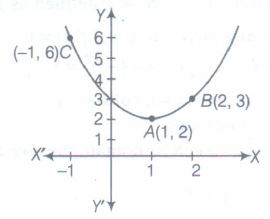
With the help of following graph, find the equation of function. Also, check whether the function is many-one or not.
18.
Given a function defined by \(f(x)=\sqrt{4-x^{2}} 0 \leq x \leq 2,0 \leq f(x) \leq 2\) . Show that f is bijective function.
19.
Show that the function \(f: \mathbf{R} \rightarrow\{x \in \mathbf{R}:-1<x<1\}\)
20.
Show that f : N\( \rightarrow \)N, given by
\(f(x)=\left\{\begin{array}{l}x+1, \text { if } x \text { is odd } \\ x-1, \text { if } x \text { is even }\end{array}\right. \text {is bijective (both one-one and onto)}\)
21.
Show that the function f : N ➝ N, given by f(1) = f(2) = 1 and f(x) = x - 1 for every x > 2, is onto but not one-one.
22.
If N denotes the set of all natural numbers and R is the relation on N x N defined by (a, b) R (c, d), if ad(b + c) = bc (a + d). Show that R is an equivalence relation.
1.
\(\cos \frac{\pi}{3}=\frac{1}{2} \text {, also } \cos \frac{5 \pi}{3}=\frac{1}{2} \text {, not one-one }\)
2.
Given) f : R →→ R defined by f(x) = [x]
For one-one: We know by definition that for
a ≤ x
x1 ≠ x2 ⇒ f(x1) = f(x2) = a
Hence, not one-one.
For onto: For y(non integer) in co-domain there does not exist x ∈ R in domain such that f(x) = y. Hence, not onto.
3.
Given \(f(x)=x^3+1\)
For \(x_1 \neq x_2\)
\(\Rightarrow x_1^3 \neq x_2^3 \Rightarrow x_1^3+1 \neq x_2^3+1\)
\(\Rightarrow f\left(x_1\right) \neq f\left(x_2\right)\), hence, one-one
4.
(i) Let \(x_{ 1 },x_{ 2 }\in R\).
Now \(f(x_{ 1 })=f(x_{ 2 })\Rightarrow \frac { 4x_{ 1 }-3 }{ 5 } =\frac { 4x_{ 2 }-3 }{ 5 } \)
\(\Rightarrow \) \(4x_{ 1 }-3=4x_{ 2 }-3\Rightarrow 4x_{ 1 }=4x_{ 2 }\)
\(\Rightarrow \) \(x_{ 1 }=x_{ 2 }\Rightarrow \quad 'f'\) one-one
Let \(y\in R.\) Let \(y=f(x_{ 0 })\).
Then \(\frac { 4x_{ 0 }-3 }{ 5 } =y\Rightarrow x_{ 0 }=\frac { 5y+3 }{ 4 } \Rightarrow x_{ 0 }\in R\)
\(f(x_{ 0 })=\frac { 4x_{ 0 }-3 }{ 5 } =\frac { 4 }{ 5 } \left( \frac { 5y+3 }{ 4 } \right) -\frac { 3 }{ 5 } \)
\(=y+\frac { 3 }{ 5 } -\frac { 3 }{ 5 } =y\)
\(\therefore \) For each \(y\in R\), there exists \(x_{ 0 }y\in R\) such that
\(f(x_{ 0 })=y\)
\(\therefore \) 'f' is one-one and onto function.
5.
The smallest equivalence relation R1 containing (1, 2) and (2, 1) is {(1, 1), (2, 2), (3, 3), (1, 2), (2, 1)}.
Now we are left with only 4 pairs namely (2, 3), (3, 2), (1, 3) and (3, 1).
If we add any one, say (2, 3) to R1, then for symmetry we must add (3, 2) also and now for transitivity we are forced to add (1, 3) and (3, 1).
Thus, the only equivalence relation bigger than R1 is the universal relation.
This shows that the total number of equivalence relations containing (1, 2) and (2, 1) is two.
6.
Partition the set N into pairwise disjoint subsets. The equivalent classes are as given by:
\(A_{ 0 }=\{ 5,10,15,20,............\} \)
\(A_{ 1 }=\{ 1,16,11,16,21,.......\} \)
\(A_{ 2 }=\{ 2,7,12,17,22,.........\} \)
\(A_{ 3 }=\{ 3,8,13,18,23,.........\} \)
\(A_{ 4 }=\{ 4,9,14,19,24,.........\} \)
Clearly the above five sets are pairwise disjoint and \(A_{ 0 }\cup A_{ 1 }\cup A_{ 2 }\cup A_{ 3 }\cup A_{ 4 }=\overset { 4 }{ \underset { i=0 }{ \cup } } A_{ i }=N\)
7.
\([0]={ \pm 2,\pm 4,\pm 6,\quad .......\} . }\)
8.
(d)
2nxn
9.
(a)
{(x, y): x2 + y2 = 5}
10.
Reflexive, true as x s x ⇒ x - x + \(\sqrt3\)
= \(\sqrt3\) is an irrational number
Symmetric, fase e.g x = \(\sqrt3\), y= 2
x S y ⇒ \(\sqrt3\) - 2 + \(\sqrt3\) = 2 \(\sqrt3\) -2 is an irrational number
but ySx ⇒ 2 - \(\sqrt3\) + \(\sqrt3\) = 2 \(\sqrt3\) -2 is not irrational number
transitive, false e.g = x = 1 + \(\sqrt3\), y = 5 z = 2 \(\sqrt3\)
x S y ⇒ 1 + \(\sqrt3\) - 5 + \(\sqrt3\) = 2 \(\sqrt3\) - 4 is an irrational number
y S z ⇒ 5 -2 \(\sqrt3\) + \(\sqrt3\) = 5 - \(\sqrt3\) is an irrational number
But x S z ⇒ 1 + \(\sqrt3\) - 2 \(\sqrt3\) + \(\sqrt3\) = 1 is an irrational number
11.
Here (1,2) e R, (2,1) € R, if transitive (1,1) should belong to R.
12.
T1 and T3 are similar as their sides are proportional.
13.
The given relation is R = {(x, y):x, y ∈ Z and x-y is divisible by 3}.
To prove R is an equivalence relation, we have to prove R is reflexive, symmetric and transitive.
Reflexive : As, for any x ∈ Z, we have x - x = 0, which is divisible by 3.
⇒ (x - x) is divisible by 3
⇒ (x,x)∈ R, ∀ x ∈ Z
Therefore, R is reflexive.
Symmetric Let (x, y) ∈ R, where x, y ∈ Z.
⇒ (x - y) is divisible by 3. [by definition of R]
⇒ x - y=3 A for some A ∈ Z.
⇒ y - x = 3(-A)
⇒ (y - x) is also divisible by 3.
⇒ (y, x)∈R
Therefore, R is symmetric.
Transitive Let (x, y) ∈ R, where x, y ∈ Z.
⇒ (x - y) is divisible by 3.
⇒ x - y = 3A for some A∈Z
Again, let (y, z) ∈ R, where y, z∈ Z.
⇒ (y - z) is divisible by 3.
⇒ y - z = 3B for some B ∈ Z.
Now, (x - y)+(y - z) = 3A + 3B
⇒ x - 2 = 3(A + B)
⇒ (x - z) is divisible by 3 for some
(A + B)∈ Z ⇒ (x,z) ∈ R
Therefore, R is transitive.
Thus, R is reflexive, symmetric and transitive. Hence, it is an equivalence relation.
14.
Given, function \(f: \mid-4,4] \rightarrow[0,4]\)
Defined by \(f(x)=\sqrt{16-x^2}\)
For one-one Let \(x_1, x_2 \in[-4,4]\)
Such that \(f\left(x_1\right)=f\left(x_2\right)\)
\(\Rightarrow \sqrt{16-x_1^2}=\sqrt{16-x_2^2} \)
\(\Rightarrow 16-x_1^2=16-x_2^2\)
\(\Rightarrow x_1^2=x_2^2 \Rightarrow\left(x_1^2-x_2^2\right)=0\)
\(\Rightarrow f(x)\) is not one-one function.
For onto
Let \(y \in[0,4]\) (codomain) be any arbitrary element.
Then, y=f(x)
\(\Rightarrow y=\sqrt{16-x^2} \Rightarrow y^2=16-x^2 \)
\(\Rightarrow x^2=16-y^2 \Rightarrow x=\sqrt{16-y^2}\)
Thus, for each \(y \in[0,4]\), there exists
\(x=\sqrt{16-y^2} \in[-4,4]\)
Such that f(x)=y
So, f(x) is onto.
Also, given \(f(a)=\sqrt{7} \Rightarrow \sqrt{16-a^2}=\sqrt{7}\)
\(\Rightarrow \quad 16-a^2=7 \quad \Rightarrow a^2=9 \Rightarrow a= \pm 3\)
\( \Rightarrow \quad\left(x_1-x_2\right)\left(x_1+x_2\right)=0 \Rightarrow x_1-x_2=0 \)
\( \text { or } \quad x_1+x_2=0 \Rightarrow x_1=x_2 \text { or } x_1=-x_2\)
15.
Given, \(f(x)=\frac{4 x}{3 x+4}\) and \(f: R-\left\{-\frac{4}{3}\right\} \rightarrow R\)
For one-one Let \(f\left(x_1\right)=f\left(x_2\right)\), for some \(x_1, x_2 \in R-\left\{-\frac{4}{3}\right\}\)
\(\Rightarrow \frac{4 x_1}{3 x_1+4} =\frac{4 x_2}{3 x_2+4}\)
\(\Rightarrow \left(x_1\right)\left(3 x_2+4\right) =\left(x_2\right)\left(3 x_1+4\right)\)
\(\Rightarrow 3 x_1 x_2+4 x_1 =3 x_1 x_2+4 x_2\)
\(\Rightarrow 4 x_1 =4 x_2 \Rightarrow x_1=x_2\)
\(\Rightarrow f(x) \text { is one-one function. }\)
For onto Let \(y=\frac{4 x}{3 x+4}\)
\(\Rightarrow 3 x y+4 y=4 x \Rightarrow 4 x-3 x y=4 y\)
\(\Rightarrow x(4-3 y)=4 y \Rightarrow x=\frac{4 y}{4-3 y}\)
Clearly, x will not define, if 4-3 y=0
\(\Rightarrow \quad y=\frac{4}{3}\)
Therefore Range of \(f(x)=R-\left\{\frac{4}{3}\right\}\)
Therefore Range of \(f(x) \neq\) Codomain of f(x) So, f(x) is not an onto function.
16.
Relation R is defined by (a, b) R (c, d) \(\Leftrightarrow\) ad = be for all (a, b), (c, d) \(\in\) N x N.
For reflexive: (a, b) R (a, b) \(\Leftrightarrow\) ab = ba, which is true in N. Hence, reflexive.
For symmetric: (a, b) R (c, d) \(\Leftrightarrow\) ad = be
\(\Leftrightarrow\) cb = da \(\Leftrightarrow\) (c, d) R (a, b).
Hence, symmetric.
For transitive: Consider (a, b) R (c, d) and
(c, d) R (e,f) \(\Leftrightarrow\) ad = be and
cf = de \(\Leftrightarrow\) ad-cf = be-de \(\Leftrightarrow\) af = be
\(\Leftrightarrow\) (a, b) R (e,f). Hence, transitive.
Since relation R is reflexive, symmetric and transitive.
Hence, relation R is an equivalence relation.
17.
It is clear from the graph that it is a parabolic curve. So, let the equation of the function is
\(y=a x^{2}+b x+c \)
Points on the curve are A(1, 2), B(2, 3) and C(-1, 6) On putting the points A(1, 2), B(2, 3) and C(-1, 6) in the
Equation (i) one-by-one, we get
At \(A(1,2), 2=a(1)^{2}+b(1)+c \Rightarrow 2=a+b+c \)
At \(B(2,3), 3=a(2)^{2}+2 b+c \Rightarrow 3=4 a+2 b+c \)
and at \(C(-1,6), 6=a(-1)^{2}+b(-1)+c \)
⇒ 6 = a - b + c
On solving Equation (ii), (iii) and (iv), we get
\(a=1, b=-2 \text { and } c=3\)
On putting the values of a, b and c in Equation (i), we get
\(y=x^{2}-2 x+3\)
\(\therefore\) Required equation of function is \(f(x)=y=x^{2}-2 x+3\)
Now,
\(y=(x-1)^{2}+2 \)
\(\Rightarrow (x-1)^{2}=y-2 \)
\(\Rightarrow (x-1) =\pm \sqrt{y-2}\)
\(\Rightarrow x =1 \pm \sqrt{y-2}\)
Let y = 3, then \(x=1 \pm \sqrt{3-2} \)
\(\Rightarrow x=1 \pm 1 \Rightarrow x=2,0 \)
Here, we see that for two different values of domain (i.e. x = 0, 2 ). We get same image (i.e. y = 3). Hence, f(x) is many-one function.
18.
We have, \( y=f(x)=\sqrt{4-x^{2}, 0 \leq x \leq 2,0 \leq y \leq 2} \)
For one-one Let \( x_{1}, x_{2}\) be any two elements of the interval 0 \(\leq \)x \(\leq \)2,
such that \(f\left(x_{1}\right)=f\left(x_{2}\right) \Rightarrow \sqrt{4-x_{1}^{2}}=\sqrt{4-x_{2}^{2}} \Rightarrow 4-x_{1}^{2}=4-x_{2}^{2} \Rightarrow \)
\(x_{1}^{2}=x_{2}^{2} \Rightarrow x_{1}=\pm x_{2} \Rightarrow x_{1}=x_{2}\)
\(\left[x_{1} \neq-x_{2},\right. since x_{1} and x_{2} are non-negative ] \)
So, f(x) is one-one. For onto Let k \(\in\)[0, 2] be any arbitrary element and let
\(f(x)=k \Rightarrow \sqrt{4-x^{2}}=k \)
On squaring both sides, we get \(4-x^{2}=k^{2}\)
[\(\because\) x is non-negative, so we take positive]
Also, for \(0 \leq k \leq 2\), we have \(0 \leq \sqrt{4-k^{3}} \leq 2 \Rightarrow 0 \leq x \leq 2\), which is true.
Thus, for each k \( \in\)[0, 2], there exists \(x=\sqrt{4-k^{2}} \in[0,2] \) such that f(x) = k .
So, f(x) is onto. Hence, f is bijective function.
19.
We have a function\(f: \mathbf{R} \rightarrow\{x \in \mathbf{R}:-1<x<1\}\)
\(f(x)=\frac{x}{1+|x|}=\left\{\begin{array} \frac{x}{1+x}, \text { if } x \geq 0 \\ \frac{x}{1-x}, \text { if } x<0 \end{array}\right. \)
For one-one Let \(x_{1}, x_{2} e R\) . Then, the following cases arise
Case T When both are lesg than 0
Let \(x_{1}, x_{2} e \ R \ such \ that \ x_{1}<0, x_{2}<0\) and\( f\left(x_{1}\right)=f\left(x_{2}\right) \)
\(\Rightarrow \quad \frac{x_{1}}{1-x_{1}}=\frac{x_{2}}{1-x_{2}} \Rightarrow x_{1}-x_{1} x_{2}=x_{2}-x_{1} x_{2} \)
\(\Rightarrow \quad x_{1}=x_{3} \)
Case II
When both are greater than or equal to 0 Let \(x_{1}, x_{2} \in R\)
such that \( x_{1} \geq 0, x_{2} \geq 0 and f\left(x_{1}\right)=f\left(x_{2}\right) \)
\(\frac{x_{1}}{1+x_{1}}=\frac{x_{2}}{1+x_{2}} \Rightarrow x_{1}+x_{1} x_{2}=x_{2}+x_{1} x_{2}\)
Case III When one is non-negative and other is negative Let \( x_{1} \geq 0\ and\ x_{2}<0\)
Now, if \(f\left(x_{1}\right)=f\left(x_{2}\right)\) , then\( \frac{x_{1}}{1+x_{1}}=\frac{x_{2}}{1-x_{3}} \)
\(\Rightarrow x_{1}-x_{\mathrm{t}} x_{2}=x_{2}+x_{1} x_{2} \)
\(\Rightarrow \quad x_{1}-x_{2}=2 x_{1} x_{2} \), which is not possible as \(\mathrm{LHS}>0\)
and RHS \(\leq 0 . Thus, x_{1} \neq x_{2} \Rightarrow f\left(x_{1}\right) \neq f\left(x_{2}\right) \)
From cases L , II and \(\Pi\) , we get f is one-one.
For onto Let \(y \in(-1,1)\) be any arbitrary element. Then. the following cases arise
Case I When y \(\geq\) 0 , t.e. 0 \(\leq\) y<1
\(\left[\because f(x)=\frac{x}{1+x} \geq 0\right.\)]
Cónsider, \(y=f(x)=\frac{x}{1+x}\)
\(\Rightarrow y+y x=x \Rightarrow y=x-y x \)
(\(\Rightarrow \ x=\frac{y}{1-y} \geq 0\), for 0
Thus, for each y \(\in\)[0, 1) , there exists \(x=\frac{y}{1-y} \in R\) such that f(x) = y .
Case II When y < 0, he. -1
\(\left[\because f(x)=\frac{x}{1-x}<0\right] \)
Consider, \(y=f(x)=\frac{x}{1-x} \)
\(\Rightarrow y=y x=x \Rightarrow y=y x+x=x(y+1) \)
\( (x=\frac{y}{y+1}<0, \text { for }-1\)
Thus, for each y \(\in\)(-1, 0) , there exist \(x=\frac{y}{y+1} \in R\) such that f(x) = y
From cases I and II, we get f is onto.
20.
\(\text { Given function } f(x)=\left\{\begin{array}{ll} x+1, & \text { if } x \text { is odd } \\ x-1, & \text { if } x \text { is ever } \end{array}\right.\)
For one-one:
\(\text {(i) Let } x_{1}, x_{2} \in N \text { and } x_{1}, x_{2}, \text { are both even. }\)
\(x_{1} \neq x_{2} \Rightarrow x_{1}-1 \neq x_{2}-1 \Rightarrow f\left(x_{1}\right) \neq f\left(x_{2}\right)\)
\(\text {(ii) Let } x_{1}, x_{2} \in N \text { and } x_{1}, x_{2}, \text { are both odd. }\)
\(x_{1} \neq x_{2} \Rightarrow x_{1}+1 \neq x_{2}+1 \Rightarrow f\left(x_{1}\right) \neq f\left(x_{2}\right)\)
\(\text {(iii) Let } x_{1}, x_{2} \in N \text { and } x_{1} \text { is even and } x_{2} \text { is odd. Then } x_{1} \neq x_{2}\)
\(\text {Also, } f\left(x_{1}\right)=x_{1}-1(\text { odd }) \text { and } f\left(x_{2}\right)=x_{2}+1(\text { even })\)
\(\Rightarrow f\left(x_{1}\right) \neq f\left(x_{2}\right)\)
In all the three cases \(x_{1} \neq x_{2}\)
\(\Rightarrow f\left(x_{1}\right) \neq f\left(x_{2}\right)\)
Hence, function is one-one.
For onto: Let y \(\in\)N (co-domain)
If y is even
\(\Rightarrow y=x+1 \Rightarrow x=y-1 \in N \text { (domain) }\)
f (y - 1) = y -1 + 1 = y
If y is odd
\(\Rightarrow y=x-1 \Rightarrow x=y+1 \in N \text { (domain) }\)
f (y + 1) = y +1 - 1 = y
\(\therefore\) For every y \(\in\)N (co-domain), there exists x \(\in\) N (domain) such that y = f(x). Hence, function is onto.
\(\therefore\) f is both one-one and onto.
21.
We have a function f :N ➝ N, defmed as
[(1) = [(2) = 1 and [(x) = x - 1, for every x > 2
For one-one Since, [(1) = [(2) = 1, therefore 1 and 2
have same image, namely 1. So, f is not one-one.
For onto Note that y = 1 has two pre-images, namely i and 2. Now, let y ∈ N, y ≠ 1 be any arbitrary element.
Then, y = [(x) ⇒ y = x -1
⇒ x = y + 1 > 2 for every y ∈ N, y ≠ 1
Thus, for every y ∈ N, y ≠ 1, there exists x = y +1 such that
[(x) = [(y +1) = Y+1-1 = y
Hence, f is onto.
22.
We .have a relation R on N x N defined by (a, b)R(c, d), if
ad(b + c) = bc(a + d) .
Reflexive Let (a, b) ∈ N x N be any arbitrary element.
We have to show that (a, b) R (a, b), i.e.
ab(b + a) = ba(a + b), which is always true, as natural numbers are commutative under usual multiplication and addition .•
Since, (a, b) ∈ N x N was arbitrary, so R is reflexive.
Symmetric Let (a, b), (c, d) ∈ N x N
such that (a, b) R (c, d), i.e. ad(b + c) = bc(a + d)
We have to show that (c, d) R (a, b),
i.e. cb(d + a) = da(c + b)
From Equation (i), we have ad( b + c) = bc( a + d)
⇒ da(c + b) = eb(d + a)
[natural numbers are commutative under
usual addition and multiplication] [1]
⇒ cb(d+a) = da(c+b)
⇒ (c, d)R(a, b)
So, R is symmetric.
Transitive Let (a, b), (c, d) and (e, f) ∈N x N such that (a, b) R (c, d) and (c, d) R (e, f).
⇒ (a, b)R(c, d) ⇒ ad(b+c) = be(a+d)
\( \Rightarrow \frac{b+c}{b c}=\frac{a+d}{a d} \)
\(\Rightarrow \frac{1}{c}+\frac{1}{b}=\frac{1}{d}+\frac{1}{a}\)
and \((c, d) R(e, f) \Rightarrow c f(d+e)=d e(c+f)\)
\(\Rightarrow \frac{d+e}{d e}=\frac{c+f}{c f} \)
\( \Rightarrow \frac{1}{e}+\frac{1}{d}=\frac{1}{f}+\frac{1}{c}\)
Now, adding Equation (ii) and (iii), we get
\(\left(\frac{1}{c}+\frac{1}{b}\right)+\left(\frac{1}{e}+\frac{1}{d}\right)=\left(\frac{1}{d}+\frac{1}{a}\right)+\left(\frac{1}{f}+\frac{1}{c}\right) \)
\(\Rightarrow \frac{1}{b}+\frac{1}{e}=\frac{1}{a}+\frac{1}{f}\)
\(\Rightarrow \frac{e+b}{b e}=\frac{f+a}{a f}\)
\(\Rightarrow a f(e+b)=b e(f+a)\)
\(\Rightarrow a f(b+e)=b e(a+f) \)
\(\Rightarrow (a, b) R(e, f)\)
So, R is transitive.
Hence, R is an equivalence relation.

12th Standard CBSE Syllabus & Materials
12th Standard CBSE
CBSE 12th Computer Science Python Revision Tour I - New Previous year Question Papers Study Material - QB365 Set A
NEW12th Standard CBSE
CBSE 12th Business Studies Planning Important Questions And Answers Study Material - QB365 Set A
NEW12th Standard CBSE
CBSE 12th Business Studies Business Environment Important Questions And Answers Study Material - QB365 Set A
NEW12th Standard CBSE
CBSE 12th Business Studies Principles of Management Important Questions And Answers Study Material - QB365 Set A



NCERT Books

Syllabus

Exam Pattern

Sample Question Papers

Previous year Question Papers

Important Notes

MCQ Practice test

NCERT Exemplers

Case study Questions

Image Based Questions

Passage based Questions

HOT Questions

Value Based Questions

Model Questions Papers
NCERT ( Book Back ) Questions

Assertion and Reason
Important Questions And Answers

CBSE 12th Standard CBSE Subjects
CBSE Standards








