
 100% FREE ACCESS
12th Standard CBSE Syllabus & Materials
12th Standard CBSE
CBSE 12th Economics Government Budget and the Economy Previous year Question Papers Study Material - QB365 Set A
NEW12th Standard CBSE
CBSE 12th Computer Science Interface Python with MySQL - New Previous year Question Papers Study Material - QB365 Set A
NEW12th Standard CBSE
CBSE 12th Computer Science Database Concept - New Previous year Question Papers Study Material - QB365 Set A
NEW12th Standard CBSE
CBSE 12th Computer Science Data Communication - New Previous year Question Papers Study Material - QB365 Set A
NEW12th Standard CBSE
CBSE 12th Computer Science Data Structures - New Previous year Question Papers Study Material - QB365 Set A
NEW12th Standard CBSE
CBSE 12th Computer Science Functions - New Previous year Question Papers Study Material - QB365 Set A

Published on: 25/10/2025
Download CBSE Class 12th Standard CBSE Maths question papers, sample papers, important questions, and previous year solved papers in PDF format. Get free study materials, NCERT solutions, and exam preparation resources for Class 12th Standard CBSE Maths
Questions + Answers key
Take MCQ Maths Test
1.
Prove that the function defined by f (x) = tan x is a continuous function.
2.
Evaluate the definite integral in \(\int _{ -1 }^{ 1 }{ { x }^{ 17 } } \cos ^{ 4 }{ x } dx=0\)
3.
Evaluate the definite integral in \(\int _{ 0 }^{ \frac { \pi }{ 2 } }{ \frac { \cos ^{ 2 }{ x dx} }{ \cos ^{ 2 }{ x } +4\sin ^{ 2 }{ x } } } \)
4.
Solve the following Linear Programming Problems graphically:
Maximise Z = 5x + 3y
subject to 3x + 5y ≤ 15, 5x + 2y ≤ 10, x ≥ 0, y ≥ 0
5.
Find the equation of a curve passing through the origin, given that the slope of the tangent to the curve at any point (x, y) is the equal to the sum of the co-ordinates of the point.
6.
A die is thrown three times. Events A and B are defined as below:
A: 4 on the third throw
B: 6 on the first and 5 on the second throw.
Find the probability of A,given that B has already occured.
7.
Evaluate the following integral.
\(\int \frac{x^{3} \sin \left(\tan ^{-1} x^{4}\right)}{1+x^{8}} d x\)
8.
A stone is dropped into a quiet lake and waves moves in circles at a speed of 5 cm/ s. At the instant when the radius of the circular wave is 8 cm, how fast is the enclosed area increasing?
9.
Write the equation of tangent drawn to the curve y = sinx at the point (0, 0).
10.
Find the values of each of the expressions in Exercises : \(\tan \left(\sin ^{-1} \frac{3}{5}+\cot ^{-1} \frac{3}{2}\right)\)
11.
Prove that if E and F are independent events, then so are the events E and F′.
12.
The points, at which the function f given by \(f(x)=\left\{\begin{array}{ll}\frac{x}{|x|}, & x<0 \\ -1, & x \geq 0\end{array}\right.\) is continuous, is/are
\(x \in R\)
x=0
\(x \in R-\{0\}\)
x = -1 and 1
13.
The value of \(\lambda\), for which two vectors \(2 \hat{i}-\hat{j}+2 \hat{k}\) and \(3 \hat{i}+\lambda \hat{j}+\hat{k}\) are perpendicular is
2
4
6
8
14.
The value of |A|, if \(A=\left[\begin{array}{ccc}0 & 2 x-1 & \sqrt{x} \\ 1-2 x & 0 & 2 \sqrt{x} \\ -\sqrt{x} & -2 \sqrt{x} & 0\end{array}\right]\), where \(x \in R^{+}\), is
\((2 x+1)^2\)
0
\((2 x+1)^3\)
None of these
15.
Solution of LPP
To maximise Z = 4x + 8y
subject to constraints: \(2 x+y \leq 30, x+2 y \leq 24, x \geq 3,\)\(y \leq 9, y \geq 0 \text { is }\)
x = 12, y = 6
x = 6, y = 12
x = 9, y = 6
none of these
16.
A line makes equal angles with axes, direction cosines of line are
1, 1, 1
\(\frac{1}{3}, \frac{1}{3}, \frac{1}{3}\)
\(\frac{1}{\sqrt{3}}, \frac{1}{\sqrt{3}}, \frac{1}{\sqrt{3}}\)
\(\frac{1}{\sqrt{3}}, \frac{-1}{\sqrt{3}}, \frac{1}{\sqrt{3}}\)
17.
For the function \(f(x)=x^{3}-5 x^{2}-3 x, x \in[1,3]\) the value of C for mean value theorem is
\(\frac{7}{4}\)
\(\frac{7}{3}\)
\(\frac{3}{7}\)
None of these
18.
Let \(\Delta=\left|\begin{array}{lll} A x & x^{2} & 1 \\ B y & y^{2} & 1 \\ C z & z^{2} & 1 \end{array}\right| \text { and } \Delta_{1}=\left|\begin{array}{ccc} A & B & C \\ x & y & z \\ z y & z x & x y \end{array}\right|\) then
\(\Delta_{1}=-\Delta\)
\(\Delta \neq \Delta_{1}\)
\(\Delta^{2}-\Delta_{1}=0\)
None of these
19.
Which of the given values of x and y make the following pair of matrices equal \(\left[\begin{array}{cc} 3 x+7 & 5 \\ y+1 & 2-3 x \end{array}\right]\left[\begin{array}{cc} 0 & y-2 \\ 8 & 4 \end{array}\right] ?\)
\(x=\frac{-1}{3}, y=7\)
not possible to find
\(y=7, x=\frac{-2}{3}\)
\(x=\frac{-1}{3}, y=\frac{-2}{3}\)
20.
The linear inequalities on the variables of a linear programming problem are called ………
Variables
Non-variable values
Solutions
Constraints
21.
What are direction numbers of a line.
numbers which are proportional to the direction cosines of a line
numbers which are proportional to the direction cosines of a line.
numbers which are same as direction angles of a line
numbers which are proportional to the direction angles of a line
22.
If P(A|B) > P(A), then which of the following is correct
P(B|A) < P(B)
P(A ∩ B) < P(A) . P(B)
P(B|A) > P(B)
P(B|A) = P(B)
23.
Area of a rectangle having vertices A, B, C and D with position vectors \(-\widehat { i } +\frac { 1 }{ 2 } \widehat { j } +4\widehat { k } \), \(\widehat { i } +\frac { 1 }{ 2 } \widehat { j } +4\widehat { k } \), \(\widehat { i } -\frac { 1 }{ 2 } \widehat { j } +4\widehat { k } \) and \(-\widehat { i } -\frac { 1 }{ 2 } \widehat { j } +4\widehat { k } \), respectively is
\(\frac12\)
1
2
4
24.
If \(\overrightarrow { a } \) are \(\overrightarrow { b } \) two collinear vectors, then which of the following are incorrect:
\(\overrightarrow { b } \) = \(\lambda \overrightarrow { a } \)for some scalar λ
\(\overrightarrow { a } \) 土 \(\overrightarrow { b } \)
the respective components of \(\overrightarrow { a } \) and \(\overrightarrow { b } \) are not proportional
both the vectors \(\overrightarrow { a } \) and \(\overrightarrow { b } \) have same direction, but different magnitudes
25.
The general solution of the differential equation \(\frac { ydx-xdy }{ y } =0\) is
xy = C
x = Cy2
y = Cx
y = Cx2
26.
The order of the differential equation \({ 2x }^{ 2 }\frac { { d }^{ 2 }y }{ { dx }^{ 2 } } -3\frac { dy }{ dx } +y=0\) is
2
1
0
not defined
27.
\(\int { \frac { { e }^{ x }(1+x) }{ { cos }^{ 2 }({ e }^{ x }x) } } \)dx equals
– cot (exx) + C
tan (xex) + C
tan (ex) + C
cot (ex) + C
28.
The rate of change of the area of a circle with respect to its radius r at r = 6 cm is
10π
12π
8π
11π
29.
Let A = \(\left[ \begin{matrix} 1 & sin\theta & 1 \\ -sin\theta & 1 & sin\theta \\ -1 & -sin\theta & 1 \end{matrix} \right] \), where 0 ≤ θ ≤2ㅠ.Then
Det (A) = 0
Det (A) ∈ (2, ∞)
Det (A) ∈ (2, 4)
Det (A) ∈ [2, 4]
30.
If \(\begin{vmatrix} x & 2 \\ 18 & x \end{vmatrix}=\begin{vmatrix} 6 & 2 \\ 18 & 6 \end{vmatrix}\) , then x is equal to
6
土6
-6
0
31.
Let A = {1, 2, 3}. Then number of equivalence relations containing (1, 2) is
1
2
3
4
32.
Show that the relation R in the set Z of integers given by R = {(a, b) : 2 divides a – b} is an equivalence relation.
33.
Find the equation of the plane through the line of intersection of \(\vec{r} \cdot(2 \hat{i}-3 \hat{j}+4 \hat{k})=1\) and \(\vec{r} \cdot(\hat{i}-\hat{j})+4=0\) and perpendicular to the plane \(\vec{r} \cdot(2 \hat{i}-\hat{j}+\hat{k})+8=0\). Hence, find whether the plane thus obtained contains the line x-1 = 2y-4 = 3z-12.
34.
Find the area of the region bounded by the line y = 3x + 2, the x-axis and the ordinates x = -1 and x = 1.
35.
Find minors and cofactors of the elements of the determinant \(\left|\begin{array}{rrr} 2 & -3 & 5 \\ 6 & 0 & 4 \\ 1 & 5 & -7 \end{array}\right|\) and verify that \(a_{11} A_{31}+a_{12} A_{32}+a_{13} A_{33}=0\)
36.
A rectangular visiting card is to contain 24 sq. cm. of printed matter. The margins at the top and bottom of thecard are to be I cmandthemargins on the left and right are to be \(1 \frac{1}{2}\) cm as shown below:
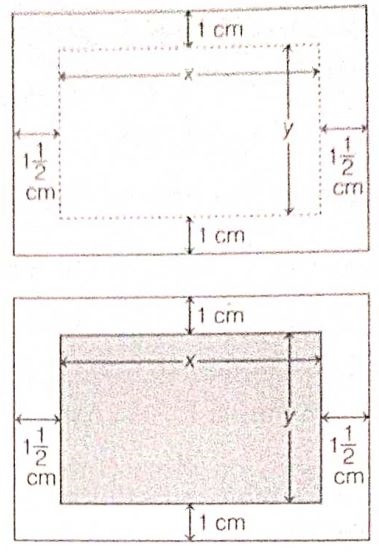
On the basis of the above information, answer the following questions.
(i) Write the expression for the area of the visiting card in terms of x.
(ii) Obtain the dimensions of the card of minimum area.
37.
Teams A, B, C went for playing a tug of war game. Teams A, B, C have attached a rope to a metal ring and is trying to pull the ring into their own area (team areas shown below).
Team A pulls with force F1 = \(\hat{4}+\hat{0} \hat{j}\) KN
Team B ⟶ F2 = \(-2 \hat{i}+4 \hat{j}\) KN
Team C ⟶ F3 = \(-3 \hat{i}-3 \hat{j}\) KN
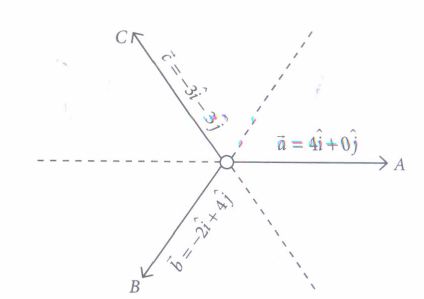
Based on the above information, answer the following questions.
(i) Which team will win the game ?
| (a) Team B | (b) Team A | (c) Team C | (d) No one |
(ii) What is the magnitude of the teams combined force ?
| (a) 7 KN | (b) 1.4 KN | (c) 1.5 KN | (d) 2 KN |
(iii) In what direction is the ring getting pulled?
| (a) 2.0 radian | (b) 2.5 radian | (c) 2.4 radian | (d) 3 radian |
(iv) What is the magnitude of the force of Team B?
| (a) 2\(\sqrt 5\) KN | (b) 6 KN | (c) 2 KN | (d) \(\sqrt 6\) KN |
(v) How many KN force is applied by Team A?
| (a) 5 KN | (b) 4 KN | (c) 2 KN | (d) 16 KN |
38.
In a play zone, Aastha is playing crane game. It has 12 blue balls, 8 red balls, 10 yellow balls and 5 green balls. If Aastha draws two balls one after the other without replacement, then answer the following questions.
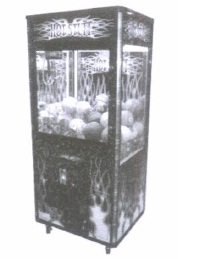
(i) What is the probability that the first ball is blue and the second ball is green?
| \((a) \ \frac{5}{119}\) | \((b) \ \frac{12}{119}\) | \((c) \ \frac{6}{119}\) | \((d) \ \frac{5}{119}\) |
(ii) What is the probability that the first ball is yellow and the second ball is red?
| \((a) \ \frac{6}{119}\) | \((b) \ \frac{8}{119}\) | \((c) \ \frac{24}{119}\) | (d) None of these |
(iii) What is the probability that both the balls are red?
| \((a) \ \frac{4}{85}\) | \((b) \ \frac{24}{595}\) | \((c) \ \frac{12}{119}\) | \((c) \ \frac{64}{119}\) |
(iv) What is the probability that the first ball is green and the second ball is not yellow?
| \((a) \ \frac{10}{119}\) | \((b) \ \frac{6}{85}\) | \((c) \ \frac{12}{119}\) | (d) None of these |
(v) What is the probability that both the balls are not blue?
| \((a) \ \frac{6}{595}\) | \((b) \ \frac{12}{85}\) | \((c) \ \frac{15}{17}\) | \((d) \ \frac{253}{595}\) |
1.
The function This is defined for all real numbers such that \(\cos x \neq 0, \text { i.e., } x \neq(2 n+1) \frac{\pi}{2}\)
We have just proved that both sine and cosine functions are continuous. Thus tan x being a quotient of two continuous functions is continuous wherever it is defined.
An interesting fact is the behaviour of continuous functions with respect to composition of functions. Recall that if f and g are two real functions, then
(f o g) (x) = f (g(x))
is defined whenever the range of g is a subset of domain of f.
2.
Here \(f(x)={ x }^{ 17 } \cos ^{ 2 }{ x } .\)
\(\therefore \ f\left( -x \right) ={ (-x) }^{ 17 } \cos ^{ 4 }{ (-x) } \)
\( ={ (-x) }^{ 17 }\ { (\cos { x } ) }^{ 4 }=-{ x }^{ 17 }\cos ^{ 4 }{ x } =-f\left( x \right) \)
\(\Rightarrow f\left( x \right) \) is an odd function.
\(\therefore \ I= \int _{ -1 }^{ 1 }{ { x }^{ 17 } } \cos ^{ 4 }{ x } dx=0\)
3.
\(I= \int _{ 0 }^{ \frac { \pi }{ 2 } }{ \frac { \cos ^{ 2 }{ x } }{ \cos ^{ 2 }{ x } +4\sin ^{ 2 }{ x } } } dx...(1)\)
\( =\int _{ 0 }^{ \frac { \pi }{ 2 } }{ \frac { \sin ^{ 2 }{ x } dx }{ \sec ^{ 2 }{ x } +\tan ^{ 2 }{ x } +\sec ^{ 2 }{ x } } } .\)
[Dividng numerator and denominator by \(\cos ^{ 4 }{ x } \)]
Put \(\cos ^{ 4 }{ x } \) so that \(\sec ^{ 2 }{ x } dx=dt.\)
when \(x=0,t=0.\) when \(x=\frac { \pi }{ 2 } . t\rightarrow \infty \)
\(\therefore \ I=\lim _{ k\rightarrow \infty }{ \int _{ 0 }^{ k }{ \frac { dt }{ (1+{ t }^{ 2 })+4{ t }^{ 2 }(1+{ t }^{ 2 }) } } } \)
\(=\lim _{ k\rightarrow \infty }{ \int _{ 0 }^{ k }{ \frac { dt }{ (1+{ t }^{ 2 })(1+{ 4t }^{ 2 }) } } } \)
\(=\lim _{ k\rightarrow \infty }{ \int _{ 0 }^{ k }{ \left( \frac { -\frac { 1 }{ 3 } }{ 1+{ t }^{ 2 } } +\frac { \frac { 4 }{ 3 } }{ 1+{ t }^{ 2 } } \right) } } dt\)
[Partial Fractions]
\(=-\frac { 1 }{ 3 } \lim _{ k\rightarrow \infty }{ { \left[ \tan ^{ -1 }{ t } \right] }_{ 0 }^{ k } } +\frac { 4 }{ 3 } .\frac { 1 }{ 4 } \lim _{ k\rightarrow \infty }{ \int _{ 0 }^{ k }{ \frac { dt }{ { \left( \frac { 1 }{ 2 } \right) }^{ 2 }+{ t }^{ 2 } } } } \)
\(=-\frac { 1 }{ 3 } \left[ \frac { \pi }{ 2 } -0 \right] +\frac { 1 }{ 3 } .\frac { 1 }{ \frac { 1 }{ 2 } } \lim _{ k\rightarrow \infty }{ { \left[ \tan ^{ -1 }{ \frac { t }{ \frac { 1 }{ 2 } } } \right] }_{ 0 }^{ k } } \)
\(=-\frac { \pi }{ 6 } +\frac { 2 }{ 3 } \lim _{ k\rightarrow \infty }{ \left( \tan ^{ -1 }{ 2k-0 } \right) } \)
\(=-\frac { \pi }{ 6 } +\frac { 2 }{ 3 } \left( \frac { \pi }{ 2 } -0 \right) =-\frac { \pi }{ 6 } +\frac { \pi }{ 3 } =\frac { \pi }{ 6 } .\)
4.
The feasible region determined by the system of constraints, 3x + 5y ≤ 15, 5x + 2y ≤ 10, x ≥ 0, and y ≥ 0, are as follows.
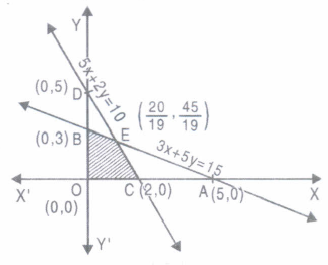
The corner points of the feasible region are O (0, 0), A (2, 0), B (0, 3), and C\(\left( \frac { 20 }{ 19 } ,\frac { 45 }{ 19 } \right) \)
The values of Z at these corner points are as follows.
Corner Point |
Corresponding Value of Z |
| C : (2,0) | 10 |
| E : \(\left( \frac { 20 }{ 19 } ,\frac { 45 }{ 19 } \right) \) | \(\frac { 235 }{ 19 } \) (Maximum) |
| B : (0,3) | 9 |
| O : (0,0) | 0 |
Therefore, the maximum value of Z is \(\frac { 235 }{ 19 } \) at \(\left( \frac { 20 }{ 19 } ,\frac { 45 }{ 19 } \right) \).
5.
We know that the slope of the tangent to the curve is \(\frac { dy }{ dx } .\)
By the question, \(\frac { dy }{ dx } =x+y\)
\(\Rightarrow\) \(\frac { dy }{ dx } -y=x\) .(1)
Here \('P'=-1\) and \('Q'=x.\)
\(\therefore\) I.F. \(={ e }^{ \int { Pdx } }={ e }^{ \int { -1.dx } }={ e }^{ -x }\)
Multiplying (1) by \({ e }^{ -x },\) we get:
\({ e }^{ -x }.\frac { dy }{ dx } -y.{ e }^{ -x }=x.{ e }^{ -x }.\)
\(\Rightarrow\) \(\frac { d }{ dx } \left( y.{ e }^{ -x } \right) =x{ e }^{ -x }.\)
Integrating,
\(y.{ e }^{ -x }=\int { x.{ e }^{ -x } } dx+C\)
\(=x.\frac { { e }^{ -x } }{ -1 } -\int { \left( 1 \right) } \frac { { e }^{ -x } }{ -1 } dx+C\)
[Integrating by Parts]
\(=-x{ e }^{ -x }+\int { { e }^{ -x } } dx+C\)
\(=-x{ e }^{ -x }+\frac { { e }^{ -x } }{ -1 } +C\)
\(\Rightarrow\) \(y=-x-1+C\quad { e }^{ x }\)
Since the curve passes through of the origin(0,0),
\(\therefore\) \(0=-0-1+C\quad { e }^{ 0 }\Rightarrow C=1.\)
Putting in (2),\(y=-x-1+{ e }^{ x }\)
\(\Rightarrow x+y+1={ e }^{ x },\)
Which is the requested equation of the curve.
6.
The sample space has 216 outcomes.
\(\text { Now } \quad \mathrm{A}=\left\{\begin{array}{lllll} (1,1,4) & (1,2,4) & \ldots & (1,6,4) & (2,1,4) & (2,2,4) & \ldots (2,6,4) \\ (3,1,4) & (3,2,4) & \ldots &(3,6,4) & (4,1,4) & (4,2,4) & \ldots(4,6,4) \\ (5,1,4) & (5,2,4) & \ldots & (5,6,4) & (6,1,4) & (6,2,4) & \ldots(6,6,4) \end{array}\right\}\)
B = {(6,5,1), (6,5,2), (6,5,3), (6,5,4), (6,5,5), (6,5,6)} and A ∩ B = {(6,5,4)}.
\(\text { Now }P(B)=\frac{6}{216} \text { and } P(A \cap B)=\frac{1}{216} \)
Then \(P(A|B)=\frac { P(A\cap B) }{ P(B) } =\frac { \frac { 1 }{ 216 } }{ \frac { 6 }{ 216 } } =\frac { 1 }{ 6 }\)
7.
\(\text { Put } \tan ^{-1} x^{4}=t \Rightarrow \frac{1}{1+x^{8}} \cdot 4 x^{3} d x=d t\)
\(-\frac{1}{4} \cos \left(\tan ^{-1} x^{4}\right)+C\)
8.
The area of a circle (A) with radius (r) is given by .
.
Therefore, the rate of change of area (A) with respect to time (t) is given by,
 [By chain rule]
It is given that .
.
Thus, when r = 8 cm,

Hence, when the radius of the circular wave is 8 cm, the enclosed area is increasing at the rate of 80 π cm2/s.
9.
Given,y= sin x
Here,\(\frac{d y}{d x}=\cos x \)
\(\therefore\) Slope of tangent at (0,0) = 1
Hence, the equation of tangent is y = Xl.
10.
Given expression \(\tan \left(\sin ^{-1} \frac{3}{5}+\cot ^{-1} \frac{3}{2}\right)\)
Putting \(\sin ^{-1}\left(\frac{3}{5}\right)=x \text { and } \cot ^{-1}\left(\frac{3}{2}\right)=y\)
Or \( \sin (x)=3 / 5 \ and \ \cot y=3 / 2 \)
\(Now, \sin (x)=3 / 5 \Rightarrow \cos x=\sqrt{1-\sin ^2 x}=4 / 5\ and \ \sec x=5 / 4 \)
(Using identities \(\cos \mathrm{x}=\sqrt{1-\sin ^2 x} \text { and } \sec \mathrm{x}=1 / \cos\))
\(\tan x=\sqrt{\sec ^2 x-1}=\sqrt{\frac{25}{16}-1}=3 / 4 \text { and } \tan y=1 / \cot (y)=2 / 3\)
we can written as
\( \tan \left(\sin ^{-1}\left(\frac{3}{5}\right)+\cot ^{-1} \frac{3}{2}\right)=\tan (x+y) \)
\(=\frac{\tan x+\tan y}{1-\tan x \tan y}=\frac{\frac{3}{4}+\frac{2}{3}}{1-\frac{3}{4} \times \frac{2}{3}} \)
\(=17 / 6\)
11.
Since E and F are independent, we have
P(E ∩ F) = P(E) . P(F) ....(1)
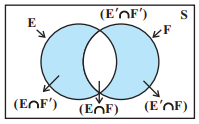
From the venn diagram in Fig 13.3, it is clear that E ∩ F and E ∩ F′ are mutually exclusive events and also E =(E ∩ F) ∪ (E ∩ F′). Therefore P(E) = P(E ∩ F) + P(E ∩ F′)
or P(E ∩ F′) = P(E) − P(E ∩ F)
= P(E) − P(E) . P(F) (by (1))
= P(E) (1−P(F))
= P(E). P(F′)
Hence, E and F′ are independent
12.
(a)
\(x \in R\)
13.
(d)
8
14.
(b)
0
15.
(a)
x = 12, y = 6
16.
(c)
\(\frac{1}{\sqrt{3}}, \frac{1}{\sqrt{3}}, \frac{1}{\sqrt{3}}\)
17.
(b)
\(\frac{7}{3}\)
18.
\( \Delta_{1} =\left|\begin{array}{ccc} A & B & C \\ x & y & z \\ z y & z x & x y \end{array}\right| =\left|\begin{array}{ccc} A & x & z y \\ B & y & z x \\ C & z & x y \end{array}\right| \\ =\frac{1}{x y z}\left|\begin{array}{lll} A x & x^{2} & x y z \\ B y & y^{2} & x y z \\ C z & z^{2} & x y z \end{array}\right|=\frac{x y z}{x y z}\left|\begin{array}{ccc} A x & x^{2} & 1 \\ B y & y^{2} & 1 \\ C z & z^{2} & 1 \end{array}\right|=\Delta \)
19.
(b)
not possible to find
20.
(d)
Constraints
21.
(c)
numbers which are same as direction angles of a line
22.
(c)
P(B|A) > P(B)
23.
(c)
2
24.
(a)
\(\overrightarrow { b } \) = \(\lambda \overrightarrow { a } \)for some scalar λ
25.
(c)
y = Cx
26.
(a)
2
27.
(b)
tan (xex) + C
28.
(b)
12π
29.
(d)
Det (A) ∈ [2, 4]
30.
(b)
土6
31.
(b)
2
32.
R is reflexive, as 2 divides (a – a) for all a ∈ Z. Further, if (a, b) ∈ R, then 2 divides a – b. Therefore, 2 divides b – a. Hence, (b, a) ∈ R, which shows that R is symmetric. Similarly, if (a, b) ∈ R and (b, c) ∈ R, then a – b and b – c are divisible by 2. Now, a – c = (a – b) + (b – c) is even (Why?). So, (a – c) is divisible by 2. This shows that R is transitive. Thus, R is an equivalence relation in Z.
note that all even integers are related to zero, as (0, ± 2), (0, ± 4) etc., lie in R and no odd integer is related to 0, as (0, ± 1), (0, ± 3) etc., do not lie in R. Similarly, all odd integers are related to one and no even integer is related to one. Therefore, the set E of all even integers and the set O of all odd integers are subsets of Z satisfying following conditions:
(i) All elements of E are related to each other and all elements of O are related to each other.
(ii) No element of E is related to any element of O and vice-versa.
(iii) E and O are disjoint and Z = E \(\cup\) O.
The subset E is called the equivalence class containing zero and is denoted by [0]. Similarly, O is the equivalence class containing 1 and is denoted by [1]. Note that [0] \(\ne\)[1], [0] = [2r] and [1] = [2r + 1], r \(\in\) Z. Infact, what we have seen above is true for an arbitrary equivalence relation R in a set X. Given an arbitrary equivalence relation R in an arbitrary set X, R divides X into mutually disjoint subsets Ai called partitions or subdivisions of X satisfying:
(i) all elements of Ai are related to each other, for all i.
(ii) no element of Ai is related to any element of Aj, i \(\ne\) j.
(iii) \(\cup\) Aj = X and Ai \(\cap\) Aj = f, i \(\ne\) j.
The subsets Ai are called equivalence classes. The interesting part of the situation is that we can go reverse also. For example, consider a subdivision of the set Z given by three mutually disjoint subsets A1, A2 and A3 whose union is Z with
A1 = {x \(\in\) Z : x is a multiple of 3} = {..., – 6, – 3, 0, 3, 6, ...}
A2 = {x \(\in\) Z : x – 1 is a multiple of 3} = {..., – 5, – 2, 1, 4, 7, ...}
A3 = {x \(\in\) Z : x – 2 is a multiple of 3} = {..., – 4, – 1, 2, 5, 8, ...}
Define a relation R in Z given by R = {(a, b) : 3 divides a – b}. Following the arguments similar to those , we can show that R is an equivalence relation. Also, A1 coincides with the set of all integers in Z which are related to zero, A2 coincides with the set of all integers which are related to 1 and A3 coincides with the set of all integers in Z which are related to 2. Thus, A1 = [0], A2 = [1] and A3 = [2].
In fact, A1 = [3r], A2 = [3r + 1] and A3 = [3r + 2], for all r \(\in\) Z.
33.
Given that equation of line is
x -1 = 2y -4 = 3z -12
\(\Rightarrow \frac{x-1}{1}=\frac{y-2}{1 / 2}=\frac{z-4}{1 / 3}\)
The plane \(\vec{r} \cdot(-5 \hat{i}+2 \hat{j}+12 \hat{k})=47\) contains the given line if
(i) it passes through (1, 2, 4).
(ii) it is parallel to the line
We have, \((\hat{i}+2 \hat{j}+4 \hat{k})(-5 \hat{i}+2 \hat{j}+12 \hat{k})\)
= - 5 + 4 + 48 =47
So, the plane passes through the point (1, 2, 4)
Also \(1(-5)+\frac{1}{2}(2)+\frac{1}{3}(12)\)
= -5 + 1 + 4 = 0
Therefore, the plane is parallel to the line
= \(\vec{r} \cdot(-5 \hat{i}+2 \hat{j}+12 \hat{k})=47\)
34.
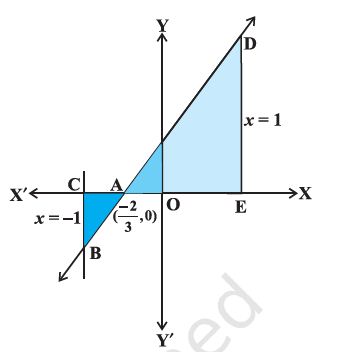
As shown in the Figure, the line y = 3x + 2 meets x-axis at x\(=\frac{-2}{3}\) and its graph lies below x-axis for \(x \in\left(-1, \frac{-2}{3}\right)\) and above x-axis for \(x \in\left(\frac{-2}{3}, 1\right)\)
The required area = Area of the region ACBA + Area of the region ADEA
\(=\left|\int_{-1}^{\frac{-2}{3}}(3 x+2) d x\right|+\int_{\frac{-2}{3}}^1(3 x+2) d x\)
\(=\left|\left[\frac{3 x^2}{2}+2 x\right]_{-1}^{\frac{-2}{3}}\right|+\left[\frac{3 x^2}{2}+2 x\right]_{\frac{-2}{3}}^1=\frac{1}{6}+\frac{25}{6}=\frac{13}{3}\)
35.
Given, determinant \(\left|\begin{array}{rrr} 2 & -3 & 5 \\ 6 & 0 & 4 \\ 1 & 5 & -7 \end{array}\right|\)
We have \(M_{11}=\left|\begin{array}{rr} 0 & 4 \\ 5 & -7 \end{array}\right|=0-20=-20\)
\(A_{11}=(-1)^{1+1} M_{11}=(-20)=-20\)
\(\left[\because \text { cofactor } C_{i j}=(-1)^{i+j} M_{i j}\right]\)
\(M_{12}=\left|\begin{array}{rr} 6 & 4 \\ 1 & -7 \end{array}\right|=-42-4=-46 \)
\(C_{12}=(-1)^{1+2} M_{12}=-(-46)=46 \)
\( M_{13}=\left|\begin{array}{ll} 6 & 0 \\ 1 & 5 \end{array}\right|=30-0=30\)
\(C_{13}=(-1)^{1+3} M_{13}=(30)=30 \)
\(M_{21}=\left|\begin{array}{rr} -3 & 5 \\ 5 & -7 \end{array}\right|=21-25=-4 \)
\(C_{21}=(-1)^{2+1} M_{21}=-(-4)=4 \)
\(M_{22}=\left|\begin{array}{rr} 2 & 5 \\ 1 & -7 \end{array}\right|=-14-5=-19 \)
\(C_{22}=(-1)^{2+2} M_{22}=(-19)=-19 \)
\(M_{23}=\left|\begin{array}{rr} 2 & -3 \\ 1 & 5 \end{array}\right|=10+3=13 \)
\(C_{23}=(-1)^{2+3} M_{23}=-(13)=-13 \)
\(M_{31}=\left|\begin{array}{rr} -3 & 5 \\ 0 & 4 \end{array}\right|=-12-0=-12 \)
\(C_{31}=(-1)^{3+1} M_{31}=(-12)=-12 \)
\(M_{32}=\left|\begin{array}{rr} 2 & 5 \\ 6 & 4 \end{array}\right|=8-30=-22 \)
\(C_{32}=(-1)^{3+2} M_{32}=-(-22)=22 ;\)
\(M_{33}=\left|\begin{array}{rr} 2 & -3 \\ 6 & 0 \end{array}\right|=0+18=18\)
\(C_{33}=(-1)^{3+3} M_{33}=(18)=18 \)
We have, \(a_{11}=2, a_{12}=-3, a_{13}=5, C_{31}=-12\)
\( C_{32} =22, C_{33}=18 \)
\(\therefore a_{11} C_{31} +a_{12} C_{32}+a_{13} C_{33} \)
\(=(2)(-12)+(-3)(22)+(5)(18) \)
\( =-24-66+90=-90+90=0 \)
36.
(i) Let the width of the printed part be x cm and height of the printed part be y cm.
Given, area of printed part = 24 cm2
\(\Rightarrow \quad x y=24 \Rightarrow y=\frac{24}{x}\)
From given condition,
Width of the page = (x+ 3) cm
Height of the page = (y + 2) cm
\(\therefore\) Area of paper, \(\begin{aligned}
A & =(x+3)(y+2)=(x+3)\left(\frac{24}{x}+2\right)
\end{aligned}\)
\(\begin{aligned}
=24+2 x+\frac{72}{x}+6=30+3 x+\frac{48}{x}
\end{aligned}\)
(ii) We have, \(A=24+2 x+\frac{72}{x}+6\)
\(\therefore \quad \frac{d A}{d x}=2-\frac{72}{x^2}\)
For maximum or minimum,
\(\frac{d A}{d x}=0 \Rightarrow 2 x^2-72=0\)
\(\begin{array}{ll}
\Rightarrow & x^2=36
\end{array}\)
\(\begin{array}{ll}
\Rightarrow & x= \pm 6 \Rightarrow x=6
\end{array}\) [\(\because\) x cannot be negative]
Now, \(\frac{d^3 A}{d x^2}=\frac{44}{x^3}\)
At \(x=6 \frac{d^3 A}{d x^2}>0\)
\(\therefore\) Area is minimum when x = 6
\(\Rightarrow \quad y=\frac{24}{6}=4\)
\(\therefore\) dimensions of the page are
Width of the page = x + 3 = 6 + 3 = 9 cm
Height of the page = y + 2 = (4 + 2) = 6 cm
37.
Here, \(\left|\vec{F}_{1}\right|=\sqrt{(4)^{2}+0^{2}}=4 \mathrm{KN}\)
\( \left|\vec{F}_{2}\right|=\sqrt{(-2)^{2}+4^{2}}=\sqrt{20} \mathrm{KN} \)
\(\left|\vec{F}_{3}\right|=\sqrt{(-3)^{2}+(-3)^{2}}=\sqrt{18} \mathrm{KN}\)
(i) (a): Since, \(\sqrt 20\) is larger. So, team B will win the game.
(ii) (b): Let F be the combined force
\(\therefore \vec{F}=\vec{F}_{1}+\vec{F}_{2}+\vec{F}_{3}=4 \hat{i}+0 \hat{j}-3 \hat{i}-3 \hat{j}-2 \hat{i}+4 \hat{j} \)
\(=-\hat{i}+\hat{j} \)
\(\therefore |\vec{F}|=\sqrt{(-1)^{2}+1^{2}}=\sqrt{2}=1.4 \mathrm{KN}\)
(iii) (c) : We have, \(\vec{F}=-\hat{i}+\hat{j}\)
\(\therefore \theta=\tan ^{-1}\left(\frac{F_{y}}{F_{x}}\right)=\tan ^{-1}\left(\frac{1}{-1}\right)=\frac{3 \pi}{4} \text { radian }\)
= 0.75 x 3.14 radian = 2.3555 radian ≈ 2.4 radian
(iv) (a): Magnitude of force of Team B = \(\sqrt 20\) KN
= 2\(\sqrt 5\) KN
(v) (b): 4 KN force is applied by team A.
38.
Let B, R, Y and G denote the events that ball drawn is blue, red, yellow and green respectively.
\(\therefore P(B)=\frac{12}{35}, P(R)=\frac{8}{35}, P(Y)=\frac{10}{35} \text { and } P(G)=\frac{5}{35}\)
\((i) \ (c): P(G \cap B)=P(B) \cdot P(G \mid B)=\frac{12}{35} \cdot \frac{5}{34}=\frac{6}{119}\)
\((ii) \ (\mathbf{b}): P(R \cap Y)=P(Y) \cdot P(R \mid Y)=\frac{10}{35} \cdot \frac{8}{34}=\frac{8}{119}\)
(iii) (a): Let E = event of drawing a first red ball and
F = event of drawing a second red ball
Here, \(P(E)=\frac{8}{35} \text { and } P(E)=\frac{7}{34}\)
\(\therefore \P(F \cap E)=P(E) \cdot P(F \mid E)=\frac{8}{35} \cdot \frac{7}{34}=\frac{4}{85}\)
\(\text {(iv) }(c): P\left(Y^{\prime} \cap G\right)=P(G) \cdot\left(Y^{\prime} \mid G\right)=\frac{5}{35} \cdot \frac{24}{34}=\frac{12}{119}\)
(v) (d): Let E = event of drawing a first non-blue ball and F = event of drawing a second non-blue ball
Here, \(P(E)=\frac{23}{35} \text { and } P(F)=\frac{22}{34}\)
\(\therefore \ P(F \cap E)=P(E) \cdot P(F \mid E)=\frac{23}{35} \cdot \frac{22}{34}=\frac{253}{595}\)

12th Standard CBSE Syllabus & Materials
12th Standard CBSE
CBSE 12th Computer Science Python Revision Tour I - New Previous year Question Papers Study Material - QB365 Set A
NEW12th Standard CBSE
CBSE 12th Business Studies Planning Important Questions And Answers Study Material - QB365 Set A
NEW12th Standard CBSE
CBSE 12th Business Studies Business Environment Important Questions And Answers Study Material - QB365 Set A
NEW12th Standard CBSE
CBSE 12th Business Studies Principles of Management Important Questions And Answers Study Material - QB365 Set A



NCERT Books

Syllabus

Exam Pattern

Sample Question Papers

Previous year Question Papers

Important Notes

MCQ Practice test

NCERT Exemplers

Case study Questions

Image Based Questions

Passage based Questions

HOT Questions

Value Based Questions

Model Questions Papers
NCERT ( Book Back ) Questions

Assertion and Reason
Important Questions And Answers

CBSE 12th Standard CBSE Subjects
CBSE Standards








