
 100% FREE ACCESS
12th Standard CBSE Syllabus & Materials
12th Standard CBSE
CBSE 12th Economics Government Budget and the Economy Previous year Question Papers Study Material - QB365 Set A
NEW12th Standard CBSE
CBSE 12th Computer Science Interface Python with MySQL - New Previous year Question Papers Study Material - QB365 Set A
NEW12th Standard CBSE
CBSE 12th Computer Science Database Concept - New Previous year Question Papers Study Material - QB365 Set A
NEW12th Standard CBSE
CBSE 12th Computer Science Data Communication - New Previous year Question Papers Study Material - QB365 Set A
NEW12th Standard CBSE
CBSE 12th Computer Science Data Structures - New Previous year Question Papers Study Material - QB365 Set A
NEW12th Standard CBSE
CBSE 12th Computer Science Functions - New Previous year Question Papers Study Material - QB365 Set A

Published on: 25/10/2025
Download CBSE Class 12th Standard CBSE Maths question papers, sample papers, important questions, and previous year solved papers in PDF format. Get free study materials, NCERT solutions, and exam preparation resources for Class 12th Standard CBSE Maths
Questions + Answers key
Take MCQ Maths Test
1.
Verify that ax2 + by2 = 1 is a solution of the differential equation \(x\left(y y_2+y_1^2\right)=y y_1\)
2.
Find the position vector of c which divides the line segment joining A & B whose position vectors are \(3\overset\rightarrow a+\overset\rightarrow b\)and \(\overset\rightarrow a-3\overset\rightarrow b\) internally in the ratio 2:3.
3.
Evaluate the integral: \(\int^{\pi}_{-\pi}\ x^{10}\ sin^7\ x\ dx.\)
4.
\(\int sin\ 3x\ sin\ 2x\ dx.\)
5.
Integrate the functions in \(\frac { 1 }{ ({ x }^{ 2 }+1)({ x }^{ 2 }+4) } \)
6.
For any two vectors \(\overset { \rightarrow }{ a } \) and \(\overset { \rightarrow }{ b } \), we always have \(|\overset { \rightarrow }{ a } +\overset { \rightarrow }{ b } |\le |\overset { \rightarrow }{ a } |+|\overset { \rightarrow }{ b } |\)(triangle inequality).
7.
Find the distance between the lines l1 and l2 given by:
\(\vec { r } =\hat { i } +2\hat { j } -4\hat { k } +\lambda (2\hat { i } +3\hat { j } +6\hat { k } )and\)
\(\vec { r } =3\hat { i } +3\hat { j } -5\hat { k } +\mu (2\hat { i } +3\hat { j } +6\hat { k } )\)
8.
Given two independent events A and B such that P(A) = 0.3, P(B) = 0.6 Find:
(i) P(A and B)
(ii) P(A and not B)
(iii) P(A or B)
(iv) P(neither A nor B).
9.
Find \(\int \frac{5 x-2}{1+2 x+3 x^2} d x.\)
10.
Find the particular solution of the differential equation
(3xy+y2)dx+(x2+xy)dy = 0 for x = 1, y = 1
11.
Using integration, find the area of the region given by {(x, y) : (x2 ≤ y ≤ |x| ) }
1.
We have, ax2 + by2 = 1
On differentiating both sides w.r.t. x, we get
2ax + 2by y1 = 0 [\(\because\) y1 = dy/dx]
\(\Rightarrow\) 2(ax + by y1) = 0
\(\Rightarrow\) ax + byy1 = 0 ...(i)
Again, on differentiating both sides w.r.t. x,we get
a + b(y1y1 + yy2) = 0 [\(\because\) y2 = d2y/dx2]
\(\begin{aligned} \Rightarrow \quad a+b\left(y_1^2+y y_2\right)=0 \end{aligned}\)
\(\Rightarrow \quad a=-b\left(y y_2+y_1^2\right)\) ...(ii)
On putting a = - b(yy2 + \(y_1^2\)) in Eq. (i), we get
\(\begin{array}{rlrl} -b\left(y y_2+y_1^2\right) x+b y y_1 =0 \end{array}\)
\(\begin{array}{rlrl} \Rightarrow b\left\{-\left(y y_2+y_1^2\right) x+y y_1\right\} =0 \end{array}\)
\(\begin{array}{rlrl} \Rightarrow x\left(y y_2+y_1^2\right) =y y_1 \end{array}\)
Hence Proved.
2.
Positive vector of \(C=\frac{2(\overset\rightarrow a-3\overset\rightarrow b)+3(2\overset\rightarrow a+\overset\rightarrow b)}{2+3}\)
\(=\frac{2\overset\rightarrow a-6\overset\rightarrow b+6\overset\rightarrow a+3\overset\rightarrow b}{5}\)
Position vector of \(C=\frac{8\overset\rightarrow a-3\overset\rightarrow b}{5}\)
3.
0
4.
\(\text { Consider } \quad \int \sin 3 x \sin x d x =\frac{1}{2} \int 2 \sin 3 x \sin x d x
\)
\(=\frac{1}{2} \int(\cos 2 x-\cos 4 x) d x=\frac{1}{2}\left[\frac{\sin 2 x}{2}-\frac{\sin 4 x}{4}\right]+C
\)
5.
\(I= \int { \frac { 1 }{ ({ x }^{ 2 }+1)({ x }^{ 2 }+4) } } dx\)
Let \(\quad \frac { 1 }{ ({ x }^{ 2 }+1)({ x }^{ 2 }+4) } =\frac { 1 }{ (y+1)(y+4) } ,\ where\ { x }^{ 2 }=y.\)
Let \(\frac { 1 }{ (y+1)(y+4) } \equiv \frac { A }{ y+1 } +\frac { B }{ (y+4) } ....(1)\)
Multiplying by \((y+1)(y+4),\)
we get: \(1\equiv A(y+4)+B(y+1).\)
Putting \(y=-1 1=A(3)\Rightarrow A=\frac { 1 }{ 3 } .\)
Putting \(y=-4, 1=B(-3) \Rightarrow B=-\frac { 1 }{ 3 } .\)
Putting in (1)
\(\frac { 1 }{ (y+1)(y+4) } =\frac { \frac { 1 }{ 3 } }{ y+1 } +\frac { \frac { 1 }{ 3 } }{ y+4 } \)
\(\Rightarrow \frac { 1 }{ ({ x }^{ 2 }+1)({ x }^{ 2 }+4) } =\frac { \frac { 1 }{ 3 } }{ { x }^{ 2 }+1 } +\frac { \frac { 1 }{ 3 } }{ { x }^{ 2 }+4 } \)
\(\therefore I= \frac { 1 }{ 3 } \int { \frac { dx }{ { 1 }^{ 2 }+{ x }^{ 2 } } - } \frac { 1 }{ 3 } \int { \frac { dx }{ { 2 }^{ 2 }+{ x }^{ 2 } } } \)
\(=\frac { 1 }{ 3 } \tan ^{ -1 }{ x } -\frac { 1 }{ 3 } .\frac { 1 }{ 2 } \tan ^{ -1 }{ \frac { x }{ 2 } } +C\)
\(=\frac { 1 }{ 3 } \tan ^{ -1 }{ x } -\frac { 1 }{ 6 } \tan ^{ -1 }{ \frac { x }{ 2 } } +C\)
6.
The inequality holds trivially in case either
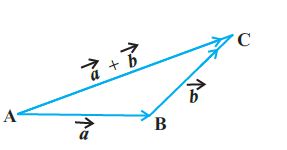
\(\vec{a}=\overrightarrow{0} \text { or } \vec{b}=\overrightarrow{0} \text { (How?). So, let }|\vec{a}| \neq \overrightarrow{0} \neq|\vec{b}| \text { . Then, }\)
\(|\vec{a}+\vec{b}|^{2}=(\vec{a}+\vec{b})^{2}=(\vec{a}+\vec{b}) \cdot(\vec{a}+\vec{b})\)
\(=\vec{a} \cdot \vec{a}+\vec{a} \cdot \vec{b}+\vec{b} \cdot \vec{a}+\vec{b} \cdot \vec{b}\)
\(=|\vec{a}|^{2}+2 \vec{a} \cdot \vec{b}+|\vec{b}|^{2} \quad \text { (scalar product is commutative) }\)
\(\left.\leq|\vec{a}|^{2}+2|\vec{a} \cdot \vec{b}|+|\vec{b}|^{2} \quad \text { (since } x \leq|x| \forall x \in \mathbf{R}\right)\)
\(\leq|\vec{a}|^{2}+2|\vec{a}||\vec{b}|+|\vec{b}|^{2} \quad \text { (from Example 19) } \)
\(=(|\vec{a}|+|\vec{b}|)^{2}\)
\(\text {Hence }|\vec{a}+\vec{b}| \leq|\vec{a}|+|\vec{b}| \)
7.
The two lines are parallel (Why? ) We have
\(\vec{a}_{1}=\hat{i}+2 \hat{j}-4 \hat{k}, \vec{a}_{2}=3 \hat{i}+3 \hat{j}-5 \hat{k} \text { and } \vec{b}=2 \hat{i}+3 \hat{j}+6 \hat{k} \)
Therefore, the distance between the lines is given by
\(d=\left|\frac{\vec{b} \times\left(\vec{a}_{2}-\vec{a}_{1}\right)}{|\vec{b}|}\right|=\left|\frac{\left|\begin{array}{ccc} \hat{i} & \hat{j} & \hat{k} \\ 2 & 3 & 6 \\ 2 & 1 & -1 \end{array}\right|}{\sqrt{4+9+36}}\right| \)
\(=\frac{|-9 \hat{i}+14 \hat{j}-4 \hat{k}|}{\sqrt{49}}=\frac{\sqrt{293}}{\sqrt{49}}=\frac{\sqrt{293}}{7} \)
8.
Since A and B are independent events,
\(\therefore \) P(A and B) = \(P(A\cap B)=P(A)P(B)\)
(0.3)(0.6) = 0.18
(ii) P(A and not B) = \(P(A\cap \overset { \_ }{ B } )\)
= \(P(A)-P(A\cap B)\)
= 0.3 - 0.18 = 0.12
(iii) \(P(AorB)=P(A\cup B)\)
=\(\) \(P(A)+P(B)-P(A\cap B)\)
= 0.3 + 0.6 - 0.18
= 0.9 - 0.18 = 0.72
(iv) P(neither A nor B) = \(P(\overset { \_ }{ A } \cap \overset { \_ }{ B } )\)
= \(P(\overset { \_ }{ A } )P(\overset { \_ }{ B } )\)
[\(\because \) A, B are independent \(\Rightarrow\overset { \_ \_ }{ A } ,\overset { \_ \_ }{ B } \) are independent]
= (1-P(A)) (1-P(B))
= (1 - 0.3) (1 - 0.6)
= (0.7) (0.4) = 0.28
9.
Let \(I=\int \frac{5 x-2}{1+2 x+3 x^2} d x\)
Here, (5 x-2) can be written as
\(5 x-2 =A \frac{d}{d x}\left(1+2 x+3 x^2\right)+B\)
\(\Rightarrow 5 x-2 =A(2+6 x)+B\)
On comparing the coefficients of x and constant terms, we get
5 = 6 A
\(A =\frac{5}{6}\)
and -2 =2 A+B
\(\Rightarrow B =-2 A-2=-\frac{5}{3}-2 =-\frac{11}{3}\quad\left[\because A=\frac{5}{6}\right]\)
Then, from Eq. (i), we get
\( l=\int \frac{\frac{5}{6}(2+6 x)-\frac{11}{3}}{1+2 x+3 x^2} d x\)
\( \Rightarrow \quad I=\int \frac{\frac{5}{6}(2+6 x)}{1+2 x+3 x^2} d x-\int \frac{\left(\frac{11}{3}\right)}{1+2 x+3 x^2} d x \)
\(\Rightarrow \quad I=I_1-I_2\)
where \(I_1=\frac{5}{6} \int \frac{2+6 x}{1+2 x+3 x^2} d x\)
Put \(1+2 x+3 x^2=t \Rightarrow(2+6 x) d x=d t\)
\(\therefore I_1=\frac{5}{6} \int \frac{d t}{t}=\frac{5}{6} \log |t|+C_1=\frac{5}{6} \log \left|1+2 x+3 x^2\right|+C_1\)
and \(I_2=\frac{11}{3} \int \frac{d x}{3 x^2+2 x+1}=\frac{11}{9} \int \frac{d x}{\left[x^2+\frac{2 x}{3}+\frac{1}{3}\right]}\) \({\left[\because t=1+2 x+3 x^2\right]}\)
\(=\frac{11}{9} \int \frac{d x}{\left(x+\frac{1}{3}\right)^2+\frac{2}{9}}=\frac{11}{9} \cdot \frac{1}{\frac{\sqrt{2}}{3}} \tan ^{-1}\left(\frac{x+\frac{1}{3}}{\frac{\sqrt{2}}{3}}\right)+C_2\)
\(\left.[\because \int \frac{1}{x^2+a^2} d x=\frac{1}{a} \tan ^{-1}\left(\frac{x}{a}\right)+C\right] \)
\(=\frac{11}{3 \sqrt{2}} \tan ^{-1}\left(\frac{3 x+1}{\sqrt{2}}\right)+C_2\)
On putting the values of I1 and I2 in Eq. (ii), we get
\(I=\frac{5}{6} \log \left|1+2 x+3 x^2\right|-\frac{11}{3 \sqrt{2}} \tan ^{-1}\left(\frac{3 x+1}{\sqrt{2}}\right)+C\)
where \(C=C_1-C_2\)
10.
The given D.E is
(3xy+y2)dx+(x2+xy0dy = 0
where x = 1, y = 1
\(\Rightarrow\) \(\frac { dy }{ dx } =-\frac { 3xy+{ y }^{ 2 } }{ { x }^{ 2 }+xy } \) ..(i)
which is a linear homogeneous equation put,
y = vx
\(\frac { dy }{ dx } =v+x\frac { dv }{ dx } \)
From (i), \(v+x\frac { dv }{ dx } =-\frac { 3xvx+{ v }^{ 2 }{ x }^{ 2 } }{ x^{ 2 }+x.vx } \)
\(=-\frac { (3v+{ v }^{ 2 }) }{ 1+v } \)
x dv/dx = \(-\frac { (3v+{ v }^{ 2 }) }{ 1+v } -v\)
= \(\frac { -3v-{ v }^{ 2 }-v-{ v }^{ 2 } }{ 1+v } \)
\(\Rightarrow \quad x\frac { dv }{ dx } =\frac { -4v-2v^{ 2 } }{ 1+v } \)
\(\Rightarrow \quad \frac { 1+v }{ 2{ v }^{ 2 }+4v } dv=\frac { 2 }{ ({ x }^{ 2 }-1)^{ 2 } } \)
Integrating both sides, we get
1/4log |2v2 + 4v| + log |x| = logC1
\(\Rightarrow \left( 2\frac { { y }^{ 2 } }{ { x }^{ 2 } } +4\frac { y }{ x } \right) ^{ 1/4 }=C_{ 1 }\)
\(\Rightarrow\) 2x2y2+4x3y = C
When x = 1, y = 1, C = 6
Hence 2x2y2+4x3y = 6
\(\Rightarrow\) x2y2+2x2y = 3
11.
Given, x2 ≤ y..(i)
and y ≤ |x|...(ii)
Clearly, curve (i) is parabola directed upward with vertex at (0, 0) and symmetrical about y-axis.
Also \(y=|x|=\begin{cases} x\quad if\quad x\ge 0 \\ -x\quad ,if\quad x<\quad 0 \end{cases}\)
The lines y = x and y = - x both passes through origin and have slope of + 1& - 1 respectively.
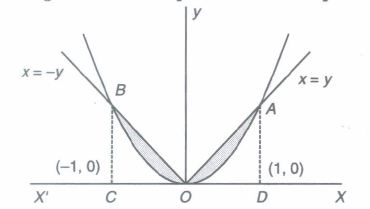
⇒ Required Area = 2x Standard Area on a side
= \(-\left[ \left( \frac { 1 }{ 2 } -1 \right) -\left( \frac { 16 }{ 2 } -4 \right) \right] \)
= \(2{ \left[ \frac { { x }^{ 2 } }{ 2 } -\frac { { x }^{ 3 } }{ 2 } \right] }_{ 0 }^{ 1 }\)
= \(2\left[ \frac { 1 }{ 2 } -\frac { 1 }{ 3 } \right] =2\times \frac { 1 }{ 6 } \)
= \(\frac { 1 }{ 3 } \) sq.units

12th Standard CBSE Syllabus & Materials
12th Standard CBSE
CBSE 12th Computer Science Python Revision Tour I - New Previous year Question Papers Study Material - QB365 Set A
NEW12th Standard CBSE
CBSE 12th Business Studies Planning Important Questions And Answers Study Material - QB365 Set A
NEW12th Standard CBSE
CBSE 12th Business Studies Business Environment Important Questions And Answers Study Material - QB365 Set A
NEW12th Standard CBSE
CBSE 12th Business Studies Principles of Management Important Questions And Answers Study Material - QB365 Set A



NCERT Books

Syllabus

Exam Pattern

Sample Question Papers

Previous year Question Papers

Important Notes

MCQ Practice test

NCERT Exemplers

Case study Questions

Image Based Questions

Passage based Questions

HOT Questions

Value Based Questions

Model Questions Papers
NCERT ( Book Back ) Questions

Assertion and Reason
Important Questions And Answers

CBSE 12th Standard CBSE Subjects
CBSE Standards








