
 100% FREE ACCESS
12th Standard CBSE Syllabus & Materials
12th Standard CBSE
CBSE 12th Economics Government Budget and the Economy Previous year Question Papers Study Material - QB365 Set A
NEW12th Standard CBSE
CBSE 12th Computer Science Interface Python with MySQL - New Previous year Question Papers Study Material - QB365 Set A
NEW12th Standard CBSE
CBSE 12th Computer Science Database Concept - New Previous year Question Papers Study Material - QB365 Set A
NEW12th Standard CBSE
CBSE 12th Computer Science Data Communication - New Previous year Question Papers Study Material - QB365 Set A
NEW12th Standard CBSE
CBSE 12th Computer Science Data Structures - New Previous year Question Papers Study Material - QB365 Set A
NEW12th Standard CBSE
CBSE 12th Computer Science Functions - New Previous year Question Papers Study Material - QB365 Set A

Published on: 25/10/2025
Download CBSE Class 12th Standard CBSE Maths question papers, sample papers, important questions, and previous year solved papers in PDF format. Get free study materials, NCERT solutions, and exam preparation resources for Class 12th Standard CBSE Maths
Questions + Answers key
Take MCQ Maths Test
1.
If the projection of the vector \(\hat{i}+\hat{j}+\hat{k}\) on the vector \(p \hat{i}+\hat{j}-2 \hat{k} \text { is } \frac{1}{3}\), then find the value of p.
2.
Find the second derivative of the following function.
e6x cos 3x
3.
Examine the consistency of the system of equations. x + 3y = 5 and 2x + 6y = 8.
4.
Find \(\lambda\), if the vectors
\(\overrightarrow a=\overset\wedge i+3\overset\wedge j+\overset\wedge k,\overrightarrow b=2\overset\wedge i-\overset\wedge j-\overset\wedge k\) and \(\overrightarrow c=\lambda \overset\wedge j+3\overset\wedge k\) are coplanar.
5.
Find X, if \(X+\begin{bmatrix} 2 & -1 \\ 3 & -1 \end{bmatrix}=\begin{bmatrix} 2 & 4 \\ 5 & 0 \end{bmatrix}\).
6.
Find if the binary operation * given by a * b = \(a+b\over2\) in the set of real numbers, associative.
7.
If f(x) = 27x3 and g(x) = x1/3 find gof(x).
8.
If \(\vec{p}=5 \hat{i}+\lambda \hat{j}-3 \hat{k} \text { and } \vec{q}=\hat{i}+3 \hat{j}-5 \hat{k}\), then find the value of \(\lambda\), so that \(\vec{p}+\vec{q} \text { and } \vec{p}-\vec{q}\) are perpendicular vectors.
9.
If \(R= \big\{(x,y):x+2y\}\) is a relation on a set of natural numbers (N), then write the domain, range and codomain of R.
10.
Find graphically, the maximum value of Z = 2x + 5y, subject to constraints given below: 2x + 4y \(\le \) 8 \(\Rightarrow\) x + 2y \(\le \) 4
3x + y \(\le \) 6
x + y \(\le \) 4
x \(\\ \ge \) 0, y \(\\ \ge \) 0
11.
Using properties of determinants, prove that :
\(\left| \begin{matrix} 1 & 1+p & 1+p+q \\ 3 & 4+3p & 2+4p+3q \\ 4 & 7+4p & 2+7p+4q \end{matrix} \right| =1\)
12.
Differentiate the following w.r.t. x or find \(\frac { dy }{ dx } \):
y=ex log (sin 2x).
13.
Find x, if \(\left[ x\quad 1 \right] \begin{bmatrix} 1 & 0 \\ -2 & -3 \end{bmatrix}\left[ \begin{matrix} x \\ 3 \end{matrix} \right] =O\)
14.
Let A = {1, 2, 3}, B = {4, 5, 6, 7} and let f = {(1, 4), (2, 5), (3, 6)} be a function from A to B. Show that f is one-one.
15.
Using vectors, find the area of the \(\Delta\)ABC with vertices A(1,2, 3), B (2,-1, 4) and C(4, 5, -1).
16.
Find the value of 'p' for which the vectors:\(3\overset { \wedge }{ i } -2\overset { \wedge }{ j } +9\overset { \wedge }{ k } \) and \(\overset { \wedge }{ i } -2p\overset { \wedge }{ j } +3\overset { \wedge }{ k } \) are paralell.
17.
If \(\vec{a}=5 \hat{i}-\hat{j}-3 \hat{k} \text { and } \vec{b}=\hat{i}+3 \hat{j}-5 \hat{k}\) , then show that the vector \(\overset { \rightarrow }{ a } +\overset { \rightarrow }{ b } \) and \(\overset { \rightarrow }{ a } -\overset { \rightarrow }{ b } \) are perpendicular.
18.
Find dy/dx in the following: \(y={ e }^{ { sin }^{ -1 }x }\)
19.
\(Find\ \frac { dy }{ dx } ,\ if\ { x }^{ 2/3 }+{ y }^{ 2/3 }={ a }^{ 2/3 }\)
20.
\(If\quad A=\begin{bmatrix} 3 & -2 \\ 4 & -2 \end{bmatrix}\ and\ I=\begin{bmatrix} 1 & 0 \\ 0 & 1 \end{bmatrix},find\ k\ so\ that:{ A }^{ 2 }=kA-2I\)
21.
Without expanding, prove that : \(\Delta =\left| \begin{matrix} x+y & y+z & z+x \\ z & x & y \\ 1 & 1 & 1 \end{matrix} \right| =0\)
22.
Consider \(f:N\rightarrow N,G:N\rightarrow N\) and \(h:N\rightarrow R\) defined as:\(f(x)=2x,\ g(y)=3y+4\) and \(h(z)=sinz\) , where \(z\in N\) . Show that ho (gof)=(hog) of.
23.
If \(\sin (x y)=1\), then \(\frac{d y}{d x}\) is equal to
\(\frac{x}{y}\)
\(-\frac{x}{y}\)
\(\frac{y}{x}\)
\(-\frac{y}{x}\)
24.
If \((2 \hat{i}+6 \hat{j}+27 \hat{k}) \times(\hat{i}+p \hat{j}+q \hat{k})=0\), then the values of p and q are
p = 6 and q = 27
p = 3 and q = \(\frac{27}{2}\)
p = 6 and q = \(\frac{27}{2}\)
p = 3 and q = 27
25.
If \(x\left[\begin{array}{l}1 \\ 2\end{array}\right]+y\left[\begin{array}{l}2 \\ 5\end{array}\right]=\left[\begin{array}{l}4 \\ 9\end{array}\right]\), then
x = 1, y = 2
x = 2, y = 1
x = 1, y = -1
x = 3, y = 2
26.
The corner points of the feasible region in the graphical representation of a linear programming problem are (2, 72), (15, 20) and (40,15). If Z = 18x + 9y be the objective function, then
Z is maximum at (2, 72), minimum at (15, 20).
Z is maximum at (15, 20), minimum at (40, 15).
Z is maximum at (40, 15), minimum at (15, 20).
Z is maximum at (40,15), minimum at (2, 72).
27.
A function f : R \(\rightarrow\) R defined as f(x) = x2 - 4x + 5 is
injective but not surjective
surjective but not injective.
both injective and surjective.
neither injective nor surjective.
28.
Direction ratios of the line \(\frac{4-x}{2}=\frac{y}{6}=\frac{1-z}{3} \text { are }\)
2,6,3
-2,6,3
2, - 6, 3
none of these
29.
Unit vectors along vector \(\hat{i}+2 \hat{j}-2 \hat{k}\) are
\(\pm(\hat{i}+2 \hat{j}-2 \hat{k})\)
\(\frac{1}{3} \hat{i}+\frac{2}{3} \hat{j}-\frac{2}{3} \hat{k}\)
\(\pm\left(\frac{1}{3} \hat{i}+\frac{2}{3} \hat{j}-\frac{2}{3} \hat{k}\right)\)
none of these
30.
The equation of X -axis in space is
x = 0, y = 0
x = 0, z = 0
x = 0
y = 0, z = 0
31.
If \(\Delta=\left|\begin{array}{lll} a & h & g \\ h & b & f \\ g & f & c \end{array}\right|\) then the cofactor A21 is
-(he + fg)
fg -hc
fg + hc
hc-fg
32.
If \(\left[\begin{array}{rr}1 & 2 \\ -2 & -b\end{array}\right]+\left[\begin{array}{ll}a & 4 \\ 3 & 2\end{array}\right]=\left[\begin{array}{ll}5 & 6 \\ 1 & 0\end{array}\right]\), then \(a^{2}+b^{2}\) is equal to
20
22
12
10
33.
A ……… of a feasible region is a point in the region, which is the intersection of two boundary lines.
Section point
Corner point
Reasonable point
Vertex point
34.
If \(\overrightarrow { b } =\lambda \overrightarrow { a } \), the vectors a and b are ______ .
coinitial
free vector
zero vector
collinear
35.
Let A = {1, 2, 3, 4} and let R = {(2, 2), (3, 3), (4, 4), (1, 2)} be a relation on A. Then, R is
Symmetric
Transitive
Reflexive
Equivalence relation
36.
Feasible region is the set of points which satisfy
the objective functions
some of the given constraints
all of the given constraints
none of these
37.
A line makes angle α, β, γ with x-axis, y-axis and z-axis respectively then cos 2α + cos 2β + cos 2γ is equal to
2
1
-2
-1
38.
If f(x) = ex and g(x) = loge x, then (gof)’ (x) is
0
1
e
1 + e
39.
The value \(\left| \begin{matrix} 6 & 0 & -1 \\ 2 & 1 & 4 \\ 1 & 1 & 3 \end{matrix} \right| \) is
-7
7
8
10
40.
Set A has 3 elements and the set B has 4 elements. Then the number of injective functions that can be defined from set A to set B is
144
12
24
64
41.
Assertion (A) The vectors \(\begin{aligned} \vec{a}=6 \hat{i}+2 \hat{j}-8 \hat{k} \end{aligned}\)
\(\begin{aligned} \vec{b}=10 \hat{i}-2 \hat{j}-6 \hat{k} \end{aligned}\)
\(\vec{c}=4 \hat{i}-4 \hat{j}+2 \hat{k}\) represent the sides of a right angled triangle.
Reason (R) Three non-zero vectors of which none of two are collinear forms a triangle, if their resultant is zero vector or sum of any two vectors is equal to the third.
(a) Both Assertion (A) and Reason (R) are true and the Reason (R) is the correct explanation of the Assertion (A).
(b) Both Assertion (A) and Reason (R) are true but Reason (R) is not the correct explanation of the Assertion (A).
(c) Assertion (A) is true but Reason (R) is false.
(d) Assertion (A) is false but Reason (R) is true.
42.
Assertion: Let \(A=\begin{bmatrix}
1& 4\\
2& 5\\
4& 7\\
\end{bmatrix}\)and \(B=\begin{bmatrix}
4& 3& 6\\
7& 8& 9\\
5& 1& 2\\
\end{bmatrix}\), then the product of the matrices A and B is not defined.
Reason: The number of rows in B is not equal to number of columns in A.
(a) Assertion is correct, reason is correct; reason is a correct explanation for assertion.
(b) Assertion is correct, reason is correct; reason is not a correct explanation for assertion
(c) Assertion is correct, reason is incorrect
(d) Assertion is incorrect, reason is correct.
43.
Read the following passage and answer the questions given below.
Teams A, B, C went for playing a tug of war game. Teams A, B, C have attached a rope to a metal ring and is trying to pull the ring into their own area.
Team A pulls with force \(\vec{F}_1=6 \hat{i}+0 \hat{j} k N\),
Team B pulls with force \(\vec{F}_2=-4 \hat{i}+4 \hat{j} k N,\)
Team C pulls with force \(\vec{F}_3=-3 \hat{i}-3 \hat{j} k N,\)
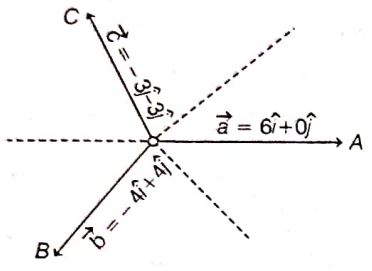
(i) What is the magnitude of the force of team A?
(ii) Which team will win the game?
(iii) Find the magnitude of the resultant force exerted by the teams.
Or
In what direction is the ring getting pulled?
44.
Gautam buys 5 pens, 3 bags and 1 instrument box and pays a sum of ₹160. From the same shop. Vikram buys 2 pens, 1 bag and 3 instrument boxes and pays a sum of ₹190. Also, Ankur buys I pen, 2 bags and 4 instrument boxes and pays a sum of ₹ 250.
(i) Convert the given above situation into a matrix equation of the form AX = B.
(ii) Find | A |
(iii) Find A-1 (or) (iii) Determine P = A2-5A.
45.
Students of a school are taken to a railway museum to learn about railways heritage and its history.
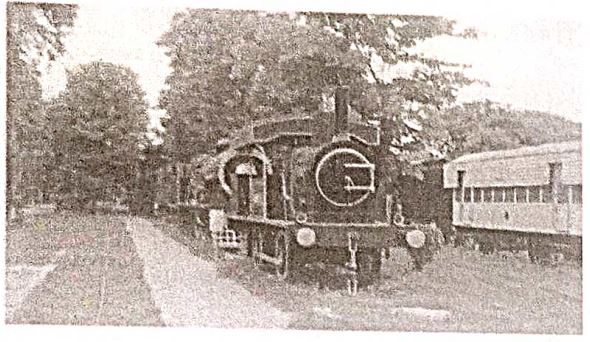
An exhibit in the museum depicted many rail lines on the track near the railway station. Let L be the set of all rail lines on the railway track and R be the relation on L defined by
R = {(l1, l2) : l1 is parallel to l2}
On the basis of the above information, answer the following questions.
(i) Find whether the relation R is symmetric or not.
(ii) Find whether the relation R is transitive or not.
(iii) If one of the rail lines on the railway track is represented by the equation y = 3x + 2, then find the set of rail lines in R related to it.
Or
Let S be the relation defined by S= ((l1,l2) : l1 is perpendicular to l2) check whether the relation S is symmetric and transitive.
1.
Let, the given vectors be \(\vec{a}=\hat{i}+\hat{j}+\hat{k}\) and \(\vec{b}=p \hat{i}+\hat{j}-2 \hat{k}\).
Also, given projection of \(\vec{a} \text { on } \vec{b}=\frac{1}{3}\)
\(\therefore\) Projection of \(\vec{a} \text { on } \vec{b}=\frac{\vec{a} \cdot \vec{b}}{|\vec{b}|}\)
\(\begin{array}{ll}
\Rightarrow & \frac{1}{3}=\frac{(\hat{i}+\hat{j}+\hat{k}) \cdot(p \hat{i}+\hat{j}-2 \hat{k})}{\sqrt{p^2+(1)^2+(-2)^2}}
\end{array}\)
\(\begin{array}{ll}
\Rightarrow & \frac{1}{3}=\frac{p+1-2}{\sqrt{p^2+1+4}}=\frac{p-1}{\sqrt{p^2+5}}
\end{array}\)
\(\Rightarrow \quad \sqrt{p^2+5}=3 p-3\)
On squaring both sides, we get
p2 + 5 = 9p2 + 9 - 18p
\(\begin{aligned}
\Rightarrow 8 p^2-18 p+4=0 \Rightarrow 4 p^2-9 p+2=0
\end{aligned}\)
\(\begin{aligned}
\Rightarrow 4 p^2-8 p-p+2=0 \Rightarrow(4 p-1)(p-2)=0 \\
\end{aligned}\)
\(\begin{aligned}
\Rightarrow \quad p=\frac{1}{4} \text { or } p=2
\end{aligned}\)
2.
\(e^{6 x}(3 \cos 3 x-4 \sin 3 x)\)
3.
The given system of equation is
x + 3y = 5 and
2x + 6y = 8.
The given system of equations can be written in the form of A X = B, where
\(A=\left[\begin{array}{ll} 1 & 3 \\ 2 & 6 \end{array}\right], X=\left[\begin{array}{l} x \\ y \end{array}\right] \text { and } B=\left[\begin{array}{l} 5 \\ 8 \end{array}\right] \).
Now, |A| = 1(6) - 3(2) = 6 - 6 = 0
∴ A is a singular matrix.
\(\text { Now, }(\operatorname{adj} A)=\left[\begin{array}{cc} 6 & -3 \\ -2 & 1 \end{array}\right]\)
\((a d j A) B=\left[\begin{array}{cc} 6 & -3 \\ -2 & 1 \end{array}\right]\left[\begin{array}{l} 5 \\ 8 \end{array}\right]=\left[\begin{array}{c} 30-24 \\ -10+8 \end{array}\right]=\left[\begin{array}{l} 6 \\ -2 \end{array}\right] \neq O\)
Thus, the solution of the given system of equations does not exist. Hence, the system of equation is inconsistent
4.
\(\left| \begin{matrix} 1 & 3 & 1 \\ 2 & -1 & -1 \\ 0 & \lambda & 3 \end{matrix} \right| =0\)
\(\Rightarrow \lambda=7\)
5.
\(X=\begin{bmatrix} 2 & 4 \\ 5 & 0 \end{bmatrix}-\begin{bmatrix} 2 & -1 \\ 3 & -1 \end{bmatrix}
\)
\(=\begin{bmatrix} 2-2 & 4+1 \\ 5-3 & 0+1 \end{bmatrix}=\begin{bmatrix} 0 & 5 \\ 2 & 1 \end{bmatrix}.
\)
6.
\(a *(b * c)=a *\left(\frac{b+c}{2}\right)=\frac{a+\frac{b+c}{2}}{2}=\frac{2 a+b+c}{4} \ldots(1)\)
and \((a * b) * c=\left(\frac{a+b}{2}\right) * c=\frac{\frac{a+b}{2}+c}{2}=\frac{a+b+2 c}{4} \ldots(2)\)
From (1) and (2), we get
a * (b* c) ≠ (a * b) * c
Hence, not associative
7.
\( f(x)=27 x^3 and g(x)=x^{1 / 3}\\ \operatorname{gof}(x)=g[f(x)]=g\left[27 x^3\right]=\left[27 x^3\right]^{1 / 3} \\ =\left[(3 x)^3\right]^{1 / 3}=3 x \therefore \operatorname{gof}(x)=3 x \)
8.
\(\lambda= \pm 1\)
9.
Given, \(R= \big\{(x,y):x+2y\}\) on a set of natural numbers,Consider, x + 2y = 8, which can be rewritten as \(y= \frac{8-x}{2} \)
Now, as x, y \(\in\) N, therefore substitute values of x from natural numbers such that y \(\in\) N.
On putting x = 2, we get \(y= \frac{8-2}{2} =3 \)
On putting x = 4,we get \(y= \frac{8-4}{2} =2 \)
On putting x = 6, we get \(y= \frac{8-6}{2} =1 \)
Thus, R = {(2, 3), (4, 2), (6, 1)}
[\(\therefore\)there is no other value of x, for which y \(\in\) N]
\(\therefore\) Domain of R = {2, 4, 6}, codomain of R = N and range of R = {3, 2, 1}.
10.
Given inequations are
\(2 x+4 y \leq 8 \text { or } \ x+2 y \leq 4 \)
\(3 x+y \leq 6, x+y \leq 4, \ x \geq 0, \ y \geq 0
\)
Maximise Z = 2x + 5y on plotting the graph of the inequations we notice shaded portion as feasible solution
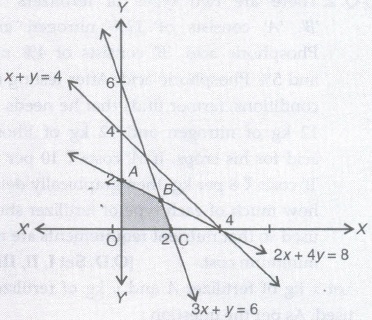
Possible points for maximum Z are A(2, 0),\(B\left(\frac{8}{5}, \frac{6}{5}\right)\) C (0,2)
| Points | Z= 2x + 5y | Values |
| A(2,0) | 4 + 0 | 4 |
| \(B\left(\frac{8}{5}, \frac{6}{5}\right)\) | \(\frac{16}{5}+\frac{30}{5}\) | \(\frac{46}{5}=9 \frac{1}{5}\) |
| C(0,2) | 0 + 10 | 10 \(\leftarrow\) Maximum |
Z is maximum at qo, 2), i.e. x = 0, y = 2, maximum value = 10
11.
Taking L.H.S = \(\left| \begin{matrix} 1 & 1+p & 1+p+q \\ 3 & 4+3p & 2+4p+3q \\ 4 & 7+4p & 2+7p+4q \end{matrix} \right| \)
Applying \(R_{ 2 }\rightarrow R_{ 2 }+R_{ 2 }+3R_{ 1 }\)
\(=\left| \begin{matrix} 1 & 1+p & 1+p+q \\ 0 & 1 & -1+p \\ 4 & 7+4p & 2+7p+4q \end{matrix} \right| \)
Applying \(R_{ 2 }\rightarrow R_{ 3 }+R_{ 3 }-4R_{ 1 }\)
\(=\left| \begin{matrix} 1 & 1+p & 1+p+q \\ 0 & 1 & -1+p \\ 0 & 3 & -2+3p \end{matrix} \right| \)
Applying \(R_{ 3 }\rightarrow R_{ 3 }-3R_{ 2 }\)
\(=\left| \begin{matrix} 1 & 1+p & 1+p+q \\ 0 & 1 & -1+p \\ 0 & 0 & 1 \end{matrix} \right| \)
Expanding along R3
= 1 = R.H.S
12.
\(\frac { dy }{ dx } ={ e }^{ x }\left[ 2cot2x+log\quad (sin2x) \right] \)
13.
\({\left[\begin{array}{ll} x-2 & -3 \end{array}\right]\left[\begin{array}{l} x \\ 3 \end{array}\right]=0} \)
\(\Rightarrow\left[x^{2}-2 x-9\right]=[0] \Rightarrow x^{2}-2 x-9=0 \)
\(x=\frac { 2\pm \sqrt { 4+36 } }{ 2 } =1\pm \sqrt { 10 } \)
14.
It is given that A = {1, 2, 3}, B = {4, 5, 6, 7}.
f: A → B is defined as f = {(1, 4), (2, 5), (3, 6)}.
∴ f (1) = 4, f (2) = 5, f (3) = 6
It is seen that the images of distinct elements of A under f are distinct.
Hence, function f is one-one.
15.
\(\text { Area of } \triangle A B C=\frac{1}{2}|\overrightarrow{B C} \times \overrightarrow{B A}| \)
\(\overrightarrow{B C}=(4 \hat{i}+5 \hat{j}-\hat{k})-(2 \hat{i}-\hat{j}+4 \hat{k})=2 \hat{i}+6 \hat{j}-5 \hat{k} \)
\(\text { and } \overrightarrow{B A}=(\hat{i}+2 \hat{j}+3 \hat{k})-(2 \hat{i}-\hat{j}+4 \hat{k})=-\hat{i}+3 \hat{j}-\hat{k} \)
\(\overrightarrow{B C} \times \overrightarrow{B A}=\left|\begin{array}{rrr} \hat{i} & \hat{j} & \hat{k} \\ 2 & 6 & -5 \\ -1 & 3 & -1 \end{array}\right|=\hat{i}(9)-\hat{j}(-7)+\hat{k}(12) \)
\(=9 \hat{i}+7 \hat{j}+12 \hat{k} \)
\(\therefore \text { Area of triangle }=\frac{1}{2}|9 \hat{i}+7 \hat{j}+12 \hat{k}|\)
\(=\frac{1}{2} \sqrt{81+49+144}=\frac{1}{2} \sqrt{274} \text { sq units } \)
16.
The given vectors \(3\overset { \wedge }{ i } -2\overset { \wedge }{ j } +9\overset { \wedge }{ k } \) and \(\overset { \wedge }{ i } -2p\overset { \wedge }{ j } +3\overset { \wedge }{ k } \) are parallel
if \(\frac { 3 }{ 1 } =\frac { 2 }{ -2p } =\frac { 9 }{ 3 } 3=\frac { 1 }{ -p } =3\)
if \(p=-\frac { 1 }{ 3 } \)
17.
We know that two nonzero vectors are perpendicular if their scalar product is zero.
\(\text{Here} \ \vec{a}+\vec{b}=(5 \hat{i}-\hat{j}-3 \hat{k})+(\hat{i}+3 \hat{j}-5 \hat{k})=6 \hat{i}+2 \hat{j}-8 \hat{k} \)
\(\text{and} \ \vec{a}-\vec{b}=(5 \hat{i}-\hat{j}-3 \hat{k})-(\hat{i}+3 \hat{j}-5 \hat{k})=4 \hat{i}-4 \hat{j}+2 \hat{k} \)
\(\text{so} \ (\vec{a}+\vec{b}) \cdot(\vec{a}-\vec{b})=(6 \hat{i}+2 \hat{j}-8 \hat{k}) \cdot(4 \hat{i}-4 \hat{j}+2 \hat{k})=24-8-16=0 . \)
\(\text {Hence } \ \vec{a}+\vec{b} \text { and } \vec{a}-\vec{b} \) are perpendicular vectors.
18.
\(Let\quad y={ e }^{ { sin }^{ -1 }x }\)
\(\frac { dy }{ dx } ={ e }^{ { sin }^{ -1 }x }\frac { d }{ dx } ({ sin }^{ -1 }x)\)
\(={ e }^{ { sin }^{ -1 }x }\left( \frac { 1 }{ \sqrt { 1-{ x }^{ 2 } } } \right) \)
\(=\frac { { e }^{ { sin }^{ -1 }x } }{ \sqrt { 1-{ x }^{ 2 } } } ,x\epsilon (-1,1)\)
19.
Let x = a cos3 θ, y = a sin3 θ. Then
\( x^{\frac{2}{3}}+y^{\frac{2}{3}} =\left(a \cos ^3 \theta\right)^{\frac{2}{3}}+\left(a \sin ^3 \theta\right)^{\frac{2}{3}} \)
\( =a^{\frac{2}{3}}\left(\cos ^2 \theta+\left(\sin ^2 \theta\right)=a^{\frac{2}{3}}\right. \)
Hence, \(x=a \cos ^3 \theta, y=a \sin ^3 \theta\) is parametric equation of \(x^{\frac{2}{3}}+y^{\frac{2}{3}}=a^{\frac{2}{3}}\)
\(Therefore\ \frac{d y}{d x}=\frac{\frac{d y}{d \theta}}{\frac{d x}{d \theta}}=\frac{3 a \sin ^2 \theta \cos \theta}{-3 a \cos ^2 \theta \sin \theta}=-\tan \theta=-\sqrt[3]{\frac{y}{x}} \)
\(=\frac { -\sqrt [ 3 ]{ \frac { y }{ a } } }{ \sqrt [ 3 ]{ \frac { y }{ x } } } \)
\(=-\sqrt [ 3 ]{ \frac { y }{ x } } \)
20.
\({ A }^{ 2 }=AA=\begin{bmatrix} 3 & -2 \\ 4 & -2 \end{bmatrix}\begin{bmatrix} 3 & -2 \\ 4 & -2 \end{bmatrix}\)
\(=\begin{bmatrix} 3\times 3+(-2)\times 4 & 3\times (-2)+(-2)\times (-2) \\ 4\times 3+(-2)\times 4 & 4\times (-2)+(-2)\times (-2) \end{bmatrix}\)
\(=\begin{bmatrix} 9-8 & -6+4 \\ 12-8 & -8+4 \end{bmatrix}=\begin{bmatrix} 1 & -2 \\ 4 & -4 \end{bmatrix}.\)
\(Now { A }^{ 2 }=kA-2I\)
\(\Rightarrow \begin{bmatrix} 1 & -2 \\ 4 & -4 \end{bmatrix}=k\begin{bmatrix} 3 & -2 \\ 4 & -2 \end{bmatrix}-2\begin{bmatrix} 1 & 0 \\ 0 & 1 \end{bmatrix}\)
\(\Rightarrow \begin{bmatrix} 1 & -2 \\ 4 & -4 \end{bmatrix}=\begin{bmatrix} 3k & -2k \\ 4k & -2k \end{bmatrix}+\begin{bmatrix} -2 & 0 \\ 0 & -2 \end{bmatrix}\)
\(=\begin{bmatrix} 3k-2 & -2k \\ 4k & -2k-2 \end{bmatrix}.\)
Equating corresponding elements:
1 = 3k-2
\(\Rightarrow \)3k = 3\(\Rightarrow \) k = 1
-2 = -2k \(\Rightarrow \) k = 1
4 = 4k \(\Rightarrow \) k = 1
-4 = -2k - 2 \(\Rightarrow \) -2k = 4 - 2 = 2 \(\Rightarrow \) k = 1.
Hence, k = 1.
21.
Operating R1 \(\rightarrow\) R1 + R2 + R3, we get
\(\Delta =\left| \begin{matrix} x+y+z & z+y+z & x+y+z \\ z & x & y \\ 1 & 1 & 1 \end{matrix} \right| \) = 0
Since the elements of R1 and R3 are proportional, \(\Delta\) = 0.
22.
We have
ho(gof) (x) = h(gof (x)) = h(g(f (x))) = h(g(2x))
= h(3(2x) + 4) = h(6x + 4) = sin (6x + 4) \(\forall x\in N\).
Also, ((hog)of ) (x) = (hog) ( f (x)) = (hog) (2x) = h(g(2x))
= h(3(2x) + 4) = h(6x + 4) = sin (6x + 4),\(\forall x\in N\)
This shows that ho(gof) = (hog) o f.
This result is true in general situation as well.
23.
(d)
\(-\frac{y}{x}\)
24.
(b)
p = 3 and q = \(\frac{27}{2}\)
25.
(b)
x = 2, y = 1
26.
(c)
Z is maximum at (40, 15), minimum at (15, 20).
27.
(d)
neither injective nor surjective.
28.
(c)
2, - 6, 3
29.
(c)
\(\pm\left(\frac{1}{3} \hat{i}+\frac{2}{3} \hat{j}-\frac{2}{3} \hat{k}\right)\)
30.
(d)
y = 0, z = 0
31.
\(A_{21}=(-1)^{2+1} M_{21}=-M_{21}=-\left|\begin{array}{ll} h & g \\ f & c \end{array}\right|\)
32.
We have, \(\left[\begin{array}{cc}1 & 2 \\ -2 & -b\end{array}\right]+\left[\begin{array}{ll}a & 4 \\ 3 & 2\end{array}\right]=\left[\begin{array}{ll}5 & 6 \\ 1 & 0\end{array}\right]\)
= \(\left[\begin{array}{cc}a+1 & 6 \\ 1 & 2-b\end{array}\right]=\left[\begin{array}{ll}5 & 6 \\ 1 & 0\end{array}\right]\)
\(\Rightarrow\)a + 1 = 5, 2 - b = 0
\(\Rightarrow\)a = 4, b = 2
\(\Rightarrow\)\(a^{2}+b^{2}=20\)
33.
(b)
Corner point
34.
(d)
collinear
35.
(b)
Transitive
36.
(c)
all of the given constraints
37.
As \({ cos }^{ 2 }\alpha +{ cos }^{ 2 }\beta +{ cos }^{ 2 }\gamma =1\)
\(\Rightarrow \frac { 1+cos2\alpha }{ 2 } +\frac { 1+cos2\beta }{ 2 } +\frac { 1+cos2\gamma }{ 2 } =1\)
= cos 2α + cos 2β + cos 2γ = 1
38.
As (gof) (x) = g[f(x)] = g(ex)
= loge ex = x
∴ (gof)' (x) = 1
39.
Δ = 6(-1)- 1(1) = -7
40.
Total injective mappings/functions
= 4 P3 = 4! = 24.
41.
(a) Both Assertion (A) and Reason (R) are true and the Reason (R) is the correct explanation of the Assertion (A).
42.
(a) Assertion is correct, reason is correct; reason is a correct explanation for assertion.
43.
Given, \(\vec{F}_1=6 \hat{i}+0 \hat{j} k N\)
\(\begin{aligned}
\therefore \quad\left|\vec{F}_1\right|=\sqrt{6^2+0^2}=6 \mathrm{kN} \\
\end{aligned}\)
\(\vec{F}_2=-4 \hat{i}+4 \hat{j} k N\)
\(\therefore \quad\left|\vec{F}_2\right|=\sqrt{(-4)^2+4^2}=4 \sqrt{2} k N\)
\(\vec{F}_3=-3 \hat{i}-3 \hat{j} k N\)
\(\Rightarrow\left|\vec{F}_3\right|=\sqrt{(-3)^2+(-3)^2}=3 \sqrt{2} \mathrm{kN}\)
(i) Magnitude of force of team \(A=\left|\vec{F}_1\right|=6 \mathrm{kN}\)
(ii) Since, magnitude of force of team A is greater than other teams, therefore team A will win the game.
(iii) Resultant force,
\( \vec{F}=\vec{F}_1+\vec{F}_2+\vec{F}_3\)
\(=(6 \hat{i}+0 \hat{j})+(-4 \hat{i}+4 \hat{j})+(-3 \hat{i}-3 \hat{j}) \)
\(\vec{F}=(-\hat{i}+\hat{j}) k N
\)
\(\Rightarrow |\vec{F}|=\sqrt{(-1)^2+(1)^2}=\sqrt{2} k N \)
Or
Resultant force \(\vec{F}=-\hat{i}+\hat{j}\)
Let \(\vec{F}\) makes an angle \(\theta\) with the X-axis,then its direction cosine along X-axis is cos \(\theta\).
\(\therefore \cos \theta=\frac{f_x}{\sqrt{f_x^2+f_y^2}} \text { (where } f_x \text { and } f_y\) are direction ratios along X-axis and Y-axis, respectively.)
\(\begin{aligned}
\cos \theta & =\frac{-1}{\sqrt{(-1)^2+(1)^2}}=\frac{-1}{\sqrt{2}}
\end{aligned}\)
\(\begin{aligned}
\Rightarrow & & \theta & =\cos ^{-1}\left(\frac{-1}{\sqrt{2}}\right)
\end{aligned}\)
\(\Rightarrow \theta =\pi-\frac{\pi}{4}=\frac{3 \pi}{4}\)
where '\(\theta\)' is the angle made by the resultant force with the '+' ve direction of the X-axis.
44.
Let the price of a pen, bag and instrument box are ₹ x, ₹y and ₹z respectively, then
\(5 x+3 y+z=160\)
(for Gautam)
\(2 x+y+3 z=190\)
(for Vikram)
\(\text { and } x+2 y+4 z=250\)
(for Ankur)
(i) This system of equation can be written as AX=B, where
\(A=\left[\begin{array}{lll} 5 & 3 & 1 \\ 2 & 1 & 3 \\ 1 & 2 & 4 \end{array}\right]\)
\(X=\left[\begin{array}{l} x \\ y \\ z \end{array}\right] \text { and } B=\left[\begin{array}{l} 160 \\ 190 \\ 250 \end{array}\right]\)
(ii) |A| =5(4-6)-3(8-3)+1(4-1)
\(=5(-2)-3(5)+1(3) =-10-15+3=-22 \neq 0\)
(iii) Cofactors of |A| are
\(A_{11}=(-1)^{1+1}\left|\begin{array}{ll} 1 & 3 \\ 2 & 4 \end{array}\right|=(4-6)=-2\)
\(A_{12}=(-1)^{1+2}\left|\begin{array}{ll} 2 & 3 \\ 1 & 4 \end{array}\right|=-(8-3)=-5\)
\(A_{13}=(-1)^{1+3}\left|\begin{array}{ll} 2 & 1 \\ 1 & 2 \end{array}\right|=4-1=3\)
\(A_{21}=(-1)^{2+1}\left|\begin{array}{ll} 3 & 1 \\ 2 & 4 \end{array}\right|=-(12-2)=-10 \)
\( A_{22}=(-1)^{2+2}\left|\begin{array}{ll} 5 & 1 \\ 1 & 4 \end{array}\right|=20-1=19\)
\(A_{23}=(-1)^{2+3}\left|\begin{array}{ll} 5 & 3 \\ 1 & 2 \end{array}\right|=-(10-3)=-7\)
\( A_{31}=(-1)^{3+1}\left|\begin{array}{ll} 3 & 1 \\ 1 & 3 \end{array}\right|=(9-1)=8 \)
\(A_{32}=(-1)^{3+2}\left|\begin{array}{ll} 5 & 1 \\ 2 & 3 \end{array}\right|=-(15-2)=-13\)
\(A_{33}=(-1)^{3+3}\left|\begin{array}{ll}
5 & 3 \\
2 & 1
\end{array}\right|^2=(5-6)=-1 \)
\(\therefore \operatorname{adj} A =\left[\begin{array}{lll}
A_{11} & A_{12} & A_{13} \\
A_{21} & A_{22} & A_{23} \\
A_{31} & A_{32} & A_{33}
\end{array}\right]^\tau\)
\(=\left[\begin{array}{ccc}
-2 & -5 & 3 \\
-10 & 19 & -7 \\
8 & -13 & -1
\end{array}\right]^T\)
\( =\left[\begin{array}{ccc}
-2 & -10 & 8 \\
-5 & 19 & -13 \\
3 & -7 & -1
\end{array}\right]^2\)
\( \therefore A^{-1}=\frac{\operatorname{adj} A}{|A|}=-\frac{1}{22}\left[\begin{array}{ccc}
-2 & -10 & 8 \\
-5 & 19 & -13 \\
3 & -7 & -1
\end{array}\right] \)
Or
(iii) P =A2-5 A
\(=\left[\begin{array}{ccc} 5 & 3 & 1 \\ 2 & 1 & 3 \\ 1 & 2 & 4 \end{array}\right]\left[\begin{array}{lll} 5 & 3 & 1 \\ 2 & 1 & 3 \\ 1 & 2 & 4 \end{array}\right]-5\left[\begin{array}{lll} 5 & 3 & 1 \\ 2 & 1 & 3 \\ 1 & 2 & 4 \end{array}\right]\)
\( =\left[\begin{array}{ccc} 25+6+1 & 15+3+2 & 5+9+4 \\ 10+2+3 & 6+1+6 & 2+3+12 \\ 5+4+4 & 3+2+8 & 1+6+16 \end{array}\right] \)
\(=\left[\begin{array}{lll} 32 & 20 & 18 \\ 15 & 13 & 17 \\ 13 & 13 & 23 \end{array}\right]-\left[\begin{array}{ccc} 25 & 15 & 5 \\ 10 & 5 & 15 \\ 5 & 10 & 20 \end{array}\right] \)
\(=\left[\begin{array}{lll} 7 & 5 & 13 \\ 5 & 8 & 2 \\ 8 & 3 & 3 \end{array}\right]\)
45.
We have, R = {(l1,l2) :l1 is parallel to l2}
(i) If l1 is parallel to l2, then l2 is parallel to l1.
So, if (l1, l2) \(\in R,\) then (l2, l1) \(\in R\)
\(\therefore\) R is symmetric.
(ii) If l1 is parallel to l2 and l2 is parallel to l3, then l1 is parallel to l3.
So, if \(\left(l_1, l_2\right) \in R,\left(l_2, l_3\right) \in R\), then (l1,l3)\(\in R\)
\(\therefore\) R is transitive.
(iii) Let equation of line parallel to y = 3x + 2 be y = mx + c, where m is the slope of line. Since, y = 3x + 2 and y = mx + c are parallel. Slope of (y =3x + 2) = Slope of(y = mx + c)
\(\Rightarrow\) 3 = m i.e. m = 3
Hence, the required line is
y = 3x + c, where c \(\in R\)
Or
We have, S = {(I1, I2) : l1 is perpendicular to l2}
For Symmetric If I1, is perpendicular to I2, then l2 is perpendicular to l1.
So, if (l1,l2) \(\in S\), then (l2, l1) \(\in S\)
\(\therefore\) S is symmetric.
For Transitive If I1, is perpendicular to l2, and l2, is perpendicular to l3, then I1, is not perpendicular to l3, it is parallel to I3.
So, if \(\left(l_1, l_2\right) \in S,\left(l_2, l_3\right) \in S \text {, then }\left(l_1, l_3\right) \notin S \text {. }\)
\(\therefore\) S is not transitive.

12th Standard CBSE Syllabus & Materials
12th Standard CBSE
CBSE 12th Computer Science Python Revision Tour I - New Previous year Question Papers Study Material - QB365 Set A
NEW12th Standard CBSE
CBSE 12th Business Studies Planning Important Questions And Answers Study Material - QB365 Set A
NEW12th Standard CBSE
CBSE 12th Business Studies Business Environment Important Questions And Answers Study Material - QB365 Set A
NEW12th Standard CBSE
CBSE 12th Business Studies Principles of Management Important Questions And Answers Study Material - QB365 Set A



NCERT Books

Syllabus

Exam Pattern

Sample Question Papers

Previous year Question Papers

Important Notes

MCQ Practice test

NCERT Exemplers

Case study Questions

Image Based Questions

Passage based Questions

HOT Questions

Value Based Questions

Model Questions Papers
NCERT ( Book Back ) Questions

Assertion and Reason
Important Questions And Answers

CBSE 12th Standard CBSE Subjects
CBSE Standards








