
 100% FREE ACCESS
12th Standard CBSE Syllabus & Materials
12th Standard CBSE
CBSE 12th Economics Government Budget and the Economy Previous year Question Papers Study Material - QB365 Set A
NEW12th Standard CBSE
CBSE 12th Computer Science Interface Python with MySQL - New Previous year Question Papers Study Material - QB365 Set A
NEW12th Standard CBSE
CBSE 12th Computer Science Database Concept - New Previous year Question Papers Study Material - QB365 Set A
NEW12th Standard CBSE
CBSE 12th Computer Science Data Communication - New Previous year Question Papers Study Material - QB365 Set A
NEW12th Standard CBSE
CBSE 12th Computer Science Data Structures - New Previous year Question Papers Study Material - QB365 Set A
NEW12th Standard CBSE
CBSE 12th Computer Science Functions - New Previous year Question Papers Study Material - QB365 Set A

Published on: 25/10/2025
Download CBSE Class 12th Standard CBSE Maths question papers, sample papers, important questions, and previous year solved papers in PDF format. Get free study materials, NCERT solutions, and exam preparation resources for Class 12th Standard CBSE Maths
Questions + Answers key
Take MCQ Maths Test
1.
The cartesian equation of the line is \(\frac { x-5 }{ 3 } =\frac { y+4 }{ 7 } =\frac { z-6 }{ 2 } \). Write its vector form.
2.
Find the equation of the line, which passes through the point(1, 2, 3) and is parallel to the vector \(3\vec { i } +2\vec { j } -2\vec { k } \)
3.
Show that the points: (2, 3, 4); (-1, -2, 1); (5, 8, 7) are collinear.
4.
Find the angle between the pair of lines
\(\frac { x+3 }{ 3 } =\frac { y-1 }{ 5 } =\frac { z+3 }{ 4 } \)and \(\frac { x+1 }{ 1 } =\frac { y-4 }{ 1 } =\frac { z-5 }{ 2 } \).
5.
Find the direction-cosines of x, y and z-axis.
6.
Find the direction cosines of the line passing through the two points (-2, 4, -5) and (1, 2, 3)
7.
Find the shortest distance between the lines \({ l }_{ 1 }\) and \({ l }_{ 2 }\) whose vector equations are \(\vec { r } =\hat { i } +\hat { j } +\lambda (2\hat { i } -\hat { j } +\hat { k } )\) and \(\vec { r } =2\hat { i } +\hat { j } +\hat { k } +\mu (3\hat { i } -5\hat { j } +2\hat { k } )\)
8.
Find the shortest distance between the following two lines:
\(\overrightarrow { r } =(1+\lambda )\acute { i } +(2-\lambda )\acute { j } +(\lambda +1)\acute { k } \\ \vec { r } =(2\acute { i } -\acute { j } -\acute { k } )+\mu (2\acute { i } +\acute { j } +2\acute { k } )\)
9.
Find the equation of the line passing through the point P(4, 6, 2) and the point of intersection of the line \(\frac { x-1 }{ 3 } =\frac { y }{ 2 } =\frac { z+1 }{ 7 } \) and the plane x + y - z = 8.
10.
Find the length and the foot of the perpendicular drawn from the point (2,-1,5) to the line \(\frac { x-11 }{ 10 } =\frac { y+2 }{ -4 } =\frac { z+8 }{ -11 } \).
11.
Find the co-ordinates of the point P where the line through A(3, - 4, - 5), 8(2, - 3, 1) crosses the plane, passing through the points (2, 2, 1), (3, 0, 1), (4, - 1, 0). Also, find the ratio in which P divides the line segment AB.
12.
Find the equation of the plane passing through the line of intersection of the planes \(\vec { r } .\left( \overset { \wedge }{ i } +\overset { \wedge }{ j } +\overset { \wedge }{ k } \right) =1\) and \(\vec { r } .\left( \quad 2\overset { \wedge }{ i } +3\overset { \wedge }{ j } -\overset { \wedge }{ k } \right) +4=0\) which is perpendicular to the plane \(\vec { r } .\left( \overset { \wedge }{ i } +\overset { \wedge }{ j } -4\overset { \wedge }{ k } \right) =5\)
13.
Show that the lines \({{x+3}\over{-3}}={{y-1}\over{1}}={{z-5}\over{5}}\) and \({{x+1}\over{-1}}={{y-2}\over{2}}={{z-5}\over{5}}\) are coplanar. Also, find the equation of the plane containing these lines.
14.
The equations of y-axis in space are
x = 0, y = 0
x = 0, z = 0
y = 0, z = 0
y = 0
15.
A line makes angle α, β, γ with x-axis, y-axis and z-axis respectively then cos 2α + cos 2β + cos 2γ is equal to
2
1
-2
-1
16.
Direction ratios of a line are 2, 3, -6. Then direction cosines of a line making obtuse angle with the y-axis are
\(\frac { 2 }{ 7 } ,\frac { -3 }{ 7 } ,\frac { -6 }{ 7 } \)
\(\frac { -2 }{ 7 } ,\frac { 3 }{ 7 } ,\frac { -6 }{ 7 } \)
\(\frac { -2 }{ 7 } ,\frac { -3 }{ 7 } ,\frac { 6 }{ 7 } \)
\(\frac { -2 }{ 7 } ,\frac { -3 }{ 7 } ,\frac { -6 }{ 7 } \)
17.
P is a point on the line segment joining the points (3, 5, -1) and (6, 3, -2). If y-coordinate of point P is 2, then its x-coordinate will be
2
\(\frac{17}{3}\)
\(\frac{15}{3}\)
-5
18.
The distance of point (2, 5, 7) from the x-axis is
2
\(\sqrt{74}\)
\(\sqrt{29}\)
\(\sqrt{53}\)
1.
The given cartesian equation of the line is:
\(\frac { x-5 }{ 3 } =\frac { y+4 }{ 7 } =\frac { z-6 }{ 2 } \) . (1)
This passes through the point(5,-4,6) and has <3,7,2> as its direction ratios
\(\Rightarrow\) the line (1) passes through the point A\((\vec { a } )\)where
\(\vec { a } =5\vec { i } -4\vec { j } +6\vec { k } \ \text {and is in the direction of}\)
\( \vec { m } =3\vec { i } +7\vec { j } +2\vec { k } \)
The vector equation of the required line is:
\(\vec { r } =\vec { a } +\lambda \vec { m } \)
\(i.e.\ \vec { r } =\left( 5\vec { i } -4\vec { j } +6\vec { k } \right) +\lambda \left( \vec { i } +7\vec { j } +2\vec { k } \right) \)
2.
It is given that the line passes through the point A (1, 2, 3). Therefore, the position vector through A
\(\vec { a } =\hat { i } +2\hat { j } +3\hat { k } \quad and\)
\(\vec { b } =3\vec { i } +2\vec { j } -2\vec { k } \)
The equation of the required line is:
\(\vec { r } =\left( \hat { i } +2\hat { j } +3\hat { k } \right) +\lambda \left( 3\vec { i } +2\vec { j } -2\vec { k } \right) ;\lambda \in R\)
3.
Let A(2, 3, 4); B(-1, -2, 1) and C(5, 8, 7) be the given points
Direction ratios of AB are: (-1-2, -2-3, 1-4)
i.e. (-3, -5, -3) i.e. (3, 5, 3)
Direction-ratios of BC are: (5-(-1), 8-(-2(,7-1)
i.e. (6, 10, 6) i.e. (3, 5, 3)
\(\Rightarrow\) AB and BC have same direction ratios
\(\Rightarrow\) AB||BC
But B is a common point.Hence A, B, C are collinear.
4.
The direction ratios of the first line are 3, 5, 4 and the direction ratios of the second line are 1, 1, 2. If θ is the angle between them, then
\(cos\theta =\left| \frac { (3)(1)+(5)(1)+(4)(2) }{ \sqrt { 9+25+16 } \sqrt { 1+1+4 } } \right| =\left| \frac { 3+5+8 }{ \sqrt { 50 } \sqrt { 6 } } \right| =\frac { 16 }{ 5\sqrt { 2 } \sqrt { 6 } } =\frac { 8\sqrt { 3 } }{ 15 } \)
Hence,the required angle is \(\theta -\cos ^{ -1 }{ \left( \frac { 8\sqrt { 3 } }{ 15 } \right) } \)
5.
The x-axis makes angles 0°, 90° and 90° respectively with x, y and z-axis.
Therefore, the direction cosines of x-axis are cos 0°, cos 90°, cos 90° i.e., 1, 0, 0.
Similarly, direction cosines of y-axis and z-axis are 0, 1, 0 and 0, 0, 1 respectively.
6.
We know that the direction-cosines of the line joining P(x1, y1, z1) and q(x2, y2, z2) are:
\(\frac{x_{2}-x_{1}}{\mathrm{PQ}}, \frac{y_{2}-y_{1}}{\mathrm{PQ}}, \frac{z_{2}-z_{1}}{\mathrm{PQ}} \)
\(\text {where } \mathrm{PQ}=\sqrt{\left(x_{2}-x_{1}\right)^{2}+\left(y_{2}-y_{1}\right)^{2}+\left(z_{2}-z_{1}\right)^{2}} \)
Here P is (– 2, 4, – 5) and Q is (1, 2, 3).
\(\mathrm{PQ}=\sqrt{(1-(-2))^{2}+(2-4)^{2}+(3-(-5))^{2}}=\sqrt{77}\)
Thus, the direction cosines of the line joining two points is
\(\frac{3}{\sqrt{77}}, \frac{-2}{\sqrt{77}}, \frac{8}{\sqrt{77}}\)
7.
The given lines are:
\(\vec { r } =\hat { i } +\hat { j } +\lambda (2\hat { i } -\hat { j } +\hat { k } )\quad and\)
\(\vec { r } =2\hat { i } +\hat { j } -\hat { k } +\mu (3\hat { i } -5\hat { j } +2\hat { k } )\)
Comparing with \(\vec { r } =\vec { { a }_{ 1 } } +\lambda \vec { b } and\quad \vec { r } =\vec { { a }_{ 2 } } +\lambda \vec { b } ,\text {we have}:\)
\(\vec { r } =\vec { { a }_{ 1 } } +\lambda \vec { b } \ and\quad \vec { r } =\vec { { a }_{ 2 } } +\lambda \vec { b } ,we\quad have:\)
\(\vec { { b }_{ 1 } } =2\hat { i } -\hat { j } +\hat { k } \ and\quad \vec { { b }_{ 2 } } =3\hat { i } -5\hat { j } +2\hat { k } ;\)
\(\vec { { a }_{ 1 } } =\hat { i } +\hat { j } \ and \ \vec { { a }_{ 2 } } =2\hat { i } +\hat { j } -\hat { k } \)
\( \therefore \vec{a}_2-\vec{a}_1=\hat{i}-\hat{k} \\ \vec{b}_1 \times \vec{b}_2=(2 \hat{i}-\hat{j}+\hat{k}) \times(3 \hat{i}-5 \hat{j}+2 \hat{k}) \)
\(\vec { { b }_{ 1 } } \times \vec { { b }_{ 2 } } =\left| \begin{matrix} \hat { i } & \hat { j } & \hat { k } \\ 2 & -1 & 1 \\ 3 & -5 & 2 \end{matrix} \right| =3\hat { i } -\hat { j } -7\hat { k } \)
\(\left|\vec{b}_{1} \times \vec{b}_{2}\right|=\sqrt{9+1+49}=\sqrt{59}\)
Hence, the shortest distance between the given lines is given by
\(d=\left|\frac{\left(\vec{b}_{1} \times \vec{b}_{2}\right) \cdot\left(\vec{a}_{2}-\vec{a}_{1}\right)}{\left|\vec{b}_{1} \times \vec{b}_{2}\right|}\right|=\frac{|3-0+7|}{\sqrt{59}}=\frac{10}{\sqrt{59}}\)
8.
Consider, the line \( \vec{r}=(1+\lambda) \hat{i}+(2-\lambda) \hat{j}+(\lambda+1) \hat{k} \)
\(i.e., \vec{r}=(\hat{i}+2 \hat{j}+\hat{k})+\lambda(\hat{i}-\hat{j}+\hat{k}) \)
\(\text {Here } \vec{a}_{1}=\hat{i}+2 \hat{j}+\hat{k}, \vec{b}_{1}=\hat{i}-\hat{j}+\hat{k} \)
Shortest distance between the lines
\(=\left|\frac{\left(\overrightarrow{a_{2}}-\vec{a}_{1}\right) \cdot\left(\vec{b}_{1} \times \overrightarrow{b_{2}}\right)}{\left|\vec{b}_{1} \times \overrightarrow{b_{2}}\right|}\right|\)
\(\text {Now } \vec{a}_{2}-\vec{a}_{1}=2 \hat{i}-\hat{j}-\hat{k}-\hat{i}-2 \hat{j}-\hat{k}=\hat{i}-3 \hat{j}-2 \hat{k}\)
\(\vec{b}_{1} \times \vec{b}_{2} =\left|\begin{array}{rrr} \hat{i} & \hat{j} & \hat{k} \\ 1 & -1 & 1 \\ 2 & 1 & 2 \end{array}\right| \)
\(-\hat{i}(-2-1)-\hat{j}(2-2)+\hat{k}(1+2) \)
\(=-3 \hat{i}+3 \hat{k} \)
\(\left|\vec{b}_{1} \times \vec{b}_{2}\right| =\sqrt{9+9}=3 \sqrt{2} \)
Shortest distance = \(\left| \frac { (\acute { i } -3\acute { j } -2\acute { k } ).(-3\acute { i } +3\acute { k } ) }{ 3\sqrt { 2 } } \right| =\left| \frac { -3-6 }{ 3\sqrt { 2 } } \right| =\frac { 3 }{ \sqrt { 2 } } =\frac { 3\sqrt { 2 } }{ 2 } \) units
9.
General point on the line \( \frac{x-1}{3}=\frac{y}{2}=\frac{z+1}{7} \text { is }\)
\(Q(3 \lambda+1,2 \lambda, 7 \lambda-1)\)
If this point lies on the plane then
\(3 \lambda+1+2 \lambda-7 \lambda+1=8 \)
\(\Rightarrow-2 \lambda=6 \Rightarrow \lambda=-3 \)
Substituting in (i), point of intersection is
\(Q(-8,-6,-22)\)
Direction ratios of P Q are12,12, 24 or 1, 1, 2
Equation of PQ is \(\frac { x-4 }{ 1 } =\frac { y-6 }{ 1 } =\frac { z-2 }{ 2 } \)
10.
General point on the line
\(\frac{x-11}{10}=\frac{y+2}{-4}=\frac{z+8}{-11}=\lambda \text { (say) is } \)
\(Q(10 \lambda+11,-4 \lambda-2,-11 \lambda-8) \)
Direction ratios of PQ are
\(10 \lambda+11-2,-4 \lambda-2+1,-11 \lambda-8-5 \)
\(\text { i.c. } 10 \lambda+9,-4 \lambda-1,-11 \lambda-13 \)
If PQ is perpendicular to the given line, then
\(10(10 \lambda+9)-4(-4 \lambda-1)-11(-11 \lambda-13)=0 \)
\(\Rightarrow 237 \lambda=-237 \Rightarrow \lambda=-1 \)
Substituting in (i), we get the foot of perpendicular as Q(1, 2, 3)
Length of perpendicular
\(P Q =\sqrt{(2-1)^{2}+(-1-2)^{2}+(5-3)^{2}} \)
\(=\sqrt{1+9+4}=\sqrt{14} . \)
11.
Equation of line through (3,- 4,- 5) and (2,- 3,1)
\({ { x-3}\over{2-3 } }={ { y-(-4)}\over{-3-(-4) } }={ { z-(-5)}\over{ 1-(-5)} }\)
\(\Rightarrow\) \({ {x-3 }\over{ -1} }={ {y+4 }\over{1 } }={ { z+5}\over{ 6} }=\lambda\)(Let)
\(\therefore\) Co-ordinate of any random point on this line
M \((-\lambda+3,\lambda-4,6\lambda-5).\)
Also, equation of plane passing through the points (2, 2,1), (3, 0,1) and (4, -1, 0) is given by the formula:
\(\begin{vmatrix} x-{ x }_{ 1 } & y-{ y }_{ 1 } & z-{ z }_{ 1 } \\ { x }_{ 2 }-{ x }_{ 1 } & { y }_{ 2 }-{ y }_{ 1 } & { z }_{ 2 }-{ z }_{ 1 } \\ { x }_{ 3 }-{ x }_{ 1 } & { y }_{ 3 }-{ y }_{ 1 } & { z }_{ 3 }-{ z }_{ 1 } \end{vmatrix}=0\)
i.e., \(\begin{vmatrix} x-2 & y-2 & z-1 \\ 3-2 & 0-2 & 1-1 \\ 4-2 & -1-2 & 0-1 \end{vmatrix}=0\)
\(\Rightarrow\) \(\begin{vmatrix} x-2 & y-2 & z-1 \\ 1 & -2 & 0 \\ 2 & -3 & -1 \end{vmatrix}=0\)
\(\Rightarrow\) ( x - 2 )( 2 - 0 ) - ( y - 2 ) ( - 1 - 0 )+ ( z - 1 ) ( - 3 + 4 ) = 0
\(\Rightarrow\) 2x + y + z -7 = 0 ..(i)
When the line crosses the plane, M must satisfy the plane (i).
So, we have
\(2(-\lambda+3)+(\lambda-4)+(6\lambda-5)-7=0\)
\(\Rightarrow\) \(\lambda=2\)
Hence, required co-ordinates of the point of intersection is M (1, - 2, 7).
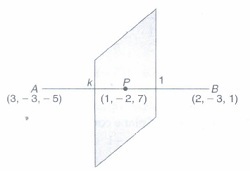
\(\therefore\) Co-ordinates of Pare (1, - 2, 7).
Now, for ratio:
Let P divides AB in the ratio k : 1.
\(\therefore\) Using section formula
\(1={{2k+3}\over{k+1}}\)
\(\Rightarrow\) 2k + 3 = k + 1
\(\therefore\) k = -2
Ratio is - 2 : 1 or 2 : 1 externally.
12.
Equation of plane passing through the intersection of two given planes is
\(\vec { r } .\left( \overset { \wedge }{ i } +\overset { \wedge }{ j } +4\overset { \wedge }{ k } \right) -1+\lambda \left\{ \vec { r } .(2\hat { i } +3\hat { j } -\hat { k } )+4 \right\} =0\)
\(\vec { r } .\left\{ (1+2\lambda )\hat { i } +(1+3\lambda )\hat { j } +(1-\lambda )\hat { k } \right\} -1+4\lambda \)
Plane (i) is to the plane
∴ 1(1+2λ) + 1(1+3λ) - 4(1-λ) = 0
⇒ 9λ = 2 ⇒ \(\lambda =\frac { 2 }{ 9 } \)
∴Eqn.of plane is \(\vec { r } .\left( \frac { 13 }{ 9 } \hat { i } +\frac { 15 }{ 9 } \hat { j } +\frac { 7 }{ 9 } \hat { k } \right) -\frac { 1 }{ 9 } =0\)
or 13x + 15 y +7z -1 = 0
13.
Lines \({{x-{x}_{1}}\over{{l}_{1}}}={{y-{y}_{1}}\over{{m}_{1}}}={{z-{z}_{1}}\over{{n}_{1}}}\) and \({{x-{x}_{2}}\over{{l}_{2}}}={{y-{y}_{2}}\over{{m}_{2}}}={{z-{z}_{2}}\over{{n}_{2}}}\) are coplaner, if
\(\begin{vmatrix} { x }_{ 2 }-{ x }_{ 1 } & { y }_{ 2 }-{ y }_{ 1 } & { z }_{ 2 }-{ z }_{ 1 } \\ { l }_{ 1 } & { m }_{ 1 } & { n }_{ 1 } \\ { l }_{ 2 } & { m }_{ 2 } & { n }_{ 2 } \end{vmatrix}=0\)
Now, \(\begin{vmatrix} -1+3 & 2-1 & 5-5 \\ -3 & 1 & 5 \\ -1 & 2 & 5 \end{vmatrix}=\begin{vmatrix} 2 & 1 & 0 \\ -3 & 1 & 5 \\ -1 & 2 & 5 \end{vmatrix}\)
= 2 (5 -10) - 1 (-15 + 5) + 0
= -10 + 10 = 0
Thus, given lines are coplanar.
Now, equation of plane containing these lines is:
\(\begin{vmatrix} x+3 & y-1 & x-5 \\ -3 & 1 & 5 \\ -1 & 2 & 5 \end{vmatrix}=0\)
\(\Rightarrow\) (x + 3) (5 -10) - (y -1) (-15 + 5) + (z - 5) (- 6 + 1) = 0
\(\Rightarrow\) - 5 (x + 3) + 10(y-l) -5(z -5) = 0
\(\Rightarrow\) - 5x + 10y - 5z = 0
\(\Rightarrow\) x - 2y + z = 0.
14.
As on the y-axis, x-coordinate and z-coordinate are zeroes
15.
As \({ cos }^{ 2 }\alpha +{ cos }^{ 2 }\beta +{ cos }^{ 2 }\gamma =1\)
\(\Rightarrow \frac { 1+cos2\alpha }{ 2 } +\frac { 1+cos2\beta }{ 2 } +\frac { 1+cos2\gamma }{ 2 } =1\)
= cos 2α + cos 2β + cos 2γ = 1
16.
As direction cosines of a line whose direction ratio are 2,3, -6 are
\(\frac { -2 }{ 7 } ,\frac { 3 }{ 7 } ,\frac { 6 }{ 7 } \)
As angle with the y-axis is obtuse,
∴ cos β < 0,
Therefore direction ratios are \(\frac { -2 }{ 7 } ,\frac { -3 }{ 7 } ,\frac { 6 }{ 7 } \)
17.
As let P divides the join of (3, 5, -1) and (6, 3, -2) in the ratio k : 1
\(\therefore \frac { 3k+5 }{ k+1 } =2\)
\(\Rightarrow 3k+5=2k+2\Rightarrow k=-3\)
∴ x-coordinate is
\(\frac { 6k+3 }{ k+1 } =\frac { -18+3 }{ -3+1 } =\frac { 15 }{ 2 } \)
18.
As distance of point (2, 5, 7) from the x-axis is
\(\sqrt { { 5 }^{ 2 }+{ 7 }^{ 2 } } =\sqrt { 25+49 } =\sqrt { 74 } \)

12th Standard CBSE Syllabus & Materials
12th Standard CBSE
CBSE 12th Computer Science Python Revision Tour I - New Previous year Question Papers Study Material - QB365 Set A
NEW12th Standard CBSE
CBSE 12th Business Studies Planning Important Questions And Answers Study Material - QB365 Set A
NEW12th Standard CBSE
CBSE 12th Business Studies Business Environment Important Questions And Answers Study Material - QB365 Set A
NEW12th Standard CBSE
CBSE 12th Business Studies Principles of Management Important Questions And Answers Study Material - QB365 Set A



NCERT Books

Syllabus

Exam Pattern

Sample Question Papers

Previous year Question Papers

Important Notes

MCQ Practice test

NCERT Exemplers

Case study Questions

Image Based Questions

Passage based Questions

HOT Questions

Value Based Questions

Model Questions Papers
NCERT ( Book Back ) Questions

Assertion and Reason
Important Questions And Answers

CBSE 12th Standard CBSE Subjects
CBSE Standards








