
 100% FREE ACCESS
12th Standard CBSE Syllabus & Materials
12th Standard CBSE
CBSE 12th Economics Government Budget and the Economy Previous year Question Papers Study Material - QB365 Set A
NEW12th Standard CBSE
CBSE 12th Computer Science Interface Python with MySQL - New Previous year Question Papers Study Material - QB365 Set A
NEW12th Standard CBSE
CBSE 12th Computer Science Database Concept - New Previous year Question Papers Study Material - QB365 Set A
NEW12th Standard CBSE
CBSE 12th Computer Science Data Communication - New Previous year Question Papers Study Material - QB365 Set A
NEW12th Standard CBSE
CBSE 12th Computer Science Data Structures - New Previous year Question Papers Study Material - QB365 Set A
NEW12th Standard CBSE
CBSE 12th Computer Science Functions - New Previous year Question Papers Study Material - QB365 Set A

Published on: 25/10/2025
Download CBSE Class 12th Standard CBSE Maths question papers, sample papers, important questions, and previous year solved papers in PDF format. Get free study materials, NCERT solutions, and exam preparation resources for Class 12th Standard CBSE Maths
Questions + Answers key
Take MCQ Maths Test
1.
Find the distance between the line \(\vec{r}=3 \hat{i}+5 \hat{j}-2 \hat{k}+\lambda(3 \hat{i}+\hat{j}+3 \hat{k})\) and the plane determined by the points A(1, 1, 0), B(1, 2, 1) and C(- 2, 2, - 1).
2.
If A, Band Care the vertices of a \(\Delta A B C\),then what is the value of \(\overrightarrow{A B}+\overrightarrow{B C}+\overrightarrow{C A} ?\)
3.
Find the angle between two planes: 2x + y - 2z = 5 and 3x - 6y - 2z = 7, using vector method.
4.
Find the equations of the line passing through \((\alpha ,\beta ,\gamma )\) and perpendicular to lines \(\frac { x }{ { l }_{ 1 } } =\frac { y }{ { m }_{ 1 } } =\frac { z }{ { n }_{ 1 } } \) and \(\frac { x }{ { l }_{ 2 } } =\frac { y }{ { m }_{ 2 } } =\frac { z }{ { n }_{ 2 } } \)
5.
Find x, such that the points A(3, 2, 1), B(4, x, 5), C(4, 2, -2) and D(6, 5, -1) are coplanar.
6.
If \(\overrightarrow { a } \times \overrightarrow { b } =\overrightarrow { a } \times \overrightarrow { c } \ and\ \overrightarrow { a } \times \overrightarrow { c } =\overrightarrow { b } \times \overrightarrow { d } \) prove that \(\overrightarrow { a } -\overrightarrow { d } \) is parallel to \(\overrightarrow { b } -\overrightarrow { c } \) provided \(\overrightarrow { a } \neq \overrightarrow { d } \ and\ \overrightarrow { b } \neq \overrightarrow { c } \)
7.
If the vectors \(\vec{a} \text { and } \vec{b}\)are such that \(|\vec{a}|=3,|\vec{b}|=\frac{2}{3}\) and \(\vec{a} \times \vec{b}\)is a unit vector, then find the angle between \(\vec{a} \text { and } \vec{b}\).
8.
Write the distance of the point (3, - 5, 12) from the x-axis.
9.
Find the cartesian equation of the line which passes through the point (-2,4, -5) and is parallel to the line \(\frac{x+3}{3}=\frac{4-y}{5}=\frac{z+8}{6}\).
10.
Given that P (3, 2,- 4), Q (5, 4, -6) and R (9, 8, -10) are collinear. Find the ratio in which Q divides PR.
11.
Find the area of parallelogram whose adjacent sides are determined by the vector.
\(\overset\rightarrow a=\overset\wedge i-\overset\wedge j+2\overset\wedge k\) and \(\overset\rightarrow b=2\overset\wedge i-\overset\wedge j-\overset\wedge k\)
12.
If \(\overset\rightarrow a=x\overset\wedge i+2 \overset\wedge j-z\overset\wedge k\) and \(\overset\rightarrow b=3\overset\wedge i-y\overset\wedge j+\overset\wedge k\) are two equal vectors, then write the value of x+y+z.
13.
\(\text { If }|\vec{a}|=5,|\vec{b}|=\mid 3 \text { and }|\vec{a} \times \vec{b}|=25 \text { , then } \vec{a} \cdot \vec{b} \text { is equal to }\)
12
5
13
60
14.
If \(\vec{a} \cdot \vec{b}=0 \text { and } \vec{a} \times \vec{b}=0\), then
\(|\vec{a}|=0\)
\(|\vec{b}|=0\)
Both (a) and (b) are true
Either \(|\vec{a}|=0 \text { or }|\vec{b}|=0\)
15.
If \(\theta\) is the angle between two vectors \(\vec{a} \text { and } \vec{b}\), then \(\vec{a} \cdot \vec{b} \geq 0\) only when
\(<\theta<\frac{\pi}{2}\)
\(0 \leq \theta \leq \frac{\pi}{2}\)
\(0<\theta<\pi\)
\(0 \leq \theta \leq \pi\)
16.
If a line in the ZX-plane makes an angle 60o with Z-axis, the direction cosines of this line are:
\(\frac { \sqrt { 3 } }{ 2 } ,0,\frac { 1 }{ 2 } \)
\(\frac { 1 }{ 2 } ,0,\frac { \sqrt { 3 } }{ 2 } \)
\(\frac { \sqrt { 3 } }{ 2 } ,\frac { 1 }{ 2 } ,0\)
\(0,\frac { \sqrt { 3 } }{ 2 } ,\frac { 1 }{ 2 } \)
17.
The direction cosines of the line equally inclined with the axes are:
1, 1, 1
1/\(\sqrt3\), 1/\(\sqrt3\), 1/\(\sqrt3\)
1, 0, 0
1/3, 1/3, 1/3
18.
Three planes, viz the XY Plane, XZ Plane and the YZ Plane divide the space into eight parts. Each part is called an OCTANT. What is the relation between these three planes
They form the angles α, β & γ with each other
Any two must be perpendicular to each other
All three are mutually perpendicular
no relation between these three planes
19.
Two motorcycles A and B are running at the speed more than allowed speed on the road along the lines \(\vec{r}=\lambda(\hat{i}+2 \hat{j}-\hat{k}) \text { and } \vec{r}=3 \hat{i}+3 \hat{j}+\mu(2 \hat{i}+\hat{j}+\hat{k})\), respectively.
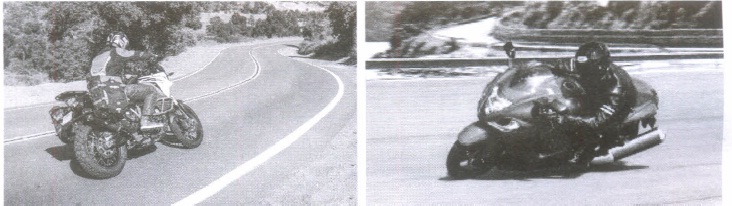
Based on the above information, answer the following questions.
(i) The cartesian equation of the line along which motorcycle A is running, is
| (a) \(\frac{x+1}{1}=\frac{y+1}{2}=\frac{z-1}{-1}\) | (b) \(\frac{x}{1}=\frac{y}{2}=\frac{z}{-1}\) | (c) \(\frac{x}{1}=\frac{y}{2}=\frac{z}{1}\) | (d) none of these |
(ii) The direction cosines of line along which motorcycle A is running, are
| (a) < 1, -2, 1 > | (b) < 1, 2, -1 > | (c) \(<\frac{1}{\sqrt{6}}, \frac{-2}{\sqrt{6}}, \frac{1}{\sqrt{6}}>\) | (d) \(<\frac{1}{\sqrt{6}}, \frac{2}{\sqrt{6}}, \frac{-1}{\sqrt{6}}>\) |
(iii) The direction ratios of line along which motorcycle B is running, are
| (a) < 1, 0, 2 > | (b) < 2, 1, 0 > | (c) < 1, 1, 2 > | (d) < 2, 1, 1 > |
(iv) The shortest distance between the gives lines is
| (a) 4 units | (b) 2.\(\sqrt 3\) units | (c) 3.\(\sqrt 2\) units | (d) 0 units |
(v) The motorcycles will meet with an accident at the point
| (a) (-1, 1, 2) | (b) (2, 1, -1) | (c) (1, 2, -1) | (d) does not exist |
20.
Teams A, B, C went for playing a tug of war game. Teams A, B, C have attached a rope to a metal ring and is trying to pull the ring into their own area (team areas shown below).
Team A pulls with force F1 = \(\hat{4}+\hat{0} \hat{j}\) KN
Team B ⟶ F2 = \(-2 \hat{i}+4 \hat{j}\) KN
Team C ⟶ F3 = \(-3 \hat{i}-3 \hat{j}\) KN
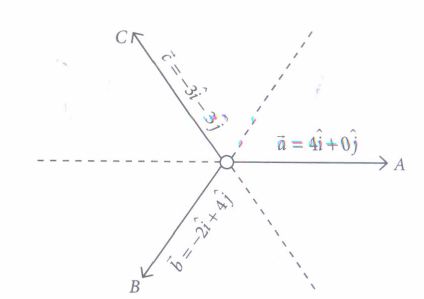
Based on the above information, answer the following questions.
(i) Which team will win the game ?
| (a) Team B | (b) Team A | (c) Team C | (d) No one |
(ii) What is the magnitude of the teams combined force ?
| (a) 7 KN | (b) 1.4 KN | (c) 1.5 KN | (d) 2 KN |
(iii) In what direction is the ring getting pulled?
| (a) 2.0 radian | (b) 2.5 radian | (c) 2.4 radian | (d) 3 radian |
(iv) What is the magnitude of the force of Team B?
| (a) 2\(\sqrt 5\) KN | (b) 6 KN | (c) 2 KN | (d) \(\sqrt 6\) KN |
(v) How many KN force is applied by Team A?
| (a) 5 KN | (b) 4 KN | (c) 2 KN | (d) 16 KN |
21.
Consider the shown figure.
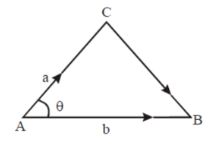
Assertion: If a and b represent the adjacent sides of a triangle as shown, then its area is \(\frac{1}{2}|a\times b|\)
Reason: Area of \(\Delta\)ABC = \(\frac{1}{2}\)|b||a| sin \(\theta\) where, \(\theta\) is the angle between the adjacent sides a and b (as shown).
(a) Assertion is correct, Reason is correct; Reason is a correct explanation for assertion.
(b) Assertion is correct, Reason is correct; Reason is not a correct explanation for Assertion
(c) Assertion is correct, Reason is incorrect
(d) Assertion is incorrect, Reason is correct.
22.
Assertion: The pair of lines given by \(\overrightarrow{r}=\hat{i}-\hat{j}+\lambda (2i+k)\) and \(\overrightarrow{r}=2\hat{i}-\hat{k}+\mu (i+\hat{j}-k)\)intersect.
Reason: Two lines intersect each other, if they are not parallel and shortest distance = 0.
(a) Assertion is correct, Reason is correct; Reason is a correct explanation for assertion.
(b) Assertion is correct, Reason is correct; Reason is not a correct explanation for Assertion
(c) Assertion is correct, Reason is incorrect
(d) Assertion is incorrect, Reason is correct.
23.
If \(\vec{a}, \vec{b} \text { and } \vec{c}\) are three vectors, such that \(|\vec{a}|=3\), \(|\vec{b}|=4 \text { and }|\vec{c}|=5\) and each one of these is perpendicular to the sum of other two, then find \(|\vec{a}+\vec{b}+\vec{c}|\).
24.
Find the shortest distance between the lines
\(\vec{r}=3 \hat{i}+2 \hat{j}-4 \hat{k}+\lambda(\hat{i}+2 \hat{j}+2 \hat{k})\)
and \(\vec{r}=5 \hat{i}-2 \hat{j}+\mu(3 \hat{i}+2 \hat{j}+6 \hat{k})\)
If the lines intersect, find their point of intersection.
1.
Given line is \(\vec{r}=3 \hat{i}+5 \hat{j}-2 \hat{k}+\lambda(3 \hat{i}+\hat{j}+3 \hat{k})\)
Equation of the plane passing through three points is
\(\left|\begin{array}{ccc} x-1 & y-1 & z \\ 0 & 1 & 1 \\ -3 & 1 & -1 \end{array}\right|=0\)
\(\Rightarrow\) {(x-1)(-1-1)-(y-1)(0+3)+z(0+3)} = 0
\(\Rightarrow\) (x-1)(-2)-(y-1)(3)+3z = 0
\(\Rightarrow\) -2x+2-3y+3+3z = 0 or 2x+3y-3z-5 = 0
Since, \(2(3)+3(1)-3(3)=0 \Rightarrow\) lines is parallel to the plane.
Now, distance between the line and the plane
= distance of plane from any point on the line
\(=\left|\frac{2(3)+3(5)+(-3)(-2)-5}{\sqrt{(2)^{2}+(3)^{2}+(-3)^{2}}}\right|=\sqrt{22}\) \([\because(3,5,-2) \text { lies on the line }]\)
2.
By triangle law of vector addition, we get
\(\overrightarrow{A B}+\overrightarrow{B C}=\overrightarrow{A C}\)
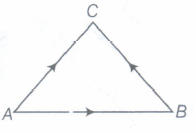
\(\Rightarrow \overrightarrow{A B}+\overrightarrow{B C}+\overrightarrow{C A}=\overrightarrow{C A}+\overrightarrow{A C}\)
\(\Rightarrow \overrightarrow{A B}+\overrightarrow{B C} \mid+\overrightarrow{C A}=\overrightarrow{C A}-\overrightarrow{C A} \quad[\because \overrightarrow{A C}=-\overrightarrow{C A}]\)
\(\therefore \overrightarrow{A B}+\overrightarrow{B C}+\overrightarrow{C A}=\overrightarrow{0}\)
3.
The angle between two planes is the angle between their normals. From the equation of the planes, the normal vectors are
\(\overrightarrow{\mathrm{N}}_{1}=2 \hat{i}+\hat{j}-2 \hat{k} \text { and } \overrightarrow{\mathrm{N}}_{2}=3 \hat{i}-6 \hat{j}-2 \hat{k}\)
\(\text {Therefore } \cos \theta=\left|\frac{\overrightarrow{\mathrm{N}}_{1} \cdot \overrightarrow{\mathrm{N}}_{2}}{\left|\overrightarrow{\mathrm{N}}_{1}\right|\left|\overrightarrow{\mathrm{N}}_{2}\right|}\right|=\left|\frac{(2 \hat{i}+\hat{j}-2 \hat{k}) \cdot(3 \hat{i}-6 \hat{j}-2 \hat{k})}{\sqrt{4+1+4} \sqrt{9+36+4}}\right|=\left(\frac{4}{21}\right)\)
\(\text {Hence }\theta=\cos ^{-1}\left(\frac{4}{21}\right) \)
4.
Let line passing through \((\alpha, \beta, \gamma) \text { be }\)
\(\frac{x-\alpha}{a}=\frac{y-\beta}{b}=\frac{z-\gamma}{c}\)
According to given condition,
\(a l_{1}+b m_{1}+c n_{1}=0\)
\(\text { and } a l_{2}+b m_{2}+c n_{2}=0\)
\(\Rightarrow \frac{a}{m_{1} n_{2}-m_{2} n_{1}}=\frac{-b}{l_{1} n_{2}-l_{2} n_{1}}=\frac{c}{l_{1} m_{2}-l_{2} m_{1}}\)
Substitute in (i)
\(\text { Ans. } \frac{x-\alpha}{m_{1} n_{2}-m_{2} n_{1}}=\frac{y-\beta}{n_{1} l_{2}-n_{2} l_{1}}=\frac{z-\gamma}{l_{1} m_{2}-l_{2} m_{1}} \)
5.
\(\overrightarrow{A B} =(4-3) \hat{i}+(x-2) \hat{j}+(5-1) \hat{k} \)
\(=\hat{i}+(x-2) \hat{j}+4 \hat{k} \)
\(\overrightarrow{A C} =(4-3) \hat{i}+(2-2) \hat{j}+(-2-1) \hat{k}=\hat{i}-3 \hat{k} \)
\(\overrightarrow{A D} =(6-3) \hat{i}+(5-2) \hat{j}+(-1-1) \hat{k} \)
\(=3 \hat{i}+3 \hat{j}+3 \hat{k} \)
If points are coplanar
\({[\overrightarrow{A B} \overrightarrow{A C} \overrightarrow{A D}]=0 \Rightarrow\left|\begin{array}{rrr} 1 & x-2 & 4 \\ 1 & 0 & -3 \\ 3 & 3 & -2 \end{array}\right|=0} \)
\(\Rightarrow 1(9)-(x-2)(7)+4(3)=0 \Rightarrow x=5 \)
6.
\((\overrightarrow { a } -\overrightarrow { d } )\) x \((\overrightarrow { b } -\overrightarrow { c } )\)
\(=\overrightarrow { a } *\overrightarrow { b } -\overrightarrow { a } *\overrightarrow { c } -\overrightarrow { d } *\overrightarrow { b } +\overrightarrow { d } *\overrightarrow { c } \)
\(=\overrightarrow { c } *\overrightarrow { d } -\overrightarrow { b } *\overrightarrow { d } -\overrightarrow { d } *\overrightarrow { b } +\overrightarrow { d } -\overrightarrow { c } \)
\([\because \overrightarrow { a } *\overrightarrow { b } =\overrightarrow { c } -\overrightarrow { d } and\overrightarrow { a } *\overrightarrow { c } =\overrightarrow { b } *\overrightarrow { d } ]\)
\(=\overrightarrow { c } *\overrightarrow { d } -\overrightarrow { b } *\overrightarrow { d } +\overrightarrow { b } *\overrightarrow { d } -\overrightarrow { c } *\overrightarrow { d } =\overrightarrow { 0 } \)
Hence, \((\overrightarrow { a } -\overrightarrow { d } )\) is parallel to \((\overrightarrow { b } -\overrightarrow { c } )\)
7.
Given, \(|\vec{a}|=3 \text { and } \vec{b}=\frac{2}{3}\)
Let \(\theta\) be the angle between \(\vec{a} \text { and } \vec{b}\).
Also, given \(|\vec{a} \times \vec{b}|=1\)
\(\begin{aligned}
|\vec{a}||\vec{b}| \sin \theta=1
\end{aligned}\)
\(\Rightarrow \quad 3 \times \frac{2}{3} \sin \theta=1\)
\(\Rightarrow \quad 2 \sin \theta=1\)
\(\Rightarrow \quad \sin \theta=\frac{1}{2}
\)
\(\Rightarrow \quad \theta=\frac{\pi}{6}\)
8.
Distance of the point (3, - 5, 12) from the x-axis
\(=\sqrt{(-5)^2+(12)^2}=\sqrt{25+144} \)
\(=\sqrt{169}=13 \text { units }\)
9.
Since, the required line is parallel to the line
\(\frac{x+3}{3}=\frac{4-y}{5}=\frac{z+8}{6} \)
or \( \frac{x+3}{3}=\frac{y-4}{-5}=\frac{z+8}{6}
\)
10.
Let Q divides PR in the ratio k: 1.Then, the coordinates of
\(Q \operatorname{are}\left(\frac{9 k+3}{k+1}, \frac{8 k+2}{k+1}, \frac{-10 k-4}{k+1}\right)\)
But it is given that coordinates of Q are (5,4, -6).
\(\therefore \quad \frac{9 k+3}{k+1}=5, \frac{8 k+2}{k+1}=4, \frac{-10 k-4}{k+1}=-6\)
On solving all these equations, we get k = 1/2.
So, Q divides PR in the ratio 1: 2.
11.
\(\overset\rightarrow a \times \overset\rightarrow b\)= \(\left| \begin{matrix} \overset { \wedge }{ i } & \overset { \wedge }{ j } & \overset { \wedge }{ k } \\ 1 & -1 & 2 \\ 2 & -1 & -1 \end{matrix} \right| \)
\(=i(1+2)-j(-1-4)+k(1-2)\)
= 3i + 5j + k
Area of \(\left| \overrightarrow { a } \times \overrightarrow { b } \right| =\sqrt{9+25+1}\)
\(=\sqrt{35} sq.units\)
12.
\(\overset\rightarrow a=x\overset\wedge i+2\overset\wedge j-z\overset\wedge k \)
and \(\overset\rightarrow b=3\overset\wedge i-y\overset\wedge j+\overset\wedge k \)
are equal vectors
So, \(\overset\rightarrow a=\overset\rightarrow b\)
\(\Rightarrow x\overset\wedge i+2\overset\wedge j-z \overset\wedge k=3 \overset\wedge i-y\overset\wedge j+\overset\wedge k\)
\(\therefore \) x = 3 ,y = -2, z = -1
\(\therefore \) x + y + z = 3 - 2 - 1 = 0
13.
(d)
60
14.
(d)
Either \(|\vec{a}|=0 \text { or }|\vec{b}|=0\)
15.
16.
(a)
\(\frac { \sqrt { 3 } }{ 2 } ,0,\frac { 1 }{ 2 } \)
17.
(b)
1/\(\sqrt3\), 1/\(\sqrt3\), 1/\(\sqrt3\)
18.
(c)
All three are mutually perpendicular
19.
(i) (b): The line along which motorcycle A is running, \(\vec{r}=\lambda(\hat{i}+2 \hat{j}-\hat{k})\) is which can be rewritten as \((x \hat{i}+y \hat{j}+z \hat{k})=\lambda \hat{i}+2 \lambda \hat{j}-\lambda \hat{k}\)
\(\Rightarrow x=\lambda, y=2 \lambda, z=-\lambda \Rightarrow \frac{x}{1}=\lambda, \frac{y}{2}=\lambda, \frac{z}{-1}=\lambda\)
Thus, the required cartesian equation is \(\frac{x}{1}=\frac{y}{2}=\frac{z}{-1}\)
(ii) (d): Clearly, D.R:s of the required line are < 1, 2, -1 >
∴ D.Cs are \( <\frac{1}{\sqrt{1^{2}+2^{2}+(-1)^{2}}}, \frac{2}{\sqrt{1^{2}+2^{2}+(-1)^{2}}}, \frac{-1}{\sqrt{1^{2}+2^{2}+(-1)^{2}}}> \)
\(\text { i.e., }<\frac{1}{\sqrt{6}}, \frac{2}{\sqrt{6}}, \frac{-1}{\sqrt{6}}>\)
(iii) (d): The line along which motorcycle B is running, is \(\vec{r}=(3 \hat{i}+3 \hat{j})+\mu(2 \hat{i}+\hat{j}+\hat{k})\), which is parallel to the vector \(2 \hat{i}+\hat{j}+\hat{k}\).
∴ D.R.'s of the required line are < 2, 1, 1 >.
(iv) (d): Here, \(\vec{a}_{1}=0 \hat{i}+0 \hat{j}+0 \hat{k}, \vec{a}_{2}=3 \hat{i}+3 \hat{j}, \vec{b}_{1}=\hat{i}+2 \hat{j}-\hat{k} \vec{b}_{2}=2 \hat{i}+\hat{j}+\hat{k}\)
\(\therefore \vec{a}_{2}-\vec{a}_{1}=3 \hat{i}+3 \hat{j}\)
and \(\vec{b}_{1} \times \vec{b}_{2}=\left|\begin{array}{ccc} \hat{i} & \hat{j} & \hat{k} \\ 1 & 2 & -1 \\ 2 & 1 & 1 \end{array}\right|=3 \hat{i}-3 \hat{j}-3 \hat{k}\)
Now, \(\left(\vec{a}_{2}-\vec{a}_{1}\right) \cdot\left(\vec{b}_{1} \times \vec{b}_{2}\right)=(3 \hat{i}+3 \hat{j}) \cdot(3 \hat{i}-3 \hat{j}-3 \hat{k})\)
= 9 - 9 = 0.
Hence, shortest distance between the given lines is 0.
(v) (c): Since, the point (1, 2, -1) satisfy both the equations of lines, therefore point of intersection of given lines is (1, 2, -1). So, the motorcycles will meet with an accident at the point (1, 2, -1).
20.
Here, \(\left|\vec{F}_{1}\right|=\sqrt{(4)^{2}+0^{2}}=4 \mathrm{KN}\)
\( \left|\vec{F}_{2}\right|=\sqrt{(-2)^{2}+4^{2}}=\sqrt{20} \mathrm{KN} \)
\(\left|\vec{F}_{3}\right|=\sqrt{(-3)^{2}+(-3)^{2}}=\sqrt{18} \mathrm{KN}\)
(i) (a): Since, \(\sqrt 20\) is larger. So, team B will win the game.
(ii) (b): Let F be the combined force
\(\therefore \vec{F}=\vec{F}_{1}+\vec{F}_{2}+\vec{F}_{3}=4 \hat{i}+0 \hat{j}-3 \hat{i}-3 \hat{j}-2 \hat{i}+4 \hat{j} \)
\(=-\hat{i}+\hat{j} \)
\(\therefore |\vec{F}|=\sqrt{(-1)^{2}+1^{2}}=\sqrt{2}=1.4 \mathrm{KN}\)
(iii) (c) : We have, \(\vec{F}=-\hat{i}+\hat{j}\)
\(\therefore \theta=\tan ^{-1}\left(\frac{F_{y}}{F_{x}}\right)=\tan ^{-1}\left(\frac{1}{-1}\right)=\frac{3 \pi}{4} \text { radian }\)
= 0.75 x 3.14 radian = 2.3555 radian ≈ 2.4 radian
(iv) (a): Magnitude of force of Team B = \(\sqrt 20\) KN
= 2\(\sqrt 5\) KN
(v) (b): 4 KN force is applied by team A.
21.
(a) Assertion is correct, Reason is correct; Reason is a correct explanation for assertion.
22.
(a) Assertion is correct, Reason is correct; Reason is a correct explanation for assertion.
23.
Given \(\vec{a} \perp(\vec{b}+\vec{c}), \vec{b} \perp(\vec{c}+\vec{a}), \vec{c} \perp(\vec{a}+\vec{b})\)
and \(|\vec{a}|=3,|\vec{b}|=4,|\vec{c}|=5\)
To prove \(|\vec{a}+\vec{b}+\vec{c}|=5 \sqrt{2}\)
Consider, \(\begin{array}{r} |\vec{a}+\vec{b}+\vec{c}|^2=(\vec{a}+\vec{b}+\vec{c}) \cdot(\vec{a}+\vec{b}+\vec{c}) \end{array}\)
\(\begin{array}{r} {\left[\because|\vec{x}|^2=\vec{x} \cdot \vec{x}\right]} \end{array}\)
\(\begin{aligned} &=\vec{a} \cdot \vec{a}+\vec{a} \cdot \vec{b}+\vec{a} \cdot \vec{c}+\vec{b} \cdot \vec{a}+\vec{b} \cdot \vec{b}+\vec{b} \cdot \vec{c}+\vec{c} \cdot \vec{a}+\vec{c} \cdot \vec{b}+\vec{c} \cdot \vec{c} \end{aligned}\)
\(\begin{aligned} &=|\vec{a}|^2+|\vec{b}|^2+|\vec{c}|^2+\vec{a} \cdot(\vec{b}+\vec{c})+\vec{b} \cdot(\vec{a}+\vec{c})+\vec{c} \cdot(\vec{a}+\vec{b}) \end{aligned}\)
\(=|\vec{a}|^2+|\vec{b}|^2+|\vec{c}|^2+0+0+0\)
\(\left[\begin{array}{l} \because \vec{a} \perp(\vec{b}+\vec{c}) \text {, therefore } \\ \vec{a} \cdot(\vec{b}+\vec{c})=0 \\ \text { Similarly, } \vec{b} \cdot(\vec{a}+\vec{c})=0 \\ \text { and } \vec{c} \cdot(\vec{a}+\vec{b})=0 \end{array}\right]\)
= 32 + 42 + 52 = 9 + 16 + 25 [given]
\(\Rightarrow|\vec{a}+\vec{b}+\vec{c}|^2=50 \Rightarrow|\vec{a}+\vec{b}+\vec{c}|=5 \sqrt{2}\)
[length cannot be '-' ve]
24.
The vector equations of given lines are
\(\begin{aligned}
\vec{r}=3 \hat{i}+2 \hat{j}-4 \hat{k}+\lambda(\hat{i}+2 \hat{j}+2 \hat{k})
\end{aligned}\)
and \(\begin{aligned}
\vec{r}=5 \hat{i}-2 \hat{j}+\mu(3 \hat{i}+2 \hat{j}+6 \hat{k})
\end{aligned}\)
On comparing them with \(\vec{r}=\overrightarrow{a_1}+\lambda \overrightarrow{b_1}\) and \(\vec{r}=\overrightarrow{a_2}+\mu \overrightarrow{b_2}\), we get
\(\overrightarrow{a_1}=3 \hat{i}+2 \hat{j}-4 \hat{k}, \overrightarrow{a_2}=5 \hat{i}-2 \hat{j}, \vec{b}_1=\hat{i}+2 \hat{j}+2 \hat{k}\)
and \(\vec{b}_2=3 \hat{i}+2 \hat{j}+6 \hat{k}\)
\(\therefore \quad \overrightarrow{a_2}-\overrightarrow{a_1}=(5 \hat{i}-2 \hat{j})-(3 \hat{i}+2 \hat{j}-4 \hat{k})\)
\(=2 \hat{i}-4 \hat{j}+4 \hat{k}\)
\(\begin{aligned}
\therefore \quad \vec{b}_1 \times \vec{b}_2 & =\left|\begin{array}{lll}
\hat{i} & \hat{j} & \hat{k} \\
1 & 2 & 2 \\
3 & 2 & 6
\end{array}\right|
\end{aligned}\)
\(\begin{aligned}
=\hat{i}(12-4)-\hat{j}(6-6)+\hat{k}(2-6)
\end{aligned}\)
\(\begin{aligned}
=8 \hat{i}-4 \hat{k}
\end{aligned}\)
\(\therefore\left(\vec{a}_2-\vec{a}_1\right) \cdot\left(\vec{b}_1 \times \vec{b}_2\right)=(2 \hat{i}-4 \hat{j}+4 \hat{k}) \cdot(8 \hat{i}-4 \hat{k})\)
= 16 + 0 - 16 = 0
\(\therefore\) The lines are intersecting and the shortest distance between the lines is 0.
Now, the position vectors of arbitrary points on the given lines are \((3+\lambda) \hat{i}+(2+2 \lambda) \hat{j}+(-4+2 \lambda) \hat{k}\) and \((5+3 \mu) \hat{i}+(-2+2 \mu) \hat{j}+6 \mu \hat{k}\), respectively.
Since, lines intersect then they have a common point.
\(\therefore \begin{aligned}
3+\lambda & =5+3 \mu
\end{aligned}\) ...(i)
\(\begin{aligned}
2+2 \lambda & =-2+2 \mu
\end{aligned}\) ...(ii)
\(\begin{aligned}
-4+2 \lambda & =6 \mu
\end{aligned}\) ...(iii)
On solving Eqs. (i) and (ii), we get
\(\lambda=-4 \text { and } \mu=-2\)
\(\therefore\) Point of intersection is (3 - 4, 2 - 8, -4 - 8)
i.e. (-1, -6, -12).

12th Standard CBSE Syllabus & Materials
12th Standard CBSE
CBSE 12th Computer Science Python Revision Tour I - New Previous year Question Papers Study Material - QB365 Set A
NEW12th Standard CBSE
CBSE 12th Business Studies Planning Important Questions And Answers Study Material - QB365 Set A
NEW12th Standard CBSE
CBSE 12th Business Studies Business Environment Important Questions And Answers Study Material - QB365 Set A
NEW12th Standard CBSE
CBSE 12th Business Studies Principles of Management Important Questions And Answers Study Material - QB365 Set A



NCERT Books

Syllabus

Exam Pattern

Sample Question Papers

Previous year Question Papers

Important Notes

MCQ Practice test

NCERT Exemplers

Case study Questions

Image Based Questions

Passage based Questions

HOT Questions

Value Based Questions

Model Questions Papers
NCERT ( Book Back ) Questions

Assertion and Reason
Important Questions And Answers

CBSE 12th Standard CBSE Subjects
CBSE Standards








