
 100% FREE ACCESS
12th Standard CBSE Syllabus & Materials
12th Standard CBSE
CBSE 12th Economics Government Budget and the Economy Previous year Question Papers Study Material - QB365 Set A
NEW12th Standard CBSE
CBSE 12th Computer Science Interface Python with MySQL - New Previous year Question Papers Study Material - QB365 Set A
NEW12th Standard CBSE
CBSE 12th Computer Science Database Concept - New Previous year Question Papers Study Material - QB365 Set A
NEW12th Standard CBSE
CBSE 12th Computer Science Data Communication - New Previous year Question Papers Study Material - QB365 Set A
NEW12th Standard CBSE
CBSE 12th Computer Science Data Structures - New Previous year Question Papers Study Material - QB365 Set A
NEW12th Standard CBSE
CBSE 12th Computer Science Functions - New Previous year Question Papers Study Material - QB365 Set A

Published on: 25/10/2025
Download CBSE Class 12th Standard CBSE Maths question papers, sample papers, important questions, and previous year solved papers in PDF format. Get free study materials, NCERT solutions, and exam preparation resources for Class 12th Standard CBSE Maths
Questions + Answers key
Take MCQ Maths Test
1.
Compute the magnitude of the following vectors:
\(\vec{a}=\hat{i}+\hat{j}+k ; \quad \vec{b}=2 \hat{i}-7 \hat{j}-3 \hat{k} ; \quad \vec{c}=\frac{1}{\sqrt{3}} \hat{i}+\frac{1}{\sqrt{3}} \hat{j}-\frac{1}{\sqrt{3}} \hat{k}\)
2.
Classify the following measure as scalar and vector:
(i) 10 kg
(ii) 2 meters north-east
(iii) 40°
(iv) 40 watt
(v) 10-19 coulombus
(vi) 20m/s2.
3.
Find the scalar and vector components of the vector with initial point (2, 1) and terminal point (-5, 7).
4.
Let \(\overrightarrow { a } =\hat { i } +4\hat { j } +2\hat { k } ,\overrightarrow { b } =3\hat { i } -2\hat { j } +7\hat { k } \) and \(\overrightarrow { c } =2\hat { i } -\hat { j } +4\hat { k } ,\) find a vector \(\overrightarrow { d } \) which is perpendicular to both \(\overrightarrow { a } \quad and\quad \overrightarrow { b } \quad and\quad \overrightarrow { c } .\overrightarrow { d } =15\)
5.
Find the position vector of a point R which divides the line joining two points P and Q whose position vectors are (\(2\overrightarrow { a } +\overrightarrow { b } \)) and (\(\overrightarrow { a } -3\overrightarrow { b } \)) externally in the ratio 1:2 Also,show that P is the mid point of the line segment RQ.
6.
The scalar product of the vector \(\hat { i } +\hat { j } +\hat { k } \) with the unit vector along the sum of vectors \(2\hat { i } +4\hat { j } -5\hat { k } \quad and\quad \lambda \hat { i } +2\hat { j } +3\hat { k } \) is equal to one. Find the value of \(\lambda\)
7.
If \(\hat { i } +\hat { j } +\hat { k } ,2\hat { i } +5\hat { j } ,3\hat { i } +2\hat { j } -3\hat { k } \ and\ \hat { i } -6\hat { j } -\hat { k } \) respectively, are the position vectors of the points A, B, C and D, then find the angle between the straight lines AB and CD. Find whether \(\overrightarrow { AB } \) and \( \overrightarrow { CD } \) are collinear or not.
8.
If the vertices A, B, C of a \(\Delta ABC\) have position vectors (1, 2, 3), (-1, 0, 0) and (0, 1, 2) respectively, what is the magnitude of \(\angle ABC\)?
9.
Area of a rectangle having vertices A, B, C and D with position vectors \(-\widehat { i } +\frac { 1 }{ 2 } \widehat { j } +4\widehat { k } \), \(\widehat { i } +\frac { 1 }{ 2 } \widehat { j } +4\widehat { k } \), \(\widehat { i } -\frac { 1 }{ 2 } \widehat { j } +4\widehat { k } \) and \(-\widehat { i } -\frac { 1 }{ 2 } \widehat { j } +4\widehat { k } \), respectively is
\(\frac12\)
1
2
4
10.
If is \(\overrightarrow { a } \) nonzero vector of magnitude ‘a’ and λ a nonzero scalar, then \(\overrightarrow { a } \)λ is unit vector if
λ = 1
λ = -1
a = |λ|
a = I/|λ|
11.
If \(\overrightarrow { a } \) are \(\overrightarrow { b } \) two collinear vectors, then which of the following are incorrect:
\(\overrightarrow { b } \) = \(\lambda \overrightarrow { a } \)for some scalar λ
\(\overrightarrow { a } \) 土 \(\overrightarrow { b } \)
the respective components of \(\overrightarrow { a } \) and \(\overrightarrow { b } \) are not proportional
both the vectors \(\overrightarrow { a } \) and \(\overrightarrow { b } \) have same direction, but different magnitudes
12.
In triangle ABC Fig which of the following is not true:
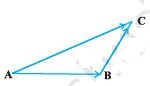
\(\overrightarrow { AB } +\overrightarrow { BC } +\overrightarrow { CA } =\overrightarrow { 0 } \)
\(\overrightarrow { AB } +\overrightarrow { BC } -\overrightarrow { AC } =\overrightarrow { 0 } \)
\(\overrightarrow { AB } +\overrightarrow { BC } -\overrightarrow { AC } =\overrightarrow { 0 } \)
\(\overrightarrow { AB } -\overrightarrow { CB } +\overrightarrow { CA } =\overrightarrow { 0 } \)
13.
Let the vectors \(\vec{a} \text { and } \vec{b} \text { be such that }|a| \overrightarrow{=} 3 \text { and } \overrightarrow{|b|}=\frac{\sqrt{2}}{3} \text { then } \vec{a} \times \vec{b}\) is a unit is a vector, if the angle between is:
\(\frac { \pi }{ 6 } \)
\(\frac { \pi }{ 4 } \)
\(\frac { \pi }{ 3 } \)
\(\frac { \pi }{ 2 } \)
14.
Ginni purchased an air plant holder which is in the shape of a tetrahedron.
Let A, B, C and D are the coordinates of the air plant holder where A \(\equiv \) (1, 1, 1), B \(\equiv \) (2, 1, 3), C \(\equiv \) (3, 2, 2) and D \(\equiv \)(3, 3, 4).
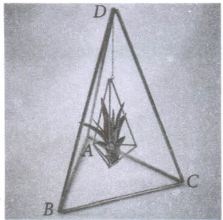
Based on the above information, answer the following questions.
(i) Find the position vector of \(\overrightarrow{A B} \).
| (a) \(-\hat{i}-2 \hat{k}\) | (b) \(2 \hat{i}+\hat{k}\) | (c) \(\hat{i}+2 \hat{k}\) | (d)\(-2 \hat{i}-\hat{k}\) |
(ii) Find the position vector of \(\overrightarrow{A C} \).
| (a) \(2 \hat{i}-\hat{j}-\hat{k}\) | (b) \(2 \hat{i}+\hat{j}+\hat{k}\) | (c) \(-2 \hat{i}-\hat{j}+\hat{k}\) | (d) \(\hat{i}+2 \hat{j}+\hat{k}\) |
(iii) Find the position vector of \(\overrightarrow{AD} .\).
| (a) \( 2 \hat{i}-2 \hat{j}-3 \hat{k}\) | (b) \( \hat{i}+\hat{j}-3 \hat{k}\) | (c) \(3 \hat{i}+2 \hat{j}+2 \hat{k}\) | (d) \(2\hat{i}+2 \hat{j}+3 \hat{k}\) |
(iv) Area of \(\Delta A B C\) =
| (a) \(\frac{\sqrt{11}}{2} \mathrm{sq .units}\) | (b) \(\frac{\sqrt{14}}{2} sq. units\) | (c) \(\frac{\sqrt{13}}{2}\) | (d)\(\frac{\sqrt{17}}{2} \mathrm{sq .units}\) |
(v) Find the unit vector along \(\overrightarrow{AD} .\)
| (a) \(\frac{1}{\sqrt{17}}(2 \hat{i}+2 \hat{j}+3 \hat{k})\) | (b)\(\frac{1}{\sqrt{17}}(3 \hat{i}+3 \hat{j}+2 \hat{k})\) | (c) \(\frac{1}{\sqrt{11}}(2 \hat{i}+2 \hat{j}+3 \hat{k})\) | (d) \((2 \hat{i}+2 \hat{j}+3 \hat{k})\) |
15.
Ritika starts walking from his house to shopping mall. Instead of going to the mall directly, she first goes to a ATM, from there to her daughter's school and then reaches the mall. In the diagram, A, B, C and D represent the coordinates of House, ATM, School and Mall respectively.
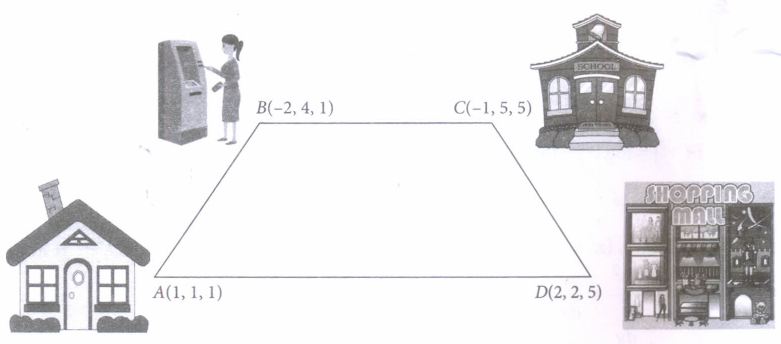
Based on the above information, answer the following questions.
(i) Distance between House (A) and ATM (B) is
| (a) 3 units | (b) 3\(\sqrt 2\) units | (c) \(\sqrt 2\)units | (d) 4\(\sqrt 2\) units |
(ii) Distance between ATM (B) and School (C) is
| (a) \(\sqrt 2\) units | (b) 2\(\sqrt 2\) units | (c) 3\(\sqrt 2\) units | (d) 4\(\sqrt 2\) units |
(iii) Distance. between School (C) and Shopping mall (D) is
| a) 3\(\sqrt 2\) units | (b) 5\(\sqrt 2\) units | (c) 7\(\sqrt 2\) units | (d) 10\(\sqrt 2\) units |
(iv) What is the total distance travelled by Ritika ?
| a) 4\(\sqrt 2\) units | (b) 6\(\sqrt 2\) units | (c) 8\(\sqrt 2\) units | (d) 9\(\sqrt 2\) units |
(v) What is the extra distance travelled by Ritika in reaching the shopping mall?
| a) 3\(\sqrt 2\) units | (b) 5\(\sqrt 2\) units | (c) 6\(\sqrt 2\) units | (d) 7\(\sqrt 2\) units |
16.
Write the projection of the vector \((\vec{b}+\vec{c})\) on the vector \(\vec{a} \text {, where } \vec{a}=2 \hat{i}-2 \hat{j}+\hat{k}, \vec{b}=\hat{i}+2 \hat{j}-2 \hat{k}\) and \(\vec{c}=2 \hat{i}-\hat{j}+4 \hat{k}\)
17.
In which of the vectors are:
(i) Collinear
(ii) Equal
(iii) Coinitial
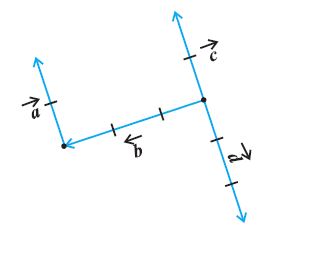
18.
Classify the following measures as scalars and vectors.
(i) 5 seconds
(ii) 1000 cm3
(iii) 10 Newton
(iv) 30 km/hr
(v) 10 g/cm3
(vi) 20 m/s towards north
19.
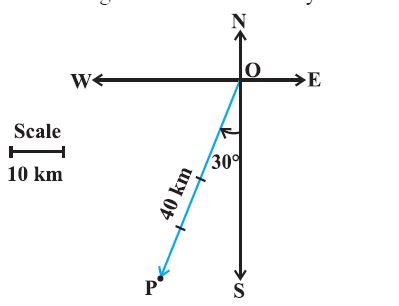
Represent graphically a displacement of 40 km, 30° west of south.
20.
Let the vectors \(\vec{a}, \vec{b}, \vec{c}\) be given as \(a_1 \hat{i}+a_2 \hat{j}+a_3 \hat{k}, b_1 \hat{i}+b_2 \hat{j}+b_3 \hat{k},\) \(c_1 \hat{i}+c_2 \hat{j}+c_3 \hat{k}\). Then show that \(\vec{a} \times(\vec{b}+\vec{c})=\vec{a} \times \vec{b}+\vec{a} \times \vec{c} .\)
1.
The given vectors are:
\(\vec{a} =\hat{i}+\hat{j}+\hat{k} ; \quad \vec{b}=2 \hat{i}-7 \hat{j}-3 \hat{k} ; \quad \vec{c}=\frac{1}{\sqrt{3}} \hat{i}+\frac{1}{\sqrt{3}} \hat{j}-\frac{1}{\sqrt{3}} \hat{k} \)
\(|\vec{a}| =\sqrt{(1)^{2}+(1)^{2}+(1)^{2}}=\sqrt{3} \)
\(|\vec{b}| =\sqrt{(2)^{2}+(-7)^{2}+(-3)^{2}} \)
\(=\sqrt{4+49+9}\)
\(=\sqrt{62} \)
\(|\vec{c}| =\sqrt{\left(\frac{1}{\sqrt{3}}\right)^{2}+\left(\frac{1}{\sqrt{3}}\right)^{2}+\left(-\frac{1}{\sqrt{3}}\right)^{2}} \)
\(=\sqrt{\frac{1}{3}+\frac{1}{3}+\frac{1}{3}}=1 \)
2.
(i) Scalar
(ii) Scalar
(iii) Scalar
(iv) Vector
(v) Scalar
(vi) vector
3.
The vector with the initial point P(2, 1) and terminal point Q(-5, 7) can be given by \(\)
\(\overrightarrow{\mathrm{PQ}}=(-5-2) \hat{i}+(7-1) \hat{j} \)
\(\Rightarrow \overrightarrow{\mathrm{PQ}}=-7 \hat{i}+6 \hat{j} \)
Hence, the required scalar components are -7 and 6 while the vector components are -7 \( \hat{i}+6 \hat{j} \)
4.
Let \(\overset { \rightarrow }{ d } =x\overset { \wedge }{ i } +y\overset { \wedge }{ j } +z\overset { \wedge }{ k } \) ..(1)
Now \(\overset { \rightarrow }{ d } \) is perp.to \(\overset { \rightarrow }{ a } \)
\(\therefore\) \(\overset { \rightarrow }{ d } \).\(\overset { \rightarrow }{ a } \) = 0
\(\Rightarrow (x\overset { \wedge }{ i } +y\overset { \wedge }{ j } +z\overset { \wedge }{ k } ).(\overset { \wedge }{ i } +4\overset { \wedge }{ j } +2\overset { \wedge }{ k } )=0\) ...(2)
\(\Rightarrow x+4y+2z=0\)
and \(\overset { \rightarrow }{ d } \) is prep.to \(\overset { \rightarrow }{ b } \)
\(\therefore\) \(\overset { \rightarrow }{ d } \).\(\overset { \rightarrow }{ b } \) = 0
\(\therefore(\hat{i} \hat{i}+\hat{j}+z \hat{k}) \cdot(3 \hat{i}-2 \hat{j}+7 \hat{k})=0\)
\(\Rightarrow\) 3x - 2y + 7z = 0..(3)
Also \(\overset { \rightarrow }{ c } \).\(\overset { \rightarrow }{ d } \) = 15
\(\Rightarrow\) \((2\overset { \wedge }{ i } -\overset { \wedge }{ j } +4\overset { \wedge }{ k } ).(x\overset { \wedge }{ i } +y\overset { \wedge }{ j } +z\overset { \wedge }{ k } )=15\)
2x - y + 4z = 15 ......(4)
(3)-3(2) gives: -14y + z = 0 ..(5)
(4)-2(2) gives : -9y = 15 ....(6)
from (6). y = -\(\frac { 5 }{ 3 } \)
putting in (5), -14(\(\frac {- 5 }{ 3 } \)) + z = 0
\(\Rightarrow\) z = -\(\frac {- 70 }{ 3 } \)
Putting in (2), \(x -\frac {- 20 }{ 3 } -\frac {140}{3}=0 \rightarrow x =\frac {160}{3}\)
putting in (1)
\(\vec{d} =\frac{160}{3} \hat{i}-\frac{5}{3} \hat{j}-\frac{70}{8} \hat{k} \)
\(=\frac{5}{3}(32 \hat{i}-\hat{j}-14 \hat{k}) \)
5.
\(3 \vec{a}+5 \vec{b}\)
6.
Let \(\hat{a}=\hat{i}+\hat{j}+\hat{k} \)
\(\hat{b}=2 \hat{i}+4 \hat{j}-5 \hat{k} \)
and \(\hat{c}=\lambda \hat{i}+2 \hat{j}+3 \hat{k}\)
now the unit vector along \(\overset { \wedge }{ b } +\overset { \wedge }{ c } \)
\(=\frac { (\lambda +2)\overset { \wedge }{ i } +6\overset { \wedge }{ j } -2\overset { \wedge }{ k } }{ \sqrt { { (\lambda +2) }^{ 2 } } +36+4 } \)
By the question
(\(\hat { i } +\hat { j } +\hat { k } \)).\(=\frac { (\lambda +2)\overset { \wedge }{ i } +6\overset { \wedge }{ j } -2\overset { \wedge }{ k } }{ \sqrt { { (\lambda +2) }^{ 2 } } +40 } \) =1
\(=\frac { 1 }{ \sqrt { { (\lambda +2) }^{ 2 } } +40 } (\lambda +2+6)= 6\)
\(\Rightarrow \lambda +6=\sqrt { { (\lambda +2) }^{ 2 }+40 } \)
Squaring, \({ \lambda }^{ 2 }+12\lambda +36\)
\(={ \lambda }^{ 2 }+4\lambda +4+40\)
\(\Rightarrow 12\lambda +36=4\lambda +44\)
\(\Rightarrow 8\lambda =8\)
\(Hence\ \lambda =1\)
7.
Given \(\overrightarrow{O A}=(\hat{i}+\hat{j}+\hat{k}), \overrightarrow{O B}=(2 \hat{i}+5 \hat{j})\)
\(\overrightarrow{O C}=(3 \hat{i}+2 \hat{j}-3 \hat{k}) \text { and } \overrightarrow{O D}=(\hat{i}-6 \hat{j}-\hat{k})\)
Angle between \(\overrightarrow{A B} \text { and } \overrightarrow{C D}\) is given by
\(\cos \theta=\frac{\overrightarrow{A B} \cdot \overrightarrow{C D}}{|\overrightarrow{A B}| \cdot|\overrightarrow{C D}|}\) ...(i)
Here, \(\begin{aligned}
\overrightarrow{A B} & =(2-1) \hat{i}+(5-1) \hat{j}+(0-1) \hat{k}
\end{aligned}\)
\(\begin{aligned}
=\hat{i}+4 \hat{j}-\hat{k}
\end{aligned}\),
\(\begin{aligned}
\overrightarrow{C D} & =(1-3) \hat{i}+(-6-2) \hat{j}+\{-1-(-3)\} \hat{k}
\end{aligned}\)
\(\begin{aligned}
=-2 \hat{i}-8 \hat{j}+2 \hat{k}
\end{aligned}\)
\(\begin{aligned}
|\overrightarrow{A B}|=\sqrt{1^2+4^2+(-1)^2}=\sqrt{18}=\sqrt{9 \times 2}=3 \sqrt{2}
\end{aligned}\)
and \(\begin{aligned}
|\overrightarrow{C D}|=\sqrt{(-2)^2+(-8)^2+2^2}
\end{aligned}\)
\(=\sqrt{72}=\sqrt{36 \times 2}=6 \sqrt{2}\)
Now, \(\cos \theta=\frac{(\hat{i}+4 \hat{j}-\hat{k}) \cdot(-2 \hat{i}-8 \hat{j}+2 \hat{k})}{3 \sqrt{2} \times 6 \sqrt{2}}\)
[from Eq. (i)]
\(=\frac{1(-2)+4(-8)+(-1)(2)}{3 \times 6 \times 2}=-1\)
\(\cos \theta=-1 \Rightarrow \theta=180^{\circ}=\pi\)
So, angle between \(\overrightarrow{A B} \text { and } \overrightarrow{C D}\) is \(\pi\).
Also, since angle between \(\overrightarrow{A B} \text { and } \overrightarrow{C D}\) is 180°, they are in opposite directions.
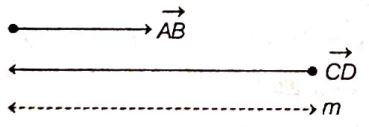
Since, \(\overrightarrow{A B} \text { and } \overrightarrow{C D}\) are parallel to the same line m, they are collinear.
8.
The vertices of △ABC are given as A(1, 2, 3), B(−1, 0, 0), and C(0, 1, 2) .
Also, it is aiven that \( \square \mathrm{ABC} \text { is the anale between the vectors } \overrightarrow{\mathrm{BA}} \text { and } \overrightarrow{\mathrm{BC}}\)
\(\overrightarrow{\mathrm{BA}}=\{1-(-1)\} \hat{i}+(2-0) \hat{j}+(3-0) \hat{k}=2 \hat{i}+2 \hat{j}+3 \hat{k} \)
\(\overrightarrow{\mathrm{BC}}=\{0-(-1)\} \hat{i}+(1-0) \hat{j}+(2-0) \hat{k}=\hat{i}+\hat{j}+2 \hat{k} \)
\(\therefore \overrightarrow{\mathrm{BA}} \cdot \overrightarrow{\mathrm{BC}}=(2 \hat{i}+2 \hat{j}+3 \hat{k}) \cdot(\hat{i}+\hat{j}+2 \hat{k})=2 \times 1+2 \times 1+3 \times 2=2+2+6=10 \)
\(|\overrightarrow{\mathrm{BA}}|=\sqrt{2^{2}+2^{2}+3^{2}}=\sqrt{4+4+9}=\sqrt{17} \)
\(|\overrightarrow{\mathrm{BC}}|=\sqrt{1+1+2^{2}}=\sqrt{6} \)
Now, it is known that:
\(\overrightarrow{\mathrm{BA}} \cdot \overrightarrow{\mathrm{BC}}=|\overrightarrow{\mathrm{BA}} \| \overrightarrow{\mathrm{BC}}| \cos (\angle \mathrm{ABC}) \)
\(\therefore 10=\sqrt{17} \times \sqrt{6} \cos (\angle \mathrm{ABC}) \)
\(\Rightarrow \cos (\angle \mathrm{ABC})=\frac{10}{\sqrt{17} \times \sqrt{6}} \)
\(\Rightarrow \angle \mathrm{ABC}=\cos ^{-1}\left(\frac{10}{\sqrt{102}}\right) \)
9.
(c)
2
10.
(d)
a = I/|λ|
11.
(a)
\(\overrightarrow { b } \) = \(\lambda \overrightarrow { a } \)for some scalar λ
12.
(c)
\(\overrightarrow { AB } +\overrightarrow { BC } -\overrightarrow { AC } =\overrightarrow { 0 } \)
13.
(b)
\(\frac { \pi }{ 4 } \)
14.
(i) (c): Position vector of \(\overrightarrow{A B} \)
\(=(2-1) \hat{i} \dot{+}(1-1) \hat{j}+(3-1) \hat{k}=\hat{i}+2 \hat{k}\)
(ii) (b): Position vector of \(\overrightarrow{A C} \)
\(=(3-1) \hat{i}+(2-1) \hat{j}+(2-1) \hat{k}=2 \hat{i}+\hat{j}+\hat{k}\)
(iii) (d): Position vector of \(\overrightarrow{AD} \)
\(=(3-1) \hat{i}+(3-1) \hat{j}+(4-1) \hat{k}=2 \hat{i}+2 \hat{j}+3 \hat{k}\)
(iv) (b): Area of \(\Delta A B C\) = \(\frac{1}{2}|\overrightarrow{A B} \times \overrightarrow{A C}|\)
\(\overrightarrow{A B} \times \overrightarrow{A C}=\left|\begin{array}{lll} \hat{i} & \hat{j} & \hat{k} \\ 1 & 0 & 2 \\ 2 & 1 & 1 \end{array}\right|=\hat{i}(0-2)-\hat{j}(1-4)+\hat{k}(1-0)\)
\(=-2 \hat{i}+3 \hat{j}+\hat{k}\)
\( \Rightarrow |\overrightarrow{A B} \times \overrightarrow{A C}| =\sqrt{(-2)^{2}+3^{2}+1^{2}} \)
\(=\sqrt{4+9+1}=\sqrt{14}\)
Area of \(\Delta A B C\) \(=\frac{1}{2} \sqrt{14} \text { sq. units }\)
(v) (a): Unit vector along \(\overrightarrow{A D}=\frac{\overrightarrow{A D}}{|\overrightarrow{A D}|}\)
\(=\frac{2 \hat{i}+2 \hat{j}+3 k}{\sqrt{2^{2}+2^{2}+3^{2}}}=\frac{2 \hat{i}+2 \hat{j}+3 \hat{k}}{\sqrt{4+4+9}}=\frac{1}{\sqrt{17}}(2 \hat{i}+2 \hat{j}+3 \hat{k})\)
15.
(i) (b) : \(\overrightarrow{A B}=(-2 \hat{i}+4 \hat{j}+\hat{k})-(\hat{i}+\hat{j}+\hat{k})=-3 \hat{i}+3 \hat{j}\)
\(\therefore \overrightarrow{A B}=\sqrt{(-3)^{2}+3^{2}}=\sqrt{9+9}=\sqrt{18}=3 \sqrt{2}\)
Distance between House (A) and ATM (B) is 3\(\sqrt 2\) units.
(ii) (c): \(\overrightarrow{B C}=(-\hat{i}+5 \hat{j}+5 \hat{k})-(-2 \hat{i}+4 \hat{j}+\hat{k})=\hat{i}+\hat{j}+4 \hat{k}\)
\( \therefore |\overrightarrow{B C}| =\sqrt{1^{2}+1^{2}+4^{2}}=\sqrt{1+1+16} \)
\(=\sqrt{18}=3 \sqrt{2}\)
Distance between ATM (B) and School (C) is 3\(\sqrt 2\) units.
(iii) (a): \(\overrightarrow{C D}=(2 \hat{i}+2 \hat{j}+5 \hat{k})-(-\hat{i}+5 \hat{j}+5 \hat{k})=3 \hat{i}-3 \hat{j}\)
\(\therefore |\overrightarrow{C D}|=\sqrt{3^{2}+(-3)^{2}}=\sqrt{9+9}=3 \sqrt{2}\)
Distance between School (C) and Shopping mall (D) is 3\(\sqrt 2\) units.
(iv) (d): Total distance travelled by Ritika
\( =|\overrightarrow{A B}|+|\overrightarrow{B C}|+|\overrightarrow{C D}|=(3 \sqrt{2}+3 \sqrt{2}+3 \sqrt{2}) \text { units } \)
\(=9 \sqrt{2} \text { units }\)
(v) (c): Distance between house and shopping mall is \(|\overrightarrow{A D}|\)
Now, \(\overrightarrow{A D}=\hat{i}+\hat{j}+4 \hat{k}\)
\(\therefore|\overrightarrow{A D}|=\sqrt{1^{2}+1^{2}+4^{2}}=\sqrt{1+1+16}=\sqrt{18}=3 \sqrt{2}\)
Thus, extra distance travelled by Ritika in reaching shopping mall = \((9 \sqrt{2}-3 \sqrt{2})\) units = \(6 \sqrt{2} \) units.
16.
To find projection of \((\vec{b}+\vec{c}) \text { on } \vec{a}\)
Given, \(\vec{a}=2 \hat{i}-2 \hat{j}+\hat{k}, \vec{b}=\hat{i}+2 \hat{j}-2 \hat{k}\)
and \(\vec{c}=2 \hat{i}-\hat{j}+4 \hat{k}\)
Consider, \(\begin{aligned}
(\vec{b}+\vec{c}) & =(\hat{i}+2 \hat{j}-2 \hat{k})+(2 \hat{i}-\hat{j}+4 \hat{k})
\end{aligned}\)
\(\begin{aligned}
=3 \hat{i}+\hat{j}+2 \hat{k}
\end{aligned}\)
Now, the projection of \(\vec{b}+\vec{c} \text { on } \vec{a}\) is given by
\(\begin{aligned}
\frac{(\vec{b}+\vec{c}) \vec{a}}{|\vec{a}|}=\frac{(3 \hat{i}+\hat{j}+2 \hat{k})(2 \hat{i}-2 \hat{j}+\hat{k})}{\sqrt{2^2+(-2)^2+1^2}}
\end{aligned}\)
\(\begin{aligned}
\frac{6-2+2}{\sqrt{4+4+1}}=\frac{6}{\sqrt{9}}=\frac{6}{3}=2
\end{aligned}\)
17.
(i) Collinear vectors : \(\vec{a}, \vec{c} \text { and } \vec{d}\)
(ii) Equal vectors : \(\vec{a} \text { and } \vec{c} \text { . }\)
(iii) Coinitial vectors : \(\vec{b}, \vec{c} \text { and } \vec{d}\)
18.
(i) Time-scalar
(ii) Volume-scalar
(iii) Force-vector
(iv) Speed-scalar
(v) Density-scalar
(vi) Velocity-vector
19.
The vector \(\overrightarrow{\mathrm{OP}}\) represents the required displacement
20.

12th Standard CBSE Syllabus & Materials
12th Standard CBSE
CBSE 12th Computer Science Python Revision Tour I - New Previous year Question Papers Study Material - QB365 Set A
NEW12th Standard CBSE
CBSE 12th Business Studies Planning Important Questions And Answers Study Material - QB365 Set A
NEW12th Standard CBSE
CBSE 12th Business Studies Business Environment Important Questions And Answers Study Material - QB365 Set A
NEW12th Standard CBSE
CBSE 12th Business Studies Principles of Management Important Questions And Answers Study Material - QB365 Set A



NCERT Books

Syllabus

Exam Pattern

Sample Question Papers

Previous year Question Papers

Important Notes

MCQ Practice test

NCERT Exemplers

Case study Questions

Image Based Questions

Passage based Questions

HOT Questions

Value Based Questions

Model Questions Papers
NCERT ( Book Back ) Questions

Assertion and Reason
Important Questions And Answers

CBSE 12th Standard CBSE Subjects
CBSE Standards








