
 100% FREE ACCESS
12th Standard CBSE Syllabus & Materials
12th Standard CBSE
CBSE 12th Economics Government Budget and the Economy Previous year Question Papers Study Material - QB365 Set A
NEW12th Standard CBSE
CBSE 12th Computer Science Interface Python with MySQL - New Previous year Question Papers Study Material - QB365 Set A
NEW12th Standard CBSE
CBSE 12th Computer Science Database Concept - New Previous year Question Papers Study Material - QB365 Set A
NEW12th Standard CBSE
CBSE 12th Computer Science Data Communication - New Previous year Question Papers Study Material - QB365 Set A
NEW12th Standard CBSE
CBSE 12th Computer Science Data Structures - New Previous year Question Papers Study Material - QB365 Set A
NEW12th Standard CBSE
CBSE 12th Computer Science Functions - New Previous year Question Papers Study Material - QB365 Set A

Published on: 25/10/2025
Download CBSE Class 12th Standard CBSE Maths question papers, sample papers, important questions, and previous year solved papers in PDF format. Get free study materials, NCERT solutions, and exam preparation resources for Class 12th Standard CBSE Maths
Questions + Answers key
Take MCQ Maths Test
1.
If \(\vec{a}=\hat{i}+\hat{j}+\hat{k}, \vec{b}=2 \hat{i}-\hat{j}+3 \hat{k}\) and \(\vec{c}=\hat{i}-2 \hat{j}+\hat{k}\), find a unit vector parallel to the vector \(2 \vec{a}-\vec{b}+3 \vec{c}\)
2.
Find the angle between the line \(\vec{r}=(-\hat{i}+3 \hat{k})+\lambda(2 \hat{i}+3 \hat{j}+6 \hat{k})\) and plane \(\vec{r} \cdot(10 \hat{i}+2 \hat{j}-11 \hat{k})=3\).
3.
Solve the following Linear Programming Problem graphically:
Minimise Z = – 3x + 4 y
subject to constraints
\(x+2 y \leq 8,3 x+2 y \leq 12\)
and \(x, y \geq 0 \text {. }\)
4.
Find the angle between the lines whose direction ratios are a, b, c and b – c, c – a, a – b.
5.
In a school, there are 1000 students, out of which 430 are girls. It is known that out of 430, 10% of the girls study in class XII. What is the probability that a student chosen randomly studies in Class XII given that the chosen student is a girl?
6.
12 cards, numbered 1 to 12, are placed in box mixed up thoroughly and then a card is drawn at random from the box. If it is known that the number on the drawn card is more than 3, find the probability that it is an even number.
7.
An urn contains 6 balls of which two are red and four are black. Two balls are drawn at random. Probability that they are of the different colours is
\(\frac{2}{5}\)
\(\frac{1}{15}\)
\(\frac{8}{15}\)
\(\frac{4}{15}\)
8.
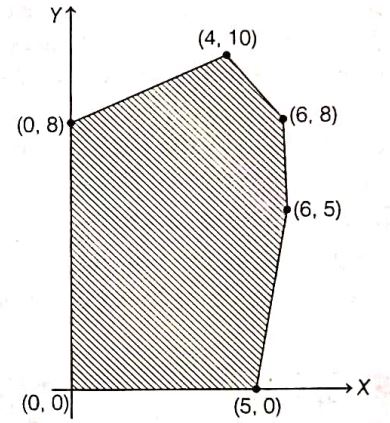
In the given graph, the feasible region for a LPP is shaded. The objective function Z = 2x - 3y will be minimum at
(4, 10)
(6, 8)
(0, 8)
(6, 5)
9.
The corner points of the feasible region of linear programming problem are (0, 4), (8,0) and \(\left(\frac{20}{4}, \frac{4}{3}\right)\) If Z = 30x + 24y is the objective function, then (Maximum value of Z- Minimum value of Z) is equal to
144
96
120
136
10.
The Cartesian equation of the line passing through the point (1, - 3, 2) and parallel to the line \(\vec{r}=(2+\lambda) \hat{i}+\lambda \hat{j}+(2 \lambda-1) \hat{k}\) is
\(\frac{x-1}{2}=\frac{y+3}{0}=\frac{z-2}{-1}\)
\(\frac{x+1}{1}=\frac{y-3}{1}=\frac{z+2}{2}\)
\(\frac{x+1}{2}=\frac{y-3}{0}=\frac{z+2}{-1}\)
\(\frac{x-1}{1}=\frac{y+3}{1}=\frac{z-2}{2}\)
11.
Direction ratios of the line \(\frac{4-x}{2}=\frac{y}{6}=\frac{1-z}{3} \text { are }\)
2,6,3
-2,6,3
2, - 6, 3
none of these
12.
IfA and B are two events such that \(A \subset B\) and \(P(B) \neq 0\), then which of the following is correct?
\(P\left(\frac{B}{A}\right)=\frac{P(A)}{P(B)}\)
\(P\left(\frac{A}{B}\right)
\(P\left(\frac{A}{B}\right) \geq P(A)\)
None of these
13.
In which of the following problem(s), linear programming can be used
manufacturing problems
diet problems
transportation problems
All of these
14.
The equation of X -axis in space is
x = 0, y = 0
x = 0, z = 0
x = 0
y = 0, z = 0
15.
If \(\vec{a} \cdot \vec{b}=0 \text { and } \vec{a} \times \vec{b}=0\), then
\(|\vec{a}|=0\)
\(|\vec{b}|=0\)
Both (a) and (b) are true
Either \(|\vec{a}|=0 \text { or }|\vec{b}|=0\)
16.
Let Z = ax + by is a linear objective function. Variables x and y are called ……… variables.
Independent
Continuous
Decision
Dependent
17.
A line makes angles α, β, γ with the positive directions of X-axis, Y-axis and Z-axis, respectively, then the directions cosines of the line are:
1800 - α, 1800 - β, 1800 - γ
cos α, cos β, cos γ
900 - α, 900 - β, 900 - γ
sin α, sin β, sin γ
18.
The direction cosines of the line whose direction ratios are 6, – 6, 3 are:
\(\frac { 2 }{ 3 } ,\frac { -2 }{ 3 } ,\frac { 1 }{ 3 } \)
\(\frac { -2 }{ 3 } ,\frac { 2 }{ 3 } ,\frac { -1 }{ 3 } \)
\(\frac { 6 }{ 3 } ,\frac { -6 }{ 3 } ,\frac { -1 }{ 3 } \)
\(\frac { 2 }{ 9 } ,\frac { -2 }{ 9 } ,\frac { 1 }{ 9 } \)
19.
If A and B are two events such that P(A) ≠ 0 and P(B | A) = 1, then
A ⊂ B
B ⊂ A
B = Φ
A = Φ
20.
The probability that a student is not a swimmer is \(\frac { 1 }{ 5 } \). Then the probability that out of five students, four are swimmers is
\(_{ }^{ 5 }{ { C }_{ 4 } }{ \left( \frac { 4 }{ 5 } \right) }^{ 4 }\frac { 1 }{ 5 } \)
\({ \left( \frac { 4 }{ 5 } \right) }^{ 4 }\frac { 1 }{ 5 } \)
\(_{ }^{ 5 }{ { C }_{ 1 }\frac { 1 }{ 5 } }{ \left( \frac { 4 }{ 5 } \right) }^{ 4 }\)
None of these
21.
If A and B are events such that P(A|B) = P(B|A), then _____.
A ⊂ B but A ≠ B
A = B
A ∩ B = Φ
P(A) = P(B)
22.
If \(\theta\) is the angle between two vectors \(\overrightarrow { a } \) and \(\overrightarrow { b } \), then \(\overrightarrow { a } .\overrightarrow { b } \ge 0\) only when
\(0<\theta <\frac { \pi }{ 2 } \)
\(0\le \theta \le \frac { \pi }{ 2 } \)
\(0<\theta <\pi \)
\(0\le \theta \le \pi \)
23.
If is \(\overrightarrow { a } \) nonzero vector of magnitude ‘a’ and λ a nonzero scalar, then \(\overrightarrow { a } \)λ is unit vector if
λ = 1
λ = -1
a = |λ|
a = I/|λ|
24.
A dealer wishes to purchase a number of fans and sewing machines. He has only Rs. 5,760 to invest and has space for at most 20 items. A fan costs him Rs. 360 and a sewing machine Rs. 240. He expects to sell a fan at a profit of Rs. 22 and a sewing machine at a profit of Rs. 18. Assigning that he can sell all the items that he buys, how should he invests his money to maximise the profit? The LPP for above question is
x → fans, y → sewing machinesTo maximise z = 22x + 18y subject to constraints
x ≥ 0, y ≥ 0, x + y ≤ 20, 360x + 240y ≥ 5760
x → fans, y → sewing machinesTo maximise z = 18x + 22ysubject to constraints
x ≥ 0, y ≥ 0, x + y ≤ 20 360x + 240y ≥ 5760
x → fans, y → sewing machines To maximise Z = 22x + 18y
x ≥ 0, y ≥ 0, x + y ≥ 0, 360x + 240y ≥ 5760
x → fans, y → sewing machines To maximise z = 22x + 18j
x ≥ 0, y ≥ 0, x + y ≤ 20 360x + 240y ≤ 5760
25.
The area of a parrallelgram whose one diagonal is \(2\widehat { i } +\widehat { j } -2\widehat { k } \) and one side is \(3\widehat { i } +\widehat { j } -\widehat { k } \) is
\(\widehat { i } -4\widehat { j } -\widehat { k } \)
\(3\sqrt { 2 } \) sq unts
\(6\sqrt { 2 } \) sq units
6 sq units
26.
Let the vectors \(\vec{a} \text { and } \vec{b} \text { be such that }|a| \overrightarrow{=} 3 \text { and } \overrightarrow{|b|}=\frac{\sqrt{2}}{3} \text { then } \vec{a} \times \vec{b}\) is a unit is a vector, if the angle between is:
\(\frac { \pi }{ 6 } \)
\(\frac { \pi }{ 4 } \)
\(\frac { \pi }{ 3 } \)
\(\frac { \pi }{ 2 } \)
27.
Find the acute angle between the lines
\(\frac{x-4}{3}=\frac{y+3}{4}=\frac{z+1}{5} \text { and } \frac{x-1}{4}=\frac{y+1}{-3}=\frac{z+10}{5}\)
28.
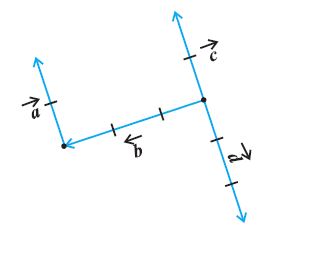
In which of the vectors are:
(i) Collinear
(ii) Equal
(iii) Coinitial
29.
A small firm manufactures necklaces and bracelets. The total number of necklaces and bracelets that it can handle per day is at most 24. It takes one hour to make a bracelet and half an hour to make a necklace. The maximum number of hours available per day is 16. If the profit on a necklace is Rs. 100 and that on a bracelet is Rs. 300. Formulate linear programming problem for finding how many, each should be produced daily to maximise the profit, if it is being given that atleast one of each must be produced?
30.
If a line makes angles 90°, 60° and 30° with the positive direction of x, y and z- axis respectively, then find its direction cosines.
31.
Prove that if E and F are independent events, then so are the events E and F′.
32.
Let the vectors \(\vec{a}, \vec{b}, \vec{c}\) be given as \(a_1 \hat{i}+a_2 \hat{j}+a_3 \hat{k}, b_1 \hat{i}+b_2 \hat{j}+b_3 \hat{k},\) \(c_1 \hat{i}+c_2 \hat{j}+c_3 \hat{k}\). Then show that \(\vec{a} \times(\vec{b}+\vec{c})=\vec{a} \times \vec{b}+\vec{a} \times \vec{c} .\)
33.
An insurance company insured 2000 scooter drivers, 4000 car drivers and 6000 truck drivers. The probabilities of an accident for them are 0.01, 0.03 and 0.15, respectively. One of the insured persons meets with an accident. What is the probability that he is a scooter driver or a car driver?
34.
Find the equation of the plane through the intersection of the planes \(\vec{r} \cdot(\hat{i}+3 \hat{j})-6=0\) and \(a\vec{r} \cdot(3 \hat{i}-\hat{j}-4 \hat{k})=0\) whose perpendicular distance from origin is unity.
35.
A farmer welfare society has 50 hectare of land to grow two crops a and b. The profit from crops a and b per hectare are estimated as Rs. 10,000 and Rs. 9,500 respectively. To control weeds, a liquid herbicide has to be used for crops a and b at rates of 20 litre and 10 litre per hectare, further not more than 800 litre of herbicide should be used in order to protect fish and wildlife using a pond which collects drainage from this land. How much land should be allocated to each crop so as to maximise the total profit of the society? What value do you see in it?
36.
In a diamond exhibition, a diamond is covered in cubical glass box having coordinates 0(0, 0, 0), A(1, 0, 0), B(1, 2, 0), C(0, 2, 0), O'(0,0,3), A'(1, 0, 3), B'(1, 2, 3) and C(0, 2, 3).
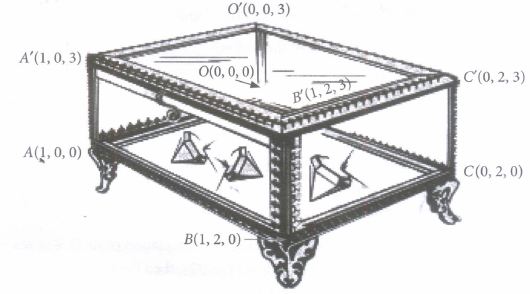
Based on the above information, answer the following questions.
(i) Direction ratios of OA are
| (a) < 0, 1, 0 > | (b) <1, 0, 0> | (c) < 0, 0, 1 > | (d) none of these |
(ii) Equation of diagonal OB' is
| (a) \(\frac{x}{1}=\frac{y}{2}=\frac{z}{3}\) | (b) \(\frac{x}{0}=\frac{y}{1}=\frac{z}{2}\) | (c) \(\frac{x}{1}=\frac{y}{0}=\frac{z}{2}\) | (d) none of these |
(iii) Equation of plane OABC is
| (a) x = 0 | (b) y = 0 | (c) z = 0 | (d) none of these |
(iv) Equation of plane O' A' B' C is
| (a) x = 3 | (b) y = 3 | (c) z = 3 | (d) z = 2 |
(v) Equation of plane ABB' A' is
| (a) x = 1 | (b) y = 1 | (c) z = 2 | (d) x = 3 |
37.
A doctor is to visit a patient. From the past experience, it is known that the probabilities that he will come by cab, metro, bike or by other means of transport are respectively 0.3, 0.2, 0.1 and 0.4. The probabilities that he will be late are 0.25, 0.3, 0.35 and 0.1 if he comes by cab, metro, bike and other means of transport respectively.
Based on the above information, answer the following questions.
(i) When the doctor arrives late, what is the probability that he comes by metro?
| \((a) \ \frac{5}{4}\) | \((b) \ \frac{2}{7}\) | \((c) \ \frac{5}{21}\) | \((d) \ \frac{1}{6}\) |
(ii) When the doctor arrives late, what is the probability that he comes by cab?
| \((a) \ \frac{4}{21}\) | \((b) \ \frac{1}{7}\) | \((c) \ \frac{5}{14}\) | \((d) \ \frac{2}{21}\) |
(iii) When the doctor arrives late, what is the probability that he comes by bike?
| \((a) \ \frac{5}{21}\) | \((b) \ \frac{4}{7}\) | \((c) \ \frac{5}{6}\) | \((d) \ \frac{1}{6}\) |
(iv) When the doctor arrives late, what is the probability that he comes by other means of transport?
| \((a) \ \frac{6}{7}\) | \((b) \ \frac{5}{14}\) | \((c) \ \frac{4}{21}\) | \((d) \ \frac{2}{7}\) |
(v) What is the probability that the doctor is late by any means?
| \((a) \ 1\) | \((b) \ 0\) | \((c) \ \frac{1}{2}\) | \((d) \ \frac{1}{4}\) |
38.
Corner points of the feasible region for an LPP are (0, 3), (5, 0), (6, 8), (0, 8). Let Z = 4x - 6y be the objective function.
Based on the above information, answer the following questions.
(i) The minimum value of Z occurs at
| (a) (6, 8) | (b) (5, 0) | (c) (0, 3) | (d) (0, 8) |
(ii) Maximum value of Z occurs at
| (a) (5, 0) | (b) (0, 8) | (c) (0, 3) | (d) (6, 8) |
(iii) Maximum of Z - Minimumof Z =
| (a) 58 | (b) 68 | (c) 78 | (d) 88 |
(iv) The corner points of the feasible region determined by the system of linear inequalities are
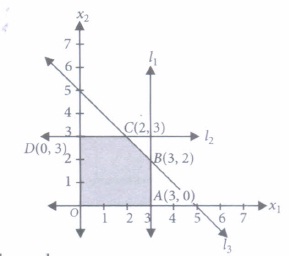
| (a) (0, 0), (-3, 0), (3, 2), (2, 3) | (b) (3, 0), (3, 2), (2, 3), (0, -3) | (c) (0, 0), (3, 0), (3, 2), (2, 3), (0, 3) | (d) None of these |
(v) The feasible solution of LPP belongs to
| (a) first and second quadrant | (b) first and third quadrant | (c) only second quadrant | (d) only first quadrant |
1.
\(\frac{3}{\sqrt{22}} \hat{i}-\frac{3}{\sqrt{22}} \hat{j}+\frac{2}{\sqrt{22}} \hat{k}\)
2.
Given equation of line is
\(a\vec{r}=(-\hat{i}+3 \hat{k})+\lambda(2 \hat{i}+3 \hat{j}+6 \hat{k})\)
and equation of plane is \(\vec{r} \cdot(10 \hat{i}+2 \hat{j}-11 \hat{k})=3\) .
On comparing with \(\vec{r}=\vec{a}+\lambda \vec{b} \text { and } \vec{r} \cdot \vec{n}=d\) ,we get
\(\vec{b}=(2 \hat{i}+3 \hat{j}+6 \hat{k}) \text { and } \vec{n}=10 \hat{i}+2 \hat{j}-11 \hat{k}\)
The angle \(\phi\) between the line and the plane is
\(\sin \phi=\left|\frac{\vec{b} \cdot \vec{n}}{|\vec{b}||\vec{n}|}\right|\)
\(=\mid \frac{(2 \hat{i}+3 \hat{j}+6 \hat{k}) \cdot(10 \hat{i}+2 \hat{j}-11 \hat{k})}{\sqrt{(2)^{2}+(3)^{2}+(6)^{2}} \sqrt{(10)^{2}+(2)^{2}+(-11)^{2}}}\)
\(=\mid \frac{(2)(10)+(3)(2)+(6)(-11)}{\sqrt{4+9+36} \sqrt{100+4+121}}\)
\(=\left|\frac{20+6-66}{\sqrt{49} \sqrt{225}}\right|=\left|\frac{-40}{7 \times 15}\right|=\frac{8}{21}\)
\(\therefore \phi=\sin ^{-1}\left(\frac{8}{21}\right)\)
3.
Given, Z = -3x + 4y
Subject to the constraints
x + 2y \( \leq\) 8; 3x + 2y \( \leq\) 12 and x \(\geq\)0, y \(\geq\) 0
Now, considering the inequations as equations, we get
x + 2y = 8 ...(i)
3x + 2y = 12 ...(ii)
Table for line x + 2y = 8 is
| x | 8 | 0 |
| y | 0 | 4 |
On putting (0, 0) in the inequality x + 2y \( \leq\) 8
0 \( \leq\) 8 (which is true)
So, half plane is towards the origin.
Table for line 3x + 2y = 12
| x | 4 | 0 |
| y | 0 | 6 |
On putting (0, 0) in the inequality 3x + 2y \( \leq\)12
0 \( \leq\) 12 (which is true)
So, half plane is towards the origin.
Also, x \(\geq\) 0 and y \(\geq\) 0, so the feasible region lies in the Ist quadrant.
The point of intersection of Eqs. (i) and (ii) is (2, 3).
The graphical representation of the above system of inequations is given below.
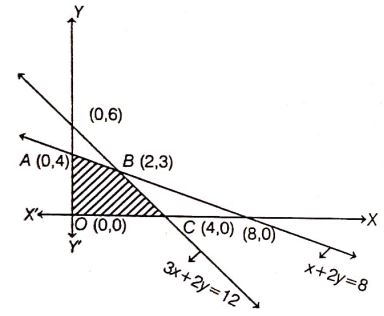
| Corner points | Value of Z = -3x + 4y |
| A(0, 4) | 16 |
| B(2, 3) | 6 |
| C(4, 0) | -12 (Minimum) |
| O(0, 0) | 0 |
Hence, Z = -12 is minimum at (4, 0).
4.
The angle between the lines whose direction ratios are a, b, c and b-c,c-a, a-b \(\)
\(\cos Q=\left|\frac{a(b-c)+b(c-a)+c(a-b)}{\sqrt{a^{2}+b^{2}+c^{2}}+\sqrt{(b-c)^{2}+(c-a)^{2}+(a-b)^{2}}}\right| \)
\(\Rightarrow \cos Q=0 \)
\(\Rightarrow Q=\cos ^{-1} 0 \)
\(\Rightarrow Q=90^{\circ} \)
Thus, the angle between the lines is \( 90^{\circ} \text {. }\)
5.
Let E denote the event that a student chosen randomly studies in Class XII and F be the event that the randomly chosen student is a girl. We have to find P (E|F).
\(\text { Now } \mathrm{P}(\mathrm{F}) =\frac{430}{1000}=0.43 \text { and } \mathrm{P}(\mathrm{E} \cap \mathrm{F})=\frac{43}{1000}=0.043 \text { (Why?) }\)
\(\text { Then } \mathrm{P}(\mathrm{E} \mid \mathrm{F}) =\frac{\mathrm{P}(\mathrm{E} \cap \mathrm{F})}{\mathrm{P}(\mathrm{F})}=\frac{0.043}{0.43}=0.1 \)
6.
Total cards are 12
A : number drawn is more than 3, i.e. 4, 5, 6, ..., 12.
B : getting an even number, i.e. 2, 4, 6, 8, 10, 12.
\(A \cap B: 4,6,8,10,12 \)
\(P(B / A)=\frac{P(A \cap B)}{P(A)}=\frac{5 / 12}{9 / 12}=\frac{5}{9} .
\)
7.
(c)
\(\frac{8}{15}\)
8.
(c)
(0, 8)
9.
(a)
144
10.
(d)
\(\frac{x-1}{1}=\frac{y+3}{1}=\frac{z-2}{2}\)
11.
(c)
2, - 6, 3
12.
(c)
\(P\left(\frac{A}{B}\right) \geq P(A)\)
13.
(d)
All of these
14.
(d)
y = 0, z = 0
15.
(d)
Either \(|\vec{a}|=0 \text { or }|\vec{b}|=0\)
16.
(c)
Decision
17.
(b)
cos α, cos β, cos γ
18.
(a)
\(\frac { 2 }{ 3 } ,\frac { -2 }{ 3 } ,\frac { 1 }{ 3 } \)
19.
(a)
A ⊂ B
20.
(a)
\(_{ }^{ 5 }{ { C }_{ 4 } }{ \left( \frac { 4 }{ 5 } \right) }^{ 4 }\frac { 1 }{ 5 } \)
21.
(d)
P(A) = P(B)
22.
(b)
\(0\le \theta \le \frac { \pi }{ 2 } \)
23.
(d)
a = I/|λ|
24.
(d)
x → fans, y → sewing machines To maximise z = 22x + 18j
x ≥ 0, y ≥ 0, x + y ≤ 20 360x + 240y ≤ 5760
25.
As area of parallelogram
= \(\left| \begin{matrix} \widehat { i } & \widehat { j } & \widehat { k } \\ 2 & 1 & -2 \\ 3 & 1 & -1 \end{matrix} \right| \)
= \(\left| \widehat { i } -4\widehat { j } -\widehat { k } \right| \)
= \(\sqrt { 1+16+1 } \)
= \(3\sqrt { 2 } \) sq units
26.
(b)
\(\frac { \pi }{ 4 } \)
27.
Given, lines are
\(\begin{aligned}
\frac{x-4}{3}=\frac{y+3}{4}=\frac{z+1}{5}
\end{aligned}\) ...(i)
and \(\begin{aligned}
\frac{x-1}{4}=\frac{y+1}{-3}=\frac{z+10}{5}
\end{aligned}\) ...(ii)
DR's of line (i) is 3, 4, 5 and DR's of line (ii) is 4, -3, 5.
Vector in the direction of first line \(\vec{b}=3 \hat{i}+4 \hat{j}+5 \hat{k}\)
Vector in the direction of second line
\(\vec{d}=4 \hat{i}-3 \hat{j}+5 \hat{k}\)
Acute angle \(\theta\) between two lines is given by
\(\cos \theta=\frac{\overrightarrow{\mid b} \cdot \vec{d} \mid}{|\vec{b}||\vec{d}|}\)
\(\begin{aligned}
\cos \theta & =\frac{|(3 \hat{i}+4 \hat{j}+5 \hat{k}) \cdot(4 \hat{i}-3 \hat{j}+5 \hat{k})|}{|(3 \hat{i}+4 \hat{j}+5 \hat{k})||(4 \hat{i}-3 \hat{j}+5 \hat{k})|}
\end{aligned}\)
\(\begin{aligned}
\Rightarrow \quad \cos \theta & =\frac{|12-12+25|}{\sqrt{9+16+25} \sqrt{16+9+25}}
\end{aligned}\)
\(\begin{aligned}
\Rightarrow \quad \cos \theta=\frac{25}{\sqrt{50} \sqrt{50}} \end{aligned}\)
\(\begin{aligned}
\Rightarrow \quad \cos \theta=\frac{1}{2} \Rightarrow \theta=\frac{\pi}{3}
\end{aligned}\)
28.
(i) Collinear vectors : \(\vec{a}, \vec{c} \text { and } \vec{d}\)
(ii) Equal vectors : \(\vec{a} \text { and } \vec{c} \text { . }\)
(iii) Coinitial vectors : \(\vec{b}, \vec{c} \text { and } \vec{d}\)
29.
Let x necklaces and y bracelets manufactured by small firm.
\(\begin{array}{c|c|c|c} \hline \text { Item } & \text { Number } & \begin{array}{c} \text { Manufactures } \\ \text { times (in hours) } \end{array} & \text { Profit (in Rs.) } \\ \hline \text { Necklaces } & x & x / 2 & 100 x \\ \text { Bracelets } & y & y & 300 y \\ \text { Total } & x+y & \frac{x}{2}+y & 100 x+300 y \\ \hline \text { Availability } & 24 & 16 & \\ \hline \end{array}\)
Our problem is to maximise Z = 100x + 300y subject to constraints are
\(x \geq 1, y \geq 1 \)
\(x+y \leq 24 ; \frac{1}{2} x+y \leq 16\)
30.
Let the d.c. 's of the lines be l, m, n.
Then \(\mathrm{I}=\cos 90^{\circ}=0, \mathrm{~m}=\cos 60^{\circ}=\frac{1}{2} n=\cos 30^{\circ}=\frac{\sqrt{3}}{2}\)
31.
Since E and F are independent, we have
P(E ∩ F) = P(E) . P(F) ....(1)
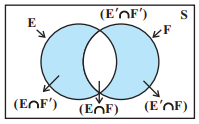
From the venn diagram in Fig 13.3, it is clear that E ∩ F and E ∩ F′ are mutually exclusive events and also E =(E ∩ F) ∪ (E ∩ F′). Therefore P(E) = P(E ∩ F) + P(E ∩ F′)
or P(E ∩ F′) = P(E) − P(E ∩ F)
= P(E) − P(E) . P(F) (by (1))
= P(E) (1−P(F))
= P(E). P(F′)
Hence, E and F′ are independent
32.
33.
Let us define the events as|
E1 : Insured person is a scooter driver
E2 : Insured person is a car driver
E3 : Insured person is a truck driver
A : Insured person meets with an accident
Then, n(E1) = 2000, n(E2) = 4000 and n(E3) = 6000
Here, total insured person, n(S) = 12000
Now, P(E1) = Probability that the insured person is a scooter driver
\(=\frac{n\left(E_1\right)}{n(S)}=\frac{2000}{12000}=\frac{1}{6}\)
P(E2) = Probability that the insured person is a car driver
\(=\frac{n\left(E_2\right)}{n(S)}=\frac{4000}{12000}=\frac{1}{3}\)
and P(E3) = Probability that the insured person is a truck driver
\(=\frac{n\left(E_3\right)}{n(S)}=\frac{6000}{12000}=\frac{1}{2}\)
Also, P(A/E1)= Probability that scooter driver meets with an accident
= 0.01
P(A/E2) = Probability that car driver meets with an accident
= 0.03
and P(A/E3) = Probability that truck driver meets with an accident
= 0.15
The probability that the person met with an accident was a scooter driver,
\(P\left(E_1 / A\right)=\frac{P\left(E_1\right) \cdot P\left(A / E_1\right)}{\left[\begin{array}{r}
P\left(E_1\right) \cdot P\left(A / E_1\right)+P\left(E_2\right) \cdot P\left(A / E_2\right) \\
+P\left(E_3\right) \cdot P\left(A / E_3\right)
\end{array}\right]}\)
[by Baye's theorem]
\(=\frac{\frac{1}{6} \times 0.01}{\left[\left(\frac{1}{6} \times 0.01\right)+\left(\frac{1}{3} \times 0.03\right)+\left(\frac{1}{2} \times 0.15\right)\right]}\)
\(=\frac{\frac{1}{6}}{\frac{1}{6}+1+\frac{15}{2}}=\frac{1}{6} \times \frac{6}{1+6+45}=\frac{1}{52}\)
The probability that the person met with an accident was a car driver, P (E2 /A)
\(=\frac{P\left(E_2\right) \cdot P\left(A / E_2\right)}{P\left(E_1\right) P\left(A / E_1\right)+P\left(E_2\right) \cdot P\left(A / E_2\right)+P\left(E_3\right) \cdot P\left(A / E_3\right)}\)
\(=\frac{\frac{1}{3} \times 0.03}{\left(\frac{1}{6} \times 0.01\right)+\left(\frac{1}{3} \times 0.03\right)+\left(\frac{1}{2} \times 0.15\right)}\)
\(=\frac{\frac{1}{100}}{\frac{1}{600}+\frac{1}{100}+\frac{15}{200}}=\frac{\frac{1}{100}}{\frac{1+6+45}{600}}=\frac{6}{52}\)
Hence, the required probability is P(E1 U E2 / A) = P(E1/A) + P(E2 / A)
\(=\frac{1}{52}+\frac{6}{52}=\frac{7}{52}\)
34.
Equation of plane passing through the intersection of given planes is
\(\vec{r} \cdot[(\hat{i}+3 \hat{j})+\lambda(3 \hat{i}-\hat{j}-4 \hat{k})]=6+0 \cdot \lambda\)
\(\Rightarrow \vec{r} \cdot[(1+3 \lambda) \hat{i}+(3-\lambda) \hat{j}+\hat{k}(-4 \lambda)]=6\) ...(i)
On dividing both sides by
\(\sqrt{(1+3 \lambda)^{2}+(3-\lambda)^{2}+(-4 \lambda)^{2}}\) ,We get
\(\frac{\vec{r} \cdot[(1+3 \lambda) \hat{i}+(3-\lambda) \hat{j}+\hat{k}(-4 \lambda)]}{\sqrt{(1+3 \lambda)^{2}+(3-\lambda)^{2}+(-4 \lambda)^{2}}}\)
\(=\frac{6}{\sqrt{(1+3 \lambda)^{2}+(3-\lambda)^{2}+(-4 \lambda)^{2}}}\)
Given the perpendicular distance from origin is unity.
\(\therefore \frac{6}{\sqrt{(1+3 \lambda)^{2}+(3-\lambda)^{2}+(-4 \lambda)^{2}}}=1\)
\(\Rightarrow (1+3 \lambda)^{2}+(3-\lambda)^{2}+(-4 \lambda)^{2}=36\)
\(\Rightarrow 1+9 \lambda^{2}+6 \lambda+9+\lambda^{2}-6 \lambda+16 \lambda^{2}=36\)
\(\Rightarrow 26 \lambda^{2}+10=36 \Rightarrow \lambda^{2}=1\)
\(\Rightarrow \lambda=\pm 1\)
On putting the value of \(\lambda\) in Eq. (i), the required equation of plane are
\(\vec{r} \cdot[(1 \pm 3) \hat{i}+(3 \mp 1) \hat{j}+(\mp 4) \hat{k}]=6\)
\(\Rightarrow \vec{r} \cdot[(1+3) \hat{i}+(3-1) \hat{j}+(-4) \hat{k}]=6\)
and \(\vec{r} \cdot[(1-3) \hat{i}+(3+1) \hat{j}+4 \hat{k}]=6\)
\(\Rightarrow \vec{r} \cdot(4 \hat{i}+2 \hat{j}-4 \hat{k})=6\)
and \(\vec{r} \cdot(-2 \hat{i}+4 \hat{j}+4 \hat{k})=6\)
and \(-2 x+4 y+4 z-6=0\)
35.
Let land allocated to crop a = x hectare
Let land allocated to crop b = y hectare
Obviously, x \(\ge \) 0, y \(\ge \) 0
Profit per hectare on a = Rs. 10,000
Profit per hectare on b = Rs. 9,500
Total profit = 10,00x + 9,500y
To maximise: Z=10,000x + 9,500y
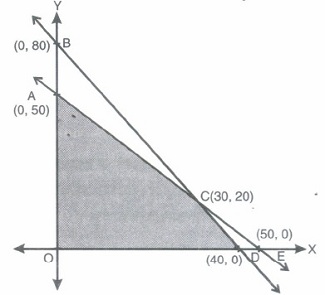
Given: x + y \(\le \) 50 (related to land) ...(i)
20x + 10y \(\le \) 800 (related to herbicide)
\(\Rightarrow\) 2x + y\(\le \) 80..(ii)
x \(\ge \) 0, y\(\ge \) 0
Calculate value on O, A, C, D and note,
At point O(0, 0),
Z = 0
At point A(00, 50),
Z = 0 + 9500 \(\times\)50
= Rs. 4,75,000
At point D(40, 0),
Z = Rs. 4,00,000
At point C(30, 20),
Z = Rs. 4,90,000,
Which is maximum i.e., society will get maximum profit of Rs. 4,90,000 by allocationg 30 hectare to crop a and 20 hectare to crop b.
Value: Awareness would increase the profit of farmers.
36.
(i) (b) : D.R:s of OA are < 1-0, 0-0, 0-0 >, i.e., < 1, 0, 0 >.
(ii) (a) : Equation of diagonal OB' is \(\frac{x-0}{1}=\frac{y-0}{2}=\frac{z-0}{3} \text { i.e., } \frac{x}{1}=\frac{y}{2}=\frac{z}{3}\)
(iii) (c) : OABC is xy-plane, therefore its equation is z = 0.
(iv) (c) : Plane O'A'B'C is parallel to xy-plane passing through (0, 0, 3), therefore its equation is z = 3.
(v) (a) : Plane ABB' A' is parallel to yz-plane passing through (1, 0, 0), therefore its equation is x = 1.
37.
Let E be the event that the doctor visit the patient late and let A1, A2, A3, A4 be the events that the doctor comes by cab, metro, bike and other means of transport respectively.
\(P\left(A_{1}\right)=0.3, P\left(A_{2}\right)=0.2, P\left(A_{3}\right)=0.1, P\left(A_{4}\right)=0.4\)
P(E I A1) = Probability that the doctor arriving late when he comes by cab = 0.25
Similarly, P ( E I A2) = 0.3, P (E I A3) = 0.35 and P ( E I A3) = 0.1
(i) (b): P(A2 | E) = Probability that the doctor arriving late and he comes by metro
\(=\frac{P\left(A_{2}\right) P\left(E \mid A_{2}\right)}{\sum P\left(A_{i}\right) P\left(E \mid A_{i}\right)}\)
\(=\frac{(0.2)(0.3)}{(0.3)(0.25)+(0.2)(0.3)+(0.1)(0.35)+(0.4)(0.1)}\)
\(=\frac{0.06}{0.21}=\frac{2}{7}\)
(ii) (c): P(A1 | E) = Probability that the doctor arriving late and he comes by cab
\(=\frac{P\left(A_{1}\right) P\left(E \mid A_{1}\right)}{\Sigma P\left(A_{i}\right) P\left(E \mid A_{i}\right)}\)
\(=\frac{(0.3)(0,25)}{(0.3)(0.25)+(0.2)(0.3)+(0.1)(0.35)+(0.4)(0.1)}\)
\(=\frac{0.075}{0.21}=\frac{5}{14}\)
(iii) (d): P(A3| E) = Probability that the doctor arriving late and he comes by bike
\(=\frac{P\left(A_{3}\right) P\left(E \mid A_{3}\right)}{\sum P\left(A_{i}\right) P\left(E \mid A_{i}\right)}\)
\(=\frac{(0.1)(0.35)}{(0.3)(0.25)+(0.2)(0.3)+(0.1)(0.35)+(0.4)(0.1)}\)
\(=\frac{0.035}{0.21}=\frac{1}{6}\)
(iv) (c): P(A4 | E) = Probability that the doctor arriving late and he comes by other means of transport
\(=\frac{P\left(A_{4}\right) P\left(E \mid A_{4}\right)}{\Sigma P\left(A_{i}\right) P\left(E \mid A_{i}\right)}\)
\(=\frac{(0.4)(0.1)}{(0.3)(0.25)+(0.2)(0.3)+(0.1)(0.35)+(0.4)(0.1)}\)
\(=\frac{0.04}{0.21}=\frac{4}{21}\)
(v) (a): Probability that the doctor is late by any means
\(=\frac{2}{7}+\frac{5}{14}+\frac{1}{6}+\frac{4}{21}=1\)
38.
Construct the following table of values of objective function
| Corner Points | Value of Z = 4x - 6y |
| (0,3) | 4 x 0 - 6 x 3 = -18 |
| (5,0) | 4 x 5 - 6 x 0 = 20 |
| (6,8) | 4 x 6 - 6 x 8 = -24 |
| (0,8) | 4 x 0 - 6 x 8 = -48 |
(i) (d): Minimum value of Z is -48 which occurs at (0,8).
(ii) (a): Maximumvalue of Z is 20, which occurs at (5,0).
(iii) (b): Maximum of Z - Minimum of Z
= 20 - (-48) = 20 + 48 = 68
(iv) (c): The corner points of the feasible region are O(0,0), A(3, 0), B(3, 2), C(2, 3), D(0, 3).
(v) (d)

12th Standard CBSE Syllabus & Materials
12th Standard CBSE
CBSE 12th Computer Science Python Revision Tour I - New Previous year Question Papers Study Material - QB365 Set A
NEW12th Standard CBSE
CBSE 12th Business Studies Planning Important Questions And Answers Study Material - QB365 Set A
NEW12th Standard CBSE
CBSE 12th Business Studies Business Environment Important Questions And Answers Study Material - QB365 Set A
NEW12th Standard CBSE
CBSE 12th Business Studies Principles of Management Important Questions And Answers Study Material - QB365 Set A



NCERT Books

Syllabus

Exam Pattern

Sample Question Papers

Previous year Question Papers

Important Notes

MCQ Practice test

NCERT Exemplers

Case study Questions

Image Based Questions

Passage based Questions

HOT Questions

Value Based Questions

Model Questions Papers
NCERT ( Book Back ) Questions

Assertion and Reason
Important Questions And Answers

CBSE 12th Standard CBSE Subjects
CBSE Standards








