
 100% FREE ACCESS
12th Standard CBSE Syllabus & Materials
12th Standard CBSE
CBSE 12th Economics Government Budget and the Economy Previous year Question Papers Study Material - QB365 Set A
NEW12th Standard CBSE
CBSE 12th Computer Science Interface Python with MySQL - New Previous year Question Papers Study Material - QB365 Set A
NEW12th Standard CBSE
CBSE 12th Computer Science Database Concept - New Previous year Question Papers Study Material - QB365 Set A
NEW12th Standard CBSE
CBSE 12th Computer Science Data Communication - New Previous year Question Papers Study Material - QB365 Set A
NEW12th Standard CBSE
CBSE 12th Computer Science Data Structures - New Previous year Question Papers Study Material - QB365 Set A
NEW12th Standard CBSE
CBSE 12th Computer Science Functions - New Previous year Question Papers Study Material - QB365 Set A

Published on: 25/10/2025
Download CBSE Class 12th Standard CBSE Maths question papers, sample papers, important questions, and previous year solved papers in PDF format. Get free study materials, NCERT solutions, and exam preparation resources for Class 12th Standard CBSE Maths
Questions + Answers key
Take MCQ Maths Test
1.
Find the position vectors of the points which divide the line joining the two points \(3 \vec{a}-2 \vec{b}\) and \(2 \vec{a}-5 \vec{b}\) internally and externally in the ratio 3 : 2.
2.
For what values of \(\vec{a}\) the vectors \(2 \hat{i}-3 \hat{j}+4 \hat{k} \text { and } a \hat{i}+6 \hat{j}-8 \hat{k}\) are collinear?
3.
Find the value of p for which the vectors \(\vec{a}=3 \hat{i}+2 \hat{j}+9 \hat{k} \text { and } \vec{b}=\hat{i}+p \hat{j}+3 \hat{k}\) are
(i) perpendicular.
(ii) parallel
4.
If the dot products of a vector with vectors \(3 \hat{i}-5 \hat{k}, 2 \hat{i}+7 \hat{j} \text { and } \hat{i}+\hat{j}+\hat{k}\) are respectively -1, 6 and 5, then find the vector.
5.
Find the position vector of a point C which divides the line segment joining A and B, whose position vectors are \(2 \vec{a}+\vec{b} \text { and } \vec{a}-3 \vec{b}\) externally in the ratio 1: 2. Also, show that A is the mid-point of the line segment BC.
6.
Find the unit vector perpendicular to both the vectors \(\overrightarrow a+\overrightarrow b\) and \(\overrightarrow a-\overrightarrow b\), where
\(\overrightarrow a=\overset\wedge i+\overset\wedge j+\overset\wedge k\) and \(\overrightarrow b=\overset\wedge i+2\overset\wedge j+3\overset\wedge k\).
7.
Find the angle between the vectors \(\hat{j}-2 \hat{j}+3 \hat{k} \quad \text { and } \quad 3 \hat{i}-2 \hat{j}+\hat{k}\)
8.
Show that the four points A(4, 5, 1), B(0, -1, -1), C(3, 9, 4) and D(-4, 4, 4) are coplanar.
9.
If \(\overrightarrow { a } =\hat { i } +\hat { j } +2\hat { k } \quad \overrightarrow { b } =3\hat { i } +2\hat { j } -\hat { k }\) find \( (\hat { a } +3\hat { b } ).(2\hat { a } -\hat { b } )\)
10.
Find \(\lambda \) so that the vectors \(2\hat { i } -\hat { j } +\hat { k } ,\hat { i } +2\hat { j } -3\hat { k } \) and \( 3\hat { i } +\lambda \hat { j } +5\hat { k } \) are coplanar.
11.
If \((\overrightarrow { a } +\overrightarrow { b } ).(\overrightarrow { a } -\overrightarrow { b } )=12\) and \(\left| \overrightarrow { a } \right| =2\left| \overrightarrow { b } \right| \) find \(\left| \overrightarrow { a } \right| \ and\ \left| \overrightarrow { b } \right| \)
12.
If \(\overrightarrow { a } \times \overrightarrow { b } =\overrightarrow { a } \times \overrightarrow { c } \ and\ \overrightarrow { a } \times \overrightarrow { c } =\overrightarrow { b } \times \overrightarrow { d } \) prove that \(\overrightarrow { a } -\overrightarrow { d } \) is parallel to \(\overrightarrow { b } -\overrightarrow { c } \) provided \(\overrightarrow { a } \neq \overrightarrow { d } \ and\ \overrightarrow { b } \neq \overrightarrow { c } \)
13.
Dot product of a vector \(\hat { i } -\hat { j } +\hat { k } ,2\hat { i } +\hat { j } -3\hat { k } \ and\ \hat { i } +\hat { j } +\hat { k } \) are respectively 4, 0 and 2. Find the vector.
14.
Find the projection (vector) of \(2 \hat{i}-\hat{j}+\hat{k} \text { on } \hat{i}-2 \hat{j}+\hat{k}\)
15.
If \(\vec{a}=2 \hat{i}-\hat{j}+\hat{k}, \vec{b}=\hat{i}+\hat{j}-2 \hat{k}\) and \(\vec{c}=\hat{i}+3 \hat{j}-\hat{k}\) then find \(\lambda\)
16.
If \(\vec{a}=5 \hat{i}-\hat{j}-3 \hat{k} \text { and } \vec{b}=\hat{i}+3 \hat{j}-5 \hat{k}\) then show thatt he vectors \((\vec{a}+\vec{b}) \text { and }(\vec{a}-\vec{b})\) are perpendicular.
17.
If \(\vec{a}=\hat{i}+\hat{j}+2 \hat{k} \text { and } \vec{b}=2 \hat{i}+\hat{j}-2 \hat{k}\) then find the unit vector in the direction of \(2 \vec{a}-\vec{b}\)
18.
Find the area of parallelogram whose adjacent sides are determined by the vector.
\(\overset\rightarrow a=\overset\wedge i-\overset\wedge j+2\overset\wedge k\) and \(\overset\rightarrow b=2\overset\wedge i-\overset\wedge j-\overset\wedge k\)
19.
Given that \(\overrightarrow a.\overrightarrow b=0\) and \(\overrightarrow a\times\overrightarrow b=0\), what can you conclude about the vector \(\overrightarrow a \) and \(\overrightarrow b\)?
20.
Find the projection of \(\overset\rightarrow a+\overset\rightarrow b\) on \(\overset\rightarrow a-\overset\rightarrow b,\)\(\overset\rightarrow a=i+2j+k,\overset\rightarrow b=3\overset\wedge i+\overset\wedge j-\overset\wedge k\).
21.
If \(\left|\overset\rightarrow a+\overset\rightarrow b \right| =60,\left|\overset\rightarrow a-\overset\rightarrow b \right|=40\)and \(\left| \overset\rightarrow a \right| =22,\) then find \(\left| \overset\rightarrow b \right| \).
22.
Which of the following statement is correct?
\(\vec{a} \cdot(\vec{b} \times \vec{c})=[\vec{b} \vec{c} \vec{a}]\)
\([\vec{a} \vec{b} \vec{c}]=[\vec{c} \vec{a} \vec{b}]\)
\([\vec{c} \vec{a} \vec{b}]=\vec{c} \cdot(\vec{a} \times \vec{b})=(\vec{a} \times \vec{b}) \cdot \vec{c}\)
All are correct
23.
The value of \(\hat{i} \cdot(\hat{j} \times \hat{k})+\hat{j} \cdot(\hat{k} \times \hat{i})+\hat{k} \cdot(\hat{i} \times \hat{j})\) is
zero
-1
1
3
24.
If \(\theta\) is the angle between two vectors \(\vec{a} \text { and } \vec{b}\), then \(\vec{a} \cdot \vec{b} \geq 0\) only when
\(<\theta<\frac{\pi}{2}\)
\(0 \leq \theta \leq \frac{\pi}{2}\)
\(0<\theta<\pi\)
\(0 \leq \theta \leq \pi\)
25.
\(2 \hat{i}+4 \hat{k}, 5 \hat{i}+3 \sqrt{3} \hat{j}+4 \hat{k},-2 \sqrt{3} \hat{j}+\hat{k} \text { and } 2 \hat{i}+\hat{k}\) are the position vectors of points A, B, Cand D respectively, then \(\overrightarrow{C D}\) is equal to
\(\frac{2}{3} \overrightarrow{A B}\)
\(\frac{1}{3} \overrightarrow{A B}\)
\(5 \overrightarrow{A B}\)
None of these
26.
The direction cosines of the vector \(\hat{i}+2 \hat{j}+3 \hat{k}\) are
\(\frac{1}{\sqrt{14}}, \frac{2}{\sqrt{14}}, \frac{3}{\sqrt{14}}\)
\(\frac{2}{\sqrt{14}}, \frac{3}{\sqrt{14}}, \frac{4}{\sqrt{14}}\)
\(\frac{11}{\sqrt{14}}, \frac{13}{\sqrt{14}}, \frac{21}{\sqrt{14}}\)
None of these
27.
For any two vectors a and b
|a – b| ≥ |a| – |b|
|a – b| = |a| – |b|
|a + b| ≤ |a – |b|
|a – b| = |a + b|
28.
A vector of magnitude 14 units, which is parallel to the \(\widehat { i } +2\widehat { j } -3\widehat { k } \) vector
\(\frac { (\widehat { i } +2\widehat { j } -3\widehat { k } ) }{ 14 } \)
\(\frac { (\widehat { i } +2\widehat { j } -3\widehat { k } ) }{ \sqrt{14 } }\)
\(\sqrt { 14 } (\widehat { i } +2\widehat { j } -3\widehat { k } )\)
14\((\widehat { i } +2\widehat { j } -3\widehat { k } )\)
29.
If a and b are the position vectors of two points A and B and C is a point on AB produced such that AC = 3AB, then position vector of C will be
3b – 2a
3a – b
3a – 2b
3b – a
30.
The angles α, β, γ made by the vector \(\overrightarrow { r } \) with the positive direction of X, Y and Z-axes respectively, then the direction cosines of the vector \(\overrightarrow { r } \) are:
cos α, cos β, cos γ
sin α, sin β, sin γ
1800 - α, 1800 - β, cos1800 - γ
tan α, tan β, tan γ
31.
If the magnitude of the position vector \(\overrightarrow { a } =x\widehat { i } +2\widehat { j } -2x\widehat { k } \) is 7, the value of x is:
±1
±5
±3
±2
32.
If \(\overrightarrow { b } =\lambda \overrightarrow { a } \), the vectors a and b are ______ .
coinitial
free vector
zero vector
collinear
33.
If a, b, c and d are the position vectors of the points A, B, C and D such that a + c = b + d, then ABCD is a
Trapezium
Rectangle
Square
Parallelogram
34.
The area of a parrallelgram whose one diagonal is \(2\widehat { i } +\widehat { j } -2\widehat { k } \) and one side is \(3\widehat { i } +\widehat { j } -\widehat { k } \) is
\(\widehat { i } -4\widehat { j } -\widehat { k } \)
\(3\sqrt { 2 } \) sq unts
\(6\sqrt { 2 } \) sq units
6 sq units
35.
If for non zero vectors \(\vec { a } \) and \(\vec { b } \), \(\vec { a } \) x \(\vec { b } \) is a unit vector and |\(\vec { a } \)| = |\(\vec { b } \)| = \(\sqrt2\), then angle θ between vectors \(\vec { a } \) and \(\vec { b } \) is
\(\frac { \pi }{ 2 } \)
\(\frac { \pi }{ 3 } \)
\(\frac { \pi }{ 6 } \)
\(-\frac { \pi }{ 2 } \)
36.
If \(\vec { a } \) and \(\vec { b } \) are unit vectors, then what is the angle between \(\vec { a } \) and \(\vec { b } \) for \(\sqrt { 3 } \vec { a } -\vec { b } \) to be a unit vector?
30°
45°
60°
90°
1.
Let A and B be the given points whose position vectors are \(3 \vec{a}-2 \vec{b} \text { and } 2 \vec{a}-5 \vec{b}\) respectively, with respect to the origin \(\text { i.e. } \overrightarrow{O A}=3 \vec{a}-2 \vec{b} \text { and } \overrightarrow{O B}=2 \vec{a}-5 \vec{b} \text { . }\)
Let P and Q be the points, which divides the line joining
A and B internally and externally respectively, in the ratio 3: 2.
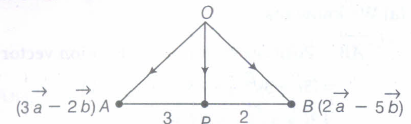
Then, by using section formula of internal division, we get
\(\overrightarrow{O P}=\frac{3 \overrightarrow{O B}+2 \overrightarrow{O A}}{3+2}=\frac{3(2 \vec{a}-5 \vec{b})+2(3 \vec{a}-2 \vec{b})}{5}\)
\(=\frac{6 \vec{a}-15 \vec{b}+6 \vec{a}-4 \vec{b}}{5}=\frac{12 \vec{a}-19 \vec{b}}{5}\)
\(=\frac{12}{5} \vec{a}-\frac{19}{5} \vec{b}\)
Now,by using section formula of external division, we get
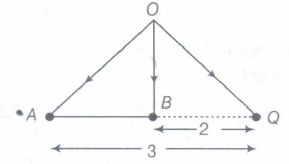
\(\overrightarrow{O Q}=\frac{3 \overrightarrow{O B}-2 \overrightarrow{O A}}{3-2}=\frac{3(2 \vec{a}-5 \vec{b})-2(3 \vec{a}-2 \vec{b})}{1}\)
\(=\frac{6 \vec{a}-15 \vec{b}-6 \vec{a}+4 \vec{b}}{1}=-11 \vec{b}\)
2.
Let given vectors are \(\vec{a}=2 \hat{i}-3 \hat{j}+4 \hat{k} \text { and } \vec{b}=a \hat{i}+6 \hat{j}-8 \hat{k}\) .
We know that vectors \(\vec{a}=a_{1} \hat{i}+a_{2} \hat{j}+a_{3} \hat{k}\) and \(\vec{b}=b_{1} \hat{i}+b_{2} \hat{j}+b_{3} \hat{k}\) are cellinear, if
\(\frac{b_{1}}{a_{1}}=\frac{b_{2}}{a_{2}}=\frac{b_{3}}{a_{3}}\)
\(\therefore\frac{a}{2}=\frac{6}{-3}=\frac{-8}{4}\)
\(\Rightarrow \frac{a}{2}=-2 \Rightarrow a=-4\)
3.
(i) If vectors \(\vec{a} \text { and } \vec{b}\) are perpendicular, then \(\vec{a} \cdot \vec{b}=0\)
\(\Rightarrow(3 \hat{i}+2 \hat{j}+9 \hat{k}) \cdot(\hat{i}+p \hat{j}+3 \hat{k})=0\)
\(\Rightarrow 3+2 p+27=0\)
\(\Rightarrow p=-15\)
(ii) We know that, the vectors \(\vec{a}=a_{1} \hat{i}+a_{2} \hat{j}+a_{3} \hat{k}\) and
\(\vec{b}=b_{1} \hat{i}+b_{2} \hat{j}+b_{3} \hat{k}\) are parallel iff
\(\Rightarrow \frac{a_{1}}{b_{1}}=\frac{a_{2}}{b_{2}}=\frac{a_{3}}{b_{3}}=l\)
So, the given vectors \(\vec{a}=3 \hat{i}+2 \hat{j}+9 \hat{k}\)
and \(\vec{b}=\hat{i}+p \hat{j}+3 \hat{k}\) will be parallel iff
\(\frac{3}{1}=\frac{2}{p}=\frac{9}{3}\)
\(\Rightarrow 3=\frac{2}{p} \Rightarrow p=\frac{2}{3}\)
4.
Let \(\vec{a}=3 \hat{i}-5 \hat{k}, \vec{b}=2 \hat{i}+7 \hat{j} \text { and } \vec{c}=\hat{i}+\hat{j}+\hat{k}\) be three given vectors.
Let \(\vec{r}=x \hat{i}+y \hat{j}+z \hat{k}\) be a vector such that its dot products with \(\vec{a}, \vec{b} \text { and } \vec{c}\) are -1, 6 and 5 respectively, we have
\(\vec{r} \cdot \vec{a}=(x \hat{i}+y \hat{j}+z \hat{k}) \cdot(3 \hat{i}-5 \hat{k}) \Rightarrow-1=3 x-5 z\) ..(i)
\(\vec{r} \cdot \vec{b}=(x \hat{i}+y \hat{j}+z \hat{k}) \cdot(2 \hat{i}+7 \hat{j}) \Rightarrow 6=2 x+7 y\) ...(ii)
and \(\vec{r} \cdot \vec{c}=(x \hat{i}+y \hat{j}+z \hat{k}) \cdot(\hat{i}+\hat{j}+\hat{k}) \Rightarrow 5=x+y+z\) ...(iii)
On solving Equation (i), (ii) and (iii), we get
x = 3, y = 0 and z = 2
Hence, the required vector is \(\vec{r}=3 \hat{i}+2 \hat{k}\)
5.
Given, \(\overrightarrow{O A}=2 \vec{a}+\vec{b} \text { and } \overrightarrow{O B}=\vec{a}-3 \vec{b}\)
Also, it is given that C is the point which divides the line joining A and B externally in the ratio 1: 2.
Then by using section formula of external division, we get
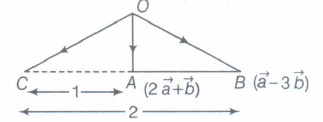
\(\overrightarrow{O C}=\frac{2 \overrightarrow{O A}-\overrightarrow{O B}}{2-1}\)
\(\Rightarrow \overrightarrow{O C}=\frac{2(\overrightarrow{2 a}+\vec{b})-1(\vec{a}-3 \vec{b})}{1} \quad[\text { from Eq }\)
\(=4 \vec{a}+2 \vec{b}-\vec{a}+3 \vec{b}=3 \vec{a}+5 \vec{b}\)
i.e. to show \(\overrightarrow{O A}=\frac{\overrightarrow{O B}+\overrightarrow{O C}}{2}\)
Consider, \(\frac{\overrightarrow{O B}+\overrightarrow{O C}}{2}=\frac{\vec{a}-3 \vec{b}+3 \vec{a}+5 \vec{b}}{2}\)
[from Equation (i) and (ii)]
\(=\frac{4 \vec{a}+2 \vec{b}}{2}=2 \vec{a}+\vec{b}=\overrightarrow{O A} \quad[\text { from Eq. }(i)]\)
Thus, \(\frac{\overrightarrow{O B}+\overrightarrow{O C}}{2}=\overrightarrow{O A}\)
Hence, A is mid-point of line segment BC.
6.
\(\overrightarrow a+\overrightarrow b=({2\overset\wedge i+3\overset\wedge j+4\overset\wedge k}),\) and \(\overrightarrow a-\overrightarrow b=\overset\wedge j-2\overset\wedge k\)
Let \(\overrightarrow c=(\overrightarrow a+\overrightarrow b)\times (\overrightarrow a-\overrightarrow b)\)
\(=\left| \begin{matrix} \overset { \wedge }{ i } & \overset { \wedge }{ j } & \overset { \wedge }{ k } \\ 2 & 3 & 4 \\ 0 & -1 & -2 \end{matrix} \right| \)
\(\Rightarrow \overrightarrow c=-2\overset\wedge i+4\overset\wedge j-2\overset\wedge k\)
\(\Rightarrow \overset\wedge c=-\frac{1}{\sqrt6}\overset\wedge i+\frac{2}{\sqrt6}\overset\wedge j-\frac{1}{\sqrt6}\overset\wedge k\)
7.
let \(\overset { \rightarrow }{ a } =\overset { \wedge }{ j } -2\overset { \wedge }{ j } +3\overset { \wedge }{ k } \ \text {and}\)\(\overset { \rightarrow }{ b } =3\overset { \wedge }{ i } -2\overset { \wedge }{ j } +\overset { \wedge }{ k } \)
then \(\overset { \rightarrow }{ |a| } =\sqrt { { 1 }^{ 2 }+{ (-2) }^{ 2 }+{ 3 }^{ 2 } } \)
\(=\sqrt { 1+4+9 } =\sqrt { 14 } \)
\(\overset { \rightarrow }{ |b| } =\sqrt { { 3 }^{ 2 }+{ (-2) }^{ 2 }+{ 1 }^{ 2 } } \)
\(=\sqrt { 9+4+1 } =\sqrt { 14 } \)
and \(\overset { \rightarrow }{ a } .\overset { \rightarrow }{ b } =(\overset { \wedge }{ j } -2\overset { \wedge }{ j } +3\overset { \wedge }{ k } )+(3\overset { \wedge }{ i } -2\overset { \wedge }{ j } +\overset { \wedge }{ k } )\)
= (1)(3)+(-2)(-2)+(3)(1)
= 3+4+3 = 10
if cos \(\theta\) be the angle between \(\overset { \rightarrow }{ a }\ and\ \overset { \rightarrow }{ b } \)
then cos \(\theta\) \(=\frac { \overset { \rightarrow }{ a } .\overset { \rightarrow }{ b } }{ \overset { \rightarrow }{ |a| } \overset { \rightarrow }{ |b| } } =\frac { 10 }{ \sqrt { 14 } \sqrt { 14 } } =\frac { 10 }{ 14 } =\frac { 5 }{ 7 } \)
Hence, \(\theta\) = cos-1 \(\frac { 5 }{ 7 } \)
\(\therefore \overset { \rightarrow }{ a } \ and\ \overset { \rightarrow }{ b } \) may have opposite direction, their magnitudes may be different.
8.
\(\overset { \rightarrow }{ AB } =-4\overset { \wedge }{ i } -6\overset { \wedge }{ j } -2\overset { \wedge }{ k } \)
\(\overset { \rightarrow }{ BC } =3\overset { \wedge }{ i } +10\overset { \wedge }{ j } +52\overset { \wedge }{ k } \)
\(\overset { \rightarrow }{ CD } =-7\overset { \wedge }{ i } -5\overset { \wedge }{ j }\)
The four points are coplanar if \(\overset { \rightarrow }{ AB } ,\overset { \rightarrow }{ BC } ,\overset { \rightarrow }{ CD } \) are coplanar.
If \(\left[ \overset { \rightarrow }{ AB } ,\overset { \rightarrow }{ BC } ,\overset { \rightarrow }{ CD } \right] =0\quad i.e.if\left| \begin{matrix} -4 & -6 & -2 \\ 3 & 10 & 5 \\ -7 & -5 & 0 \end{matrix} \right| =0\)
If -4(0 + 25) + 6(0 + 35) -2(-15 + 70) = 0
If -100 + 210 - 110 = 0
If 0 = 0, which is true.
9.
-15
10.
\(\lambda=-4\)
11.
\(\left| \overrightarrow { a } \right| \ and\ \left| \overrightarrow { b } \right| \) =4,2
12.
\((\overrightarrow { a } -\overrightarrow { d } )\) x \((\overrightarrow { b } -\overrightarrow { c } )\)
\(=\overrightarrow { a } *\overrightarrow { b } -\overrightarrow { a } *\overrightarrow { c } -\overrightarrow { d } *\overrightarrow { b } +\overrightarrow { d } *\overrightarrow { c } \)
\(=\overrightarrow { c } *\overrightarrow { d } -\overrightarrow { b } *\overrightarrow { d } -\overrightarrow { d } *\overrightarrow { b } +\overrightarrow { d } -\overrightarrow { c } \)
\([\because \overrightarrow { a } *\overrightarrow { b } =\overrightarrow { c } -\overrightarrow { d } and\overrightarrow { a } *\overrightarrow { c } =\overrightarrow { b } *\overrightarrow { d } ]\)
\(=\overrightarrow { c } *\overrightarrow { d } -\overrightarrow { b } *\overrightarrow { d } +\overrightarrow { b } *\overrightarrow { d } -\overrightarrow { c } *\overrightarrow { d } =\overrightarrow { 0 } \)
Hence, \((\overrightarrow { a } -\overrightarrow { d } )\) is parallel to \((\overrightarrow { b } -\overrightarrow { c } )\)
13.
\(\text {Let vector be } \vec{r}=x \hat{i}+y \hat{j}+z \hat{k}\)
According to given condition \( x-y+z=4 \text { ; }\)
\(2 x+y-3 z=0 ; x+y+z=2 \)
\(x-y+z=4 \)
\(2 x+y-3 z=0 \)
\(x+y+z=2 \)
From (ii), y = 3z − 2x
Substituting in (i) and (iii), we get
\(x-3 z+2 x+z=4 \Rightarrow 3 x-2 z=4 \)
\(x+3 z-2 x+z=2 \Rightarrow-x+4 z=2 \)
Solving (v) and (vi), we get
\(x=2, z=1\)
Substituting in (iv), we get
\(y=-1\)
\(\therefore \text { Vector is } 2 \hat{i}-\hat{j}+\hat{k} \)
14.
Let \(\vec{a}=2 \hat{i}-\hat{j}+\hat{k} \text { and } \vec{b}=\hat{i}-2 \hat{j}+\hat{k}\)
Now, projection vector of \(\vec{a} \text { on } \vec{b}=\frac{\vec{a} \cdot \vec{b}}{|\vec{b}|^2} \vec{b}\)
Here, \(\begin{aligned}
\vec{a} \cdot \vec{b} & =(2 \hat{i}-\hat{j}+\hat{k}) \cdot(\hat{i}-2 \hat{j}+\hat{k})
\end{aligned}\)
\(\begin{aligned}
=2 \times 1+(-1) \times(-2)+1 \times 1
\end{aligned}\)
= 2 + 2 + 1 = 5
and \(|\vec{b}|=\sqrt{(1)^2+(-2)^2+(1)^2}=\sqrt{1+4+1}=\sqrt{6}\)
\(\therefore\) Projection vector of \(\vec{a} \text { on } \vec{b}=\frac{5}{6}(\hat{i}-2 \hat{j}+\hat{k})\)
15.
We have, \(\vec{a}=2 \hat{i}+2 \hat{j}+3 \hat{k}, \vec{b}=-\hat{i}+2 \hat{j}+\hat{k}\)
and \(\vec{c}=3 \hat{i}+\hat{j}\)
Now, \(\vec{a}+\lambda \vec{b}=(2 \hat{i}+2 \hat{j}+3 \hat{k})+\lambda(-\hat{i}+2 \hat{j}+\hat{k})\)
\( =2 \hat{i}+2 \hat{j}+3 \hat{k}-\lambda \hat{i}+2 \lambda \hat{j}+\lambda \hat{k} \)
\(=(2-\lambda) \hat{i}+(2+2 \lambda) \hat{j}+(3+\lambda) \hat{k}\)
Since, \(\vec{a}+\lambda \vec{b}\) is perpendicular to \(\vec{c}\).
\(\therefore \ (\vec{a}+\lambda \vec{b}) \cdot \vec{c}=0\)
\(\Rightarrow [(2-\lambda) \hat{i}+(2+2 \lambda) \hat{j}+(3+\lambda) \hat{k}] \cdot(3 \hat{i}+\hat{j})=0\)
\(\Rightarrow(2-\lambda)(3)+(2+2 \lambda)(1)+(3+\lambda)(0)=0\)
\(\Rightarrow 6-3 \lambda+2+2 \lambda=0\)
\(\Rightarrow\)\(-\lambda+8=0\)
\(\therefore\) \(\lambda=8\)
16.
We have,\(\vec{a}=5 \hat{i}-\hat{j}-3 \hat{k} \text { and } \vec{b}=\hat{i}+3 \hat{j}-5 \hat{k}\)
Now,\(\vec{a}+\vec{b}=5 \hat{i}-\hat{j}-3 \hat{k}+\hat{i}+3 \hat{j}-5 \hat{k}=6 \hat{i}+2 \hat{j}-8 \hat{k}\)
and \(\vec{a}-\vec{b}=5 \hat{i}-\hat{j}-3 \hat{k}-\hat{i}-3 \hat{j}+5 \hat{k}=4 \hat{i}-4 \hat{j}+2 \hat{k}\)
Now,\((\vec{a}+\vec{b}) \cdot(\vec{a}-\vec{b})=(6 \hat{i}+2 \hat{j}-8 \hat{k}) \cdot(4 \hat{i}-4 \hat{j}+2 \hat{k})\)
= 24 - 8 -16 = 0
Hence,\((\vec{a}+\vec{b}) \text { and }(\vec{a}-\vec{b})\) are perpendicular vectors.
17.
\(=\frac{\hat{j}+6 \hat{k}}{\sqrt{37}}\)
18.
\(\overset\rightarrow a \times \overset\rightarrow b\)= \(\left| \begin{matrix} \overset { \wedge }{ i } & \overset { \wedge }{ j } & \overset { \wedge }{ k } \\ 1 & -1 & 2 \\ 2 & -1 & -1 \end{matrix} \right| \)
\(=i(1+2)-j(-1-4)+k(1-2)\)
= 3i + 5j + k
Area of \(\left| \overrightarrow { a } \times \overrightarrow { b } \right| =\sqrt{9+25+1}\)
\(=\sqrt{35} sq.units\)
19.
\(\overrightarrow a.\overrightarrow b =0\)
\(\left| \overrightarrow { a } \right| =0 or \left| \overrightarrow {b } \right| =0\)
or \(\overrightarrow a\bot \overrightarrow b\) ...(i)
\(\overrightarrow a\times\overrightarrow b=0\)
\(\left| \overrightarrow {a } \right| =0 or \left| \overrightarrow {b } \right| =0\)
or \(a\parallel b\) ...(ii)
By eqn. (i) and (ii),
It is conclude that \(\left| \overrightarrow { a} \right| =0 or \left| \overrightarrow { b } \right| =0\)
\(\left| \overrightarrow { a} \right| \bot \left| \overrightarrow { b } \right| \) and \(a \parallel b\) is not possible.
20.
\(\overset\rightarrow c=\overset\rightarrow a+\overset\rightarrow b\)
\(=\overset\wedge i+2\overset\wedge j+\overset\wedge k+3\overset\wedge i+\overset\wedge j-\overset\wedge k\)
\(\Rightarrow \overset\rightarrow c=4\overset\wedge i+3\overset\wedge j\)
\(\Rightarrow \overset\rightarrow d=\overset\rightarrow a-\overset\rightarrow b\)
=(i+2j+k)-(3i+j-k)
\(\Rightarrow\overset\rightarrow d =-2\overset\wedge i+\overset\wedge j+2\overset\wedge k\)
Projection \(\overset\rightarrow c \) on \(\overset\rightarrow d\)\(=\frac{\overset\rightarrow c.\overset\rightarrow d}{\left| \overset\rightarrow d \right| }\)
\(=\frac{(4\overset\wedge i+3\overset\wedge j).(-2\overset\wedge i+\overset\wedge j+2\overset\wedge k)}{\left|-2\overset\wedge i+\overset\wedge j+2\overset\wedge k \right| }\)
\(=\frac{-8+3}{\sqrt{4+1+4}}=-\frac{5}{3}\)
21.
\(\left|\overset\rightarrow a+\overset\rightarrow b \right|^{ 2 } +\left|\overset\rightarrow a-\overset\rightarrow b \right|^{ 2 }=2{(\left| \overset\rightarrow a \right| ^{2 }+\left|\overset\rightarrow b \right| ^{ 2 })}\)
\(\Rightarrow\left| \overset\rightarrow b \right| ^{ 2 }=2,116\)
\(\Rightarrow\left| \overset\rightarrow b \right| =46\)
22.
(d)
All are correct
23.
(d)
3
24.
25.
(a)
\(\frac{2}{3} \overrightarrow{A B}\)
26.
(a)
\(\frac{1}{\sqrt{14}}, \frac{2}{\sqrt{14}}, \frac{3}{\sqrt{14}}\)
27.
(a)
|a – b| ≥ |a| – |b|
28.
(c)
\(\sqrt { 14 } (\widehat { i } +2\widehat { j } -3\widehat { k } )\)
29.
(a)
3b – 2a
30.
(a)
cos α, cos β, cos γ
31.
(c)
±3
32.
(d)
collinear
33.
(d)
Parallelogram
34.
As area of parallelogram
= \(\left| \begin{matrix} \widehat { i } & \widehat { j } & \widehat { k } \\ 2 & 1 & -2 \\ 3 & 1 & -1 \end{matrix} \right| \)
= \(\left| \widehat { i } -4\widehat { j } -\widehat { k } \right| \)
= \(\sqrt { 1+16+1 } \)
= \(3\sqrt { 2 } \) sq units
35.
As sin \(\theta \) = \(\frac { |\vec { a } \times \vec { b } | }{ |\vec { b } ||\vec { b } | } \)
\(=\frac { 1 }{ \sqrt { 2 } .\sqrt { 2 } } =\frac { 1 }{ 2 } \)
\(\Rightarrow \theta =\frac { \pi }{ 6 } \)
36.
As \({ \left| \sqrt { 3 } \vec { a } -\vec { b } \right| }^{ 2 }=({ \sqrt { 3 } \vec { a } -\vec { b } ) }^{ 2 }\)
\(=3\vec { { a }^{ 2 } } +\vec { { b }^{ 2 } } -2\sqrt { 3 } \vec { a } .\vec { b } \)
\(1=3+1-2\sqrt { 3 } \vec { a } .\vec { b } \)
\(\Rightarrow \vec { a } .\vec { b } =\frac { \sqrt { 3 } }{ 2 } \)
\(\therefore cos\theta =\frac { \vec { a } .\vec { b } }{ |\vec { b } ||\vec { b } | } =\frac { \sqrt { 3 } }{ 2 } \)\(\Rightarrow \theta ={ 30 }^{ 0 }\)

12th Standard CBSE Syllabus & Materials
12th Standard CBSE
CBSE 12th Computer Science Python Revision Tour I - New Previous year Question Papers Study Material - QB365 Set A
NEW12th Standard CBSE
CBSE 12th Business Studies Planning Important Questions And Answers Study Material - QB365 Set A
NEW12th Standard CBSE
CBSE 12th Business Studies Business Environment Important Questions And Answers Study Material - QB365 Set A
NEW12th Standard CBSE
CBSE 12th Business Studies Principles of Management Important Questions And Answers Study Material - QB365 Set A



NCERT Books

Syllabus

Exam Pattern

Sample Question Papers

Previous year Question Papers

Important Notes

MCQ Practice test

NCERT Exemplers

Case study Questions

Image Based Questions

Passage based Questions

HOT Questions

Value Based Questions

Model Questions Papers
NCERT ( Book Back ) Questions

Assertion and Reason
Important Questions And Answers

CBSE 12th Standard CBSE Subjects
CBSE Standards








