
 100% FREE ACCESS
12th Standard CBSE Syllabus & Materials
12th Standard CBSE
CBSE 12th Economics Government Budget and the Economy Previous year Question Papers Study Material - QB365 Set A
NEW12th Standard CBSE
CBSE 12th Computer Science Interface Python with MySQL - New Previous year Question Papers Study Material - QB365 Set A
NEW12th Standard CBSE
CBSE 12th Computer Science Database Concept - New Previous year Question Papers Study Material - QB365 Set A
NEW12th Standard CBSE
CBSE 12th Computer Science Data Communication - New Previous year Question Papers Study Material - QB365 Set A
NEW12th Standard CBSE
CBSE 12th Computer Science Data Structures - New Previous year Question Papers Study Material - QB365 Set A
NEW12th Standard CBSE
CBSE 12th Computer Science Functions - New Previous year Question Papers Study Material - QB365 Set A

Published on: 25/10/2025
Download CBSE Class 12th Standard CBSE Physics question papers, sample papers, important questions, and previous year solved papers in PDF format. Get free study materials, NCERT solutions, and exam preparation resources for Class 12th Standard CBSE Physics
Questions + Answers key
Take MCQ Physics Test
1.
A simple ac generator having a constant magnetic field is connected to a resistive load. Explain with reasons what will be the effects of doubling its speed of rotation on the following:
(a) the frequency of rotation,
(b) the generator emf, and
(c) the mechanical power required to rotate the generator?
2.
A voltage V = V0 sin ωt is applied to a series LCR circuit. Derive the expression for the average power dissipated over a cycle.
Under what condition is
(i) no power dissipated even though the current flows through the circuit,
(ii) maximum power dissipated in the circuit.
3.
A step-up transformer is operated on a 2.5 kV line. It supplies a load with 20 A. The ratio of the primary winding to the secondary is 10 :
If the transformer is 90% efficient, calculate
(i) the power output
(ii) the voltage and
(iii) the current in the secondar
4.
1 MW power is to be delivered from a power station to a town 10 km away. One uses a pair of Cu wires of radius 0.5 cm for this purpose. Calculate the fraction of ohmic losses to power transmitted, if
(i) power is ttansmitted at 220 V. Comment on the feasibility of doing this.
(ii) a step-up transformer is used to boost the. voltage at 11000 V, power transmitted, then a step-up transformer is used to bring voltage is 220 V.(Take, PCu = 1.7 x 10⁻⁸ SI unit)
5.
A step-down transformer converts a voltage of 2200 V into 220 V in the transmission line. Number of turns in primary coil is 5000. Efficiency of transformer is 90% and its output power is 8 kW. Determine
(i) number of turns in the secondary coil.
(ii) input power.
6.
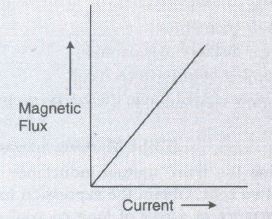
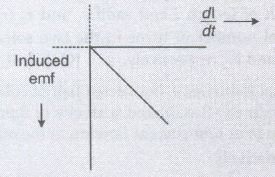
The current flowing through an inductor of self inductance L is continuously increasing. Plot a graph showing the variation of
(i) Magnetic flux versus the current
(ii) Induced emf versus dI/dt
(iii) Magnetic potential energy stored versus the current.
7.
An a.c. generator consists of a coil of 50 turns and area rotating at an angular speed of area \(2.5 \ { m }^{ 2 }\) rotating at an angular speed of \(60\ rad{ \ s }^{ -1 }\) in a uniform magnetic field B=0.3 T between two fixed pole pieces. The resistance of the circuit including that of the coil is \(500\Omega \) . Find
(i) the max. current drawn from the generator.
(ii) What will be the orientation of the coil w.r.t. the magnetic field to have (a) maximum (b) zero magnetic flux?
(iii) Would the generator work if the coil were stationary and instead, the pole pieces rotated together with the same speed as above?
8.
An a.c. generator consists of a coil of 100 turns and cross sectional area of \(3{ m }^{ 2 }\), rotating at a constant angular speed of 60 rad/sec in a uniform magnetic field of 0.04 T. The resistance of the coil is \(500 \ \Omega \). Calculate
(i) maximum current drawn from the generator and
(ii) max. power dissipation in the coil.
9.
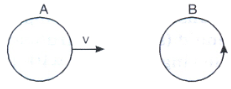
There are two coils A and B as shown in Fig. A current start flowing in B as shown, when A is moved towards B and stops when A stops moving. The current in A is counterclockwise. B is kept stationary when A moves. We can infer that
(a) there is a constant current in the clockwise direction in A.
(b) there is a varying current in A.
(c) there is no current in A.
(d) there is a constant current in the counterclockwise direction in A.
10.
A \(100\mu F\) capacitor in series with a \(40\Omega \) is connected to a 110 V, 60 Hz supply.
(a) What is the maximum current in the circuit?
(b) What is the time lag between the current maximum and the voltage maximum?
11.
A resistance of 40 is connected to an a.c. source of 220 V, 50 Hz. Find
(i) the rms current
(ii) maximum instantaneous current in the resistor
(iii) time taken by the current to change from max. value to rms value.
12.
The equation of a.c. in a circuit is I = 50 sin 100\(\pi\)t. Find
(i) frequency of a.c.
(ii) mean value of a.c.over positive half cycle
(iii) rms value of current and
(iv) value of current 1/600s after it was zero.
13.
The instantaneous current from an a.c. source is I = 5 sin 100\(\pi \) t. What is the frequency of a.c? What is the rms value of current?
14.
What is the root mean square value of current or effective current of an a.c. having a peak value of 5.0 amp? What will be the reading shown for this current by
(i) an a.c. ammeter
(ii) an ordinary moving coil ammeter?
15.
A capacitor of 1.0 \(\mu\)F is connected to series with a resistance of 104 ohm; and a battery of 2.0V. Find the maximum value of current and current after 0.02 s.
16.
An LC circuit a 20 mH inductor and a \(50\mu F\) capacitor with an initial charge of 10 mC. The resistance of the circuit is negligible. Let the instant the circuit is closed be t = 0.
(a) What is the total energy stored initially? IS it conserved during LC oscillations?
(b) What is the natural frequency of the circuit?
(c) At what time is the energy stored
(i) completely electrical (i.e., stored in the capacitor)?
(ii) completely magnetic (i.e., stored in the inductor).
(d) At what times is the total energy shared equally between the inductor and the capacitor?
(e) If a resistor is inserted in the circuit, how much energy is eventually dissipated as heat?
17.
An alternating current from a source is represented by I = 10 sin 314 t. What are the effective values of current and frequency of the source?
18.
For an a.c., can ever:
(a) r.m.s. value be equal to peak value?
(b) average value be equal to peak value?
(c) r.m.s. values be equal to average value
(d) all the three values be equal?
19.
A 110 V d.c. source replaces an a.c. source such that heat produced is same in the two cases. What is the rms value of alternating voltage sources.
20.
In India, domestic power supply is at 220 V, 50 hz, while in U.S.A, it is 110 V, 60 hz. Give one advantage and one disadvantages of 220 V supply over 110 V supply.
21.
What is the basic difference in the design of an a.c. generator and d.c. generator?
22.
If an AC main supply is given to be 220 V. What would be the average emf during a positive half-cycle?
198 V
386 V
256 V
None of these
23.
A 60 W load is connected to the secondary of a transformer whose primary draws line voltage of 220 V. If a current of 0.54 A flows in the load, then what is the current in the primary coil?
2.7 A
0.27 A
1.65 A
2.85 A
24.
What is not possible in a transformer?
Eddy current
Direct current
Alternating current
Induced current
25.
In a series L-C-R circuit, the capacitance Cis changed to 4C. To keep the resonant frequency same, the inductance must be changed by
2L
L/2
4L
L/4
26.
A resistance of 20 \(\Omega \) is connected to a source of an alternating potential, V = 220 sin (100\(\pi\)t). The time taken by current to change from its peak value to rms value is
0.2 s
0.25 s
25 x 10-3 s
2.5 x 10⁻³ s
27.
The peak voltage in a 220 V, AC source is
220 V
about 160 V
about 310 V
440 V
28.
Tthe line that draws power supply to your house from street has
zero average current
220V average voltage
voltage and current out of phase by \({ 90 }^{ \circ }\)
voltage and current possibly differing in phase \(\phi \) such that \(\left| \phi \right| <\frac { \pi }{ 2 } \)
29.
To reduce the reasonant frequency in an LCR series circuit with a generator
the generator frequency should be reduced
another capacitor should be added in parallel to the first
the iron core of the inductor should be removed
dielectric in the capacitor should be removed
30.
A metal plate is getting heated. It can be because
a direct current is passing through the plate
it is placed in a time varying magnetic field
it is placed in a space varying magnetic field, but does not vary with time
a current is passing through the plate
31.
A battery of 12V is connected to primary of a transformer with turns ratio ns/np= 10. Voltage across secondary would by
120 V
1.3 V
12 V
Zero
1.
The maximum emf induced in a generator is given by \(E_{0}=N B A \omega\)
When the speed of rotation (ω) is doubled:
(a) The frequency of ac will be doubled.
(b) The emf gets doubled.
(c) The mechanical power required to rotate the generator also gets doubled.
2.
Let an alternating current of I = Im sin ωt be passing through a network of L, C and R creating a potential difference of V = Vm sin \((\omega t \pm \phi) \text { where } \phi\) is the phase difference. Then the power consumed is given by \(P=V I=V_{m} I_{m} \sin (\omega t \pm \phi) \sin \omega t\)
\( \therefore \ P =V_{m} I_{m}(\sin \omega t \cos \phi \pm \cos \omega t \sin \phi) \sin \omega t \)
\(P =V_{m} I_{m}\left(\sin ^{2} \omega t \cos \phi \pm \frac{1}{2} \sin 2 \omega t \sin \phi\right) \)
\(P_{a v}=\frac{\int_{0}^{T} P d t}{\int_{0}^{T} P_{a v}=\frac{V_{m} I_{m}}{T}}\left[\begin{array}{l} \int_{0}^{T} \sin ^{2} \omega t \cos \phi d t \\ \quad+\frac{1}{2} \int_{0}^{T} \sin \phi \sin 2 \omega t d t \end{array}\right]\)
\(P_{a v}=\frac{V_{m} I_{m}}{T}\left[\frac{T}{2} \cos \phi+0\right]\left[\because \int_{0}^{T} \sin ^{2} \omega t d t=\frac{T}{2} \text { and } \int_{0}^{T} \sin 2 \omega t d t=0\right]\)
\(P_{a v}=\frac{V_{m} I_{m}}{2} \cos \phi=V_{\mathrm{rms}} I_{\mathrm{rms}} \cos \phi\)
(i) No power is dissipated if (a) resistance in the circuit is zero and (b) phase angle between voltage and current is π/2.
(ii) Maximum power is dissipated if (a) resistance in the circuit is maximum and (b) phase angle between voltage and current is zero.
3.
Given, input voltage, Vp = 2.5 x 10³ V
Input current, Ip = 20 A
Also, \(\frac{N_{p}}{N_{s}}=\frac{10}{1} \Rightarrow \frac{N_{s}}{N_{p}}=\frac{1}{10}\) ...........(i)
Percentage efficiency \(=\frac{\text { Output power }}{\text { Input power }} \times 100\)
\(\Rightarrow \ \frac{90}{100}=\frac{\text { Output power }}{V_{p} I_{p}}\)
(i) Output power \(=\frac{90}{100} \times\left(V_{p} I_{p}\right)\)
\(=\frac{90}{100} \times\left(2.5 \times 10^{3} \mathrm{~V}\right) \times(20 \mathrm{~A})\)
= 4.5 x 10⁴ W
(ii) \(\because \quad \frac{V_{s}}{V_{p}}=\frac{N_{s}}{N_{p}}\)
\(\Rightarrow \ V_{s}=\frac{N_{s}}{N_{p}} \times V_{p}\)
Voltage, \(V_{s}=\frac{1}{10} \times 2.5 \times 10^{3} \mathrm{~V}=250 \mathrm{~V}\)
(iii) Vs Is = 4.5 x 10⁴ W
Current, \(I_{s}=\frac{4.5 \times 10^{4}}{V_{s}}=\frac{4.5 \times 10^{4}}{250}=180 \mathrm{~A}\)
4.
(i) The town is 10 km away, length of pair of Cu wires
used, I = 20 km = 20000 m.
Resistance of Cu wires,
\(R=\rho \frac{l}{A}=\rho \frac{l}{\pi(r)^{2}}=\frac{1.7 \times 10^{-8} \times 20000}{3.14\left(0.5 \times 10^{-2}\right)^{2}} \approx 4 \Omega\)
\(I \text { at } 220 \mathrm{~V}, V I=10^{6} \mathrm{~W} ; I=\frac{10^{6}}{220}=0.45 \times 10^{4} \mathrm{~A}\)
RI2 = power loss = 4 x (0.45)2 x 10⁸> 106 W
Therefore, this method cannot be used for transmission.
(ii) When power, P = 106 W is transmitted at 11000 V.
V \('I'\)= 106 W = 11000 \(I'\)
Current drawn, \(I^{\prime}=\frac{1}{1.1} \times 10^{2}\)
Power loss \(=R I^{2}=\frac{1}{121} \times 4 \times 10^{6}=3.3 \times 10^{4} \mathrm{~W}\)
\(\therefore\) Fraction of power loss \(=\frac{3.3 \times 10^{4}}{10^{6}}=3.3 \%\)
5.
Given, Ep = 2200V , Es = 220 V, Np = 5000
Efficiency, \(\eta \) = 90%
Output power, p0 = 8kW
Since, efficiency,
\(\eta=\frac{\text { Output power }}{\text { Input power }}=\frac{P_{o}}{P_{i}}\)
\(\Rightarrow \quad P_{i}=\frac{P_{o}}{\eta}=\frac{8}{90 / 100}=8.9 \mathrm{~kW}\)
Also, \(\frac{N_s}{N_p}=\frac{E_s}{E_p} \Rightarrow N_s=\frac{E_s}{E_p} N_p=\frac{220}{2200} \times 5000\)
\(\Rightarrow\) Ns = 500
6.
(i) Magnetic flux versus current
(ii)
Alternatively
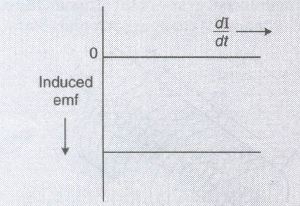
When Iis increasing at constant rate
(iii) Magnetic energy stored
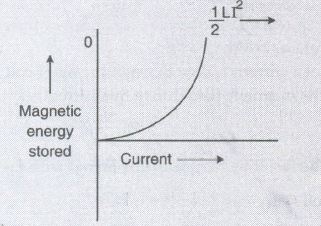
7.
(i) Here, \(N=50, \ A=2.5{ m }^{ 2 }, \ \omega =60 \ rad \ { s }^{ -1 }\)
\(B=0.3T, \ R=500\Omega ,\ { I }_{ 0 }=?\)
\({ I }_{ 0 }=\frac { { e }_{ 0 } }{ R } =\frac { NAB\omega }{ R } =\frac { 50\times 2.5\times 0.3\times 60 }{ 500 } \)
\(=4.5A\)
(ii) Magnetic flux will be max. if the coil is in the vertical position. On the other hand, magnetic flux will be zero if the coil is in the horizontal position.
(iii) Yes, the generator will work if the coil is stationary and instead, the pole pieces are rotated together.
8.
Here, \(N=100,\ A=3{ m }^{ 2 },\ \omega =60/sec.\)
\(B=0.04T,\ R=500\Omega ,\ { I }_{ 0 }=?,\ { P }_{ 0 }=?\)
\({ I }_{ 0 }=\frac { { E }_{ 0 } }{ R } =\frac { NAB\omega }{ R } =\frac { 100\times 3\times 0.04\times 60 }{ 500 } \)
\(=1.44A\)
Max. power dissipation \(={ E }_{ \upsilon }{ I }_{ \upsilon }\)
\(=\frac { { E }_{ 0 } }{ \sqrt { 2 } } \frac { { I }_{ 0 } }{ \sqrt { 2 } } =\frac { { I }_{ 0 }^{ 2 }R }{ 2 } =\frac { { \left( 1.44 \right) }^{ 2 }\times 500 }{ 2 } \)
\(=518.4 \ W\)
9.
(d) From Lenz's law we find that when A is moved towards B, current starts flowing in B and when A stops, the current also stops it means there is a constant current in anticlockwise direction in A.
10.
(a) Io = 3.23A
(b) 1.55ms
11.
\(Here, \ R=40\Omega , \ { E }_{ v }=220V, \ v=50Hz,\)
\((i) \ { I }_{ v }=\frac { { E }_{ v } }{ R } =\frac { 220 }{ 40 } =5.5 \ A\)
\({ I }_{ 0 }=\sqrt { 2 } { I }_{ v }=1.414\times 5.5=7.8 \ A\)
If alternating current is given by
\(I={ I }_{ 0 } \ sin \ \omega t, \ then\)
\({ I }_{ 0 }={ I }_{ 0 } \ sin{ \omega t }; \ sin \ { \omega t }_{ 1 }=1 \ or \ { \omega t }_{ 1 }=\frac { \pi }{ 2 }\)
\(and \ { I }_{ v }=\frac { { { I } }_{ 0 } }{ \sqrt { 2 } } ={ I }_{ 0 }sin{ \ \omega t }_{ 2 }, \ which \ implies\)
\({ \omega t }_{ 2 }=\frac { \pi }{ 2 } +\frac { \pi }{ 4 } \ \ \therefore \omega \left( { t }_{ 2 }-{ t }_{ 1 } \right) =\frac { \pi }{ 2 } +\frac { \pi }{ 4 } -\frac { \pi }{ 2 } =\frac { \pi }{ 4 }\)
\({ t }_{ 2 }-{ t }_{ 1 }=\frac { \pi }{ 4\omega } =\frac { \pi }{ 4\times 2\pi v } =\frac { 1 }{ 8v } =\frac { 1 }{ 8\times 50 } =2.5\times { 10 }^{ -3 }s=2.5 \ ms\)
12.
Here, I = 50 sin 100\(\pi\)t.
Compare it with I = I0 sin \(\omega\)t = I0 sin 2\(\pi\)vt
I0 = 50A, 2\(\pi\)v = 100, v = 50c/s
Mean value of a.c. over positive half cycle
\(=\frac { 2{ I }_{ 0 } }{ \pi } =\frac { 2\times 50 }{ 3.14 } =31.8A\)
\({ I }_{ v }=\frac { { I }_{ 0 } }{ \sqrt { 2 } } =\frac { 50 }{ 1.414 } =35.35A\)
\(From \ I={ I }_{ 0 }sin \ \omega t\)
\(I=50\ sin\ 2\pi \times 50\times \frac { 1 }{ 600 } =50\times \frac { 1 }{ 2 } =25A\)
13.
\(Here,\ I=5sin\ 100\pi t\)
\( Compare\ with\ I={ I }_{ 0 }sin\ \omega t\)
\({ I }_{ 0 }=5A,\ \omega =2\pi v=100\pi\)
\(v=\frac { 100\pi }{ 2\pi } =50 \ Hz\)
\(\ { I }_{ v }=\frac { { I }_{ 0 } }{ \sqrt { 2 } } =\frac { 5 }{ \sqrt { 2 } } =\frac { 5\sqrt { 2 } }{ 2 } =3.54A\)
14.
Here, Iv = ? I0 = 5.0 A
As \({ I }_{ v }=\frac { { I }_{ 0 } }{ \sqrt { 2 } } \)
\(\therefore \ \ { I }_{ v }=\frac { 5 }{ \sqrt { 2 } } \times \frac { \sqrt { 2 } }{ \sqrt { 2 } } =\frac { 5\times 1.414 }{ 2 } =3.54A\)
(i) An a.c. ammeter will read 3.54 ampere
(ii) An ordinary moving coil ammeter will read zero because it records average value of current over a complete cycle, which is zero in case of alternating current.
15.
\(Here, \ C=1.0\mu F={ 10 }^{ -6 }F\)
\(R={ 10 }^{ 4 }ohm, \ { E }_{ 0 }=2.0volt\)
\(During \ charging \ of \ the \ condenser,\)
\(q={ q }_{ 0 }\left( 1-{ e }^{ -t/RC } \right) \ I=-{ I }_{ 0 }{ e }^{ -t/RC }, \ where\)
\({ I }_{ 0 }=\frac { E }{ R } =\frac { 2.0 }{ { 10 }^{ 4 } } =2.0\times { 10 }^{ -4 }amp\)
\(At \ t=0.02s, \ I={ I }_{ 0 }\left( { e }^{ -0.02/{ 10 }^{ 4 }\times { 10 }^{ -6 } } \right) =2\times { 10 }^{ -4 }{ e }^{ -2 }\)
\(=\frac { 2\times { 10 }^{ -4 } }{ { e }^{ 2 } } =\frac { 2\times { 10 }^{ -4 } }{ \left( 2.718 \right) ^{ 2 } } =0.27\times { 10 }^{ -4 }A\)
\(I=27\times { 10 }^{ -6 } \ A=27\mu A\)
16.
(a) 1.0 J, yes
(b) \(\omega \) = 103 rad s-1, v = 159 Hz
(c) 1.0 J
17.
\(Here,I=10 \ sin \ 314 \ t;\)
\(Compare \ it \ with \ I={ I }_{ 0 }sin \ \omega \ t\)
\(\ { I }_{ 0 }=10amp,{ I }_{ eff }=\frac { { I }_{ 0 } }{ \sqrt { 2 } } =\frac { 10 }{ \sqrt { 2 } } =7.07A\)
\( \omega =314=3.14 \times 100=100\pi \)
\( v=\frac { \omega }{ 2\pi } =\frac { 100\pi }{ 2\pi } =50Hz\)
18.
Yes, when the a.c. is a square wave, r.m.s. value, average value and peak value of a.c. are equal. Choice(d) is correct.
19.
As heat produced is the same, rms voltage of a.c. source = d.c. voltage = 110 V
20.
For transfer of power \(\left( =V\times I \right) \) at higher voltage (220 V instead of 110 V), current carried by wires is just half. Therefore, such wires need not be very thick, saving lot of transmission material and reducing the cost of transmission. This is one advantage of 220 V supply. But to design a device of particular wattage, \(P=\frac { { V }^{ 2 } }{ R } \) , as \({ V }^{ 2 }\) is 4 times, R must be four times. If not, the dissipation of power in the form of heat will be larger on 220 V supply. This is one disadvantage of this supply.
21.
The slip ring arrangement in an a.c. generator is replaced by split ring arrangement or commutator arrangement in d.c. generator.
22.
(a)
198 V
23.
(b)
0.27 A
24.
(b)
Direct current
25.
(d)
L/4
26.
(d)
2.5 x 10⁻³ s
27.
(c)
about 310 V
28.
(d)
voltage and current possibly differing in phase \(\phi \) such that \(\left| \phi \right| <\frac { \pi }{ 2 } \)
29.
(b)
another capacitor should be added in parallel to the first
30.
(a)
a direct current is passing through the plate
31.
(d)
Zero

12th Standard CBSE Syllabus & Materials
12th Standard CBSE
CBSE 12th Computer Science Python Revision Tour I - New Previous year Question Papers Study Material - QB365 Set A
NEW12th Standard CBSE
CBSE 12th Business Studies Planning Important Questions And Answers Study Material - QB365 Set A
NEW12th Standard CBSE
CBSE 12th Business Studies Business Environment Important Questions And Answers Study Material - QB365 Set A
NEW12th Standard CBSE
CBSE 12th Business Studies Principles of Management Important Questions And Answers Study Material - QB365 Set A



NCERT Books

Syllabus

Exam Pattern

Sample Question Papers

Previous year Question Papers

Important Notes

MCQ Practice test

NCERT Exemplers

Case study Questions

Image Based Questions

Passage based Questions

HOT Questions

Value Based Questions

Model Questions Papers
NCERT ( Book Back ) Questions

Assertion and Reason
Important Questions And Answers

CBSE 12th Standard CBSE Subjects
CBSE Standards








