
 100% FREE ACCESS
12th Standard CBSE Syllabus & Materials
12th Standard CBSE
CBSE 12th Economics Government Budget and the Economy Previous year Question Papers Study Material - QB365 Set A
NEW12th Standard CBSE
CBSE 12th Computer Science Interface Python with MySQL - New Previous year Question Papers Study Material - QB365 Set A
NEW12th Standard CBSE
CBSE 12th Computer Science Database Concept - New Previous year Question Papers Study Material - QB365 Set A
NEW12th Standard CBSE
CBSE 12th Computer Science Data Communication - New Previous year Question Papers Study Material - QB365 Set A
NEW12th Standard CBSE
CBSE 12th Computer Science Data Structures - New Previous year Question Papers Study Material - QB365 Set A
NEW12th Standard CBSE
CBSE 12th Computer Science Functions - New Previous year Question Papers Study Material - QB365 Set A

Published on: 25/10/2025
Download CBSE Class 12th Standard CBSE Physics question papers, sample papers, important questions, and previous year solved papers in PDF format. Get free study materials, NCERT solutions, and exam preparation resources for Class 12th Standard CBSE Physics
Questions + Answers key
Take MCQ Physics Test
1.
Define root mean square current. Also, obtain its expression.
2.
A capacitor has a reactance of 100\(\Omega \) at 50 Hz. What will be its reactance at 125 Hz?
3.
A resistance of \(40\ \Omega \) is connected to an a.c. source of 220 V, 50 Hz. Find the (i) rms current, (ii) maximum instantaneous current in resistor.
4.
A coil of inductance 50H is connected to a battery of emf 2V through a resistance of 10 ohm. What is the time constant of the circuit and maximum value of current in the circuit?
5.
A coil has a self inductance of 10 mH. What is the maximum magnitude of the induced emf in the inductor, when a current I = 0.1 sin 200 t ampere is sent through it.
6.
A 12 V resistance and an inductance of \(\frac { 0.05 }{ \pi } H\) are connected in series.Across the end of this ciuit an alternating voltage of 130 V and frequency 50 Hz is connected. Calculate the current in the circuit and the potential difference across the inductance.
7.
Find the capacitance of capacitor to run a \(30V\), \(10W\) lamp, when connected in series to an alternating e.m.f of \(220V\) at \(50Hz\) .
8.
The magnetic flux linked with a coil varies with time according to equation where is in weber and time is in milli-sec. What is the magnitude of induced e.m.f at t = 1s?
9.
A \(60\mu F\) capacitor is connected to a \(110V\),\(60Hz\) a.c.supply. Determine the rms value of the current in the circuit.
10.
why does a motor take more current when we start it?
11.
Write the function of a transformer. State its principle of working with the help of a Mention diagram. various energy losses in this device.
12.
A series RL circuit with R =10 2 an L=\(\left(\frac{100}{\pi}\right)\) mH is connected to an AC source of voltage V=141sin(100 \(\pi\) t), where V is in volts and t is in seconds. Calculate
(i) impedance of the circuit
(ii) phase angle, and
(ii) voltage drop across the inductor
13.
A circuit is set up by connecting inductance L = 100 mH, resistor R = 100 Ω and a capacitor of reactance 200 Ω in series. An alternating emf of \(15 \sqrt{2} \mathrm{~V}\) 500/π Hz is applied across this series combination. Calculate the power dissipated in the resistor.
14.
A coil of 0.01 H inductance and 1 \(\Omega\) resistance is connected to 200 V, 50 Hz AC supply. Find the impedance of the circuit and time lag between maximum alternating voltage and current.
1.
The rms current is that value of current which produces the same amount of heat as is produced by the alternating current when flows through the same conductor for the same time period.
Let an instantaneous current I = Im sin rot is passing through a resistor R. Let it be constant for a very short duration of time dt.
Then, very small amount of heat produced is given by dH = I2R dt
Heat produced for one complete cycle is given by
\(H=\int_{o}^{T} d H=\int_{o}^{T} I^{2} R d t\)
\( \therefore \ H =\int_{0}^{T} I_{m}^{2}\left(\sin ^{2} \omega t\right) R d t=I_{m}^{2} R \int_{0}^{T} \sin ^{2} \omega t d t \)
\(=I_{m}^{2} R \int_{t=0}^{T}\left(\frac{1-\cos 2 \omega t}{2}\right) d t \)
\(H =\frac{I_{m}^{2} R}{2}\left[\int_{0}^{T} d t-\int_{0}^{T}(\cos 2 \omega t) d t\right] \)
\(=\frac{I_{m}^{2} R}{2}\left\{T-\left[\frac{\sin 2 \omega t}{2 \omega}\right]_{0}^{T}\right\} \)
\( \text { As } \omega=2 \pi / T \)
\(\mathrm{H}=\frac{I_{m}^{2} R T}{2}-\frac{I_{m}^{2} R}{2}\left[\sin 2 \times \frac{2 \pi}{T} \times T-\sin 0\right] \)
\((\because \sin 4 \pi=\sin 0=0) \)
\(\therefore \ \mathrm{H}=\frac{I_{m}^{2} R T}{2}\)
\(\)If Irms is steady current flowing through the same circuit for the same time interval T producing the same amount of heat H, then the heat produced is
\(H=I_{\mathrm{rms}}^{2} R T\) .......(ii)
Equating (i) and (ii), we get
\( \frac{I_{\mathrm{m}}^{2} R T}{2}=I_{\mathrm{rms}}^{2} R T \)
\(\therefore \frac{I_{\mathrm{m}}}{\sqrt{2}}=I_{\mathrm{rms}} \ \text { or } \ I_{\mathrm{rms}}=0.707 I_{\mathrm{m}} \)
2.
Here, \(X_{ C }=100\Omega ,\ v=50\ Hz\)
\(X'_{ C }=? \ v'=125 \ Hz\)
As \(X_{ C }\propto \frac { 1 }{ v } \therefore \frac { X'_{ C } }{ X_{ C } } =\frac { v }{ v' } =\frac { 50 }{ 125 } =0.4\)
\(X'_{ C }=0.4X_{ C }=40\Omega \)
3.
Here, \(R=40\ \Omega ,\ E_{ v }=200V \ v=50Hz\)
\(I_{ v }=\frac { E_{ v } }{ R } =\frac { 220 }{ 40 } =5.5\ A\)
Max. instantaneous current, \(I_{ v }\)
\(=1.414\times 5.5=7.8\ A\)
4.
Here, L = 50H, E = 2V, R = 10 ohm, \(\tau =?,\ I_{ 0 }\)
\(\tau =\frac { L }{ R } =\frac { 50 }{ 10 } =5s\)
\(I_{ 0 }=\frac { E }{ R } =\frac { 2 }{ 10 } =0.2A\)
5.
\(Here,L=10 \ mH=10 \times { 10 }^{ -3 }H={ 10 }^{ -2 }H\)
\(I=0.1 \ sin \ 200 \ t\)
\( \frac { dI }{ dt } =0.1 \ cos \ 200t \times 200=20 \ cos \ 200t\)
\({ (\frac { dI }{ dt } ) }_{ ma \times }=20 \times 1\)
\( As \ e=L(dI/dt)\)
\(\\ \therefore { \ \ e }_{ ma \times }=L{ \ (dI/dt) }_{ ma \times }={ 10 }^{ -2 } \times 20=0.2 \ V\)
6.
\( { I }_{ v }=\frac { { E }_{ v } }{ Z } =\frac { 130 }{ 2 } \ \ ...(i)\)
\(Since \ \ Z=\sqrt { { R }^{ 2 }+{ X }_{ L }^{ 2 } } =\sqrt { { \left( 12 \right) }^{ 2 }{ +\left( 2\pi vL \right) }^{ 2 } }\)
\(=\sqrt { { \left( 12 \right) }^{ 2 }+{ \left( 2\pi \times 50\times \frac { 0.05 }{ \pi } \right) }^{ 2 } } \)
\(or \ Z=\sqrt { 144+{ \left( 5 \right) }^{ 2 } } =13\Omega \)
\(So \ \ { I }_{ v } \ =\frac { 130 }{ 13 } =10 \ A\)
\(\\ And \ \ { E }_{ L }={ X }_{ L }I=5\times 10=50 \ V\)
7.
\(Given \ E=220V, \ v=50Hz,\)
\(P=10W, \ voltage \ of \ lamp=30V\)
\(=\frac { 10 }{ 30 } =\frac { 1 }{ 3 } A\)
\(R=\frac { 30 }{ { 1 }/{ 3 } } =90\Omega\)
\(Z=\frac { E }{ I } \)
\(=\frac { 220 }{ { 1 }/{ 3 } } =600\Omega\)
\( Z=\sqrt { { R }^{ 2 }+\frac { 1 }{ { \omega }^{ 2 }{ C }^{ 2 } } }\)
\(=\sqrt { { R }^{ 2 }+\frac { 1 }{ 4{ \pi }^{ 2 }{ v }^{ 2 }{ C }^{ 2 } } }\)
\(or \ \ 600=\sqrt { { (90) }^{ 2 }+\frac { 1 }{ { C }^{ 2 }\times 4\times { \pi }^{ 2 }\times { 50 }^{ 2 } } }\)
\( \\ or \ C=4.866\times { 10 }^{ -6 }F\)
\(=4.866\mu F\)
8.
Given \(\phi =5{ t }^{ 2 }+7t+9,t=1s=1000ms\)
\(\therefore \) magnitude of induced e.m.f.
\(e=\left| e \right| =\frac { d\phi }{ dt } =\frac { d }{ dt } \left( 5{ t }^{ 2 }+7t+9 \right) \)
\(=10t+7\)
\(=10\times 1000+7=10007V.\)
9.
\(Given \ C=60\mu F=60\times { 10 }^{ -6 }F\)
\( { \ E }_{ v }=110V,v=60Hz\)
\(Since \ { I }_{ v }=\frac { { E }_{ v } }{ { X }_{ C } }\)
\(\therefore \ { I }_{ v }=\omega C{ E }_{ v }=2\pi v \ C \ { E }_{ v }\)
\( =2\times 3.142\times 60\times 60\times 60\times { 10 }^{ -6 }\times 110\)
\( =2.49A\)
\(or \ { I }_{ v }=2.49A\)
10.
When we start the motor, there is no back emf as the motor is at rest. So, a large current flows through the coil. As the motor rotates, the back emf increases and intake of current decreases.
11.
Conversion of ac of low voltage into ac of high voltage & vice versa. Mutual induction : When alternating voltage is applied to primary windings, emf is induced in the secondary windings.
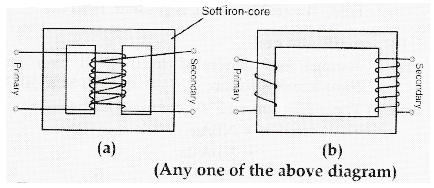
Energy losses :
(a) Leakage of magnetic flux
(b) Eddy currents
(c) Hysteresis loss
(d) Copper loss
12.
\(\begin{aligned} & R=10 \Omega \\ & L=\left(\frac{100}{\pi}\right) \mathrm{mH}=\frac{100}{\pi} \times 10^{-3} \mathrm{H} \\ & V=141 \sin (100 \pi t) \end{aligned}\)
\( \therefore V_0 =141 \mathrm{~V} \)
\(\therefore \omega t =100 \pi t \)
\( \Rightarrow 2 \pi f =100 \pi \)
\(\Rightarrow f =50 \mathrm{~Hz} \)
\(\text { (i) } Z =\sqrt{\left(X_L\right)^2+R^2=\sqrt{(10)^2+(2 \pi / L)^2}} \)
\(=\sqrt{100+\left(2 \times \pi \times 50 \times \frac{100}{\pi} \times 10^{-3}\right)^2} \)
\(=\sqrt{100+\left(100 \times 100 \times 10^{-3}\right)^2} =\sqrt{100+\left(10^4 \times 10^{-3}\right)^2} \)
\(\begin{aligned} =\sqrt{100+(10)^2} & \equiv \sqrt{200}=10 \sqrt{2} \Omega \end{aligned}\)
\(\text { (ii) } \therefore \tan \phi =\frac{\omega L}{R}=\frac{2 \times \pi \times 50 \times \frac{100}{\pi} \times 10^{-3}}{10} \)
\(=\frac{100 \times 100 \times 10^{-3}}{10}=1 \)
\( \Rightarrow \phi =45^{\circ} \)
\(\text { (iii) } V_L =I X_L=\frac{V_{\text {ras }}}{Z} \cdot \omega L \)
\(=\frac{14 \mathrm{I}}{\sqrt{2} \times 10 \sqrt{2}} \times 100 \pi \times \frac{100}{\pi} \times 10^{-3}=705 \mathrm{volt} \)
13.
\(
\text { Given: } L=100 \times 10^{-3} \mathrm{H}, R=100 \Omega, X_{C}=200 \Omega,
V_{\mathrm{rms}}=15 \sqrt{2} \mathrm{~V}
\)
\(
v =\frac{500}{\pi} \mathrm{Hz}
\)
\(\therefore \quad X_{L} =2 \pi v L
\)
\(=2 \pi \times \frac{500}{\pi} \times 100 \times 10^{-3}=100 \Omega\)
The impedance of the circuit is given by
\(
Z =\sqrt{R^{2}+\left(X_{C}-X_{L}\right)^{2}}
\)
\(=\sqrt{(100)^{2}+(200-100)^{2}}
\)
\(Z =\sqrt{2 \times 10^{4}}=\sqrt{2} \times 100
\)
\(\text { and } \ I_{\mathrm{rms}} =\frac{V_{\mathrm{rms}}}{Z}=\frac{15 \sqrt{2}}{\sqrt{2} \times 100}=0.15 \mathrm{~A}
\)
Power dissipated is given by
\(
P =\left(I_{\mathrm{rms}}\right)^{2} \times R
\)
\(
=(0.15)^{2} \times 100=2.25 \mathrm{~W}
\)
14.
Given, inductance, L = 0.01 H
Resistance, R = 1 \(\Omega\)
Voltage, V = 200 V
Frequency, v = 50 Hz
Impedance of the circuit, Z \(=\sqrt{R^{2}+X_{L}^{2}}\)
\(=\sqrt{R^{2}+(2 \pi V L)^{2}}=\sqrt{1^{2}+(2 \times 3.14 \times 50 \times 0.01)^{2}}\)
\(=\sqrt{10.86}=3.3 \Omega\)
\(\tan \phi=\frac{\omega L}{R}=\frac{2 \pi v L}{R}=\frac{2 \times 3.14 \times 50 \times 0.01}{1}=3.14\)
\(\Rightarrow \quad \phi=\tan ^{-1}(3.14) \approx 72^{\circ}\)
Phase difference, \(\phi=\frac{72 \times \pi}{180} \mathrm{rad}\)
Time lag between maximum alternating voltage and current,
\(\Delta t=\frac{\phi}{\omega}=\frac{72 \pi}{180 \times 2 \pi \times 50}=\frac{1}{250} \mathrm{~s}\)

12th Standard CBSE Syllabus & Materials
12th Standard CBSE
CBSE 12th Computer Science Python Revision Tour I - New Previous year Question Papers Study Material - QB365 Set A
NEW12th Standard CBSE
CBSE 12th Business Studies Planning Important Questions And Answers Study Material - QB365 Set A
NEW12th Standard CBSE
CBSE 12th Business Studies Business Environment Important Questions And Answers Study Material - QB365 Set A
NEW12th Standard CBSE
CBSE 12th Business Studies Principles of Management Important Questions And Answers Study Material - QB365 Set A



NCERT Books

Syllabus

Exam Pattern

Sample Question Papers

Previous year Question Papers

Important Notes

MCQ Practice test

NCERT Exemplers

Case study Questions

Image Based Questions

Passage based Questions

HOT Questions

Value Based Questions

Model Questions Papers
NCERT ( Book Back ) Questions

Assertion and Reason
Important Questions And Answers

CBSE 12th Standard CBSE Subjects
CBSE Standards








