
 100% FREE ACCESS
12th Standard CBSE Syllabus & Materials
12th Standard CBSE
CBSE 12th Economics Government Budget and the Economy Previous year Question Papers Study Material - QB365 Set A
NEW12th Standard CBSE
CBSE 12th Computer Science Interface Python with MySQL - New Previous year Question Papers Study Material - QB365 Set A
NEW12th Standard CBSE
CBSE 12th Computer Science Database Concept - New Previous year Question Papers Study Material - QB365 Set A
NEW12th Standard CBSE
CBSE 12th Computer Science Data Communication - New Previous year Question Papers Study Material - QB365 Set A
NEW12th Standard CBSE
CBSE 12th Computer Science Data Structures - New Previous year Question Papers Study Material - QB365 Set A
NEW12th Standard CBSE
CBSE 12th Computer Science Functions - New Previous year Question Papers Study Material - QB365 Set A

Published on: 25/10/2025
Download CBSE Class 12th Standard CBSE Physics question papers, sample papers, important questions, and previous year solved papers in PDF format. Get free study materials, NCERT solutions, and exam preparation resources for Class 12th Standard CBSE Physics
Questions + Answers key
Take MCQ Physics Test
1.
A 30cm long conductor moves normal to a uniform magnetic field of 0.05 T at \(20 \ { ms }^{ -1 }\). Calculate the induced e.m.f.
2.
A \(44mH\) inductor is connected to \(220V\),\(50Hz\) ac supply.Determine the rms value of the current in the circuit.
3.
When current in a coil changes with time, how is the back e.m.f. induced in the coil related to it?
4.
A \(100\mu F\) capacitor in series with a \(40\Omega \) is connected to a 110 V, 60 Hz supply.
(a) What is the maximum current in the circuit?
(b) What is the time lag between the current maximum and the voltage maximum?
5.
(i) Define self-inductance. Write its SI unit.
(ii) A long solenoid with 15 turns per cm has a small loop of area 2.0 cm2 placed inside normal to the axis. If the current carried by the solenoid changes steadily from 2.0 A to 4.0 A in 0.1 s, what is the induced emf in the loop while the current is changing?
6.
A resistor of \(400\Omega \) an inductor of \(\frac { 5 }{ \pi H } \)and a capacitor of \(\frac { 50 }{ \pi } \mu F\) are connected in series across a source of alternating voltage of 140 \(sin\ \pi t\ V\). Find the voltage (rms) across the resistor, the inductor and the capacitor. Is the algebraic sum of these voltage more than the source voltage? If yes, resolve the paradox.
7.
Define electromagnetic induction, magnetic flux linked with a given area and magnetic induction. What are their units? When is magnetic flux taken (i) positive and (ii) negative.
8.
An LC circuit a 20 mH inductor and a \(50\mu F\) capacitor with an initial charge of 10 mC. The resistance of the circuit is negligible. Let the instant the circuit is closed be t = 0.
(a) What is the total energy stored initially? IS it conserved during LC oscillations?
(b) What is the natural frequency of the circuit?
(c) At what time is the energy stored
(i) completely electrical (i.e., stored in the capacitor)?
(ii) completely magnetic (i.e., stored in the inductor).
(d) At what times is the total energy shared equally between the inductor and the capacitor?
(e) If a resistor is inserted in the circuit, how much energy is eventually dissipated as heat?
9.
A 110 V d.c. source replaces an a.c. source such that heat produced is same in the two cases. What is the rms value of alternating voltage sources.
10.
What are the advantages of three phase a.c.?
11.
What is the basic difference in the design of an a.c. generator and d.c. generator?
12.
Can a transformer work on d.c.?
13.
Explain why resistance coils are usually double wound.
14.
Can one have an inductance without a resistance ? How about a resistance with an inductance?
15.
Show that the rate of change of magnetic flux has the same units as induced e.m.f.
16.
An artificial satellite with a metal surface is orbiting the earth around the equator : Will the earth's magnetism induce some current in it ?
17.
Write an expression for mutual inductance of two co-axial solenoids.
18.
Are eddy currents useful or harmful ?
19.
The inductance of a coil is 0.25H. Calculate its inductive reactance in a.c. of frequency 50 Hz.
20.
The self induced emf in a coil when current charges on it is given by.
21.
The induced e.m.f. is sometimes called back e.m.f. Why ?
22.
Name the S.I. units of magnetic flux and magnetic induction.
23.
A vertical metallic pole falls down through the plane of magnetic meridian. Will any e.m.f. be induced between its ends ?
24.
Does change in magnetic flux induce e.m.f. or current ?
25.
What is the relation between weber and Maxwell ?
26.
When an AC voltage of 220V is applied to the capacitor C
the maximum voltage between plates is 220V
the current is in phase with he applied voltage
The charge on the plates is in phase with the applied voltage
power delivered to the capacitor is zero
27.
The power factor of an a.c. circuit is given by cos \(\phi \)=
\(\frac { R }{ Z } \)
\(\frac { Z }{ R } \)
\(\frac { R }{ { X }_{ L } } \)
\(\frac { R }{ { X }_{ C } } \)
28.
Q factor of resonance is given by
\(\frac { 1 }{ R } \sqrt { \frac { L }{ C } } \)
\(\frac { 1 }{ R } \sqrt { \frac { C }{ L } } \)
\(\frac { 1 }{ L } \sqrt { \frac { R }{ C } } \)
\(\frac { 1 }{ C } \sqrt { \frac { L }{ R } } \)
29.
Phase difference between voltage across L and C in series is
\({ 0 }^{ \circ }\)
\({9 0 }^{ \circ }\)
\({180 }^{ \circ }\)
\({ 360 }^{ \circ }\)
30.
The peak value of 220 V a.c. is
220V
\(\frac { 220 }{ \sqrt { 2 } } V\)
440V
\(220\sqrt { 2 } V\)
31.
When number of turns of a soleniod is doubled, its self inductance becomes k times, where k =
2
1
8
4
32.
Which one is not an application of eddy currents?
Magnetic brakes
speedometers
Induction furnace
Transformers
33.
Choose the wrong statement:
When ever the amount of magnetic flux linked with a circuit changes, an e.m.f. is induced in the circuit.
The induced e.m.f. lasts so long as the change in magnetic flux continues
Large the amount of magnetic flux linked with a circuit, greater is the e.m.f. induced in it.
The direction of induced e.m.f. is given by Lenz's Llaw.
34.
SI unit of magnetic flux is
henry
weber
coulomb
volt
35.
In the relation \(\phi \) = BA cos \(\theta \), \(\theta \) is angle........
which normal to surface area makes with the direction of magnetic field
which magnetic field makes with the surface
which is never constant
none of the above
1.
Given \(l=30cm=0.3m\)
\(B=0.05T\)
\(\upsilon =20{ ms }^{ -1 }\)
\(\therefore \) Induced e.m.f.
\(e=Bl\upsilon =0.05\times 0.3\times 20=3 \ V\)
2.
\(Given \ L=44mH=44\times { 10 }^{ -3 }H\)
\( { \ E }_{ v }=220V,v=50Hz\)
\({ \ I }_{ v }=?\)
\(Since \ { I }_{ v }=\frac { { E }_{ v } }{ { X }_{ L } } =\frac { 220 }{ \omega L }\)
\( \therefore \ { I }_{ v }=\frac { 220 }{ 2\pi vL } \)
\(or \ { I }_{ v }=\frac { 2220 }{ 2\times 3.142\times 50\times 44\times { 10 }^{ -3 } } \)
\(=15.9A\)
3.
The back emf in the coil opposes the change in the current as per Lenz's law.
4.
(a) Io = 3.23A
(b) 1.55ms
5.
Self-Inductance When the current in a coil is changed, a back emf is induced in the same coil. This phenomenon is called self-inductance. If Lis self-inductance of coil, then
\(N\phi \propto I\Rightarrow N\phi =LI\Rightarrow L=\frac { N\phi }{ I } \)
The SI unit of self-inductance is Henry (H).
(ii) Mutual inductance of solenoid coil system
\(M=\frac { { \mu }_{ 0 }{ N }_{ 1 }{ N }_{ 2 }{ A }_{ 2 } }{ l } \)
Here, N1 = 15, N2 = 1, l = 1cm = 10-2m,
A = 2.0cm2 = 20 x 10-4m2
∴ \(M=\frac { 4\pi \times { 10 }^{ -7 }\times 15\times 1\times 2.0\times { 10 }^{ -4 } }{ { 10 }^{ -2 } } \)
\(=120\pi \times { 10 }^{ -9 }H\)
Induced emf in the loop
\({ \varepsilon }_{ 2 }=M\frac { { \Delta I }_{ 1 } }{ { \Delta t } } (numerically)=20\pi \times { 10 }^{ -9 }\frac { \left( 4-2 \right) }{ 0.1 } \)
\(=120\times 3.14\times { 10 }^{ -9 }\times \frac { 2 }{ 0.1 } =7.5\times { 10 }^{ -6 }V=7.5\mu V\)
6.
Applied voltage, V = 140 \(sin\ 100\pi t\ V\)
\(C \ = \ \frac { 50 }{ \pi } \mu F=\frac { 50 }{ \pi } \times { 10 }^{ -6 }F.\\ L \ = \ \frac { 5 }{ \pi } H, \ R=400\Omega \)
Comparing with V = V0 \(sin\ \omega t,\) we get
V0 = 140 V and \(\omega =100\pi \)
Inducting reactance,
\({ X }_{ L }=\omega L=100\pi \times \frac { 5 }{ \pi } =500\Omega \)
Capacitive reactance,
\({ X }_{ C }=\frac { 1 }{ \omega C } =\frac { 1 }{ 100\pi \times \frac { 50 }{ \pi } \times { 10 }^{ -6 } } \)
\(=200\Omega \quad \)
Impedance of the circuit,
\(Z=\sqrt { { R }^{ 2 }+({ X }_{ L }-{ X }_{ C })^{ 2 } } \)
\(=\sqrt { ({ 400) }^{ 2 }+({ 500-200) }^{ 2 } } \)
\( =\sqrt { 1600+900 } \ = \ 500\Omega \)
Maximum current in the circuit,
\({ I }_{ 0 }=\frac { { V }_{ 0 } }{ Z } =\frac { 140 }{ 500 }\)
\( { I }_{ rms }=\frac { { I }_{ 0 } }{ \sqrt { 2 } } =\frac { 140 }{ 500\times \sqrt { 2 } } =0.2\quad A\)
\({ V }_{ rms }\) across resistor, VR = Irms R
\(=0.2\times 400\ =\ 80V\)
Vrms across capacitor, VC = Irms XL
\(=0.2\times 200\ =\ 40V\)
Now, \(V\neq { V }_{ R }+{ V }_{ L }+{ V }_{ C }\)
Because VC,VL and VR are not in same phase, instead
\(V=\sqrt { { V }_{ R }^{ 2 }+({ V }_{ L }-{ V }_{ C })^{ 2 } } \)
\(=\sqrt { { 80 }^{ 2 }+({ 100-40) }^{ 2 } } =100V\)
Which is same as that of applied rms voltage.
7.
Electromagnetic induction
Electromagnetic induction may be defined as the phenomenon of production of electric current (or e.m.f.) in a closed coil (or circuit), when magnetic flux linked with the coil (or circuit) is changed.
Magnetic flux \(\left( \phi \right) \). The total number of lines of induction passing normally through a given area is called magnetic flux. Consider a surface A. Take a small element of area dA. If \(\overrightarrow { B } \) makes an angle \(\theta \) with the area vector \(d\overrightarrow { A } \), then magnetic flux linked with area dA will be
\(d\phi =\overrightarrow { B } .d\overrightarrow { A } \)
(where area vector is a vector \(d\overrightarrow { A } \) having magnitude dA and direction normal to \(dA\))
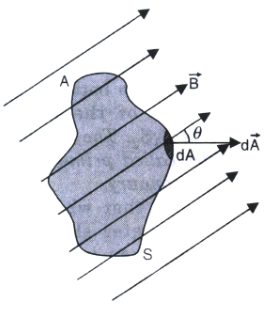
Total magnitude flux linked with the whole surface S will be
\(\phi =\int { \overrightarrow { B } .d\overrightarrow { A } } \)
If the surface is plane and having area S, then
\(\phi =\overrightarrow { B } .\overrightarrow { A } \)
or \(\phi =BA\cos { \theta } \) .....(1)
Units of \(\phi \)
If \(B=1T,A=1{ m }^{ 2 },\theta ={ 0 }^{ ° },then\quad \phi =1Wb.\)
Hence magnetic flux is said to be 1 weber (1Wb) if a magnetic field of 1 tesla is normal to the area of 1 \({ m }^{ 2 }.\)
So \(1Wb=1T{ m }^{ 2 }\)
Magnetic induction (B). It is defined as the magnetic flux associated per unit area.
i.e. \(B=\frac { \phi }{ A } \)
Units. In S.I. the unit of B is Wb \({ m }^{ 2 }\) or tesla (T).
Positive and negative flux
Since \(\phi =BA\cos { \theta } \)
So (I) \(If \ \theta >{ 90 }^{ ° },\phi =-ve\left( i.e. \ \phi \ is \ inward \ the \ surface \right) \)
(ii) \(If \ \theta <{ 90 }^{ ° },\phi =+ve\left( i.e. \ \phi \ is \ outward \ to \ the \ surface \right) \)
(iii) \(If \ \theta ={ 90 }^{ ° },\phi =BS\left( i.e. \ maximum \ flux \right) \)
Dimensional formula of \(\phi \)
\(\phi =BA\cos { \theta =\frac { FA }{ q\upsilon } \cos { \theta \left[ \therefore F=qB\upsilon \right] } } \)
\(=\frac { \left[ ML{ T }^{ -2 } \right] \left[ { L }^{ 2 } \right] }{ \left[ AT \right] \left[ L{ T }^{ -1 } \right] } \)
\(=\left[ M{ L }^{ 2 }{ T }^{ -2 }{ A }^{ -1 } \right] \)
8.
(a) 1.0 J, yes
(b) \(\omega \) = 103 rad s-1, v = 159 Hz
(c) 1.0 J
9.
As heat produced is the same, rms voltage of a.c. source = d.c. voltage = 110 V
10.
(i) Output of three phase a.c. is almost constant.
(ii) Output of three phase a.c. is greater than the output of one phase and two phase systems.
(iii) Three phase a.c. system is more economical.
11.
The slip ring arrangement in an a.c. generator is replaced by split ring arrangement or commutator arrangement in d.c. generator.
12.
No, a transformer cannot work on d.c.
13.
The resistance coils are double wound to avoid induction effects. Magnetic field due to current in one half of the coil is cancelled by magnetic field due to current in the other half of the coil (which is in opposite direction).
14.
No, as every material has some resistance. Yes, we can coil a wire to have resistance with inductance.
15.
Induced e.m.f., \(e=V=\frac { work }{ charge } =\frac { M{ L }^{ 2 }{ T }^{ -2 } }{ AT } \)
\(=[{ M }^{ 1 }{ L }^{ 2 }{ T }^{ -3 }{ A }^{ -1 }]\)
Rate of change of magnetic flux\(=\frac { d\Phi }{ dt } =\frac { BA }{ t } \)
\(=\frac { FA }{ q\upsilon t } =\frac { { (MLT }^{ -2 })({ L }^{ 2 }) }{ (AT)({ L }T^{ -1 })(T) } \ (\because F=Bq\upsilon )\\ \ \ =[{ M }^{ 1 }{ L }^{ 2 }T^{ -3 }A^{ -1 }]\)
Both have the same units/dimensions.
16.
No, current is induced. This is because orbiting satellite intercepts only the vertical component of earth's magnetic field, which is zero at the equator.
17.
\(M=\frac{\mu_0 N_1 N_2 A}{l}\), Here, A is area of cross section of inner solenoid and l is length of longer solenoid.
18.
They are both, useful and harmful.
19.
\(X_L=\omega L=2 \pi \nu L=2 \pi \times 50 \times 0.25\)
\(=25 \pi \mathrm{ohm}\)
20.
\(e=-L \frac{d l}{d t}\)
Where symbols have usual meaning.
21.
This is because induced e.m.f. opposes the current due to the actual source e.m.f.
22.
Weber, Tesla.
23.
No, because the pole intercepts neither H nor V.
24.
Due to change in magnetic flux, e.m.f. is always induced, but induced current will flow only when tghe circuit is complete.
25.
1 weber = 108 Maxwell
26.
(c)
The charge on the plates is in phase with the applied voltage
27.
(a)
\(\frac { R }{ Z } \)
28.
(a)
\(\frac { 1 }{ R } \sqrt { \frac { L }{ C } } \)
29.
(c)
\({180 }^{ \circ }\)
30.
(d)
\(220\sqrt { 2 } V\)
31.
(d)
4
32.
(d)
Transformers
33.
(c)
Large the amount of magnetic flux linked with a circuit, greater is the e.m.f. induced in it.
34.
(b)
weber
35.
(a)
which normal to surface area makes with the direction of magnetic field

12th Standard CBSE Syllabus & Materials
12th Standard CBSE
CBSE 12th Computer Science Python Revision Tour I - New Previous year Question Papers Study Material - QB365 Set A
NEW12th Standard CBSE
CBSE 12th Business Studies Planning Important Questions And Answers Study Material - QB365 Set A
NEW12th Standard CBSE
CBSE 12th Business Studies Business Environment Important Questions And Answers Study Material - QB365 Set A
NEW12th Standard CBSE
CBSE 12th Business Studies Principles of Management Important Questions And Answers Study Material - QB365 Set A



NCERT Books

Syllabus

Exam Pattern

Sample Question Papers

Previous year Question Papers

Important Notes

MCQ Practice test

NCERT Exemplers

Case study Questions

Image Based Questions

Passage based Questions

HOT Questions

Value Based Questions

Model Questions Papers
NCERT ( Book Back ) Questions

Assertion and Reason
Important Questions And Answers

CBSE 12th Standard CBSE Subjects
CBSE Standards








