
 100% FREE ACCESS
12th Standard CBSE Syllabus & Materials
12th Standard CBSE
CBSE 12th Economics Government Budget and the Economy Previous year Question Papers Study Material - QB365 Set A
NEW12th Standard CBSE
CBSE 12th Computer Science Interface Python with MySQL - New Previous year Question Papers Study Material - QB365 Set A
NEW12th Standard CBSE
CBSE 12th Computer Science Database Concept - New Previous year Question Papers Study Material - QB365 Set A
NEW12th Standard CBSE
CBSE 12th Computer Science Data Communication - New Previous year Question Papers Study Material - QB365 Set A
NEW12th Standard CBSE
CBSE 12th Computer Science Data Structures - New Previous year Question Papers Study Material - QB365 Set A
NEW12th Standard CBSE
CBSE 12th Computer Science Functions - New Previous year Question Papers Study Material - QB365 Set A

Published on: 25/10/2025
Download CBSE Class 12th Standard CBSE Physics question papers, sample papers, important questions, and previous year solved papers in PDF format. Get free study materials, NCERT solutions, and exam preparation resources for Class 12th Standard CBSE Physics
Questions + Answers key
Take MCQ Physics Test
1.
A magnetic needle free to rotate in a vertical plane parallel to the magnetic meridian has its North tip pointing down at 220 with the horizontal. The horizontal component of the earth's magnetic field at the place is known to be 0.35 gauss. Determine the magnitude of the earth's magnetic field at the place.
2.
AB is a potentiometer wire as shown in figure. If the value of R is increased, in which direction will the balance point J shift?

3.
Two identical parallel plate (air) capacitors C1 and C2 have capacitance C each. The space between their plates is now filled with dielectrics as shown in the figure. If the two capacitors still have equal capacitance, then obtain the relation between dielectric constants K, K1 and K2.

4.
Automobile ignition failure occurs in damp weather. Explain, why?
5.
A parallel plate capacitor, each with plate area A and separation d is charged to a potential difference V. The battery used to charge it remains connected. A dielectric slab of thickness d and dielectric constant K is now placed between the plates.
What change if any will take place in
(i) charge on plates?
(ii) electric field intensity between the plates?
(iii) capacitance of the capacitor?
Justify your answer in each case.
6.
The graphs shown here depict the variation of current Irms with angular frequency \(\omega t\) for two different series L-C-R circuits.
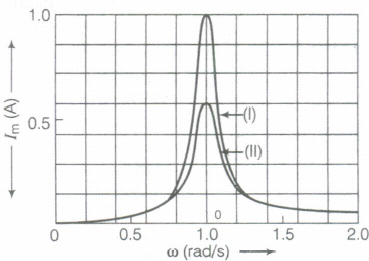
Observe the graphs carefully. State the relation between L and C values of the two circuits when the current in the two circuits is maximum. Indicate the circuit for which power factor is higher quality factor Q is larger. Give the reasons for each case.
7.
State Gauss' law in electrostatics. A cube with each side a is kept in an electric field given by E = Cx\(\widehat { i }\) as shown in the figure, where C is a positive dimensionless constant.
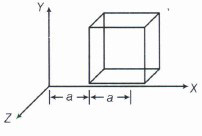
Find out
(i) the electric flux through the cube and
(ii) the net charge inside the cube.
8.
Two long coaxial insulated solenoids, S1 and S2 of equal lengths are wound one over the other as shown in the figure. A steady current I flows through the inner solenoid S1 to the other end B, which is connected to the outer solenoid S2 through which the same current I flows in the opposite direction, so as to come out at end A. If n1and n2 are the number of turns per unit length, find the magnitude and direction of the net magnetic field at s point (a) inside on the axis and (b) outside the combined system.

9.
(i) Consider circuit in the figure. How much energy is absorbed by electrons from the initial state of no current (Ignore thermal motion) to the state of drift velocity?
(ii) Electrons give up energy at the rate of RI2 per second to the thermal energy. What time scale would number associate with energy in problem (i)? Given, n = number of electron per volume = 1029 per m3. Length of circuit = 10cm cross-section = A = (1 mm)2

10.
Draw a schematic sketch of cyclotron. Explain briefly how it works and" how it is used to accelerate the charge particles?
(i) Show the time period of ions in a cyclotron is independent of both the speed and radius of circular path.
(ii) What is resonance condition? How is it used to accelerate the charged particles?
11.
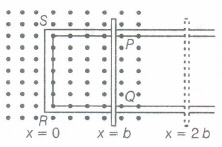
State Faraday's law of electromagnetic induction. Figure shows rectangular conductor PQRS in which the conductor PQ is free to move in a uniform magnetic field B perpendicular to the plane of the paper. The field extends from x = 0 to x = b and is zero for x > b. Assume that only the arm PQ possesses resistance r. When the arm PQ is pulled outward from x = 0 to x =2b and is then moved backward to x = 0 with constant speed v. Obtain the expressions for the flux and the induced emf. Sketch the variations of these quantities with distance 0 < x < 2b.
1.
0.38 gauss
2.
As, the value of R is increased, the current flowing in the circuit will decrease. And the potential gradient, i.e. potential drop per unit length also decreases, so that the balance length will increase. Thus, J will shift towards B.
3.
After inserting the dielectric medium, let their capacitances become C1' and C2'.
For C1 , C1' = KC ...(i)
For C2 , C2' = \(\frac { { K }_{ 1 }{ \varepsilon }_{ 0 }\left( { A }/{ 2 } \right) }{ d } +\frac { { K }_{ 2 }{ \varepsilon }_{ 0 }\left( { A }/{ 2 } \right) }{ d } \)
C2 acts as if two capcitors each of area A/2 and separation d are connected in parallel combination
\({ C' }_{ 2 }=\frac { { \varepsilon }_{ 0 }{ A } }{ d } \left( \frac { { K }_{ 1 } }{ 2 } +\frac { { K }_{ 2 } }{ 2 } \right) \)
\(\\ { C' }_{ 2 }=C\left( \frac { { K }_{ 1 }+{ K }_{ 2 } }{ 2 } \right) \left[ \because C=\frac { { \varepsilon }_{ 0 }{ A } }{ d } \right] \) ...(ii)
According to the problem, C'1 = C'2
\(\Rightarrow KC=C\left( \frac { { K }_{ 1 }+{ K }_{ 2 } }{ 2 } \right) \Rightarrow K=\frac { { K }_{ 1 }+{ K }_{ 2 } }{ 2 } \)
4.
The insulating porcelain of the spark plugs accumulates a film of dirt.
The surface dirt is hygroscopic and picks up moisture from the air. Therefore, in humid weather, the insulating porcelain of the plugs becomes quasi-conductor.
This allows an appreciable proportion of the spark to leak across the surface of the plug instead of discharging across the gap.
5.
On introduction of dielectric slab to fill the gap between plates of capacitor completely when capacitor is connected with battery.
(i) The potential difference V between capacitors is same due to connectivity with battery and hence, charge q' becomes K times of original charge as
q' = C'V' = (KC) (V) = K(CV) = Kq
q' = Kq
(ii) Electric field intensity continue to be the same as potential difference and separation between two plates remain unaffected as
\(E=\frac { V }{ d } \)
(iii) The capacitance of capacitor becomes K times of original capacitor.
\(\therefore \ C'=KC=\frac { K{ \varepsilon }_{ 0 }A }{ d } \)
6.
Since, resonant angular frequency \(\omega t\) is same for both the graphs.
i.e., \(({\omega}_{0})_{1}=({\omega}_{0})_{2}\) \(\left( \because {\omega}_{0}={ {I }\over{\sqrt{LC} } } \right)\)
\(\Rightarrow\) \({{1}\over{\sqrt{{L}_{1}{C}_{1}}}}={{1}\over{\sqrt{{L}_{2}{C}_{2}}}}\Rightarrow{L}_{1}{C}_{1}={L}_{1}{C}_{2}\) or \({ { {L}_{1} }\over{{L}_{2} } }={ { {C}_{2} }\over{{C}_{1} } }\)
In graph(I), current Im1 is greater than graph (II) \({I}_{{m}_{1}}\)is greater than graph (II), \({I}_{{m}_{2}}.\)
i.e. \({I}_{{m}_{1}}>{I}_{{m}_{2}}\Rightarrow{R}_{1}<{R}_{2}\)
Power factor of circuit represented by graph (I) has power factor as cos \(\phi =R.\)
\(\because\) \(Q={{I}\over{R}}\sqrt{{{L}\over{C}}}\) [ For two graphs ]
i.e. \(Q\infty{{I}\over{R}}\)
As, R1
Quality factor of graph (I) is higher than that of graph (II).
7.
(i) Now, the electric field, E = Cx\(\widehat { i }\) is in X-direction only. So, face with surface normal vector perpendicular to this field would give zero electric flux, i.e. \(\phi\) = E dS \(cos90^{o}\) = 0, through it.
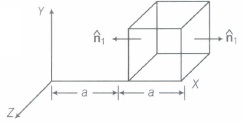
So, flux would be across only two surfaces.
Magnitude of E at left face,
EL = Cx = Ca [x = a at left face]
Magnitude of E at right face,
ER = Cx = C2a = 2aC [x = 2a at right face]
Thus, corresponding fluxes are
\({ \phi }_{ L }\) = EL . dS = E L dS cos\(\theta\)
= - aC \(\times\) a2 = - a3 C [\(\because\) \(\theta=180^{o}\)]
\({ \phi }_{ R }\) = ER . dS
= 2aC dS cos\(\theta\) [ \(\because \theta=0^{o}\)]
= 2aCa2 = 2a3C
Now, net flux through cube
= \({ \phi }_{ L }+{ \phi }_{ R }\)
= - a3 C + 2a3C
= a3 C N-m2 C-1
(ii) Net charge inside the cube, again, we can use Gauss' law to find total charge q inside the cube.
We have' \(\phi=\frac { q }{ { \varepsilon }_{ 0 } } \)
or q = \(\phi{ \varepsilon }_{ 0 }\)
q = a3 C \({ \varepsilon }_{ 0 }\)
8.
According to Ampere's circuital law, the net field is given by \(B={ \mu }_{ 0 }nI\)
(a) The net magnetic field is given by
\({ B }_{ net }={ B }_{ 2 }-{ B }_{ 1 }-{ \mu }_{ 0{ n }_{ 2 } }I-{ \mu }_{ 0 }{ n }_{ 1 }\quad [\because { I }_{ 2 }={ I }_{ 1 }=I]\)
\(={ \mu }_{ 0 }I({ n }_{ 2 }-{ n }_{ 1 })\)
The direction is from B to A.
(b) As the magnetic fields due to S1 is confined solely inside S1 as the solenoids are assumed to be very long. So, there is no magnetic field outside S1 due to current in S1, similarly, there is no field outside S2 .
Bnet = 0
9.
(i) By Ohm's law, current I is given by
\(I=6V/6\Omega =1A\)
But, \(I=neA{ v }_{ d }\)
or \({ v }_{ d }=\frac { I }{ neA } =\frac { 1 }{ { 10 }^{ 29 }\times \left( 1.6\times { 10 }^{ -19 } \right) \times \left( { 10 }^{ -6 } \right) } \)
\(\Rightarrow \) \({ v }_{ d }=\frac { 1 }{ 1.6 } \times { 10 }^{ -4 }\quad m/s\)
Number of electrons in the wire = \(nAl\)
KE of all electrons \(=\left( nAl \right) \times \frac { 1 }{ 2 } { m }_{ e }{ v }^{ 2 }d\)
\(=\left( { 10 }^{ 29 }\times { 10 }^{ -6 }\times { 10 }^{ -1 } \right) \times \frac { 1 }{ 2 } \times \left( 9.1\times { 10 }^{ -31 } \right) \times { \left( \frac { 1 }{ 1.6 } \times { 10 }^{ -4 } \right) }^{ 2 }\)
\(=1.78\times { 10 }^{ -17 }J\)
(ii) Power loss in wire = I2R =\({ \left( 1 \right) }^{ 2 }\times 6=6J{ s }^{ -1 }\)
\(=\frac { 1.78\times { 10 }^{ -17 } }{ 6J{ s }^{ -1 } } =0.30\times { 10 }^{ -17 }s\)
\(={ 10 }^{ -17 }s\)
10.
(ii) The frequencies of charge particle must be equal to the frequency of AC oscillator. This is known as resonance condition.
This makes time period of charged particle and oscillator equal. Therefore, the time taken by charge particle to complete half revolution is equal to the time of change the polarity of dees. This facilitate the acceleration of charge particle.
If two frequencies do not match, then instead of acceleration, charged particle may accelerate.
11.
The magnitude of the induced emf in a circuit is equal to the time rate of change of magnetic flux through the circuit.
Mathematically, the induced emf is given by
\(\varepsilon=\frac{-d\phi}{dt}\)
First consider the forward motion from x = 0 to x =2b
The flux \({ \phi }_{ B }\) linked with the section SPQR is
\({ \phi} _{ B }=Blx,o\le x\le b\)
= Blb, b \(\le\) x \(\le\) 2b
The Induced emf is,
\(\varepsilon =\frac { d{ \phi }_{ B } }{ dt } \)
= Blv 0 \(\le\) x \(\le\) b
= 0 b \(\le\) x \(\le\) 2b

12th Standard CBSE Syllabus & Materials
12th Standard CBSE
CBSE 12th Computer Science Python Revision Tour I - New Previous year Question Papers Study Material - QB365 Set A
NEW12th Standard CBSE
CBSE 12th Business Studies Planning Important Questions And Answers Study Material - QB365 Set A
NEW12th Standard CBSE
CBSE 12th Business Studies Business Environment Important Questions And Answers Study Material - QB365 Set A
NEW12th Standard CBSE
CBSE 12th Business Studies Principles of Management Important Questions And Answers Study Material - QB365 Set A



NCERT Books

Syllabus

Exam Pattern

Sample Question Papers

Previous year Question Papers

Important Notes

MCQ Practice test

NCERT Exemplers

Case study Questions

Image Based Questions

Passage based Questions

HOT Questions

Value Based Questions

Model Questions Papers
NCERT ( Book Back ) Questions

Assertion and Reason
Important Questions And Answers

CBSE 12th Standard CBSE Subjects
CBSE Standards








