
 100% FREE ACCESS
12th Standard CBSE Syllabus & Materials
12th Standard CBSE
CBSE 12th Economics Government Budget and the Economy Previous year Question Papers Study Material - QB365 Set A
NEW12th Standard CBSE
CBSE 12th Computer Science Interface Python with MySQL - New Previous year Question Papers Study Material - QB365 Set A
NEW12th Standard CBSE
CBSE 12th Computer Science Database Concept - New Previous year Question Papers Study Material - QB365 Set A
NEW12th Standard CBSE
CBSE 12th Computer Science Data Communication - New Previous year Question Papers Study Material - QB365 Set A
NEW12th Standard CBSE
CBSE 12th Computer Science Data Structures - New Previous year Question Papers Study Material - QB365 Set A
NEW12th Standard CBSE
CBSE 12th Computer Science Functions - New Previous year Question Papers Study Material - QB365 Set A

Published on: 25/10/2025
Download CBSE Class 12th Standard CBSE Physics question papers, sample papers, important questions, and previous year solved papers in PDF format. Get free study materials, NCERT solutions, and exam preparation resources for Class 12th Standard CBSE Physics
Questions + Answers key
Take MCQ Physics Test
1.
Suppose you are given a chance to repeat the alpha-particle scattering experiment using a thin sheet of solid hydrogen in place of the gold foil. (Hydrogen is a solid at temperatures below 14 K.) What results do you expect?
2.
In the Rutherford’s nuclear model of the atom, the nucleus (radius about 10–15 m) is analogous to the sun about which the electron move in orbit (radius \(\approx \) 10–10 m) like the earth orbits around the sun. If the dimensions of the solar system had the same proportions as those of the atom, would the earth be closer to or farther away from the sun than actually it is? The radius of earth’s orbit is about 1.5 x 10¹¹ m. The radius of sun is taken as 7 x 10⁸ m.
3.
Show that the density of nucleus over a wide range of nuclei is constant independent of mass number.
4.
When white light is passed through an unexcited gas, what happens to the transmitted light?
5.
Name two elementary particles which have almost infinite life time.
6.
In a hydrogen atom, if the electron is replaced by a particle which is 200 times heavier but has the same charge, how would its radius change?
7.
In the study of Geiger-Marsdon experiment on scattering of α-particles by a thin foil of gold, draw the trajectory of α-particles in the Coulomb field of target nucleus. Explain briefly how one gets the information on the size of the nucleus from this study. From the relation \(R=R_{0} A^{1 / 3}\)
where Ro is constant and A is the mass number of the nucleus, show that nuclear matter density is independent of A.
8.
(i) In H-atom, an electron undergoes transition from second excited state to the first excited state and then to the ground state. Identify the spectral series to which these transitions belong.
(ii) Find out the ratio of the wavelengths of the emitted radiations in the two cases.
9.
According to the classical electromagnetic theory, calculate the initial frequency of the light emitted by the electron revolving around a proton in hydrogen atom.
10.
It is found experimentally that 13.6 eV energy is required to separate a hydrogen atom into a proton and an electron. Compute the orbital radius and the velocity of the electron in a hydrogen atom.
11.
If Bohr's quantization postulate is a basic law of nature, it should be equally valid for the case of planetary motion also. Why then do we never speak of quantization of orbits of planets around the sun?
12.
When \(_{ 92 }{ { U }^{ 235 } }\) undergoes fission, 0.1% of the original mass is released into energy. How much energy is released by an atom bomb which contains 10kg of \(_{ 92 }{ { U }^{ 235 } }\)
13.
The ratio of the nuclear densities of two nuclei having mass numbers 64 and 125 is
\(\frac{64}{125}\)
\(\frac{4}{5}\)
\(\frac{5}{4}\)
1
14.
The hydrogen atom can give spectral lines in the Lyman, Balmer and Paschen series. Which of the following statement is correct?
Lyman series is in the infrared region.
Balmer series is in the visible region.
Paschen series is in the visible region.
Balmer series is in the ultraviolet region
15.
In Bohr's model, the atomic radius of the first orbit is r0. Then, the radius of the third orbit is
r0/9
r0
9r0
3r0
16.
How much mass has to converted into energy to produce electric power of 200 MWfor one hour?
2 x 10⁻⁶ kg
8 x 10⁻⁶ kg
1 x 10⁻⁶ kg
3 x 10⁻⁶ kg
17.
The kinetic energy in ground state of hydrogen atom is - 13.6eV. What will be the potential energy of electron in this state
- 27.2 eV
+ 27.2 eV
-13.6 eV
0 eV
18.
Which of the following statement(s) is (are) correct?
The rest mass of a stable nucleus is less than the sum of the rest masses of its separated nucleons.
The rest mass of a stable nucleus is greater than the rest masses of its separated nucleons.
In nuclear fission, energy is released by fusing two nuclei of medium mass. (approximately 100 amu)
In nuclear fission, energy is released by fragmentation of a very heavy nucleus.
19.
Two samples X and Y contain equal amounts of radioactive substances. If \(\frac { 1 }{ 16 } th\) of sample X and \(\frac { 1 }{ 256 } th\) of sample Y remain after 8 h, then the ratio of half periods of X and Y is
2 : 1
1 : 2
1 : 4
1 : 16
4 : 1
20.
The activity of a radioactive sample is measured as \({ N }_{ 0 }\) counts per minute at t = 0 and \({ N }_{ 0 }/e\) counts per minute at t = 5 minutes. The time (in minutes) at which the activity reduces to half its value is.
\(\log _{ e }{ 2/5 } \)
\(\frac { 5 }{ \log _{ e }{ 2 } } \)
\(5\log _{ 10 }{ 2 } \)
\(5\log _{ e }{ 2 } \)
21.
The wavelength of the first line of Lyman series for hydrogen atom is equal to that of the second line of Balmer series for a hydrogen like ion. The atomic number Z of hydrogen like ion is
3
4
1
2
22.
An excited hydrogen atom emits a photon of wavelength in returning to the ground state. The quantum number n of excited state is given by (R = Rydberg constant)
\(\sqrt { \lambda R\left( \lambda R-1 \right) } \)
\(\sqrt { \frac { \lambda R }{ \left( \lambda R-1 \right) } } \)
\(\sqrt { \frac { \lambda R-1 }{ \lambda R } } \)
\(\sqrt { \frac { 1 }{ \lambda R\left( \lambda R-1 \right) } } \)
23.
Write shortcomings of Rutherford atomic model. Explain how these were overcome by the postulates of Bohr's atomic model?
24.
Draw the curve showing the variation of binding energy per nucleon with the mass number of nuclei. Using it explain the fusion of nuclei lying on ascending part and fission of nuclei lying on descending part of this curve.
25.
The radionuclide 11C decays according to
\({ }_{6}^{11} \mathrm{C} \rightarrow{ }_{5}^{11} \mathrm{~B}+e^{+}+v: \quad T_{1 / 2}=20.3 \mathrm{~min}\)
The maximum energy of the emitted positron is 0.960 MeV. Given the mass values:
\(m\left({ }_{6}^{11} \mathrm{C}\right)=11.011434 \mathrm{u} \text { and } m\left({ }_{6}^{11} \mathrm{~B}\right)=11.009305 \mathrm{u},\)
calculate Q and compare it with the maximum energy of the positron emitted.
1.
In the alpha-particle scattering experiment, if a thin sheet of solid hydrogen is used in place of a gold foil, then the scattering angle would not be large enough. This is because the mass of hydrogen (1.67 x 10⁻²⁷ kg) is less than the mass of incident α−particles (6.64 x 10⁻²⁷ kg). Thus, the mass of the scattering particle is more than the target nucleus (hydrogen). As a result, the α−particles would not bounce back if solid hydrogen is used in the α-particle scattering experiment.
2.
The ratio of the radius of electron’s orbit to the radius of nucleus is (10–10 m) /(10–15 m) = 105, that is, the radius of the electron’s orbit is 105 times larger than the radius of nucleus. If the radius of the earth’s orbit around the sun were 105 times larger than the radius of the sun, the radius of the earth’s orbit would be 105 x 7 x 108 m = 7 x 10¹³ m. This is more than 100 times greater than the actual orbital radius of earth. Thus, the earth would be much farther away from the sun. It implies that an atom contains a much greater fraction of empty space than our solar system does.
3.
We have
\(R={ R }_{ 0 }{ A }^{ \frac { 1 }{ 3 } }\)
\(\therefore \) Density \(\rho \) = \(\frac { mA }{ \frac { 4 }{ 3 } \pi \left( { R }_{ 0 }{ A }^{ \frac { 1 }{ 3 } } \right) ^{ 3 } } \)
=\(\frac { m }{ \frac { 4 }{ 3 } \pi { R }_{ 0 }^{ 3 } } \)
Hence is independent of A. (Here m is the mass of the nucleus).
4.
When white light is passed through a gas and analysed by spectrometer, we find some dark lines in the spectrum. These dark lines correspond precisely to those wavelengths which were found in the emission line spectrum of the gas. This is called absorption spectrum.
5.
Electron and proton have almost infinite lifetime.
6.
As radius, \(r\propto \frac { 1 }{ m } \)
\(\therefore \) When electron is replaced by a particle 200 times heavier, the radius would decrease to \(\frac { 1 }{ 200 } \) time the original radius.
7.
Trajectory of a-particles in the coulomb field of target nucleus is shown below:
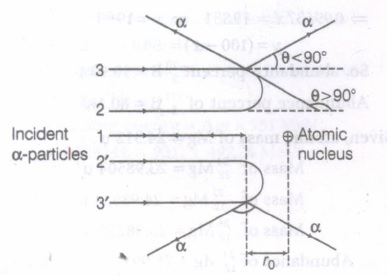
From this experiment, the following points are observed.
(i) Most of the a-particles pass straight through the gold foil. It means that they do not suffer any collision with gold atoms.
(ii) About one a-particle in every 8000 a-particles deflects by more than 90°. As most of the a-particles go undeflected and only a few get deflected, this shows that most of the space in an atom is empty and at the centre of the atom, there exists a nucleus. By the number of a-particles get deflected, the information regarding size of the nucleus can be known.
8.
(i) An electron undergoes transition from second excited state to the first excited state which corresponds to Balmer series and then to the ground state which corresponds to Lyman series.
(ii) The wavelength of the emitted radiations in the two cases.
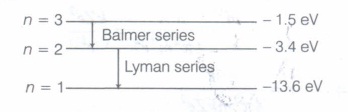
We know that,\(\lambda=\frac{h c}{\Delta E}\)
Frorn n3 \(\rightarrow\) n2,
\(\lambda_{1}=\frac{h c}{E_{3}-E_{2}}\)
\(=\frac{h c}{(-1.5)-(-3.4)}=\frac{h c}{1.9}\)
From n2 \(\rightarrow\) n1
\(\lambda_{2}=\frac{h c}{E_{2}-E_{1}}\)
\(=\frac{h c}{(-3.4)-(-13.6)}=\frac{h c}{10.20}\)
\(\therefore \quad \frac{\lambda_{1}}{\lambda_{2}}=\frac{10.20}{1.9}=5.3\)
9.
we know that velocity of electron moving around a proton in hydrogen atom in an orbit of radius 5.3 × 10⁻¹¹ m is 2.2 × 10⁻⁶ m/s. Thus, the frequency of the electron moving around the proton is
\(v=\frac{v}{2 \pi r}=\frac{2.2 \times 10^{6} \mathrm{~m} \mathrm{~s}^{-1}}{2 \pi\left(5.3 \times 10^{-11} \mathrm{~m}\right)}\)
\(\approx \) 6.6 × 10¹⁵ Hz
According to the classical electromagnetic theory we know that the frequency of the electromagnetic waves emitted by the revolving electrons is equal to the frequency of its revolution around the nucleus. Thus the initial frequency of the light emitted is 6.6 × 10¹⁵ Hz.
10.
Total energy of the electron in hydrogen atom is –13.6 eV = –13.6 × 1.6 × 10–19 J = –2.2 ×10⁻¹⁸ J. Thus from Equation we have
\(-\frac{e^{2}}{8 \pi \varepsilon_{0} r}=-2.2 \times 10^{-18} \mathrm{~J}\)
This gives the orbital radius
\(r=-\frac{e^{2}}{8 \pi \varepsilon_{0} E}=-\frac{\left(9 \times 10^{9} \mathrm{~N} \mathrm{~m}^{2} / \mathrm{C}^{2}\right)\left(1.6 \times 10^{-19} \mathrm{C}\right)^{2}}{(2)\left(-2.2 \times 10^{-18} \mathrm{~J}\right)}\)
= 5.3 × 10⁻¹¹ m
The velocity of the revolving electron can be computed from Eq.uation with m = 9.1 × 10⁻³¹ kg,
\(v=\frac{e}{\sqrt{4 \pi \varepsilon_{0} m r}}=2.2 \times 10^{6} \mathrm{~m} / \mathrm{s}\)
11.
Bohr's quantization postulate is in terms of Planck's constant (h). But angular momenta associated with planetary motion are \(\approx { 10 }^{ 70 }h\) . In terms of Bohr's quantization postulate, this will correspond to \(n\approx { 10 }^{ 70 }\) For such large values of n, the differences in successive energies and angular momenta of the quantized levels are so small, that the levels can be considered as continuous and not discrete.
12.
\(9\times { 10 }^{ 14 }J\)
13.
(d)
1
14.
(b)
Balmer series is in the visible region.
15.
(c)
9r0
16.
(b)
8 x 10⁻⁶ kg
17.
(b)
+ 27.2 eV
18.
(a)
The rest mass of a stable nucleus is less than the sum of the rest masses of its separated nucleons.
19.
(a)
2 : 1
20.
21.
(d)
2
22.
(b)
\(\sqrt { \frac { \lambda R }{ \left( \lambda R-1 \right) } } \)
23.
Shortcomings of Rutherford's atomic model.
(i) Line spectrum
Rutherford's atomic model could not explain the sharply defined discrete wavelengths in the hydrogen spectrum.
(ii) Stability of atom
Rutherford's orbital motion of electrons around the nucleus could not explain the stability of an atom. According to electron dynamics an accelerated electron radiate energy, so the radius of orbit goes on decreasing, and finally, the electron will fall into the nucleus and the atom will not be stable.
Bohr's model: Bohr removes the drawbacks of the Rutherford model based on plank's quantum theory. According to Bohr
(1) Electron can revolve in well defined energy levels in which its angular momentum is integral multiple of \(\left(\frac{h}{2 \pi}\right)\)
\(m v r=\frac{n h}{2 \pi^{\prime}}\)
n = principal quantam number
n = 1,2,3...
(2) Electron revolving in a definite orbit does not radiate energy, it will radiate energy only when changing the orbit. The energy of an electron in an orbit is
\(E_n=-\frac{R h C}{n^2}=\frac{-13.6}{n^2} e V\)
24.
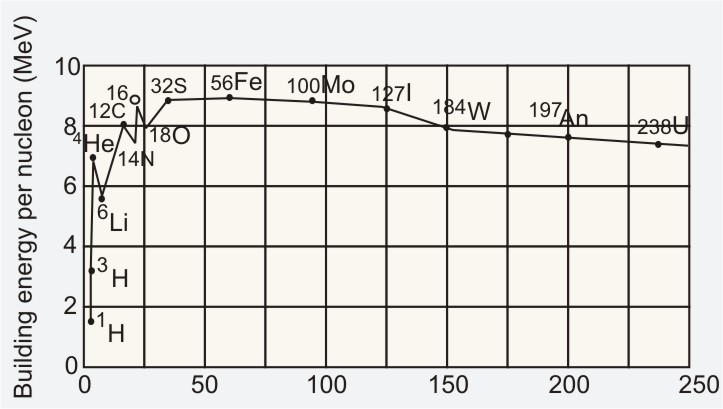
On the ascending part of the curve, B.E./A increases with the mass number (A).
So, B.E. of the resultant will be greater than that of the nuclei which are fused together. Hence the fusion of the nuclei on the ascending part results in an increase in binding energy, therefore, more stable nucleus
On the descending part of the curve, the B.E. of the heavier nuclei is lower. So the fission of the heavier nuclei, on the descending part, will cause an increase in B.E. and, therefore, more stable nucleus
25.
The given nuclear reaction is:
\({ }_{6}^{11} C \rightarrow_{5}^{11} B+e^{+} v\)
Half life of \(-6^{11} C \text { nuclei } T_{\frac{1}{2}}=20.3 \mathrm{~min}\)
Atomic mass of \(m\left({ }_{6}^{11} C\right)=11.011434 \mathrm{u}\)
Atomic mass of \(m\left({ }_{6}^{11} B\right)=11.009305 u\)
Maximum energy possessed by the emitted positron = 0.960 MeV
The change in the Q-value (ΔQ) of the nuclear masses of the \({ }_{6}^{11} C\) nucleus is given as:
\(\left.\triangle Q=\left[m \prime{(6} C^{11}\right)-\left[m{ }^{\prime}\left({ }_{5}^{11} B\right)+m_{e}\right]\right] c^{2} \ldots .(1)\)
Where,
me = Mass of an electron or positron = 0.000548 u
c = Speed of light
m’ = Respective nuclear masses
If atomic masses are used instead of nuclear masses, then we have to add 6 me in the case of 11C and 5 me in the case of 11B
Hence, equation (1) reduces to:
\(\triangle Q=\left[m\left({ }_{6} C^{11}\right)-m\left({ }_{5}^{11} B\right)-2 m\right] c^{2} \text { are the atomic masses }\)
\(\text { Here } m\left({ }_{6} C^{11}\right) \text { and } m\left({ }_{5}^{11} B\right) \text { are the atomic masses }\)
∴ΔQ = [11.011434 − 11.009305 − 2 x 0.000548] c2
= (0.001033 c2) u
But 1 u = 931.5 Mev/c2
∴ΔQ = 0.001033 x 931.5 ≈ 0.962 MeV
The value of Q is almost comparable to the maximum energy of the emitted positron.

12th Standard CBSE Syllabus & Materials
12th Standard CBSE
CBSE 12th Computer Science Python Revision Tour I - New Previous year Question Papers Study Material - QB365 Set A
NEW12th Standard CBSE
CBSE 12th Business Studies Planning Important Questions And Answers Study Material - QB365 Set A
NEW12th Standard CBSE
CBSE 12th Business Studies Business Environment Important Questions And Answers Study Material - QB365 Set A
NEW12th Standard CBSE
CBSE 12th Business Studies Principles of Management Important Questions And Answers Study Material - QB365 Set A



NCERT Books

Syllabus

Exam Pattern

Sample Question Papers

Previous year Question Papers

Important Notes

MCQ Practice test

NCERT Exemplers

Case study Questions

Image Based Questions

Passage based Questions

HOT Questions

Value Based Questions

Model Questions Papers
NCERT ( Book Back ) Questions

Assertion and Reason
Important Questions And Answers

CBSE 12th Standard CBSE Subjects
CBSE Standards








