
 100% FREE ACCESS
12th Standard CBSE Syllabus & Materials
12th Standard CBSE
CBSE 12th Economics Government Budget and the Economy Previous year Question Papers Study Material - QB365 Set A
NEW12th Standard CBSE
CBSE 12th Computer Science Interface Python with MySQL - New Previous year Question Papers Study Material - QB365 Set A
NEW12th Standard CBSE
CBSE 12th Computer Science Database Concept - New Previous year Question Papers Study Material - QB365 Set A
NEW12th Standard CBSE
CBSE 12th Computer Science Data Communication - New Previous year Question Papers Study Material - QB365 Set A
NEW12th Standard CBSE
CBSE 12th Computer Science Data Structures - New Previous year Question Papers Study Material - QB365 Set A
NEW12th Standard CBSE
CBSE 12th Computer Science Functions - New Previous year Question Papers Study Material - QB365 Set A

Published on: 25/10/2025
Download CBSE Class 12th Standard CBSE Physics question papers, sample papers, important questions, and previous year solved papers in PDF format. Get free study materials, NCERT solutions, and exam preparation resources for Class 12th Standard CBSE Physics
Questions + Answers key
Take MCQ Physics Test
1.
Using Rydberg's formula, calculate the longest wavelengths belonging to Lyman and Balmer series. In which region of hydrogen spectrum do these transitions lie? [Given R = 1.1 x 10⁷ m-1]
2.
In an experiment on a-particle scattering by a thin foil of gold, draw a plot showing the number of particles scattered versus the scattering angle θ.
Why is it that a very small fraction of the particles are scattered at θ > 90°?
Write two important conclusions that can be drawn regarding the structure of the atom from the study of this experiment.
3.
A neutron strikes \(_{ 5 }{ { B }^{ 10 } }\)nucleus with the subsequent emission of an alpha particle. What is the atomic number, mass number and chemical name of the remaining nucleus?
4.
Calculate the equivalent energy of electron and proton at rest.Given that mass of electron \(=9.1\times { 10 }^{ -31 }kg\) and mass of proton \(=1.673\times { 10 }^{ -27 }kg\) .
5.
What is the energy possessed by an electron for \(n=\infty \)?
6.
What is the shortest wavelength present in the Paschen series of spectral lines?
7.
(a) Write two important limitations of Rutherford model which could not explain the observed features of atomic spectra. How were these explained in Bohr's model of hydrogen atom? Use the Rydberg formula to calculate the wavelength of the H∝ line.
(b) Using Bohr's postulates, obtain the expression for the radius of the nth orbit in hydrogen atom.
8.
It is estimated that the atomic bomb exploded at Hiroshima released a total energy of \(7.6\times { 10 }^{ 13 }\)J. If on the average, 200MeV energy was released per fission, calculate
(i) the number of Uranium atoms fissioned.
(ii) the mass of Uranium used in the bomb.
9.
In the \(\alpha\)-particle scattering experiment, the shape of the trajectory of the scattered \(\alpha\)-particles depend upon
only on impact parameter
only on the source of \(\alpha\)-particles
Both impact parameter and source of \(\alpha\)-particles
impact paramerer and the screen material of the detector
10.
The radius of the innermost electron orbit of a hydrogen atom is 5.3 x 10⁻¹¹ m.The radius of the n = 3 orbit is
1.01 x 10⁻¹⁰ m
1.59 x 10⁻¹⁰ m
2.12 x 10⁻¹⁰ m
4.77 x 10⁻¹⁰ m
11.
In the Bohr model of the hydrogen atom, let R, V and E represent the radius of the orbit, speed of the \({ e }^{ - }\) and total energy of the \({ e }^{ - }\) respectively. Which of the following quantities are proportional to the quantum number n?
VR
RE
\(\frac { V }{ E } \)
\(\frac { R }{ E } \)
12.
The half life period of a radioactive element X is same as the mean life of another radioactive element Y. Initially, both of them have the same number of atoms. Then :
X and Y have the same decay rate initially
X and Y decay at the same rate always
Y will decay at a faster rate than X
X will decay at a faster rate than Y
13.
An electron in a hydrogen atom makes a transition \({ n }_{ 1 }\longrightarrow { n }_{ 2 },\) where \({ n }_{ 1 } \ and \ { n }_{ 2 }\) are the principal quantum numbers of the two states. Assume the Bohr model to be valid. The time period of the electron in the initial state is eight times that in final state. The possible values of \({ n }_{ 1 } \ and \ { n }_{ 2 }\) are
\({ n }_{ 1 }=4,\ { n }_{ 2 }=2\)
\({ n }_{ 1 }=8,\ { n }_{ 2 }=2\)
\({ n }_{ 1 }=8,\ { n }_{ 2 }=1\)
\({ n }_{ 1 }=6,\ { n }_{ 2 }=3\)
14.
In Bohr's model of hydrogen atom :
the radius of the nth orbit is proportional to \({ n }^{ 2 }\)
the total energy of the electron is nth orbit is inversely proportional to n
the angular momentum of electron in nth orbit is an integral multiple of \(\frac { h }{ 2\pi } \)
the magnitude of potential energy of the electron in any orbit is greater than its K.E.
15.
In a sample of radioactive substance, what percentage decays in one mean life time?
69.3%
64%
50%
36%
16.
An excited hydrogen atom emits a photon of wavelength in returning to the ground state. The quantum number n of excited state is given by (R = Rydberg constant)
\(\sqrt { \lambda R\left( \lambda R-1 \right) } \)
\(\sqrt { \frac { \lambda R }{ \left( \lambda R-1 \right) } } \)
\(\sqrt { \frac { \lambda R-1 }{ \lambda R } } \)
\(\sqrt { \frac { 1 }{ \lambda R\left( \lambda R-1 \right) } } \)
17.
The longest wavelength in Balmer series of hydrogen spectrum will be
\(6557\mathring { A } \)
\(1216\mathring { A } \)
\(4800\mathring { A } \)
\(5600\mathring { A } \)
18.
A radioactive element has half-life of 30 seconds. If one of the nuclei decays now, the next one will decay
any time
after 30 s
after 60 s
after 30 h
19.
Determine the ratio of distance of closest approach of a proton and an alpha particle incident on a thin gold foil, if they have same kinetic energy.
20.
What is the difference between Rutherford and Bohr's model?
21.
Define the distance of closest approach. An \(\alpha\)-particle of kinetic energy K is bombarded on a thin gold foil. The distance of the closest approach is r. What will be the distance of closest approach for an α-particle of double the kinetic energy?
22.
The number of \(\alpha\)-particles scattered at an angle of 90° is 100 per minute. What will be the number of \(\alpha\)-particles, when it is scattered at an angle of 60°?
23.
which observation led to the conclusion in the \(\alpha\)-particle scattering exp. That atom has vast empty space?
1.
Rydberg's formula \(\frac{1}{\lambda}=R\left(\frac{1}{n_{f}^{2}}-\frac{1}{n_{i}^{2}}\right)\)
The transition corresponding to longest wavelength in the Lyman series,
\(
\text { i.e. } n_{i}=2 \text { and } n_{f}=1
\)
\(\therefore \quad \frac{1}{\lambda} =R\left(1-\frac{1}{4}\right)=\frac{3}{4} R
\)
\(\Rightarrow \quad \lambda =\frac{4}{3 R}=\frac{4}{3 \times 1.1 \times 10^{7}} \mathrm{~m}
\)
\(=1.21 \times 10^{-7} \mathrm{~m}
\)
\(\lambda =121 \mathrm{~nm}
\)
The transition corresponding to longest wavelength in the Balmer series
\(
\text { i.e. } n_{i}=3 \text { and } n_{f}=2
\)
\(\therefore \quad \frac{1}{\lambda} =R\left(\frac{1}{4}-\frac{1}{9}\right)=\frac{5}{36} R
\)
\(\Rightarrow \quad \lambda =\frac{36}{5 R}=\frac{36}{5 \times 1.1 \times 10^{7}}
\)
\( =6.545 \times 10^{-7} \mathrm{~m}
\)
\(\lambda =655 \mathrm{~nm}
\)
The first transition lies in the ultraviolet region and the second one belongs to visible region.
2.
According to the Rutherford's nuclear model of an atom, most of the space in an atom is empty with a positively charged nucleus occupying only a small space at its centre. Thus, for most of the α-particles, the impact parameter being very large, they pass through the atom without being affected by the positively charged nucleus and suffer scattering at an angle less than 90°. Only a few gets scattered at θ > 90°.
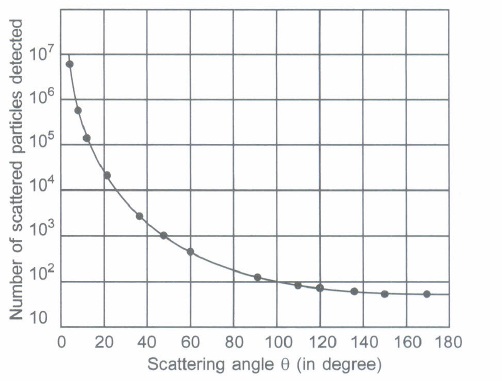
Conclusions:
(i) The mass of the atom is concentrated in a small volume.
(ii) The entire positive charge ofthe atom is with the nucleus and the negatively charged electrons are distributed around it.
3.
\(_{ 3 }{ { Li }^{ 7 } }\)
4.
0.511 MeV, 941.1 MeV
\({ E }_{ 1 }={ m }_{ e }{ c }^{ 2 }=9.1\times { 10 }^{ -31 }{ \left( 3\times { 10 }^{ 8 } \right) }^{ 2 }J\)
\(=\frac { 81.9\times { 10 }^{ -15 } }{ 1.6\times { 10 }^{ -13 } } MeV=0.511 \ MeV\)
\({ E }_{ 2 }={ m }_{ p }{ c }^{ 2 }=1.673\times { 10 }^{ -27 }{ \left( 3\times { 10 }^{ 8 } \right) }^{ 2 }J\)
\(=\frac { 1.673\times { 9\times 10 }^{ -11 } }{ 1.6\times { 10 }^{ -13 } } MeV=941.1 \ MeV\)
5.
\(E_n=-\frac{13.6}{n^2} \mathrm{eV}\)
when \(n=\infty\)
6.
Rydberg’s formula is given as
\(\frac{\mathrm{hc}}{\lambda}=21.76 \times 10^{-19}\left[\frac{1}{n_{1}^{2}}-\frac{1}{n_{2}^{2}}\right]\)
Where,
h = Planck’s constant = 6.6 x 10⁻³⁴ Js
c = Speed of light = 3 x 10⁸ m/s
(n1 and n2 are integers)
The shortest wavelength present in the Paschen series of the spectral lines is given for values n1 = 3 and n2 = ∞.
\(\frac{\mathrm{hc}}{\lambda}=21.76 \times 10^{-19}\left[\frac{1}{(3)^{2}}-\frac{1}{(\infty)^{2}}\right]\)
\(\lambda=\frac{6.6 \times 10^{-34} \times 3 \times 10^{8} \times 9}{21.76 \times 10^{-19}}\)
= 8.189 x 10⁻⁷ m
= 818.9 nm
7.
(a) (i) Electron moving in a circular orbit around the nucleus would get accelerated, therefore it would spiral into the nucleus, as it looses its energy.
(ii) It must emit a continuous spectrum. According to Bohr's model of hydrogen atom
(i) Electron in an atom can revolve in certain stable orbits without the emission of radiant energy
8.
Number of Uranium atoms fissioned
\(n=\frac { total \ energy \ released }{ energy \ released/fission } \)
\( =\frac { 7.6\times { 10 }^{ 13 } }{ 200\times 1.6\times { 10 }^{ -13 } } =2.375\times { 10 }^{ 24 }\)
\( =\frac { 7.6\times { 10 }^{ 13 } }{ 200\times 1.6\times { 10 }^{ -13 } } =2.375\times { 10 }^{ 24 }\)
\( Mass \ of \ Uranium=\frac { Mass \ number }{ Avogadro's \ number } \times n\)
\(=\frac { 235\times 2.375\times { 10 }^{ 24 } }{ 6.023\times { 10 }^{ 23 } } =926.66g\)
9.
(a)
only on impact parameter
10.
(d)
4.77 x 10⁻¹⁰ m
11.
(a)
VR
12.
(c)
Y will decay at a faster rate than X
13.
(a)
\({ n }_{ 1 }=4,\ { n }_{ 2 }=2\)
14.
(a)
the radius of the nth orbit is proportional to \({ n }^{ 2 }\)
15.
(b)
64%
16.
(b)
\(\sqrt { \frac { \lambda R }{ \left( \lambda R-1 \right) } } \)
17.
(a)
\(6557\mathring { A } \)
18.
(a)
any time
19.
∵ Distance of closest approach, \(r_{0}=\frac{1}{4 \pi \varepsilon_{0}} \cdot \frac{q_{1} q_{2}}{K . E}\)
As the kinetic energy is same and q1 = e for a proton,
q' = 2e for an α-particle
q2 = Ze, charge on nucleus.
Then \(\frac{\left(r_{0}\right)_{p}}{\left(r_{0}\right)_{\alpha}}=\frac{q_{1}}{q_{1}^{\prime}}=\frac{e}{2 e}=\frac{1}{2}\)
20.
According to the Rutherford model, electrons are revolving round the nucleus in different orbits. These revolving electrons have some acceleration, so this will radiate energy in the form of EM wave, hence the orbits of electrons will go on decreasing and finally they will fall into the nucleus.
According to the Bohr model, electrons can revolve only in definite orbits without radiating any energy, where the angular momentum of an electron is an integral multiple of h/2π.
21.
The distance of closest approach is given by
\(\frac{1}{4 \pi \varepsilon_0} \cdot \frac{2 e \times Z_e}{r}=K\) ...(i)
i.e. \(r \propto \frac{1}{K}\)
Let r0 be the new distance of closest approach for a twice energetic \(\alpha\)-particle.
\(\frac{r_0}{r}=\frac{K}{2 K}=\frac{1}{2} \Rightarrow r_0=\frac{r}{2}\)
22.
Number of \(\alpha\)-particles scattered at an angle of \(\theta\)B is given by
\(N \propto \frac{1}{\sin ^{4} \theta / 2} \Rightarrow \frac{N_{1}}{N_{2}}=\left(\frac{\sin \frac{\theta_{2}}{2}}{\sin \frac{\theta_{1}}{2}}\right)^{4}\)
\(\Rightarrow \frac{100}{N_{2}}=\left(\frac{\sin 30^{\circ}}{\sin 45^{\circ}}\right)^{4} \Rightarrow \frac{100}{N_{2}}=\frac{4}{16} \Rightarrow\) N 2 = 400
23.
A larger number of alpha particle went through undeflected

12th Standard CBSE Syllabus & Materials
12th Standard CBSE
CBSE 12th Computer Science Python Revision Tour I - New Previous year Question Papers Study Material - QB365 Set A
NEW12th Standard CBSE
CBSE 12th Business Studies Planning Important Questions And Answers Study Material - QB365 Set A
NEW12th Standard CBSE
CBSE 12th Business Studies Business Environment Important Questions And Answers Study Material - QB365 Set A
NEW12th Standard CBSE
CBSE 12th Business Studies Principles of Management Important Questions And Answers Study Material - QB365 Set A



NCERT Books

Syllabus

Exam Pattern

Sample Question Papers

Previous year Question Papers

Important Notes

MCQ Practice test

NCERT Exemplers

Case study Questions

Image Based Questions

Passage based Questions

HOT Questions

Value Based Questions

Model Questions Papers
NCERT ( Book Back ) Questions

Assertion and Reason
Important Questions And Answers

CBSE 12th Standard CBSE Subjects
CBSE Standards








