
 100% FREE ACCESS
12th Standard CBSE Syllabus & Materials
12th Standard CBSE
CBSE 12th Economics Government Budget and the Economy Previous year Question Papers Study Material - QB365 Set A
NEW12th Standard CBSE
CBSE 12th Computer Science Interface Python with MySQL - New Previous year Question Papers Study Material - QB365 Set A
NEW12th Standard CBSE
CBSE 12th Computer Science Database Concept - New Previous year Question Papers Study Material - QB365 Set A
NEW12th Standard CBSE
CBSE 12th Computer Science Data Communication - New Previous year Question Papers Study Material - QB365 Set A
NEW12th Standard CBSE
CBSE 12th Computer Science Data Structures - New Previous year Question Papers Study Material - QB365 Set A
NEW12th Standard CBSE
CBSE 12th Computer Science Functions - New Previous year Question Papers Study Material - QB365 Set A

Published on: 25/10/2025
Download CBSE Class 12th Standard CBSE Physics question papers, sample papers, important questions, and previous year solved papers in PDF format. Get free study materials, NCERT solutions, and exam preparation resources for Class 12th Standard CBSE Physics
Questions + Answers key
Take MCQ Physics Test
1.
The de-Broglie wavelength of a photon is twice the de-Broglie wavelength of an electron.The speed of the electron is \({ v }_{ e }=\frac { c }{ 100 } \) Then
\(\frac { { E }_{ e } }{ { E }_{ p } } ={ 10 }^{ -4 }\)
\(\frac { { E }_{ e } }{ { E }_{ p } } ={ 10 }^{ -2 }\)
\(\frac { { p }_{ e } }{ { m }_{ e }c } ={ 10 }^{ -2 }\)
\(\frac { { p }_{ e } }{ { m }_{ e }c } ={ 10 }^{ -4 }\)
2.
An electron is moving with an initial velocity \(\frac { h }{ mv } ={ v }_{ 0 }\overset { \wedge }{ L } \) and is in a magnetic field \(\vec { B= } \ { B }_{ 0 }\vec { j } \) Then its de-Broglie wavelength
remains constant
increases with time.
decreases with time.
increases and decreases periodically.
3.
A proton,a neutron, an electron and an \(\alpha \)-particle have the same energy.Then their de-Broglie wavelengths compare as
\(\lambda _{ p }=\lambda _{ n }>\lambda _{ c }>\lambda _{ \alpha }\)
\(\lambda _{ \alpha }<\lambda _= \lambda _{ n }>\lambda _{ c }\)
\(\lambda _{ e }<\lambda _=\lambda _{ n }>\lambda _{ \alpha }\)
\(\lambda _{ c }=\lambda =\lambda _{ n }=\lambda _{ \alpha }\)
4.
The half life of a radioactive substance in 30 days. What is the time taken for ¾ of its original mass to disintegrate?
5.
Visible light can not eject photo electrons from copper surface, whose work function is 4.4 ev , why? Prove mathematically
6.
The De-broglie wave length associated with an electron accelerated through the potential difference “V” is \(\lambda \). What will be its wave length , when accelerating potential is increased to 4v?
7.
A stream of electron travelling with a speed at right angle to a uniform electric field E, is deflected in a circular path of radius “r” . Prove that e/m = v2 /rE.
8.
An electron and alpha particle and proton have same kinetic energy , which have shortest De-broglie wavelength?
9.
Following table gives values of work function for a few photosensitive metal
| S.NO | Metal | Work functions |
|---|---|---|
| 1 | Na | 1.92 |
| 2 | K | 2.15 |
| 3 | Mo | 4.17 |
If each metal is exposed to radiation of wavelength 300nm which of them will not emit photo electron
10.
Light from bulb falls on a wodden table but no photon electrons are emitted why ?
11.
The de-broglie wave length of a photon is same as the wave length of electron. Show that K.E. of a photon is 2mc \(\lambda \)/h times K.E. of electron. Where ‘m’ is mass of electron,c is velocity of light.
12.
What is the energy associated with a photon of wavelength 6000 A0 ?
13.
In Davisson – Germer experiment if the angle of diffraction is 520 find Glancing angle?
14.
What is the value of stopping potential between the cathode and anode of photocell? If the max K.E of electrons emitted is 5eV?
15.
Alkali metals are most suitable for photoelectric emission. Why?
16.
If wavelength of electromagnetic waves are doubled what will happen to energy of photon?
17.
(i) Monochromatic light of frequency 6.0 x 10¹⁴ Hz is produced by a laser. The power emitted is 2.0 x 10⁻³ W. Estimate the number of photons emitted per second on an average by the source.
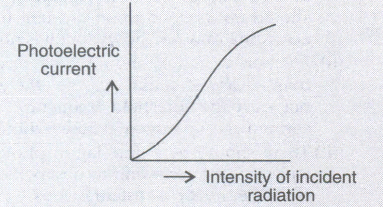
(ii) Draw a plot showing the variation of photoelectric current versus the intensity of incident radiation on a given photosensitive surface.
18.
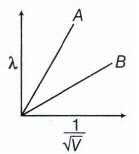
The two lines marked A and B in the given figure. Show a plot of de-Broglie wavelength \(\lambda \) versus \(\frac { 1 }{ \sqrt { V } } \), where V is the accelerating potential for two nuclei \(_{ 1 }^{ 2 }{ H }\) and \(_{ 1 }^{ 3 }{ H }\).
(i) What does the slope of the lines represent?
(ii) Identify, which of the lines corresponded to these nuclei.
19.
A proton and an \(\alpha \) particle are accelerated through the same potential. Which one of the two has
(i) greater value of de-Broglie wavelength associated with it and
(ii) less kinetic energy? Give reasons to justify your answer.
20.
Two monochromatic radiations, blue and violet, of the same intensity are incident on a photosensitive surface and cause photoelectric emission. Would
(i) the number of electrons emitted per second and
(ii) the maximum kinetic energy of the electrons be equal in the two cases? Justify your answer.
21.
You are given two nuclei \(_{ 3 }{ { X }^{ 7 } }\) and \(_{ 3 }{ { Y }^{ 4 } }\) . Explain giving reasons, as to which one of the two nuclei is likely to be more stable?
22.
Why must heavy stable nucleus contain more neutrons than protons?
23.
A particle of mass M at rest decays into two particles of masses \({ m }_{ 1 } \ and \ { m }_{ 2 }\) having non-zero velocities. What is the ratio of the de-Broglie wavelengths of the two particles?
24.
If the wavelength of an electromagnetic radiation is doubled, what will happen to (i) the energy of photons and (ii) the momentum of a photon?
25.
Ultraviolet light is incident on two photosensitive materials having work function \({ \phi }_{ 1 }\ and\ { \phi }_{ 2 }.\) In which case will the K.E. of the emitted electrons be greater? Why?
26.
The threshold frequency of a metal is \({ f }_{ 0 }\) When the light of frequency \({ 2f }_{ 0 }\) is incident on the metal plate, the maximum velocity of electrons emitted is \({ v }_{ 1 }\) When the frequency of the incident radiation is increased to, \({ 5f }_{ 0 }\) the maximum velocity of electrons emitted is \({ v }_{ 2}.\) Find the ratio of \({ v }_{ 1 }and{ v }_{ 2 }\)
27.
For a photosensitive surface, threshold wavelength is.\({ \lambda }_{ 0 }\) Does photoemission occur if the wavelength of the incident radiation is (i) more than \({ \lambda }_{ 0 }\) (ii) less than\({ \lambda }_{ 0 }\) Justify your answer?
28.
Radiations of frequencies \({ v }_{ 1 }and{ v }_{ 2 }\)are made to fall in turn, on a photosensitive surface. The stopping potentials required for stopping the mist energetic photoelectrons in the two cases are respectively\({ v }_{ 1 }and{ v }_{ 2 }\). Obtain a formula for determining the threshold frequency in terms of these parameters.
29.
The number of ejected photoelectrons increases with an increase in the intensity of light but not with the increase in the frequency of light. Why?
30.
The electron in the hydrogen atom passes from the n = 4 energy level to the n = 1 level.What is the maximum number of photons that can be emitted? and minimum number?
31.
Plot a graph showing the variation of stopping potential with the frequency of incident radiation for two different photosensitive materials having work functions W01 and W02 (W01> W02). On what' factors does the
(i) slope and
(ii) intercept of the lines depend ?
32.
An electron, an \(\alpha\) - particle and a photon have the same kinetic energy. Which of these particles has the largest de-Broglie wavelength?
1.
(b)
\(\frac { { E }_{ e } }{ { E }_{ p } } ={ 10 }^{ -2 }\)
2.
(a)
remains constant
3.
(b)
\(\lambda _{ \alpha }<\lambda _= \lambda _{ n }>\lambda _{ c }\)
4.
N/No = (1/2)n
t = 2T = 2 x 30 = 60 days
5.
\(\lambda=h c / \Phi=2823 \mathrm{~A}\)
6.
\( \lambda / 2\)
7.
\(\mathrm{Ee}=\mathrm{Mv}^2 / \mathrm{r}\)
8.
Alpha particles due to its largest mass
9.
Mo will not emit photo electron , because its work function is more than 4 ev
10.
The energy of light obtained from the bulb is much less than work function of the wodden block. Hence no photon electrons are emitted.
11.
\(\lambda_{p h}=\lambda=\lambda=h / m v\)
K.E of electrons E \(=1 / 2 m v^2=1 / 2 m\left[h / m^2\right] \lambda\)
\(
=\mathrm{h}^2 / 2 \mathrm{~m}^2 \lambda \\
\therefore \mathrm{Eph}=\mathrm{Ee}(2 \mathrm{mc} \lambda / \mathrm{h})
\)
12.
\(E=h c / \lambda\)
= 3.3 x 10⁻¹⁹ J
13.
\(\theta=90-\phi / 2\)
\(=90-52 / 2=64^{\circ}\)
14.
stopping potential V0 = Kmax/e = 5ev/e = 5V
15.
Alkali metals have too low work functions. Even visible light can eject electrons from them.
16.
\(E=h v,\)
\(
=\mathrm{hc} / \lambda \\
\mathrm{E} \infty 1 / \lambda
\)
17.
Power = nhw, where n = No.of photons per second
\(2.0\times { 10 }^{ -3 }=n\times 6.6\times { 10 }^{ -34 }\times 6\times { 10 }^{ 14 }\)
\(n=\frac { 2.0\times { 10 }^{ -3 } }{ 6.6\times { 10 }^{ -34 }\times 6\times { 10 }^{ 14 } } \)
\( =0.050\times { 10 }^{ 17 }=5\times { 10 }^{ 15 } \ Photons/second1/2\)
18.
de-Broglie wavelength of accelerating charged particle is given by
\(\lambda =\frac { h }{ \sqrt { 2mqV } } \Rightarrow \lambda \sqrt { V } =\frac { h }{ \sqrt { 2mq } } =constant\)
(i) The slope of the lines represent \(\frac { h }{ \sqrt { 2mq } } .\)
where, h is Planck's constant, q is the charge and m is the mass of charged particle.
(ii) 1H2 and 1H3 carry same charge (as they have same atomic number).
\(\therefore \ \lambda \sqrt { V } \propto \frac { 1 }{ \sqrt { m } } \)
The lighter mass i.e 1H2 is represented by line of greater slope i.e A and similarly 1H3 by line B.
19.
(i) The de-Broglie wavelength of a particle is given as
\(\lambda=\frac{b}{\sqrt{2 m V_0 q}}\)
Since, \(\alpha\)-particle and proton both are accelerated through the same potential V0.
\(\begin{aligned}
\therefore \quad \lambda \propto \frac{1}{\sqrt{m q}}
\end{aligned}\)
\(\begin{aligned}
\text { or } \quad \frac{\lambda_a}{\lambda_p}=\sqrt{\frac{m_p q_p}{m_a q_a}}
\end{aligned}\)
As, charge on \(\alpha\)-particle = 2 \(\times\)charge on proton
\(q_{\mathrm{\alpha}}=2 q_{p} \Rightarrow \frac{q_{\mathrm{p}}}{q_{\mathrm{\alpha}}}=\frac{1}{2}\)
Mass of \(\alpha\)-particle = 4 \(\times\) Mass of proton
ma = 4 \(\times\) mp
\(\Rightarrow \quad \frac{m_p}{m_\alpha}=\frac{1}{4}\)
\(\begin{array}{ll}
\therefore & \frac{\lambda_{\mathrm{a}}}{\lambda_p}=\sqrt{\frac{1}{4} \cdot \frac{1}{2}}=\frac{1}{2 \sqrt{2}}\end{array}\)
\(\begin{array}{ll}
\Rightarrow & \lambda_p=2 \sqrt{2 \lambda_\alpha}
\end{array}\)
i.e. proton has greater de-Broglie wavelength than that \(\alpha\)-paricle.
(ii) \(\mathrm{KE} \propto q\) (for same accelerating potential)
Since, charge on an \(\alpha\)-paricle is more as compared to a proton, so it will have a greater value of KE. Hence, proton will have lesser KE.
20.
The intensities for both the monochromatic radiations are same but their frequencies are different. It represents
(i) the number of electrons ejected in two cases are same because it depends on the number of incident photons.
(ii) As, \(K{ E }_{ max }=hv-{ \phi }_{ 0 }=hc/\lambda-{ \phi }_{ 0 }\)
[Einstein's photoelectric equation]
\(\therefore\) The KEmax of violet radiation will be more.
21.
In case of \(_{ 3 }{ { X }^{ 7 } }\),
\(\frac { neutron\quad number }{ proton\quad number } =\frac { 7-3 }{ 3 } =1.33\)
In case of \(_{ 3 }{ { Y }^{ 4 } }\quad \)
\(\frac { neutron\quad number }{ proton\quad number } =\frac { 4-3 }{ 3 } =\frac { 1 }{ 3 } =0.33\)
For stability, this ratio has to be close to one.
Obviously, nucleus \(_{ 3 }{ { X }^{ 7 } }\) is more stable than the nucleus \(_{ 3 }{ { Y }^{ 4 } }\).
22.
Coulomb forces between protons are repulsive and nuclear forces are ordinarily attractive. For nuclei to be stable nuclear forces must dominate the repulsive forces. Therefore, number of neutrons must be greater than the number of protons.
23.
Let v1 and v2 be the velocities of the two particles of masses m1 and m2 respectively
According to law of conservation of linear momentum \(\ { m }_{ 1 }\overset { \rightarrow }{ { v }_{ 1 } } +{ m }_{ 2 }\overset { \rightarrow }{ { v }_{ 2 } } =M\times 0=0 \)
\( { m }_{ 1 }\overset { \rightarrow }{ { v }_{ 1 } } =-{ m }_{ 2 }\overset { \rightarrow }{ { v }_{ 2 } } \ or \ \left| { m }_{ 1 }\overset { \rightarrow }{ { v }_{ 1 } } \right| =\left| { m }_{ 2 }\overset { \rightarrow }{ { v }_{ 2 } } \right| \)
\( { \lambda }_{ 1 }=\frac { h }{ { m }_{ 1 }{ v }_{ 1 } } and{ \lambda }_{ 2 }=\frac { h }{ { m }_{ 2 }{ v }_{ 2 } } \)
\(or \ \frac { { \lambda }_{ 1 } }{ { \lambda }_{ 2 } } =\frac { { m }_{ 2 }{ v }_{ 2 } }{ { m }_{ 1 }{ v }_{ 1 } } =1\)
24.
(i) Energy of a photon,
\(E=hv=\frac { hc }{ \lambda } ,i.e.,E\alpha \frac { 1 }{ \lambda }\)
\(\frac { E' }{ E } =\frac { \lambda }{ 2\lambda } =\frac { 1 }{ 2 } or \ E'=\frac { E }{ 2 } \)
Thus the energy of a photon becomes half when the wavelength of radiation is doubled.
(ii) Momentum of photon,
\(p=\frac { hv }{ c } =\frac { h }{ \lambda } i.e.,\ p\alpha \frac { 1 }{ \lambda } \)
\(\\ \frac { p' }{ p } =\frac { \lambda }{ 2\lambda } =\frac { 1 }{ 2 } or\ p'=\frac { p }{ 2 } \)
Thus the momentum of photon becomes half when the wavelength of radiation is doubled.
25.
Max.K.E. of photoelectron, \({ K }_{ max }=hv-{ \phi }_{ 0 }\) As \({ \phi }_{ 1 }>{ \phi }_{ 2 }\) , so the max. K.E. of the emitted photoelectrons will be greater for the photosensitive material having work function \({ \phi }_{ 2 }\) .
26.
As \({ f }_{ 0 }\) is the threshold frequency, so \({ { \phi }_{ 0 }=hf }_{ 0 }\)
Using Einstein's photoelectric equation, we have
\(\frac { 1 }{ 2 } { mv }_{ 1 }^{ 2 }=h\times 2{ f }_{ 0 }-{ hf }_{ 0 }={ hf }_{ 0 }\)
\(and \ { \frac { 1 }{ 2 } }{ mv }_{ 2 }^{ 2 }=h\times 5{ f }_{ 0 }-{ hf }_{ 0 }=4{ hf }_{ 0 }\)
\(\\ \frac { { v }_{ 1 }^{ 2 } }{ { v }_{ 2 }^{ 2 } } =\frac { 1 }{ 4 } \ or \ \frac { { v }_{ 1 } }{ { v }_{ 2 } } =\frac { 1 }{ 2 } \)
27.
The maximum kinetic energy of the emitted photoelectron from a metal surface is given by
\({ K }_{ max }=\frac { 1 }{ 2 } { mv }_{ max }^{ 2 }=\frac { hc }{ \lambda } -\ \frac { hc }{ { \lambda }_{ 0 } } =hc\left( \frac { { \lambda }_{ 0 }-\lambda }{ \lambda { \lambda }_{ 0 } } \right) \)
(i)When is \(\lambda >{ \lambda }_{ 0 }\)\({ K }_{ max }\) negative is imaginary. Thus photoelectric emission will not occur.
(ii)When \(\lambda <{ \lambda }_{ 0 }\)\({ K }_{ max }\) is positive, \({ v }_{ max }\) is positive.Thus photoelectric emission will take place and K.E. of photoelectron increases as \(\lambda \)decreases.
28.
If vo is the threshold frequency, then from photoelectric equation, we have
\({ ev }_{ 1 }=h{ v }_{ 1 }-{ \phi }_{ 0 } \ and \ { ev }_{ 2 }={ hv }_{ 2 }-{ \phi }_{ 0 }\)
\(e({ v }_{ 2 }-{ v }_{ 1 })=h({ v }_{ 2 }-{ v }_{ 1 })or \ h=\frac { e({ v }_{ 2 }-{ v }_{ 1 }) }{ ({ v }_{ 2 }-{ v }_{ 1 }) } \)
\(Now,{ ev }_{ 1 }={ hv }_{ 1 }-{ \phi }_{ 0 }={ hv }_{ 1 }-{ hv }_{ 0 }\)
\(or \ { v }_{ 0 }={ v }_{ 1 }-\frac { { ev }_{ 1 } }{ h } ={ v }_{ 1 }-{ ev }_{ 1 }\left[ \frac { { v }_{ 2 }-{ v }_{ 1 } }{ e({ v }_{ 2 }-{ v }_{ 1 }) } \right]\)
\(={ v }_{ 1 }-\frac { { v }_{ 1 }({ v }_{ 2 }-{ v }_{ 1 }) }{ ({ v }_{ 2 }-{ v }_{ 1 }) } =\frac { { v }_{ 1 }{ V }_{ 2 }-{ v }_{ 1 }{ V }_{ 1 }-{ v }_{ 2 }{ V }_{ 1 }+{ v }_{ 1 }{ V }_{ 1 } }{ ({ v }_{ 2 }-{ v }_{ 1 }) } \)
29.
One incident photon can eject one photoelectron from a photosensitive surface. Therefore the no. of photoelectrons ejected per second depends upon the intensity of the incident light. The increase in the frequency of the incident photon but one photon of high energy can not eject more than one photoelectron from a photosensitive surface.
30.
When an electron in hydrogen atom passes from n=4 energy level to n=1 level, max. a number of photons =6, corresponding to transitions \(4\rightarrow 3;3\rightarrow 2;2\rightarrow 1;4\rightarrow 2,3\rightarrow 1,4\rightarrow 1.\) The minimum number of photons can be one only corresponding to the transition \(4\rightarrow 1.\)
31.
(i) Slope is determined by h and e. (or slop is independent of the metal used)
(ii) Work function of the metal.
.png)
32.
For a particle, de Broglie wavelength, \(\lambda\) = h/p
Kinetic energy, K = p2/2m
Then, \(\lambda\) = h / \(\sqrt{2 m K}\)
For the same kinetic energy K, the de Broglie wavelength associated with the particle is inversely proportional to the square root of their masses. A proton \(\left(\begin{array}{l} 1 \\ 1 \end{array} \mathrm{H}\right)\) is 1836 times massive than an electron and an \(\alpha\)-particle \(\left(\begin{array}{l} 4 \\ 2 \end{array} \mathrm{He}\right)\) four times that of a proton. Hence, \(\alpha\) – particle has the shortest de Broglie wavelength.

12th Standard CBSE Syllabus & Materials
12th Standard CBSE
CBSE 12th Computer Science Python Revision Tour I - New Previous year Question Papers Study Material - QB365 Set A
NEW12th Standard CBSE
CBSE 12th Business Studies Planning Important Questions And Answers Study Material - QB365 Set A
NEW12th Standard CBSE
CBSE 12th Business Studies Business Environment Important Questions And Answers Study Material - QB365 Set A
NEW12th Standard CBSE
CBSE 12th Business Studies Principles of Management Important Questions And Answers Study Material - QB365 Set A



NCERT Books

Syllabus

Exam Pattern

Sample Question Papers

Previous year Question Papers

Important Notes

MCQ Practice test

NCERT Exemplers

Case study Questions

Image Based Questions

Passage based Questions

HOT Questions

Value Based Questions

Model Questions Papers
NCERT ( Book Back ) Questions

Assertion and Reason
Important Questions And Answers

CBSE 12th Standard CBSE Subjects
CBSE Standards








