
 100% FREE ACCESS
12th Standard CBSE Syllabus & Materials
12th Standard CBSE
CBSE 12th Economics Government Budget and the Economy Previous year Question Papers Study Material - QB365 Set A
NEW12th Standard CBSE
CBSE 12th Computer Science Interface Python with MySQL - New Previous year Question Papers Study Material - QB365 Set A
NEW12th Standard CBSE
CBSE 12th Computer Science Database Concept - New Previous year Question Papers Study Material - QB365 Set A
NEW12th Standard CBSE
CBSE 12th Computer Science Data Communication - New Previous year Question Papers Study Material - QB365 Set A
NEW12th Standard CBSE
CBSE 12th Computer Science Data Structures - New Previous year Question Papers Study Material - QB365 Set A
NEW12th Standard CBSE
CBSE 12th Computer Science Functions - New Previous year Question Papers Study Material - QB365 Set A

Published on: 25/10/2025
Download CBSE Class 12th Standard CBSE Physics question papers, sample papers, important questions, and previous year solved papers in PDF format. Get free study materials, NCERT solutions, and exam preparation resources for Class 12th Standard CBSE Physics
Questions + Answers key
Take MCQ Physics Test
1.
A small candle, 2.5 cm in size is placed at 27 cm in front of a concave mirror of radius of curvature 36 cm. At what distance from the mirror should a screen be placed in order to obtain a sharp image? Describe the nature and size of the image. If the candle is moved closer to the mirror, how would the screen have to be moved?
2.
(i) If f = 0.5 m for a glass lens, what is the power of the lens?
(ii) The radii of curvature of the faces of a double convex lens are 10 cm and 15 cm. Its focal length is 12 cm. What is the refractive index of glass?
(iii) A convex lens has 20 cm focal length in air. What is focal length in water? (Refractive index of air-water = 1.33, refractive index for air-glass = 1.5.)
3.
An object is placed at (i) 10 cm, (ii) 5 cm in front of a concave mirror of radius of curvature 15 cm. Find the position, nature, and magnification of the image in each case.
4.
Explain how does the resistivity of a conductor depend upon
(i) number density 'n' of free electrons, and
(ii) relaxation time \(\rho \) ?
5.
A charge of 8 mC is located at the origin. Calculate the work done in taking a small charge of -2\(\times\)10-9C from a point P (0, 0, 3 cm) to a point Q(0, 4 cm, 0) via a point R(0, 6 cm, 9 cm).
6.
Write two characteristic features to distinguish between n-type and p-type semiconductors.
7.
Why should the area of cross-section of the meter-bridge wire be uniform? Explain.
8.
To reduce the reasonant frequency in an LCR series circuit with a generator
the generator frequency should be reduced
another capacitor should be added in parallel to the first
the iron core of the inductor should be removed
dielectric in the capacitor should be removed
9.
If the wavelength of light in an experiment on photoelectric effect is doubled
the photoelectric emission will not take place
the photoelectric emission may or may not take place
the stopping potential will decrease
the stopping potential will increase
10.
A Ge specimen is doped with AI. The concentration of acceptor atoms is \(-10^{ 21 }\) atoms/\(m^{ 3 }\) , the concentration of electrons in the specimen is
\(10^{ 17 }/m^{ 3 }\)
\(10^{ 15 }/m^{ 3 }\)
\(10^{ 4 }/m^{ 3 }\)
\(10^{ 2 }/m^{ 3 }\)
11.
Which of the following is not an insulator?
glass
rubber
ebonite
human body
12.
A small link dot on a paper is seen through a glass slab of thickness 4 cm and refractive index 1.5. The dot appears to be raised by
1 cm
2 cm
3 cm
1.33 cm
13.
When an electric field is applied across a semiconductor
electrons move from lower energy level to higher energy level in the condition band
electrons move from higher energy level to lower energy level in the conduction band
holes in the valence band move from higher energy level to lower energy level
holes in the valence band move from lower energy level to higher energy level.
14.
Ground wave propagation is not suited for
high frequency signals
low frequency signals
medium frequency signals
none of the above
15.
A flood light is covered with a filter that transmits red light. The electric field of the emerging beam is represented by a sinusoidal wave.
\({ E }_{ x }=36 \ sin\quad (1.20\times { 10 }^{ 7 }z=3.6\times { 10 }^{ 15 }t) \ V/m\)
the average intensity of the beam is watt/\({ (metre) }^{ 2 }\) will be:
6.88
3.44
1.72
0.86
16.
Describe Young's double slit experiment to produce interference pattern due to a monochromatic source of light. Deduce the expression for the fringe width.
17.
There are two coils, which have mutal inductance of 10 H. When the circuit is closed, current in the primary coil is raised to 3 A within a time range of 1 millisecond. Calculate the emf induced in secondary coil.
18.
The three stable isotopes of neon \(_{ 10 }{ { Ne }^{ 20 } },_{ 10 }{ { Ne }^{ 21 } }and_{ 10 }{ { Ne }^{ 22 } }\)have respective abundances of 90.51%, 0.27% and 9.22%. The atomic masses of the three isotopes are 19.99u, 20.99u and 21.99 u respectively. Obtain the average atomic mass of neon.
1.
Size of the candle, h = 2.5 cm
Image size = h’
Object distance, u = -27 cm
Radius of curvature of the concave mirror, R = -36 cm
\(f=\frac { R }{ 2 } =-18\)cm
Image distance = v
The image distance can be obtained using the mirror formula:
\(\frac { 1 }{ u } +\frac { 1 }{ v } =\frac { 1 }{ f } \)
\(\frac { 1 }{ v } =\frac { 1 }{ f } -\frac { 1 }{ u } \)
\(\frac { 1 }{ -18 } =\frac { 1 }{ -27 } =\frac { -3+2 }{ 54 } =-\frac { 1 }{ 54 } \)
∴ v = -54 cm
Therefore, the screen should be placed 54 cm away from the mirror to obtain a sharp image.
The magnification of the image is given as:
\(m=\frac { { h }^{ ' } }{ h } =-\frac { v }{ u } \)
\(\therefore { h }^{ ' }=-\frac { v }{ u } \times h\)
\(=-\left( \frac { -54 }{ -27 } \right) \times 2.5=-5\)cm
The height of the candle’s image is 5 cm. The negative sign indicates that the image is inverted and real.
If the candle is moved closer to the mirror, then the screen will have to be moved away from the mirror in order to obtain the image.
2.
(i) Power = +2 dioptre.
(ii) Here, we have f = +12 cm, R1 = +10 cm, R2 = -15 cm.
Refractive index of air is taken as unity.
We use the lens formula. The sign convention has to be applied for f, R1 and R2.
Substituting the values, we have
\(\frac { 1 }{ 12 } =(n-1)\left( \frac { 1 }{ 10 } -\frac { 1 }{ 15 } \right) \)
This gives n = 1.5.
(iii) For a glass lens in air, n2 = 1.5, n1 = 1, f = +20 cm. Hence, the lens formula gives
\(\frac { 1 }{ 20 } =0.5\left( \frac { 1 }{ { R }_{ 1 } } -\frac { 1 }{ { R }_{ 2 } } \right) \)
For the same glass lens in water, n2 = 1.5, n1 = 1.33. Therefore \(\frac { 1.33 }{ f } =(1.5-1.33)\left[ \frac { 1 }{ { R }_{ 1 } } -\frac { 1 }{ { R }_{ 2 } } \right] \)
Combining these two equations, we find f = + 78.2 cm.
3.
The focal length f = -15/2 cm = -7.5 cm
(i) The object distance u = -10 cm. Then Eq gives
\(\frac { 1 }{ v } +\frac { 1 }{ 10 } =\frac { 1 }{ -7.5 } \)
or \(v=\frac { 10\times 7.5 }{ -2.5 } =-30\) cm
The image is 30 cm from the mirror on the same side as the object
Also, magnification m = \(\frac { v }{ u } =-\frac { (-30) }{ (-10) } =-3\)
The image is magnified, real and inverted.
(ii) The object distance u = -5 cm. Then from Eq
\(\frac { 1 }{ v } +\frac { 1 }{ -5 } =\frac { 1 }{ -7.5 } \)
or \(v=\frac { 5\times 7.5 }{ (7.5-5) } =15\) cm
This image is formed at 15 cm behind the mirror. It is a virtual image.
Magnification m = 15 \(-\frac { v }{ u } =-\frac { 15 }{ (-5) } =3\)
The image is magnified, virtual and erect.
4.
Since drift velocity \({ v }_{ d }\) and current, I flowing in a conductor are related by the relation:
\({ v }_{ d }=\frac { I }{ neA } ......(1)\)
Also drift velocity in terms of average relaxation time T is given by
\({ v }_{ d }=\frac { eE\tau }{ m } .......(2)\)
From (1) and (2), we have
\(\frac { eE\tau }{ m } =\frac { I }{ neA } \)
\(or\quad \frac { E }{ I } =\frac { m }{ n{ e }^{ 2 }A\tau }\)
\(or\quad \frac { V }{ lI } =\frac { m }{ n{ e }^{ 2 }A\tau }\)
\(or\quad \frac { V }{ I } =\frac { ml }{ n{ e }^{ 2 }A\tau } ........(3)\)
The R.H.S. of Eq(3) is constant
\( \frac { V }{ I } = \ Constant\)
This is Ohm′s law
\((But \ \frac { V }{ I } =R,\)the resistance of the conductor)
So Equation (3) becomes
\(R=\frac { ml }{ n{ e }^{ 2 }A\tau } \)
\(But\quad R=\rho \frac { l }{ A }\)
\(\therefore \quad \rho \frac { l }{ A } =\frac { ml }{ n{ e }^{ 2 }A\tau }\)
\(\rho =\frac { m }{ n{ e }^{ 2 }A\tau } )\)
5.
Charge located at the origin, q = 8 mC = 8 x 10⁻³ C
The magnitude of the charge taken from the point P to R and then to Q, q1 = 2 x 10⁻⁹ C
Here OP= d1= 3 cm = 3 x 10⁻² m
OQ = d2= 4 cm = 4 x 10⁻² m
Potential at the point P, V1 \(=\frac{q}{4 \pi \epsilon_{0} d_{1}}\)
Potential at the point Q, V1 \(=\frac{q}{4 \pi \epsilon_{0} d_{1}}\)
The work done (W) is independent of the path
Therefore, W = q1[V1 – V2]
\(=V_{2}=q_{1}\left[\frac{q}{4 \pi \epsilon_{0} d_{2}}-\frac{q}{4 \pi \epsilon_{0} d_{1}}\right]\)
\(=V_{2}=\frac{q q_{1}}{4 \pi \epsilon_{0}}\left[\frac{1}{d_{2}}-\frac{1}{d_{1}}\right]\)
Where, \(\frac{1}{4 \pi \epsilon_{0}}=9 \times 10^{9} \mathrm{Nm}^{2} \mathrm{C}^{-2}\)
Therefore,
\(W=9 \times 10^{9} \times 8 \times 10^{-3} \times\left(-2 \times 10^{-9}\right)\left[\frac{1}{4 \times 10^{-2}}-\frac{1}{3 \times 10^{-2}}\right]\)
= -144 x 10-3 x (-100/12)
= 1.2 Joule
Therefore, the work done during the process is 1.2 J
6.
(i) In n-type semiconductor, the semiconductor is doped with pentavalent impurity. The electrons are majority carriers and holes are minority carriers or ne >> nh , (ne = number density of electrons, nh = number density of holes).
In energy band diagram of n-type semiconductor, the donor energy level ED is slightly below the bottom of conduction band Ec and thus. the electron can move to conduction band, even with small supply of energy.

(ii) In p-type semiconductor, the semiconductor is doped with trivalent impurity. The holes are the majority carriers and electrons are the minority carriers, i.e. nb >> ne . In energy band diagram of p-type, the acceptor energy level EA is slightly above the top of valence band EV .
Thus, even with small supply of energy, electron from valence band can jump to level E4 and ionise the acceptor, negatively.
7.
The area of cross-section of the meter bridge wire should be uniform otherwise the resistance per unit length of bridge wire will be different over different length of meter bridge.
8.
(b)
another capacitor should be added in parallel to the first
9.
(b)
the photoelectric emission may or may not take place
10.
(a)
\(10^{ 17 }/m^{ 3 }\)
11.
(d)
human body
12.
(d)
1.33 cm
13.
(a)
electrons move from lower energy level to higher energy level in the condition band
14.
(a)
high frequency signals
15.
(c)
1.72
16.
Let two coherent sources of light, S1 and S2 (narrow slits) are derived from a source S. The, two slits, S1 and S 2 are equidistant from source, S. Now, suppose S1 and S2 are separated by distance d. The slits and screen are distance D apart.
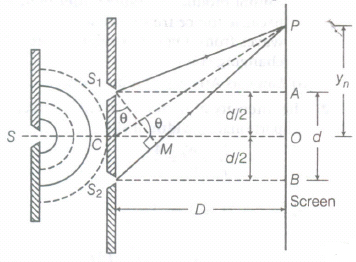
Considering any arbitrary point P on the screen at a distance Yn from the centre O. The path difference between interfering waves is given by S2P - S1P
i.e. Path difference = S2P - S1P = S2M
S2P - S = d sin \(\theta\)
where, S1 M \(\bot\) S2 P
[ \(\because\) \(\angle\) S2S2 M = \(\angle\) OCP ( by geometry)
\(\Rightarrow\) S1P = PM \(\Rightarrow\) S2P = S2 M ]
If \(\theta\) is small then sin \(\theta \approx \theta\approx tan\ \theta\)
\(\therefore\) Path difference,
S2P - S1 P = S2 M = dsin \(\theta\) d tan \(\theta\)
Path difference = d \(\left( {{{y}_{n}}\over{D}} \right)\) ...(i)
[ \(\because\) In \(\triangle\)PCO, tan \(\theta={{OP}\over{CO}}={{{y}_{n}}\over{D}}\) ]
For constructive interference
Path difference = n\(\lambda\) where, n = 0, 1, 2,....
[from Eq. (i)]
\(\Rightarrow\) \({y}_{n}={{Dn\lambda}\over{d}}\)
\(\Rightarrow\) \({y}_{n+1}={{D(n+1)\lambda}\over{d}}\)
\(\therefore\) Fringe width of dark fringe = Yn+1 - Yn
[ \(\because\) Dark fringe exist between two bright fringes]
\(\beta={{D\lambda}\over{d}}(n+1)-{{Dn\lambda}\over{d}}\)
= \({{D\lambda}\over{d}}(n+1-n)={{D\lambda}\over{d}}\)
Fringe width of dark fringe, \(\beta={{D\lambda}\over{d}}\) ....(ii)
For destructive interference
Path difference = (2n -1)\({{\lambda}\over{2}},\) where n = 1, 2, 3, .....
\(\Rightarrow\) \({{{y'}_{n}d}\over{D}}=(2n-1){{}\lambda{}}\) [ from Eq.(i)]
\(\Rightarrow\) \({y'}_{n}={{(2n-1)D\lambda}\over{2d }}\)
where, y'n is the separation of nth order dark fringe from central fringe.
\(\therefore\) \({y'}_{n+1}=(2n+1){{D\lambda}\over{}2d}\)
\(\therefore\) Fringe width of bright fringe = Separation between (n + l)th and nth order dark fringe from centered fringe.
\(\Rightarrow\) \(\beta = {y'}_{n+1}-{y'}_{n}\)
or \(\beta={{(2n+1)D\lambda}\over{2d}}-{{(2n-1)D\lambda}\over{2d}}\)
= \({{D\lambda}\over{2d}}[2n+1-2+1]={{D\lambda}\over{2d}}\)
= \({{D\lambda}\over{2d}}[2n+1-2n+1]={{D\lambda}\over{2d}}\)
Fringe width of bright fringe, \(\beta={{D\lambda}\over{d}}\) ...(iii)
From Eqs. (ii) and (iii), we can see that, fringe width of dark fringe = fringe width bright fringe \(\beta={{D\lambda}\over{d}}\)
17.
Given, mutal inductance, M = 10 H
Change in current, dl = 3 A
Change in time, dt = 1 millisecond = 10-3s
Emf induced, e = ?
Emf induced in secondary coil is given by e = \(\frac { M\ dl }{ dt } \)
Emf induced = \(\frac { 10 \times 3 }{ 10^{ -3 } } \) = 3 \( \times \) 104 V
18.
The masses of three isotopes are 19.99u, 20.99u, 21.99u
Their relative abundances are 90.51%, 0.27% and 9.22%
\(\therefore average \ atomic \ mass \ of \ Neon \ is\)
\(m=\frac { 90.51\times 19.99+0.27\times 20.99+9.22\times 21.99 }{ (90.51+0.27+9.22) }\)
\(=\frac { 1809.29+5.67+202.75 }{ 100 } \)
\( =\frac { 2017.7 }{ 100 } \)
\(=20.17u\)

12th Standard CBSE Syllabus & Materials
12th Standard CBSE
CBSE 12th Computer Science Python Revision Tour I - New Previous year Question Papers Study Material - QB365 Set A
NEW12th Standard CBSE
CBSE 12th Business Studies Planning Important Questions And Answers Study Material - QB365 Set A
NEW12th Standard CBSE
CBSE 12th Business Studies Business Environment Important Questions And Answers Study Material - QB365 Set A
NEW12th Standard CBSE
CBSE 12th Business Studies Principles of Management Important Questions And Answers Study Material - QB365 Set A



NCERT Books

Syllabus

Exam Pattern

Sample Question Papers

Previous year Question Papers

Important Notes

MCQ Practice test

NCERT Exemplers

Case study Questions

Image Based Questions

Passage based Questions

HOT Questions

Value Based Questions

Model Questions Papers
NCERT ( Book Back ) Questions

Assertion and Reason
Important Questions And Answers

CBSE 12th Standard CBSE Subjects
CBSE Standards








