
 100% FREE ACCESS
12th Standard CBSE Syllabus & Materials
12th Standard CBSE
CBSE 12th Economics Government Budget and the Economy Previous year Question Papers Study Material - QB365 Set A
NEW12th Standard CBSE
CBSE 12th Computer Science Interface Python with MySQL - New Previous year Question Papers Study Material - QB365 Set A
NEW12th Standard CBSE
CBSE 12th Computer Science Database Concept - New Previous year Question Papers Study Material - QB365 Set A
NEW12th Standard CBSE
CBSE 12th Computer Science Data Communication - New Previous year Question Papers Study Material - QB365 Set A
NEW12th Standard CBSE
CBSE 12th Computer Science Data Structures - New Previous year Question Papers Study Material - QB365 Set A
NEW12th Standard CBSE
CBSE 12th Computer Science Functions - New Previous year Question Papers Study Material - QB365 Set A

Published on: 25/10/2025
Download CBSE Class 12th Standard CBSE Physics question papers, sample papers, important questions, and previous year solved papers in PDF format. Get free study materials, NCERT solutions, and exam preparation resources for Class 12th Standard CBSE Physics
Questions + Answers key
Take MCQ Physics Test
1.
The hydrogen atom can give spectral lines in the Lyman, Balmer and Paschen series. Which of the following statement is correct?
Lyman series is in the infrared region.
Balmer series is in the visible region.
Paschen series is in the visible region.
Balmer series is in the ultraviolet region
2.
A transformer works on the principle of
converter
inverter.
mutual inductance
self-inductance
3.
The material suitable for making electromagnets should have
high retentivity and high coercivity
low retentivity and low coercivity
high retentivity and low coercivity
low retentivity and high coercivity
4.
A current carrying closed loop of an irregular shape lying in more than one plane when placed in uniform magnetic field, the force acting on it
will be more in the plane where its larger position is covered.
is zero.
is infinite.
mayor may not be zero.
5.
A metallic sphere has a charge of 10 μC. A unit negative charge is brought from A to B both 100 cm away from the sphere but A being east of it while B being on west. The net work done is
zero
2/10 joule
-2/10 joule
-1/10 joule
6.
The photoelectric threshold frequency of a metal is v. When light of frequency 6v is incident on the metal, the maximum kinetic energy of the emitted photo electron is
4hv
5hv
3hv
(3/2)hv
7.
Atoms consist of a positively charged nucleus is obvious from the following observation of Geiger- Marsden experiment
most of \(\alpha\)-particles do not pass straight through the gold foil
many of \(\alpha\)-particles are scattered through the acute angles.
very large number of a-particles are deflectedby large angles
None of the above
8.
A horizontal straight wire 20 m long extending from east to west is falling with a speed of 5.0 ms-1 at right angles to the horizontal component of the earth's magnetic field 0.30 x 10⁻⁴ Wbm-2. The instantaneous value of the emf induced in the wire will be
6.0 mV
3 mV
4.5 mV
1.5 mV
9.
Radius of a hollow sphere is R and a charge q is placed at the centre of hollow sphere. If the radius of sphere becomes half and charge also becomes half, then the value of emergent total flux from the surface of sphere is
\(4 q / \varepsilon_{0}\)
\(2 q / \varepsilon_{0}\)
\(q / 2 \varepsilon_{0}\)
\(q / \varepsilon_{0}\)
10.
The critical angle of a prism is 30°. The velocity of light in the medium is
1.5 x 10⁸ m/s
3 x 10⁸ m/s
4.5 x 10⁸ m/s
None of these
11.
What happens when charge is placed on a soap bubble?
It collapses
Its radius increases
Its radius decreases
None of the above
12.
A galvanometer having a coil resistance of \(100\Omega \) gives a full scale deflection, when a current of 1 mA is passed through it. The value of the resistance, which can convert this galvanometer into ammeter giving a full scale deflection for a current of 10 A is
\(0.01\Omega \)
\(2\Omega \)
\(0.1\Omega \)
\(3\Omega \)
13.
The magnetic field of earth can be modeled by that of a point dipole placed at the center of the earth. The dipole axis makes an angle of \(11.3°\)with the axis of the earth. At Mumbai, declination is nearly zero. Then,
the declination varies between \(11.3°\)W to \(11.3°\)
the least declination is \(\ 0°\)
the plane defined by dipole axis and earth axis passes through Greenwich.
declination averaged over the earth must be always negative.
14.
The impurity atoms with which pure silicon should be doped to make a p-type semiconductors are those of
Phosphorous
boron
antimony
aluminium
15.
The collector plate in an experiment on photo-electric effect is kept vertically above the emitter plate. Light source is put on and a saturation photoelectric current is recorded. An electric field is switched on which has a vertically downward direction
the stopping potential will decrease
the threshold wavelength will increase
the photoelectric current will increase
the kinetic energy of the electrons will increase
16.
The electric field intensity produced by the radiations coming from 100 W bulb at a 3m distance is E. The electric field intensity produced by the radiations coming from 50w bulb at the same distance is:
\(\frac { E }{ 2 } \)
\(2E\)
\(\frac { E }{ \sqrt { 2 } } \)
\(\sqrt { 2E } \)
17.
All the photoelectrons are not emitted with same energy. The energies of photoelectrons are distributed over a certain range. Why?
18.
You are given two converging lenses offocal length 1.25 cm and 5 cm to design a compound microscope. If it is desired to have a magnification of 30, then find out the separation between the objective and eyepiece.
19.
Suppose that the lower half of the concave mirror’s reflecting surface in Fig. is covered with an opaque (non-reflective) material. What effect will this have on the image of an object placed in front of the mirror?
20.
A negligibly small current is passed through a wire length 15 m and uniform cross-section \(6.0\times { 10 }^{ -7 }m^{ 2 }\) and its resistance is measured to be \(5.0\Omega \). What is the resistivity of the material at the temperature of the experiment?
21.
Suppose a pure Si crystal has \(5\times 10^{ 28 }\) atmos \(m^{ -3 }\). It is doped by ppm concentration of pentavalent As. Calculate the number of electrons and holes. Given that \({ n }_{ i }=1.5\times { 10 }^{ 16 }m^{ 3 }\)
22.
Find the energy equivalent of one atomic mass unit, first in Joules and then in MeV. Using this, express the mass defect of \({ }_{8}^{16} \mathrm{O} \text { in } \mathrm{MeV} / \mathrm{c}^{2}\)
23.
(a) Determine the electrostatic potential energy of a system consisting of two charges 7 μC and –2 μC (and with no external field) placed at (–9 cm, 0, 0) and (9 cm, 0, 0) respectively.
(b) How much work is required to separate the two charges infinitely away from each other?
(c) Suppose that the same system of charges is now placed in an external electric field E = A (1/r 2); A = 9 x 10⁵ NC-1 m2. What would the electrostatic energy of the configuration be?
24.
A horizontal straight wire 10 m long extending from east to west is falling with a speed of 50 m s–1, at right angles to the horizontal component of the earth’s magnetic field, 0.30 x 10- 4 Wb m-2.
(a) What is the instantaneous value of the emf induced in the wire?
(b) What is the direction of the emf?
(c) Which end of the wire is at the higher electrical potential?
25.
(a) The size of the atom in Thomson’s model is ______ the atomic size in Rutherford’s model. (much greater than/no different from/much less than.)
(b) In the ground state of ________ electrons are in stable equilibrium, while in .......... electrons always experience a net force. (Thomson’s model/ Rutherford’s model).
(c) A classical atom based on _________ is doomed to collapse. (Thomson’s model/ Rutherford’s model.
(d) An atom has a nearly continuous mass distribution in a _______ but has a highly non-uniform mass distribution in ______ (Thomson’s model/ Rutherford’s model)
(e) The positively charged part of the atom possesses most of the mass in ________ (Rutherford’s model/both the models.)
26.
In a potentiometer arrangement, a cell of emf 2.25 V gives a balance point at 30 cm length of the wire.If the cell is replaced by another cell and the balance point shifts to 60 cm, what is the emf of the second cell?
27.
The horizontal component of the earth's magnetic field at a certain place is 3.0 x 10⁻⁵ T and the direction of the field is from geographic south to the geographic north. A very long straight conductor is carrying a steady current of 1 A. What is the force per unit length on it when it is placed on a horizontal table and the direction of current is (a) east to west (b) south to north ?
28.
Find the photon energy in (i) calories (ii) watt-hour (iii) electron volt, for electromagnetic wave of wavelength \(300\mu m\) Given \(h=6.6\times { 10 }^{ -34 }Js\)
29.
(a) For circuits used for transporting electric power, a low power factor implies large power loss in transmission. Explain.
(b) Power factor can often be improved by the use of a capacitor of appropriate capacitance in the circuit. Explain
30.
(i) If f = 0.5 m for a glass lens, what is the power of the lens?
(ii) The radii of curvature of the faces of a double convex lens are 10 cm and 15 cm. Its focal length is 12 cm. What is the refractive index of glass?
(iii) A convex lens has 20 cm focal length in air. What is focal length in water? (Refractive index of air-water = 1.33, refractive index for air-glass = 1.5.)
31.
(a) calculate the potential at a point P due to a charge of \(4\times 10^{-7}C\) located 9 cm away.
(b) Hence obtain the work done in bringing a charge of \(2\times 10^{-9}C\) from infinity to the point P. Does the answer depend on the path along which the charge is brought?
32.
33.
A prism is a portion of a transparent medium bounded by two plane faces inclined to each other at a suitable angle. A ray of light suffers two refractions on passing through a prism and hence deviates through a certain angle from its original path. The angle of deviation of a prism is, \(\delta\) = (\(\mu\)- 1) A, through which a ray deviates on passing through a thin prism of small refracting angle A.
If \(\mu\) is refractive index of the material of the prism, then prism formula is,\(\mu=\frac{\sin \left(A+\delta_{m}\right) / 2}{\sin A / 2}\)
(i) For which colour, angle of deviation is minimum?
| (a) Red | (b) Yellow | (c) Violet | (d) Blue |
(ii) When white light moves through vacuum
| (a) all colours have same speed | (b) different colours have different speeds |
| (c) violet has more speed than red | (d) red has more speed than violet. |
(iii) The deviation through a prism is maximum when angle of incidence is
| (a) 45° | (b) 70° | (c) 90° | (d) 60° |
(iv) What is the deviation produced by a prism of angle 6°? (Refractive index of the material of the prism is 1.644).
| (a) 3.864° | (b): 4.595° | (c) 7.259° | (d) 1.252° |
(v) A ray of light falling at an angle of 50° is refracted through a prism and suffers minimum deviation. If the angle of prism is 60°, then the angle of minimum deviation is
| (a) 45° | (b) 75° | (c) 50° | (d) 40° |
1.
(b)
Balmer series is in the visible region.
2.
(c)
mutual inductance
3.
(c)
high retentivity and low coercivity
4.
(b)
is zero.
5.
(a)
zero
6.
(b)
5hv
7.
(b)
many of \(\alpha\)-particles are scattered through the acute angles.
8.
(b)
3 mV
9.
(c)
\(q / 2 \varepsilon_{0}\)
10.
(a)
1.5 x 10⁸ m/s
11.
(b)
Its radius increases
12.
(a)
\(0.01\Omega \)
13.
(a)
the declination varies between \(11.3°\)W to \(11.3°\)
14.
(d)
aluminium
15.
(d)
the kinetic energy of the electrons will increase
16.
(a)
\(\frac { E }{ 2 } \)
17.
All the electrons in the photo-sensitive material do not belong to the highest level of energy. The energies of the free electrons in the material belongs to many different closely spaced levels. So, the energies of the photoelectrons emitted from the material are distributed over a certain range.
18.
Given, fo = 1.25 cm, f. = - 5 cm
Magnification, m = 30 , D = 25 cm
If the object is very close to the principal focus of the objective and the image formed by the objective is very close to eyepiece, then magnifying power of a microscope is given by
\( m=-\frac{L}{f_{0}} \cdot \frac{D}{f_{e}} \)
\(\Rightarrow 30=\frac{L}{1.25} \cdot \frac{25}{5} \)
\(\Rightarrow L=\frac{125 \times 30 \times 5}{25 \times 100} \)
\(\Rightarrow L=\frac{25 \times 30}{100} \Rightarrow L=\frac{30}{4} \)
⇒ L = 7.5 cm
This is a required separation between the objective and the eyepiece.
19.
You may think that the image will now show only half of the object, but taking the laws of reflection to be true for all points of the remaining part of the mirror, the image will be that of the whole object. However, as the area of the reflecting surface has been reduced, the intensity of the image will be low (in this case, half).
20.
Let the resistivity of the material be \(\rho \).
∴ Resistance of wire,\(\ R=\rho \frac { l }{ A } \)
or \(\rho =\frac { RA }{ l } \)
= \(\quad \frac { 5\times 6\times { 10 }^{ -7 } }{ 15 } \)
= \(2\times { 10 }^{ -7 }\Omega -m\)
Thus the resistivity of the material at the temperature of the experiment is \(2\times { 10 }^{ -7 }\Omega -m\)
21.
Note that thermally generated electrons (ni ~1016m–3) are negligibly small as compared to those produced by doping.
Therefore, ne \(\approx\) ND
Since ne nh = \(n_{i}^{2}\) , The number of holes
nh = (2.25 x 1032 ) / (5 x10²²)
= ~ 4.5 x 10⁹ m–3
22.
1u = 1.6605 x 10⁻²⁷ kg
To convert it into energy units, we multiply it by c2 and find that energy equivalent = \(1.6605 \times 10^{-27} \times\left(2.9979 \times 10^{8}\right)^{2} \mathrm{~kg} \mathrm{~m}^{2} / \mathrm{s}^{2}\)
\(=1.4924 \times 10^{-10} \mathrm{~J}\)
\(=\frac{1.4924 \times 10^{-10}}{1.602 \times 10^{-19}} \mathrm{eV}\)
\(=0.9315 \times 10^{9} \mathrm{eV}\)
\(=931.5 \mathrm{MeV}\)
or, \(1 \mathrm{u}=931.5 \mathrm{MeV} / \mathrm{c}^{2}\)
For, \({ }_{8}^{16} \mathrm{O}, \quad \Delta M=0.13691 \mathrm{u}=0.13691 \times 931.5 \mathrm{MeV} / \mathrm{c}^{2}\)
\(=127.5 \mathrm{MeV} / \mathrm{c}^{2}\)
The energy needed to separate \({ }_{8}^{16} \mathrm{O}\) into its constituents is thus 127.5 MeV/c2.
23.
(a) \(U=\frac{1}{4 \pi \varepsilon_{0}} \frac{q_{1} q_{2}}{r}=9 \times 10^{9} \times \frac{7 \times(-2) \times 10^{-12}}{0.18}=-0.7 \mathrm{~J}\)
(b) W = U2 – U1 = 0 – U = 0 – (–0.7) = 0.7 J.
(c) The mutual interaction energy of the two charges remains unchanged. In addition, there is the energy of interaction of the two charges with the external electric field. We find
\(q_{1} V\left(\mathbf{r}_{1}\right)+q_{2} V\left(\mathbf{r}_{2}\right)=A \frac{7 \mu \mathrm{C}}{0.09 \mathrm{~m}}+A \frac{-2 \mu \mathrm{C}}{0.09 \mathrm{~m}}\)
and the net electrostatic energy is
\(q_{1} V\left(\mathbf{r}_{1}\right)+q_{2} V\left(\mathbf{r}_{2}\right)+\frac{q_{1} q_{2}}{4 \pi \varepsilon_{0} r_{12}}=A \frac{7 \mu C}{0.09 m}+A \frac{-2 \mu C}{0.09 m}-0.7 \mathrm{~J}\)
= 70 − 20 − 0.7 = 49.3 J
24.
Given, velocity of straight wire,
v = 5m/s
Horizontal component of the earth's magnetic field,
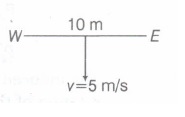
Length of the wire, \(\mathrm{I}=10 \mathrm{~m}\)
Falling speed of the wire, \(v=5.0 \mathrm{~m} / \mathrm{s}\)
Magnetic field strength, \(B=0.3 \times 10^{-4} \mathrm{~Wb} \mathrm{~m}^{-2}\)
(a) Emf induced in the wire,
\( e=B l v \)
\(=0.3 \times 10^{-4} \times 5 \times 10 =1.5 \times 10^{-3} V\)
(b) Using Fleming's right-hand rule, it can be inferred that the direction of the induced emf is from West to East.
(c) The eastern end of the wire is at a higher potential.
25.
(a) The sizes of the atoms taken in Thomson’s model and Rutherford’s model have the same order of magnitude.
(b) In the ground state of Thomson’s model, the electrons are in stable equilibrium. However, in Rutherford’s model, the electrons always experience a net force.
(c) A classical atom based on Rutherford’s model is doomed to collapse.
(d) An atom has a nearly continuous mass distribution in Thomson’s model, but has a highly non-uniform mass distribution in Rutherford’s model.
(e) The positively charged part of the atom possesses most of the mass in both the models.
26.
Given, E1 = 2.25 V, l1 = 30 cm
l2 = 60 cm, E2 = ?
As, we know that in the case of the potentiometer, the potential gradient remains constant.
So, E ∝ l
\(\frac { E1 }{ E2 } =\frac { l1 }{ l2 } \) .....(i)
Substituting the given values in Eq.(i), we get
\(\frac { 2.24 }{ E2 } =\frac { 30 }{ 60 } \)
\(E2=\frac { 2.25X60 }{ 30 } =4.5\ V\)
27.
F = Il x B
F = Il B sinθ
The force per unit length is
f = F / l = I B sinθ
(a) When the current is flowing from east to west,
θ = 90°
Hence,
f = I B
= 1 x 3x 10–5 = 3 x 10⁻⁵ N m–1
This is larger than the value 2 x 10⁻⁷ Nm–1 quoted in the definition of the ampere. Hence it is important to eliminate the effect of the earth’s magnetic field and other stray fields while standardising the ampere.
The direction of the force is downwards. This direction may be obtained by the directional property of cross product of vectors.
(b) When the current is flowing from south to north,
θ = 0o
f = 0
Hence there is no force on the conductor.
28.
\(\lambda =300\mu m=300\times { 10 }^{ -6 }m=3\times { 10 }^{ 8 }\)
\(E=\frac { hc }{ \lambda } =\frac { 6.6\times { 10 }^{ -34 }\times 3\times { 10 }^{ 8 } }{ 300\times { 10 }^{ -6 } } J\)
\( =6.6\times { 10 }^{ -22 }J\)
\( =\frac { 6.6\times { 10 }^{ -22 } }{ 4.2 } cal=\frac { 6.6\times { 10 }^{ -22 } }{ 60\times 60 } watt \ hour\)
\( =\frac { 6.6\times { 10 }^{ -22 } }{ 1.6\times { 10 }^{ -19 } } electron \ volt\)
29.
(a) We know that P = I V cos\(\phi \) where cos\(\phi \) is the power factor. To supply a given power at a given voltage, if cos\(\phi \) is small, we have to increase current accordingly. But this will lead to large power loss (I2R) in transmission.
(b) Suppose in a circuit, current I lags the voltage by an angle \(\phi \). Then power factor \(\phi \) = R/Z.
We can improve the power factor (tending to 1) by making Z tend to R. Let us understand, with the help of a phasor diagram.
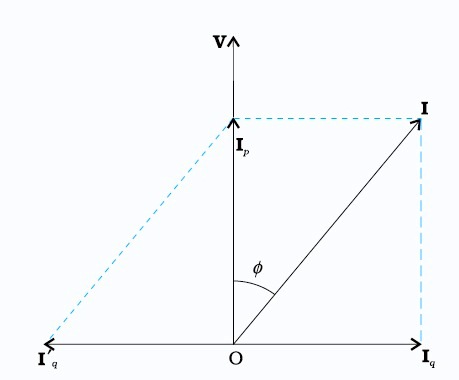
how this can be achieved. Let us resolve I into two components. Ip along the applied voltage V and Iq perpendicular to the applied voltage. Iq as you have learnt in Section 7.7, is called the wattless component since corresponding to this component of current, there is no power loss. IP is known as the power component because it is in phase with the voltage and corresponds to power loss in the circuit.
It’s clear from this analysis that if we want to improve power factor, we must completely neutralize the lagging wattless current Iq by an equal leading wattless current I'q. This can be done by connecting a capacitor of appropriate value in parallel so that Iq and I′q cancel each other and P is effectively Ip V.
30.
(i) Power = +2 dioptre.
(ii) Here, we have f = +12 cm, R1 = +10 cm, R2 = -15 cm.
Refractive index of air is taken as unity.
We use the lens formula. The sign convention has to be applied for f, R1 and R2.
Substituting the values, we have
\(\frac { 1 }{ 12 } =(n-1)\left( \frac { 1 }{ 10 } -\frac { 1 }{ 15 } \right) \)
This gives n = 1.5.
(iii) For a glass lens in air, n2 = 1.5, n1 = 1, f = +20 cm. Hence, the lens formula gives
\(\frac { 1 }{ 20 } =0.5\left( \frac { 1 }{ { R }_{ 1 } } -\frac { 1 }{ { R }_{ 2 } } \right) \)
For the same glass lens in water, n2 = 1.5, n1 = 1.33. Therefore \(\frac { 1.33 }{ f } =(1.5-1.33)\left[ \frac { 1 }{ { R }_{ 1 } } -\frac { 1 }{ { R }_{ 2 } } \right] \)
Combining these two equations, we find f = + 78.2 cm.
31.
\(V=\frac{1}{4 \pi \varepsilon_{0}} \frac{Q}{r}=9 \times 10^{9} \mathrm{Nm}^{2} \mathrm{C}^{-2} \times \frac{4 \times 10^{-7} \mathrm{C}}{0.09 \mathrm{~m}}\)
= 4 x 10⁴ V
(b) W = qV = 2 x 10−9C x 4 x 104 V
= 8 x 10⁻⁵ J
No, work done will be path independent. Any arbitrary infinitesimal path can be resolved into two perpendicular displacements: One along r and another perpendicular to r. The work done corresponding to the later will be zero.
32.
33.
(i) (a): Angle of deviation is minimum for the red colour.
(ii) (a): In vacuum all colours have same speed, because there is no dispersion of light in vacuum.
(iii) (c): The deviation is maximum when angle is 90°.
(iv) (a): \(A=6^{\circ} ; \mu=1.644\)
\(f=(\mu-1) A \)
\(f=(1.644-1) 6=0.644 \times 6 \)
\(\delta=3.864^{\circ}\)
(v) (d): \(i_{1}=50^{\circ} ; A=60^{\circ}, \delta_{m}=?\)
\(A+\delta_{m}=i_{1}+i_{2}=50^{\circ}+50^{\circ}=100^{\circ} \)
\(\delta_{m}=100^{\circ}-A=100-60^{\circ}=40^{\circ}\)

12th Standard CBSE Syllabus & Materials
12th Standard CBSE
CBSE 12th Computer Science Python Revision Tour I - New Previous year Question Papers Study Material - QB365 Set A
NEW12th Standard CBSE
CBSE 12th Business Studies Planning Important Questions And Answers Study Material - QB365 Set A
NEW12th Standard CBSE
CBSE 12th Business Studies Business Environment Important Questions And Answers Study Material - QB365 Set A
NEW12th Standard CBSE
CBSE 12th Business Studies Principles of Management Important Questions And Answers Study Material - QB365 Set A



NCERT Books

Syllabus

Exam Pattern

Sample Question Papers

Previous year Question Papers

Important Notes

MCQ Practice test

NCERT Exemplers

Case study Questions

Image Based Questions

Passage based Questions

HOT Questions

Value Based Questions

Model Questions Papers
NCERT ( Book Back ) Questions

Assertion and Reason
Important Questions And Answers

CBSE 12th Standard CBSE Subjects
CBSE Standards








