
 100% FREE ACCESS
12th Standard CBSE Syllabus & Materials
12th Standard CBSE
CBSE 12th Economics Government Budget and the Economy Previous year Question Papers Study Material - QB365 Set A
NEW12th Standard CBSE
CBSE 12th Computer Science Interface Python with MySQL - New Previous year Question Papers Study Material - QB365 Set A
NEW12th Standard CBSE
CBSE 12th Computer Science Database Concept - New Previous year Question Papers Study Material - QB365 Set A
NEW12th Standard CBSE
CBSE 12th Computer Science Data Communication - New Previous year Question Papers Study Material - QB365 Set A
NEW12th Standard CBSE
CBSE 12th Computer Science Data Structures - New Previous year Question Papers Study Material - QB365 Set A
NEW12th Standard CBSE
CBSE 12th Computer Science Functions - New Previous year Question Papers Study Material - QB365 Set A

Published on: 25/10/2025
Download CBSE Class 12th Standard CBSE Physics question papers, sample papers, important questions, and previous year solved papers in PDF format. Get free study materials, NCERT solutions, and exam preparation resources for Class 12th Standard CBSE Physics
Questions + Answers key
Take MCQ Physics Test
1.
A radio can tune into any station from 5.5MHz to 16MHz band. What is the corresponding wavelength band?
2.
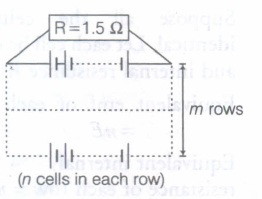
12 cells, each of emf 1.5 V and internal resistance of 0.5 Ω, are arranged in m rows each containing n cells connected in series, as shown in the figure. Calculate the values of n and m for which this combination would send maximum current through an external resistance of 1.5 Ω.
3.
Calculate the energy equivalent of 1 g of substance.
4.
A e.m. wave, Y1, has a wavelength of 1cm while another e.m. wave, Y2, has a frequency of 1015 Hz. Name these two types of waves and write one useful application for each.
5.
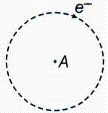
An electron is revolving around a circular loop as shown in the figure. What will be the direction of magnetic field at point A?
6.
E.M.F of a cell is 1.5V and its internal resistance 1\(\Omega\) . For what current drawn from the cell will its terminal potential difference be half of its e.m.f?
7.
An em wave travelling through a medium has electric field vector. Ey = 4 x 10⁵ cos (3.14 x 10⁸ t - 1.57 x) N/C. Here x is in m and t in s.
Then find:
(i) wavelength,
(ii) frequency,
(iii) direction of propagation,
(iv) speed of wave,
(v) refractive index of medium, and
(vi) amplitude of magnetic field vector.
8.
From the relation R = R0A1/3, where R0 is a constant and A is the mass number of a nucleus, show that the nuclear matter density is nearly constant (i.e. independent of A).
9.
A chamber is maintained at a uniform magnetic field of 5X10⁻³ T. An electron with a speed of 5X10⁷ ms-1 enters the chamber in a direction normal to the field. Calculate (i) radius of the path (ii) frequency of revolution of the electron.
Charge of electron = 1.6\(\times\) 10-19 C,
Mass of electron = 9.1\(\times\)10-31 kg.
10.
The number of free electrons per 5 cm of ordinary copper wires is 2 x 10²¹. The average drift speed of electrons is 0.25 mm/s. What is the current flowing?
11.
When impact parameter of \(\alpha\)-particle is zero, the -particle travelling directly towards the centre of the nucleus retraces its path.Explain why.
12.
Show that the energy density of em radiations is \(\varepsilon _{ 0 }{ { E }^{ 2 } }\) . Hence, find the intensity of radiations?
13.
(a) Three resistors \(1\Omega ,2\Omega \ and\ 3\Omega \) are combined in series. What is the total resistance of the combination?
(b) If the combination is connected to a battery of emf 12 V and negligible internal resistance, obtain the potential drop across each resistor.
14.
At room temperature (27.0oC) the resistance of a heating element is 100 \(\Omega\). What is the temperature of the element if the resistance is found to be 117\(\Omega\) given that the temperature coefficient of the material of the resistor is 1.70 x 10⁻⁴ oC-1.
15.
A current I flows through a long straight conductor which is bent into a circular loop of radius R in the middle as shown in the figure.
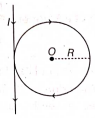
The magnitude of the net magnetic field at point O will be
zero
\(\frac{\mu_0 I}{2 R}(1+\pi)\)
\(\frac{\mu_0 I}{4 \pi R}\)
\(\frac{\mu_0 I}{2 R}\left(1-\frac{1}{\pi}\right)\)
16.
A conductor of 10\(\Omega\) is connected across a 6V ideal source. The power supplied by the source to the conductor is
1.8W
2.4W
3.6W
7.2W
17.
A magnetic field can be produced
only by moving charge
only by changing electric field
Both (a) and (b)
None of the above
18.
A 100 W-220 V bulb is connected to a supply of 110 V. The power dissipated in the bulb will be
100 W
50 W
25 W
2 W
19.
Energy equivalent of 2 g of a substance is
18 x 1013mJ
18 x 1013J
9 x 10¹³mJ
9 x 10¹³J
20.
To draw maximum current from a combination of cells, how should the cells be grouped?
series
Parallel
Mixed
Depends upon the relative values of external and internal resistance
21.
According to the Kirchhoff's law the sum of the products of current and resistance as well as emfs in a closed loop is:
greater than zero
zero
less than zero
determained by the emf
22.
A current of 5 A is flowing through a circular coil of diameter 14 cm having 100 turns. The magnetic dipole moment associated with this coil is :
\(0.077{ Am }^{ 2 }\)
\(0.77{ Am }^{ 2 }\)
\(7.7{ Am }^{ 2 }\)
\(77{ Am }^{ 2 }\)
23.
A galvanometer having a coil resistance of \(100\Omega \) gives a full scale deflection, when a current of 1 mA is passed through it. The value of the resistance, which can convert this galvanometer into ammeter giving a full scale deflection for a current of 10 A is
\(0.01\Omega \)
\(2\Omega \)
\(0.1\Omega \)
\(3\Omega \)
24.
A proton and an \(\alpha \)-particle moving with same velocity enter into a uniform magnetic field, acting normal to the plane of their motion. The ratio of radii of the circular paths described by the proton and \(\alpha \)-particle is
1 : 2
1 : 4
1 : 16
4 : 1
25.
Which one of the following groups of electromagnetic waves is/are in order of increasing frequency?
microwaves, ultraviolet rays and x-rays
Radio waves, infrared radiation and visible light
Gamma rays, visible light and ultraviolet rays
Gamma rays, ultraviolet rays, radio waves
26.
Heavy stable nuclei have more neutrons than protons. This is because of the fact that
neutrons are heavier than protons
electrostatic force between protons is repulsive
neutrons decay into protons through beta decay
nuclear forces between neutrons are weaker than that between protons
27.
Obtain the frequency of revolution of the electron in its circular orbit. Does the answer depend on the speed of the electron? Explain.
28.
A closely wound solenoid 80 cm long has 5 layers of windings of 400 turns each. The diameter of the solenoid is 1.8 cm. If the current carried is 8.0 A, estimate the magnitude of B inside the solenoid near its centre.
29.
Obtain the binding energy of the nuclei \(\begin{array}{l} 26 \\ 56 \end{array} \text { Fe }\) and \(\begin{array}{l} 209 \\ 83 \end{array} \text { Bi }\)in units of MeV from the following data:
m (\(\begin{array}{l} 26 \\ 56 \end{array} \text { Fe }\) ) = 55.934939 u
m (\(\begin{array}{l} 209 \\ 83 \end{array} \text { Bi }\) ) = 208.980388 u
30.
Draw the plot of binding energy per nucleon (BE/A) as a function of mass number A. Write two important conclusions that can be drawn regarding the nature of nuclear force.
Use this graph to explain the release of energy in both the processes of nuclear fusion and fission.
Write the basic nuclear process of neutron undergoing p-decay. Why is the detection of neutrinos found very difficult?
31.
A battery of emf 10 V and internal resistance 3 Ω is connected to a resistor. If the current in the circuit is 0.5 A, what is the resistance of the resistor? What is the terminal voltage of the battery when the circuit is closed?
32.
A solenoid coil of 300 turns/m is carrying a current of 5 A. The length of the solenoid is 0.5 m and has a radius of 1 cm. Find the magnitude of the magnetic field well inside the solenoid.
33.
Assertion (A) : In an electromagnetic wave, magnitude of magnetic field vector is much smaller than the magnitude of electric field vector.
Reason (R) : Energy of electromagnetic waves is shared equally by the electric and magnetic fields
Codes:
(a) Both A and R are true and R is the correct explanation of A
(b) Both A and R are true but R is NOT the correct explanation of A
(c) A is true but R is false
(d) A is false and R is also false
34.
Assertion (A) : Density of all the nuclei is same.
Reason (R) : Radius of nucleus is directly proportional to the cube root of mass number.
Codes:
(a) Both A and R are true and R is the correct explanation of A
(b) Both A and R are true but R is NOT the correct explanation of A
(c) A is true but R is false
(d) A is false and R is also false
35.
Assertion (A) : An ammeter is connected in series in the circuit.
Reason (R) : An ammeter is a high resistance galvanometer
Codes:
(a) Both A and R are true and R is the correct explanation of A
(b) Both A and R are true but R is NOT the correct explanation of A
(c) A is true but R is false
(d) A is false and R is also false
36.
Assertion: If the length of the conductor is doubled, the drift velocity will become half of the original value (keeping potential difference unchanged).
Reason : At constant potential difference, drift velocity is inversely proportional to the length of the conductor.
Codes:
(a) Both A and R are true and R is the correct explanation of A
(b) Both A and R are true but R is NOT the correct explanation of A
(c) A is true but R is false
(d) A is false and R is also false
37.

38.
Ampere's law gives a method to calculate the magnetic field due to given current distribution. According to it, the circulation \(\oint \vec{B} \cdot d \vec{l}\) of the resultant magnetic field along a closed plane curve is equal to \(\mu_{0}\) times the total current crossing the area bounded by the closed curve provided the electric field inside the loop remains constant. Ampere's law is more useful under certain symmetrical conditions. Consider one such case of a long Straight wire with circular cross-section (radius R) carrying current I uniformly distributed across this cross-section.
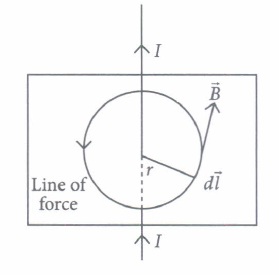
(i) The magnetic field at a radial distance r from the centre of the wire in the region r > R, is
| \(\text { (a) } \frac{\mu_{0} I}{2 \pi r}\) | \(\text { (b) } \frac{\mu_{0} I}{2 \pi R}\) | \(\text { (c) } \frac{\mu_{0} I R^{2}}{2 \pi r}\) | \(\text { (d) } \frac{\mu_{0} I r^{2}}{2 \pi R}\) |
(ii) The magnetic field at a distance r in the region r < R is
| \(\text { (a) } \frac{\mu_{0} I}{2 r}\) | \(\text { (b) } \frac{\mu_{0} I r^{2}}{2 \pi R^{2}}\) | \(\text { (c) } \frac{\mu_{0} I}{2 \pi r}\) | \(\text { (d) } \frac{\mu_{0} I r}{2 \pi R^{2}}\) |
(iii) A long straight wire of a circular cross section (radius a) carries a steady current I and the current I is uniformly distributed across this cross-section. Which of the following plots represents the variation of magnitude of magnetic field B with distance r from the centre of the wire?

(iv) A long straight wire of radius R carries a steady current I. The current is uniformly distributed across its cross-section. The ratio of magnetic field at R/2 and 2R is
| \(\text { (a) } \frac{1}{2}\) | (b) 2 | \(\text { (c) } \frac{1}{4}\) | (d) 1 |
(v) A direct current I flows along the length of an infinitely long straight thin walled pipe, then the magnetic field is
| (a) uniform throughout the pipe but not zero | (b) zero only along the axis of the pipe |
| (c) zero at any point inside the pipe | (d) maximum at the centre and minimum at the edges. |
1.
Here, V1 = 5.5MHz = 5.5 x 10⁶ Hz
v2 = 16 MHz = 16 x 106Hz
\(\therefore \quad \lambda_{1}=\frac{c}{v_{1}}=\frac{3 \times 10^{8}}{5.5 \times 10^{6}}\)
\(=0.545 \times 10^{2} \mathrm{~m}=54.5 \mathrm{~m}\)
\(\Rightarrow \quad \lambda_{2}=\frac{c}{v_{2}}=\frac{3 \times 10^{8}}{16 \times 10^{6}}=0.1875 \times 10^{2}\)
\(=18.75 \mathrm{~cm}\)
Hence, corresponding wavelengths of above frequencies are 54.5 m and 18.75 m.
2.
For maximum current through the external resistance, external resistance = total internal resistance of cells
\(\text { or } \ R=\frac{n r}{m}\)
∴ \(1.5=\frac{n \times 0.5}{\frac{12}{n}}\) [∵ mn = 12]
or 36 = n2
∴ n = 6 and m = 2
3.
Energy, \(E=10^{-3} \times\left(3 \times 10^{8}\right)^{2} \mathrm{~J}\)
\(E=10^{-3} \times 9 \times 10^{16}=9 \times 10^{13} \mathrm{~J}\)
Thus, if one gram of matter is converted to energy, there is a release of enormous amount of energy.
4.
Y1 Microwaves
Microwave oven, Aircraft Navigator or any other
Y2 Ultraviolet waves
Sterilize surgical instruments, food preservation or any other
5.
As, electron is revolving clockwise, therefore conventional current due to the motion of electron will be in anti-clockwise direction.
So, according to right hand rule,magnetic field at point A will be in outward direction to the plane of circular loop.
6.
As we know E = V + Ir and \(V=\frac{E}{2}, r=1 \Omega\)
\(\therefore E=\frac{E}{2}+I r \ \Rightarrow \ I=\frac{E}{2 r}=\frac{1.5}{2 \times 1}=0.75 \mathrm{~A}\)
7.
\(\text { Given } E_{y}=4 \times 10^{5} \cos \left(3.14 \times 10^{8} t-1.57 x\right) \mathrm{N} / \mathrm{C}\)
∵ General equation of electric field is given by
\(E_{y}=E_{0} \cos (\omega t-k x) \mathrm{N} / \mathrm{C}\)
\(\therefore E_{0}=4 \times 10^{5} \mathrm{~N} / \mathrm{C}, \omega=3.14 \times 10^{8} \mathrm{rad} \mathrm{s}^{-1} \)
\(k=1.57 \mathrm{rad} \cdot \mathrm{m}^{-1} \)
\((i) \lambda=\frac{2 \pi}{k}=\frac{2 \times 3.14}{1.57} \mathrm{~m}=4 \mathrm{~m} \)
\((ii) \mathrm{v}=\frac{\omega}{2 \pi}=\frac{3.14 \times 10^{8}}{2 \times 3.14} \mathrm{~Hz}=5 \times 10^{7} \mathrm{~Hz}\)
(iii) The direction of propagation is +x direction.
\( \text { (iv) } v=\frac{\omega}{k}=\frac{3.14 \times 10^{8}}{1.57} \mathrm{~m} / \mathrm{s}=2 \times 10^{8} \mathrm{~m} / \mathrm{s} \)
\(\text { (v) } \mu=\frac{c}{v}=\frac{3 \times 10^{8}}{2 \times 10^{8}}=1.5 \)
\(\text { (vi) } \because \frac{E_{0}}{B_{0}}=c \)
\(\Rightarrow B_{0}=\frac{E_{0}}{c}=\frac{4 \times 10^{5}}{3 \times 10^{8}} \mathrm{~T}=1.33 \times 10^{-3} \mathrm{~T} \)
8.
We have the expression for nuclear radius as:
R = R0A1/3
Where,
R0 = Constant.
A = Mass number of the nucleus
Nuclear matter density, \(\rho \ =\frac{Mass\ of\ the\ nucles}{Volume\ of\ the\ nucles}\)
Let m be the average mass of the nucleus.
Hence, mass of the nucleus = mA
\(\therefore \rho=m \frac{A}{\frac{4}{3} \pi R^{3}}=\frac{3 \mathrm{~mA}}{4 \pi\left(R_{0} A^{\frac{1}{3}}\right)^{3}}=\frac{3 m A}{4 \pi R_{0}^{3} A}=\frac{3 \mathrm{~m}}{4 \pi R_{0}^{3}}\)
Hence, the nuclear matter density is independent of A. It is nearly constant.
9.
Here, B=5X10⁻³T, v=5X10⁷ ms-1,
e=1.6X10⁻¹⁹C, m=9.1X10⁻³¹ kg
(i) Radius of the circular path,
\(r=\frac { mv }{ Be } =\frac { \left( 9.1\times { 10 }^{ -31 } \right) \times \left( 5\times { 10 }^{ 7 } \right) }{ \left( 5\times { 10 }^{ -3 } \right) \times \left( 1.6\times { 10 }^{ -19 } \right) } \)
= 5.7X10⁻² m
= 5.7cm
(ii) Frequencyof revolution,
\(v=\frac { eB }{ 2\pi m } =\frac { \left( 1.6\times { 10 }^{ -19 } \right) \times \left( 5\times { 10 }^{ -3 } \right) }{ 2\times 3.14\times \left( 9.1\times { 10 }^{ -31 } \right) } \)
= 1.4X10⁸ Hz
10.
If A is the area of cross-section of the wire, then number of electrons per unit volume of copper wire is
n = \(\frac{2 \times 10^{21}}{A\times(5\times10^{-2})}m^{-3}\)
= nAevd
= \(\frac{2\times10^{21}}{A\times(5\times10^{-2})} \times A \times(1.6 \times 10^{-19})\times (0.25 \times 10^{-3})\)
= 1.6 A
11.
Since impact parameter is given by:
\(b={Ze^2cot{\theta\over2}\over4\pi\epsilon_0 E}\)
when b = 0, \(cot{\theta\over2}=0\)
or \({\theta\over2}=90^0\)
or \(\theta =180^0\)
i.e. \(\alpha\) -particle retrace its path as its angle of scattering is 1800
12.
Since \(\varepsilon _{ E }=\frac { 1 }{ 2 } \varepsilon _{ 0 }{ { E }^{ 2 } }\)
and \(\varepsilon _{ B }=\frac { { B }^{ 2 } }{ 2\mu _{ 0 } } \)
\(\therefore \) Total energy density \(u={ u }_{ E }+{ u }_{ B }=\frac { 1 }{ 2 } \varepsilon _{ 0 }{ E }_{ 2 }+\frac { 1 }{ 2 } \frac { { B }^{ 2 } }{ { \mu }_{ 0 } } \)
For a plane em wave, Band E are related as
\({ B }_{ v }=\frac { { E }_{ V } }{ C } \)
\(u=\frac { 1 }{ 2 } \varepsilon _{ 0 }{ E }_{ v2 }+\frac { 1 }{ 2\mu _{ 0 } } \left( \frac { { E }_{ v } }{ c } \right) ^{ 2 }\)
\(={ E^{ 2 } }_{ v }\frac { \left( { \mu }_{ 0 }\varepsilon _{ 0^{ c2 } }+1 \right) }{ 2{ \mu }_{ 0^{ c2 } } } ={ E }^{ 2 }_{ v }\)
or \(u=\frac { { E }^{ 2 }_{ v }(1+1) }{ 2{ \mu }_{ 0 }\frac { 1 }{ { \mu }_{ 0 }\varepsilon _{ 0 } } } \) \(\left[ \therefore { c }^{ 2 }=\frac { 1 }{ { \mu }_{ 0 }\varepsilon _{ 0 } } \right] \)
\(=\varepsilon _{ 0 }{ E }^{ 2 }_{ v }\)
So \(I=\frac { Energy/Time }{ Area } \)
or
\(I=\frac { Energy \ density/Time }{ Area } \times volume\)
\( =Energy\quad density\times \frac { length }{ Time } \)
\( =u\times c\)
Using eqn.(i), we get
\(\\ I=\varepsilon _{ 0 }{ E }^{ 2 }_{ v }\)
13.
Given
\({ R }_{ 1 }=1\Omega ,{ R }_{ 2 }=2\Omega ,{ R }_{ 3 }=3\Omega \)
(a) Total resistance of series combination
\({ R }_{ s }={ R }_{ 1 }+{ R }_{ 2 }+{ R }_{ 3 }\)
\({ R }_{ s }\) = 1 + 2 + 3 = \(6\Omega \)
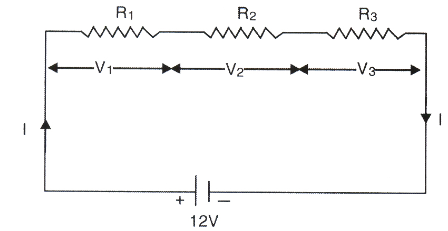
(b) Since E = I (R + r)
I = \(\frac { E }{ { R }_{ s }+0 } =\frac { E }{ { R }_{ s } } =2A\)
\({ V }_{ 1 }={ IR }_{ 1 }=2\times 1=2V\)
\({ V }_{ 2 }={ IR }_{ 2 }=2\times 2=4V\)
\({ V }_{ 3 }={ IR }_{ 3 }=2\times 3=6V\)
14.
Given, resistance of heating element at temperature 27°C,
R27 = 100 \(\Omega\)
Resistance of heating element at temperature t°C,
Rt = 117 \(\Omega\)
\(\alpha\)=1.70 \(\times\)10-4 °C-1, t = ?
By using the formula of temperature coefficient of resistance,
\(\alpha=\frac{R_2-R_1}{R_1\left(t_2-t_1\right)}\) ...(i)
Here, R1 = Rt, R1 = R27, t2 = t and t1 = 27°C
Such that, \(\alpha=\frac{R_t-R_{27}}{R_{27}(t-27)}\)
Substituting given values in Eq. (i), we get
\(\begin{aligned} 1.70 \times 10^{-4} & =\frac{117-100}{100(t-27)} \\ \end{aligned}\)
\(\begin{aligned} \text { or } \quad t-27 & =\frac{17}{100 \times 1.70 \times 10^{-4}} \end{aligned}\)
or t = 1000 + 27 = 1027°C
15.
(d)
\(\frac{\mu_0 I}{2 R}\left(1-\frac{1}{\pi}\right)\)
16.
(c)
3.6W
17.
(a)
only by moving charge
18.
(b)
50 W
19.
(b)
18 x 1013J
20.
(c)
Mixed
21.
(b)
zero
22.
(c)
\(7.7{ Am }^{ 2 }\)
23.
(a)
\(0.01\Omega \)
24.
(a)
1 : 2
25.
(a)
microwaves, ultraviolet rays and x-rays
26.
(b)
electrostatic force between protons is repulsive
27.
Magnetic field strength, B = 6.5 x 10⁻⁴ T
Charge of the electron, e = 1.6 x 10⁻¹⁹ C
Mass of the electron, me = 9.1 x 10⁻³¹ kg
Velocity of the electron, v = 4.8 x 10⁶ m/s
Radius of the orbit, r = 4.2 cm = 0.042 m
Frequency of revolution of the electron = ν
Angular frequency of the electron = ω = 2πν
Velocity of the electron is related to the angular frequency as:
v = rω
In the circular orbit, the magnetic force on the electron is balanced by the centripetal force. Hence, we can write:
\(e v B=\frac{m v^{2}}{r}\)
\(e B=\frac{m}{r}(r \omega)=\frac{m}{r}(2 \pi r v)\)
\(v=\frac{B e}{2 \pi m}\)
This expression for frequency is independent of the speed of the electron.
On substituting the known values in this expression, we get the frequency as:
\(V=\frac{6.5 \times 10^{-4} \times 1.6 \times 10^{-19}}{2 \times 3.14 \times 9.1 \times 10^{-31}}\)
= 18.2 x 10⁶ Hz
\(\approx\) 18 MHz
Hence, the frequency of the electron is around 18 MHz and is independent of the speed of the electron.
28.
Length of the solenoid, l = 80 cm = 0.8 m
There are five layers of windings of 400 turns each on the solenoid.
∴ Total number of turns on the solenoid, N = 5 x 400 = 2000
Diameter of the solenoid, D = 1.8 cm = 0.018 m
Current carried by the solenoid, I = 8.0 A
Magnitude of the magnetic field inside the solenoid near its centre is given by the relation,
\(B=\frac{\mu_{0} N I}{l}\)
Where,
μ0 = Permeability of free space = 4π x 10–7 T m A–1
\(B=\frac{4 \pi \times 10^{-7} \times 2000 \times 8}{0.8}\)
\(=8 \pi \times 10^{-3}=2.512 \times 10^{-2} T\)
Hence, the magnitude of the magnetic field inside the solenoid near its centre is 2.512 x 10⁻² T.
29.
Atomic mass of \(\begin{array}{l} 26 \\ 56 \end{array} \text { Fe }\),m1 = 55.934939 u
\(\begin{array}{l} 26 \\ 56 \end{array} \text { Fe }\) nucleus has 26 protons and (56 − 26) = 30 neutrons
Hence, the mass defect of the nucleus,Δm = 26 x mH + 30 x mn − m1
Where,
Mass of a proton, mH = 1.007825 u
Mass of a neutron, mn = 1.008665 u
∴Δm = 26 x 1.007825 + 30 x 1.008665 − 55.934939
= 26.20345 + 30.25995 − 55.934939
= 0.528461 u
But 1 u = 931.5 MeV/c2
∴Δm = 0.528461 x 931.5 MeV/c2
The binding energy of this nucleus is given as:
Eb1 = Δmc2
Where,
c = Speed of light
∴Eb1 = 0.528461 x 931.5 \(\left(\frac{M e V}{c^{2}}\right) \times c^{2}\)
= 492.26 MeV
Average binding energy per nucleon =\(\frac{492.26}{56}=8.79 \mathrm{MeV}\)
Atomic mass of \(\begin{array}{l} 209 \\ 83 \end{array} \text { Bi }\), m2 = 208.980388 u
\(\begin{array}{l} 209 \\ 83 \end{array} \text { Bi }\) nucleus has 83 protons and (209 − 83) 126 neutrons.
Hence, the mass defect of this nucleus is given as:
Δm' = 83 x mH + 126 x mn − m2
Where,
Mass of a proton, mH = 1.007825 u
Mass of a neutron, mn = 1.008665 u
∴Δm' = 83 x 1.007825 + 126 x 1.008665 − 208.980388
= 83.649475 + 127.091790 − 208.980388
= 1.760877 u
But 1 u = 931.5 MeV/c2
∴Δm' = 1.760877 x 931.5 MeV/c2
Hence, the binding energy of this nucleus is given as:
Eb2 = Δm'c2
= 1.760877 x 931.5 \(\left(\frac{M e V}{c^{2}}\right) \times c^{2}\)
= 1640.26 MeV
Average bindingenergy per nucleon \(=\frac{1640.26}{209}=7.848 \mathrm{MeV}\)
30.
While drawing the plot. we have to keep in mind that first binding energy will increase sharply and then it will be constant almost.
For plot of binding energy per nucleon as the function of mass number A
Following are the two conclusions that can be drawn regarding the nature of the nuclear force.
The force is attractive and strong enough to produce a binding energy of few MeV per nucleon.
The two important conclusions regarding the nature of nuclear force are given below.
(i) The nuclear force is attractive and sufficiently strong to produce a binding energy of a few MeV per nucleon.
(ii) The constancy of the binding energy in the wide range of mass number 30 < A < 170 indicate that nuclear force is a short-range force.
(b) (i) According to the binding energy curve, a very heavy nucleus (A > 170), has lower binding energy per nucleon compared to nuclei of middle mass number (30 < A < 170).
Thus, if a heavy nucleus breaks into two nuclei of mass number between 30 and 170, nucleons get more tightly bound. This implies energy would be released in the process. (nuclear fission)
(ii) When two light nuclei (A < 10) join to form a heavier nucleus, the binding energy per nucleon of fused heavier nucleus increases.
Again it indicates that energy would be released in the process (nuclear fusion).
(c) The basic nuclear process of neutron undergoing β-decay is given as
\(n \rightarrow p+e^{-}+\bar{v}\)
Here \(\bar{v}\) is antinutrino.
Neutrino and antineutrino both are neutral particles with very small (possibly, even zero) mass compared to the electrons. They have only weak interaction with other particles. Therefore, the detection of neutrinos is found very difficult.
31.
Given, E = 10 V, r = 3 \(\Omega\), I = 0.5 A
As, \(\begin{aligned} I & =\frac{E}{R+r} \end{aligned}\)
\(\begin{aligned} R & =\frac{E}{I}-r \end{aligned}\)
\(\begin{aligned} =\frac{10}{0.5}-3=17 \Omega \end{aligned}\)
and terminal voltage, V = IR = 0.5 \(\times\)17 = 8.5 V
32.
n = 300 turns/m ;
I = 5 A ; l = 0.5 m, r = 10-2 m.
\({ B }={ \mu }_{ o }nI=\left( 4\pi \times { 10 }^{ -7 } \right) \times 300\times 5\)
= 1.9 x 10⁻³ T.
33.
(b): At every instant the ratio of the magnitudes of the electrip field to the magnetic field of an em wave is given by E/B = c.
From this equation, the magnitude of electric vector is much greater than the magnitude of magnetic vector. Also electromagnetic waves, carry energy which is equally shared by electric and magnetic field.
34.
(a): Experimentally, it is found that the average radius of a nucleus is given by
\(R=R_{0} A^{1 / 3} \text { where } R_{0}=1.1 \times 10^{-15} \mathrm{~m}=1.1 \mathrm{fm}\)
and A = mass number
The volume of a nucleus is \(V=\frac{4}{3} \pi R^{3}=\frac{4}{3} \pi R_{0}^{3} A\)
Now as the masses of a proton and a neutron are roughly equal, say m, the mass of a nucleus is also roughly proportional to the mass number A, M = mA
Hence density within a nucleus \(\rho=\frac{M}{V}=\frac{m A}{\frac{4}{3} \pi R_{0}^{3} A}\)
\(=\frac{m}{\frac{4}{3} \pi R_{0}^{3}}\) is independent of the mass number A.
35.
(c): An ammeter is a low resistance galvanometer. It is used to measure the current in amperes. To measure the current of a circuit, the ammeter is connected in series in the circuit so that the current to be measured must pass through it. Since, the resistance of ammeter is low, so its inclusion in series in the circuit does not change the resistance and hence the main current in the circuit.
36.
(a): Drift velocity of free electrons is given by \(v_{d}=\frac{e E}{m} \tau\)
where,\(E=\frac{\text { Potential difference }}{\text { length }}=\frac{V}{l}\)
\(\therefore \quad v_{d}=\frac{e V}{m l} \tau \text { i.e., } v_{d} \propto 1 / l \text { where, } \frac{e V \tau}{m}\)
It mean if I is doubled, the drift velocity will become half of the original value.
37.
38.
(i) (a) :Magnetic field due to a long current carrying wire at r
\(B=\frac{\mu_{0}}{2 \pi} \frac{I}{r}\)
(ii) (d): Let I' be the current in region r < R
Then, \(I^{\prime}=\frac{I}{\pi R^{2}} \pi\left(r^{2}\right) \text { or } I^{\prime}=\frac{I r^{2}}{R^{2}}\)
So, magnetic. field \(B=\frac{\mu_{0} I^{\prime}}{2 \pi r}=\frac{\mu_{0} I r^{2}}{2 \pi R^{2} r}=\frac{\mu_{0} I r}{2 \pi R^{2}}\)
(iii) (a): Magnetic field due to a long straight wire of radius a carrying current I at a point distant r from the centre of the wire is given as follows
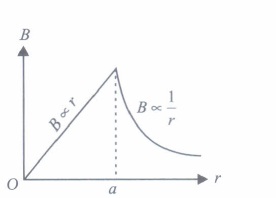
\(B=\frac{\mu_{0} I r}{2 \pi a^{2}} \quad \text { for } \quad r<a\)
\(B=\frac{\mu_{0} I}{2 \pi a} \quad \text { for } r=a\)
\(B=\frac{\mu_{0} I}{2 \pi r} \quad \text { for } r>a\)
The variation of magnetic field B with distance r from the centre of wire is shown in the figure.
(iv) (d): Let the magnetic fields due to a long straight wire of radius R carrying a steady current I at a distance r from the centre of the wire are
\(B_{1}=\frac{\mu_{0} I r}{2 \pi R^{2}} \quad(\text { For } r<R)\)
and \(B_{2}=\frac{\mu_{0} I}{2 \pi R} \quad(\text { For } r>R)\)
So, the magnetic field at \(r=\frac{R}{2} \text { is } B_{1}=\frac{\mu_{0} I}{2 \pi R^{2}}\left(\frac{R}{2}\right)=\frac{\mu_{0} I}{4 \pi R}\)
and at \(r=2 R \text { is } B_{2}=\frac{\mu_{0} I}{2 \pi(2 R)}=\frac{\mu_{0} I}{4 \pi R}\)
\(\therefore\) Their corresponding ratio is \(\frac{B_{1}}{B_{2}}=\frac{\left(\mu_{0} I / 4 \pi R\right)}{\left(\mu_{0} I / 4 \pi R\right)}=1\)
(v) (c)

12th Standard CBSE Syllabus & Materials
12th Standard CBSE
CBSE 12th Computer Science Python Revision Tour I - New Previous year Question Papers Study Material - QB365 Set A
NEW12th Standard CBSE
CBSE 12th Business Studies Planning Important Questions And Answers Study Material - QB365 Set A
NEW12th Standard CBSE
CBSE 12th Business Studies Business Environment Important Questions And Answers Study Material - QB365 Set A
NEW12th Standard CBSE
CBSE 12th Business Studies Principles of Management Important Questions And Answers Study Material - QB365 Set A



NCERT Books

Syllabus

Exam Pattern

Sample Question Papers

Previous year Question Papers

Important Notes

MCQ Practice test

NCERT Exemplers

Case study Questions

Image Based Questions

Passage based Questions

HOT Questions

Value Based Questions

Model Questions Papers
NCERT ( Book Back ) Questions

Assertion and Reason
Important Questions And Answers

CBSE 12th Standard CBSE Subjects
CBSE Standards








