
 100% FREE ACCESS
12th Standard CBSE Syllabus & Materials
12th Standard CBSE
CBSE 12th Economics Government Budget and the Economy Previous year Question Papers Study Material - QB365 Set A
NEW12th Standard CBSE
CBSE 12th Computer Science Interface Python with MySQL - New Previous year Question Papers Study Material - QB365 Set A
NEW12th Standard CBSE
CBSE 12th Computer Science Database Concept - New Previous year Question Papers Study Material - QB365 Set A
NEW12th Standard CBSE
CBSE 12th Computer Science Data Communication - New Previous year Question Papers Study Material - QB365 Set A
NEW12th Standard CBSE
CBSE 12th Computer Science Data Structures - New Previous year Question Papers Study Material - QB365 Set A
NEW12th Standard CBSE
CBSE 12th Computer Science Functions - New Previous year Question Papers Study Material - QB365 Set A

Published on: 25/10/2025
Download CBSE Class 12th Standard CBSE Physics question papers, sample papers, important questions, and previous year solved papers in PDF format. Get free study materials, NCERT solutions, and exam preparation resources for Class 12th Standard CBSE Physics
Questions + Answers key
Take MCQ Physics Test
1.
Why is the potentiometer preferred to a voltmeter for measuring emf of a cell?
2.
A negligibly small current is passed through a wire length 15 m and uniform cross-section \(6.0\times { 10 }^{ -7 }m^{ 2 }\) and its resistance is measured to be \(5.0\Omega \). What is the resistivity of the material at the temperature of the experiment?
3.
The storage battery of a car has an emf of 12 V. If the internal resistance of the battery is 0.4\(\Omega \), what is the maximum current that can be drawn from the battery?
4.
What should be the properties of standard resistances?
5.
A storage battery of e.m. 12.0V and internal resistance 0.5\(\Omega\)is to be charged by a 120Vd.c. supply of negligible internal resistance. What resistance is required in the circuit for the charging current to be 3A? What is the terminal voltage o the battery during charging?
6.
A long straight wire carries a current of 35 A. What is the magnitude of the field B at a point 20 cm from the wire?
7.
The electric field intensity produced by the radiations coming from 100 W bulb at a 3m distance is E.What will be the electric field produced by the radiations coming from 50 W bulb at the same distance?
8.
If the wavefront of electromagnetic wave travelling in a vacuum is given by; \(\overset { \rightarrow }{ r } =\hat { i } +\hat { j } +\hat { k } \) find the angle made by the direction of propagation of e.m. wave with the y-axis.
9.
If the current sensitivity of a moving coil galvanometer is increased by 20%, its resistance also increases by 1.5 times. How will the voltage sensitivity of the galvanometer be affected?
10.
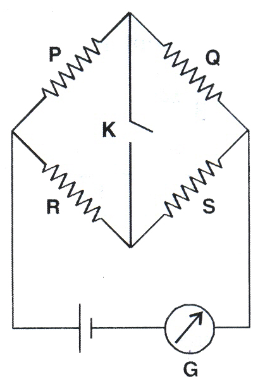
In a Wheatstone bridge experiment, a student by mistake connects key (K) in place of galvanometer and galvanometer (G) in place of the key (K). How will be the test for the balance of the bridge?
11.
Is the motion of a charge across junction momentum conserving? Why or why not?
12.
A silver wire has a resistance of 2.1\(\Omega\) at 27.5oC and a resistance of 2.7\(\Omega\) at 100oC. Determine the temperature coefficient of resistivity of silver.
13.
(i) Two point charges q1, and q2, are kept at a distance of r12 in air. Deduce the expression for the electrostatic potential energy of this system.
(ii) If an external electric field (E) is applied on the system, write the expression for the total energy of this system.
14.
A dipole consisting of an electron and a proton separated by a distance of \(4\times 10^{-10}m\) is situated in an electric field of intensity \(3\times 10^5NC^{-1}\) at an angle of 30o with the field. Calculate the dipole moment and the torque acting on it. Charge e on an electron = \(1.6\times 10^{-19}C\)
15.
A parallel plate capacitor with air between the plates has a capacitance of 8 pF (1pF = 10-12F). What will be the capacitance if the distance between the plates is reduced by half, and the space between them is filled with a substance of dielectric constant 6?
16.
A straight wire is kept horizontally along east-west direction. If a steady current flows in wire from east to west, the magnetic field at a point above the wire will point towards
East
West
North
South
17.
Which of the following has maximum penetrating power?
Ultraviolet radiation
Microwaves
\(\gamma \text { -rays }\)
Radio waves
18.
A positive charge enters in a magnetic field and travels parallel to but opposite the field. If experiences
an upward force
a downward force
an accelerated force
no force
19.
The gyro-magnetic ratio of an electron in an H-atom, according to Bohr model, is
independent of which orbit it is in.
neutral
positive
increases with the quantum number n.
20.
A circular coil of radius 4 cm and of 20 turns carries a current of 3 amperes. It is placed in a magnetic field of intensity 0.5 weber/m2. The magnetic dipole moment of the coil is
0.15 ampere-m2
0.3 ampere-m2
0.45 ampere-m2
0.6 ampere-m2
21.
A capacitor is charged by using a battery which is then disconnected. A dielectric slab is then slipped between the plates, which results in
reduction of charge on the plates and increase of potential difference across the plates.
increase in the potential difference across the plate, reduction in stored energy, but no change in the charge on the plates.
decrease in the potential difference across the plates, reduction in the stored energy, but no change in the charge on the plates
none of these
22.
Which of the following options is correct? In a region of constant potential
the electric field is uniform.
the electric field is zero
there can be charge inside the region.
the electric field shall necessarily change if a charge is placed outside the region.
23.
The magnitude of the two charges is doubled and the distance of their separation also doubled. The electrostatic force between them Will
be halved
be doubled
become four times
remain unchanged
24.
A hemisphere is uniformly charged positively. The electric field at a point on a diameter away from the centre is directed
perpendicular to the diameter
parallel to the diameter
at an angle tilted towards the diameter
at an angle tilted away from the diameter
25.
When air inbetween the plates of a capacitor is replaced by mica of dielectric constant 6, its capacity
remains unaffected
reduced to 1/6th
becomes 6 times
none of the above
26.
A galvanometer having a coil resistance of \(100\Omega \) gives a full scale deflection, when a current of 1 mA is passed through it. The value of the resistance, which can convert this galvanometer into ammeter giving a full scale deflection for a current of 10 A is
\(0.01\Omega \)
\(2\Omega \)
\(0.1\Omega \)
\(3\Omega \)
27.
An electromagnetic wave is travelling through a medium of refractive index \({ \mu }_{ 1 }\) and is incident on the boundary of medium of refractive index \({ \mu }_{ 2 }\) . If the wave reflects at the boundary
The wave undergoes a phase change of 180 degrees If \({ \mu }_{ 1 }>{ \mu }_{ 2 }\)
The wave undergoes a phase change of 180 degrees If \({ \mu }_{ 1 }<{ \mu }_{ 2 }\)
The wave undergoes a phase change If \({ \mu }_{ 1 }>{ \mu }_{ 2 }\)
The wave undergoes a phase change If \({ \mu }_{ 1 }<{ \mu }_{ 2 }\)
28.
A flood light is covered with a filter that transmits red light. The electric field of the emerging beam is represented by a sinusoidal wave.
\({ E }_{ x }=36 \ sin\quad (1.20\times { 10 }^{ 7 }z=3.6\times { 10 }^{ 15 }t) \ V/m\)
the average intensity of the beam is watt/\({ (metre) }^{ 2 }\) will be:
6.88
3.44
1.72
0.86
29.
which of the following electromagnetic waves has smaller wavelengths?
X-rays
Microwaves
\(\gamma \) -rays
Radiowaves
30.
A light has a wavelength 6000 A. The energy of light is
5 eV
2.07 eV
1.07 eV
0.207 eV
31.
Electrostatic Potential and Capacitance, explores the concepts of electric potential energy, electric potential, and capacitance. The electric potential at a point in an electric field is the amount of work done per unit charge in bringing a positive test charge from infinity to that point against the electric force. It’s important to note that the potential energy of a system of charges is defined as the work done in assembling the system of charges from infinity. The chapter further introduces the concept of capacitance. A capacitor is a device that stores electrical energy in an electric field. It’s essentially a system of two conductors separated by an insulator, and its capacitance is the ratio of the amount of charge stored on one conductor to the potential difference between the conductors.
1.What is the electric potential at a point in an electric field?
A) The amount of work done per unit charge in bringing a negative test charge from infinity to that point.
B) The amount of work done per unit charge in bringing a positive test charge from infinity to that point.
C) The force experienced by a unit positive charge at that point.
D) The force experienced by a unit negative charge at that point.
2.How is the potential energy of a system of charges defined?
A) As the work done in disassembling the system of charges to infinity.
B) As the work done in assembling the system of charges from infinity.
C) As the force experienced by the system of charges.
D) As the amount of charge in the system.
3.What is a capacitor?
A) A device that measures the potential difference between two points.
B) A device that measures the amount of charge in an electric field.
C) A device that stores electrical energy in an electric field.
D) A device that converts electrical energy into mechanical energy.
4.What is the capacitance of a capacitor?
A) The ratio of the potential difference between the conductors to the amount of charge stored on one conductor.
B) The ratio of the amount of charge stored on one conductor to the potential difference between the conductors.
C) The total amount of charge stored on the conductors.
D) The potential difference between the conductors.
5.What does a capacitor essentially consist of?
A) Two conductors separated by an insulator.
B) Two insulators separated by a conductor.
C) A single conductor surrounded by an insulator.
D) A single insulator surrounded by a conductor.
32.
Electric field between oppositely charged parallel conducting plates:
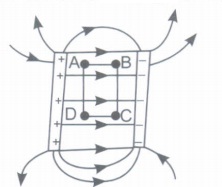
When two plane parallel conducting plates, having the size and spacing shown in figure given below are given equal and opposite charges, the field between and around them is approximately as shown, while most of the charge accumulates at the opposing faces of the plates and the field is essentially uniform in the space between them, there is a small quantity of charge on the outer surfaces of the plates and a certain spreadwing or fringing of the field at the edges of the plates.
As the plates are made larger and the distance between them diminished, the fringing becomes relatively less. This kind of arrangement is called capacitors.
Now if two plates are separated by a distance '3d', and are maintained at a potential difference' V' then answer the following questions.
(i) What is the use of capacitors?
(ii) If two protons are placed at points A and B respectively, then which one will experience more force?
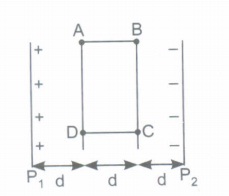
(iii) When both the protons are released then which one will gain more K.E. just before striking the -ve plate?
(iv) If one proton is moved along
(a) A to B
(b) B to C
(c) C to D
(d) Along ABCD, then how much work is done by external agent?
(v) Which property of electric field is shown by answer to (iv) (d) part?
1.
Emf measured by the potentiometer is more accurate because the cell is in open circuit giving no current.
2.
Let the resistivity of the material be \(\rho \).
∴ Resistance of wire,\(\ R=\rho \frac { l }{ A } \)
or \(\rho =\frac { RA }{ l } \)
= \(\quad \frac { 5\times 6\times { 10 }^{ -7 } }{ 15 } \)
= \(2\times { 10 }^{ -7 }\Omega -m\)
Thus the resistivity of the material at the temperature of the experiment is \(2\times { 10 }^{ -7 }\Omega -m\)
3.
Emf of the battery, E = 12 V
Internal resistance of the battery, r = 0.4 Ω
Maximum current drawn from the battery = I
According to Ohm’s law,
E = Ir
\(I=\frac{E}{r}\)
\(=\frac{12}{0.4}=30 A\)
The maximum current drawn from the given battery is 30 A.
4.
The properties of standard resistance should be:
(i) Its value should not charge with time.
(ii) It should show negligible variation in resistance with temperature.
(iii) It should have a proper capacity for carrying current without overheating.
(iv) It should have low inductance.
(v) It should have robust construction and convenient size.
5.
35.5\(\Omega\)
13.5V
6.
Current in the wire, I = 35 A
Distance of a point from the wire, r = 20 cm = 0.2 m
Magnitude of the magnetic field at this point is given as:
\(B=\frac{\mu_{0}}{4 \pi} \frac{2 I}{r}\)
Where,
μ0 = Permeability of free space = 4π x 10–7 T m A–1
\(B=\frac{4 \pi \times 10^{-7} \times 2 \times 35}{4 \pi \times 0.2}\)
= 3.3 x 10⁻⁵ T
Hence, the magnitude of the magnetic field at a point 20 cm from the wire is 3.5 × 10⁻⁵ T.
7.
As, we know that
Electric field intensity,
\( E= \ \sqrt { \frac { { Pc\mu }_{ 0 } }{ { 4\pi r }^{ 2 } } }\)
\( i.e.\ E\alpha \ \sqrt { \frac { P }{ { r }^{ 2 } } } \)
As, r is constant in this question.
So, \(E\alpha \sqrt { P } \)
For two different situations,
\({ \ E }_{ 1 }\alpha \sqrt { { P }_{ 1 } } and \ { E }_{ 2 } \ \alpha \sqrt { { P }_{ 2 } } \)
\(frac { { E }_{ 1 } }{ { E }_{ 2 } } =\left( \frac { { P }_{ 1 } }{ { P }_{ 2 } } \right) ^{ { 1 }/{ 2 } }\Rightarrow \frac { { E }_{ 1 } }{ { E }_{ 2 } } =\left( \frac { 100 }{ 50 } \right) ^{ { 1 }/{ 2 } }=\sqrt { 2 }\)
\(\Rightarrow \ { E }_{ 2 }=\frac { { E }_{ 1 } }{ \sqrt { 2 } }\)
\(As,d { E }_{ 1 }=E\Rightarrow { E }_{ 2 }=\frac { E }{ \sqrt { 2 } } \)
8.
If \(\theta \) is the angle which the direction of propagation of c.m. wave with y-axis, then
\(cos \ \theta =\frac { \overset { \rightarrow }{ r } .\hat { j } }{ r } =\frac { (\hat { i } +\hat { j } +\hat { k } ) }{ \sqrt { { 1 }^{ 2 }+{ 1 }^{ 2 }+{ 1 }^{ 2 } } } =\frac { 1 }{ \sqrt { 3 } } \ or \ \theta ={ cos }^{ -1 }\left( \frac { 1 }{ \sqrt { 3 } } \right) \)
9.
\(Original \ current \ sensitivity, \ { I }_{ s }=\frac { \theta }{ I } \)
\(Original \ voltage \ sensitivity, \ { V }_{ s }=\frac { \theta }{ V } =\frac { \theta }{ IR } =\frac { { I }_{ s } }{ R } \)
New current sensitivity,
\({ I }_{ s }^{ \prime }={ I }_{ s }+\frac { 20 }{ 100 } { I }_{ s }=\frac { 6 }{ 5 } { I }_{ s }\)
New Voltage sensitivity
\({ V }_{ s }^{ ' }=\frac { { I }_{ s }^{ ' } }{ 1.5R } =\frac { (6/5){ I }_{ s } }{ (3/2)R } =\frac { 4 }{ 5 } { V }_{ s }=0.8{ V }_{ s }\)
% decrease in voltage sensitivity
\(\frac { { V }_{ s }-{ V }_{ s }^{ ' } }{ { V }_{ s } } \times 100=\frac { { V }_{ s }-{ 0.8V }_{ s } }{ { V }_{ s } } \times 100=20%\)
10.
In a balanced position of the bridge no current will flow in key (K) and hence a constant current will flow in the galvanometer and it will show a constant deflection even when the key K is pressed.
11.
When an electron approaches a junction, in addition to the uniform electric field E facing it normally, it keeps the drift velocity fixed, as drift velocity depends on E by the relation of drift velocity,\({ v }_{ d }=\frac { eE }{ m } \tau \)
This results into accumulation of charges on the surface of wires at the junction. These produce an additional electric field. These fields change the direction conserving momentum. Thus, the motion of a charge junction is not momentum conserving.
12.
Temperature, T1 = 27.5°C
Resistance of the silver wire at T1, R1 = 2.1 Ω
Temperature, T2 = 100°C
Resistance of the silver wire at T2, R2 = 2.7 Ω
Temperature coefficient of silver = α
It is related with temperature and resistance as
\(\alpha=\frac{R_{2}-R_{1}}{R_{2}\left(T_{2}-T_{1}\right)}\)
\(=\frac{2.7-2.1}{2.1(100-27.5)}=0.0039^{\circ} \mathrm{C}^{-1}\)
Therefore, the temperature coefficient of silver is 0.0039°C−1.
13.
Work done in bringing q2 from infinity to a point
\(=q_2 \times \frac{1}{4 \pi \epsilon_0} \frac{q_1}{r_{12}}\)
The potential energy of the system
\(=\frac{1}{4 \pi \epsilon_0} \frac{q_1 q_2}{r_{12}}\)
b) Total energy of the system
\(=q_1 V_1+q_2 V_2+\frac{1}{4 \pi \epsilon_0} \frac{q_1 q_2}{r_{12}}\)
14.
Here q = \(1.6\times 10^{-19}C\)
\(2a=4\times10^{-10}m, E=3\times 10^5NC^{-1}, \theta=30^o\)
\(p=q\times2a=1.6\times10^{-19}\times4\times10^{-10}\)
= \(6.4\times10^{-29}Cm\)
\(\tau=pEsin\theta=6.4\times10^{-29}\times3\times10^5\times sin 30^o\)
\(=9.6\times 10^{-24}Nm\)
15.
Given,
Capacitance, C = 8pF.
In the first case, the parallel plates are at a distance ‘d’ and is filled with air.
Air has dielectric constant, k = 1
Capacitance, C\(=\frac{k \times \epsilon_{o} \times A}{d}=\frac{\epsilon_{o} \times A}{d}\) .......(i)
Here,
A = area of each plate
ϵo = permittivity of free space.
Now, if the distance between the parallel plates is reduced to half, then d1 = d/2
Given, dielectric constant of the substance, k1 = 6
Hence, the capacitance of the capacitor,
\(\mathrm{C}_{1}=\frac{k_{1} \times \epsilon_{o} \times A}{d_{1}}=\frac{6 \epsilon_{0} \times A}{d / 2}=\frac{12 \epsilon_{o} A}{d}\) .......(ii)
Taking ratios of eqns. (1) and (2), we get,
C1 = 2 x 6 C = 12 C = 12 x 8 pF = 96pF.
Hence, the capacitance between the plates is 96pF.
16.
(c)
North
17.
(c)
\(\gamma \text { -rays }\)
18.
(d)
no force
19.
(a)
independent of which orbit it is in.
20.
(b)
0.3 ampere-m2
21.
(c)
decrease in the potential difference across the plates, reduction in the stored energy, but no change in the charge on the plates
22.
(b)
the electric field is zero
23.
(d)
remain unchanged
24.
(a)
perpendicular to the diameter
25.
(c)
becomes 6 times
26.
(a)
\(0.01\Omega \)
27.
(d)
The wave undergoes a phase change If \({ \mu }_{ 1 }<{ \mu }_{ 2 }\)
28.
(c)
1.72
29.
(c)
\(\gamma \) -rays
30.
(b)
2.07 eV
31.
1.B) The amount of work done per unit charge in bringing a positive test charge from infinity to that point.
2.B) As the work done in assembling the system of charges from infinity.
3.C) A device that stores electrical energy in an electric field.
4.B) The ratio of the amount of charge stored on one conductor to the potential difference between the conductors.
5.A) Two conductors separated by an insulator.
32.
(i) Capacitors are used to store electric charges and electric energy.
(ii) Both the protons will experience same force. Reason: F = qE; E = constant; q = +e (same)
(iii) \(\because\) VD =.VA > VB = Vc
\(\therefore\) Gain in K.E. = q x P.D.
\( \therefore\) Gain in K.E. of proton released from point A will be more.
(iv) (a) \(W_{A \rightarrow B}=e\left(V_{B}-V_{A}\right)\) \(\left[\begin{array}{c} \because W=q \times \text { P.D. } \\ E=\frac{V}{d} \end{array}\right]\)
= e[E.2d - E.d]
= eE.d
(b) \(\because\) VB = Vc
\(\therefore\) WBC = 0
(c) WCD = e[VD - VC]
= e[E.(d) - E(2d)]
= - eEd
(d) WABCD = WAB + WBC + WCD + WDA
= eEd + 0 - eEd + 0
= 0
(v) Electric field is conservative as work done along a closed path is zero.

12th Standard CBSE Syllabus & Materials
12th Standard CBSE
CBSE 12th Computer Science Python Revision Tour I - New Previous year Question Papers Study Material - QB365 Set A
NEW12th Standard CBSE
CBSE 12th Business Studies Planning Important Questions And Answers Study Material - QB365 Set A
NEW12th Standard CBSE
CBSE 12th Business Studies Business Environment Important Questions And Answers Study Material - QB365 Set A
NEW12th Standard CBSE
CBSE 12th Business Studies Principles of Management Important Questions And Answers Study Material - QB365 Set A



NCERT Books

Syllabus

Exam Pattern

Sample Question Papers

Previous year Question Papers

Important Notes

MCQ Practice test

NCERT Exemplers

Case study Questions

Image Based Questions

Passage based Questions

HOT Questions

Value Based Questions

Model Questions Papers
NCERT ( Book Back ) Questions

Assertion and Reason
Important Questions And Answers

CBSE 12th Standard CBSE Subjects
CBSE Standards








