
 100% FREE ACCESS
12th Standard CBSE Syllabus & Materials
12th Standard CBSE
CBSE 12th Economics Government Budget and the Economy Previous year Question Papers Study Material - QB365 Set A
NEW12th Standard CBSE
CBSE 12th Computer Science Interface Python with MySQL - New Previous year Question Papers Study Material - QB365 Set A
NEW12th Standard CBSE
CBSE 12th Computer Science Database Concept - New Previous year Question Papers Study Material - QB365 Set A
NEW12th Standard CBSE
CBSE 12th Computer Science Data Communication - New Previous year Question Papers Study Material - QB365 Set A
NEW12th Standard CBSE
CBSE 12th Computer Science Data Structures - New Previous year Question Papers Study Material - QB365 Set A
NEW12th Standard CBSE
CBSE 12th Computer Science Functions - New Previous year Question Papers Study Material - QB365 Set A

Published on: 25/10/2025
Download CBSE Class 12th Standard CBSE Physics question papers, sample papers, important questions, and previous year solved papers in PDF format. Get free study materials, NCERT solutions, and exam preparation resources for Class 12th Standard CBSE Physics
Questions + Answers key
Take MCQ Physics Test
1.
Define the term 'electric dipole moment'. Is it a scalar or vector?
Deduce an expression for the electric field at a point on the equatorial plane of an electric dipole of length 2a.
2.
A point charge of 2.0 μC is at the centre of a cubic Gaussian surface 9.0 cm on edge. What is the net electric flux through the surface?
3.
Derive the expression for the average power dissipated in a series LCR circuit for an ac source of a voltage, v = vm sin rot, carrying a current, i = imsin ( \(\omega \)+ \(\Phi \))
Hence define the term "Wattles's current". State under what condition it can be realized in a circuit.
4.
A house wiring, supplied with a 220 V supply line is protected by a 9 ampere fuse. Find the maximum number of 60 W bulbs in parallel that can be turned on.
5.
A radio can tune in to any station in the 7.5 MHz to 12 MHz band. What is the corresponding wavelength band?
6.
An aeroplane is travelling west at the speed of 500 m/s. What is the voltage difference between the ends of the wings 25 m long, if the earth's magnetic field at the location has a magnitude of \(5 \times { 10 }^{ -4 }T\) and dip angle is \({ 30 }^{ \circ }\)?
7.
A \(100\mu F\) the capacitor in series with a \(10\Omega \) resistance is connected to a \(110V\), \(12kHz\) supply. Hence explain the statement that a capacitor is a conductor at very high frequencies. Compare this behavior with that of a capacitor in a d.c. circuit after the steady-state.
8.
At room temperature (27.0oC) the resistance of a heating element is 100 \(\Omega\). What is the temperature of the element if the resistance is found to be 117\(\Omega\) given that the temperature coefficient of the material of the resistor is 1.70 x 10⁻⁴ oC-1.
9.
An electric dipole with dipole moment 4x10⁻⁹C-m is aligned at 30° with the direction of a uniform electric field of magnitude 5 x10⁻⁴ N/C. Calculate the maynitude of the torque acting on the dipole.
10.
The resistance of the platinum wire of a platinum resistance thermometer at the ice point is 5 Ω and at steam point is 5.23 Ω. When the thermometer is inserted in a hot bath, the resistance of the platinum wire is 5.795 Ω. Calculate the temperature of the bath.
11.
Two coils are being moved out of magnetic field- one coil is moved rapidly and the other slowly. In which case is more work done and why?
12.
(i) Name the three elements of the Earth's magnetic field.
(ii) Where on the surface of the Barth is the vertical component of the Earth's magnetic field zero?
13.
Self-induction of an air core inductor increases from 0.01 mH to 10 mH on introducing an iron core into it. What is the relative permeability of the core used?
14.
The storage battery of a car has an emf of 12 V. If the internal resistance of the battery is 0.4\(\Omega \), what is the maximum current that can be drawn from the battery?
15.
Two point charge of \(+3\times {{10}^{-8}}C\) and \(-2\times {{10}^{-8}}C\) are located 15cm apart in air. Find at what point on the joining these charge the electric potential is zero. Take potential at infinity to be zero.
16.
A small flat search coil of area 5 cm³ with 140 closely wound turns is placed between the poles of a poweful magnet producing magnetic field 0.09T and then quickly removed out of the field region. Calculate
(i) Change of magnetic flux through the coil, and
(ii) emf induced in the coil.
17.
i) Derive an expression for the electric field at any point on the equatorial line of an electric dipole.
ii) Two identical point charges g, each are kept 2 m apart in air. A third point charge Q of unknown magnitude and sign is placed on the line joining the charges such that the system remains in equilibrium. Find the position and nature of Q.
18.
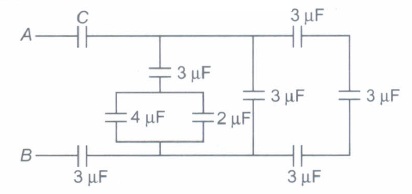
For what value of C does the equivalent capacitance between A and B is 1 μF the given circuit.
19.
Two point charges 4\(\mu\)C and + 1 \(\mu\)C areseparated by a distance of 2 m in air. Find the point on the line joining charges at which the net electric field of the system is zero.
20.
Derive an expression for the impedance of a series LCR circuit connected to an AC supply of variable frequency.
Plot a graph showing variation of current with the frequency of the applied voltage. Explain briefly how the phenomenon of resonance in the circuit can be used in the tuning mechanism of a radio or a TV set.
21.
Show that one ampere is equivalent to flow of 6.25 x 10¹⁸ elementary electrons per second? Charge on electron = 1.6 x 10⁻¹⁹ C.
22.
A series LCR circuit with L = 4.0H, C = 100\(\mu\)F and R = 60\(\Omega \) is connected to a variable frequency 240V source. Calculate
(i) angular frequency of the source which drives the circuit in resonance,
(ii) current at the resonating frequency,
(iii) rms potential drop across the inductor at resonance.
23.
A spherical conductor of radius 12 cm has a charge of 1.6 \(\times\)10 7C distributed uniformly on its surface. What is the electric field.
(a) inside the sphere
(b) just outside the sphere
(c) at point 18 cm from the centre of the sphere?
24.
In a DCcircuit,the direction of current inside the battery and outside the battery, respectively are
positive to negative terminal and negative to positive terminal
positive to negative terminal and positive to negative terminal
negative to positive terminal and positive to negative terminal
negative to positive terminal and negative to positive terminal
25.
When an alternating voltage E - E0, sinot is applied to a circuit, a current \(I=I_0 \sin \left(\omega t+\frac{\pi}{2}\right)\), sincov flows through it. The average power dissipated in the circuit is
\(E_{\mathrm{rms}} \cdot I_{\mathrm{rms}}\)
\(E_0 I_0\)
\(\frac{E_0 I_0}{\sqrt{2}}\)
zero
26.
The quantum nature of light explains the observations on photoelectric effect as
there is a minimum frequency of incident radiation below which no electrons are emitted.
the maximum kinetic energy of photoelectrons depends only on the frequency of incident radiation.
when the metal surface is illuminated, electrons are ejected from the surface after sometime.
the photoelectric current is independent of the intensity of incident radiation.
27.
Speed of electromagnetic wave related to electric field and magnetic field vector in vacuum
\( c=\frac{E_{0}}{B_{0}} \)
\( c=\frac{B_{0}}{E_{0}} \)
\(c=E_{0} B_{\mathrm{o}} \)
\(c=\frac{1}{\sqrt{E_{0} B_{0}}} \)
28.
The power factor varies between
2 and 2.5
3.5 to 5
0 to 1
1 to 2
29.
A coil of self-inductance L is connected in series with a bulb B and an ac source. Brightness of the bulb decreases when
frequency of the ac source is decreased.
number of turns in the coil is reduced
a capacitance of reactance XC = XL in included
an iron rod is inserted in the coil
30.
A coil of resistance 400Ω is placed in a magnetic field. If the magnetic flux Φ linked with the coil varies with times t (see) as Φ = 50t2 + 4, the current in the coil at t = 2 sec is
0.5 A
0.1 A
2 A
1 A
31.
The strength of magnetic field at the centre of circular coil is
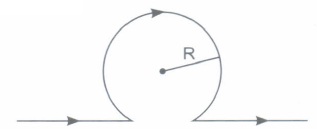
\(\frac{\mu_{0} I}{R}\left(1-\frac{1}{\pi}\right)\)
\(\frac{\mu_{0} \boldsymbol{I}}{\pi \boldsymbol{R}}\)
\(\frac{\mu_{0} I}{2 R}\left(1-\frac{1}{\pi}\right)\)
\(\frac{\mu_{0} I}{2 R}\left(1+\frac{1}{\pi}\right)\)
32.
The emf of the battery shown in figure is
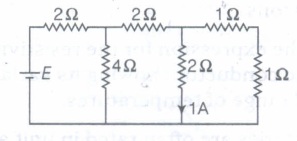
12 V
13 V
16 V
18 V
33.
2 mA current is flowing in the wire of potentiometer of 5m long and 5 Ω resistance. The potential gradient is
2 x 10⁻³ V/m
2.5 x 10⁻² V/m
1.6 x 10⁻³ V/m
2.3 x 10⁻³ V/m
34.
If the charge on each plate of a capacitor of 60 \(\mu\)F is 3 x 10⁻⁸C. Then, energy stored in the capacitor will be
2.5 x 10⁻¹⁵J
1.5 x 10⁻¹⁴J
3.5 x 10⁻¹³ J
7.5 x 10⁻¹² J
35.
Charge on a body is q1 and it is used to charge another body by induction. Charge on second body is found to be q2 after charging. Then
\(\frac{q_{1}}{q_{2}}=1\)
\(\frac{q_{1}}{q_{2}}<1\)
\(\frac{q_{1}}{q_{2}} \leq 1\)
\(\frac{q_{1}}{q_{2}} \geq 1\)
36.
The electric field at a distance R due to charge q is E. If the same charge is placed on the copper sphere Of radius R, the electric field strength at the surface of the conductor will be :
E/4
E/2
E
2E
37.
(a) If both Assertion and Reason are correct and the Reason is a correct explanation of the Assertion.
(b) If both Assertion and Reason are correct but Reason is not a correct explanation of the Assertion.
(c) If the Assertion is correct but Reason is incorrect.
(d) If both the Assertion and Reason are incorrect.
38.
Assertion (A) : In series L-C-R circuit, resonance can take place.
Reason (R) : Resonance takes place if inductance and capacitive reactances are equal and opposite.
(a) Both Assertion and Reason are true and Reason is the correct explanation of Assertion.
(b) Both Assertion and Reason are true but Reason is not the correct explanation of Assertion.
(c) Assertion is true but Reason is false.
(d) Assertion is false but Reason is true.
39.
Assertion (A) : Velocity of light is constant in all media.
Reason (R) : Light is an electromagnetic wave which has constant velocity in all media.
Codes:
(a) Both A and R are true and R is the correct explanation of A
(b) Both A and R are true but R is NOT the correct explanation of A
(c) A is true but R is false
(d) A is false and R is also false
40.
Assertion (A) : The whole charge of a conductor cannot be transferred to another isolated conductor.
Reason (R) : The total transfer of charge from one to another is not possible.
Codes:
(a) Both A and R are true and R is the correct explanation of A
(b) Both A and R are true but R is NOT the correct explanation of A
(c) A is true but R is false
(d) A is false and R is also false
41.
Assertion (A) : Charge is quantized.
Reason (R) : Charge which is less than 1 C is not possible.
Codes:
(a) Both A and R are true and R is the correct explanation of A
(b) Both A and R are true but R is NOT the correct explanation of A
(c) A is true but R is false
(d) A is false and R is also false
42.
Let a source of alternating e.m.f E = Eosinrot be connected to a circuit containing a pure inductance L. If I is the value of instantaneous current in the circuit, then \(I=I_{0} \sin \left(\omega t-\frac{\pi}{2}\right)\).The inductive reactance limits the current in a purely inductive circuit and is given by \(X_{L}=\omega L\)
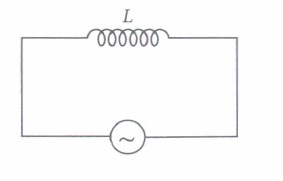
(i) A 100 hertz a.c. is flowing in a 14 mH coil. The reactance is
| \(\text { (a) } 15 \Omega\) | \(\text { (b) } 7.5 \Omega\) | \(\text { (c) } 8.8 \Omega\) | \(\text { (d) } 10 \Omega\) |
(ii) In a pure inductive circuit, resistance to the flow of current is offered by
| (a) resistor | (b) inductor | (c) capacitor | (d) resistor and inductor |
(iii) In a inductive circuit, by what value of phase angle does alternating current lags behind e.m.f.?
| 45o | 90o | (c) 120° | 75o |
(iv) How much inductance should be connected to 200 V, 50 Hz a.c. supply so that a maximum current of 0.9 A flows through it?
| (a) 5 H | (b) 1 H | (c) 10 H | (d) 4.5 H |
(v) The maximum value of current when inductance of 2 H is connected to 150 volt, 50 Hz supply is
| (a) 0.337 A | (b) 0.721 A | (c) 1.521 A | (d) 2.522 A |
43.
The resistance of a conductor at temperature toC is given by Rt = Ro (1 + \(\alpha\)t)
where Rt is the resistance at toC, Ro is the resistance at 0oC and \(\alpha\) is the characteristics constants of the material of the conductor.
Over a limited range of temperatures, that is not too large. The resistivity of a metallic conductor is approximately given by \(\rho_{t}=\rho_{0}(1+\alpha t)\).
where \(\alpha\) is the temperature coefficient of resistivity. Its unit is \(\mathrm{K}^{-1} \text {or }{ }^{\circ} \mathrm{C}^{-1}\)
For metals, \(\alpha\) is positive i.e., resistance increases with rise in temperature.
For insulators and semiconductors, \(\alpha\) is negative i.e., resistance decreases with rise in temperature.
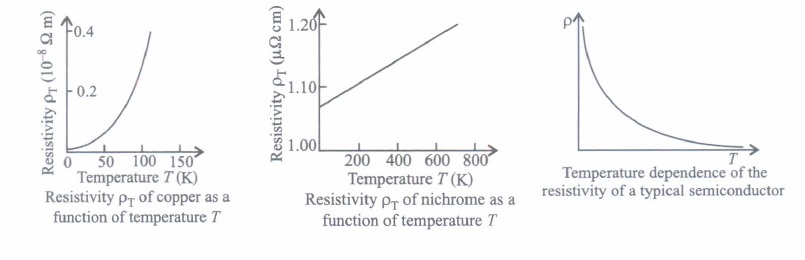
(i) Fractional increase in resistivity per unit increase in temperature is defined as
| (a) resistivity | (b) temperature coefficient of resistivity |
| (c) conductivity | (d) drift velocity |
(ii) The material whose resistivity is insensitive to temperature is
| (a) silicon | (b) copper | (c) silver | (d) nichrome |
(iii) The temperature coefficient of the resistance of a wire is 0.00125 per oC. At 300 K its resistance is 1 ohm. The resistance of wire will be 2 ohms at
| (a) 1154 K | (b) 1100 K | (c) 1400 K | (d) 1127 K |
(iv) The temperature coefficient of resistance of an alloy used for making resistors is
| (a) small and positive | (b) small and negative | (c) large and positive | (d) large and negative |
(v) For a metallic wire, the ratio V/I (V = applied potential difference and I = current flowing) is
| (a) independent of temperature |
| (b) increases as the temperature rises |
| (c) decreases as the temperature rises |
| (d) increases or decreases as temperature rises depending upon the metal |
1.
Electric dipole moment is a measurement of the strength of electric dipole. It is given by \(\vec{p}=q(\overrightarrow{2 a})\) cm, where \(\vec{p}\) is the electric dipole moment and 2a is the separation between the charges. It is a vector quantity directed from negative to positive charge on the line joining them.
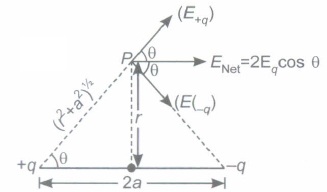
Let the dipole be made of two equal and opposite charges +q and -q, separated by 2a. Consider a point P at a distance r from the mid-point. Field at P due to each charge will be of equal magnitude \(\left|\vec{E}_{\pm q}\right|=\frac{k q}{\left(r^{2}+a^{2}\right)}\) pointing as shown.
Resolving electric fields due to two charges. We can see that Y-axis components get cancelled out.
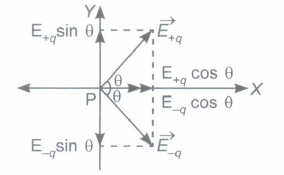
∴ Net field at P,E = 2Eq cos θ
\( E= \frac{2 k q}{\left(r^{2}+a^{2}\right)} \cdot \frac{a}{\left(r^{2}+a^{2}\right)^{1 / 2}} \)
\(= \frac{2 a q k}{\left(r^{2}+a^{2}\right)^{3 / 2}}=\frac{k p}{\left(r^{2}+a^{2}\right)^{3 / 2}} \)
\(\left(\because \cos \theta=\frac{a}{\left(r^{2}+a^{2}\right)^{1 / 2}}\right)\)
(pointing anti-parallel to dipole moment)
If r >> a, i.e. a2 can be neglected in comparison to r2.
\(\therefore \ E=\frac{k p}{r^{3}}\) (anti-parallel to \(\vec{p}\))
2.
Let us consider a charge q is placed at the centre of a cubic Gaussian surface. As per the question,
q = 2 \(\mu\)C = 2 \(\times\)10-6 C
Length of edge = 9 cm
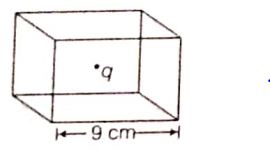
According to Gauss' theorem, the net electric flux (\(\phi\)) through the surface is given by
\(\phi=\frac{q}{\varepsilon_{0}}=\frac{2\times 10^{-6}}{8.854\times 10^{-12}} \)
= 2.26 \(\times\)105 N-m2 /C
Thus, the net electric flux through the surface is 2.26 \(\times\)105 N-m2/C.
3.
\(v={ v }_{ m }sin \ \omega t\)
\(i={ i }_{ m }sin \ (\omega t+\Phi )\)
Power at any instant
\(P=vi={ v }_{ m }{ i }_{ m }sin \ \omega t \ sin{ (\omega }_{ t }+\Phi )\)
\(P=\frac { { v }_{ m }{ i }_{ m } }{ 2 } [cos \ \Phi -cos(2\omega t+\Phi )\)
The average of second term in the above expression is zero over a full cycle
\(\therefore \ Average \ Power=\overset { - }{ P } =\ \frac { { v }_{ m }{ i }_{ m } }{ 2 } cos\quad \Phi\)
\(\overset { - }{ P } =\frac { { v }_{ m } }{ \sqrt { 2 } } \times \frac { { i }_{ m } }{ \sqrt { 2 } } cos\Phi\)
\(\overset { - }{ P } ={ V }_{ rms } \ { I }_{ rms }\)
Wattless current is that which flows in the circuit but no power dissipation occurs. It is realized only when circuit is purely inductive or capacity.i.ve, when \(cos\Phi =0\ or\ \Phi =\frac { \overset { + }{ - } \pi }{ 2 } \)
4.
Current in each bulb,
I = \(\frac{P}{V}=\frac{60}{220}=\frac{3}{11}A\)
No. of bulbs used,
n = \(\frac{9}{3/11}\)= 33
5.
f1=7.5×10⁶ Hz
f2=12×106 Hz
λ1=c/f1=40 m
λ2=c/f2=25 m
So the range is 40m to 25m
6.
\(Here,\upsilon =500m/s \ \ e=? \ l=25m\)
\(R=5 \times { 10 }^{ -4 }T, \ \delta ={ 30 }^{ \circ }\)
\(e=Bl\upsilon =Vl\upsilon =(R \ sin \ \delta )l\upsilon \)
\(=5 \times { 10 }^{ -4 }sin{ 30 }^{ \circ } \times 25 \times 500=3.125 \ V\)
7.
\((a) \ { I }_{ 0 }=\frac { \sqrt { 2 } \times 100 }{ \sqrt { 1600+\frac { 1 }{ 4{ \pi }^{ 2 }\times 144\times { 10 }^{ 6 }\times { 10 }^{ -6 } } } } =3.9A\)
Team for C is negligible at high frequency.
(b) \(tan\phi =-\frac { 1 }{ 2\pi \times 12\times { 10 }^{ 3 }\times { 10 }^{ -4 }\times 40 } =-\frac { 1 }{ 96\pi } \)
\(\delta \) is nearly zero at high frequency.
We see that high-frequency C acts like a conductor. For a d.c. circuit after steady-state, \(\omega =0\) and C amount to an open circuit.
8.
Given, resistance of heating element at temperature 27°C,
R27 = 100 \(\Omega\)
Resistance of heating element at temperature t°C,
Rt = 117 \(\Omega\)
\(\alpha\)=1.70 \(\times\)10-4 °C-1, t = ?
By using the formula of temperature coefficient of resistance,
\(\alpha=\frac{R_2-R_1}{R_1\left(t_2-t_1\right)}\) ...(i)
Here, R1 = Rt, R1 = R27, t2 = t and t1 = 27°C
Such that, \(\alpha=\frac{R_t-R_{27}}{R_{27}(t-27)}\)
Substituting given values in Eq. (i), we get
\(\begin{aligned} 1.70 \times 10^{-4} & =\frac{117-100}{100(t-27)} \\ \end{aligned}\)
\(\begin{aligned} \text { or } \quad t-27 & =\frac{17}{100 \times 1.70 \times 10^{-4}} \end{aligned}\)
or t = 1000 + 27 = 1027°C
9.
Here , q = 25 x10-9C, 2a =6 m, r=4 m,
p=q(2a)= 25x10-9x 6 = 1.5 x10⁻⁷ C-m
i) \( E_{\text {axil }}=\frac{1}{4 \pi \varepsilon_0} \cdot \frac{2 p r}{\left(r^2-a^2\right)^2} \)i
Now, \(=\frac{9 \times 10^9 \times 2 \times 1.5 \times 10^{-7} \times 4}{\left(4^2-3^2\right)^2}=\frac{2700 \times 4}{49} \)
\(=220.4 \mathrm{NC}^{-1} \)
ii)\( \therefore E_{\text {equitorial }}=\frac{1}{4 \pi \varepsilon_0} \cdot \frac{p}{\left(r^2+a^2\right)^{3 / 2}} =\frac{9 \times 10^9 \times 1.5 \times 10^{-7}}{\left(4^2+3^2\right)^{3 / 2}}=\frac{1350}{125}=10.8 \mathrm{~N} \mathrm{C}^{-1} \)
10.
R0 = 5 Ω, R100 = 5.23 Ω and Rt = 5.795 Ω
Now, \(t=\frac{R_{t}-R_{0}}{R_{100}-R_{0}} \times 100, \quad R_{t}=R_{0}(1+\alpha t)\)
\(=\frac{5.795-5}{5.23-5} \times 100\)
\(=\frac{0.795}{0.23} \times 100=345.65^{\circ} \mathrm{C}\)
11.
The One Which is moved Rapidly
12.
(i) The earth's magnetic field at a place can be completely described by three parameters which are called elements of earth's magnetic field. They are as follows:
(a) Angle of declination \(\left( \theta \right) \)
(b) Angle of dip \((\delta )\) or magnetic inclination )
(c) Horizontal component of earth's magnetic field (He)
13.
\( L_0=0.01 \mathrm{mH}=10^{-5} H \\ L=10 \mathrm{mH}=10^{-2} H \\ \mu_r=?, \mu_r=\frac{L}{L_0}=\frac{10^{-2}}{10^{-5}}=10^3 \\ \mu_r=1000 \)
14.
Emf of the battery, E = 12 V
Internal resistance of the battery, r = 0.4 Ω
Maximum current drawn from the battery = I
According to Ohm’s law,
E = Ir
\(I=\frac{E}{r}\)
\(=\frac{12}{0.4}=30 A\)
The maximum current drawn from the given battery is 30 A.
15.
\(x=0.09\)m from \(q=3\times {{10}^{-8}}C\)
16.
(i) Magnetic flux, \(\phi_1 \hat{\mathrm{i}}=N \mathrm{~B} \mathrm{~A} \cos \theta\)
\(=N B A \cos 0^{\circ}=N B A \)
\(=140 \times 0.09 \times 5 \times 10^{-4}=63 \times 10^{-4} \quad \mathrm{~Wb} .\)
\(\phi_2 \hat{\mathbf{i}} =N B A=0 \quad\{\because B=0\}\)
therefore Change in magnetic flux
\(=\phi_2-\phi_1=-63 \times 10^{-2} \mathrm{~Wb} \text {. }\)
(ii) Emf induced \(=\frac{-\Delta \phi}{\Delta t}=\frac{-63 \times 10^{-4}}{\Delta t}\)
17.
i) Consider an electric dipole consisting of two point charges + q and -q separated by a small distance AB =2l with centre at O and dipole moment, p= (2) as shown in the figure
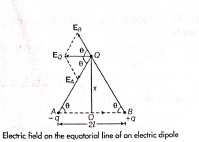
Resultant electric field intensity at the point Q.
\(\mathrm{E}_Q=\mathrm{E}_A+\mathrm{E}_B\)
The vectors EA and EB are acting at an angle 2\(\theta\)
Here, \( E_A=\frac{1}{4 \pi \varepsilon_0} \cdot \frac{q}{\left(x^2+l^2\right)} \text { and } E_E=\frac{1}{4 \pi \varepsilon_0} \cdot \frac{q}{\left(x^2+l^2\right)}\)
On resolving EA and EB into two rectangular components, the vectors \(E_A \sin \theta \text { and } E_B \sin \theta \) are equal
in magnitude and opposite to cach other and hence cancel out.
The vectors \(E_A \cos \theta \text { and } E_B cos \theta \) are acting along the same direction and hence add up.
\(\begin{aligned} \therefore \quad E_Q & =E_A \cos \theta+E_g \cos \theta=2 E_A \cos \theta \\ & =\frac{2}{4 \pi \varepsilon_0} \cdot \frac{q}{\left(x^2+l^2\right)} \cdot \frac{l}{\left(x^2+l^2\right)^{1 / 2}} \\ & {\left[\because E_A=E_b\right] } \\ & =\frac{1}{4 \pi \varepsilon_0} \cdot \frac{2 q l}{\left(x^2+l^2\right)^{3 / 2}} \end{aligned}\)
But q x 2/=|p|, the dipole moment,
\(E_Q=\frac{1}{4 \pi \varepsilon_0} \cdot \frac{|\mathrm{P}|}{\left(x^2+l^2\right)^{3 / 2}}\)
The direcion of E is along QE || BA, i.e. opposite to AB. Invector form, we can rewrite as
\(\mathrm{E}_Q=\frac{-\mathrm{p}}{4 \pi E_0\left(x^2+l^2\right)^{3/ 2}}\)
Obviously, E, is in a direction opposite to the direction of p. If the dipole is short, i.e. 2/ <
\(Clearly, \quad E_Q \propto \frac{1}{x^3}\)
\(From Eqs. (i) and (ii), we get \)
\(\frac{E_{\text {arial }}}{E_{\text {equaturial }}}=2\)
Both the magnitude and the direction of dipole field depend not only on the distance r, but also on the angle between the position vector r and dipole moment p.
The electric field due to a dipole falls off at large distances, at a much faster rate \(\left(\propto \frac{1}{r^3}\right)\) than the electric field due to a single charge \(\left(\propto \frac{1}{r^2}\right)\)
ii) Let P be thepoint at which the system of charges isin equilibrium, then
F(x)= F(2-x)
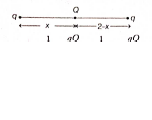
\(\frac{1}{4 \pi \varepsilon_0} \cdot \frac{q Q}{x^2}=\frac{1}{4 \pi \varepsilon_0} \cdot \frac{q Q}{(2-x)^2}\)
\(\begin{array}{ll} \Rightarrow & \frac{1}{x^2}=\frac{1}{(2-x)^2} \\ \Rightarrow & x=(2-x) \Rightarrow x=1 \end{array}\)
Thus,the charpe ) should be placed at the centre of line joining two given charges, Also, the two given charges are identical, i.e, having same nature, so the third charge could be of any nature (positive or negative), As the forces on it at the centre are equal and opposite,
18.
Given: \(C_{1}=C_{2}=C_{3}=C_{4}=C_{5}=C_{6}=C_{7}=C_{8}=3 \mu \mathrm{F}\)
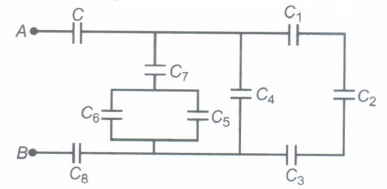
Capacitors C1, C2 and C3 are in series.
\(\therefore \ C_{123}=\frac{3}{3}=1 \mu \mathrm{F} \ \left[C_{5}=\frac{C}{n}\right]\)
Now, capacitors C123 and C4 are in parallel.
\(\therefore \ C_{1234}=C_{123}+C_{4}=1+3=4 \mu \mathrm{F}\) ...(i)
C5 and C6 are in parallel.
\(C_{56}=C_{5}+C_{6}=(3+3) \mu \mathrm{F}=6 \mu \mathrm{F}\)
C7 and C56 are in series
\(\therefore \ C_{756}=\frac{3 \times 6}{3+6}=2 \mu \mathrm{F}...(ii)\)
Now, C1234 and C756 are in parallel.
\(C_{p}=(2+4)=6 \mu \mathrm{F}\)
Finally, C, Cp and C8 are in series.
\( \therefore \frac{1}{C}+\frac{1}{C_{p}}+\frac{1}{C_{8}} =\frac{1}{1} \Rightarrow \frac{1}{C}+\frac{1}{6}+\frac{1}{3}=\frac{1}{1} \frac{1}{C} =1-\frac{1}{2}=\frac{1}{2} \Rightarrow C=2 \mu \mathrm{F} \)
19.
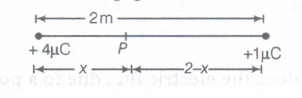
Let the net electric field be zero at point P at a distance x from charge +4\(\mu\)C, then
\(\frac{1}{4 \pi \varepsilon_{0}} \frac{4 \times 10^{-6}}{x^{2}}-\frac{1 \times 10^{-6} \times 1}{4 \pi \varepsilon_{0} \times(2-x)^{2}}=0\)
\(\Rightarrow \ \frac{4}{x^{2}}=\frac{1}{(2-x)^{2}}\)
\(\Rightarrow \ \frac{2}{x}=\frac{1}{2-x}\)
\(\Rightarrow\) x = 4-2x
\(\Rightarrow \ x=\frac{4}{3} \mathrm{~m}\)
20.
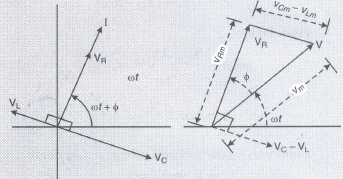
Let VL, VR, Vc and V represent the voltage across the inductor, resistor, capacitor and the source respectively. VR is parallel to I. Vc is pi/2 behind I and VL is pi/2 ahead of I.
Clearly,
\(={ i }_{ 0 }^{ 2 }[{ R }^{ 2 }+({ X }_{ L }-{ X }_{ C })^{ 2 }]\)
\({ i }_{ o }=\frac { { V }_{ 0 } }{ \sqrt { { R }^{ 2 }+({ X }_{ L }-{ X }_{ C })^{ 2 } } } \)
\(Impedence=\frac { { V }_{ 0 } }{ { i }_{ 0 } } =\sqrt { { R }^{ 2 }+({ X }_{ L }-{ X }_{ C })^{ 2 } } \)
\(\\ =\sqrt { { R }^{ 2 }+\left( \omega L-\frac { 1 }{ \omega C } \right) ^{ 2 } } \)
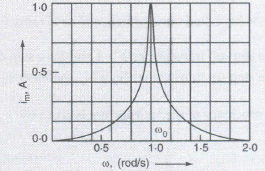
The capacitance of a capacitor in the tuning circuit is varied such that the resonant frequency of the circuit becomes nearly equal to the frequency of the radio signal to be received. When this happens, the amplitude of the current becomes maximum in the receiving circuit.
21.
Here,
I = 1 A,
t = 1 s,
e = 1.6 x 10⁻¹⁹ C
I = \(\frac{ne}{t}\)
or n = \(\frac{It}{e}\)
= \(\frac{1 \times 1}{1.6 \times 10^{-19}}\)
= 6.25 x 10¹⁸
22.
\(Here, \ L=4.0H, \ C=100\mu F={ 10 }^{ -4 }F, \ R=60\Omega \)
\({ E }_{ v }=240V, \ \omega =?, \ { I }_{ v }=?, \ { V }_{ L }=?\)
\((i) \ \omega =\frac { 1 }{ \sqrt { LC } } =\frac { 1 }{ \sqrt { 4.0\times { 10 }^{ -4 } } } =50rad/s.\)
\((ii) \ At \ resonance, \ Z=R;\)
\({ I }_{ v }=\frac { { E }_{ v } }{ Z } =\frac { { E }_{ v } }{ R } =\frac { 240 }{ 60 } =4A\)
\((iii) \ { V }_{ L }={ I }_{ v }{ X }_{ L }=4\left( \omega L \right) =4\times 50\times 4.0 \ =800V\)
23.
(1) Given,
Radius of spherical conductor, r = 12cm = 0.12m
Charge is distributed uniformly over the surface, q = 1.6 x 10⁻⁷ C.
The electric field inside a spherical conductor is zero.
(2) Electric field E, just outside the conductor is given by the relation
\(\mathrm{E}=\frac{1}{4 \pi \epsilon_{o}} \cdot \frac{q}{r^{2}}\)
Here, permittivity of free space and \(\frac{1}{4 \pi \epsilon_{o}}=9 \times 10^{9} \mathrm{Nm}^{2} \mathrm{C}^{-2}\)
Therefore,
\(\mathrm{E}=\frac{9 \times 10^{9} \times 1.6 \times 10^{-7}}{(0.12)^{2}}=10^{5} \mathrm{NC}^{-1}\)
Therefore, just outside the sphere the electric field is 4.4 x 10⁴ NC-1.
(3) From the centre of the sphere the electric field at a point 18m = E1.
From the centre of the sphere, the distance of point d = 18 cm = 0.18m
\(\mathrm{E}_{1}=\frac{1}{4 \pi \epsilon_{o}} \cdot \frac{q}{d^{2}}=\frac{9 \times 10^{9} \times 1.6 \times 10^{-7}}{\left(1.8 \times 10^{-2}\right)^{2}}=4.4 \times 10^{4} \mathrm{NC}^{-1}\)
So, from the centre of sphere the electric field at a point 18 cm away is 4.4 x 10⁴ NC-1.
24.
(c)
negative to positive terminal and positive to negative terminal
25.
(d)
zero
26.
(a)
there is a minimum frequency of incident radiation below which no electrons are emitted.
27.
(a)
\( c=\frac{E_{0}}{B_{0}} \)
28.
(c)
0 to 1
29.
(d)
an iron rod is inserted in the coil
30.
(a)
0.5 A
31.
(c)
\(\frac{\mu_{0} I}{2 R}\left(1-\frac{1}{\pi}\right)\)
32.
(b)
13 V
33.
(a)
2 x 10⁻³ V/m
34.
(d)
7.5 x 10⁻¹² J
35.
(d)
\(\frac{q_{1}}{q_{2}} \geq 1\)
36.
(c)
E
37.
38.
(a) Both Assertion and Reason are true and Reason is the correct explanation of Assertion.
39.
(d): Velocity of light has different values in different media. It depends on the refractive index of the medium. Related by formula
\(v_{\text {medium }}=\frac{\text { velocity in vacuum }}{\text { refractive index of medium }}\)
40.
(d): The whole charge of a conductor can be transferred to another isolated conductor, if it is placed inside the hollow insulated conductor and connected with it.
41.
c): The charge q on a body is given as q = ne where n is any integer positive or negative. The charge on the electron is q = 1.6 X 10⁻¹⁹ C whichis less than 1 C.
42.
(i) (c) :Inductive reactance
\(X_{L}=\omega L=2 \pi v L=2 \pi \times 100 \times 14 \times 10^{-3}\)
\(X_{L}=8.8 \Omega\)
(ii) (b)
:(iii) (b) In an inductor voltage leads the current by \(\frac{\pi}{2}\) or current lags the voltage by \(\frac{\pi}{2}\).
(iv) (b): The current in the inductor coil is given by \(I_{0}=\frac{E_{0}}{X_{L}}=\frac{\sqrt{2} E_{v}}{2 \pi v L}\)
\(L=\frac{\sqrt{2} E_{v}}{2 \pi v I_{0}}=\frac{1.414 \times 200}{2 \times 3.14 \times 50 \times 0.9}=1 \mathrm{H}\)
(v) (a): Inductive reactance
\(X_{L}=\omega L=2 \pi v L=2 \times 3.14 \times 50 \times 2=628 \Omega\)
\(I_{0}=\frac{E_{0}}{X_{L}} \Rightarrow I_{0}=\frac{\sqrt{2} \times E_{v}}{X_{L}}=\frac{\sqrt{2} \times 150}{628}=0.337 \mathrm{~A}\)
43.
(i) (b): Temperature coefficient of resistivity is defined as the fractional increase in resistivity per unit increase in temperature.
(ii) (d): Nichrome (which is an alloy of nickel, iron and chromium) exhibits a very weak dependence of resistivity with temperature.
(iii) (d): Using, \(R_{T}=R_{0}(1+\alpha T)\)
\(\therefore \quad \frac{R_{T_{2}}}{R_{T_{1}}}=\frac{R_{0}\left(1+\alpha T_{2}\right)}{R_{0}\left(1+\alpha T_{1}\right)}=\frac{2}{1}=\frac{\left(1+\alpha T_{2}\right)}{(1+\alpha \times 300)}\)
\(\Rightarrow \quad 2+\alpha \times 600=1+\alpha T_{2}\)
\(\Rightarrow \quad 1=\alpha\left(T_{2}-600\right) \Rightarrow \frac{1}{0.00125}=\left(T_{2}-600\right)\)
\(\Rightarrow \quad 800^{\circ} \mathrm{C}=T_{2}-600\)
T2 = 800 - 273 + 600
T2 = 1127 K
(iv) (a): The temperature coefficient of resistance of an alloy used for making resistors is small and positive.
(v) (b): The resistance of a metallic wire at temperature toC is given by
\(R_{t}=R_{0}(1+\alpha t)\) where \(\alpha\) is the temperature coefficient of resistance and Ro is the resistance of a wire at O°c.
For metals,\(\alpha\) is positive. Hence, resistance of a wire increases with increase in temperature.
Also, from Ohm's law
\(\frac{V}{I}=R\)
Hence on increasing the temperature, the ratio \(\frac{V}{I}\) increases.

12th Standard CBSE Syllabus & Materials
12th Standard CBSE
CBSE 12th Computer Science Python Revision Tour I - New Previous year Question Papers Study Material - QB365 Set A
NEW12th Standard CBSE
CBSE 12th Business Studies Planning Important Questions And Answers Study Material - QB365 Set A
NEW12th Standard CBSE
CBSE 12th Business Studies Business Environment Important Questions And Answers Study Material - QB365 Set A
NEW12th Standard CBSE
CBSE 12th Business Studies Principles of Management Important Questions And Answers Study Material - QB365 Set A



NCERT Books

Syllabus

Exam Pattern

Sample Question Papers

Previous year Question Papers

Important Notes

MCQ Practice test

NCERT Exemplers

Case study Questions

Image Based Questions

Passage based Questions

HOT Questions

Value Based Questions

Model Questions Papers
NCERT ( Book Back ) Questions

Assertion and Reason
Important Questions And Answers

CBSE 12th Standard CBSE Subjects
CBSE Standards








